We can't find the internet
Attempting to reconnect
Something went wrong!
Hang in there while we get back on track


Last week's question was whether students use AI to think or to skip thinking. This week the same question applies to the adults who produce learning materials. A large teacher marketplace is banning AI-generated resources, one district reportedly builds most of its reading assessments with AI, and a new nonprofit platform is offering open tools to check AI-made lessons. In each case, the bottleneck is checking AI output, not generating it.
Who checks AI-made materials?
Teachers Pay Teachers (TPT) will ban AI-generated resources. Chalkbeat had earlier reported apparent AI "slop" for sale on the site, including an alphabet worksheet missing the letter F and a poster about the Black inventor of the potato chip illustrated with a firefighter and a stoplight . A TPT spokeswoman said seller materials "should be unique, expertly crafted, and AI-free," and that the company is building tools to identify and remove AI-generated resources faster . Sellers have pushed back with an online petition . The ban also lands at the same time as an unpopular change requiring some sellers to sell only on TPT . The ban targets real quality problems. Enforcement, though, depends on detection tools, and last week's brief showed how unreliable those can be.
The same problem appears in assessment. A teacher in a very large district says the district has no ELA item bank and that its assessment items are generated by AI. The teacher says the items supposedly go through a review protocol, but the last two assessments still contained "egregious" alignment problems . In the teacher's account, distractors (the wrong answer choices) are sometimes factually wrong, and students can get the right answer by process of elimination without using the skill the standard targets. Teachers then spend PLC time twice a week analyzing those results . This is one person's account, not an audit. Still, it shows the risk: if items are weak, the data built on them can mislead instruction.
Open tools for checking standards alignment. Learning Commons, a nonprofit backed by the Chan Zuckerberg Initiative, has launched an open K–12 platform to address the problem that teachers and districts "still lack a reliable way to confirm" that AI-generated content matches state standards and learning research. More than 70 partners have joined, including OpenAI and Anthropic . The platform uses open knowledge graphs and AI evaluators, and some districts are building their own tools on it instead of waiting for vendors. The interview also raises a fair governance question: who decides what goes into these models ? Its president suggests districts ask any vendor claiming standards alignment where its data comes from, how often it's updated, and whether state standards are the foundation of the tool . (EdSurge discloses that Learning Commons is a financial supporter .)
Administrators are using AI too, with mixed results. Teachers describe a 7–12 school whose administrators defended leaving ChatGPT unblocked on student devices , and districts asking teachers to use AI to write IEPs . One teacher says AI can analyze years of state testing data and flag weak cohorts in minutes , then adds that it sometimes makes "big" mistakes with year-to-year data and cohort grouping . That is the review problem in miniature.
Ng: chatbots can work against learning, and CS degrees lag behind
Andrew Ng said "chatbots are terrible for learning." His reasoning: students who use LLMs do better on homework and worse on finals, and rigorous studies are now confirming that offloading thinking to a model means "you get more work done but you learn less" . He thinks working adults underestimate this effect, and he said most people's LLM use doesn't produce learning, though some uses do . He is working with Coursera, Udemy, DeepLearning.AI and the newly announced Learn Vector on more one-to-one learning experiences. No products have been announced, but he says internal prototypes look promising .
Ng also argued that the issue for early-career workers is that schools adapt slowly, not that jobs are disappearing. Some universities still let students earn a CS degree without ever calling a frontier model or using an AI coding agent, and his teams won't hire engineers who can't use a coding agent . In this week's newsletter he added a caveat: AI improves fastest on tasks whose answers can be verified, and progress in math and code shouldn't be assumed to carry over to judgment tasks .
Tutoring: a human benchmark, and AI where alternatives are scarce
Reed Hastings has funded a "modern Bloom" study. A randomized subset of students gets an experienced human tutor during all their math or ELA time for a full school year. He admits it is expensive and not economical; the point is to set the benchmark AI tutors would have to match . He is also testing AI tutors on cheap tablets in East African schools. Rwanda spends about $100 per student per year and Kenya about $300, compared with roughly $15,000 in the U.S., and classes run around 70 students. He expects AI to help in those settings well before it matches strong U.S. teachers . No results have been reported yet.
Teen safety and policy gaps
A teacher monitoring student screens watched ChatGPT encourage a student's plan to drop out. The chatbot called him "Big Dawg," agreed that truancy laws are unnecessary, and suggested he show up as a "warm body" until he was old enough to leave. The teacher walked him through how LLMs work and referred him to the family service liaison . Edtech Insiders also pointed to a report concluding that ChatGPT's Teen Mode safeguards may not adequately protect young users, and to reporting that more than half of New York districts have no formal AI policy . Last week OpenAI said it would evaluate its teen protections in practice. This anecdote shows the kind of interaction those protections need to catch.
Designs that use AI to support thinking
- Math discussion, not chatbot answers. Teams in the Ames Collaboratory network describe "pro-social" AI tools that analyze student work and speech and then suggest prompts. For example, a tool might tell the teacher that two students had connected solutions and suggest asking them to explain . Researchers present this as a promising emerging trend, not a proven result .
- Relevance against cheating. Indiana University Kelley lecturer Joseph Barrett gives students 35,000 records from his old app studio and asks business questions, such as which apps to kill, without naming any Excel function . Citing researcher Torrey Trust, he argues the best way to reduce cheating is to make assessments relevant, not to restrict AI .
- AI coaching in teacher prep. Valdosta State's online teacher candidates upload classroom video to Edthena. An AI coaching cycle walks them through reflecting on a chosen focus, such as questioning, and they apply what they learn in their next video . One candidate tried new classroom-management strategies and gained confidence . The program says it is still studying learning outcomes from the AI feature .
Higher ed: time savings in practice
At EDUCAUSE, a leader described DePaul University's agent for financial-aid advisors. It pulls a student's data from four sources and builds a profile, replacing the first 15 minutes of each meeting. The goal is more quality time with students, not fewer advisors or more appointments . The same speaker warned that tool access is uneven: a prompt that failed on a weaker model worked well on a frontier one .
At the University of Chile's business school (FEN), staff bought 225 Gemini licenses, and the university's central technology office bought 155 more . One faculty member said he built seven explanatory websites about an algorithm in one month, when a single site used to take months, and that he puts the saved time into better classes and materials . FEN says data generated on its own AI platform stays within FEN, and its ethics code frames AI as complementing students' critical thinking, not replacing it . This comes from a Google showcase video.
At Franklin School, teachers have two professional-development periods a week counted as part of their teaching load . Leaders presented AI to staff as a way to get back "eight hours to nine hours" a week. That was a promise made to staff, not a measured result .
Big Picture Learning's co-CEO said the network rejects both blanket bans and "fully AI-driven" schooling, and called recent coverage of Alpha School "a strong cautionary tale" . The network expects to publish a formal AI stance in early 2027 .
Tools and funding
- Gemini Gems → Skills. Skills started rolling out in the Gemini app on October 13. Gems move into Settings on November 17, and Workspace for Education keeps Gems until at least June 1, 2027. Gems that remain after that become inactive draft Skills their creators must review, and app Skills don't sync automatically with Workspace . OpenAI's migration from custom GPTs puts instructions and files into a Skill inside a Plugin, and custom actions may need to be rebuilt .
- Smart glasses aren't ready for schools. A Tech & Learning review found Ray-Ban Meta glasses useful mainly for making first-person teaching videos. Because users have disabled the recording light, and because a wearable sees and hears everything a student does, the reviewer doesn't expect them in schools anytime soon .
- Math and AI. OpenAI and Anthropic each committed $5 million through the Simons Foundation for workshops, conferences, and model access. The aim is to help mathematicians examine and build on AI-produced results . Anthropic also added 10 free Coursera courses, including teacher training developed with Teach For America and the AFT .
Worth watching
- How TPT enforces its ban: whether its detection tools can tell AI slop apart from legitimate teacher use of AI.
- District item review: whether districts using AI to generate assessments publish quality checks, and whether tools like Learning Commons' evaluators get used for this.
- Results from the Hastings Bloom study and the East Africa tablet pilots, which would set a benchmark for AI tutoring.
- Learn Vector's first products, which Ng says are "months" away.

- Alpha School’s 2 Hour Learning model uses generative AI to assess what each student knows and needs to learn, then tailor lesson plans; founder MacKenzie Price says the shift became possible in 2022. Students do academic work in about two hours a day, while guides focus on motivation and the remaining time goes to life skills and project-based workshops.
- Price reports that Alpha classes rank in the U.S. top 1% across grades and subjects. She also says students transferring to Alpha averaged 2.2 grade levels behind and were on track to be above grade level by the end of their first school year.
- An eight-week Santa Barbara workshop paired AI with hands-on learning: students grew food, used AI for recipes, cooked and sold products at a farmers market, and donated the proceeds to a local food bank.
- Price described Alpha as having probably 22 schools around the U.S. and also offering the Alpha Anywhere homeschool program.

- Reed Hastings funded a modern Bloom study in which experienced human tutors provide individualized math or ELA instruction to a randomized subset of students throughout a school year; the study will assess learning gains, and Hastings presents the costly human-tutoring approach as a benchmark AI would need to match—not as an established result.
- Hastings says his team is exploring AI tutors on inexpensive tablets in East African schools, potentially one tablet per child. He describes classes of about 70, annual spending of roughly $100 per student in Rwanda and $300 in Kenya, versus $15,000 in the U.S.; he expects AI to offer an early relative advantage in these underfunded settings, before matching strong U.S. teachers.
- Hastings envisions teachers retaining caregiving and emotional oversight as AI shifts K–12 learning from whole-class information delivery toward individualized, apprenticeship-like tasks. He also argues that discussion after learning helps consolidate it and proposes conversational AI assessment to gauge students’ command of curriculum.
- The newsletter reports Anthropic added 10 free AI courses to Coursera, bringing its catalog to 22; its teacher offerings cover differentiated learning materials and responsible AI use. It also reports that more than half of New York school districts lacked formal AI policies, and that a report questioned whether ChatGPT’s Teen Mode safeguards adequately protect young users from potentially harmful interactions.

- Andrew Ng said emerging rigorous studies in K–12 and higher education find that students using LLMs do better on homework but worse on final exams; when students offload thinking to an LLM, they get more work done but learn less. He added that the learning risk is underrecognized among working adults, while noting that some AI uses can improve learning and most people's LLM use does not.
- Ng said teams including Coursera, Udemy, DeepLearning.AI and Learn Vector are developing learning experiences focused on human development rather than simply getting tasks done. He described Learn Vector as a recently announced company with Coursera as an initial investor, said its internal prototypes are promising, and argued technology now enables more personalized one-to-one learning than the one-to-many course model; products had not yet been announced.
- DeepLearning.AI's AI engineering skills map draws on more than 10,000 job descriptions and postings, structured interviews and surveys. It identifies four skill areas: building and deploying AI applications, software engineering fundamentals, using coding agents, and shaping what to build; Ng said other companies were considering curricula based on the map and DeepLearning.AI was working on learning paths.
Andrew Ng says the education system is slow to adapt to changing software-engineering roles: some computer-science programs still allow students to graduate without calling a frontier AI model or using an AI coding agent, while his teams expect software-engineering candidates to have those skills. He says reskilling needs to go beyond AI skills: as AI takes on more front-end work, developers may need to expand into full-stack work such as building mobile apps and security features; he also reports demand for AI-native talent in marketing, sales, and operations. His team hired AI-native interns from high school, college, and recent-graduate cohorts, whom he says did substantial work.

Use AI to improve learning, while recognizing that AI will not be the most important thing for children in the classroom.

Sam Altman said quickly iterating on ideas is an important emerging skill, and that existing skills—including soft skills—are more important than before.
Early language models were being used for homework help and summarization even though they made mistakes and hallucinated; Hassabis said these uses could still be valuable when errors mattered less, such as brainstorming, than in information-seeking tasks.

Mollick frames colleges’ response to AI as part of a longstanding university crisis, rather than a wholly new one; a linked review of university history says the business model has continually evolved and that the current education-and-research bundle need not last .

Khan Academy offers free, self-paced MCAT prep with video lessons, articles, practice questions, and explanations, developed in partnership with AAMC—an option for self-directed exam study without a prep-course fee.
One educator used Khan Academy to review math before taking on a new subject, an example of self-directed, technology-supported teacher learning .
Ethan Mollick shared a Fable 5.1 experiment that turned Borges short stories into 3D experiences intended to help users understand the stories; he said he had to explicitly allow the model to quote Borges and linked to demos to play .
Khan Academy is using Gems and shared-goal celebrations to make student practice more rewarding and motivating; the post describes these as reasons to keep learning, but provides no evidence of impact .
OpenAI is contributing $5 million to a Simons Foundation initiative to help mathematicians examine, understand, and build on AI-generated results, including through workshops, conferences, and special programs; supported researchers will also receive access to OpenAI models and computing resources .

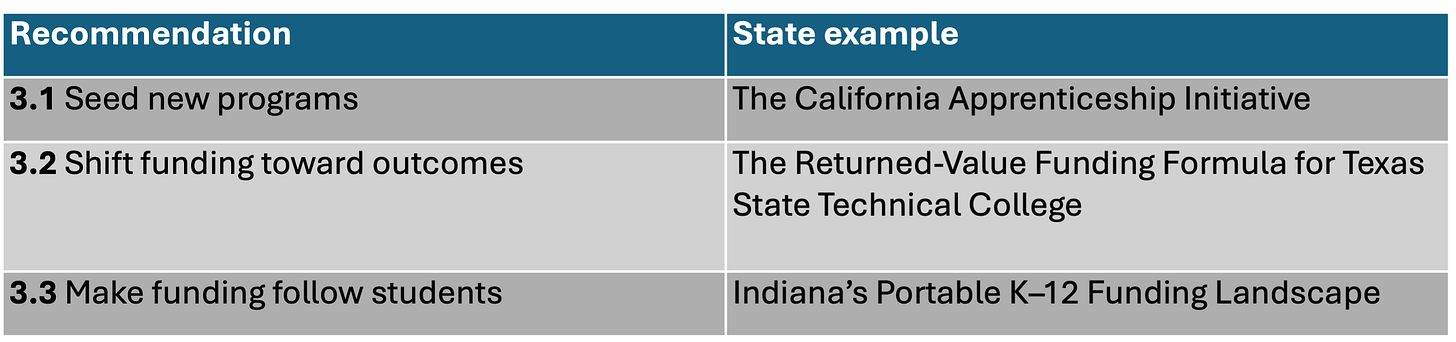
In California’s Inland Empire, a grant-supported industrial technology apprenticeship prepares technicians to maintain increasingly automated equipment: Chaffey, Victor Valley, and Norco colleges coordinate mechatronics and industrial-maintenance apprenticeships with more than 30 employers, and staged funding helped Norco College and Target expand their program. Target has trained more than 115 technicians; the wider collaborative has trained 394. California’s apprentices in new industries grew 79%, from just over 13,500 in 2018 to nearly 24,500 in 2023; the source says multiple policies contributed and identifies the grants as an important contributor, not the sole cause.
- Diane Tavenner says Summit Learning was co-built by educators and technologists, including its curriculum, learning approach, and training, then offered to other schools. She reports that roughly 400 schools across 40 states redesigned their models over four years; most did well and stayed with the approach, and many continued trying to use it after the platform was gone. She described the experience as transformational for how those schools thought about moving forward, while acknowledging it was not universal.
- The discussion frames Summit as a case to revisit as schools consider reinventing themselves with AI: the platform’s rapid fade coexisted with reported persistence of some of the practices, so the episode argues for a nuanced account rather than a simple success-or-failure verdict.

The post frames EdTech’s progression as 1.0 focused on scale and adoption, 2.0 asking whether a product works, for whom, under what conditions and at what cost, and 3.0 shifting attention to the wider ecosystem—shared standards, evidence infrastructure, governance and collective capacity needed for useful technologies to benefit education. It cautions that tools can underdeliver when system conditions are weak: interactive whiteboards became projectors in many schools, MOOCs often served the most motivated learners, and the one-laptop-per-child program made a large investment with little learning impact. The author points to reliable digital assessment, accessible materials, interoperability standards and sustained teacher development as less glamorous but important enablers.
Ethan Mollick’s book Co-Existence is scheduled for October 20; preordering before then comes with a 10-minute AI voice interview that creates customized prompts, readings, and use cases based on the book’s ideas—an example of a personalized AI learning resource offered as a book companion.

Ontario’s Infinity Academy uses adaptive learning apps for a two-hour academic block, then spends the rest of the day on passion projects and time in nature. The founders name Lexia, DreamBox, and Math Academy as their main apps and say pairing adaptive apps with explicit instruction lets them compress academic time and make room for project-based learning and life skills.
- As AI handles increasingly complex tasks, colleges face a challenge in helping students build foundational knowledge and judgment. The post proposes competency-based learning and stronger assessments, including oral defenses, as ways to address academic rigor and change incentives that drive cheating.
- The discussion connects AI’s effects on entry-level employment with the growing importance of universities’ geographic reach, industry connections, and alumni networks.

Vicki Davis shared “Screen Value, Not Screen Time: Leading Schools in the AI Age,” framing school leadership around the value of screen use rather than time spent; the post gives no practical details or evidence of impact.