We can't find the internet
Attempting to reconnect
Something went wrong!
Hang in there while we get back on track

The PM job, unbundled
Hiten Shah argues that AI products shouldn't copy a job description whole. A company might want feedback synthesized continuously without that same system owning roadmap prioritization and launch planning. Those duties can come apart once no single person has to carry all the context . Shared context can also pull work together. When Shah's team designed market-analysis software, it chose one responsibility, "keep the company current on its market," instead of copying any single department's view .
His sharper point is about who learns the work. Repetition is how exposure turns into judgment: after enough customer calls, you notice the sentence that doesn't fit the pattern. When AI absorbs that repetition, "the company gets the answer faster. The junior person gets fewer reps" . He wants ways for people to inspect inputs, make their own calls, compare them with the system's, and review failures . Put concretely: AI can summarize 100 calls in minutes, "now where does the junior PM get those 100 reps?"
Hiring is changing too. In one reported interview, a pharma GPM asked how a candidate would decide whether to build an internal help chatbot, where the answer can now be "just build the prototype." A senior PM was asked how to plan roadmaps that include AI and data engineers . One commenter's view of what to probe is judgment, not prototyping speed: whose problem it is, what evidence would change the decision, the smallest safe test, and "what decision did that learning change?"
Agents go social
Instinct now lets early-access users add an agent to group chats, for planning trips, splitting ticket costs, or running carpools. Friends don't need Instinct to take part . The permission design is worth studying. Your personal Instinct asks before trusting a group, the group agent has no direct access to personal accounts, and pending replies are held when a new member joins .
Andrew Chen argues that agents don't have network effects by default. Better models, UX, memory, and distribution "are not network effects" . He suggests measuring network effects against acquisition, engagement, and monetization KPIs, with density mattering more than scale . He expects a fight over the boundary. Horizontal agents will try to bring artifacts, transactions, and introductions inside their walls, while incumbent networks will try to stay open to every agent. If the agents win, switching agents "means leaving your network behind" .
An a16z panel added demand data. About half of Americans report using AI, but only about 4.5% pay for a subscription. Among payers, the top 10% bring in more than half of revenue, and the top 1% spend $93 a month against a $25 median . Speakers said platform capability is improving faster than consumers' willingness to use it, held back by trust in intimate access . Among 1,500+ early adopters of agents, coding is still the top use case .
Tools worth knowing
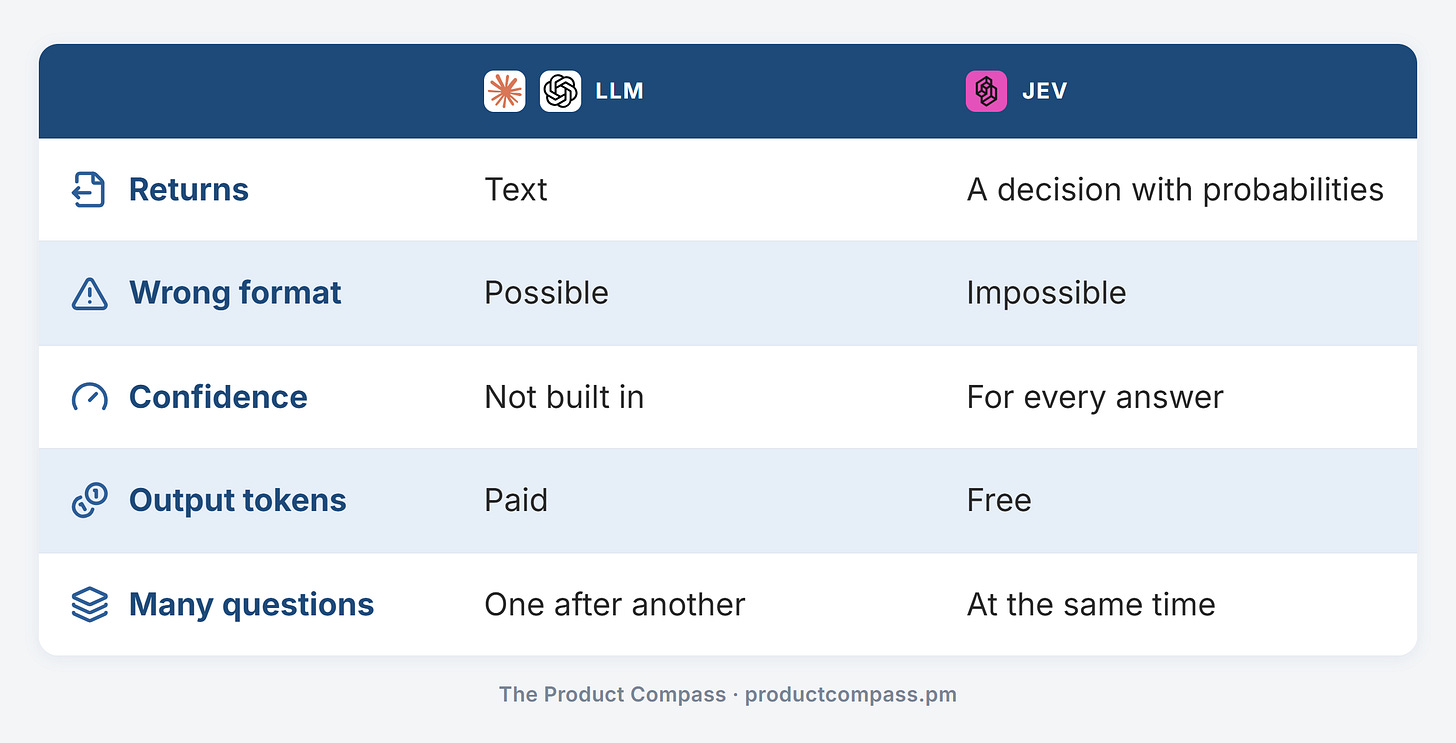
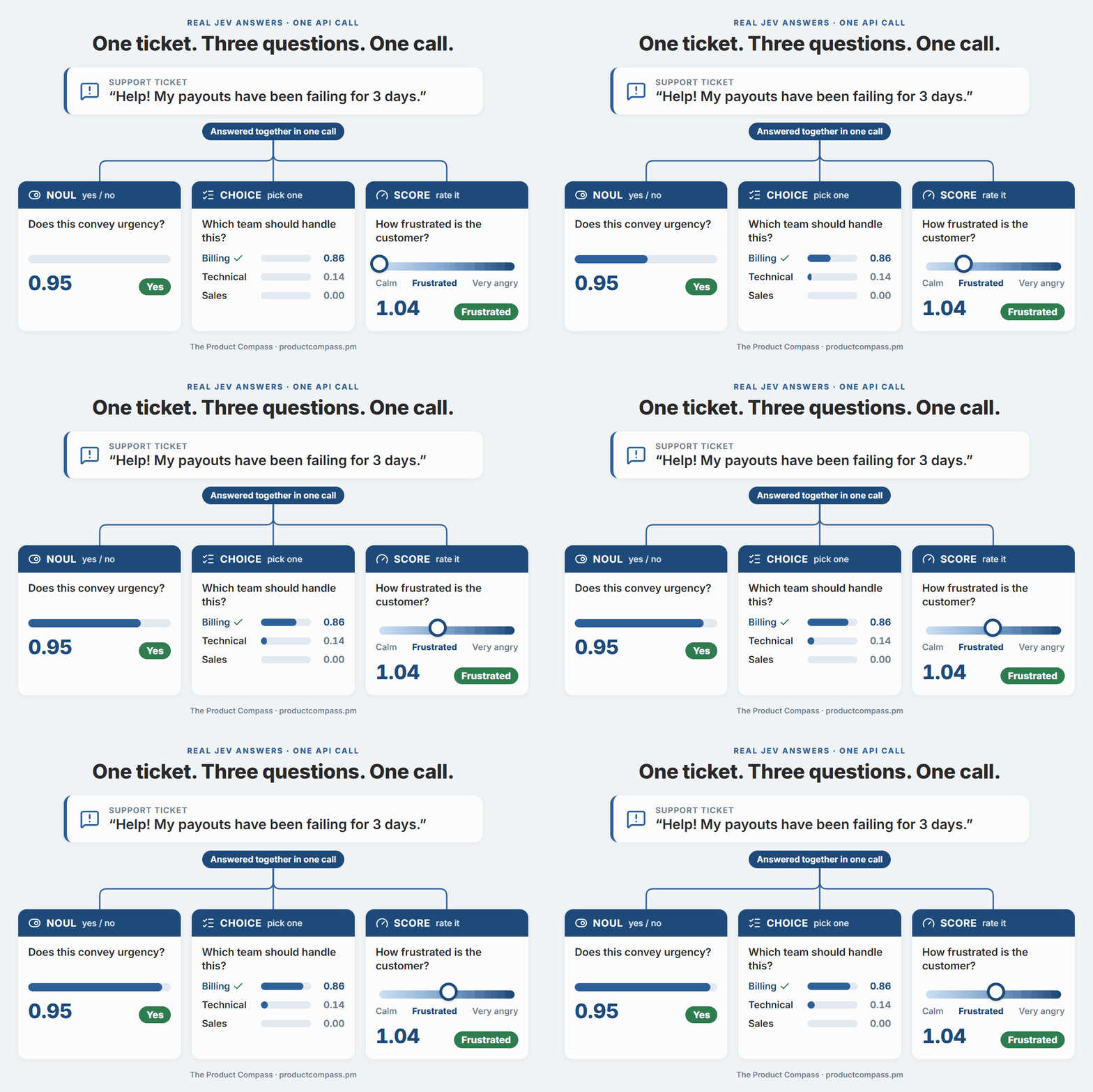
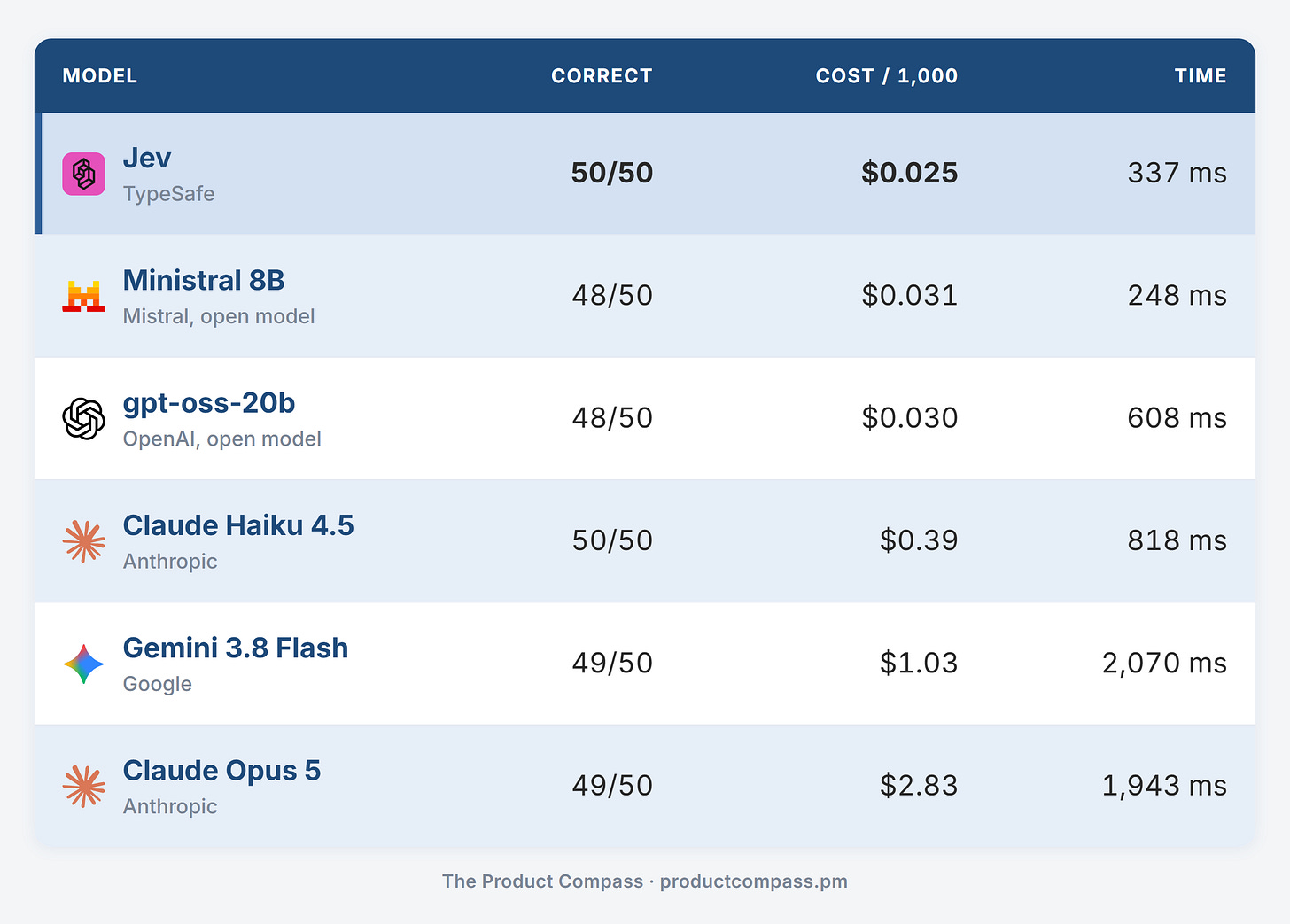
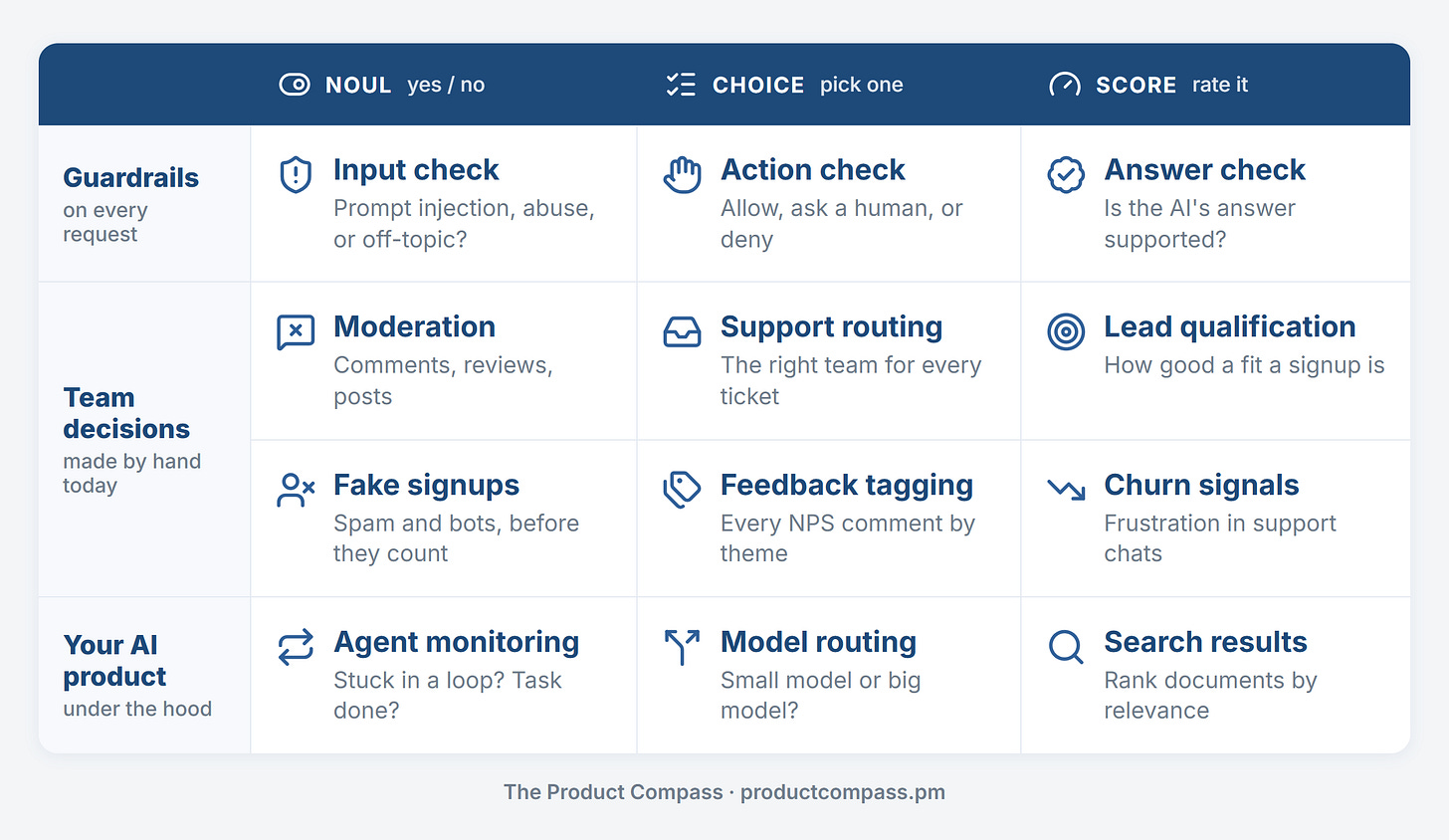
- Jev (TypeSafe AI) returns decisions with probabilities: yes/no, one choice from up to 255 options, or a score on 2–10 levels. Input costs $0.042 per million tokens and output is free . In The Product Compass's own 50-document test, it made the fewest mistakes and was 115× cheaper than Opus .
- n8n vs. Claude Code. n8n's growth has moved from personal automations to business-critical workflows. It presents itself as the orchestration layer for work you can't trust to run correctly only "95% of the time" . SAP invested at a $5.2B valuation and embedded n8n in Joule Studio .
Craft notes
- Problems over features. Marty Cagan's example is setting a goal of 30-minute employee onboarding and letting the team decide whether that means ten features or none . Prototypes are for learning, products for earning, so "don't confuse what you vibe code with something you could run your company on" .
- Taste in problems. Paul Graham says juicy problems have "one main thing you're trying to solve," while nasty ones bundle extrinsic constraints . Nasty real-world problems can still pay off: "just don't choose one by accident" .
- Builder bias. Shreyas Doshi names three causes: an "I am good at product" identity, moral aversion to marketing and distribution, and virtue-signaling about serving users . On reverse interviews, he says interviewers' follow-up questions tell you more about a company's talent than its canned prompts do .
- Support as roadmap input. One founder runs a weekly 30-minute review of the top five tickets, sorted by frequency. Each gets a doc, UI, or process fix with an owner .
- Hardware PMs facing supply crunches describe pulling procurement into roadmap discussions earlier . Another commenter describes stretching hardware life cycles from five to seven years .

- For internal HR tools, replace feature roadmaps with problems and measurable outcomes—for example, reducing onboarding to 30 minutes—and let the team determine whether the solution needs features, a redesign, or no new feature; an initial idea is not itself a requirement.
- An empowered team can be small and cross-functional, typically including a product manager, designer, and engineer; the team works on the problem, drawing on the PM’s user, industry, and business knowledge, design skills, and engineering expertise. Product discovery should test prototypes with users and relevant stakeholders before delivery, seeking evidence that the solution is valuable, usable, feasible, and viable.
- Product teams need access to users, usage data, and stakeholder time for frequent prototype reviews; usage data helps verify outcomes, while legal and regulatory requirements should be communicated as constraints.
- Prioritize outcomes over predictability except when a date is a genuine obligation, such as a legal deadline; Cagan recommends piloting the product approach on one initiative before expanding it.
- Vibe coding can help prototype and learn, but a prototype is not proof that a product is ready to run a business; production software also needs reliability, performance, fault tolerance, and accuracy.

Asked whether the issue is loving product-building or falling in love with one’s own product, Shreyas Doshi identifies three possible drivers among smart people: seeing oneself as “good at product” rather than “good at winning,” moral aversion to marketing and distribution, and seeking virtue points by saying “I just want to serve my users.”

Pangram does not evaluate posts under 50 words, so its LinkedIn use excludes short posts; Lenny’s suggestion that even more posts are AI-generated is a guess, not a measured result.

- To assess a company’s talent while interviewing, look beyond canned interview prompts: the quality of interviewers’ follow-up questions is a stronger signal, and the hiring process should be rigorous without being either too easy or excessively onerous.
- For sufficiently senior roles, conduct a reverse interview after the company signals it wants to hire you: speak with employees about the work and culture (Shreyas Doshi spoke with seven or eight people at Twitter), and ask the hiring manager to introduce three or four of the company’s strongest people across functions.
- Check claimed product competence against customer conversations and the company’s actual products: look for insight, execution pace and quality, differentiation, and market traction—not just pixel polish.

- Consumer AI reach is much broader than paid adoption: roughly half of Americans reported using AI, while the card-spend panel put paid subscriptions at about 4.5%; among payers, the top 10% generated more than half of revenue and the top 1% generated 20%, with top-1% monthly spend at $93 versus a $25 median among payers. Usage reach alone is therefore a weak proxy for subscription demand.
- For personal agents, platform capability is advancing faster than consumer willingness to use it; speakers cited privacy, safety, and trust concerns around intimate access and unexpected actions as adoption constraints. New users can face a “blank box” problem, while a group of 1,500+ early adopters still most often used agents for coding and technical automation, even with consumer assistant products.
- Product differentiation can sit above the model: easy-to-use, tailored interfaces can become more useful as models improve, while accumulated context and personal playbooks can create value that is difficult to migrate. The discussion argues that rich product experiences, context, and community—not just a model wrapper—are where software value can accrue.
- Monetization is a product and unit-economics challenge: listed consumer AI products relied heavily on subscriptions and credits, while high serving costs can make companies wary of growing too quickly without usage meters; the speakers expect ads and transaction models to matter as costs fall. They said OpenAI had reached about a $1B annualized advertising run rate after a gradual rollout, and stressed that assistant ads should be clearly labeled, relevant to commercial intent, and non-interruptive to preserve trust.
- The panel sees opportunity beyond products that help users get things done: many consumers seek ways to spend time, and entertainment and social products are major consumer destinations. Dating and recruiting were identified as multiplayer categories without a listed breakout, while AI social products had yet to take off and shopping could emerge in assistants, standalone products, or both.
Lenny’s conversation with the Head of ChatGPT and Codex discusses the possibility that model pickers will go away, loops and graphs are a passing phase, and agents will soon take most actions on the internet; it also covers OpenAI’s AI safety approach. A clip linked to the conversation quotes Tibo saying that how people work will continue to change radically.

- For consumer AI, reduce the learning burden by matching familiar mental models rather than requiring users to understand concepts such as models, cloud, VMs, or plugins; Zhuo points to Muse’s friendly persona, immediate acknowledgments, conversational language, and single default “main” thread as examples.
- Request sensitive access only when the user has a concrete benefit and at the point of need, while preserving choice: Muse offered manual entry of an email verification code or Gmail access, and asked for payment access after showing the product, amount, and receipt.
- An agent’s value should come from taking on dreaded or deferred work, not merely making already-efficient tasks faster. In Zhuo’s example, Muse found an obscure Mandarin cassette listing and a cross-border purchasing workaround, though captcha handling still required her intervention.
- To address the blank-slate problem, offer contextual, proactive suggestions; Zhuo found Muse’s Ideas useful but its generic content feed less relevant, and recommends making suggestions more prominent with concrete entry points such as saving money.
- For users managing multiple tasks, make ongoing work easier to resume: Zhuo found Muse’s side chats unclear and proposed an “active work” view combining goals, threads, and activity, with separate follow-up chats that users can return to without rereading everything.
- These are qualitative observations from a week-and-a-half of use; Zhuo also cautions that week-one retention is too early to trust.
Shreyas Doshi argues that product outcomes originate in a product person’s thinking, making better thinking the best—and, in his view, the only—way to consistently build successful products.

- Jev, a decision model from TypeSafe AI, returns a probability for a yes/no decision, selects among up to 255 choices, or assigns a score across 2–10 levels. Input costs $0.042 per million tokens and output tokens are free; in the author’s test, 32 questions took 566 ms versus 603 ms for one question.
- Suggested product applications include input checks, moderation, fake-signup detection, agent monitoring, support and model routing, feedback tagging, lead qualification, churn signals, and search-result scoring. The article presents these as quick wins because product data already flows through the system and rules can be written in a paragraph, with uncertain decisions escalated to people.
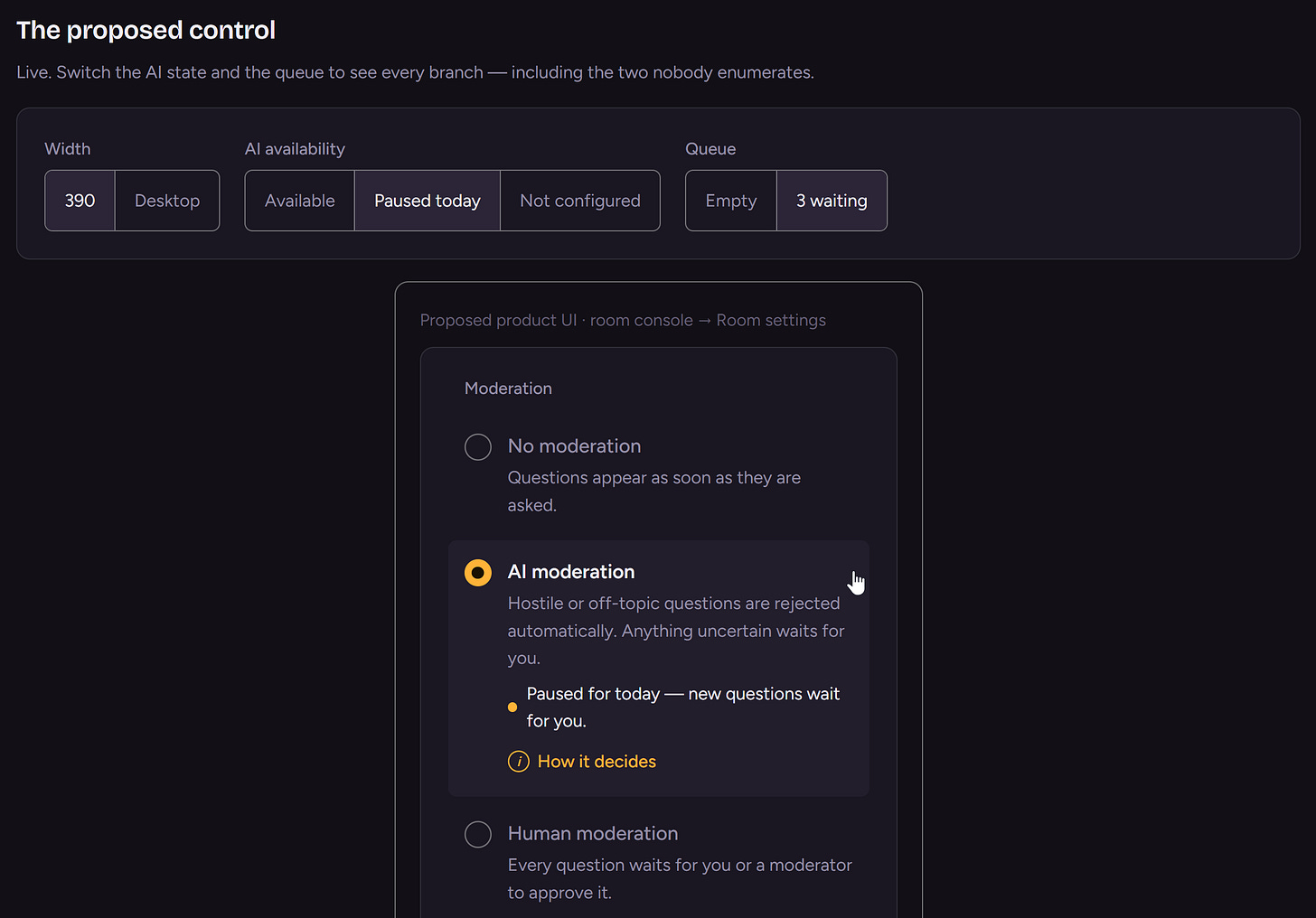
- AskOne uses Jev to screen anonymous audience questions: decisions with confidence of at least 0.8 are handled automatically, while lower-confidence questions go to a host or moderator; the author estimates a question costs about $0.00002. In the author’s tests, explicit house rules were followed 24/24 times versus 5/24 without them, and the evaluation set included 100 questions spanning multiple dimensions, including 20 ambiguous cases and prompt injections.
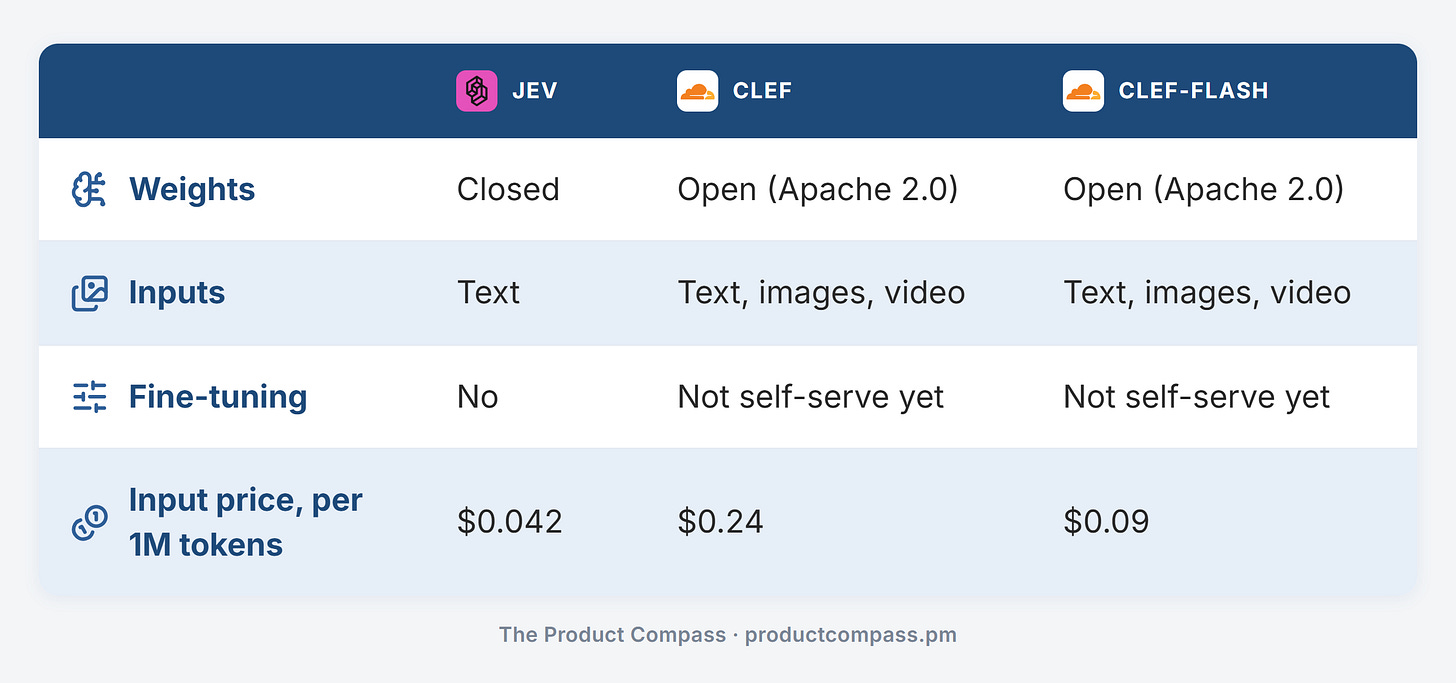
- The author’s 50-document comparison, including 32 deliberately misleading documents, found Jev made the fewest mistakes and was 115× cheaper than Opus; this is the author’s reported test, not a general benchmark claim. Jev is text-only, cannot be fine-tuned, and has a 32K-token limit; Cloudflare’s Clef won most of its benchmarks, with the author suggesting it when image support or self-hosting is needed.
Shreyas Doshi shared a new career-series video on reverse-interviewing a company and assessing its talent quality, a general career resource for evaluating potential employers rather than a product-management-specific lesson.

- n8n’s differentiation from Claude Code is orchestration: Claude Code is used for fast prototyping, while n8n connects tools, models, and data for shared processes that need reliability. n8n adds human approval gates, node-level execution logs and replay, and versioned team handoffs; its team often prototypes in Claude Code before moving workflows to n8n.
- n8n says its use cases have shifted from personal automations to business-critical workflows. The article reports SAP embedded n8n in Joule Studio after investing at a $5.2B valuation; it also reports 1.5M active users and 1,200 enterprise customers.
- n8n product squads have 3–5 engineers, 1–2 PMs, and a designer; its hiring criteria include technical depth, building experience, and understanding agent evaluation, scaling, and reliability beyond demos. Suggested portfolio evidence includes building an agent, moving it into n8n via MCP, and writing 20 test cases for an eval; interviews include live problem-solving.
- Design for agents: Tibo Sottiaux predicts agents will soon perform most actions on the internet. Notion’s MCP launch brought a flood of traffic that strained its systems and forced it to rethink its economics; he says product teams will need to decide whether to build for agents, though they can wait a while.
- Reduce AI setup burden: Tibo expects model pickers to disappear because choosing a model and reasoning effort fatigues users; Dots already has no model picker.
- Plan for rapid capability gains: Tibo advises building as if models will be roughly 10 times better in a year, with lower costs, faster performance, and modalities working together. He also sees configured agent loops and intricate graph architectures as a passing phase, not the long-term way to get the most from AI.
- Treat plugins as a distribution channel: OpenAI launched “Sign in with ChatGPT” with 16 partners; popular third-party plugins are set to share revenue when subscribers spend tokens, and ChatGPT recommendations based on retention and quality could expose a good plugin to a significant slice of its 1.2 billion users.
- Update team and work assumptions: Tibo says user understanding, learning quickly, and taste are gaining value relative to typing speed. He also expects agent-team sizes to expand and shrink as models improve, and argues AI should reduce noise and help people focus rather than simply increase output pressure.
OpenAI will share revenue with third-party plugins that see high usage, offering plugin developers a usage-linked monetization opportunity; the post gives no threshold or terms.
Lenny says he has long argued that product managers will thrive in the AI era, and Tibo agrees; the post gives no supporting rationale or practical advice.

- In an MIT Media Lab essay task involving 54 people, 15 of 18 ChatGPT users could not quote a line they had written, compared with 2 of 18 participants who used no tools. A product practice described alongside this risk is to use AI to challenge rather than replace PM judgment: gate feature work on the current alternative, how many people have the problem and how often, and whether they would pay; ask an AI thinking partner to probe customer contact, evidence, and what could break if the decision is wrong. Write the decision, your answer, and what would change your mind before asking Claude to critique them.
- For production workflows, n8n’s guidance favors orchestrating predictable steps and using AI where needed; it distinguishes fully controlled LLM workflows, guided agentic workflows, and agents that choose their own tools. It recommends approval gates for sensitive actions and error-notification workflows.
- n8n and Claude Code serve different workflow needs: Claude Code is used for fast prototyping, while n8n is presented as visual orchestration for business-critical, team-shared processes, with execution logs, reruns, version history, and handoffs. The episode reports that SAP invested in n8n at a $5.2B valuation and embedded it in Joule Studio for SAP customers; it lists 1.5M active users and 1,200 enterprise customers.
- n8n squads consist of 3–5 engineers, 1–2 PMs, and a designer; its hiring signals include technical depth, a builder mindset, and the ability to reason beyond demos about agent scaling, evaluation, and reliability. The suggested portfolio path is to build an n8n workflow, prototype and migrate an agent, then evaluate it with 20 test cases.
ChatGPT and Codex head Thomas Sottiaux says setting up and fiddling with AI “loops” is unlikely to be the lasting interaction model; he expects “Dots” to become the primary way people talk to AI.

- In a thread about hardware supply-chain crunches, rising costs, and uncertain capacity, one respondent said to bring procurement into roadmap discussions earlier because parts can arrive nine months after a spec is set .
- One infrastructure operator described reusing returned customer hardware, extending recommended lifecycles from five to seven years, improving software efficiency rather than speccing more capacity, and shifting scheduled tasks to nighttime to reduce peak loads. They also cited ESXi-to-Proxmox migrations, evaluating Firecracker or Alpine instead of larger Ubuntu/Debian VM images, and LLM-assisted code translation to Rust with a proper testing methodology .
- A commenter argued that bare-metal data-center MSPs share BOM headwinds, while end-to-end IaaS providers can differentiate through multi-year customer deals, cost-saving services, and cloud stacks; they said potential VMware-exit savings can outweigh hardware costs and server demand currently seems inelastic, allowing hardware vendors to raise prices .
Five minutes before OpenAI’s DevDay live demo, Dot noticed production was down and asked to fix it. The reply—“I don't think you're there yet”—suggested Dot was not considered ready to perform that production remediation.

- Andrew Chen recommends evaluating agent network effects separately across acquisition (virality and CAC), engagement (retention and usage), and monetization (ARPU, conversion, and share of wallet), with network density—not raw user scale—as the relevant driver. He argues agents are not inherently networked: interoperable tools that can communicate across services may remain fragmented, and strong models, UX, integrations, memory, or distribution are advantages but not network effects.
- For acquisition, agents could turn tasks into shareable artifacts, events, or group chats that bring in new users; effective loops require contact access, contextual judgment, communication channels, and trusted, non-pushy outreach. Engagement network effects may instead come from shared identity, trust, reputation, relationships, private context, and intent that improve coordination and matching as more people join.
- The strategic question is where those networks live: open protocols and specialized networks could let horizontal and vertical agents interoperate, while proprietary control of identity, relationships, context, reputation, and distribution could make switching mean leaving a network behind.

- For AI product design, start from the responsibility rather than copying a job description: PM work bundles customer calls, usage analysis, prioritization, specs, and team alignment because one person carries context; a product could instead synthesize customer feedback continuously without also owning roadmap prioritization and launch planning. Set boundaries around work that benefits from shared history and evidence, and avoid splits that force downstream systems to reconstruct context.
- AI capabilities can be offered in smaller or intermittent increments before a company needs a full-time role—for example, pricing analysis may be needed before there is enough work to hire a pricing analyst.
- Unbundling shifts coordination into system design: AI products made of specialists need clear ownership, shared state, context handoffs, and conflict resolution, or capable agents can recreate the coordination burden that jobs once handled.
- Automating junior work can remove repetition through which people build judgment; preserve learning with opportunities to inspect inputs, make independent calls, compare with the system, and review failures and changed decisions.