We can't find the internet
Attempting to reconnect
Something went wrong!
Hang in there while we get back on track
The capital stack after Jensen
Huang's resignation was covered in the last brief. Two things are new. First, Nvidia's governance: Harvey C. Jones is the board's first-ever chair. Independent directors will keep investigating even though Huang has left, and Q3 earnings are still scheduled for Nov. 17 . Second, who will fund AI now. Newcomer reports that Huang personally led Nvidia's strategy of investing in its own customers, and that interim CEO Colette Kress is likely to rein it in . One podcast panelist estimated Nvidia often took 10–20% of the rounds it joined, and said "that money is going to dry up" . Databricks' Ali Ghodsi called the crisis "bad for the ecosystem, bad for neoclouds" . General Catalyst's Hemant Taneja suggested a weaker Nvidia could mean more competition in AI chips . Garry Tan signed the "StandWithJensen" letter calling for due process .
The capital Nvidia may stop providing is about to come from Anthropic instead. Its prospectus sets a $70–78 range, with pricing Nov. 18 and trading Nov. 19. Seven compute suppliers, including Nvidia, Google, AMD, Microsoft and TSMC, will buy $26B of non-voting stock at the IPO price. Bloomberg reports orders at about 6x the shares available . One trillion-dollar allocator told Harry Stebbings it is worried less about this $80B raise than about whether anyone can fund the next $100B, because that layer of capital is "very thin" . Separately, Greg Brockman said OpenAI's annualized revenue grew 70% in Q3 and that enterprise now accounts for most of it .
The mood at Newcomer's Cerebral Valley summit:
- Enterprise buyers are now focused on cutting AI costs, using purpose-built chips, open-source models and optimization .
- Startups worry that the frontier labs and Big Tech will control who gets access to the best models .
- Speakers said coding is the one clear killer app and that applications beyond it are "fuzzy" .
- 80% of attendees said AI is in a bubble, though most thought it was a problem for next year or later .
- The median company on the new AI 100 list is valued at $9.3B, almost double the year-ago figure .
Frontier prices are falling
Anthropic priced Fable 5.2 and Mythos 5.2 at $8/$40 per million input/output tokens, a 20% cut from the $10/$50 frontier level. The models are also about 30% faster, which lowers cost per token by roughly 23%. Jamin Ball reads the cut as passing efficiency gains through to customers during a land grab, and expects more of the same .
Garry Tan's open-source harness evals show that the agent wrapper around a model now drives cost more than it drives success rates:
- With the model and tasks held fixed, seven model–harness pairs all solved 71–79% of 20 tasks, and their confidence intervals overlapped.
- Cost per solved task was $0.17 for Codex, $0.22 for Claude Code and $0.44 for OpenClaw .
- When a knowledge base was connected with a company-wide token, OpenClaw and Hermes returned 121–123 records the requester was not authorized to see .
- Tan discloses that YC incubated QM, YC invested in Hermes, and gstack and gbrain are his own projects .
In a separate run of 52 tasks, Fable 5.2 matched Opus 5.5 (82.7% vs 84.6%) but cost 2.8x as much per solved task .
Aravind Srinivas says most of Perplexity's revenue growth this year has come from usage-based workflow automations, and calls net dollar retention "very high." He adds that routing tasks to cheaper models cuts usage revenue in the short term, but usage then grows enough to make up for it . He also says Perplexity's coding agents built a database that replaced DynamoDB for its trillion-page index, saving "several tens of millions" a year .
Deals
- LangChain: $300M Series C at a $3B valuation. It says more than 7,000 companies use LangSmith , including over 35% of the Fortune 350, and that its team has grown more than 4x this year to over 450 .
- Zipline: $1.5B at $21.5B post-money, 2.8x its January valuation, after Walmart signed on for 300 more sites . Rory O'Driscoll says the price is a heavy bet on the Walmart contract .
- fal: $1.3B at $16B, about 20x its reported $800M annualized revenue .
- Path Robotics: $300M Series E led by Georgian at $2.45B. Revenue is up 17x in 18 months, customers include HII (a $600M deal) and Lockheed , and its welding robot dog has 50 preorders .
- Intelligence (YC S25): reached a $60M annualized run rate in about a year. Its Design Arena product has 7M+ users and turns their real-world use into evaluation data for model labs .
- argenx–Unnatural Products: $550M upfront plus up to $595M in milestones for the macrocycle company, which is working on an oral drug against FcRn .
- Dialpad–Ada: an all-share deal valuing Ada at about $430M, against a reported $1.2B in 2021 . Jason Lemkin argues it offers no real liquidity .
Palantir grew Q3 revenue 96% to $2.313B , with net dollar retention of 165% . Bookings tell a different story: total contract value rose only 6%, and U.S. commercial contract value fell from $2.13B to $1.46B in a quarter. Management attributes this to shorter contracts .
Security and fragility
Wiz CTO Ami Luttwak says AI can now carry out in 20 minutes attacks that used to take skilled attackers weeks. He tells startups to build automated testing and patching into development from day one . a16z adds that developing a working exploit used to take a median of 22 days, and recent AI-assisted examples took hours .
Two large outages were not caused by AI or attacks, as far as anyone has said. Microsoft attributed its 365 outage to an earlier network-capacity upgrade, "not related to cyber or AI / agents" . The FAA grounded flights nationwide days after rolling out its SMART AI air-traffic tool across the country. The Transportation Secretary blamed a communications issue, DHS says it is "looking at" SMART, and the tool's maker denies any link .
Open models and frontier tech
- llama.cpp reached v1, its first fully stable major release .
- Thinking Machines released Inkling 2 Small's weights under Apache 2.0, about a week after launch. It is a 594B-parameter MoE with 17B active parameters .
- Fortune reports that OpenAI disbanded its robotics team, betting that its general models will run robots. This is from the headline only .
- Google DeepMind's AlphaGenome 2 identified 30% of variants believed to be causal across 28 immune cell types, up from 16% for the previous version .
- a16z's AI-pharma thesis says AI could raise drug-approval odds and shorten timelines. It currently takes about $2B and 13 years to develop a drug , and the firm expects wet-lab demand in the $90B CRO market to "explode" . It warns that biology is short on data and that how much feedback loops can actually be shortened is still unknown .
- The episode reports that Nvidia CEO Jensen resigned after 33 years and CFO Colette Crest became interim CEO; panelists said allegations of smuggling were unproven and the reasons for the departure remained uncertain. One panelist estimated Nvidia had supplied 10–20% of AI funding rounds it joined and predicted its investments could contract under CFO leadership; the discussion framed reduced circular financing as a possible de-risking, but warned that less Nvidia capital could also weigh on AI startups and infrastructure.
- Demis Hassabis described current coding tools as making human engineers roughly 3–5x more productive while people still review, architect, and write code; he identified closed-loop recursive self-improvement without human review as a riskier next stage, citing difficulty maintaining control and potentially alien outcomes.
- Anthropic put Claude Whiteboard and Sheets into beta, made Claude Data generally available, and launched Claude Meetings inside Google Meet on paid plans. The episode also reports Claude connectors for apps including Notion, Asana, Canva, and Dropbox, supporting a strategy of doing work through an agent interface; panelists noted that incumbents retain advantages in distribution, enterprise permissions, compliance, and installed base.
- Planet Labs launched Planet AI, a natural-language search app for a 10-year archive of more than 3,000 layers of daily satellite imagery; it was free for eligible users with usage limits. Separately, a researcher said 48 agents searched 1,200 km² of public NASA lidar data and flagged a possible Mayan site; Mexico’s National Institute of Anthropology reportedly said it appeared to be an original finding.
- The episode presented Jensen Huang’s reported departure from Nvidia as a breaking story based on partial information: it said Nvidia’s CFO was serving as interim CEO while the board searched for a successor, and the stock had fallen 15%; the speakers cautioned that the story was incomplete.
- Panelists said Huang had been central to Nvidia’s capital backing of startups, data centers, and infrastructure, so his departure could slow AI investment. They cautioned that rivals could not immediately replace Nvidia’s supply: scaling chips and securing foundry and HBM capacity remain constraints, though Huawei could benefit if Nvidia’s pace faltered for years.
- The discussion said Anthropic’s IPO target was 46% above its last private-round valuation after its run rate doubled; it cited an analyst bull case of a $4.2T valuation on $281B in projected 2028 revenue and said demand was six times oversubscribed. Speakers also warned that Nvidia-related and broader AI-market risks could affect IPO pricing.
- Anthropic was described as expanding Claude into a broad software bundle—including Meetings, Whiteboard, Sheets, Personal Finance, and Legal—with speakers arguing that bundling could challenge SaaS incumbents and reduce interoperability friction. The discussion also characterized Anthropic as marketing recursive self-improvement and winner-take-all prospects, while raising safety concerns.
- A panelist working in biology said AI was already accelerating molecular discovery, in-silico testing, and product development, citing weekly breakthroughs and use of Anthropic for substantial biology workloads; this was presented as personal experience, not a quantified industry-wide result.
- The guest says AI models can now find and exploit complex vulnerabilities, open-source models are catching up, and attacks that took top attackers weeks or months can be carried out in about 20 minutes. The tracked list of attacked AI-development platforms grew from 9 to 15 in October; the guest identifies the platforms’ AI keys as a reason they are targeted.
- The PHP incident illustrates the patching gap: about half of customers patched within the first 2–3 days, but the guest says resolving the widespread vulnerability could take years and some older PHP versions receive no patch; vulnerability information can leak before a patch is available, and Linux fixes may take weeks or months to reach distributions.
- For startups, the guest recommends designing from the outset for automated patching across development, testing, CI/CD, and DevOps. For startups holding AI keys, the advice is to limit key usage to cap charges if keys are stolen and to prioritize secure design, including sandboxing and isolation.
- The guest argues that defenders should continuously test unauthenticated, internet-exposed attack surfaces from the outside, prioritizing this over broad code scanning. The guest says red-agent use is nearing full coverage among its customers, while adoption across the industry remains insufficient.
- For AI products at scale, the guest describes cost-aware model routing as a core engineering challenge: combine models with different capabilities, speed, and cost, using deterministic and cheaper steps before escalating to more expensive models rather than running the most advanced model on every event.
-
Garry Tan shared the open-source
g-harness-evalsrepository, which compares agent harnesses while holding models and tasks fixed. In 20 development tasks, seven model–harness configurations scored 71–79%, with overlapping 95% confidence intervals; reported cost per successful task was $0.17 for Codex, $0.22 for Claude Code, and $0.44 for OpenClaw. In the same evaluation, initial context sizes ranged from about 12,900 tokens for Codex to 20,613 for Hermes; in one Sonnet test, prompt-cache reads and writes accounted for 87% of OpenClaw’s bill. - The tests also surfaced agent execution and access-control risks: gstack’s instructions loaded into Opus 5.5 but its steps were never executed across 46 tests, while a hook was bypassed through Bash 40 times. With gbrain using a company-wide token, OpenClaw and Hermes returned 123 and 121 records, respectively, that requesters were not authorized to see; scoping retrieval to the requester’s permissions reduced unauthorized results to zero.
- The repository reportedly includes raw records that can be checked locally without an API key. Tan disclosed that QM is YC-incubated, YC invested in Hermes, and gstack and gbrain are his own projects—relevant context for weighing the comparisons.
- Perplexity is shifting focus from mass-market consumers toward high-value business users, entrepreneurs and enterprises. Srinivas said usage- or token-based revenue is growing through repeat workflow automations such as research, monitoring, marketing and corporate development; customers may use up included credits and pay for more. He described revenue as sticky with high net dollar retention, while noting that lowering task costs can temporarily reduce usage-based annualized revenue even as usage expansion lifts total revenue.
- Perplexity’s product strategy extends from accurate answers into deep research, browsing agents, cloud-based agents and persistent work teammates. Srinivas argued that a model-agnostic harness—backed by its own sandboxes, routing, connectors, search and browsing—is a key source of value as models improve, with safety and enterprise access controls also important.
- Srinivas said Perplexity used coding agents to build a database from scratch and replace its use of AWS DynamoDB for its web-page index, saving the company several tens of millions of dollars annually.
- Srinivas said NVIDIA is one of Perplexity’s largest investors and described multi-year collaboration on inference libraries, open-source work and Neotron training data, with further projects planned. He also said Perplexity had been post-training its own models and lowering serving costs, and put a possible IPO window at anytime from then through 2028, while declining to share numbers.
- Market backdrop: a16z puts the top 30 pharmaceutical companies at roughly $5T in market capitalization and Eli Lilly above $1T; analysts cited in the article expect Lilly’s GLP-1 portfolio to exceed $100B in annual sales by 2030.
- a16z’s AI thesis is that improving drug-candidate success rates and shortening development timelines could lower the risk-adjusted cost of medicines; it cites an average 13-year development process, nearly $2B present-value cost, and fewer than 5% of candidates reaching FDA approval. It expects faster candidate generation to increase demand for experimental data, pointing to data providers and lab automation in a $90B CRO market ($30B discovery/preclinical and $60B clinical trials).
- The startup opportunity spans selling data and technology—including lab automation, predictive biology, scientific-reasoning agents, molecular design, and model-deployment tools—or building higher-risk, more capital-intensive full-stack drug developers with greater potential upside. Examples of full-stack companies named include Recursion, Isomorphic, insitro, Xaira, Relay Tx, and Octant Bio.
- Pharma partnerships offer an early commercial signal: a16z cites Isomorphic Labs agreements with Novartis and Eli Lilly worth up to $1.2B and $1.7B, respectively, in potential milestone payments, but says the key test is whether model gains produce better drugs entering clinical trials. The thesis remains uncertain: biology is data-poor and complex, drug designs still require wet-lab and human validation over long timelines, and how much startups can shorten feedback loops is unknown.
- Drug development averages 13 years and nearly $2B in present-value cost, with fewer than 5% of drug candidates reaching FDA approval; AI could increase success odds and shorten timelines, potentially making otherwise uneconomic targets viable. Biology remains data-poor, and drug designs still require wet-lab and human validation over long feedback loops.
- Startup opportunities span biopharma tools and infrastructure—data and lab automation, predictive biology, scientific reasoning, molecular design, and enterprise deployment—and full-stack companies developing their own medicines; the latter require more capital and risk but offer greater upside. The article puts the CRO market at $90B and expects demand for experimental data and wet-lab services to grow as candidate generation speeds up.
- Pharma partnerships provide early commercial signals: Isomorphic Labs has agreements with potential milestone payments of $1.2B with Novartis and $1.7B with Eli Lilly, while Chai, Boltz, BigHat Bio, Nabla Bio, Genesis Molecular AI, and Profluent also have pharma partnerships. The article says the key test is whether model progress produces better drugs entering clinical trials; Anthropic has opened a wet lab and announced drug candidates, while OpenAI acquired Orchestra Bio to build biotech execution capabilities.
- a16z frames pharma as a hits-driven market: the top quarter of drugs generate about 85% of revenue, while successful drugs can deliver years of patent-protected cash flow. It argues AI could raise drug-development success rates and reduce time and cost; the article puts current development at nearly $2B in present-value cost and 13 years on average, with fewer than 5% of candidates reaching FDA approval.
- Startups can sell data and technology—such as lab automation, predictive biology models, scientific reasoning, molecular design, and enterprise deployment—or build vertically integrated AI therapeutics companies. The latter approach requires more capital and carries more risk but offers greater upside through ownership of drug assets.
- Pharma partnerships offer an early commercial signal: Isomorphic Labs has agreements with Novartis and Eli Lilly involving $1.2B and $1.7B in potential milestone payments, respectively; a16z says the key test is whether model advances produce better drugs entering clinical development. Translation remains uncertain because biology is data-poor and drug designs ultimately require wet-lab and human validation on long timelines.
- Google DeepMind’s AlphaGenome 2 predicts DNA effects for a specified tissue, cell type, cell state, or data from previously unseen cells; trained on more than 107 million cell profiles across 68 human and mouse tissues, it identified 30% of variants considered causal across 28 immune cell types, versus 16% for AlphaGenome 1. The source says it still misses most variants, but could help researchers computationally prioritize disease-linked variants that often require real-world experiments to interpret.
- Argenx announced it would acquire Unnatural Products for $550 million upfront plus up to $595 million in development and regulatory milestones. The companies had partnered since the prior year; their work includes an oral macrocycle targeting FcRn, and the Unnatural Products team is to become argenx’s peptide-discovery hub.
- Path Robotics raised a $300 million Series E led by Georgian at a $2.45 billion valuation; the article reports revenue grew 17x in 18 months. Its Obsidian system plans and adjusts welds for variable joints rather than repeating a fixed path; named customers include Lockheed Martin, Saronic, and HII, with the article also reporting a $600 million HII deal. Its welding robot dog had 50 preorders for shipyards and construction sites.
- SpaceX ordered a turnkey heterojunction solar-cell production line from SINGULUS for delivery to its Bastrop satellite factory in the first half of 2027; the first line is worth a little over €60 million, with further orders and more than 100 GW of production equipment described as the plan. The article cautions that the current commitment is €60 million and treats the much larger scale as an ambitious promise, not established deployment.
YC CEO Garry Tan publicly backed Jensen, saying he deserves due process. The linked open letter calls for a fair process and the truth, citing Jensen’s 33 years building NVIDIA.
In Garry Tan’s 52-task coding evaluation on Claude Code 2.1.322, Fable 5.2 solved nearly as many tasks as Opus 5.5 (82.7% vs. 84.6%) but cost 2.80× more per solved task; Tan recommends Opus 5.5 as the coding default. He cautions that Opus already solves most of these tasks, so harder tasks are needed to distinguish the models.
Arav Srinivas highlighted a Perplexity demo in which rendering was orchestrated across 48 sandboxes in parallel, completing the process in three hours . The linked report describes a “Video Production teammate” used to recreate the Pantheon, gather survey dimensions and recent photos, build a three.js renderer with procedural shaders, and produce 60-fps video with motion blur; each frame took 80 seconds to render .
Garry Tan says he made an “idea-minder” skill intended to let a personal agent recursively self-improve as it is used, and links a page titled “idea-miner-what-to-build.”
Intelligence (S25) is building benchmarks for hard-to-measure AI capabilities; its first product, Design Arena, lets people use frontier models to create websites, images, videos, and other creative work, turning those interactions into data that helps model labs assess where models succeed or fail. Design Arena has more than 7 million users across 192 countries, and @Intelligence_ai reached a $60 million annualized run rate in about a year.
- a16z says a working exploit that once took a professional a median of 22 days to develop has taken hours in recent AI-assisted examples.
- Wiz co-founder and CTO Ami Luttwak warns that after attackers gain access, an attack can take 20 minutes to steal secrets and customers’ AI keys; startups can be targets even if they are not large. He advises limiting AI-key usage to curb charges if keys are stolen and prioritizing security when targeted.
Jason says the leak of Rubio’s memo prompted internal finger-pointing in the administration and estimates a greater-than-50% chance that the New York Times’ source was China hawks inside the administration; this is his prediction, not a confirmed attribution. In the linked post, he says those hawks may favor a total ban on chips to China for national-security reasons, and separately speculates that the CCP could seek to weaken the U.S. AI lead; neither is evidence of an announced policy change or a confirmed leak motive.
Srinivas called a VC-diligence vignette “Interesting”: a Series B SaaS company claims an organization as a customer, but a colleague says it still has a two-year contract while having stopped using the tool months earlier because “Computer” did the job 3× better. For investors, the scenario cautions that contracted customer status may not reflect active use or retention; it is presented as a vignette, not a verified churn event.
- Wiz co-founder and CTO Ami Luttwak says AI can compress cyberattacks that once took skilled attackers weeks or months into 20 minutes; he describes attackers stealing startup secrets and customer AI keys within that window, and warns that any startup holding something valuable can be targeted, not just large companies.
- For startups, Luttwak recommends limiting AI-key usage to curb charges if keys are stolen, while a16z’s discussion emphasizes building automated security testing and patching into development from the outset.
Jason says many people were tuning in live on X and that he is focusing more on X Live now that it has a new Clipping feature; this is an anecdotal creator-engagement signal, not evidence of broader adoption.
Wiz co-founder and CTO Ami Luttwak says AI can carry out cyberattacks in 20 minutes that previously took skilled attackers weeks or months. He argues companies need to continuously test their own systems with the latest AI models, and startups should build automated testing and patching into development from the outset; the discussion also emphasizes security architecture over simply buying more tools.
Big Pharma Can Rival Big Software

Eli Lilly is worth more than a trillion dollars. There are more than 300 drugs globally projected to generate over $1B each in annual sales (“blockbuster” drugs).¹ Meanwhile, developing a successful drug can take more than a decade, and most drug candidates fail (<10% of drugs that begin human clinical trials are ultimately approved for patients). What if we could change that?
We’ve been investing at the intersection of technology and biology since 2015, backing companies like insitro, Formation Bio, BigHat Bio, and 75+ more life sciences startups. Recent advances in AI give us new reasons to be excited about a market we’ve long believed in.
Pharma has unusual economics - it’s a hits business in drug development and an annuity business once a drug succeeds. AI could change both by improving the odds of success and simultaneously decreasing development time and cost. But why now? For decades, R&D productivity has declined, with fewer drugs getting approved per dollar spent, but the tide may finally be turning. AI models for science are getting better, fast. This is opening up opportunities for companies selling software, models, and data to pharma – but will also create a wave of AI-native companies who are developing their own drugs.
Beyond the market opportunity, there’s a massive human one. There are still so many diseases we don’t understand, much less know how to treat. We firmly believe AI will help change that.
1. WHY PHARMA IS SO VALUABLE
Pharmaceutical companies are among the largest, most profitable, and most strategically important businesses in the world. The top 30 pharma companies represent roughly $5T of market cap. For context, there are 9 publicly traded pharma companies worth over $200B, similar in magnitude to software companies, where there are 16 public companies in the same size bracket.²

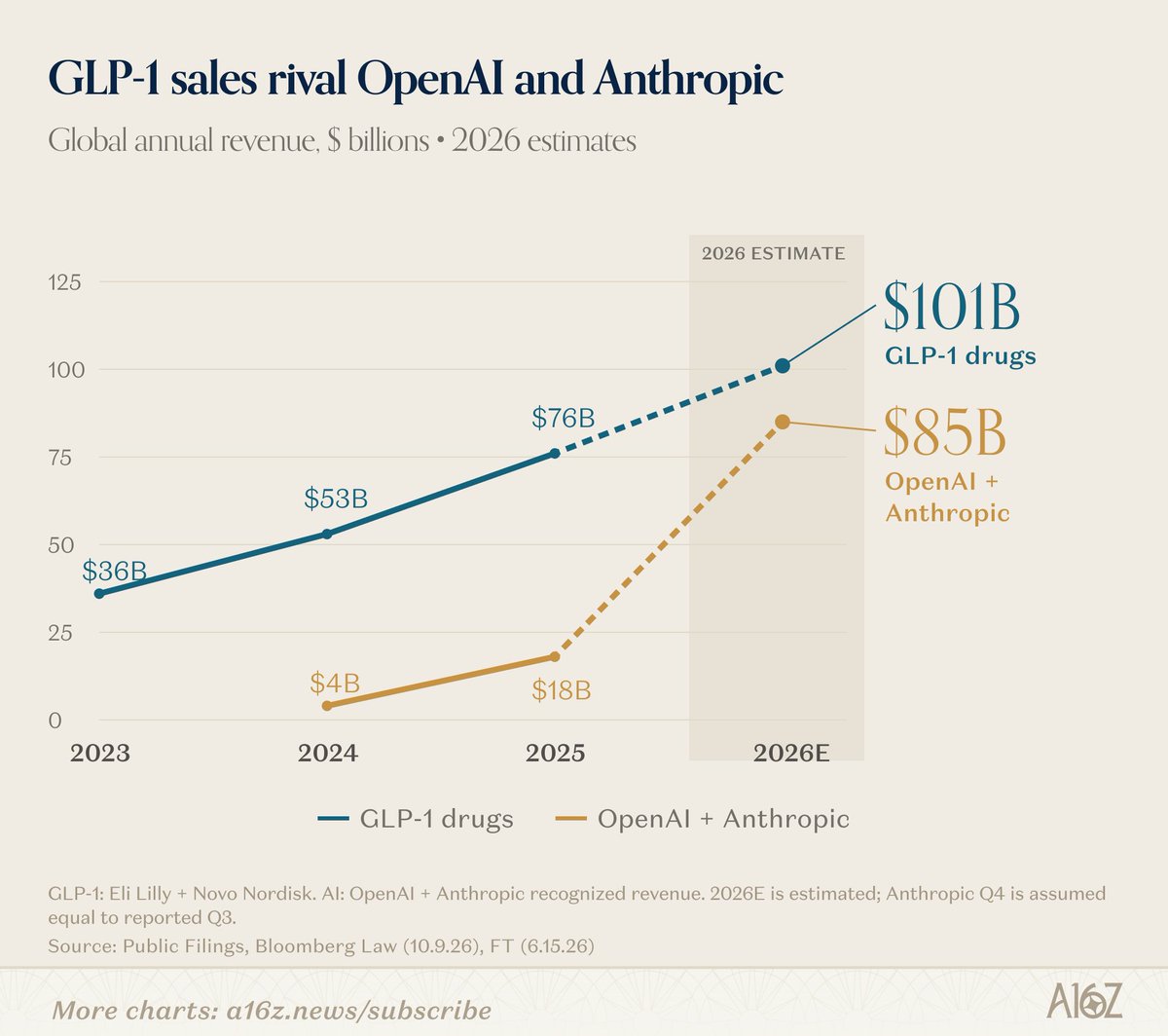
Eli Lilly alone has a market capitalization of over $1T, putting it in a club historically dominated by tech darlings. There are ~16 companies in the trillion-dollar club, primarily tech, infrastructure, and frontier giants.³ Lilly joined this group after its successful launch of tirzepatide, among the key drugs in the now widely known GLP-1+ class. In Q3 2026 alone, Lilly’s GLP-1 portfolio did close to $17B, nearly matching Anthropic’s revenue in that quarter. Analysts expect Lilly’s GLP-1 portfolio to grow to over $100B annual sales by 2030.

There is a duality to pharma economics: It is a hits business in drug development and an annuity business once a drug succeeds and is approved.
Pharma Is A Hits Business
The largest outcomes in pharma are concentrated in a handful of top-selling drugs. Drug revenues follow something close to a power-law distribution, with the top 25% of drugs generating ~85% of revenues.

For the top 10 pharma companies, roughly 50% of revenues come from the top 3 assets in their portfolio. 63% of Lilly’s revenue came from its GLP portfolio in 2025. For Merck, 54% of revenues in 2025 came from the single cancer immunotherapy drug Keytruda. Given their resource constraints, smaller biotech and pharma companies tend to have even more concentration around a few drugs.

Drugs Are Valuable Annuities
The market for drugs is deep and diversified, and the size of the prize is huge if you get it right. Annual revenue of the most successful drugs rivals that of some of the largest software companies.
There are a few generational drugs - for example, GLP-1 receptor agonists and biologics like Skyrizi, Keytruda, and Dupixent - that will generate $30B+ in annual peak sales. Eli Lilly’s injectable GLP-1 portfolio (Mounjaro and Zepbound) did nearly $40B in sales in 2025, roughly matching software giant Salesforce’s revenue over the same time frame.

The most successful drugs retain their market leadership for years on end due to patent protection. A drug usually gets 20 years of patent exclusivity after filing for a patent prior to entering the clinic. This means a typical drug has 10-14 years of exclusivity after commercial launch, and ramps to peak sales in an average of 6 years post commercial launch. Top drugs break this mold: Dupixent, the canonical immunology “pipeline in a single product” drug, was launched in 2017, sales exceeded $2B in 2019, and drove nearly $18B in sales in 2025, with serial indication expansion to more diseases continuing to drive sales up year-over-year. The drug’s patent expiration date is expected in 2031 in the U.S., creating a decade-plus of growing, patent-protected cash flow.
Beyond these “modelbusters (opens in new tab)”, there are a larger number of drugs that the industry refers to as “blockbuster drugs,” which each drive >$1B in annual peak sales. Drugs that will generate $1-10B in peak annual sales represent 29% of all branded drugs on the market today (~300 drugs based on current peak sales predictions).⁴ There are ~190 public software companies with revenue in this same range.⁵

How Novel Drugs Create Value
The 3 largest therapeutic categories, based on pharmaceutical sales today, are oncology (30% of global drug sales), metabolic disorders (18%, including GLP-1s), and immunology (11%).⁶ But many diseases still go untreated today.
Broadly speaking, there are two ways to create meaningful value with novel drugs:
“First-in-class” drugs that have a novel mechanism of action (e.g., the first approved therapy to hit a given target or pathway, sometimes to treat a previously untreatable disease).
“Best-in-class” drugs that improve on existing mechanisms of action but offer better efficacy, safety, dosing convenience, or durability than prior entrants.
There are large winners in both categories (Keytruda was first-in-class in the U.S. PD-1 immunotherapy market, and Skyrizi was best-in-class despite being third to market in the IL-23 category - both hit over $30B in peak sales and are the dominant category leaders). We’re excited about the next generation of biotech leaders pursuing either or both approaches: pioneering entirely new classes of medicines, and making the current standard of care better.
In addition to the market context (first-in-class vs best-in-class), the drug market is often sliced by type of molecule (the ‘modality’ of a drug).
Biologics (largely antibodies, peptides, mRNA therapeutics, cell therapies, and more) account for 42% of global pharmaceutical revenue and include therapies derived from biological sources like Humira and Keytruda, insulin, injectable GLP-1s, and cell therapies like CAR-T products. Most biologic drugs today are delivered as injections and infusions.
Small molecule drugs, on the other hand, account for 43% of global pharmaceutical revenue and include chemically synthesized compounds like aspirin, statins, antibiotics, and breakthrough cancer medicines like Revolution Medicines’ pan-RAS(ON) inhibitor Rasonque. Most small molecule medicines are taken orally.⁷
Across all drug categories, AI will undoubtedly play a lead role in the industry’s success over coming years. New AI models of human biology (opens in new tab) could identify novel disease targets and glean insights from generalizing far outside of the training data set of previously known drugs. And with respect to molecular design, AI models trained on proprietary datasets are helping us find structures which are likely to be safer (opens in new tab), more potent (opens in new tab), and more creatively designed (opens in new tab) to meet patient needs.
Combined with AI-led efficiencies in clinical trials and commercial distribution, this could change the economics of the entire pharma market, and allow companies to take more “shots on goal”, increasing the odds that novel therapies succeed in the clinic, and ultimately reach patients.
2. HOW AI COULD CHANGE DRUG ECONOMICS
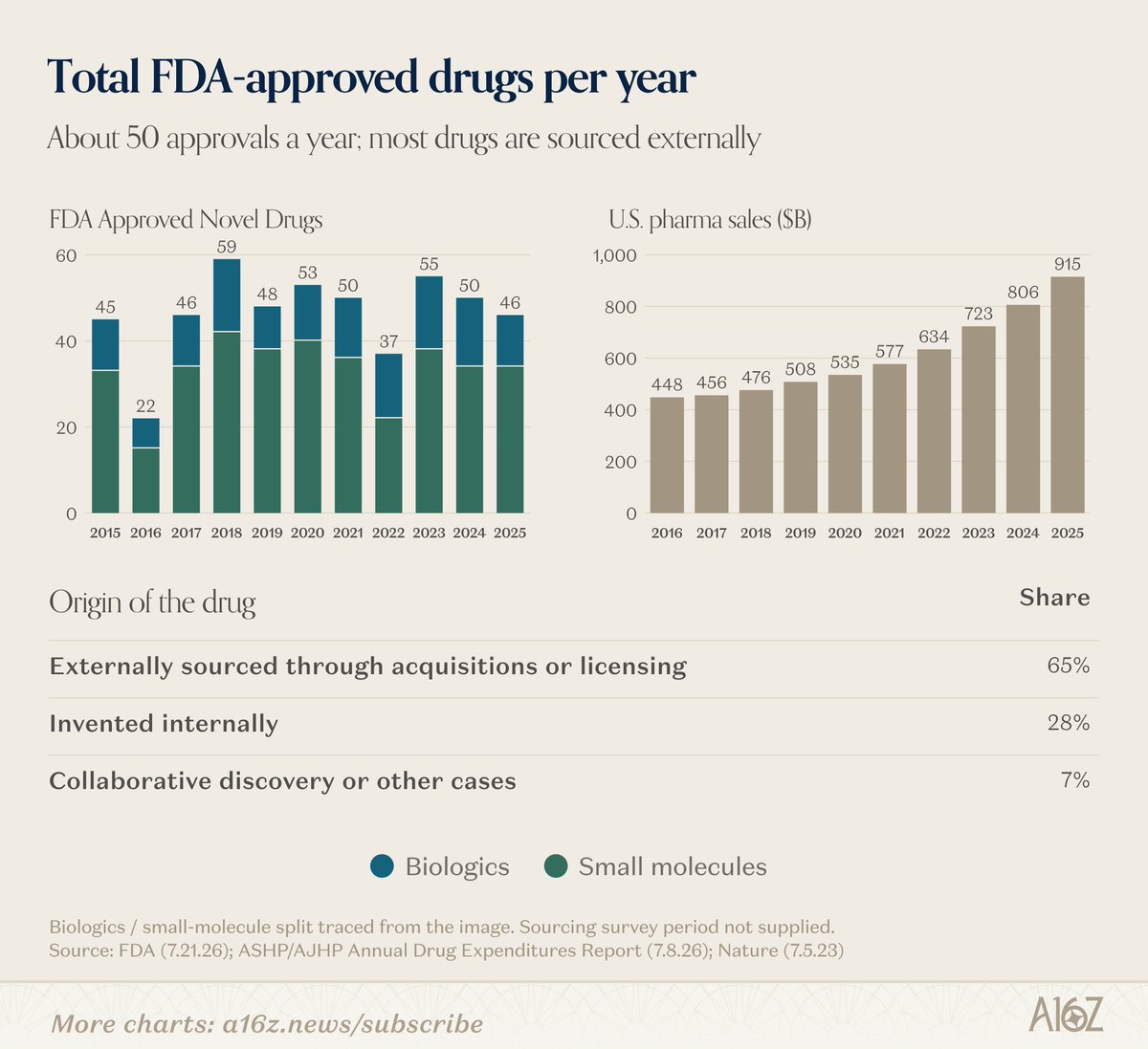
U.S. prescription drug spending has more than doubled over the past decade, but the FDA still approves only about 40-50 novel drugs each year. Much of the innovation from large pharma comes from outside, with ~two-thirds of new drugs sourced via acquisitions or licensing.

Internal drug development has historically been expensive, lengthy, and uncertain, with rising R&D investment often failing to translate into proportional gains in new drug approvals. Every promising molecule identified has to survive years of animal studies, clinical trials, and regulatory review before it can become an approved treatment available to patients, with only a tiny fraction (<5%) moving from drug candidate to FDA approval. Amortizing the cost of failed drugs across stages, the present value (PV) cost of developing a drug is close to $2B and takes 13 years on average, with rising clinical trial costs putting further pressure on R&D productivity.

As the team at Formation Bio has predicted, we are likely heading into an era of drug candidate abundance (opens in new tab). We see opportunities to leverage AI for faster and better processes at each step of the discovery and development process from target identification to market launch. These may include reasoning across existing academic literature to help pick and assess drug targets, leveraging predictive in silico models to prioritize molecules more likely to succeed, designing study protocols for clinical trials, improving patient recruitment, and speeding up document drafting for FDA submissions. While some timelines are heavily regulated by the FDA (e.g., long-term chronic toxicology studies), we expect to see lots of time and cost saving opportunities around many of these steps.
Moving a drug through the pipeline requires extensive real-world validation data. Today, many pharma companies work with Contract Research Organizations (CROs) to generate experimental data to validate and optimize their drug candidates and process high volume clinical trial samples. The global CRO market is $90B today, with $30B spent in discovery & preclinical R&D and $60B in clinical trials. We expect wet lab demand to explode as generating drug candidates becomes faster, and AI labs seek more data on which to train their models. We see an opportunity for a new crop of data providers and robotic lab automation companies to play a big role in meeting this demand.
AI could reduce the present-value cost to develop a drug in two main ways:
- increasing the probability of success
- decreasing the time to approval
Together, these improvements could significantly reduce the risk-adjusted cost of developing a successful medicine. In some cases, this may enable companies to pursue therapeutic targets and indications that might otherwise have been uneconomical. It could also make AI-native therapeutic businesses structurally more profitable, with higher returns on invested R&D capital.

How Pharma Companies Are Valued
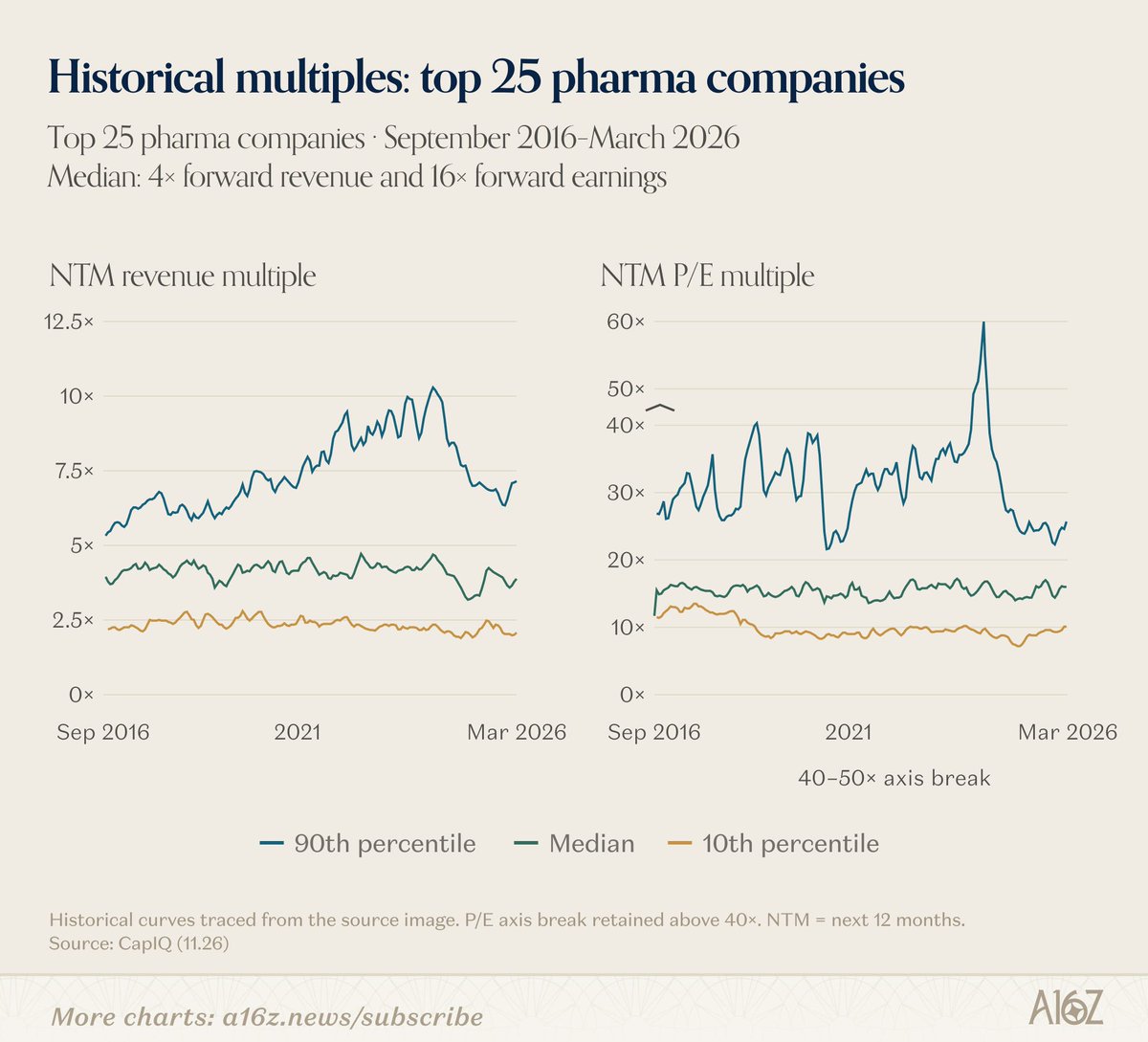
The valuation framework for large pharma companies is typically a discounted cash flow (DCF) on the mature drug portfolio (e.g., valuing the business on its expected future cash flows from forecastable drug sales), specifically approved drugs and those which have passed Phase 2 clinical trials. The simple shorthand for how valuations are done is a P/E multiple on forward earnings (often multiple years forward) with a probability-weighted adjustment for drugs still in clinical trials.
Typically, companies receive a P/E multiple of 8-20x, based on the remaining years of cash flow and exclusivity for each drug in their portfolio. This translates to 3-7x revenue with net income ranging from 20% to 40% of revenue.

Pharma companies typically don’t get much “credit” for their drug discovery engine.
Software businesses monetize their platform directly with a recurring subscription model that often realizes expansion by stacking new products and features on top of existing ones, leading to durable growth and terminal value. In contrast, given the long development times and lack of visibility for analysts, long-dated drugs in development are typically a rounding error on a PV basis. Moreover, pharma companies need to continuously replace the existing revenue base of drugs as they come off patent. For example, Humira revenue at AbbVie dropped from $20B in 2022 to $4B in 2025 after the loss of exclusivity (LOE) on the drug’s core patents. This has historically been a driving force behind large pharma’s acquisitive nature, as replenishing the asset pipeline is critical to minimize revenue volatility.
If drug discovery becomes more repeatable, investors may begin to more directly value the strength of a pharma company’s discovery engine – enabling it to earn more “valuation credit”. We can envision a future state of the industry in which, more akin to the tech sector, investors are willing to bet that a pharma company’s AI infrastructure will help it consistently develop new drugs to replace revenue lost to patent cliffs, and reduce dependence on single drug franchises. In turn, this growing investment by pharma companies in their infrastructure layer could transform their business model quality by enabling faster, more predictable, and more durable growth.
Recognizing the value of technology platforms may also impact how biotechs operate. Historically, biotech startups have developed some of the most bleeding-edge technology platforms of the industry – they have invented new methods for discovery, new drug modalities, and new assays for patient selection. But biotechs have systematically been forced to deprioritize investment in their platform infrastructure in favor of advancing individual drug assets, which is understandably where investors assign all the value.
As technology platforms become more capital efficient with AI, “platform valuation credit” (which could lower the cost of capital for biotech startups), coupled with a more diversified portfolio enabled by a lower cost of discovery, could enable biotech startups to realize broader pipeline ambitions and also encourage more technology investments across the industry. At a16z, we launched a joint venture fund with Eli Lilly (opens in new tab) called The Biotech Ecosystem Fund for expressly this purpose.
3. WHY NOW FOR AI
Eroom’s law (”Moore” spelled backwards) is the observation that drug discovery has gotten slower and more expensive, even as technology and computing power has improved. We believe Eroom’s law has finally found its equal and opposite force: continuous frontier model improvement.
AI has been making inroads into biotech for years, but the newest generation of models is unlocking new capabilities. We’re seeing early progress in scientific reasoning and molecular design, and growing commercial interest from both pharma and frontier AI labs.
There are two main vectors of progress we’re seeing at the model level:
LLMs / reasoning models are accelerating (and often completing) tasks conducted today by scientists, researchers, and other knowledge workers throughout discovery and development. This includes literature review, experimental design, data analysis, regulatory filing, and much more.
Molecule generation is clearly being enabled by a wave of structure prediction models which have rapidly become indispensable across the industry. For biologics and small molecules, the dominant class of leading models here is diffusion-based models that enable both de novo molecule generation and optimization of potential drug candidates.
We think we are close to the GPT-3 level of market maturity in Bio x AI today, and we’re excited about what is to come over the next 5 years. What does GPT-3 level mean? GPT-3 was an inflection point where we saw a single model’s ability to work across many tasks with little task-specific training. We’re starting to see similar capabilities emerging from biological models.
Specifically in the case of molecular generation, we’re seeing progress in two areas:
Generalizability (or Transfer) = learning reusable biological patterns that enable prediction and design across new targets and tasks, with little or no task-specific retraining.
Functional generation = the creation of novel biological designs that can exist and function in the real world. Some of these may challenge human intuition (e.g., novel binding epitopes).
In molecular generation, scaling laws appear to be holding, and companies continue to demonstrate improvements in newer versions of their models as they continue to train on larger and larger experimental datasets.⁸

Beyond model releases, there are signs of commercial momentum for this generation of technologies. Among these, we see large pharma companies investing in a wide variety of partnership structures with startups:
Isomorphic Labs has partnerships with J&J, Novartis, and Eli Lilly, including agreements worth $1.2B with Novartis and $1.7B with Lilly in potential milestone-based payments
Chai Discovery has partnerships with Pfizer, Novartis, BMS, GSK, Roche, and Eli Lilly
Boltz has partnerships with Pfizer, Takeda, GSK, and BMS
BigHat Bio has partnerships with Eli Lilly, J&J, and Merck
Nabla Bio has partnerships with AstraZeneca, BMS, and Takeda
Genesis Molecular AI has partnerships with Gilead and Incyte
Profluent has partnerships with Eli Lilly and BioMarin
These partnerships are early signs of commercial confidence in the technology, and the next test will be if continuing model improvements can translate into better drugs entering the clinic.
We’ve also seen increasing interest from the frontier AI labs in biology and drug discovery, underscoring this as a key area of future focus. What role the labs will play in the long run is still in flux. Their current models can already augment experienced scientists (e.g., GPT-Rosalind (opens in new tab)) helping to interpret literature and experimental data at scale, and expedite myriad back office tasks. But these ambitions seem to be growing. Over the last few months Anthropic opened a wet lab and announced (opens in new tab) the development of their own drug candidates for neglected diseases. OpenAI acquired Orchestra Bio, helping them build a more robust agentic layer for program execution at biotechs.
The low-hanging fruit is to make pharma faster, better, cheaper with AI integrated into existing pathways, as we’ve already seen with productivity tools and reasoning agents being adopted in other knowledge work industries. That alone will do a lot for human progress. At the final frontier, though, given the pace of progress and performance we’re seeing in models for drug discovery, we are betting that we will see true magic: novel drugs that simply wouldn’t have existed before.
4. THE NEW BIO BUSINESSES AI COULD UNLOCK
How can startups capture value in this new bio AI technology wave? Companies can sell the technology that improves drug discovery, or they can use it to develop and commercialize the drugs themselves. The second approach assumes more risk and requires more capital, but of course offers more upside potential. In some cases, startups are pursuing both business models simultaneously.
Selling data and technology to the biopharma industry, and to frontier AI labs
There are (a few) precedents of large businesses being built with this motion. Veeva is one of the largest vertical market software (VMS) outcomes, with a $50B market cap and contracts worth over $100M with their largest accounts. Companies like Boltz and Chai also have horizontal business models, selling into pharma companies today.
Within this approach, we’re seeing several emerging categories of startups:
Data providers & lab automation: High-quality data is a huge bottleneck for this industry. Robotic lab automation and expert data collection and benchmarking help address this problem. Companies like Medra, Tacit, Latch, and BigHat Bio are doing this today.
Predictive models of biology: Building models to simulate how cells and larger systems like organs and even patients will respond to drugs in silico, aiming to reduce the dependency on wet labs and shorten feedback loops to increase probability of success in the clinic. Some are developing “virtual cell” models; others are investing in organoid systems; others are training specialist prediction models on proprietary datasets that are not in the public domain. Companies like Axiom Bio, insitro, Noetik, Radical Numerics, and Inductive Bio are doing this today.
Scientific reasoning agents: Help identify overlooked opportunities by reasoning over academic literature and public or private data sets at scale, aiding the R&D process. These are typically LLMs applied to the scientific domain. Companies like Edison Scientific and Phylo are doing this today.
Molecular design: Diffusion-based models focused on de novo drug design are the most ubiquitously adopted across the industry today. Companies like Chai and Boltz do this today. New models are also being trained for immunogenicity prediction, RNA and oligonucleotide design, protein-protein interaction prediction, and many other modality-specific design tasks.
Model harnesses & enterprise deployment: Given the wide range of use cases for how LLMs and domain-specific models are being deployed by companies across the enterprise, there is a growing need for companies to (a) help teams select which models to use for which tasks, (b) fine-tune models with their own proprietary data, and (c) set up rapid reinforcement learning (RL) environments so that model performance on individual tasks can rapidly improve. Early applications for this have been clinical trial document management and regulatory document submission. Companies like Ephemeral, Valkai, and Collate are working here today.
Building full-stack biotech companies
One of the opportunities we’re most excited about is vertically integrated therapeutics companies that leverage AI to discover and develop their own medicines, allowing full value capture from internally developed assets. Companies taking this strategy include Recursion, Isomorphic, insitro, Xaira, Relay Tx, and Octant Bio.
These companies integrate end-to-end capabilities across the pharma value chain, from generating experimental data and building proprietary AI models, to developing their own medicines. We see tremendous potential in connecting these activities under one roof. Findings in the lab can improve models, better models can guide experimental design and selection of drug candidates, and results from clinical trials can feed back into this process, ultimately deepening our understanding of disease and improving the next iteration of impactful medicines.

5. WHY BIOLOGY IS STILL HARD
AI transforming biology has long been a promise. We’ve made exciting progress over the last decade, but we believe the current pace of technological development is unprecedented. We’re optimistic about the impact we’ll see in the near term, but recognize that biology remains a large and complex problem space. There are some headwinds worth considering (or working to address!):
Data-poor domain: Like other physical AI categories (such as robotics or autonomous vehicles), biology doesn’t have an internet-scale corpus of training data. For example, the largest corpus of existing high-fidelity public training data for proteins is the Protein Data Bank (PDB), a publicly available archive of 300K experimentally determined 3D structures of large biological molecules amassed over the last 50 years. This is tiny relative to the scale of internet data.
Biology is a highly complex system: Designing successful drugs requires a deep understanding of the multilayered biologic systems that a drug is seeking to perturb. The scale of data needed to model biology comprehensively is massive (likely much larger than language, on top of limited existing data mentioned above). Doing so may require meaningful architectural improvements or more localized models. As Daphne Koller, founder of insitro, has argued (opens in new tab), better molecular design won’t necessarily result in more effective drugs if we don’t understand which biological mechanisms to target first.
Non-verifiable domain with long feedback loops: Unlike other fields such as math or coding, drug designs or biological insights generally can’t yet be fully validated on a computer today (“in silico”). Validation of drug designs happens in a wet lab and ultimately in humans, via clinical trials regulated on very long timelines.
We’re seeing startups address each of these challenges head-on, but just how much these approaches can speed up feedback loops in the biopharma industry is still unknown.
It’s hard to think of a more impactful application of AI than developing better medicines faster and at lower cost, and building a better machine to understand and treat every health condition we can think of. It’s time to solve disease – and we’re excited to continue backing teams who are working to make this possible.
Thanks to @CarolineGoggs, @justin_kahl, Michael Cialone, Paxton Paine, and @vintweeta for writing this piece with me.
Footnotes
1. GlobaData analyst consensus sales data
2. AAPL, MSFT, GOOGL, AMZN, SPCX, META, TSLA, Samsung, PLTR, ORCL, PANW, SAP, NFLX, DELL, CRWD, IBM. Excludes semiconductor, equipment, and networking companies headquartered in China
3. CapIQ
4. GlobalData
5. CapIQ
6. Source: GlobalData, 2025.
7. GlobalData. This is for branded drugs only and did not include generics or biosimilars
8. This benchmark reflects a selection of available models and is not exhaustive; notably, public models from Boltz, Chai, and Biohub, as well as private model versions are not included
- Market backdrop: a16z puts the top 30 pharmaceutical companies at roughly $5T in market capitalization and Eli Lilly above $1T; analysts cited in the article expect Lilly’s GLP-1 portfolio to exceed $100B in annual sales by 2030.
- a16z’s AI thesis is that improving drug-candidate success rates and shortening development timelines could lower the risk-adjusted cost of medicines; it cites an average 13-year development process, nearly $2B present-value cost, and fewer than 5% of candidates reaching FDA approval. It expects faster candidate generation to increase demand for experimental data, pointing to data providers and lab automation in a $90B CRO market ($30B discovery/preclinical and $60B clinical trials).
- The startup opportunity spans selling data and technology—including lab automation, predictive biology, scientific-reasoning agents, molecular design, and model-deployment tools—or building higher-risk, more capital-intensive full-stack drug developers with greater potential upside. Examples of full-stack companies named include Recursion, Isomorphic, insitro, Xaira, Relay Tx, and Octant Bio.
- Pharma partnerships offer an early commercial signal: a16z cites Isomorphic Labs agreements with Novartis and Eli Lilly worth up to $1.2B and $1.7B, respectively, in potential milestone payments, but says the key test is whether model gains produce better drugs entering clinical trials. The thesis remains uncertain: biology is data-poor and complex, drug designs still require wet-lab and human validation over long timelines, and how much startups can shorten feedback loops is unknown.
- Drug development averages 13 years and nearly $2B in present-value cost, with fewer than 5% of drug candidates reaching FDA approval; AI could increase success odds and shorten timelines, potentially making otherwise uneconomic targets viable. Biology remains data-poor, and drug designs still require wet-lab and human validation over long feedback loops.
- Startup opportunities span biopharma tools and infrastructure—data and lab automation, predictive biology, scientific reasoning, molecular design, and enterprise deployment—and full-stack companies developing their own medicines; the latter require more capital and risk but offer greater upside. The article puts the CRO market at $90B and expects demand for experimental data and wet-lab services to grow as candidate generation speeds up.
- Pharma partnerships provide early commercial signals: Isomorphic Labs has agreements with potential milestone payments of $1.2B with Novartis and $1.7B with Eli Lilly, while Chai, Boltz, BigHat Bio, Nabla Bio, Genesis Molecular AI, and Profluent also have pharma partnerships. The article says the key test is whether model progress produces better drugs entering clinical trials; Anthropic has opened a wet lab and announced drug candidates, while OpenAI acquired Orchestra Bio to build biotech execution capabilities.
- a16z frames pharma as a hits-driven market: the top quarter of drugs generate about 85% of revenue, while successful drugs can deliver years of patent-protected cash flow. It argues AI could raise drug-development success rates and reduce time and cost; the article puts current development at nearly $2B in present-value cost and 13 years on average, with fewer than 5% of candidates reaching FDA approval.
- Startups can sell data and technology—such as lab automation, predictive biology models, scientific reasoning, molecular design, and enterprise deployment—or build vertically integrated AI therapeutics companies. The latter approach requires more capital and carries more risk but offers greater upside through ownership of drug assets.
- Pharma partnerships offer an early commercial signal: Isomorphic Labs has agreements with Novartis and Eli Lilly involving $1.2B and $1.7B in potential milestone payments, respectively; a16z says the key test is whether model advances produce better drugs entering clinical development. Translation remains uncertain because biology is data-poor and drug designs ultimately require wet-lab and human validation on long timelines.