We can't find the internet
Attempting to reconnect
Something went wrong!
Hang in there while we get back on track


Roles are expanding, and it depends on the phase
Atlassian CPO Tamar Yehoshua says the PM's job hasn't changed: find product-market fit and build a business people will pay for. What has changed is how the work gets done . Atlassian ran experiments on whether PMs should "row" (write code) or "steer." Her answer is that it depends on the type of product and its phase . She gave three examples:
- New feature in an existing codebase (Confluence): A PM who had never coded used a harness built by an engineer and checked in 26 PRs in a month, mostly UX fixes . The team used Figma MCP and a coding agent to fix about 14 design bugs an hour. Test creation dropped from half a day to 10 minutes . Yehoshua says work that took about 6 months before AI now took 6 weeks .
- New product (Rovoclaw): A PM and a designer vibe-coded a working alpha. Once engineers joined, the PM stopped coding and went back to setting direction and unblocking. The early coding had helped him understand the team's blockers .
- Large legacy codebase (Jira): PMs did not check in production code . Loom recordings became work items that started a cloud coding agent. That produced prototypes in the real front-end repo that already met compliance and design standards . An agent triaged more than 900 pieces of customer feedback . The team shipped 22 user-facing features in about 10 weeks, at about 3x normal throughput .
Atlassian's AI Fluency Index covers six capabilities on a 1–5 scale. It's used for development, not promotion, and the goal is for PMs to reach level 3 in every capability over time . Yehoshua admits they haven't figured out how to measure outcomes. For now they track PRs deployed rather than PRs written, features delivered and used, and throughput for teams and the whole organization .
High-impact ICs need a different org design
Elena Verna of Lovable defines a high-impact IC as someone who finds a problem, decides, executes across functions, ships, and owns the result . Her rule: "When the cost of building falls below the cost of coordinating, the org chart should change" . She lists what an organization needs for this to work:
- Open access to information and fewer management layers
- Authority that comes with accountability, and room to fail. She says her failed experiments have cost Lovable many millions of dollars
- Pay and status that don't depend on headcount
She warns against expecting people to be a manager and an IC at the same time .
Decision-making is now the core PM skill
Robby Stein, head of Google Search, argues that when almost anything can be built, a PM's value comes from judgment and taste, and above all from making decisions . His examples of finding the root cause:
- Instagram Stories: When the team asked why people weren't posting, audience worries came out on top. A survey of thousands confirmed it, and Close Friends only worked once it lived inside Stories .
- Reels in Brazil: The first version disappeared after a day and failed, because creators wanted their posts to last .
Outcomes, not prototype volume
Marty Cagan says that about two years ago, product teams typically had five to eight engineers. Some advanced teams now have one to three, and he considers the growth in what each team owns the bigger change . Now that anyone can prototype, his test is outcomes, not activity. Good teams throw away about 80–90% of their prototypes . To win leadership over to the product model, he recommends a low-cost pilot team that works on a meaningful problem for one quarter .
Also worth noting
- Share what makes AI work good. Hiten Shah says one person knows how to get strong research out of Claude and another knows the context that makes ChatGPT useful for sales, but "very little of what made them good becomes shared" . He adds that the corrections you make to AI output show how the work should be done next time .
- Label how much you checked AI work. At Zapier, people say at the top how much effort went in, for example "done a quick skim." Accountability is now one of four dimensions on Zapier's rubric .
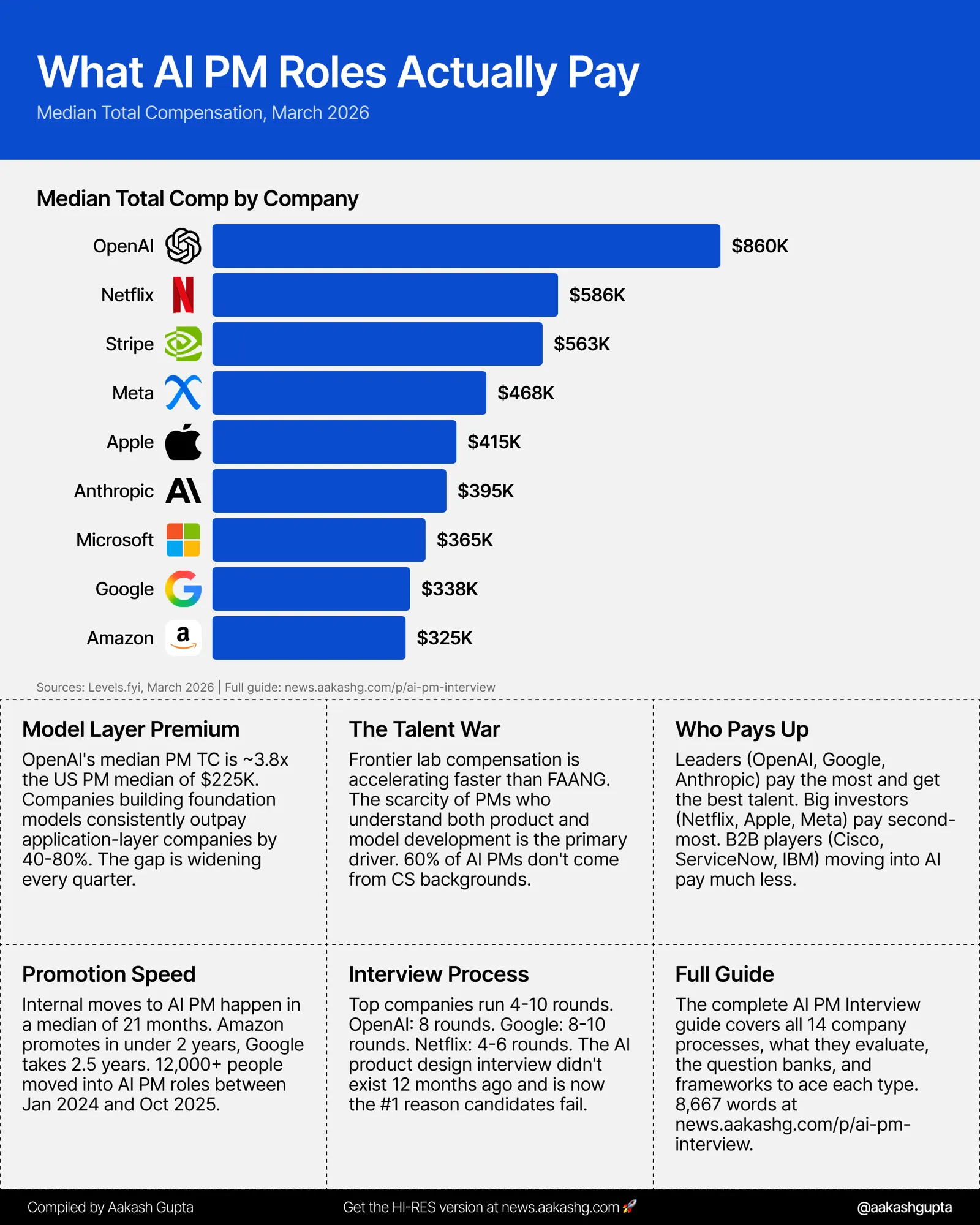
- AI PM pay. Aakash Gupta cites Levels.fyi data showing median total pay for AI PMs from $325K at Amazon to $860K at OpenAI . His advice when comparing offers: ask which layer of the stack the team works on .
- Consumer agents. Scott Belsky suggests that "human in the loop" could become the key differentiator for consumer agents . He was responding to the launch of Fo, which uses humans for tasks AI can't do and claims a 94% trust rate. Those figures are the company's own .

Lenny & Friends Summit posted three additional talks: Stripe Head of Design Katie Dill on scaling intent, quality, and artistry , Ramp CPO Geoff Charles on designing an AI software factory for speed , and Marty Cagan on “Strong opinions, loosely held” . A further batch features Lovable Head of Growth Elena Verna, Google VP and Head of Search @rmstein, and Atlassian CPO and Chief AI Officer @TYehoshua; the talks are listed on Lenny’s video page.

- A PM’s core job remains finding product-market fit, building products customers love, and building a business customers will pay for; AI changes how the work gets done, not the goal. Choose whether to work hands-on (“row”) or steer based on the product and its phase, and validate AI’s value with customers rather than relying on hype. Atlassian also identifies pairing model intelligence with organizational context as an acceleration lever.
- On Confluence features, a PM with no prior coding experience partnered with an engineer to set up a front-end harness and contributed 26 PRs in a month to address UX fixes. The team used Figma-to-code automation to fix about 14 design bugs per hour and cut test creation from half a day to 10 minutes; Remix shipped in six weeks and Confluence Slides in eight, with the speaker saying comparable work had previously taken about six months.
- Match PM involvement to the project’s phase and risk: a PM and designer coded a zero-to-one alpha, then the PM stepped back from coding to set direction, prioritize, and unblock engineers; the initial coding helped the PM understand blockers. By contrast, for Jira’s 20-plus-year-old, complex product, PMs did not check code into production and instead focused on steering and unblocking.
- Jira’s team streamlined prototyping by turning Loom recordings into work items that triggered a managed cloud coding agent, producing prototypes in the actual front-end repository that were compliant, accessible, and in Atlassian’s design language. Agents also triaged internal Slack feedback and more than 900 pieces of customer feedback; the team reported roughly 3× throughput and shipped 22 user-facing features in about 10 weeks.
- Atlassian’s AI Fluency Index covers six capabilities, uses levels 1–5, and aims for PMs to reach level 3 across capabilities over time—not level 5 in everything; quarterly AI Builder Weeks have involved more than 1,000 people and produced over 120 workflows. The speaker says AI outcome measurement remains unresolved; Atlassian tracks deployed rather than merely written PRs, features delivered to customers and their usage, OKRs, and throughput at both team and organization levels.
Lenny’s roundup lists 25 early-career PM roles as hiring now.
- Full-time, new-grad, and graduate-track openings include Databricks APM (2027; $133–150K), Roblox APM ($143K), Robinhood APM ($130K), Google APM (2027), Stripe New Grad Accelerator PM, Solace Health APM (2027), Meta Rotational PM, and Adobe’s 2027 MBA PM role.
- Other listed openings include Uncountable PM ($125–140K), IBM entry-level PM (Austin; 2027), EliseAI APM–Housing ($150–220K), Fireworks AI APM ($160–180K), AppLovin APM ($111–167K), and IXL APM ($95–120K). Red Ventures has a 2027 early-career APM–AI role in NYC; additional APM openings are listed at First Resonance ($120–150K), FourKites ($90–120K), Saronic, Fanatics Baseball ($72–84K), and Hive Models ($90–120K).
- Internship listings: Google APM (Summer 2027), Coinbase APM, Duolingo APM, Atlassian product management (Summer 2027, U.S.), and Datadog PM ($100–110K). Browse the roundup at Lenny’s Jobs.

- Product organizations measure success through outcomes, while project-oriented organizations tend to track output volume such as code shipped and bugs fixed. Outcome-based roadmaps define a problem and an outcome rather than prescribing features; communicate delivery dates when discovery gives the team evidence and confidence, since unsupported roadmap promises erode trust.
- AI is enabling some product teams to work with one to three engineers instead of the previous five to eight, while owning broader scope and facing fewer dependencies. More people can now prototype to learn, but prototype volume is activity, not an outcome; look for progress toward outcomes and expect strong teams to discard many prototypes—Cagan estimates 80–90%.
- To build leadership support for the product model, run a low-cost, low-risk, typically one-quarter pilot on a meaningful business problem and staff it with strong people; avoid combining the pilot with a company-wide restructuring. Results from the pilot are what earn trust for expanding the approach.
- As building becomes more commoditized, Cagan identifies strategy and product discovery as differentiators; product work depends on judgment, including a designer’s lens on experience and a PM’s lens on business viability, not just delivery coordination. He recommends hiring for product craft and problem-solving potential across functions, including designers and tech leads, while recognizing that domain expertise can also bring domain dogma.
- As AI agents make it possible to build with far fewer people than before, PM value shifts from coordinating execution toward judgment, taste, and making strong decisions.
- Find the underlying user job by reconstructing the real-life context of a decision, rather than jumping to feature ideas: detailed questions about a bed purchase revealed that the decisive need was not being woken by a partner's movement—not conventional ideas such as cooling, eco-friendliness, or price. For product fit, repeatedly identify and rank problems, ask why users aren't doing the target behavior, validate qualitative themes quantitatively, and iterate: Instagram Stories research surfaced audience-related inhibition, and Close Friends worked only as a Stories-native experience after other variants confused users; Instagram Reels' ephemeral Brazil launch failed because creators wanted their dances to persist and go viral, so the team made Reels a lasting format. Google also used models to rank opted-in user feedback, exposing recurring gaps such as shopping answers missing a child's height and weight; adding collaborative follow-up was among the product's biggest gains in engagement, usage, and helpfulness.
- Product craft means both removing user pain and creating a positive feeling. Agents can exercise product flows, capture and evaluate them against a rubric, and surface broken or off-spec behavior; intentional details such as a color-cycling cursor, animated response, and haptics can add delight.

- Verna defines a high-impact individual contributor (IC) as someone who finds a problem, makes a decision, executes across functions, ships, and owns iteration and outcomes—not simply a senior employee without reports. She argues AI makes this broader execution model more feasible and shifts impact from headcount toward what people ship; shorter idea-to-build-to-learn cycles become possible when building costs less than coordination.
- For this model to work, organizations need to make information accessible, give ICs decision authority alongside accountability and room to learn from failures, and allow scope to cross functional boundaries rather than adding approval layers.
- Career systems should decouple pay and status from managing people: Verna argues ICs should be eligible for leadership-level compensation and cautions against expecting people to do both a manager and IC job, given the difficulty of switching between them.
Lenny praised Supertake, a new platform that uses frontier AI and trading agents to turn users’ personal takes into shareable investment portfolios, aiming to let people invest in their ideas without prior investing knowledge.

Product teams should optimize for solving customer problems, not innovation for its own sake: consider novel solutions, but do not assume they are best, since unfamiliar flows can impose learning and cognitive costs even if they may later reduce friction.
Cross-functional collaboration can surface novel, simpler solutions by combining observed user struggles with engineering possibilities; some innovation is technically novel while leaving the user experience familiar. Novelty can differentiate a product when it serves customers.
- Elena Verna argues that AI is separating impact from headcount: a high-impact IC can identify a problem, decide, execute across functions, ship, and own outcomes and iteration. AI-assisted idea→build→learn cycles can reduce the need for lengthy coordination.
- At Lovable, Verna’s IC role includes pricing and packaging, building and deploying changes and prototypes, user research, analysis, and optimization; she works with engineers on deeper model changes.
- For this model to work, she says organizations need broad access to information, authority matched with accountability and room to learn from failures, cross-functional scope, and fewer costly approval chains. Pay and status should not depend on managing people; ICs should have leadership-level compensation and outcomes, with IC and management treated as distinct career paths rather than routinely combined roles.

When an enterprise SaaS prospect or customer makes a feature a condition of signing, renewal, or expansion, one commenter recommends weighing the opportunity’s size, how bespoke the request is, and its fit with the product, while involving the usual stakeholders. Another commenter advises adding the feature for a high-value contract and using demos while delaying delivery if it is infeasible, but says this approach is questionable when a connector or implementation is foundational to closing the deal.
- AI delegation does not transfer accountability: people still own oversight and the final product, so the cognitive load remains. Keep judgment, taste, vision, and defining quality with humans; without knowing what good looks like, effective delegation is not possible.
- Treat AI-agent use as a management responsibility: provide context, correct work, coach, and iterate. Account for the added oversight burden on individual contributors; Graham questions how it scales when agents are added on top of a recommended 10–12 human reports.
- In periods of rapid change, leaders should address employees’ grief rather than dismiss it: Graham argues that naming the strain helps people feel less alone, while clinging to old responsibilities can hinder adaptation.

- Levels.fyi median total compensation figures for AI PMs in March 2026 ranged from $325K at Amazon to $860K at OpenAI; reported medians were $586K at Netflix, $563K at Stripe, $468K at Meta, $415K at Apple, $395K at Anthropic, $365K at Microsoft and $338K at Google. OpenAI’s median was about 3.8× the cited US PM median of $225K.
- The author attributes the pay premium to foundation-model builders outpaying companies building on top of them, and says scarce AI PMs combine product and model-building knowledge; the post says 60% of AI PMs lack CS backgrounds and calls that knowledge learnable. Its advice for comparing offers: look at which layer of the stack the team works on, not just the job title.
- In compensation discussions, ask the recruiter for the role’s range before naming an expectation, and ask about total compensation rather than salary alone; the package may include base, stock, bonus and sign-on. If pressed for a number, the post suggests referring to the high end of the band, emphasizing the whole package, or waiting to assess interview fit.
- For AI-assisted team deliverables, disclose how much of the work was reviewed—for example, a quick skim versus standing behind every statement. Zapier’s rubric added accountability alongside mindset, strategy and building; the principle is that AI can take on work, but not accountability.

- When a team reorganization risks narrowing a hybrid PM/design role, make career goals explicit and propose concrete PM ownership; in this thread, the poster showed the roadmap and overall metrics and reached agreement to retain a PM role with responsibility for two product areas.
- To demonstrate product judgment, combine user research with behavioral metrics to identify the main problem, explain its business impact, prototype several possible fixes, and define how to evaluate them before choosing one. A commenter illustrates this with retention and acquisition costs, explicitly as an imaginary scenario rather than reported product data.
- One PM reports sketching in Figma, then designing and prototyping in Claude Code locally; after an initially slower start, they say the workflow made them at least 3× faster and reduced writing a development task to 1–2 prompts.

In AI-assisted product work, treat corrections as reusable expertise rather than just fixing the current output: note why it is wrong, what important point it missed, or why it would not be sent, then use that guidance to improve future work .

- TypeSafe’s approach is framed as more than faster code generation: a new software primitive lets developers express intent in natural language alongside a state machine, with the system choosing actions at confidence levels—potentially enabling software capabilities beyond conventional code.
- Evaluate AI automation by whether it reliably completes useful, productive work—not by demos or benchmark performance—and design it to run in the background, compose with other systems, and avoid paging users. The founder describes reliability as more than uptime or exact determinism: systems should show robust, consistently useful intelligence; practical automation should also clear an ROI bar rather than target every edge case.
- For SaaS product teams, the founder argues AI can make existing products substantially more useful when it adds real capability rather than just a chatbot; SaaS firms’ knowledge of user workflows and established customer reach may help them deliver that value.
- A delivery caveat: the founder characterizes coding agents as strong at syntax but weak at semantics and especially architecture, so teams may trade architectural quality for speed.
A candidate for a technical product manager role at a roughly 30-person YC-backed AI startup says their take-home was rejected because it led with data analysis instead of the company’s computer-vision and 3D-reconstruction capabilities; the candidate says the same role was reposted a month later and described by the hiring manager as “genuinely undefined.” One commenter suggests sending an updated case based on the feedback to demonstrate the candidate can do the task.
Companies are developing an “invisible AI layer”: employees separately learn effective workflows for research, writing, and sales, but the methods and context behind their outputs are rarely shared across the organization.
A promising opportunity for internal AI products is to make employees’ successful workflows reusable: the person who developed one knows which information matters, how to approach the task, and when an answer is wrong.
For AI product design, the author argues that trust, provenance, explainability, and human control belong in the system architecture—not as disclaimers added later. In one product, they replaced a single opaque confidence score with separately auditable dimensions for data quality, analysis reliability, and evidence alignment. They also report that restructuring memory and persistent hybrid retrieval reduced context assembly time by 98.22% and request lifetime by 99.29% in targeted validation; these are self-reported results, not independently validated benchmarks.
A PM asked whether teams still conduct customer discovery, warning that cheaper building may lead teams to neglect it and soliciting current practices and pain points. This is a concern framed as a question, not evidence of a fieldwide decline.