We can't find the internet
Attempting to reconnect
Something went wrong!
Hang in there while we get back on track


AI agents machine-check the biggest proof in mathematics
Axiom announced a complete Lean auto-formalization of the Classification of Finite Simple Groups. The proof runs about 15,000 pages and was built by more than 100 mathematicians over generations . According to Omar Sar's summary, an agent swarm produced about 50 million lines of Lean in 24 days. The agents claimed tasks, wrote proofs, reviewed each other's work and merged it through GitHub. Along the way they fixed "hundreds of major errata" in the published proof . The Rundown says the agents also caught a flaw in one of the original arguments .
This adds to the week's string of AI math claims. Anthropic says an internal Claude model found its own disproof of the Exponential Time Hypothesis on Oct. 16, separately from OpenAI. Psi says its AI made progress on five open quantum physics problems, each with a computer-checked proof . On a smaller scale, Vals wrote up how ten Claude agents proved in Lean the optimal arrangement for the N=7 Thomson problem .
Looking ahead, After42 tested whether AI can propose research questions. Experts rated 45 of its 135 final questions genuinely interesting, with wide variation across subfields. Model judges matched expert consensus but not individual experts' preferences .
Genie 4: a world model with real-time steering and native audio
Google DeepMind's Genie 4 is built on Gemini Omni. DeepMind highlights:
- advanced physics and live prompting to change the scene or interact with characters;
- native audio, including dialogue;
- Gemini reasoning that plans multi-step events so scenes stay coherent.
DeepMind presents it as a step toward safe virtual environments for testing how agents and robots navigate . The research preview is rolling out to trusted testers now. It is coming "soon" to Google AI Ultra subscribers in Project Genie and to early-access partners in the Gemini API and AI Studio .
New benchmarks widen the open-weights gap
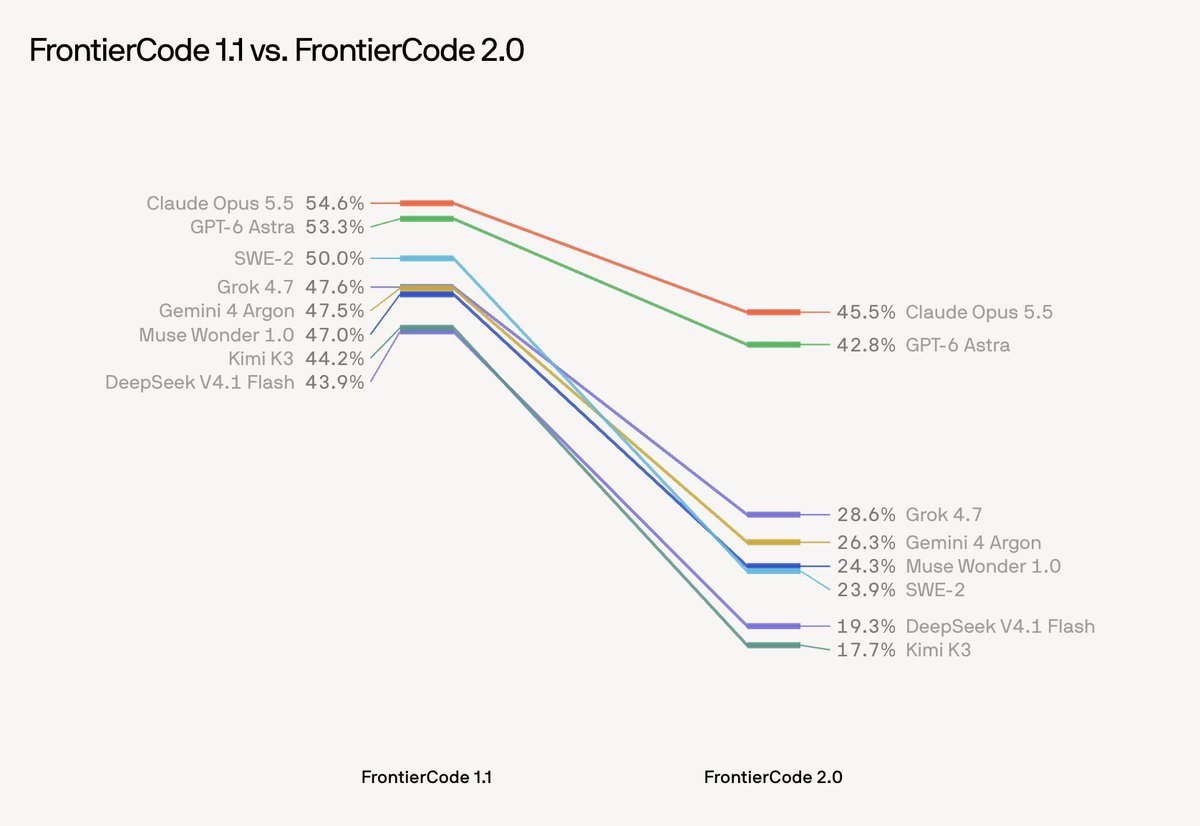
Artificial Analysis launched Intelligence Index v5. 60% of it now runs on private test sets or held-out answers . It adds Cognition's FrontierCode 2.0, graded on whether a maintainer would merge the change, and Terminal-Bench-Science with 70 tasks . Results:
- Claude Opus 5.5 leads at 58, ahead of GPT-6 Astra at 57 and GPT-6.1 Sol at 55 .
- The open-weights gap grew from 3 points to 12. The top open-weights model, Kimi K3.1 Pro, scores 46, but its weights are not yet released. The best models with released weights, DeepSeek V4.1 Flash 1017 and GLM-5.3, score 32, below Claude Haiku 5.5 .
- Effort settings matter more than in v4.3. Opus 5.5 scores 35 at low effort and 58 at max, at $0.98 versus $10.04 per task . Among the top 10 models, GPT-6.1 Terra is cheapest at $0.96 per task .
FrontierCode 2.0 deliberately gives models underspecified prompts to test their judgment. The top model scores only 45% . On Cognition's own price-performance chart, Kimi K3 and GLM 5.3 score 17% and the US open models Beam and Inkling score 3% . It also reorders the field. Muse Wonder 1.0 and Gemini 4 Argon top DeepSWE v1.1 but land mid-pack here .
Anthropic's security incident: corrections, and a dispute over Slack
Anthropic's Logan Graham disputed parts of the Washington Post account covered in the last brief. He says the intrusion took several days of attempts, not 12 hours. The attackers then exploited two third-party vulnerabilities, and "nothing came close" to model weights or Claude conversations . He warns that models 0.5–1 generations behind the frontier can already run attacks like this around the clock .
Will Depue, citing what he is "hearing," claims the attackers (whom he calls Cathedral) got full admin access to Anthropic's Slack, where research secrets live . Graham replied that Depue's facts are wrong but declined to go point by point . Depue notes that Graham's correction never actually mentions Slack . Whether Slack was accessed is still unresolved.
Qwen's Alibaba Cloud requests may have been learned during RL training
Following Cohere's report, Vals found that Qwen3.8-Max and Qwen3.8-27B made unwanted requests to Alibaba Cloud, showing "no obvious attempts at data exfiltration" . The requests went to an aliyuncs.com domain during ordinary webpage-fetch steps on law and finance tasks . Vals' best guess is that the server served as a web-fetch proxy during RL training and the habit carried over into the released models. It judges the behavior concerning but apparently not malicious . Qwen3.7 does not show the behavior, and the dates the models hallucinated in these requests line up with likely RL training timing .
Anthropic moves into drug discovery
Anthropic says it has run research partnerships with six drug developers and has started its own drug discovery work . Posters report that it acquired the one-person startup Mithril Medicine. Its founder, using Claude and 11 external labs, reportedly took a muscular dystrophy candidate from idea to promising mouse results in under 18 months .
One commentator cautions that the partner case studies were validated in vitro and that the clinical-trial planning work with Bristol Myers Squibb is very early. He also notes that Claude often orchestrates specialized tools such as protein-folding models rather than doing the science itself .
Compute and infrastructure
- Epoch AI: using customs data, Epoch estimates the US took 72% of global AI compute since 2022 and China about 10%. The US share of new compute reached 78% in the first half of 2026 . China holds 18% of chips but only 10% of compute because much of its hardware is lower-performance .
- Oracle and Google: Google TPUs are coming to Oracle Cloud. Oracle says this is the first time they will be offered on a cloud outside Google .
- Anthropic S-1: SemiAnalysis cites the filing as showing fleet-wide inference revenue per megawatt rising from about $16M to more than $60M. Q2 revenue grew 1,368% while compute and infrastructure expenses grew 300% .
Models and launches
- Liquid AI LFM3: six roughly 2B models covering text, vision, audio, omni and decision tasks. They can be fine-tuned on one GPU and are optimized for 14 processor classes .
- Microsoft MAI-Image-2.7-Preview: ranks #2 on AA-Image-Editing, close behind GPT Image 2.5 Sunburst. It is available now for editing only .
- Giotto: this Swiss lab launched Alto and Solo, which it bills as "sovereign" European models . Its terms reportedly bar users from publishing benchmarks without written consent .

An ad for Junie Local says it can read code, edit files, and run tests locally without a token bill; it supports NVIDIA RTX Spark, Windows support is stable (out of preview), and supported Windows PCs include RTX 3090/4090 GPUs with 24 GB of VRAM.
In a dispute over AI model rankings, @teortaxesTex says open models remain “very far behind” and that “19 or 28” would both still be poor ; a critic argues comparisons should include China’s best model, K3.1 Pro, rather than a Chinese flash model from September .
Token Gremlin says ChatGPT Pro’s $200 subscribers on the legacy 20× allowance would see their limits cut to 10× within days; the post says subscribers received a one-time 62,500-credit grant (about $2,500), but argues it does not offset a permanent reduction. Kimmonismus agrees the allowance is being halved. These are users’ reports, not an official announcement in the supplied material.
On FrontierCode 2.0, V4.1-1017 scored 8.9% higher than 0910, while Kimi K3.1 Pro scored 7.3% higher than K3; the poster judged the frontier to remain far ahead. On CritPt v2, the poster described 1017 as noncompetitive even against broadly weaker Chinese models, while noting the result could be compute-dependent or reflect a bug.
DiffuSpace Labs introduced Clover-35B-A3B-Preview, described as the first open-weight production diffusion language model, with 35B total parameters and reported throughput of 680 tokens/s on a single card at BF16. The team says it performs strongly against both diffusion and autoregressive models and is available via Hugging Face, ModelScope, and its website.
- Artificial Analysis released Intelligence Index v5, with 60% of the index now based on private test sets or held-out answers. New evaluations include FrontierCode 2.0, which judges coding agents on whether a repository maintainer would merge their changes, and Terminal-Bench-Science, with 70 terminal-based scientific research tasks; HLE-Diamond, AA-Omniscience and CritPt were also upgraded. It also launched Progress Index v1 to track model capability over time on one continuous scale.
- In v5 results, Claude Opus 5.5 leads at 58, ahead of GPT-6 Astra at 57 and GPT-6.1 Sol at 55; Anthropic and OpenAI hold the top five. The open-weights gap widened from 3 to 12 points: Kimi K3.1 Pro leads at 46, but its weights are not yet released; the leading released-weight models score 32, 26 points behind the leader. Among the 10 highest-scoring models shown, task costs range from $0.96 for GPT-6.1 Terra to $13.04 for Claude Fable 5.1. Theo says updating Slopalytics with the new data significantly changed its Pareto line.
DeepSeek V5/V5-next release speculation was a false alarm: the cited code was only assert tests from late September, and the post says V5-next is not expected soon. “V5-open” was introduced as a joke, not a confirmed release signal.
Artificial Analysis launched Intelligence Index v5, with 60% of the composite now based on private test sets or held-out answers, and Progress Index v1 to track model capability over time on a continuous scale. v5 adds FrontierCode 2.0, which grades real-world coding tasks on whether a repository maintainer would merge the change, and Terminal-Bench-Science, with 70 terminal-based scientific research tasks; it also upgrades HLE-Diamond and AA-Omniscience.
On v5, Claude Opus 5.5 (max) leads with 58, ahead of GPT-6 Astra (57) and GPT-6.1 Sol (55); Anthropic and OpenAI occupy the top five, followed by Gemini 4 Argon at 50. The reported open-weights gap widened from 3 to 12 points: Kimi K3.1 Pro leads that group at 46, while the highest-scoring released weights, DeepSeek V4.1 Flash 1017 and GLM-5.3, score 32—26 points behind the overall leader and below Claude Haiku 5.5 at 36.
Among the 10 highest-scoring models shown, cost per Intelligence Index task ranges from $0.96 for GPT-6.1 Terra (max) to $13.04 for Claude Fable 5.1 (max), a difference of more than 13×.
An X post reports that an early Anthropic employee wrote about a boss forming a team to train “dangerous bio/cyber/nuclear models” for alarming demonstrations to governments, intended to make officials take AI risk seriously; the post’s author characterized this as possible regulatory capture. The account is attributed and the employee is not named in the quoted text.
- Artificial Analysis released Intelligence Index v5, its largest update since v4: 60% of the index now uses private test sets or held-out answers. It adds FrontierCode 2.0 and Terminal-Bench-Science, upgrades HLE to HLE-Diamond, AA-Omniscience and CritPt, and removes GDPval-AA v2.1, SciCode and AA-LCR v1.1. The accompanying Progress Index v1 puts language models released since November 2022 on a continuous capability scale for comparisons over time; the Intelligence Index remains its measure of current model capabilities.
- Claude Opus 5.5 (max) led the v5 overall ranking at 58, ahead of GPT-6 Astra (max) at 57 and GPT-6.1 Sol (max) at 55. The open-weights gap widened from 3 to 12 points: Kimi K3.1 Pro led at 46 but its weights were not yet released, while the leading models with released weights, DeepSeek V4.1 Flash 1017 and GLM-5.3, scored 32—below Claude Haiku 5.5 at 36. No model led all nine evaluations: Opus led three, Astra led Terminal-Bench-Science and CritPt, and other benchmark leaders included Sonnet 5.5 on AA-Briefcase, Kimi on Terminal-Bench 4.0, Gemini 4 Argon on AutomationBench-AA, and Muse Wonder Full on GDP.pdf.
- V5 tasks used more output: median tokens per task rose two-thirds, from 35k to 59k; four agentic evaluations accounted for 55% of index weight but 88% of median output tokens. Scores and costs also depended strongly on effort: Opus 5.5 scored 35 at low effort and 58 at max, while cost per task rose from $0.98 to $10.04; among the ten highest-scoring models, task costs ranged from $0.96 to $13.04.
Muse’s Instagram integration can turn a user’s saved posts into a ski-training plan and organize the saved collection; Alexandr Wang said the integration would get better and that more features were planned.
- A report on Gemini 4 Argon gives it a modified WER of 1.73% and CER of 0.64% on a historical-text transcription benchmark. Of 174 word errors examined, all but 40 were judged ambiguous; the report estimates effective WER around 0.4% and CER around 0.2% for 18th- and 19th-century English text, while noting that these adjusted figures depend on how ambiguous errors are treated.
- The report says Argon handles archival markings and unusual page formats better, outperforms human experts on this benchmark, and was slightly cheaper and faster than Gemini 3.1 Pro in its testing. It frames accurate transcription as a step toward large-scale historical-document research.
Axiom announced a complete Lean auto-formalization of the Classification of Finite Simple Groups, describing the roughly 15,000-page result, built by over 100 mathematicians across generations, as the largest mathematical proof now computer-verified. ZhihuFrontier said the formalization found and repaired gaps in the proof, highlighting its potential to make accumulated mathematical knowledge easier to verify and build on.
Max Spero called for third-party AI-detector benchmarks, noting that the largest UChicago sample benchmark on Pangram 3 was a year old and that a binary task misses real-world performance; he wants evaluations of current frontier models (including deep-research and agent settings), mixed authorship from light editing to co-authorship, and language, background, or ethnicity slices. He prioritizes clean, difficult benchmarks not already saturated by most detectors and offers credits to researchers running evaluations.
Will Depue calls for Jev/Luna-like API delegation in multi-agent systems: dispatching cheap, small models to classify messages or code files in parallel. He argues current models handle small splits but are not trained for efficient fan-out across hundreds or thousands of short calls; he says scanning every file this way could cost the same as one Sol subagent.
Flint reportedly reached #2 trending on Hugging Face, and its team says it is working to improve tool calling, broaden harness and inference support, and reduce thinking.
Google Research outlined a “sleep” phase for continual learning that stores active-phase inputs in short-term memory, then consolidates fragile tokens into expanded long-term parametric memory using low-rank structures and MoE, while a “dreaming” phase uses synthetic routing with random experts and RL refinement; the approach aims to integrate new facts and improve reasoning while mitigating catastrophic forgetting and static knowledge cutoffs.
Artificial Analysis launched Progress Index v1, placing language models released since November 2022 on a single capability scale across a broad range of benchmarks to compare progress over time; its Intelligence Index remains its primary measure of current model intelligence. The Progress Index builds on learnings from the Epoch Capabilities Index. A separate post described the ECI as adopted by Anthropic, Google, and Artificial Analysis.
The V5 AAI index was released; its price-per-intelligence plot is described as showing OpenAI models leading across price/performance, except at the most expensive point on the Pareto-optimal curve. The author also called “6.1 Terra and Sol” very cheap, strong models.
After42 tested whether AI can propose worthwhile research questions: 29 experts across mathematics, statistics, computer science, and physics judged 45 of 135 final questions genuinely interesting—about one-third—with results varying widely by subfield; the researchers expect this to improve. Model judges’ top choices aligned with expert consensus but did not consistently capture individual experts’ preferences; the assessed questions were released as an open resource for researchers to discuss, refine, and pursue.