We can't find the internet
Attempting to reconnect
Something went wrong!
Hang in there while we get back on track


Going faster in the wrong direction
Marty Cagan says AI has mostly sped up the "project model." In that model, stakeholders put features on a roadmap and feature teams ship output. Now those teams are "going faster than ever but not seeing improved results" . He thinks even "the most stubborn CEOs" now see that the real problem was always figuring out what to build, and slow development hid it . In the product model, leaders assign problems with outcomes attached. Empowered teams then find solutions that are valuable, usable, feasible and viable. There, AI helps with discovery as well as building . He says efforts usually fail on value and viability, not usability or feasibility. A solution has to beat competitors, and it has to work for legal, compliance and sales, not just one stakeholder .
On the "SaaS apocalypse," Cagan points out that serious SaaS products hold thousands of business rules that often live only in the code. In three years, he hasn't seen anyone replace an ERP system by building their own . Instead, vendors are turning their internal platforms into external ones that agents can use. He thinks that makes them more valuable, not less .
Model PM jobs are hiding under other titles
Aakash Gupta read 46 open model PM postings. Few are called "model PM." The titles include PM, Research; PM, Core Models; Post Training; and Safeguards . He says the work underneath is six tasks: pick what the model gets better at, turn "better" into an eval, read transcripts of failed runs, specify how the model should behave, make the ship call, and launch . The median posted base salary is $345K, and OpenAI's Core Models PM role goes up to $490K. Only 1 posting mentions a PhD and 8 ask for Python or SQL, while 76% ask for eval experience . His advice to candidates is to show one eval set and one behavior spec built on a model you already use .
Beam: what early access actually showed
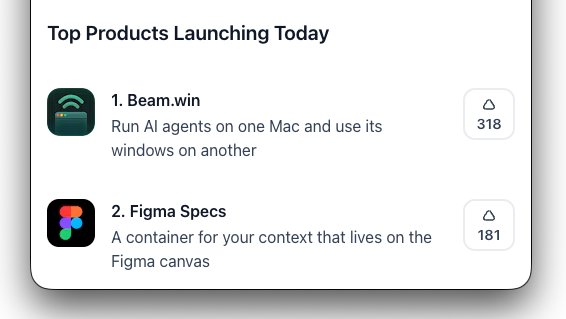
Hiten Shah published how Beam's early access worked. It started with a question on X about multi-Mac setups, which got more than 100 replies. The replies also showed where Beam was a poor fit, for example when SSH already did the job . Of 42 people who filled out a baseline form, 28 had the other Mac nearby. That changed the problem from "remote access" to reaching something on another Mac while working on the one in front of you . Shah treated repeat choice as the signal: what people opened the next time they needed an app on another Mac. Some chose Beam over Screen Sharing, and others still went back to Screen Sharing . One caution from the launch: Beam 1.0's new accounts and plans caused sign-in loops for some early users . The product hit #1 on Product Hunt on October 19 .
Pricing: one base unit, no seat fees
Databricks CRO Ron Gabrisko's advice is to find the base unit that scales with customer value and price add-ons as multipliers on top of it . Early on, Databricks charged per user plus a platform fee. Customers said each user cost them $1,000. When users became free, "consumption went out the roof" . His takeaways: start usage-based pricing early, don't mix seats with usage, and don't require big upfront commitments .
Agent oversight as a design problem
Replit's Amjad Masad says frontier models now do better with simple prompts, and micromanaging them makes results worse . Replit's answer is to make oversight visible:
- a separate thread for each parallel agent
- mobile alerts when an agent is about to go over budget or add a package
- adjusting to how hands-on each user wants to be
The risks were also on display. Andrew Chen has 10 agents with full access to his email and isn't sure "who is running what" . Scott Belsky argues that persistent agents "are liable to backfire without clear boundaries that respect basic rights and procedures" .
From the PM trenches
-
AI on product data. In an r/ProductManagement thread, the practical consensus was:
- Make the AI show the query behind every number.
- Test it on something you already know, like last month's active users.
- Treat its "why" answers as hypotheses to check with users .
Another commenter said the answer to why a feature goes unused "is usually NOT in the data." Use the data to find the segment, then interview them .
-
What the job looks like now. One PM's org now plans only two quarters ahead. Faster AI-assisted shipping freed room for projects that came out of customer interviews . Another PM says AI shifts bottlenecks rather than removing them, and understaffing has forced them to work in code without a software background .

- Replit CEO Amjad Masad said the company spent eight of its first 10 years seeking product–market fit; after a layoff, about 30 people built its coding agent, and seeing it work internally gave the team conviction. The interview reports that revenue increased 100× in a year after the agent shipped; Masad corrected the ARR framing, saying to call it run-rate revenue.
- Masad said newer frontier models can work better with simple prompts and that micromanaging them may worsen results. Replit’s agent interface supports variable oversight through separate threads for parallel work, alerts about budget or proposed changes, and adaptation to users’ preferred involvement.
- Masad argued that coding agents, rather than chat alone, are where AI can transform work; the host said over 75% of Replit users are non-engineers, and Masad cited sign-ups from large banks and financial institutions, including Visa and Amex, as well as the U.S. government. Enterprise adoption still requires quality, security, and compliance controls: Replit has built-in code review and security agents, while its enterprise process encodes customer guidelines and style guides; large financial institutions may need extra compliance support.
- Replit says its model routing uses accumulated usage data to select models and reasoning effort, with published benchmarks claiming frontier performance at 40% of the cost; restrictions at some large enterprises and governments can limit model choice.
- Masad’s “self-driving company” thesis is that AI work should feed back into shared context: he said Replit’s AI usage often happens in Slack and documents return to context. He sees humans focusing on customer needs, what to build, and setting direction while autonomous systems handle more execution.

- Marty Cagan says AI has accelerated building without fixing the project model: stakeholder-led feature roadmaps optimize shipping output, while the product model assigns teams important problems and outcomes and empowers them to find solutions that are valuable, usable, feasible, and viable.
- Product leaders own problem discovery and teams own solution discovery; teams should show that their solution solves the problem better than alternatives, not merely prove the problem exists. Cagan says customer value and business viability—including legal, compliance, and sales constraints—are more common failure risks than usability or feasibility. AI speeds prototyping and testing, but synthetic-user quality depends on how those users are generated; Cagan also says current tools do not yet match the design sensibility needed for great, competition-beating design, and their future product-strategy capability is uncertain.
- Product thinking should cover behind-the-scenes software that affects customer experience, including systems increasingly used by agents as well as people. For difficult customer problems, Cagan says empowered teams need direct access to end users, relevant data, and stakeholders, with product managers, designers, and engineers working close to customers.
- Cagan recommends configuring an LLM as an always-available product coach to teach product practices and outcome measurement; he advises setting it up to challenge the user rather than offer affirmation.
- On the “SaaS apocalypse,” Cagan argues that near-term replacement of serious business applications is unlikely because they contain thousands of often-undocumented rules. He says SaaS vendors are instead opening their platforms so customers, systems integrators, or vendor staff can build agent-based automation, which he expects to make their services more valuable.

- Cost Plus Drugs grew its generic-drug offer from 111 medicines to roughly 4,000 after demand prompted manufacturers to expand the portfolio; it added local pickup through 17,000 affiliated pharmacies to meet same-day demand, accepting a $12 fill fee that makes very low-cost items less competitive but can make pickup more attractive for specialty generics, biosimilars, insulin, and cold-shipped medicines.
- For retail, Cuban frames trust, transparent pricing, and a fixed 15% markup as the core product proposition; he says the company avoids marketing spend and expects customer savings to generate word of mouth.
- Cuban argues AI workflows still need people to supply context, account for model latency, and judge consequences; he advises retaining entry-level roles and teaching employees and executives to use AI rather than treating it as a pure job-replacement tool.
- Agent-era distribution presents a product opportunity: Cuban says agents struggle to access social posts and ads, and described the not-yet-active Agentfeeds.dev experiment to provide post transcripts to agents. He also proposed an agent-enabled service for consumers to find and query nonprofit hospitals’ financial-assistance programs, which he says are poorly marketed.

- Beam’s team recruited early users by asking people with multi-Mac setups how they worked: more than 100 replies surfaced potential users and cases where SSH was already sufficient. A 42-person baseline survey found 28 had the other Mac nearby, reframing many needs from remote access to reaching another Mac while continuing to work on the one in front of them.
- The team used actual workflow problems to guide iteration: reports included imprecise pointer clicks, confusing Mac identities, permission dialogs, and difficulty reaching sleeping machines; releases added input and sizing improvements, dialog handling, access to sleeping or headless Macs, and Whole Mac. Hiten cautioned that shipping changes did not prove the original reporters confirmed their problems were solved. Beam 1.0 also introduced sign-in loops and loss of expected access through its new account system.
- Hiten treated repeat choice—not invitations, installations, or launch rank—as the stronger validation signal: some users chose Beam over Screen Sharing, while others still returned to Screen Sharing. He described Product Hunt’s #1 ranking as a launch outcome and wanted Beam to earn a place in users’ routines.
- Beam’s early-access process used working software as part of the research. Shah asked people to share their multi-Mac setups; more than 100 replied, some were personally invited to try the app, and a baseline form captured 42 workflows. Twenty-eight respondents had the other Mac nearby, shifting the problem framing from remote access toward reaching an app on another Mac while continuing work on the Mac in front of them.
- Evaluate whether people can complete real tasks, not just whether the product looks promising: early users reported pointer misalignment, difficulty using a window from a 50-inch display on a laptop, Mac identification and permission-dialog problems, unexpected shortcuts, and unreliable access after sleep. The team iterated on these issues, but Shah cautions that shipped releases do not prove the people who first reported a problem confirmed it was solved.
- Treat repeat choice as stronger evidence of value than launch attention: some users returned with problems, tried newer builds, and chose Beam over Screen Sharing; Shah describes Beam’s #1 Product Hunt result as a launch outcome, while the goal was earning a place in users’ routines. A late account-and-plans release also introduced sign-in loops and unexpected loss of access for some early users.

- Samsung’s computational-design workflow uses demographically representative 3D/4D scans, defines KPIs such as wearable fit, comfort, and sensor performance, trains models, then iterates through digital twins, robotic simulations, and real-user testing. Some design phases that previously took weeks can be reduced to minutes, while physical fabrication and user testing remain part of the process.
- The team provides designers and R&D with data for decisions rather than making decisions for them; the interviewee emphasizes domain expertise, human-centered meaning, and keeping AI as a tool rather than letting it set the agenda.
- The team receives specific design requests but may uncover new problems during the work; the interviewee distinguishes prototyping problems from prototyping solutions and stresses understanding the problem before designing tools or engineering a solution.
- He favors small, cross-disciplinary teams with varied skills and curiosity (described as 10–15 people maximum, then more specifically five to ten), emphasizing discussion and collaboration with other teams.

Lenny highlighted the How I AI Personal Agent Bench, which tested four agents across nine tasks and ranked Grok Bot first “by a lot,” followed by Muse, ChatGPT Dot, and Claude Duet. This is a result from that specific benchmark.
Nanyu’s product principle is to feel bad in the same way customers do . Charlie Marsh frames caring as a moat: teams should feel visceral pain when things are broken and stop at nothing to fix them .
Lenny’s roundup of open roles at top AI labs includes a Thinking Machines Product Manager, Post Training role at $350K–$400K and a Character.AI Program Manager, Product Experience role at $200K–$300K . The listed compensation is base salary and excludes equity .

- After its reported bounce rate rose from 48% to 66%, the team redesigned its hero and added a live demo; it reported 158 unique visitors and said most Reddit traffic was not from its target audience, so overall bounce rate alone may not diagnose a landing-page problem. The team later reported bounce at 41% over two days, but said it still needed to test the changes with potential customers.
- Diagnose conversion issues by traffic source and funnel stage: landing-to-signup may point to messaging or the hero, signup-to-trial to onboarding, free-to-paid to delivered value, and paid-user churn to unmet expected value. The team planned to track demo starts and signups separately and give results another week or two before drawing conclusions.
- Verify analytics consistency before interpreting the result: the post reported 1,668 page views and 158 unique visitors, while a commenter noted that this exceeds 10 page views per visitor and questioned whether those figures and the 66% bounce rate covered the same period.

- Eric Schmidt urged executives to use AI directly: he says long-chain, deep-reasoning use changed how he thinks, works, invests, and runs companies. He suggests using AI to produce financial reports for discussion with the CFO, and names inventory, security, and cash forecasting as other workflows to explore.
- For choosing models by task, Schmidt expects frontier models to dominate demanding work such as math and chemistry, while cheaper open-weight models may serve “little things.” He says self-run token costs are about three to five times lower, though those models are less functional; whether using them is wise depends partly on security and espionage concerns.
- Schmidt contrasts US frontier invention with China’s faster deployment of AI across digital and mechanical products. He expects free or cheap, “good enough” Chinese models to reach most countries because many cannot afford the costs of more powerful models.
Readwise introduced Readwise Books, its third product for buying, reading, and tracking books; the invite-only beta is live, and Readwise subscribers have access. Lenny says it is free with an annual Lenny’s Newsletter subscription.

- Databricks’ pricing lesson: anchor usage pricing to a measurable base unit that scales with customer value, then price additional value through multipliers or add-ons; mixing seat-based and usage pricing can obstruct usage growth.
- An early user fee and platform fee discouraged adoption: after removing user-based pricing, Databricks saw consumption rise sharply. Make it easy to start at low cost, avoid requiring a large upfront commitment, and remove friction as customers adopt and expand usage.
- For enterprise use cases, demonstrate a tailored solution and expected outcome—using representative dummy data if needed—and be ready to deploy it, rather than relying on a generic PowerPoint presentation.
Early-access teams should not expect first users to hand them a roadmap: feedback may include bug reports, feature requests, or a return to the user’s previous workflow, leaving the team to decide what to change first. Hiten Shah says he will share the decision process used with Beam, a Mac app he built with Sam that reached #1 on Product Hunt the prior week.

Andrew Chen describes a product-design tradeoff in agentic automation: he has 10 agents with full access to his personal email and running automations, but is unsure which agent is doing what; they filter a lot of spam, leaving him to question whether the benefit is worth the uncertainty. This points to the tension between automation utility and clear permissions and visibility into agent activity.
Beam’s early-access users had spent weeks helping improve the product before some recommended it as it reached #1 on Product Hunt; users uncovered problems the team had missed, and Sam kept shipping changes. Hiten had expected the Mac app—which lets people use a window from another Mac alongside their apps—to be niche, but its Product Hunt ranking exceeded his expectations.

- With QA, PMs should specify acceptance criteria for the main and common paths, known edge cases, expected behavior, and what “done” means; QA can focus on less obvious cases such as button mashing, race conditions, and interactions across features or devices. QA can attach a brief coverage-and-bugs summary to the ticket, and draft formal test plans for the PM to review when needed.
- A useful readiness test is whether the PM can explain expected behavior to a developer in under a minute; if criteria span multiple stories, keep them in an epic or shared referenced document rather than duplicating them.
- In one no-QA SaaS team, engineers implement against the user purpose while PMs test asynchronously; a team bug bash and a small early-adopter beta (fewer than 50 customers) help surface missed cases. That team prioritizes edge cases that could break the feature or cause a painful failure state.
Clarity is a force multiplier on everything else.
Hiten Shah’s product-validation advice: even if AI makes it possible to build an app in a weekend, use early access to find the right people and learn from their attempts before assuming anyone needs it; he says he has used this approach for 20+ years and plans to illustrate it with the research and decisions behind Beam’s #1 Product Hunt launch.
- For feature-adoption questions, use product data to find which users or steps show drop-off, then treat AI explanations as hypotheses to test in user interviews; usage data alone may not explain why people do not use a feature.
- Define the metrics first and keep analytics as the source of truth: require AI conclusions to trace back to queries, filters, and underlying evidence, and spot-check them against a trusted dashboard or a known result.
- Built-in analytics AI may offer more product-data context but less flexibility; a general LLM can be more flexible, but its reliability depends on metric definitions, context, and the data exposed through connectors or APIs.