We can't find the internet
Attempting to reconnect
Something went wrong!
Hang in there while we get back on track


Claude Mods: scripting the human side of the harness
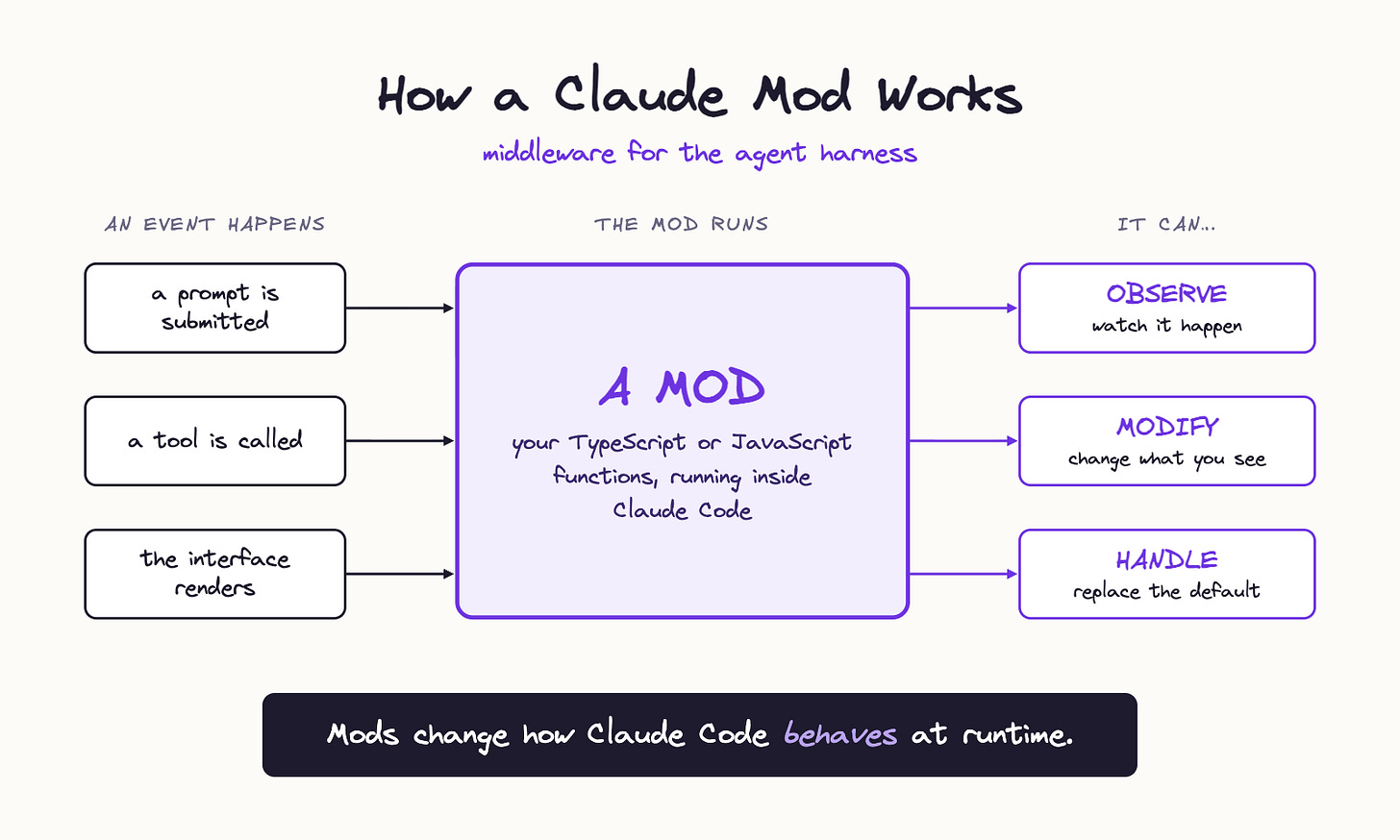
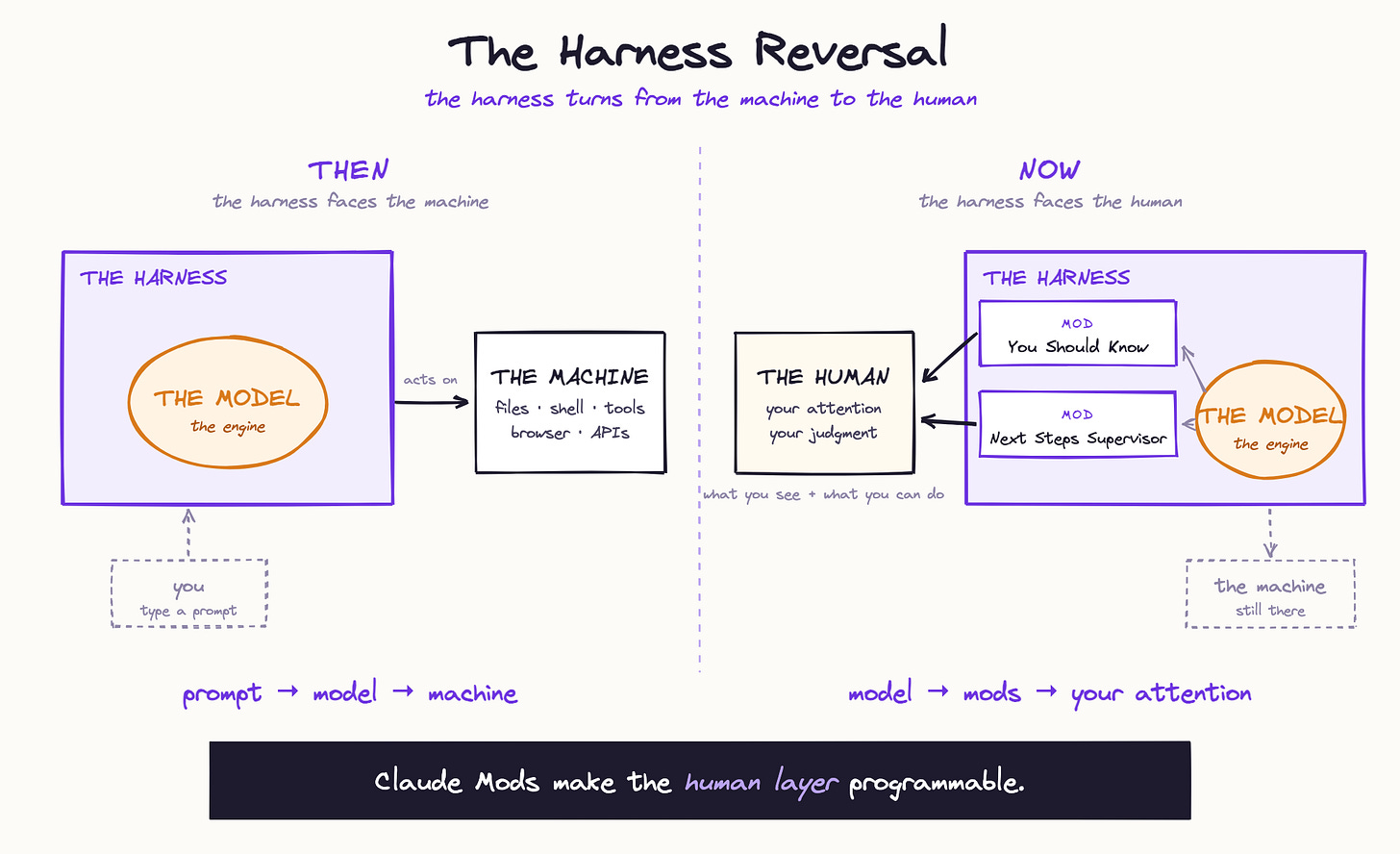
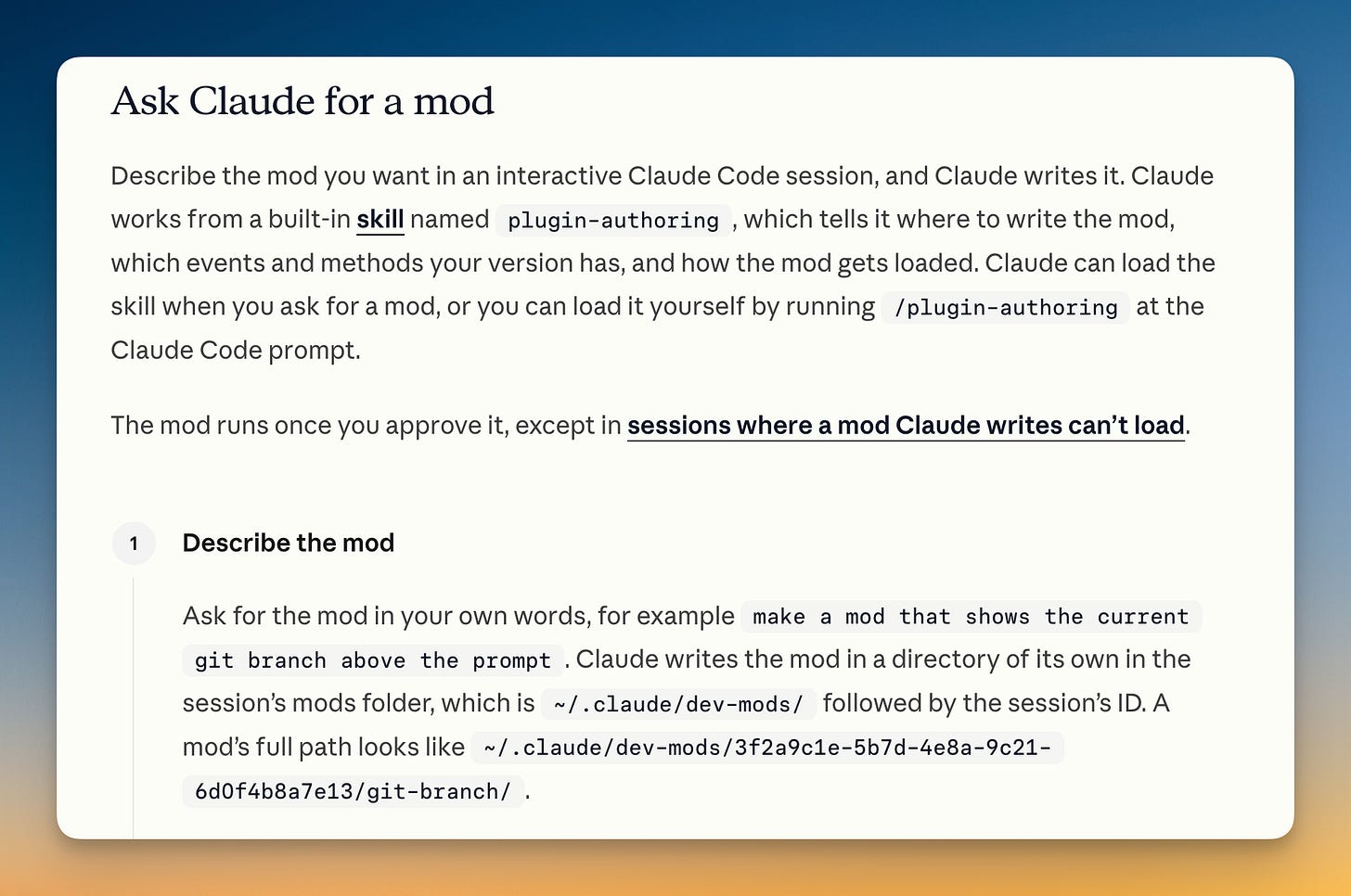
Latent Space published a hands-on deep dive into Claude Mods. A mod is a Claude Code plugin made of TypeScript or JavaScript functions that respond to events such as a prompt, a tool call or an interface render. A mod can observe the event, change how it is rendered, or handle it instead of the default behavior, in both the CLI and Desktop . You don't have to write them yourself: a built-in skill teaches Claude to build a mod from a plain-language request .
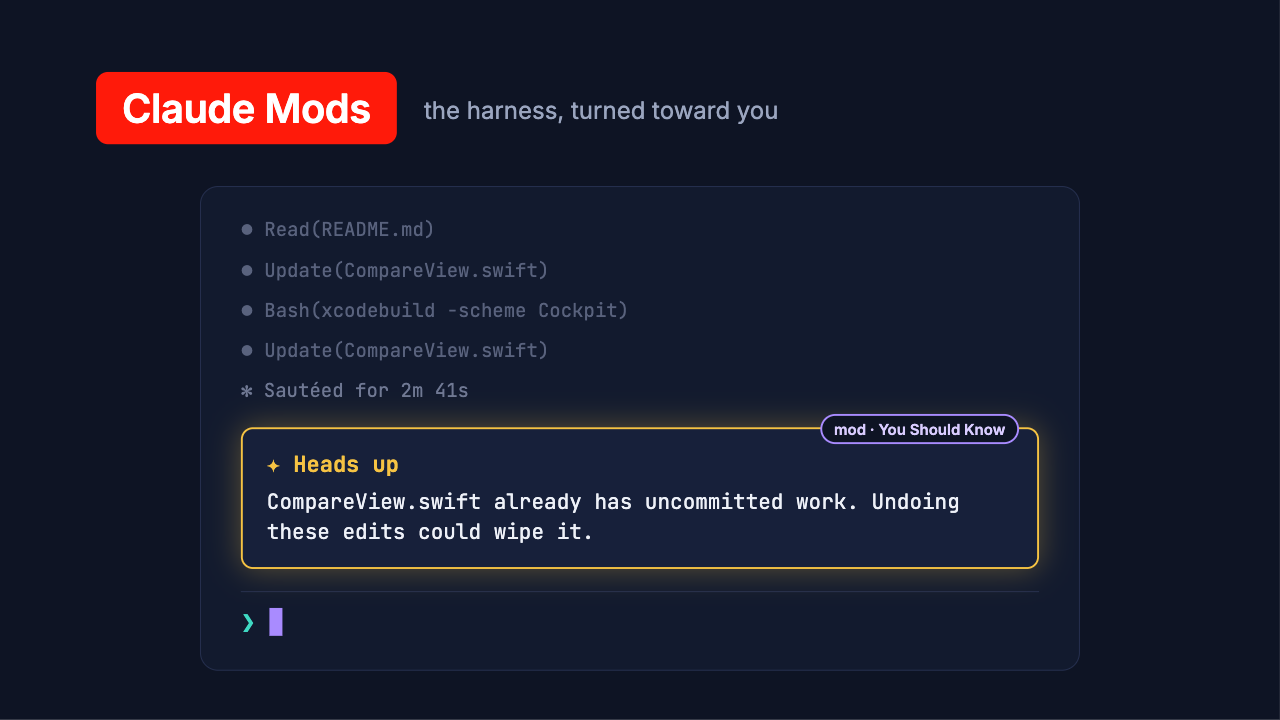
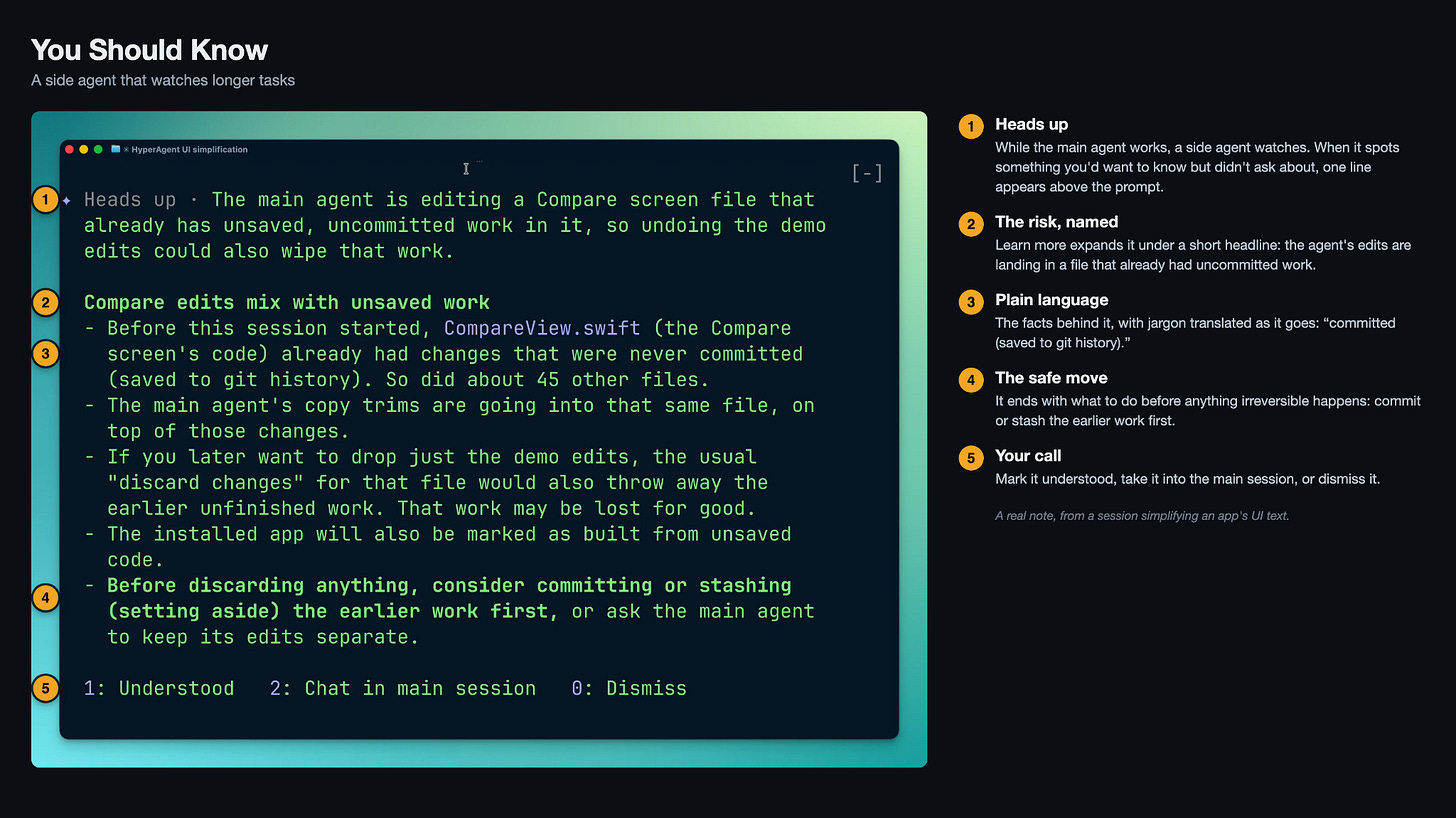
To see the built-in mods, run /plugin and open Installed. They include agents-md (loads AGENTS.md), diff, sec-default and you-should-know, which is the only one off by default . You Should Know runs a side agent that watches the main agent and flags things buried in the trace. In the author's example, it noticed that the file being edited, plus about 45 others, had uncommitted work. It suggested committing or stashing before he discarded the demo edits .
Two mods worth trying:
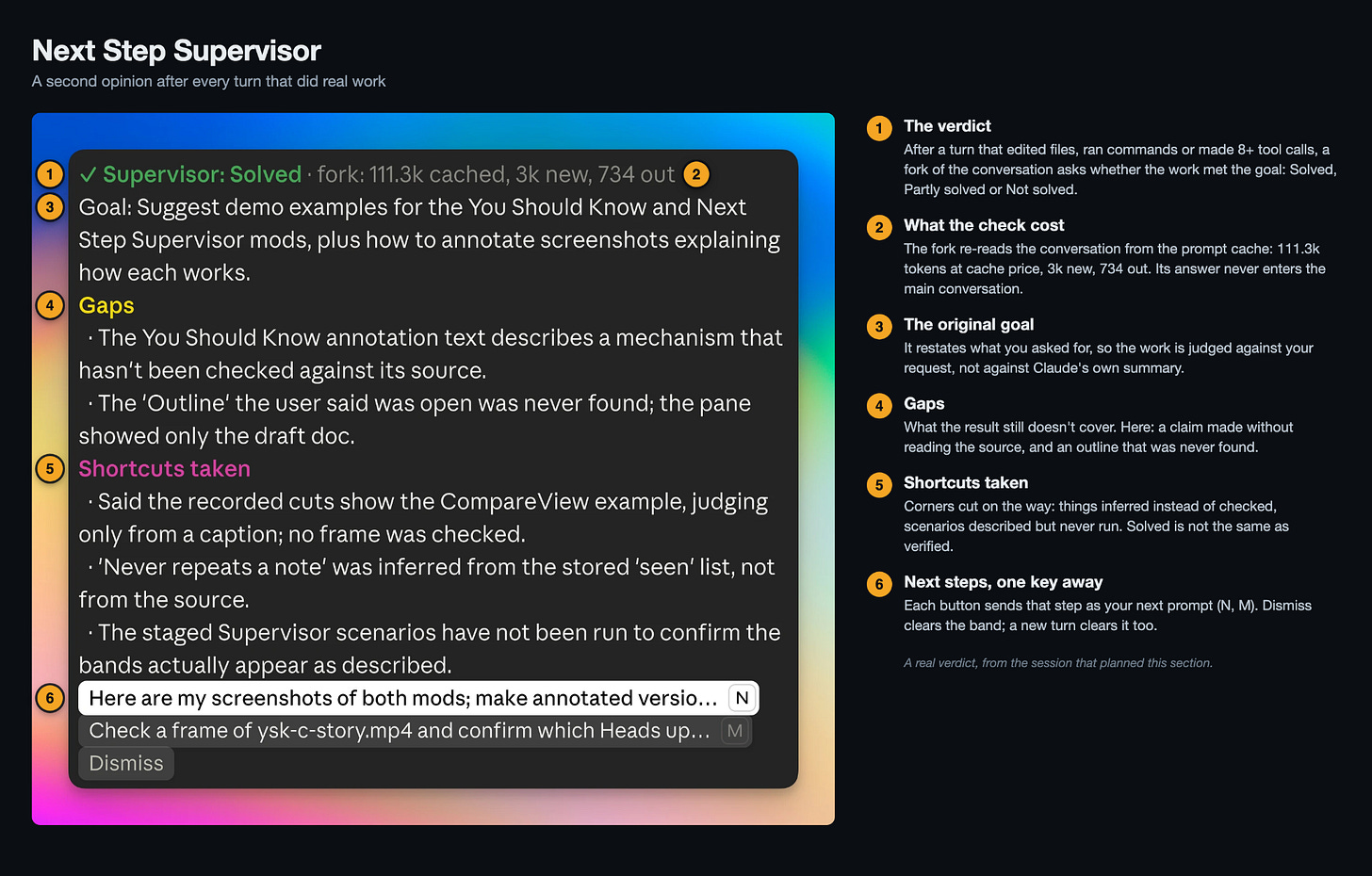
- Next Steps Supervisor, from the open-source ModSmith. It runs after any turn that edits files, runs commands or makes 8 or more tool calls, and offers a clickable next-step instruction .
-
Its costs. That trigger fired on 99 of 111 turns, so much of the output became noise. Each check costs about 5–6k input-equivalent tokens on a 50k-token session . Use
/supervisor offwhen it's not helping .
On trust: mods run with your permissions, can see every prompt, can spend your usage, and "aren't sandboxed." Built-in mods keep running even under --safe-mode. The author reads anyone else's mod code before installing it .
php2shell: models found the bugs, and agents are helping patch them
PHP shipped fixes across the whole 8.x line for two RCEs. Exploits were already circulating after the disclosure leaked . Accounts of who found the bugs differ:
- Greg Brockman (OpenAI): Calif researchers used GPT-5.6 Sol to find a version of the bug in August, and OpenAI's team independently found a more complete version in September .
- Wiz: its timeline says Wiz found the first vulnerability on Aug 19 using Wiz Atlas, Gemini 4 Argon and GPT-5.6 Sol .
Brockman says OpenAI is also working on other bugs, including a Node.js RCE announced the same day. He expects "many more" in the coming months and says the slow, manual one-bug-at-a-time process "won't scale for the agentic era" .
What you can do:
- Find stale version pins across your repos. Sourcegraph says the hard part is finding every Dockerfile, CI pipeline and Helm chart pinned to an old PHP version . It published search queries and Agentic Batch Changes specs for finding and bumping them .
- Audit your own machine. One security PSA suggests asking Claude Code to check what on your laptop is out of date .
- Consider fil-C. Armin Ronacher suspects there are more bugs like this and suggests running PHP via fil-C if you can afford it .
Agent tooling is also exposed. An October incident roundup lists exposed OpenCode AI API keys and malicious LiteLLM PyPI and Docker releases . Theo took his Railway-hosted apps offline because Railway was blocking deploys, so he couldn't redeploy with rolled keys . After hours of looking, he found no drop-in replacement, and the cheapest equivalent setup would cost 3x more .
Boris Cherny's Claude Code playbook
In this talk, Claude Code creator Boris Cherny lays out a progression for adopting it:
- Start with codebase Q&A, not edits. Ask how a class is instantiated, or have it "look through git history" to explain why a function has 15 arguments . He says onboarding for technical hires at Anthropic dropped from 2–3 weeks to 2–3 days .
- Ask for a plan before code. Tell it: "before you write code, make a plan." Plan mode isn't required .
- Give it a way to check its work, such as tests or Puppeteer or iOS-simulator screenshots. With two or three rounds of iteration, a UI built from a mock often comes out almost perfect .
-
Keep a short, shared CLAUDE.md with common commands, MCP tools, architecture notes and key files. Check in
.mcp.json; Anthropic's apps repo shares a Puppeteer MCP server this way . -
Use
claude -pfor automation. Pass allowed tools and get JSON or streaming-JSON output, and pipe it like a Unix utility in CI, incident response and log triage . Power users run several checkouts or git worktrees and connect to sessions over SSH and tmux .
Context management in LangChain's Deep Agents
The Deep Agents harness keeps big content out of the context window by offloading it. Tool results over 20k tokens are saved to a virtual filesystem; the model sees the first and last few lines and can page through the rest with a read-file tool . Human messages over 50k tokens get the same treatment . Summarization is checked before every model call and triggers at 85% usage by default (adjustable). Usage can go past 85% when one turn makes several tool calls .
LangChain's own design agent uses this stack. It has shipped 3,000+ assets, with designers' judgment encoded as skills, a design wiki and brand checks on every render, and it runs on Managed Deep Agents .
Proactive agents and long-lived apps
- Claude Duet (research preview, waitlist) is an app where Claude works proactively: it brings you what needs attention, keeps working while you're away, and checks with you before acting on your behalf . Addy Osmani says it runs on Opus 5.5 with 6,000 connectors and plugins . Kent C. Dodds calls Grok Bot, OpenAI Dot, Meta Muse and Duet "walled gardens" .
-
MiniMax Code Mini Apps are long-running apps with a frontend and a Node.js backend that expose their features to the agent through hosted MCP .
/miniapp-creatorfirst runs read-only queries to confirm it can get real data, then builds and publishes the app and checks it with screenshots . - Riley Brown spends about 45 minutes each morning talking to Dot by voice while walking. Dot handles small tasks and starts Codex sessions for longer ones; at his desk he coordinates work through Claude Code Projects .
Models and providers
- Corridor's argos-1 is a Qwen 3.5 9B fine-tune. Corridor says it beat GPT-6 Astra and Claude Opus 5.5 on its security-context-selection test of 14 models, with the lowest time to first token . Its training data was built with smithtune's trace-based workflow .
- Fireworks claims DeepSeek V4.1 Flash 1017 runs at more than 1,521 tok/s on its Ultrafast tier, which is waitlist-only .
- Geoffrey Huntley is cancelling eight ChatGPT subscriptions. He cites poor availability and slow inference rather than model quality, and says Claude is currently better on all three counts .

- For a coding-agent threat model, Sanfilippo says a fine-tuned model could misuse tool calling—for example, by running an unintended command or fetching and executing an external shell script—and potentially activate this behavior only when a project or context matches a trigger.
- His proposed check is to simulate sensitive project contexts and have a separate frontier model review each tool call for malicious behavior; he likens this to Codex or Claude Code auto-approve. He argues that inspecting tool calls and testing for triggers would make this kind of attack easy to expose in practice.
- For confidential work, he personally prefers local models to external APIs because API data passes through and is visible to the provider. He also argues that model-weight backdoors would be difficult to hide and quickly detectable; this is his assessment, not a demonstrated guarantee.

- Start newcomers with codebase Q&A rather than editing: ask how code is used or instantiated, and inspect Git history and linked issues to understand design rationale . Boris says Anthropic’s technical-hire onboarding went from about 2–3 weeks to 2–3 days with this approach .
- Before implementation, ask Claude to brainstorm, make a plan, and get approval; then give it a way to check its work—such as tests or screenshots via Puppeteer or the iOS simulator—so it can iterate. Boris says two or three rounds often make a mock-based UI nearly perfect .
-
Put common commands, MCP usage, architecture/style guidance, and key files in a short, shared project
CLAUDE.md, and equip Claude Code with the team’s batch CLIs and MCP tools . Anthropic’s apps repo shares a Puppeteer MCP server so engineers can run end-to-end tests and capture screenshots . -
For automation, use the
claude -pCLI SDK with allowed tools and JSON or streaming-JSON output in CI, incident response, and shell pipelines . Power users can parallelize work with multiple checkouts or Git worktrees and SSH/Tmux sessions .

- Claude announced a research preview of Claude Duet as a proactive agent that surfaces what needs attention, completes requested tasks while the user is away, and checks before acting.
- Kent C. Dodds grouped Grok Bot, OpenAI Dot, Meta Muse, and Claude Duet as separate “walled gardens,” and recommended Kody to help individuals and teams avoid locking into any one of them.
- Sanfilippo connects his computers through a VPN so he can access repositories across locations. For this XPS, he plans to work over SSH or synchronize the Git repository rather than use shared storage, which he says leads to Git and synchronization problems; he adds that LLMs have made these operations trivial. Other machines use passwordless SSH within the VPN with an IP allowlist; his primary computer is excluded.
-
He received a Dell XPS 14 to explore whether Dwarf Star can run local inference on hardware beyond Metal, CUDA, or ROCm. It has an Intel Core Ultra X7 358H; he identifies an Arc B390 but is unsure whether it is the GPU. He reports 32 GB in kernel logs versus about 30 GB from
free -h, and suspects the GPU may account for the difference.

Peter Steinberger attributed the PHP vulnerability in OpenAI’s linked disclosure to GPT‑5.6 Sol . OpenAI says its models helped researchers discover critical PHP security flaws; a coalition spent two months preparing fixes and protections before disclosure, and OpenAI estimates PHP runs 70% of websites .

- The interviewee argues that coding work will change but developers may become busier, have more impact, and earn more as AI helps meet demand for far more software than people previously expected.
- Asked what he had given up to AI, he said he had not looked at code in about a year and expected to stop doing occasional simple personal coding projects, which he had enjoyed.
For UI/design work, Kent C. Dodds said AI was no help when he could recognize poor design but did not know how to improve it . In a later post, he said the result was better and credited a suggestion to try Impeccable AI and starting from scratch .

Wiz Research’s timeline says it discovered the first PHP vulnerability using Wiz Atlas, Gemini 4 Argon, and GPT-5.6 Sol on Aug. 19, 2026; it confirmed unauthenticated RCE against Drupal on Aug. 20 and WordPress on Aug. 21, with patched PHP releases available Oct. 21.

Geoffrey Huntley said he was shifting 95% of his use to Anthropic because OpenAI’s service faltered after resets, and later said he was canceling “8 x ChatGPT 500 subs.” He cited poor availability and very slow inference—not just model quality—and recommended Claude for faster inference, better availability, and better models at the time.
Sanfilippo says AI use is accelerating learning and enabling him to explore subjects outside his discipline; he argues that existing knowledge helps people ask better questions and interpret AI answers more effectively.

Willison cautions against leaning heavily on GDC’s January 2026 developer survey as a measure of coding-agent adoption: responses were collected in November 2025, before the coding-agent shift he says began in 2026, and Claude Code was not listed as an option, though respondents wrote it in. GDC’s next survey, conducted in August–September and due to publish in November, mentions Claude Code but still omits Codex.
After Simon said he had added an Apache 2.0 license to Battle Drones’ code, a creator forked it into Panache, a Belle Époque RTS built fully in French with Claude Code . Simon highlighted the fork’s new models, music, and cinematic intro .

-
A long-horizon Claude Opus 5.5 Baldur’s Gate 3 harness used
claude -pwith built-in tools disabled, a Python MCP server connected to a Lua mod over TCP, Vulkan screenshots and SDL clicks. Across 99 fresh sessions, its git-backed memory accumulated 157 commits, about 23,000 curated words and 67 tactical rules; the full run took 39 hours and cost $712. - A reusable verification workflow: E. O. Kahya manually split an audit into 18 tasks and nine stages, then had Claude orchestrate deterministic SymPy/mpmath checks, including high-precision numerical validation. The core physics result survived; the reported findings were mainly calculation/bookkeeping issues and typos, making this an example of AI-assisted checking within an expert-designed pipeline rather than autonomous discovery.
- DeepSeek’s production serving design stores persistent block KV in a separate 3FS cluster, so any prefill worker can retrieve a cached prefix; reported retention is three days for agent traffic. This can support reuse of agents’ repeated instructions, repository context and tool history, but the reported 155T tokens/day includes cache hits and is not all newly computed input. DeepInfer is an open-source inference framework for DeepSeek models targeting NVIDIA SM100 and Huawei Ascend 950, but full online serving still needs external KV-cache management, prefill/decode disaggregation and replica load balancing.
- For persistent-agent infrastructure, LangChain’s Managed Deep Agents packages user-specific credentials, scoped memory, sandboxed execution and scheduled work; Hugging Face’s Agent Manager coordinates persistent sessions across Claude Code, Codex and other harnesses.

A post flags “OpenCode hacked” but gives no explanation of what happened or its impact .

Jediah Katz’s AI Engineer New York talk frames agent-harness needs as model-dependent: smarter models let Cursor remove prompts and guardrails, while Grok Bot is adding them back.

Claude announced Claude Duet as a research-preview app for a proactive agent, powered by Opus 5.5 and offering 6,000 connectors/plugins; it surfaces items needing attention, works on requested tasks while the user is away, and checks before acting on the user’s behalf.
Swyx frames Claude Code as a general-purpose hardened harness that developers can repurpose into domain-specific harnesses; his Claude Mods deep dive highlights favored mods and what to try now.

OpenAI says its models, including “5.6 Sol,” found critical PHP flaws; it credited a coordinated response with @ThePHPF, @calif_io, @wiz_io, @Cloudflare, @CISAgov, and others, and said it engaged U.S. and international government partners to help guidance reach critical systems.

- Jason Zhou predicts agent-loop-based Mini Apps could replace many internal apps and SaaS. MiniMax Code is one implementation: long-running apps with a frontend and backend that can call the Agent and vice versa; the Node.js server persists data and exposes features through hosted MCP, while the host manages processes, ports, credentials, and rollback-capable publishing.
-
MiniMax Code’s
/miniapp-creatorturns a one-sentence chat request into an app: it first uses read-only queries to confirm data access, then builds the page and backend, publishes and opens the app, and checks it with screenshots in the built-in browser. Mini Apps are available in local MiniMax Code sessions on macOS and Windows; their code runs on your machine as you, so install packages only from trusted sources.
- Claude Mods are TypeScript/JavaScript plugins for Claude Code that can react to prompts, tool calls, or interface renders and customize behavior in the CLI and Desktop; Claude’s built-in authoring skill can build a requested mod from a plain-language description.
- The built-in You Should Know side agent monitors the main agent and flags consequential details that may be buried in its trace. In one example, it caught uncommitted work in the file being edited and about 45 other files, prompting the author to commit or stash before discarding demo edits.
- ModSmith’s open-source Next Steps Supervisor runs after turns that edit files, run commands, or make at least eight tool calls, then presents findings and a clickable next-step instruction for Claude Code. The author’s trigger fired on 99 of 111 turns, creating noise; each check was estimated to use about 5–6k input-equivalent tokens on a 50k-token session.
- Treat mods as executable code with access to your permissions: they can read and write files, see prompts, and spend usage, and they are not sandboxed. The author recommends reading third-party mod code before installing it; a mod can also be switched off or adjusted when it creates noise.