We can't find the internet
Attempting to reconnect
Something went wrong!
Hang in there while we get back on track
The Claude Code team's verification rules
In an article Addy Osmani shared, the Claude Code team says about 90% of its code is written and reviewed by Claude. It argues that without verification loops you can supervise only one or two agents, because you check everything yourself, and with them you can run "dozens or hundreds in parallel" . The practices:
-
A
verifyskill. Put it in.claude/skills/, as close to the relevant code as possible. It should boot and drive the real app: the Claude Chrome extension for web, an iOS/Android MCP for mobile, computer use for desktop, or a local service for backend. Claude uses it before committing. The team treats it as the smoke-test harness and asks Claude to stress-test it until it is fast and reliable . - Test types worth investing in: end-to-end first, because they're "difficult to fool" . Then property tests with fast-check, Hypothesis or proptest, checking round-trips, invariants, idempotency and equivalence . For migrations, differential tests run the old and new systems on random or sampled production inputs and keep a list of approved differences . Flaky tests teach the agent to rerun rather than fix .
- Three-round stop rule. If a check still fails after three fix attempts, Claude stops and brings in a human .
- Checks that trigger on the diff. A 39-item reliability checklist records, for each item, a trigger readable from a diff, a check, and the incidents or PRs behind it. Claude runs only the matching items, usually 3–10 .
-
Gates the change can't edit. REVIEW.md is read from the base branch, not from the PR . Tests, build and linter run before a PR opens, enforced with a hook or a
/goal. To stop repeat failures, add a hook or a CLAUDE.md rule .
Two other items this period support the property-testing advice. In a paper shared by @eulerfx covering 25 agent-built apps, properties derived from the spec found 56 bugs that properties derived from the code missed, and the code-derived properties found 43 the spec-derived ones missed. Spec-derived properties mostly caught state, lifecycle and logic errors; code-derived ones mostly caught input handling . Caveats: the bugs were judged by the same model that wrote the tests, the prompts differed between the two approaches, and the method needs a good spec . In a Bend video, ThePrimeagen recommends writing the laws yourself and having the agent write the proofs. He notes that agents often change unit tests along with the code, which "doesn't give me confidence." His suggested target is a job-ticket state machine .
GPT-6.2 Astra and Sol: cheaper Astra, mixed reviews
The models are in the API as gpt-6.2-astra and gpt-6.2-sol. Astra costs $8/$40 per million input/output tokens, and cached input drops to $0.40 from $1, which Simon Willison calls good news for long agentic sessions. Sol stays at $2/$10 . Willison supports both in LLM 0.38 , and Armin Ronacher says Pi users can get them with pi update --models . On Willison's Three.js/OpenStreetMap mech test at Ultra effort in Codex CLI, neither model matched Claude Fable 5.2 or Gemini 4 Carbon .
Theo, who tested Astra early, would still pick Opus 5.5. He credits Astra with strong review, 3D/game work, computer use and subagent prompts, plus a reverse-proxy design he says will save $25k a month . His failure reports are useful for anyone running long jobs:
-
It blocks itself on questions you can't answer. Two hours into a
/goal, it stopped to ask about a reviewer's clip filenames. He saw the same in Codex and now runs agents on crons to check whether it has blocked again . - Its summaries are hard to read. He switches to Opus 5.5 at the end of a long run just to get a readable summary . He also uses Opus as an "auditor and translator" for Astra through a T3 Code feature .
-
It runs without progress. On his
ts-rustbenchmark, Opus finished in under two weeks for about $20k in tokens. Astra ran seven days, landed no improvements and made the compiler 56% slower, then ran four more days with no changes after he redirected it .
Other views: Tibo (OpenAI) says early testers' videos predate "a lot of changes in the last 3-4 days." He recommends Sol ultrafast, now on Pro 200 plans as well as Pro 500 . Theo has heard, secondhand, that many OpenAI engineers use Sol Ultrafast rather than Astra . swyx disagrees with the negative reviews: he calls Astra the best workflow-automation model he has used, "no longer getting stuck in horrible loops," and says it runs much of Latent Space's publishing pipeline .
Coordinators and persistent agents
Cursor Projects. You talk to one coordinator, which starts workers, for example on the data layer, the API and the UI. When one worker changes something like a schema, the coordinator pushes the change to the others . In multiplayer projects, coordinators message each other to split work and avoid conflicts. Cursor says this makes it 5–10x more productive internally . The speaker's setup advice:
- Connect docs, the task tracker, Slack and monitoring data .
- Require a demo video in the PR for UI changes, and have the agent watch CI and fix Bugbot and security-review comments .
- Configure a cloud environment so the agent can actually use what it built. The speaker calls this the single biggest lever on dev velocity .
- Route reviews by risk: schema changes need a human, flagged UI changes may not .
- Projects work best with 3–8 people and a medium-term scope .
Devin Bots give each project its own persistent identity and memory, replacing short-lived sessions . Cognition's Steven K says this means you should delegate "goals and responsibilities," not tasks. He adds that the change was "almost entirely an orchestration change" that could probably have been built a year ago . After a week of trials, swyx handed over QA, cross-platform app porting and video editing. His advice is to expect agent managers that own outcomes, not "AI Employees" .
Also notable
-
Claude Code Code Mode (experimental): Claude writes scripts that chain your tools together and can reply while long commands are still running. Opt in with
CLAUDE_CODE_EXPERIMENTAL_CODE_MODE=1. - Sandbox placement: LangChain says calling the sandbox as a tool lets you update the agent without rebuilding an image and keeps API keys outside the sandbox. The cost is network latency . Only microVM-style kernel isolation stops a compromised agent from exploiting kernel bugs .
- Prototype-to-production: Simon used Claude Opus 4.8 to generate a May research spike for Datasette Lite, but says he shipped it only in November, after becoming familiar enough with the system while working with Claude Fable 5.2.
- Prompt pattern: Simon built most of the Datasette MapLibre plugin with one Claude Fable 5.2 prompt: inspect two existing plugins and a local demo, combine their features, and brainstorm beyond them. The creative instruction produced SVG previews of GeoJSON shapes, with WebGL previews loaded only when scrolled into view.
- Agent-code sandboxing: The external-sandbox pattern keeps the coding agent outside a dedicated sandbox where its code runs. Three implementations use v86 with Alpine Linux in WebAssembly, Alpine inside Apple Containers, or Microsoft Quicksand/QEMU; all expose the same localhost API for Pi, Claude Code, and Codex. Optional HTTP/HTTPS allow-listing and credential replacement control network access and let code make authenticated calls without giving the agent the secret.
- Reported capability: Anthropic co-founder Tom Brown said the Mythos model brought Claude up on AMD in three days with almost no human intervention, porting or writing nearly all the kernels; he contrasted this with previous chip-platform onboarding that took dozens of engineers months.
- Model caveat: Assessments of GPT-6.2 Astra were mixed: Theo Browne said it could coordinate subagents on long tasks but stalled two hours into an Outer Wilds level task to ask about an obscure filename choice. In Simon’s Codex CLI Three.js mech-animation test, Astra and Sol also did not match Claude Fable 5.2 or Gemini 4 Carbon.
- The Claude Code team says about 90% of its code is written and reviewed by Claude; it argues evidence-based verification loops make it possible to delegate from one or two agents to dozens or hundreds. In internal structured-file-generation tests, a separate rubric-based grader improved task success by up to 10 points over standard prompting, with the largest gains on harder tasks.
-
Prioritize end-to-end checks of real user flows: they provide clearer evidence that a feature works than unit tests alone. Give the agent access to run and inspect the real app (for example, through the Claude Chrome extension, mobile MCP, desktop computer use, or a local backend), and create a fast, reliable repo-local
verifyskill under.claude/skills/near the relevant code for it to use before committing. - For edge cases, use property tests to check invariants such as round-trip behavior, idempotency, or equivalence, with libraries such as fast-check, Hypothesis, or proptest. For migrations where behavior should be preserved, compare old and new systems on the same randomly generated or sampled production inputs; normalize irrelevant differences and document approved changes.
- Have Claude run tests, the build, and the linter before opening a PR; if checks still fail after three repair rounds, stop and involve a human. The team also uses a 39-item reliability checklist whose diff-based triggers usually select 3–10 checks, and keeps review rules on the base/default branch so the change being reviewed cannot modify its own gate.
- Willison dates the coding-agent inflection to November 2025, when Claude Opus 4.5 and GPT-5.1 became reliable enough to use daily rather than as occasional novelties.
- To locate an intermittent beep in a room of about 40 boxes, he gave an agent access to two iPads, two laptops, and a phone as web-audio microphones connected over WebSockets. The agent found a 2007 algorithm for unreliable microphones, built a beep locator, and pinpointed the source within 41 cm; it was an old carbon monoxide detector.
- When his command-and-conquer-style game felt dull, he asked Opus 5.5 to make it more fun. Claude ran for 12 hours, simulated 1,000 battles, and added objectives, explosion feedback, and achievements; Willison said the resulting game was fun.
- Willison describes Opus 5.5 as his daily driver and “cheap Fable,” saying it comes close to or sometimes beats the original Fable 5 on benchmarks at a fraction of the price.
- Devin Bots replace ephemeral sessions with project-specific bots that have persistent identities, goals, and memory surfaced across sessions. Teams can provide high-level project context and delegate goals or responsibilities rather than repeat task-by-task setup; the explanation attributes much of the change to memory persistence and orchestration, not model improvements alone.
- After a week-long trial, swyx says he handed bots AEO, QA, cross-platform app porting, personal-admin automation, and video editing. He highlights always-on, ROI-tuned agents that own outcomes, manage and review subagents, work through channels such as text and Slack, and report through interactive artifacts rather than long chats; his workflow was cloud-based.
- Swyx cautions against treating agents as AI employees or overestimating their capabilities: delegate outcome ownership at the level above individual tasks.
- Datasette Lite’s service-worker architecture began as an AI research spike generated with Claude Opus 4.8 in May. Willison says he waited until November, when he felt familiar enough with the system to ship it, and used Claude Fable 5.2 to generate explanatory SVG diagrams.
- After building WebAssembly wheels for 163 SQLite versions, Willison used Claude Fable 5.2 to build a tool for comparing the same SQL query across selected SQLite versions—a concrete agent-assisted debugging tool.
- Willison says coding agents can compile C and Rust extensions into Pyodide-compatible WebAssembly, helping remove a former blocker to running Python apps in browsers; PostgreSQL and MySQL in WebAssembly remain less-trodden.
- OpenAI released GPT-6.2 Astra and Sol in the API, and Simon Willison added support for both in LLM 0.38. Astra costs $8/$40 per million input/output tokens, down from GPT-6 Astra’s $10/$50; its cached-input price is $0.40 per million tokens versus $1 previously. Willison called the lower cached price good news for longer agentic sessions. Sol remains $2/$10, half the price of GPT-5.6 Sol.
- In a hands-on comparison using Ultra effort in Codex CLI, Willison gave both models the same Three.js/OpenStreetMap task: animate Yonkers standing up as a mech and stomping around New York City. Neither handled the mech transformation as well as Claude Fable 5.2 or Gemini 4 Carbon on that prompt.
- For a video-editing task in the Codex desktop app, Willison gave Astra two animation URLs and specified the split-screen layout, labels, square 2000×2000 output, and an initial 10-second duration, then followed up with “OK make it 20s.”
- A caveat in Theo Browne’s pre-release feedback: Astra could manage many subagents on a long task, but then block to ask the user an obscure implementation question they could not reasonably answer; Browne said an Outer Wilds level task was blocked two hours in over a detail about reviewer output filenames.
Simon Willison compared GPT-6.2 Astra and Sol on a Three.js task: animate Yonkers standing up as a mech and stomping through Manhattan, Queens, and Brooklyn using OpenStreetMap data. He also linked Gemini 4 Carbon and Claude 5.2 Fable results for the same prompt, illustrating a practical way to compare models on a fixed coding task.
- In a Bend game prototype, he encoded behavior as laws rather than relying only on example cases: a non-movement key must leave the game state unchanged, ground color and decorations must stay consistent as the player moves, and wall influence must follow a specified algorithm. He reports checking these properties across game inputs and states; deleting a wall made the proof fail, and reverting the change made it pass again.
- His agent workflow is to write the laws himself and delegate writing the proofs to an agent; he stresses that formal proofs supplement, not replace, unit tests. He suggests applying this approach to job-ticket state machines with permitted states and transitions, and notes that agent-driven changes to unit tests can make test results less reassuring.
- Simon Willison and Prime Radiant introduced an external-sandbox pattern for coding agents: the agent stays outside a dedicated sandbox while its executed code runs inside, reducing the risk of damaging actions from mistakes or prompt injection. Three implementations are available: Node.js with v86 running Alpine Linux in WebAssembly; Python with Alpine Linux in Apple Containers; and Python with Microsoft Quicksand, which bundles QEMU and Alpine Linux.
- All three expose the same localhost API for configuring Pi, Claude Code, or Codex to send code-execution requests to the sandbox. An optional HTTP/HTTPS allow-list proxy restricts which hosts code can contact, and credential replacement enables authenticated API calls without giving the agent the secret.
Swyx says Astra is his daily-driven workflow-automation model and the best he has used; he reports it avoids getting stuck in loops and learns efficiently through compactions and skill writing. He uses it in the Latent Space and AI Engineer content-publishing pipelines, and credits it as contributing to the bootstrapped business’s revenue efficiency of more than $1 million per employee.
Combine spec-driven and code-driven property-based tests for agent-built apps: have the agent write plain-English invariants from the requirements, translate them into property tests after inspecting the code, and keep code-only-derived properties as a separate approach. In a study of 25 agent-built apps, each approach found bugs the other missed (56 spec-driven-only and 43 code-driven-only; the post reports 59% of bugs were found by only one approach); spec-driven tests mostly caught state, lifecycle, and logic errors, while code-driven tests mostly caught input-handling errors. The evidence has caveats: the prompts differed, the method requires a good spec, and the same model that wrote the tests judged the bugs, although 25 were manually sampled and reportedly held up.
OpenAI announced GPT-6.2 Astra and Sol as available, describing them as “super efficient” and built to perform in the real world; the announcement provides no coding-agent-specific capabilities or workflow details.
Kent C. Dodds posted “Works great with Kody.codes!” alongside a link to Cognition’s Devin Bots announcement, but gave no details about the setup or what worked. Cognition presents Devin Bots as a bot that leads a team of agents, with tasks ranging from writing firmware to merging thousands of PRs per week.
Ben Tossell reports that @droid with Opus 5.5 Fast did a good job building a usage tracker in one shot, though he gives no implementation details.
Riley Brown reports that Claude built a two-minute 4K Blender film from one Fable 5.2 prompt in about 4.5 hours: it wrote Python for the assets, seven sets, and camera moves and animation across 52 shots, and started seven copies of itself to build sets in parallel. The work totaled 12,500 lines of code; rendering 3,220 frames used 89 rented RunPod GPUs, with 36 running at once, and cost a little over $20. Brown says a similar prompt on a computer without his RunPod skill setup produced lower quality, and that Claude Code’s awareness of available cloud compute made it more ambitious.
Riley Brown’s software-factory pattern is to give agents a clear specification, have several AI workers build different parts in parallel, use other workers to test, send broken work back for correction, and turn mistakes into rules to prevent recurrence; he says the factory improves with use. He casts the developer as a director coordinating agents, a token budget, and the software goal, stepping aside wherever AI can do the work. His agent-first tool examples are Claude Code and Codex, with an IDE available for cases where it is needed.
Kent C. Dodds says he likes seeing companies use “MCP Server” as a selling point, calling it validating .
Brown describes a software-factory workflow: give agents a clear specification, have them build different parts in parallel, use other agents to test the results and send failures back for repair, then turn mistakes into rules so the system improves with use. The human operator acts as a director, coordinating the agent team, token budget, and software to build while delegating wherever possible; Brown names Claude Code and Codex as agent-first tools, with the IDE opened when needed.
ThePrimeagen recommends using one AI chat at a time and thinking through the work rather than running many tasks in parallel; he argues that juggling small changes without stepping back to choose the best path can produce “slop.”
Mckay Wrigley said Astra 6.2 might benchmark better but felt like a regression; he found the initial GPT Astra release had more “magic” than subsequent updates and only speculated that compute constraints might explain the change.
Running the full server-side Datasette Python app in the browser with service workers and Pyodide
In this newsletter:
Running the full server-side Datasette Python app in the browser with service workers and Pyodide
GPT-6.2 Astra and GPT-6.2 Sol and Gemini 4 Carbon
Plus 6 links, 1 quotation, and 13 releases(!)
Sponsor message: Pair the Dynatrace MCP Server with prepackaged agent skills so your AI assistant can query live observability data, correlate symptoms with specific lines of code, and verify fixes. Read the blog (opens in new tab) for a step-by-step walkthrough that traces an 89-second response time back to its database root cause.
Running the full server-side Datasette Python app in the browser with service workers and Pyodide (opens in new tab) - 2026-11-17
Datasette Lite (opens in new tab) is my port of the Datasette (opens in new tab) Python application to run directly in the browser using WebAssembly and Pyodide (opens in new tab). I’ve released a complete rewrite of Datasette Lite using service workers, and it’s now almost indistinguishable from the real server-side application.
You can now do all of the following, using a carefully crafted URL to lite.datasette.io:
Load client-side Datasette to browse any SQLite database, JSON file, CSV file or SQL script
Select a released version of Datasette to load from PyPI
Load a specific commit, tag, or branch name from the Datasette GitHub repository
Pick from over 100 versions of SQLite to use with Datasette
Install additional Datasette plugins from PyPI or URLs to wheel files, including JavaScript visualization tools
The ability to load specific Datasette references, plugins, and SQLite versions makes this a fantastic tool for linking to demos of work-in-progress features or bug reproductions, without needing to spin up a full web server to serve that demo.
As an example, consider the following URL:
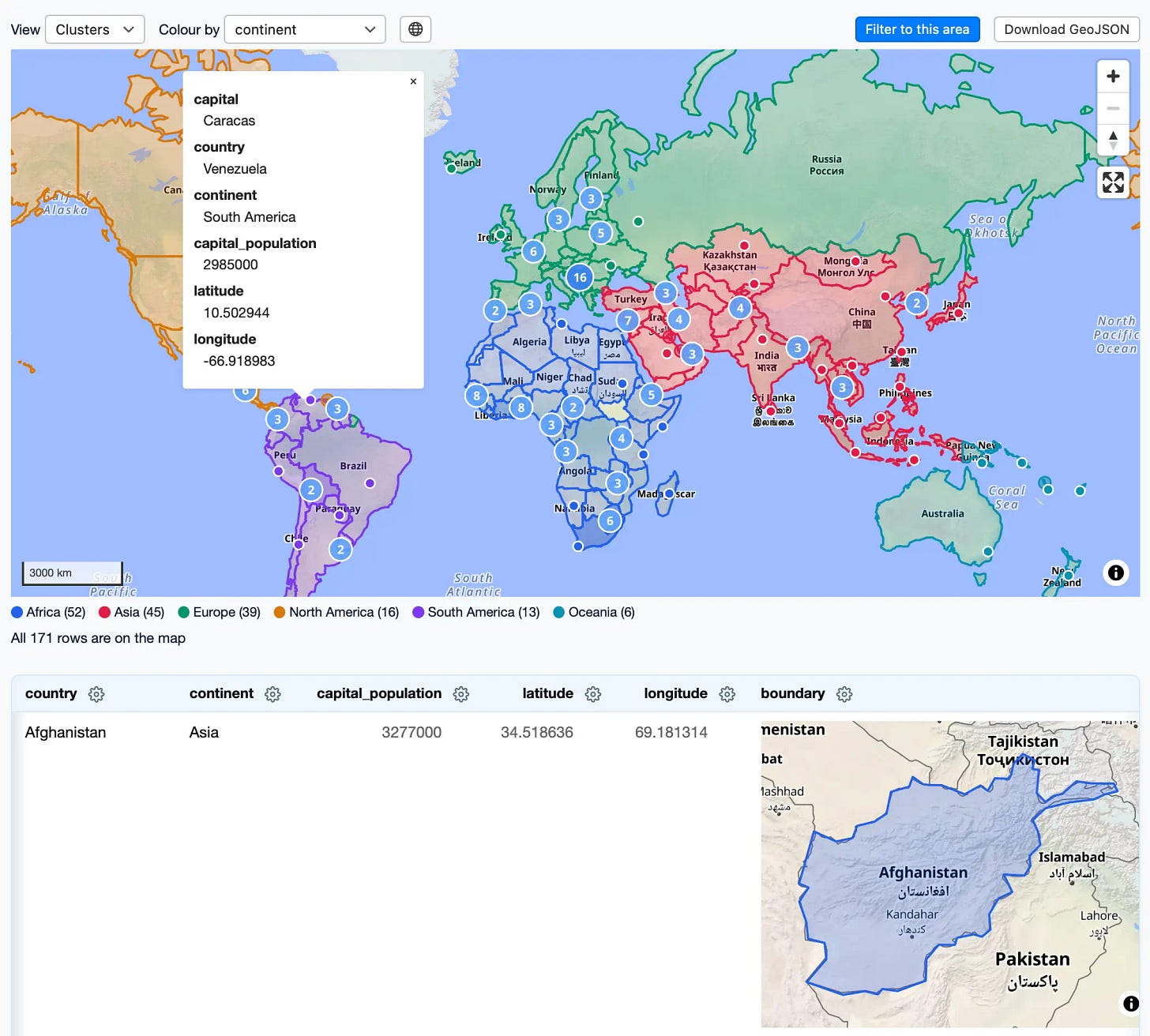
Follow that link and, after a short loading screen, you’ll find yourself on a page that looks like this:

That’s Datasette running the new datasette-maplibre (opens in new tab) plugin, loading up a database of GeoJSON shapes of countries and displaying both a combined map and individual boundary maps in a table.
Let’s break down that URL to see what it’s doing:
https://lite.datasette.io/
?install=datasette-maplibre
&url=https://.../demo.db
&metadata=https://.../metadata.yml
#/demo/capitals_and_countries%23map=0/4.2/180&color=continent
The ?install=datasette-maplibre installs that additional plugin from PyPI. You can pass &install=... as many times as you like to load more plugins.
&url=https://.../demo.db loads that SQLite database from the provided URL. These URLs need to have open CORS headers (opens in new tab) - I host files like this in Gists (opens in new tab), because they provide an easy way to get open CORS headers on a web-hosted file.
&metadata=https://.../metadata.yml loads this metadata.yml file (opens in new tab). The metadata file adds HTML descriptions to various tables, and to the Datasette homepage. Visit that homepage here (opens in new tab) for a guided tour of the other features of that plugin, all defined in the metadata file.
#/demo/capitals_and_countries%23map=0/4.2/180&color=continent is a fragment hash that turns into a location within Datasette - here it’s loading the /demo/capitals_and_countries SQL view, then appending another fragment hash to it (%23 is a URL-encoded #) which tells the map plugin to zoom to a certain location and to set the color of the shapes on the map based on the continent column in the data.
That URL is doing a lot of work! I wrote more about this trick for building URL-addressable software in URL-addressable Pyodide Python environments (opens in new tab) last year.
The full set of supported URL arguments is described in the Datasette Lite README (opens in new tab).
I’ve already started using Datasette Lite as part of the Datasette development process. Here’s a recent issue (opens in new tab) describing a pagination bug - I posted a comment there demonstrating the old, broken behavior and the new fix using links to Datasette Lite:
Demo of the bug (opens in new tab) - click next and the second page is empty.
Here’s that same page (opens in new tab) with the bug fixed (running on 1.0a43).
How this works, using service workers
Datasette Lite is not a new project. I launched the first version back in 2022 (opens in new tab), originally as a bit of a joke (running server-side apps in the browser is pretty funny) but one that quickly started proving its value.
The problem with that initial version is that it was a hack. It worked by running Datasette in a Pyodide web worker, simulating requests through that stack, then injecting the resulting HTML back into the top level page using innerHTML.
This worked for basic Datasette, but meant that any feature that used JavaScript failed to work, because script tags in innerHTML don’t execute, and the web worker tricks it used failed to load additional JavaScript or CSS files.
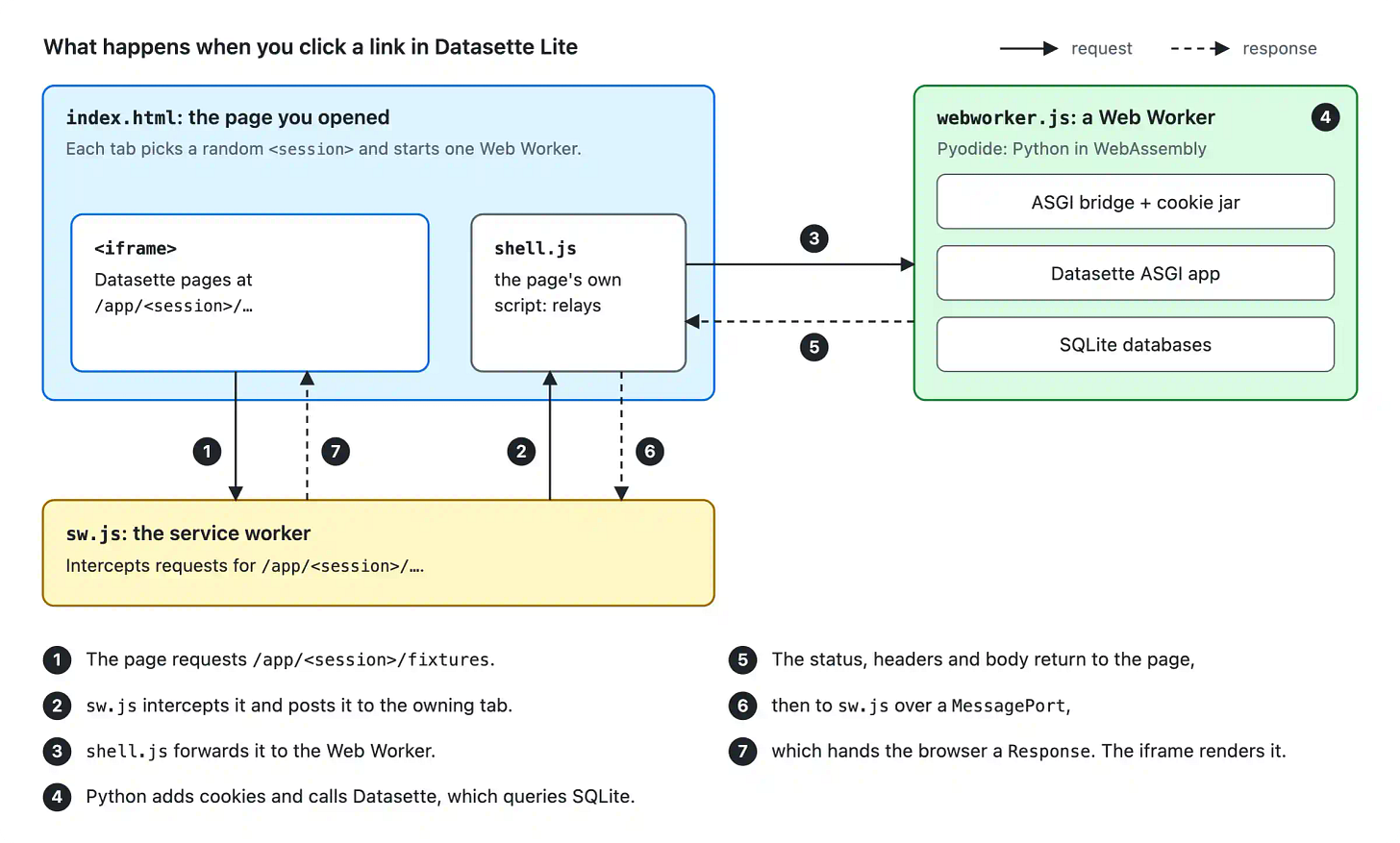
The new version takes a completely different approach based on Service Workers (opens in new tab). These allow JavaScript to intercept HTTP requests for new pages and resources and serve them from client-side code instead.
Datasette Lite registers a service worker for the entire lite.datasette.io domain. The parent page then creates an iframe that sends requests for Datasette pages to URLs that look like this:
/app/aa94e6851595/ # the homepage (HTML)
/app/aa94e6851595/data/places # a table page (HTML)
/app/aa94e6851595/-/static/navigation-search.js # (JavaScript)
/app/aa94e6851595/-/static/app.css # (CSS)
Those are regular Datasette URLs, but with a /app/aa94e6851595/ prefix. What’s that about?
The /app/<session>/ prefix is necessary because of multiple tabs.
Consider the URL above, which loads the demo instance with the datasette-maplibre plugin. That URL defines a full, custom Datasette instance. You might have that one running in a tab, then one of my other demo links running in another.
The service worker for lite.datasette.io is shared between all of those tabs. If it routed to a single instance of Datasette then every tab would share that underlying instance, no matter what plugins or other settings their URL attempted to configure.
Instead, the parent page generates a random session ID and uses it as a prefix for all of the subsequent hidden asset and page loads. The service worker can then use that session ID to route those requests back through the parent page to a web worker running a dedicated Datasette instance for that particular session.
(We still need a web worker because Pyodide in a service worker would not be able to maintain state beyond around 30 seconds, depending on the browser. There are a lot of moving parts here!)
I had Claude Fable 5.2 generate several SVG diagrams (opens in new tab) to help explain this. Here’s my favorite of those, now embedded in the Datasette Lite README:

This system started life back in May (opens in new tab) as an AI research spike (opens in new tab) generated using Claude Opus 4.8. It wasn’t until November (and Claude Fable 5.2) that I felt familiar enough with how it all works to confidently ship it to production!
Bonus feature: pick your version of SQLite
I added this feature last night (opens in new tab) as an off-shoot of investigating a potential bug in SQLite (opens in new tab).
Datasette is meant to work against any released version of SQLite since 3.25 (released in September 2018). There have been 87 further releases since then.
Being able to fire up Datasette against a specific version of SQLite is really useful for demonstrating new SQLite features and debugging weird issues.
In the past I’ve used various tricks (opens in new tab) to get different SQLite versions running with Python on my Mac, but it’s not a trivial process.
WebAssembly is perfect for this. I can load up a custom SQLite build entirely in my browser, test it there, then discard it when I close my tab.
datasette/pysqlite3-wasm-wheels (opens in new tab) is my new repository which contains WebAssembly compiled Python wheels for pysqlite3 (opens in new tab) for 163 different SQLite versions. Each version gets a file with a name like this:
pysqlite3-0.6.2-3.54.1-cp314-cp314-pyemscripten_2026_0_wasm32.whl
That’s for SQLite 3.54.1, the most recent version.
Datasette Lite now takes a special ?sqlite= URL parameter, which will accept a version number like 3.54.1, resolve the path to the corresponding wheel file, then fetch that wheel and install it into the Pyodide environment and configure Datasette to use it.
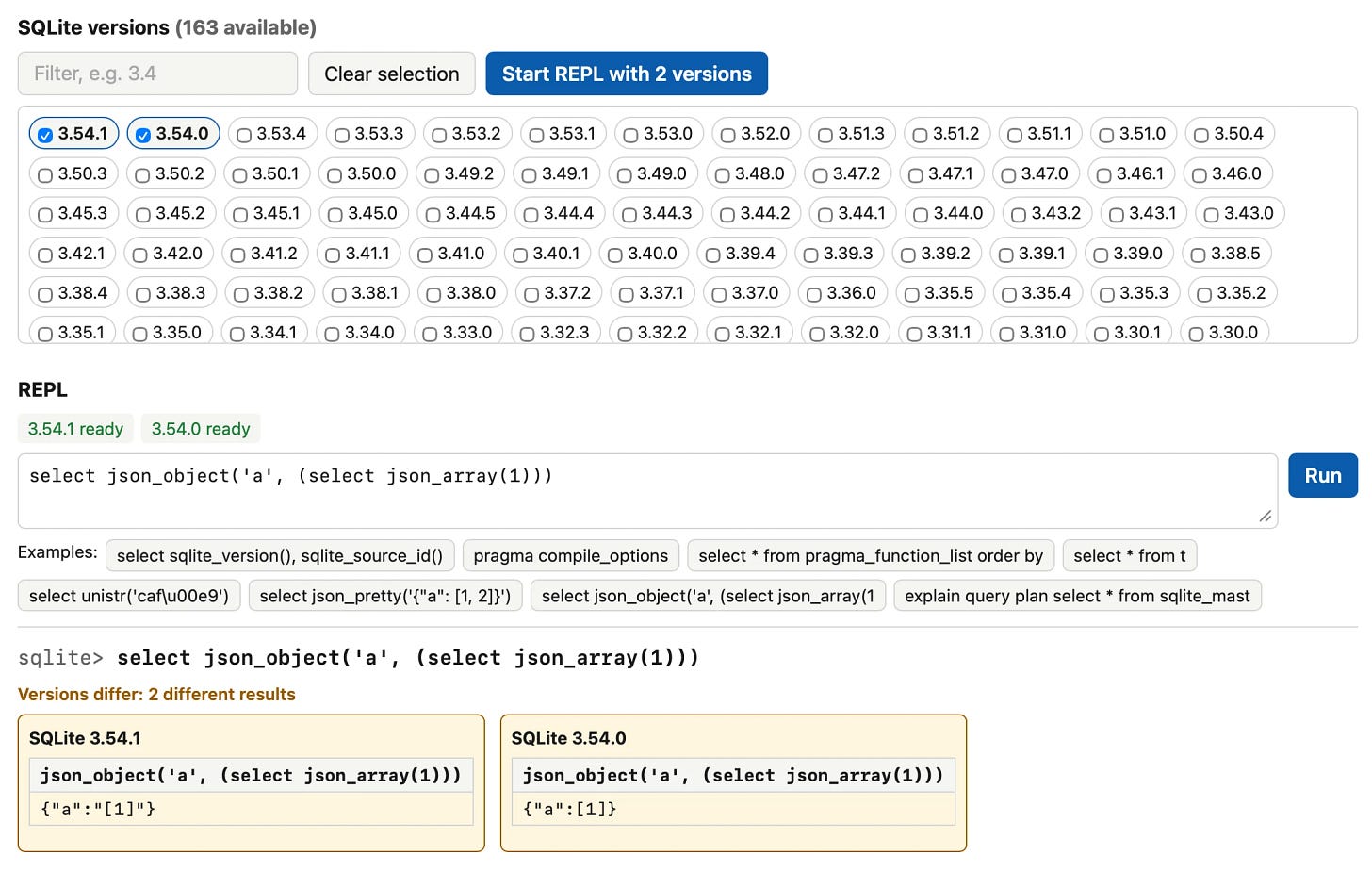
Once I’d built the wheels, I decided to have Claude Fable 5.2 build me this bonus tool (opens in new tab) for comparing a SQL query across any selected versions of SQLite. Here’s an example showing how select json_object('a', (select json_array(1))) differs between SQLite 3.54.0 and 3.54.1:

This should work for every other Python app, too
Nothing about how Datasette Lite works is unique to Datasette. Almost any Python application should be able to pull the same trick - running entirely in the browser using WebAssembly and Pyodide, as a cheap way to provide preview environments, demonstrate features, and recreate bugs.
C and Rust extensions used to be a blocker for this kind of thing, but any good coding agent can compile those to Pyodide-compatible WebAssembly now. You can even publish them to PyPI (opens in new tab) as of PEP 783 in April 2026.
One catch is databases. SQLite is no problem at all, but running PostgreSQL or MySQL in WebAssembly, while possible, is still a path less trodden.
I’d love to see WebAssembly preview environments like these become a common pattern across the Python ecosystem.
Link 2026-11-17 GPT‑6.2 Astra and GPT‑6.2 Sol (opens in new tab):
OpenAI:
We’re introducing GPT‑6.2 Astra, our new frontier model for your hardest projects, and GPT‑6.2 Sol, our efficient, versatile model for everyday work.
They’re available in the API as gpt-6.2-astra and gpt-6.2-sol. I shipped LLM 0.38 (opens in new tab) with support for the new models.
6.2 Astra is 80% of the price of 6 Astra - \$8/MTok input and \$40/MTok output, the same price as Claude Fable 5.2 (which was also 80% of its predecessor). 6 Astra and Fable 5 were both \$10/\$50. The cached price is an even bigger discount - \$0.40/million compared to \$1/million for the older model. This is great news for longer running agentic sessions.
GPT-6.2 Sol is the same \$2/\$10 price as 6.1 Sol and 6 Sol - which are half the price of GPT-5.6 Sol (\$4/\$20).
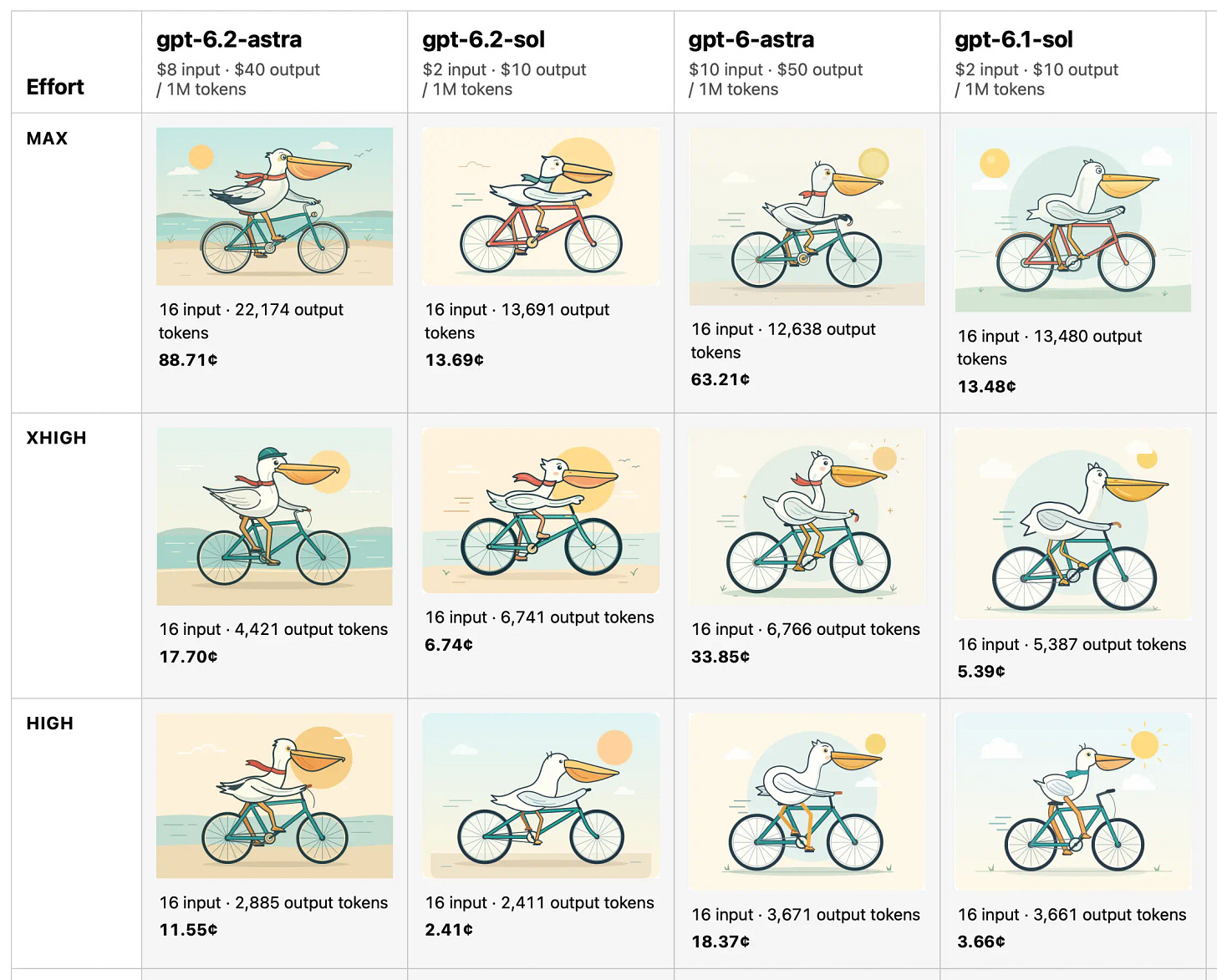
Here are the pelicans for GPT-6.2 Sol (opens in new tab) and for GPT-6.2 Astra (opens in new tab). The 6.2 Astra max pelican looks like this:

I have a full comparison grid here (opens in new tab), but here’s how the high/xhigh/max pelicans compare with the previous Sol and Astra releases:

I also ran my most recent benchmark prompt against the two models, using “Ultra’ effort levels in the Codex CLI:
Make a three js animation where yonkers stands up as a big mech (cool stand up motion) and stomps around manhattan and queens and Brooklyn, use openstreetmap mapping data
Here’s Sol (opens in new tab) and here’s Astra (opens in new tab). Neither of them did a good enough job of morphing Yonkers into a big mech, at least in comparison to Claude Fable 5.2 (opens in new tab) and Gemini 4 Carbon (opens in new tab).
This video showing the Astra and Sol animations playing out at the same time:
I created that video using GPT-6.2 Astra (Ultra) in the Codex desktop app by prompting:
https://static.simonwillison.net/static/2026/yonkers-gpt-6.2-astra-ultra/index.html and https://static.simonwillison.net/static/2026/yonkers-gpt-6.2-sol-ultra/index.html are two videos of the same thing by two different models
I need a video of the first 10 seconds where the top half of the video plays the first and the bottom half plays the second
I need an overlaid label of "GPT-6.2 Astra" on the top half and "GPT-6.2 Sol" on the bottom half. These labels should be tastefully positioned.
Make the video square and 2000x2000 pixels
Then later:
OK make it 20s
Here’s the exported transcript (opens in new tab).
The buzz around these new models is mixed at the moment. Astra 6.2 isn’t scoring quite as high as Fable 5.2 on various benchmarks, and I’ve seen a few complaints that its communication style can be confusing. Theo Browne’s review (opens in new tab) (in the form of a feedback letter he sent OpenAI during pre-release) has this useful example:
When this model is working on long tasks, it can pull in a lot of subagents and manage them pretty well. It will then proceed to randomly ask you some weird internal implementation detail bullshit that you could not under any earthly circumstance understand, much less have input on.
I sent “/goal make a new level for Outer Wilds”. 2 hours in, it’s “blocked” because it wanted to ask me “does r24’s reviewer write it’s clips to 24_g521.mp4 or 24_p11.mp4?”
Link 2026-11-17 External sandboxes for coding agents (opens in new tab):
I’ve been exploring new ways to sandbox code that is executed by agents, with a focus on making it safer to try out local models without worrying that a mistake or prompt injection attack might cause them to take damaging actions on a machine.
I worked on this project with Prime Radiant (opens in new tab), the AI research lab behind Superpowers and other projects (opens in new tab).
My post (opens in new tab) on the Prime Radiant blog introduces the external sandbox pattern, where code executed by the agent runs inside a dedicated sandbox while the agent itself lives outside of that sandbox.
To demonstrate this pattern we’ve released three sandbox server implementations:
external-sandbox-v86 (opens in new tab) runs a Node.js server which then uses v86 (opens in new tab) to run Alpine Linux inside WebAssembly.
external-sandbox-container (opens in new tab) is a Python web server which runs the sandbox in Alpine Linux inside an Apple Containers instance.
external-sandbox-quicksand (opens in new tab) is another Python web server, this time using Microsoft’s Quicksand (opens in new tab) sandboxing library, which bundles QEMU and Alpine Linux in a Python package!
Each of these implementations offers the same localhost API. You can then configure Pi, Claude Code, or Codex to send API calls to that sandbox any time they want to execute code.
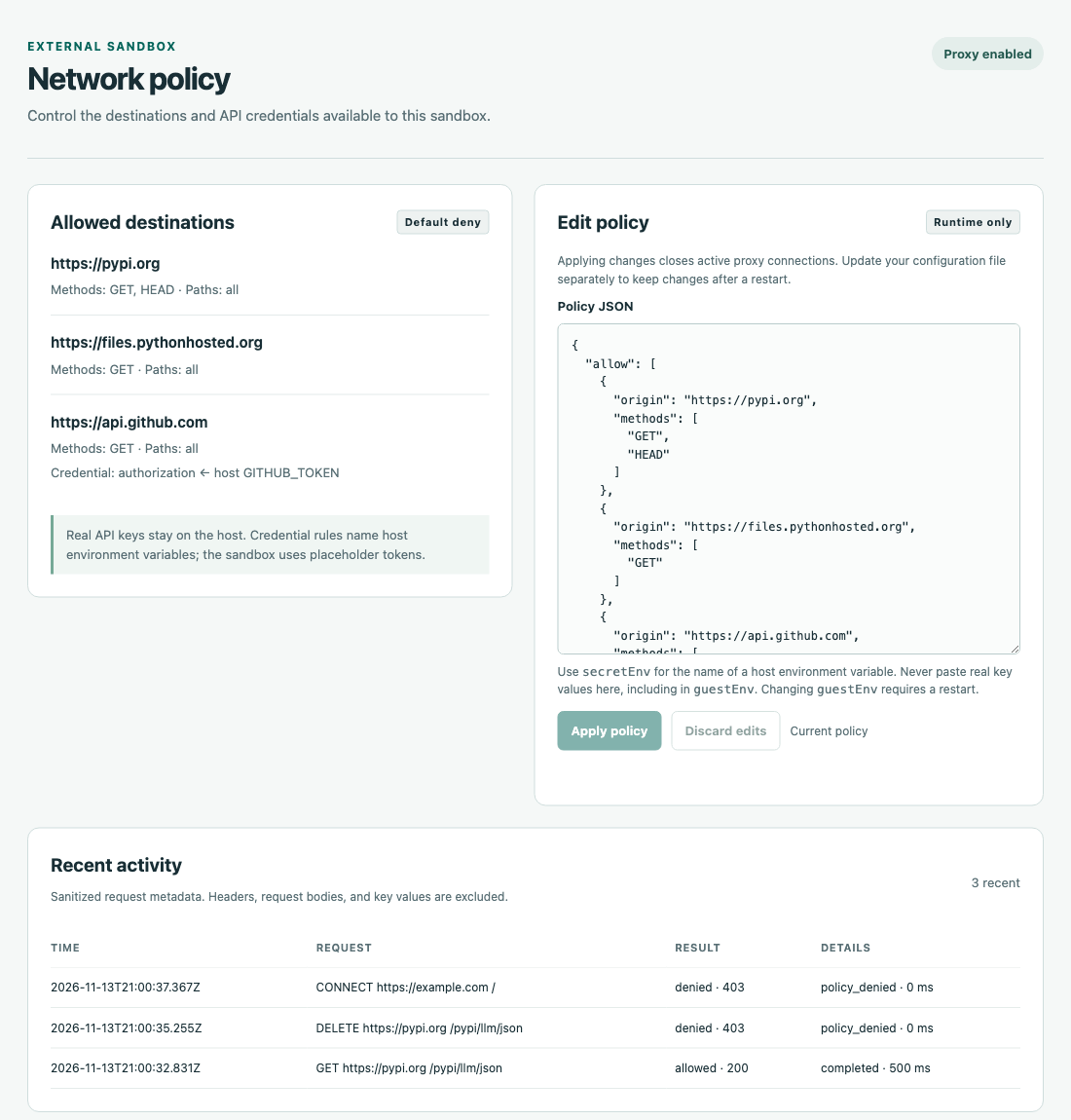
The sandboxes also include an optional HTTP/HTTPS allow-list proxy, so you can control exactly which hosts your agent’s code is allowed to communicate with - plus a credential replacement mechanism to make authenticated API calls without sharing a secret with the agent. Here’s the UI you can use to reconfigure that proxy while the sandbox is still running:

I continue to be fascinated by the challenge of safely running untrusted code. This external sandbox pattern provides a neat way to experiment with different approaches.
Release: llm-gemini 0.36 (opens in new tab)
Gemini 4 Carbon was announced two weeks ago (opens in new tab) for “a subset of cyber defenders”, but today it’s available to everyone else (opens in new tab).
This is Google’s best ever Gemini, priced at \$2/million input and \$10/million output at launch (that’s GPT-6.1 Sol / Claude Sonnet 5.5 prices) but scheduled to double in price to \$4/\$20 on December 1st (same as Opus 5.5).
Here are three pelicans (opens in new tab) for the low, medium and high thinking efforts (it defaults to medium). This is the pelican I got for high:

Gemini pelicans have all been great for a while now, so I also tested it out using Google’s Antigravity IDE with a prompt I first tried with Claude Fable 5.2 yesterday (opens in new tab):
Make a three js animation where yonkers stands up as a big mech (cool stand up motion) and stomps around manhattan and queens and Brooklyn, use openstreetmap mapping data
Here’s the HTML result (opens in new tab) (I had to prompt “build that into a standalone HTML file” to get a version with no external dependencies). I then screen-captured that as a video:
Update: Huh, just saw this on YouTube (opens in new tab) (and tweeted by Google CEO Sundar Pichai (opens in new tab)):
Using Google Antigravity’s /swarm feature, Carbon built an open-world 3D game where you explore Google’s Mountain View campus as a pelican riding a GBike — coordinating subagents to model 3D assets in Blender from Omni and Nano Banana references, build the browser game in Three.js with WebGL shaders, and pair procedural Web Audio sound effects with Lyria music.
Here’s the playable version (opens in new tab) in AI Studio.
Link 2026-11-11 Anthropic’s IPO roadshow video (opens in new tab):
Anthropic kicked off their IPO roadshow yesterday, and their roadshow video has some previously unreleased information about how their business works.
The section on “Approach to compute” with co-founder Tom Brown is particularly interesting, describing how Anthropic train and serve Claude across AWS Trainium, Google TPUs, NVIDIA GPUs, and AMD GPUs.
I’m not sure why there’s no official video transcript, but here’s one that I extracted (opens in new tab) using MacWhisper. Highlights below:
We train and serve Claude now across all four major chip families. That’s only possible because early on we made an unconventional bet on a multi-chip strategy. At the time, many people thought that running AI models on different chips wasn’t worth the effort. Each chip needs its own tailored software stack and inference stack, which is expensive and difficult to build. We’ve now been doing it for years, and we’ve gotten incredibly good at it. […]
As an example, this year, we started working with AMD GPUs for the first time. In the past, bringing on a new chip platform took dozens of engineers months of work This time, we had Mythos try it out. It got Claude running on AMD in just three days, with basically no human intervention. Claude ported or wrote almost 100% of the kernels. […]
The second driver of our compute advantage is our rate of discovery of compute multipliers. We focus on total effective compute, which is the multiplicative product of physical capacity times the compute multipliers that we discover. Each one we discover makes our pool of total effective compute bigger. For example, say you need 100 units of compute to train a model of a certain intelligence. A 4x compute multiplier means you can use 25 units of compute to train the exact same model. Or you can use those hundred physical units to train an even more intelligent model that would have previously required 400 units.
Compute multipliers create a competitive advantage for us that’s hard to replicate. They build on each other. Each new multiplier we discover has a positive effect on the multipliers before it. They stack. We believe that this can accelerate even further as we approach recursive self-improvement. Claude will be able to discover compute multipliers entirely by itself, allowing the number of compute multipliers to grow faster and faster.
We got a hint at Anthropic’s multi-chip strategy last September in their postmortem of three recent issues (opens in new tab), where they described bugs that affected just their TPU deployments.
Release: llm 0.37.2 (opens in new tab)
Fixes a security issue reported by Daniel de Araujo (opens in new tab) in GHSA-v9h7-jj4g-f862 (opens in new tab) and GHSA-r639-rr7r-x72w (opens in new tab).
LLM has a mechanism called extra-openai-models.yaml (opens in new tab) - now managed by the new-in-0.37 llm openai endpoint add (opens in new tab)command - for using LLM with OpenAI-compatible API endpoints from other providers.
Daniel reported two ways this could accidentally send your configured OpenAI API key to one of those providers: if the key named by api_key_name had never been stored, or if a responses: true model was run with -o chat_completions 1.
Link 2026-11-11 Browse tools.simonwillison.net by tag (opens in new tab):
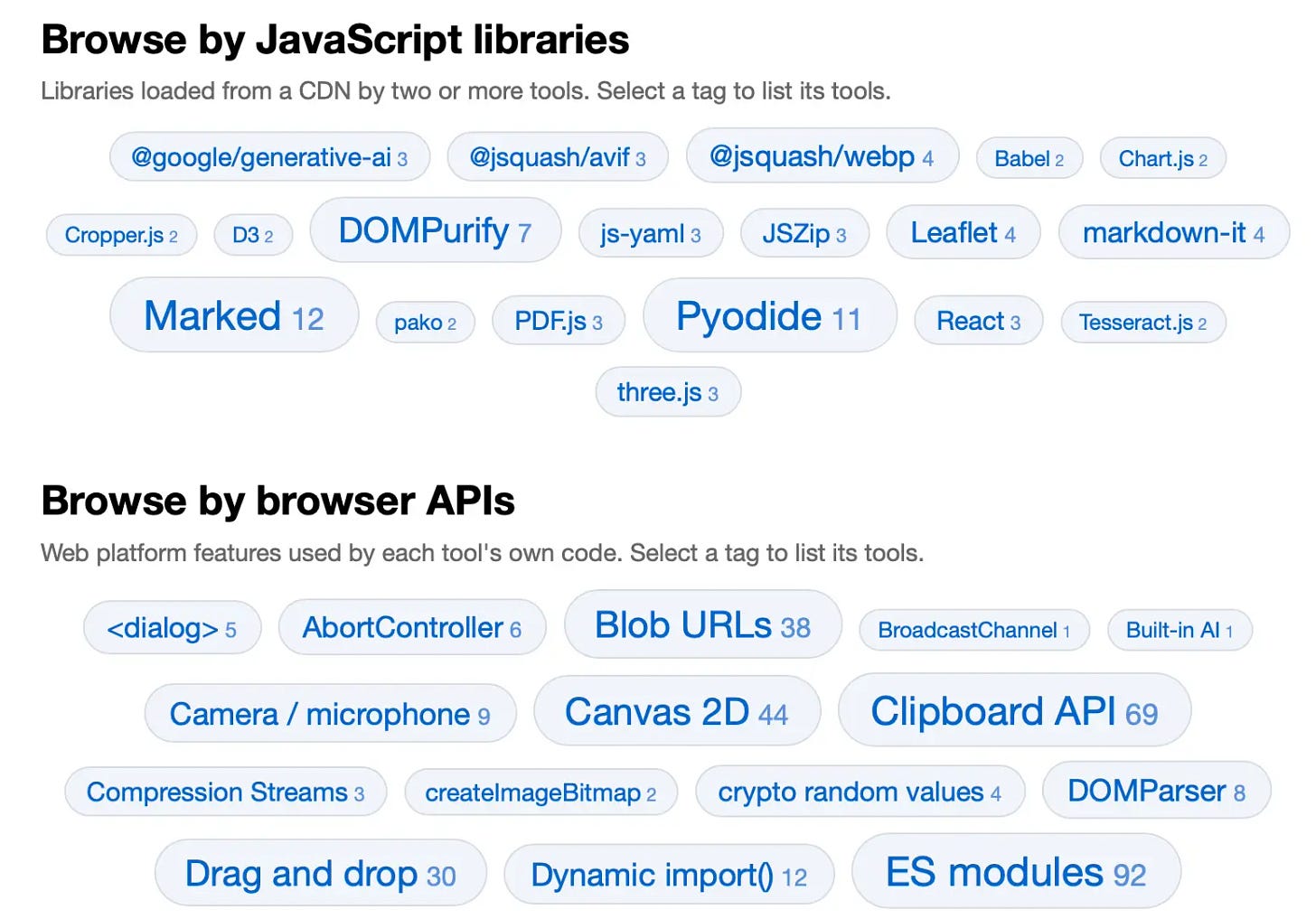
I’ve been wanting a better way to browse my collection of vibe-coded tools (244 and counting) for a while. I had a few Fable 5.2 credits left over before my weekly reset so I set it to work using tree-sitter (opens in new tab) to analyze the code for JavaScript APIs, libraries, and web API hosts used by each tool.
The homepage now features tag clouds for browsing by each of those categories of tag:

Link 2026-11-11 aws-emulator (opens in new tab):
Finally, an official emulator from AWS to run tests against a local clone of their many different services without having to provision a paid API key to do so.
It’s written in Rust by a huge swarm of agents - 29,684 commits in the first three weeks of the project. Swaminathan (Swami) Sivasubramanian wrote about how it came to be (opens in new tab) in a guest post on Werner Vogels’ blog.
It currently requires Docker to run on macOS or Windows. I’m hoping they fix that in the future - it would be great if you could download a single binary and use that as part of a standard test suite in other languages and on other platforms.
Link 2026-11-11 Gemini Decisions API (opens in new tab):
Google join Jev (opens in new tab) and OpenAI (opens in new tab) in the decision model category with “Gemini Decision 1”. This new model API is almost identical to Jev: it supports the same three types of questions (yes/no, choice, and rubric-scoring) and even reuses Jev’s term “Noul” for a yes/no question.
It’s priced the same as the GPT-6 Luna decision model: 10 cents per million input tokens, and output is free. Jev remains the cheapest of the three, at 4.2 cents per million.
Jev is text (and JSON) only. OpenAI can handle text and images. Gemini Decision 1 is fully multi-model: it covers text, images, audio, video, and PDFs.
I tested it against video by passing these questions to it along with my Yonkers stomping robot (opens in new tab) video file:
dragon: Does this video have a dragon in it?
robot: Does this video have a robot in it?
france: Is this video set in France?
usa: Is this video set in the USA?Jev and OpenAI both return 1.0 or 0.0 for yes/no questions, but Gemini insists on being a little less confident than that:
{
“dragon”: {
“type”: “yes_no”,
“probability”: 0.04976021841520312
},
“robot”: {
“type”: “yes_no”,
“probability”: 0.9234055387792485
},
“france”: {
“type”: “yes_no”,
“probability”: 0.08329171353166241
},
“usa”: {
“type”: “yes_no”,
“probability”: 0.9230459995157706
}
}Release: llm-gemini 0.37 (opens in new tab)
Google launched Gemini 4 Hydrogen (opens in new tab) today - the lowest cost member of the Gemini 4 family.
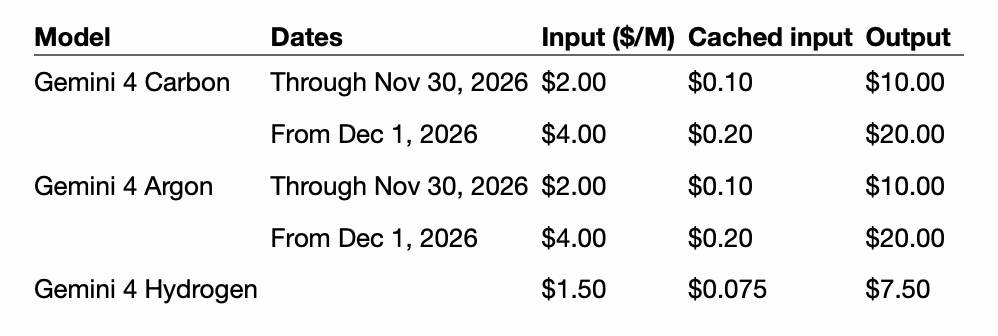
It’s actually not too far off the price of its much bigger siblings, Carbon and Argon. I’m finding Gemini 4’s pricing really confusing. Here’s the pricing scheme:

Carbon and Argon are the same price, and both are scheduled to double in price on December 1st. If they’re the same price, why have two different models? Google says (opens in new tab) that Argon “delivers Gemini 4 intelligence with faster responses and lower token spend per turn compared to Gemini 4 Carbon” - so it may be priced the same, but it will use less tokens per task.
Hydrogen, supposedly the cheap model, is currently only a 25% discount on its more capable peers. The Hydrogen price will make more sense after December 1st, when it will represent a 75% discount. It’s still considerably more expensive than Claude Haiku 5.5 and GPT-6 Luna - they’re both \$0.10/\$0.50, so Hydrogen is 15x that.
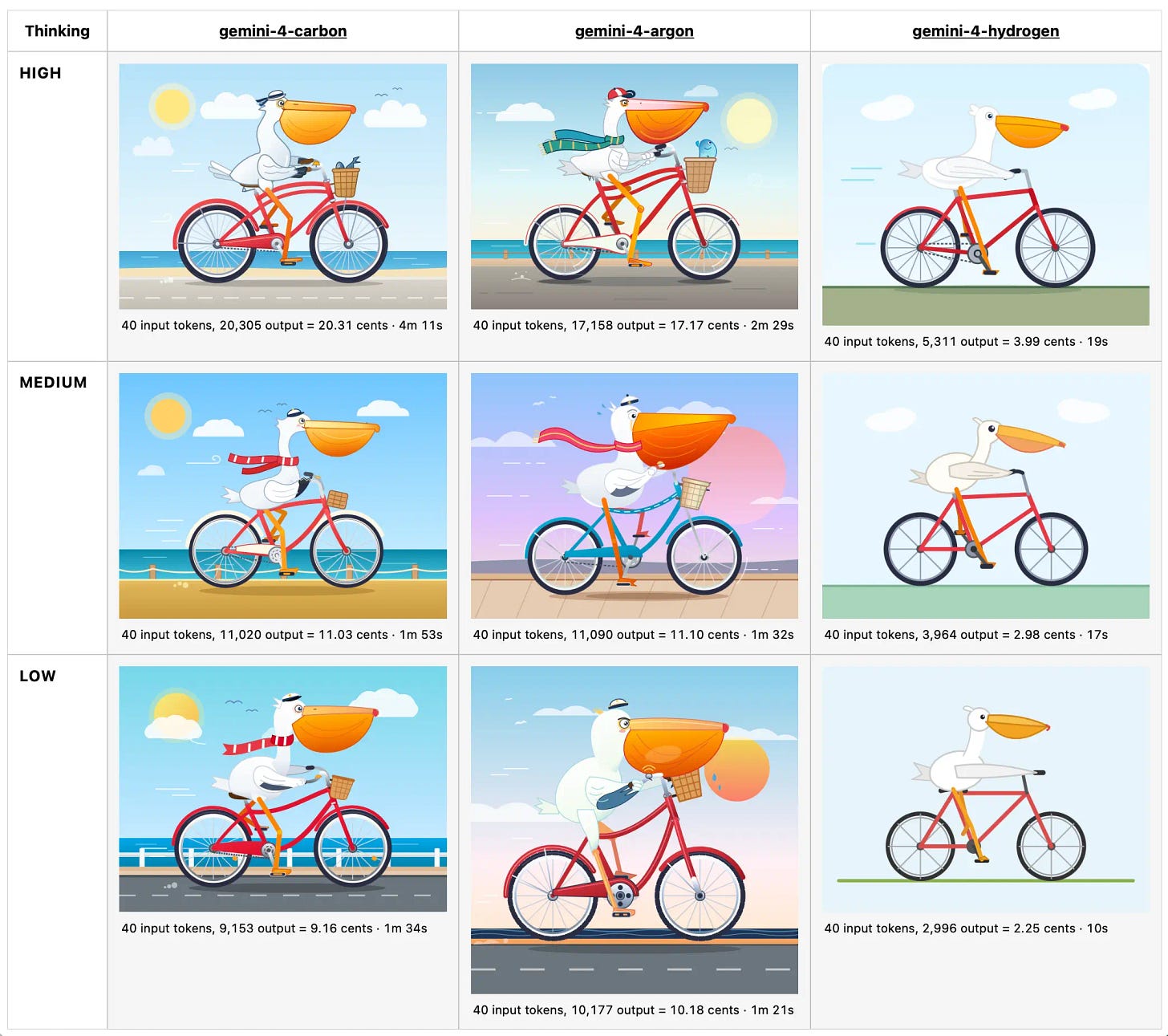
I had Hydrogen generate some pelicans (opens in new tab). Here’s a full comparison grid (opens in new tab) showing the pelicans for all three members of the Gemini 4 family at their three supported effort levels:

Considering how close they are in price, the difference in pelican quality for Hydrogen is quite stark.
Here’s how Google describe (opens in new tab) Hydrogen’s intended position in their mix of models:
In real-world software development, while teams rely on frontier models like Carbon and Argon for deep architectural judgment when designing systems or untangling subtle bugs, they still need a fast, disciplined execution model for writing code, running tests, and verifying changes. Hydrogen is built to stand on its own as a model for everyday work — or to pair with Carbon and Argon as the high-efficiency execution engine in multi-model workflows.
Most notably, Hydrogen is the new free tier model, and is the model that will power AI features in Google Search.
OpenStreetMap have a very reasonable policy that hits to their hosted tile server should send a referrer header (opens in new tab). Datasette table pages used the Referrer-Policy: no-referrer HTTP header, causing plugins that loaded tiles from OpenStreetMap to violate that policy.
datasette-leaflet is the plugin that loads a bundled Leaflet so other Datasette plugins can depend on it. It now sets the referrer policy on the tile requests themselves to strict-origin-when-cross-origin, passing the host but not the full path to the page.
One of the oldest Datasette plugins, and still one of my favorites. It now works with Datasette 1.0a42, and depends on the new datasette-leaflet (opens in new tab) to ensure OpenStreetMap tiles are requested with a referrer header.
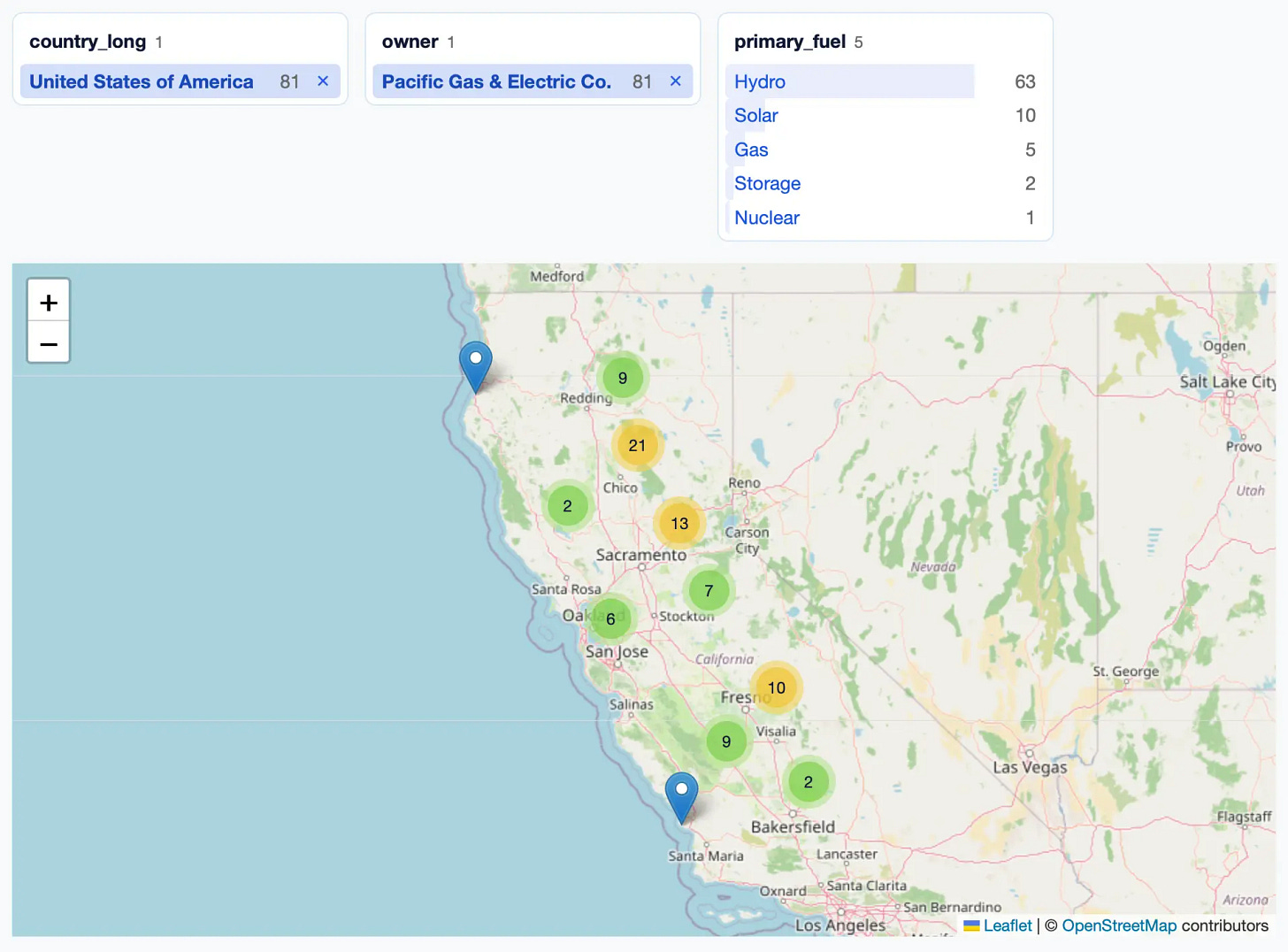
Here’s a map of power plants owned by California’s PG&E (opens in new tab), also demonstrating Datasette’s recently redesigned facets (opens in new tab):

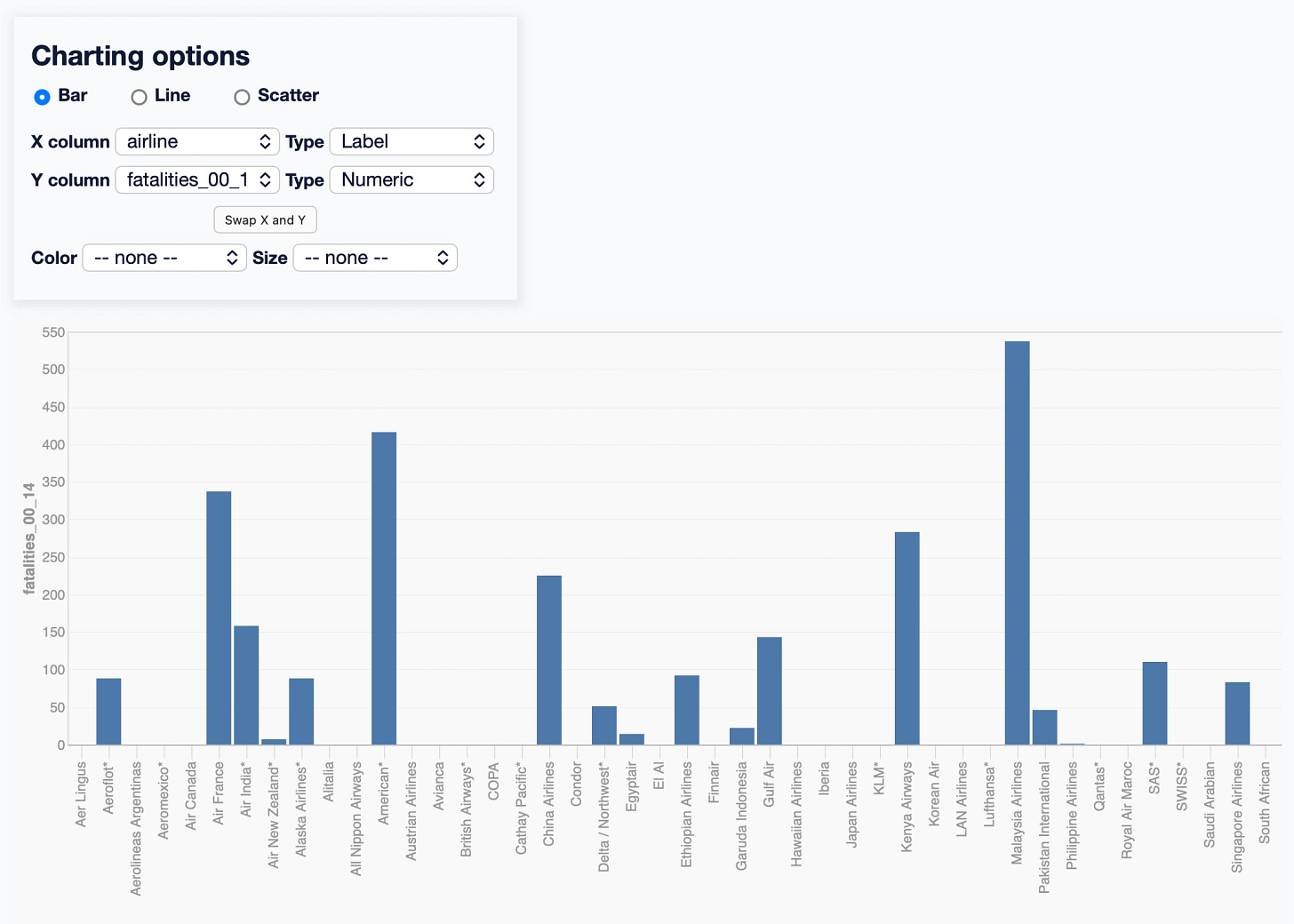
A new release of Datasette’s longest untouched plugin, for rendering charts (using Vega-Lite (opens in new tab)) against data in a table or custom query. The last release was in July 2018!
I finally bumped it for compatibility with the latest Datasette alphas, plus some cosmetic tweaks to make it work better with Datasette Lite (opens in new tab).
(Datasette Lite just gained the ability to run JavaScript plugins like this! I’ll write more about that soon.)
Since it works with Datasette Lite, the live demo in the README now links to this demo on Datasette Lite (opens in new tab).

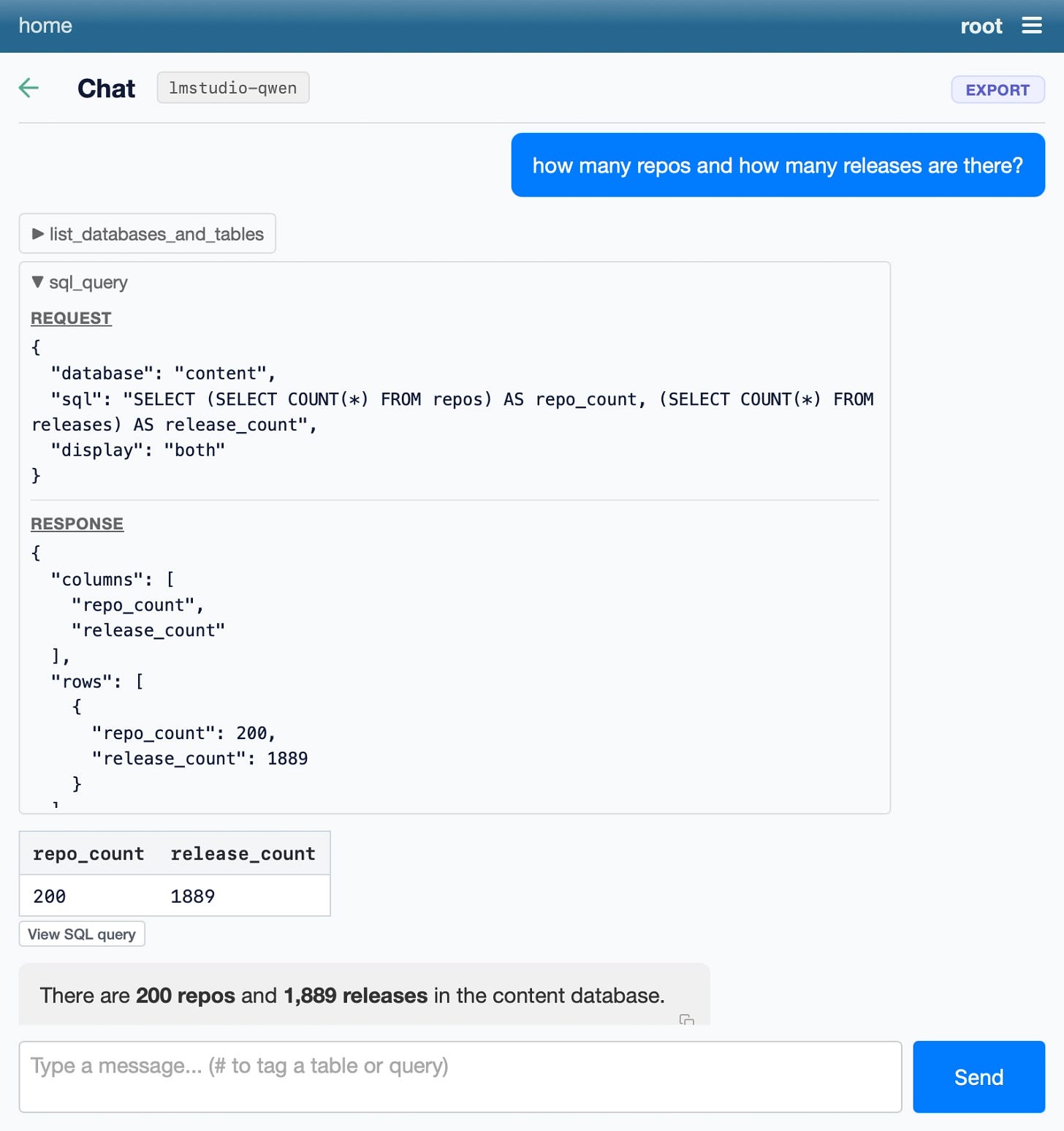
datasette-llm is the intermediate plugin for Datasette that supports configuring LLMs for use with other Datasette plugins.
This release adds support for OpenAI-compatible endpoints, so you can configure Datasette to use an LLM hosted anywhere that talks the OpenAI pseudo-standard web protocol.
This means that if you’re running local models with LM Studio (opens in new tab) or Ollama (opens in new tab) or llama.cpp (opens in new tab) (which just hit v1.0.0 (opens in new tab)) you can run Datasette via uvx like this:
wget https://datasette.io/content.dbuvx --with datasette-agent datasette
--root --secret 1
-s plugins.datasette-llm.default_model '{
"model": "lmstudio-qwen",
"model_name": "qwen/qwen3.8-27b",
"api_base": "http://localhost:1234/v1"
}' content.dbAnd you’ll get a local server running a Datasette Agent instance powered by your local model!

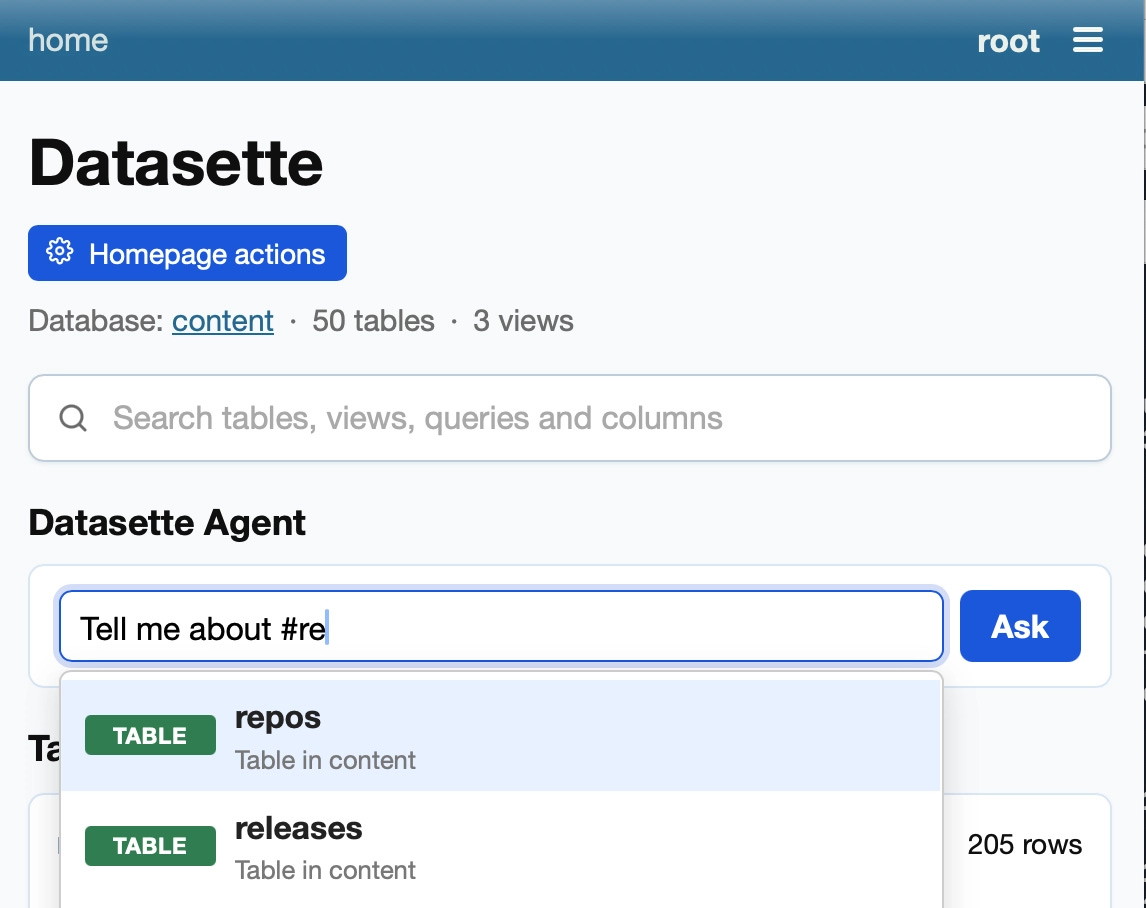
Accumulated small fixes for Datasette Agent, my agent plugin for Datasette that lets you ask questions about your data. Most notably, it now adds an agent prompt directly to the Datasette homepage, with support for hash-mentions of tables and queries:

Datasette Apps are sandboxed HTML and JavaScript applications that live inside Datasette - think Claude Artifacts, but these ones can run SQL queries against your data.
0.4a0 adds support for linking: you can link to an app with #fragments in the URL and the app can see and use those, plus supported URL schemes are reported back to Datasette Agent so it can help write apps that link to each other.
This means you can have e.g. an app that shows details about a specific record, and a completely separate app that searches those records and links to their representations in the first app.
Release: datasette 0.65.6 (opens in new tab)
I backported a minor security fix from 1.0a43:
Fixed a security issue where a database registered using
add_database(db, name=..., route=...)with a route that differs from its name could be downloaded from/<route>.dbby actors who were denied access to it. […]
Release: datasette 1.0a43 (opens in new tab)
I’ve been leaning hard into Claude Fable 5.2 to help knock things off the 1.0 milestone (opens in new tab), which is now 53% complete.
The biggest 1.0 item in this release is streaming support for output renderers (opens in new tab) - the built-in TSV and CSV export mechanisms now use this as well, and plugins can register themselves as capable of streaming every row in a table in one go via the new Response.stream() (opens in new tab) method.
There are a couple of security fixes, one of which I deemed deserving of a GitHub advisory (opens in new tab): private stored queries could be exposed, granting access to the title and SQL of the query (but not allowing that query to be executed).
There are dozens of smaller improvements. The row page JSON representation finally has a design suitable for 1.0 (opens in new tab). A new <datasette-copy-button> Web Component provides copy-schema in various places. JSON in columns on the row page can be pretty-printed. There’s a new DatasetteModal.confirm() (opens in new tab) JavaScript utility method. Plus dozens of bug fixes, including contributions by Zihan Dai (opens in new tab), Peter Olkhovets (opens in new tab), Ilya Khalafi (opens in new tab), and Ankita Advitot (opens in new tab).
The feature I’m most excited about is a pretty tiny one: I’ve added CSS multi-page view transitions to Datasette! Here’s the commit (opens in new tab) - key CSS is as follows:
/* Enable cross-document view transitions,
for anyone without prefers-reduced-motion */
@media (prefers-reduced-motion: no-preference) {
@view-transition {
navigation: auto;
}
}
/* .facet-results should morph from old position to new */
html:active-view-transition .content > .facet-results {
view-transition-name: facet-results;
}
/* So should a .table-wrapper, provided it contains .rows-and-columns */
html:active-view-transition .table-wrapper:has(> table.rows-and-columns) {
view-transition-name: rows-table;
}With that in place, navigations within Datasette - still staunchly a multi-page application - feel more like an SPA. This works on Safari and Chrome at the moment and I believe supports for Firefox is due to land in Firefox 162 (opens in new tab) on December 8th 2026 (seeing as they are no longer feature-flagged in Firefox Nightly.)
The first new Datasette geospatial plugin in quite a while! This one combines the excellent MapLibre GL (opens in new tab) library with OpenFreeMap (opens in new tab), the free vector map server operated by Zsolt Ero (you should sponsor Zsolt on GitHub (opens in new tab).)
I built most of this with a single prompt to Claude Fable 5.2:
Look at datasette-cluster-map and datasette-leaflet-geojson plugins, then look at ~/dev/tools/openfreemap-demo.html - then build a brand new Datasette plugin that uses maplibreGL and openfreemap and combines the features of those other two plugins - but be creative and think outside the box for other useful features the plugin might have
“Be creative and think outside the box” resulted in a few neat ideas - my favorite is that it displays SVG previews of GeoJSON shapes, then loads a WebGL preview only when they scroll into view.
I also had Claude build a comprehensive demo which works in the latest Datasette Lite, so you can visit this link (opens in new tab) to load the plugin and a demo database in your browser via Pyodide and WebAssembly.
I like this demo page (opens in new tab) showing both GeoJSON shapes and lat/lon points on the same map:

Release: llm 0.37.3 (opens in new tab)
A bug fix release for LLM (opens in new tab), mainly to cover a problem with the most recent Homebrew package of the software.
Homebrew now ships the latest SQLite, 3.54.1 (opens in new tab), which includes a fix (opens in new tab) that broke LLM’s logging code (opens in new tab).
Short version: in SQLite 3.54.0 the following SQL:
select json_object('a', (select json_array(1)))Returns this:
{"a":[1]}But in 3.54.1 the same query returns this:
{"a":"[1]"}According to D. Richard Hipp (opens in new tab):
That was a bug fix. Per the documentation, (SELECT json_array(…)) returns SQL text, not JSON. Hence the 3.54.1 behavior is correct and 3.54.0 was a bug.
The workaround looks like this:
select json_object('a', json((select json_array(1))))Quote 2026-11-17
A little copying is better than a little dependency.
If you find this newsletter useful, please consider sponsoring me via GitHub (opens in new tab). \$10/month and higher sponsors get a monthly newsletter with my summary of the most important trends of the past 30 days - here are previews from July (opens in new tab)and August (opens in new tab) and September (opens in new tab).
- Prototype-to-production: Simon used Claude Opus 4.8 to generate a May research spike for Datasette Lite, but says he shipped it only in November, after becoming familiar enough with the system while working with Claude Fable 5.2.
- Prompt pattern: Simon built most of the Datasette MapLibre plugin with one Claude Fable 5.2 prompt: inspect two existing plugins and a local demo, combine their features, and brainstorm beyond them. The creative instruction produced SVG previews of GeoJSON shapes, with WebGL previews loaded only when scrolled into view.
- Agent-code sandboxing: The external-sandbox pattern keeps the coding agent outside a dedicated sandbox where its code runs. Three implementations use v86 with Alpine Linux in WebAssembly, Alpine inside Apple Containers, or Microsoft Quicksand/QEMU; all expose the same localhost API for Pi, Claude Code, and Codex. Optional HTTP/HTTPS allow-listing and credential replacement control network access and let code make authenticated calls without giving the agent the secret.
- Reported capability: Anthropic co-founder Tom Brown said the Mythos model brought Claude up on AMD in three days with almost no human intervention, porting or writing nearly all the kernels; he contrasted this with previous chip-platform onboarding that took dozens of engineers months.
- Model caveat: Assessments of GPT-6.2 Astra were mixed: Theo Browne said it could coordinate subagents on long tasks but stalled two hours into an Outer Wilds level task to ask about an obscure filename choice. In Simon’s Codex CLI Three.js mech-animation test, Astra and Sol also did not match Claude Fable 5.2 or Gemini 4 Carbon.