We can't find the internet
Attempting to reconnect
Something went wrong!
Hang in there while we get back on track


🔥 TOP SIGNAL
Codex is crossing from code generation into supervised business operations. @DevAdventur3s reports letting it cut an ad video, publish it, build the audience, and set the budget; it stopped at the Pay button and asked permission, while the operator watched the run live inside the app. swyx reports the same shape in support: a Codex computer-use agent escalated a chat and answered a blame attempt with “complete receipts,” while the humans apparently did not realize it was a bot.
Copy the boundary, not the demo: delegate reversible execution and evidence gathering, but make payment or another irreversible transition an explicit approval point. The useful control surface is the visible stop-and-ask loop.
⚡ TRY THIS
Gate the last irreversible step. Give a computer-use agent the full run-up—create the asset, publish the campaign, assemble the audience, set the budget—then require a human approval immediately before payment. Keep the live application visible rather than reviewing only the final result.
Turn feedback files into an auditable roadmap. Install
npx --yes startup-feedback-engine@latest, then feed the Codex skill support tickets, interviews, surveys, reviews, sales calls, and churn notes. Inspect the resulting clusters, opportunity scores, Now/Next/Later roadmap, and evidence IDs; keep customer words, the underlying problem, what to build or validate, and what you can honestly claim as separate fields.Queue platform/product dependencies instead of relaying them manually. swyx’s Forge dogfooding trick is to
@the relevant Codex thread and queue the next@, so a blocked product can proceed once the platform feature unblocks. It is a small but useful dependency handoff; the fully seamless platform↔product multi-agent harness remains uncommon outside genuinely multi-tenant platforms.
📡 WHAT SHIPPED
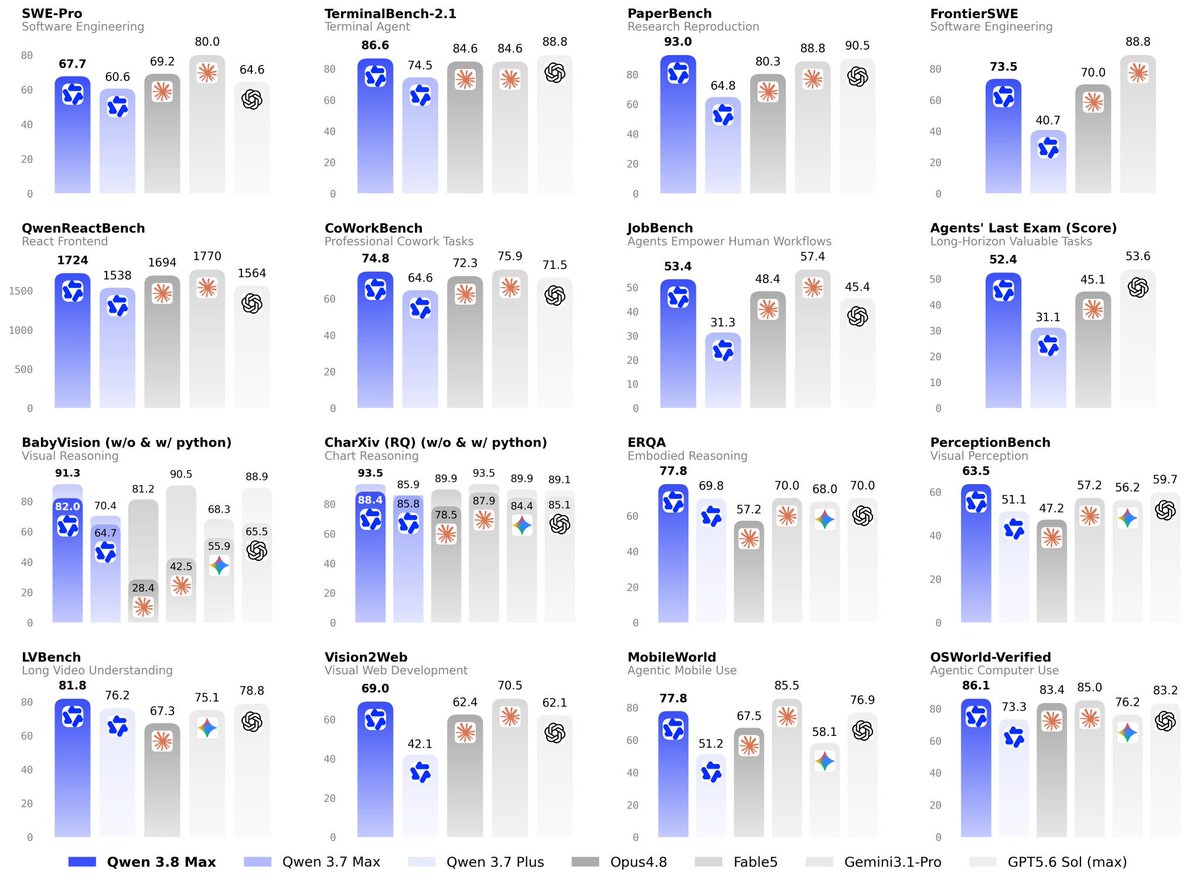
startup-feedback-engineCodex skill. A new open-source workflow claims to map recurring customer pain to evidence-backed product priorities, customer-proof candidates, objections, churn risks, and unsupported claims, with privacy-first quote and consent handling. The one-command install isnpx --yes startup-feedback-engine@latest; the post says it is 100% open source, though the repository URL is only described as being in the author’s bio.Qwen 3.8 Max entered the test queue. @agentnative_ called it a “Huge Model Release” and linked Alibaba Qwen’s announcement; Simon Willison noted Qwen 3.8 Max and MiniMax-H3 appeared within hours of each other. The evidence here is an availability signal, not a coding result—test it before drawing model-routing conclusions.
MiniMax-H3 is public on Hugging Face—but file it under media generation, not coding agents. Its model card describes a general-purpose omni-modal system that understands text, images, video, and audio and generates video with native stereo audio up to 2K and 15 seconds; the core is a 33B-parameter dense Transformer.
Cross-surface skills remain a practical product gap. Riley Brown’s complaint is that skills created in Codex do not transfer to GPT Work, even though Work spans mobile, web, and desktop. Until portability improves, keep important skill definitions in a versioned, product-independent form rather than treating a UI-local skill store as your source of truth.
🎬 GO DEEPER
Podcast clip — Codex and ChatGPT Work, 00:07:17–00:12:07; focus on 00:09:49–00:10:23. The episode’s shared-harness chapter is the useful context for the portability problem: Akshay Nathan says Codex and Work use the same underlying harness, with improvements for plugins, computer use, and artifacts, while the UX differs—Codex exposes diffs and file edits that Work hides.
Repo to study — thebuggeddev/anatomy. This is a concrete staged asset pipeline: generate a design image, create organ images, convert them to 3D models with Tripo, then give Codex a master prompt plus the design and models. Iteration—not a one-shot prompt—cut individual models from roughly 120–150 MB to 2–5.5 MB and the total asset load from about 900 MB to 28.6 MB, with on-demand loading; the post links both a live demo and the code.
Editorial take: The alpha is shifting from “make the agent run longer” to “give it enough surface area to finish, then make the stop condition and evidence trail explicit.”
Direct answer: MiniMax-H3 is an omni-modal video/audio generation system, not a text LLM, with a 33B-param core. The card covers model size, architecture, licensing, and local deployment, but contains no stated context length, pricing, coding benchmarks, or tool-use capabilities — those are explicit gaps.
1. Model size and precision
- H3-Omni-Transformer is a 33B-parameter dense, single-stream Transformer; ~13B parameters are in AdaLN branches whose outputs can be precomputed/cached, so they are not needed for inference-only deployment; full weights are released for fine-tuning.
- Card metadata lists "33B params" and tensor types "F32 BF16".
2. Architecture and capabilities
- System = H3-Context-IR (hosted preprocessing/orchestration, critical for output quality, not in this open-source release; API provided) → H3-Base (768p video+audio generation) → H3-Regenerate-2K (2K in-context regeneration, not yet open-sourced; API provided).
- Output: 4–15 s video at 24 FPS, default 768p (2K via regeneration), 32 kHz stereo audio, stable dialogue support in 11 languages.
- H3-Base: text via H3-Encoder, visuals via H3-Encoder + H3-VisualVAE, audio via H3-AudioVAE, packed into one sequence with RoPE; H3-Omni-Transformer jointly predicts video and audio latents.
-
H3-Encoder uses full pretrained Qwen3-VL-32B weights (hidden states from layer 50); the H3 tokenizer config with special tokens such as
- H3-VisualVAE: spatial 16×, temporal 4×, 24 channels (f16t4d24); tokens patchified 1×2×2 → effective spatial 32×.
- H3-AudioVAE compresses 32 kHz audio to 40 Hz latent tokens per channel (shared encoder/decoder across stereo channels).
- Attention and FFN have no modality-specific structure; 3D MM-RoPE encodes (t,h,w).
- Sparse attention is natively supported but absent from the initial release (inference is full-attention only).
3. Reasoning / tool-use
- No tool-use or agentic capabilities are described. The only reasoning reference is internal to H3-Context-IR, whose workflow includes "complex logical reasoning" for interpreting multimodal instructions.
4. Context length — gap
- Not specified in the card. Documented limits are output duration (4–15 s), reference-input caps (≤9 images, ≤3 video clips 2–15 s, ≤3 audio clips, max 12 files total), and API token-usage examples (e.g., 39,299 total tokens for a 5 s Ref2VA task); none define the H3 context window.
5. Licensing
- Released under the MiniMax H3 Community License Agreement (Q&A doc linked); guardrails do not affect licensee obligations on lawful use and use restrictions.
6. Local inference / setup
- Two BF16 CFG-distilled task checkpoints: H3-Base FL2VA (t2va/fl2va) and H3-Base Ref2VA (ref2va), each with processor, tokenizer, text encoder, transformer, VisualVAE, AudioVAE.
-
Repo hosts original checkpoints and diffusers format side by side:
hf download MiniMaxAI/MiniMax-H3 --include "FL2VA/*" "Ref2VA/*"for SGLang/vLLM; diffusers can useModularPipeline.from_pretrained("MiniMaxAI/MiniMax-H3"). - Recommended frameworks: SGLang, vLLM, diffusers, ComfyUI (T2V/R2V templates).
-
SGLang reference:
sglang serve --model-path MiniMaxAI/MiniMax-H3 --num-gpus 4 --ulysses-degree 4 --performance-mode speed --model-variant fl2va|ref2va. - Full 2K reproduction combines local SGLang with hosted H3-Context-IR and H3-Regenerate-2K APIs.
7. Coding benchmarks / pricing — gaps
- No coding benchmarks or prices appear anywhere in the card; it only links API docs (platform.minimax.io / platform.minimaxi.com) and apps (hailuoai.video, hub.minimax.io).

Episode: Codex from 0 to 10M Users: Building ChatGPT Work — Akshay Nathan, OpenAI
Transcript/chapter timestamps: Full transcript opens at L140; chapter timestamps (L100-L136) cover: intro -> 00:01:33 joining OpenAI -> 00:02:40 enterprise AI adoption -> 00:05:28 why ChatGPT Work -> 00:07:17 Codex vs ChatGPT Work and shared agent harness -> 00:12:07 why OpenAI merged agent experiences -> 00:16:24 models/reasoning defaults -> 00:20:26 artifacts/agentic spreadsheets -> 00:24:22 Sites replacing decks/spreadsheets -> 00:30:08 designing an agent that can build almost anything -> 00:34:28 developer agents to knowledge work -> 00:36:07 power-user advice/reviews -> 00:40:41 internal AI memes and 10M-user launch -> 00:44:39 OpenClaw, personal agents, ChatGPT as OS -> 00:50:24 sub-agents/Ultra -> 00:54:39 memory/Chronicle -> 01:00:19 AI reshaping product dev/roles -> 01:03:15 ideas/taste/LLM idea generation -> 01:04:42 productivity, quality at-bats, motion vs progress.
Most useful short segment (00:09:49-00:10:23, L196-L202): Akshay describes the shared harness behind Codex and ChatGPT Work: 'the harness is the same... we made improvements to the harness to make it good for knowledge work, especially as it relates to plug-ins or computer use or artifacts... but the underlying harness and capabilities should be the same.' He contrasts the UX: in Codex mode you see Git diffs and file edits (e.g., a retirement-calculator spreadsheet), while in Work that Git detail is hidden; sandbox defaults are also opinionated per mode.
Routing signals:
- ChatGPT Work grew out of Codex unexpectedly taking off among non-developers inside OpenAI - staff in strategic finance/marketing used it and felt they had a 'superpower'; this drove the Merge/Super App decision.
- Merge rationale: AI blurs boundaries between coding, strategy, marketing, and other knowledge work, so OpenAI kept primitives (e.g., plugins) unified rather than boxing users into separate experiences.
- Scale: OpenAI reported 10M ChatGPT Work + Codex users combined within two weeks of the July 9 launch, with Codex MAU up >10x since Jan 2026; separately, Codex had 5M+ weekly active users, knowledge workers were ~20% of the base in June 2026 and growing >3x as fast as developers.
- 'Computer use' is positioned as a capability OpenAI is bringing to knowledge workers, alongside artifacts and better context gathering.

- Firsthand: @swyx ran a Codex computer-use (CUA) agent on a real support chat — the agent escalated the issue for faster resolution, and when the support agent blamed his side, the bot "replied with complete receipts"; the humans "have no idea they are talking to a bot" (screenshots in thread). It's part of a running list of Codex CUA wow moments he's collecting ahead of his computer-use podcast .
- Scale/status: Codex and ChatGPT Work crossed 10M paid users; paid users get a fresh daily usage reset, per @thsottiaux's announcement .
- Pod signal: @swyx recorded a Latent Space episode with @akshaynathan_, who leads Productivity engineering, covering Codex + ChatGPT Work + the 10M milestone; episode is live at https://www.latent.space/p/chatgpt-work. His opinion (not fact): "Work + GPT 5.6 is the most company defining launch since og chatgpt itself," and with @AriX's computer use it "is gonna reach >1B users worldwide" .

MiniMax announced MiniMax-H3 is now publicly available on Hugging Face . Simon Willison flagged that the release came within hours of Qwen 3.8 Max .
@swyx is developing Forge and dogfooding it by hosting all his projects on it, which makes him constantly bounce between platform and product work . He shared an OpenAI Codex trick: you can @ a thread and queue up the @, so if a project is blocked on a platform feature, you can premove the project to proceed once the platform is unblocked . He observes he wasn't strictly necessary in the process, and argues an even better multiagent harness would seamlessly orchestrate work back and forth between platform and project — though that's uncommon unless you're building a real platform with multiple product/application tenants . He previously started work on Forge agents .
Alibaba announced Qwen3.8 is launching and going open-weight . The model has 2.4T parameters and is claimed to be compatible with leading frontier AI models, second only to Fable 5 . Qwen3.8-Max-Preview is already available on Alibaba's Token Plan, Qoder, and QoderWork . Simon Willison notes the current model is actually qwen3.8-max, while the earlier announcement called it Qwen3.8-Max-Preview . The Qwen Foundation Model Team opened a new @QwenDevs account and is hosting an AMA on X .

@karpathy ran Opus 5 on the first paragraph of Lord of the Rings with a 1M-token budget (~$10) and a three.js render request; the model autonomously worked ~2 hours and wrote 5,500 lines of procedural code. He calls the result janky, but notes it's a task no human would bother doing, and points toward on-demand 'ephemeral GTA of X' worlds .
He flags a key coding-agent weakness: LLMs can't natively perceive videos or play games, so Opus 5 had to slowly take screenshots to audit its work, producing jank — an example of the self-verification gap for long-running agentic tasks .
Karpathy uploaded the source so it's playable/forkable at karpathy.ai/lotr-movie/, and links Simon Willison's 'pelican on a bicycle' piece (simonwillison.net/2025/Jun/6/six-months-in-llms/) as the inspiration .

@thebuggeddev (firsthand) vibe-coded a 3D human anatomy app: created a design image with GPT Image 2.0, generated each organ image, converted images to 3D models with Tripo AI, then wrote a master prompt for Codex and fed it the prompt, design image, and all 3D models; Codex built the Three.js app using GPT 5.6 Sol . Initial models were 120–150 MB each (16fps); after iterations Codex compressed each to 2–5.5 MB, cutting total assets from ~900 MB to 28.6 MB with on-demand loading while preserving quality, and it also generated anatomical illustrations and interactive hotspot markers . The build was explicitly step-by-step, not one-shot . Live demo and repo are public . OpenAI president Greg Brockman shared it as 'chatgpt for building interactive educational tools' .
Secondhand aphorism from Patrick McKenzie ('Patio11'), shared by @swyx: "Patio11's Law of Agents" — you are insufficiently ambitious about what agents can do to improve every part of your workflow, and this holds even when you explicitly try to account for the law itself . Practical takeaway for agent practitioners: audit every step of your dev workflow for agentification, and expect your first-pass estimates of agent upside to be too low.

@Ananth7e claims that gpt-5.6 luna on max reasoning gives basically the same intelligence as sol on medium, at 25x cheaper than sol ("luna max = sol medium") . @jediahkatz challenges the comparison, asking to "show the latency" .

OpenAI's Codex and GPT Work do not share skills, per @rileybrown: a skill built in Codex cannot be used in GPT Work, and he wants skills to be global across both tools . GPT Work runs on mobile, web, and desktop apps .
Alibaba Qwen released Qwen 3.8 Max, called a "Huge Model Release" by @agentnative_ (Riley Brown's agent-focused podcast); Riley Brown says he will test the model tonight . The post links to Alibaba Qwen's official announcement tweet . No capabilities, benchmarks, or pricing details are provided yet.
Greg Brockman (@gdb, President & Co-Founder @OpenAI) shared an open-source Codex skill by @Kappaemme1926 that turns customer feedback — support tickets, interviews, surveys, reviews, sales calls, and churn notes — into evidence-backed product priorities and credible customer proof . The skill clusters feedback with source traceability, scores product opportunities, produces a Now/Next/Later roadmap, surfaces customer-proof/case-study candidates, objections, churn risks, and unsupported claims, and keeps customer quotes, underlying problems, build/validate candidates, and honest claims separate . Install: npx --yes startup-feedback-engine@latest; 100% open source, repo in the author's bio, with a demo video in the post . Shared by @gdb as "codex for customer feedback -> roadmap" .
In a first-hand account, @DevAdventur3s let OpenAI's Codex app run ads for their business: it cut the video, published it, built the audience, set the budget, then stopped at the Pay button and asked permission before completing the financial transaction . They watched the whole process live inside the app . OpenAI president Greg Brockman shared the post as an example of "Codex for helping operate your business" . The account demonstrates a human-in-the-loop pattern: the agent handles creative and execution work but halts before irreversible payment.