We can't find the internet
Attempting to reconnect
Something went wrong!
Hang in there while we get back on track


Education AI is entering an evidence-and-design phase. The practical question is no longer whether a system can make a student’s work look better, but whether the student can still perform when the system is removed. A current analysis of 27,000 students in China, new U.S. federal guidance, and a wave of student-facing product launches all point to that test.
The learning test is what remains when AI is gone
The clearest current signal is a short-term/long-term split. The Economist analysis reports that students using AI saw homework scores rise 18% and spent less time on assignments, but scored 20% worse on exams than students who did not use AI. The result does not make every AI use harmful; it does show why homework performance is becoming a weak proxy for learning when the tool does the hard cognitive work.
Stanford’s SCALE brief offers a useful filter for product claims. High-impact tutoring remains defined by live, human-led instruction; AI-led tools may provide supplemental practice, but they do not inherit that evidence base simply because they give one-to-one responses. The established tutoring literature reports average effects of 0.29–0.37 standard deviations, with stronger programs meeting frequently, connecting to classroom curriculum, adjusting from evidence of student understanding, maintaining a relationship over time, and training and supporting tutors.
A randomized field experiment with nearly 1,000 high-school mathematics students makes the distinction concrete. Unrestricted GPT-4 increased practice performance by 48%; a guardrailed “GPT Tutor,” supplied with teacher-written solutions and instructed to give hints, increased it by 127%. Once AI was removed, the general-chatbot group scored 17% below the control group on an unaided test, while the guardrailed group performed about the same as control. Guardrails prevented the measured harm, but did not automatically produce a learning gain.
The evaluation problem is still visible at the model level: the best of 16 frontier models scored about 56/100 on TutorBench; almost no model-and-agent combination sustained strong tutoring across a simulated 30-day relationship; and six frontier models gave the answer in 97% of conversations with simulated eighth-graders when given generic instructions to be helpful. The last result is a diagnostic simulation, not a classroom failure rate, but it shows that “helpful” and “tutoring” are different objectives.
Federal guidance meets AI-first school politics
The U.S. Department of Education’s new Dear Colleague Letter turns that learning question into a selection standard. It says technology should have a clear instructional purpose, be backed by independent evidence, be transparent about design and data use, and have strong implementation. States and districts are told to focus on learning impact, choose tools with proven results, review effectiveness regularly, and support educator training; repeated failure should lead to removal. The department’s five questions are practical: What problem does the tool solve? When and for whom should it be used? For how long? What evidence shows that it improves learning?
The guidance favors instructional value over screen exposure, but leaves decisions to states and local communities. That creates a meaningful evidence bar without a single national implementation regime. EdSurge’s account notes that the department declined to offer new rules, while experts warned that privacy, accessibility, transparency, and responsible data use should not depend entirely on a student’s state.
The same week, federal education rhetoric gave an AI-led private-school model a prominent platform. Secretary Linda McMahon posted that responsible classroom AI can “revolutionize” learning and said she had seen it firsthand at Alpha School in Austin. Alpha is expanding from roughly a dozen to about 50 campuses; its model uses AI apps for core subjects such as math and reading for two hours, then spends the rest of the day on activities such as robotics and surfing. Co-founder Mackenzie Price says students learn twice as much in a fraction of the time, while adults focus on motivation, connection, and life skills. Those are the co-founder’s claims, not a comparison study presented in the interview.
That makes Alpha a useful test case, not a settled model. The department is asking for independent, condition-specific evidence, while SCALE classifies AI-only tutoring effectiveness as unknown and flags dosage and integration as unresolved problems.
Student-facing AI is scaling before its evidence is settled
Google is distributing a study environment directly to eligible college students: one year of Google AI Pro at no cost in the United States and one year of Google AI Plus in 140-plus countries, with the offer running through December 31, 2026. Its student hub includes study notebooks, flashcards, and practice quizzes. Google says the notebooks can use diagnostic quizzes to identify knowledge gaps, generate bite-sized lessons grounded in class materials, and track progress on a live dashboard.
The rollout also treats AI as a learning interface rather than only a text box: Gemini can generate interactive 3D simulations and dynamic tables, and Gemini Live can run a multi-step research report in the background for the student to discuss by voice later.
OpenAI is making a parallel move for younger learners. Its August 18 launch of ChatGPT for Teens targets ages 13–17 and automatically places users into the teen experience when the system estimates they are under 18. Study Mode, homework reminders, quizzes, Learning Visualizations, and Study Hours are designed to guide students through work instead of supplying a quick answer. The product also adds default age-appropriate protections, Quiet Hours and selected parental controls, safety notifications in limited high-risk situations, break reminders, and restrictions against emotional dependence.
The design direction is more disciplined than a generic answer engine, but the learning question remains open. The current tutoring analysis calls these structured products meaningful design shifts while explicitly warning that stated pedagogy is not yet evidence of durable learning.
Teachers and leaders are absorbing the implementation cost
Justin Reich’s current interview, informed by conversations with 120 K–2 teachers and students, reaches a restrained conclusion: AI might modestly help some students learn some things, but is causing “a lot of headaches” and is not transformational. One immediate classroom response is defensive. Teachers are moving writing onto paper and into class to reduce chatbot completion, which protects authenticity at the cost of instructional time. Some are paying out of pocket for revision-history tools, yet students can still retype AI-generated work. Reich’s preferred “layers of resistance” approach breaks an essay into separately completed pieces before students assemble the final work.
The leadership capacity gap is just as concrete. In a June survey discussed by Vicki Davis and National Principals Association CEO Ronn Nozoe, seven in ten respondents said their schools were already immersed in AI, but only about 18% felt very confident leading implementation. Forty percent specifically asked for time for staff training and planning. The schools making progress, the speakers say, are doing so through administrator–teacher collaboration rather than a top-down mandate or an isolated “Lone Ranger” teacher.
Higher education is moving from chat to delegated work
An EDUCAUSE Exchange discussion describes agentic AI as systems that connect multiple steps, use tools, respond to events, and act across institutional workflows. Early use is most visible in research: the speaker estimates roughly 5% of researchers are using agentic tools, from Claude Code and Codex to networks of agents that search literature and pass summaries between one another. The governance issue is ownership: institutions that choose tools and write policies should carry substantial responsibility when agents act on behalf of staff or students.
The human role is shifting toward judgment, but the discussion warns that a nominal human-in-the-loop can become “agency laundering,” with people approving an agent’s work automatically. It also frames “cognitive triage”—deciding what to delegate and what to retain—as a basic skill. Whether saved time improves advising and student support or simply becomes more cases and higher output is an institutional choice.
For lifelong learning, the pressure is structural rather than cyclical. The World Economic Forum expects 39% of workers’ core skills to change by 2030; U.S. job postings show 32% of required skills changing between 2021 and 2024, with one in four jobs experiencing 75% skill turnover. Higher education therefore needs recurring, shorter bursts of upskilling tied to different industry speeds and learner backgrounds, not only occasional returns for another full degree.
What This Means
- For K–12 leaders: Turn the Department’s five questions into a procurement record for every AI tool: the learning problem, intended users, duration, implementation owner, and evidence of impact. Separate instructional use from recreational screen exposure, and make removal a real option when results do not hold.
- For assessment leaders: Add an unaided transfer check to any workflow in which AI improves the submitted artifact. Staged drafts, explanations, and observed performance can protect learning without making continuous surveillance the default; the current classroom response shows that anti-cheating measures can consume instructional time.
- For edtech buyers and product teams: Evaluate the tutor, not just the model. A credible student-facing tutor should pursue a defined objective, elicit evidence of understanding, adapt its next move, and keep the student responsible for the thinking; test engagement, dosage, and performance after AI is removed.
- For higher-ed and L&D teams: Assign clear ownership for agents and protect the time they save for judgment, feedback, and relationships rather than automatically increasing caseloads. Design recurring learning in short, rigorous units that match the pace of work and the learner’s existing expertise.
Watch This Space
- Outcome evidence for direct-to-student AI: Google’s student hub, OpenAI’s teen experience, and Alpha’s expansion all need measures beyond usage or polished work: sustained engagement, unaided performance, learning transfer, and the dosage required to produce it.
- Federal guidance becoming local practice: Watch whether states and districts convert the new evidence language into performance-based contracts, independent evaluations, transparent data-use requirements, and actual removal of tools that fail.
- The reality of human oversight: In higher education, the key test for agentic systems will be whether “human in the loop” remains attentive judgment rather than automatic approval—and whether saved time reduces burnout instead of triggering the academic ratchet.
Direct answer: As of the Aug 18, 2026 announcement , OpenAI is introducing ChatGPT for Teens as a learning-focused experience with default safety protections and parental controls. Users are automatically placed if the system estimates they are under 18 or they state an age of 13–17, so the product's teen range is 13–17 while under-18 protections apply broadly .
- Learning features: Study Mode provides guiding questions and step-by-step support; responsible homework reminders detect shortcut attempts and redirect to Study Mode; quizzes and Learning Visualizations add practice; Study Hours let teens or parents schedule times when Study Mode is on by default .
- Limitation: no quick answers: If a teen asks for a quick answer, ChatGPT guides them toward steps and questions instead, and homework reminders redirect likely assignment-shortcutting toward collaborative problem solving . The featured teacher quote stresses the tool should not simply hand students an answer .
- Default safety protections: Protections are on by default, using age-appropriate safeguards to reduce exposure to harmful or developmentally inappropriate content while preserving learning, creation, and exploration; based on Under-18 Principles, with higher-risk areas including self-harm, violence, eating disorders, dangerous activities, and explicit sexual or graphic content .
- Parental controls: Parents with linked teen accounts can set Quiet Hours, manage selected settings, and receive safety notifications in limited high-risk situations; new eating-disorder-related notifications are being added, with sharing limited .
- Healthy-use and relationship safeguards: Break reminders and consistent AI identification are included; the updated under-18 model spec bars romantic language, emotional dependence, and implications of feelings or consciousness, beyond blocking romantic or sexualized roleplay . Additional cues include sensitive-image upload reminders, teen-specific onboarding, and limited customization such as accent colors and voice variations .
- Classroom boundary / student-use limitation: The experience is designed for learning outside the classroom; educators remain in control of classroom AI use, with institution-managed access through ChatGPT for Teachers .
- Gaps/uncertainty: The source is an announcement and does not specify availability timing, platforms, regional coverage, pricing, or detailed parental-control operation; it says under-18 evaluation results are only beginning to be shared in system cards .
Direct answer
The Department's new guidance is a Dear Colleague Letter that maintains four core requirements — clear instructional purpose, independent evidence, transparent design and data use, and strong implementation — while urging states to lead and preserve educator judgment. The release does not describe a procurement procedure as such; it sets expectations for selecting, reviewing, and removing tools.
Findings
- Form and core requirements. The Department released new guidance to help states, districts, educators, families, and ed-tech providers make informed choices, in the form of a Dear Colleague Letter that focuses on instructional value over recreational engagement and urges states to pair innovation with evidence, educator judgement, transparency for parents, and emphasis on student outcomes (). The DCL maintains four requirements: clear instructional purpose, independent evidence, transparent design and data use, and strong implementation ().
- Instructional purpose. Assistant Secretary Kirsten Baesler states instructional technologies should be judged by impact on learning, not by whether they happen on a screen, and that tools that distract recreationally can expand access to advanced courses, support students with disabilities, and close learning gaps when used wisely (). States and districts should focus on learning impact (); providers should minimize unnecessary screen time ().
- Evidence. The guidance calls for technology use backed by independent evidence and tools with proven results, with regular effectiveness review (). Every ed-tech product should be able to answer, among five questions, “What evidence demonstrates that it improves student learning?” (). When evidence shows a tool is not improving learning, schools must be willing to change course, and when repeated findings confirm persistent shortcomings, they should remove it altogether ().
- Educator judgment. The DCL urges educator judgement () and calls on states to preserve the human-centered core of teaching (). It follows Secretary McMahon’s July 2025 letter, which outlined five responsible-use AI principles including that education technologies should be educator-led ().
- State/district implementation. States and local communities should continue to lead decisions about tool use (). States and districts should focus on learning impact, choose tools with proven results, review effectiveness regularly, and support educator training (). Schools and providers should build transparency around how and when technology is used, screen time, implementation, and whether use contributes to learning outcomes (). The release also affirms that states and schools are right to take steps to remove cell-phone and algorithm-driven social-media distractions ().
- Procurement gap. The release does not specify a procurement process or vendor-selection procedure; it addresses selection and use, requires choosing proven tools, and requires removing tools that repeatedly fail, while states and local communities lead decisions about tool use ().
- Uncertainty/Gap. This release is the Department’s own summary; the full DCL is linked but the linked PDF is not in this bundle, so requirements not summarized in the release cannot be verified here ().
Direct answer: The provided SCALE brief confirms the core evidence hierarchy — relational intensity is the organizing axis, human-led high-impact tutoring rests on a robust evidence base, and AI-led models taper to unknown effectiveness — but it does not mention any guardrailed versus unrestricted GPT-4 experiment, so that portion of the objective cannot be verified from this bundle.
Findings
- Relational intensity is the hierarchy axis: The brief defines AI tutoring models by 'relational intensity,' the depth and consistency of the human connection between student and tutor, ranging from human-led models with close, sustained relationships to AI-led models with minimal or no human interaction. It states that as direct human relationships decrease, the evidence base becomes thinner, leaving unresolved questions about student safety, developmental impact, and long-term efficacy.
- Evidence map: Models are classified as Green (high-intensity human instruction with strong research support), Yellow (emerging AI-assisted models dependent on implementation quality), and Red (fully automated AI models with significant evidence gaps).
- Human-led high-impact tutoring evidence base: High-impact tutoring remains defined by live human-led instruction, with current research supporting AI tools that enhance tutor effectiveness and educator capacity rather than serving as a replacement. It is 'one of the best-evidenced interventions in K-12 education.' In-person or remote tutoring with a live tutor is described as having a robust evidence base and being highly effective, with stronger evidence for in-person tutoring while virtual tutoring also shows meaningful positive effects in high-quality studies. Consistent tutoring with the same tutor is linked to improved engagement, attendance, motivation, and learning outcomes. School-day tutoring at the appropriate dosage (three or more sessions weekly, 90 minutes total, for at least 10 weeks) produces effects roughly twice as large as out-of-school programs.
- Human-led with AI support: This model has an emergent research base and is 'potentially as effective as, or more effective than, in-person and remote tutoring.'
- AI-led models: AI-led tutoring software, even learning-sciences-based, offers potential for supplemental practice but does not yet meet the established evidence base or definition of high-impact tutoring. AI tutoring with human support is rated 'Emergent evidence; early research indicates implementation determines effectiveness on student outcomes'; AI-only tutoring is rated 'Emergent evidence; unknown effectiveness.' In two-district RCTs, 40% to 47% of students never used the AI platform, and those who logged on used it only four to five weeks total, averaging two to five minutes per week. Adding human check-ins improved engagement but usage still fell short of the dosage associated with learning gains, and reading achievement did not improve. Human oversight improves engagement and keeps instruction aligned, but does not by itself get students to the dosage that produces gains.
- Guardrailed versus unrestricted GPT-4 experiment — not found: No GPT-4 experiment, guardrailed or unrestricted, appears anywhere in the bundled text (full bundle ). Guardrails are mentioned only generally: safe implementation requires evaluating 'data privacy safeguards, student safety guardrails, and the depth of unmonitored interaction,' and general-purpose tools can be adapted for education through 'prompt engineering and custom guardrails.' This component of the objective remains a gap.

- Khan says Khan Academy is launching a more proactive version of Khanmigo after the first version, used in schools, waited for prompts many students could not write; the new version aims to motivate students and increase practice while keeping teachers in the loop .
- Khan's new institute — flagged in the interview as a collaboration with TED and ETS — was announced at TED and is seeking educational accreditation for largely online bachelor's and master's programs open to students of any age; it had 3,000 signups in 2–3 weeks, most with a prior degree, and will charge at most $10,000 for the whole degree (likely much less) . The program is built on competencies and centers on group simulations/projects with peer evaluation using a durable-skills framework (communication, teamwork, creativity, critical thinking), launching with six corporate partners (McKinzie, Bin, Google, Microsoft, Replit, Accenture) .
- Khan Academy is developing an AI-based psychometric assessment system in which students explain their reasoning and teachers get a fuller picture than multiple-choice tests; Khan says this requires testing on millions of students and years of school adoption, so he doubts the market will build it .
- From a Davos conversation with Ryan Roslansky, former LinkedIn director, Khan cites labor-market data: 75M LinkedIn profiles mention 'creator' (4M as primary job), entry-level hiring is down 12% (attributed to expensive capital, not AI), AI has created 1.3M new professions, and U.S. postings requiring AI skills pay about $18,000/year more .
- Khan calls teaching one of the safest professions as AI absorbs information delivery; the teacher role shifts to coaching, planning, and motivation, and human-connection skills (communication, persuasion, teamwork, listening) become more valuable, while fully computer-based work without human interaction is most exposed .
- Khan Academy's own AI adoption: roughly $1.2M/year on Anthropic and one of Anthropic's most active users of code-review agents; one engineer spent $3,000 in a day and completed 3–4 months of work in hours . Leadership tells staff to use AI more, promises employees who automate their own work a better, higher-paid role, says only funding shortfalls would cause layoffs, and added mastery of new tools to its career matrix .
- OpenAI gave Khan Academy pre-release access to a next-generation model before ChatGPT publicly launched. After it answered and explained an AP Biology question, Sal Khan decided within a week that AI would "change everything" and committed Khan Academy to building AI responsibly, saying otherwise others would deploy it without guardrails .
- Khan Academy moved from rapid prototyping in November 2022 to launching Khanmigo around GPT-4's March 2023 release, built by a seven-to-eight-person tiger team. Khanmigo was designed as a Socratic tutor that does not give answers, with guardrails against hallucinations, cheating, and safety issues for under-18 students .
- Early classroom signal: Khanmigo was "kind of a non-event" for many students — only 10-15% of kids (and employees) are willing to try it out and find it a game-changer, and many students do not know how to construct the help they need. Khan Academy's response is deeper, more proactive integration; for the coming school year students will have to explain their reasoning to Khanmigo to get credit on multiple-choice questions, explicitly countering cognitive offloading .
- Khan Academy's early testing fed back into model development: it helped OpenAI discover mistakes in initial training data that fixed some math errors, and a Google researcher credited Khan Academy with demonstrating "the power of prompting" to researchers .
- Sal Khan frames AI-era learning as three distinct skills — learning about AI, learning subjects with AI, and learning to use AI generally (e.g., vibe coding, Claude Cowork) — with the last evolving fastest. He links AI tutoring to Bloom's two-sigma finding, arguing AI can play the role of a tutor, teacher, or peer when none is around, potentially moving a 50th-percentile student to roughly the 96th .

On the Future of Education Podcast, Mackenzie Price's Alpha School model is framed as 'disrupting education through AI' . Price describes Alpha as one-to-one, mastery-based learning, contrasted with the traditional 'time-based system' of 'a teacher in front of a classroom' .
Christy Ray, Florida's 2020 Principal of the Year, now serves as an Alpha guide after 20-plus years in Florida schools, saying she 'came to Alpha because I realized the system was broken' .
On Alpha's staff culture, Ray called hard-feedback coaching 'amazing about Alpha and also really difficult' for a high achiever, contrasting it with traditional schools where strong teachers may get only one observation a year .

Asked why "Everybody uses AI. Everybody hates AI," Sam Altman says the AI field has not explained its benefits or how downsides will be mitigated, and contrasts this with Intel's founders, who after inventing the microprocessor "putting on more classes than the local community college had in their entire course catalog" to educate customers and investors. He agrees AI should be doing more: "No excuses. We should be doing more. I think we've like tried versions of this. We haven't gotten it quite right."
The interviewer describes a custom AI tool he built trained on every note and highlight from books read since 2018 plus his podcast transcripts, which he uses daily to retrieve exact past material (e.g., what Bob Noyce or Rockefeller said) when producing episodes; Altman calls it "awesome" and says he wants AI agents that read more context than any person can (internal Slack, customer stories, research papers) to advise him, arguing the product side hasn't yet figured out "what it means to give a model more context than any person could have."
Altman predicts AI will drive "the greatest boom in people starting smaller businesses that we have ever seen," saying AI is empowering that even though the field hasn't talked about it enough and hasn't "built enough products to accelerate that."
On adoption timing, Altman says changing ingrained habits and workflows is difficult and things "have to happen gradually"; he calls the current transitional phase "mostly a product failure," comparing it to smartphones before the iPhone — all the technological pieces exist but there has been no "iPhone moment" for how people interface with technology.

- In interviews with 120 K-12 teachers and students, MIT's Justin Reich concludes generative AI "might modestly help some students learn some things" but is causing "a lot of headaches" and is not transformational; there's no good evidence daily teaching/learning practices have changed much.
- A century of ed-tech evidence shows: teachers first extend existing practices; benefits disproportionately reach affluent students; tech only works when communities have time to redesign curricula; gains are incremental (~1% per year).
- Past transformation predictions failed: Edison (1913) predicted textbooks replaced by film in 10 years; Clayton Christensen predicted by 2019 half of secondary courses online at 1/3 cost with better outcomes; MOOC boosters predicted only 50 universities left. None happened.
- AI is already reshaping homework: schools shift to in-class paper assignments to stop chatbot cheating (cutting instruction time); teachers say they must watch students write to see authentic work, and "millions of fewer minutes of homework" may reduce valuable practice.
- Teachers are paying out of pocket for Google Docs revision-history extensions to detect AI-written essays; students evade by retyping ChatGPT output, and scaling up writing surveillance is "really not good for a democratic society."
- One effective anti-cheat strategy is "layers of resistance": break essays into separate graded pieces, making shortcuts harder and forcing students to think longer before combining them.
- Reich sees promise in AI writing feedback but finds students still want human feedback because relationships drive motivation; historically, adaptive "help me" buttons go unused by the students who need them most.
- Core open question: whether schools should scaffold students into AI partnership or focus on domain knowledge so students can judge uneven AI output; science cannot yet choose between these stories.
- State/district AI-literacy requirements repeat a "tech literacy" strategy that has not worked; upgrading 3.5M teachers is huge, and even Google DeepMind engineers don't know how to train junior engineers to code with AI copilots (Claude Code, GitHub Copilot, Cursor, Codex), risking a generation who can't fix or understand code.
- AI could transform special education (e.g., personalized supports for severe language disabilities, universal design for learning), but decades of similar tech only helped affluent communities with system-level support; benefits will take community redesign, not tool adoption alone.
- If gains come at all, Reich expects 10–20 years of incremental development rather than a quick "stumbling across something" super-effective in a year or two.

Practitioners argue edtech is saturated with 'yet another dashboard or AI wrapper,' and one developer says he has yet to find a wrapper he couldn't replace with a prompt copy-pasted from a Google Doc .
One commenter says the problem isn't saturation but toolmakers' refusal to pay experienced teachers to consult (indie developers and Pearson/HMH alike); the best tools came from teachers or serious teacher collaboration — DeltaMath was initially made by a high school teacher for his own classes, and Desmos Activity Builder was developed with a team including math educator Dan Meyer . A Kami employee notes about a third of Kami's workforce are former educators .
A parent and engineer managing 300+ engineers in a regulated market warns against teachers 'vibe-coding' their own AI classroom tools: homegrown apps bypass school/district checks and balances, and he says he has seen 'terrifying examples' of student data flowing to multiple organizations without teachers knowing what data was shared, who held it, or for how long . A teacher of Thai students calls the fear of a student name leaking 'oversaturated' ; in response, the engineer details that a vibe-coded AI tutor using third-party hosting, AI-call routing, logging providers, and a homework camera could share a student's photo with multiple organizations, including bad actors — the reason GDPR or PDPA exist .
One commenter predicts feature-heavy edtech software will deflate as AI drives the cost of features to zero , and another argues edtech SaaS should be 'dismantled' so high-quality software becomes a public good, saying the industry invests in software rather than human capacity to integrate AI and edtech in meaningful, evidence-based ways . An educator adds that 'state of the art' LMS tools like Canvas and Moodle still lag consumer/enterprise tech by years .

Ethan Mollick highlights MIT/Stanford research finding that most people would be financially better off following financial advice from LLMs (GPT-5.2 & Gemini 3 Flash), though advice quality varies with how questions are asked . He connects this to his prior work teaching financial literacy, calling access to a research-backed financial advice tool 'a big deal' . He argues consumer AI is underrated for navigating hard-to-handle life tasks including personal finance and school forms , and worries that groups most trying to help people with such problems are reflexively rejecting AI despite its capabilities .
- Ethan Mollick used GPT-5.6 Sol in Codex to take over his Chrome browser, export all 5,302 of his X bookmarks (back to 2014), and asked it to find "gems" — a concrete demonstration of an AI agent automating personal knowledge-management and curation work . He first tried Grokbot, which lacked API access to his bookmarks .
- AI-curated finding: after AI surpassed humans at Go, professional players improved by learning machine-discovered strategies — an example of superhuman AI expanding, not replacing, human capability .
- AI-curated resource: a working nanoGPT (~85,000 parameters) recreated inside a spreadsheet makes a transformer model inspectable cell by cell, turning an otherwise opaque architecture into a hands-on learning artifact .
- AI-curated resource: the University of Chicago's four-year Great Books discussion course is open to anyone, offering a structured route through foundational works without degree enrollment .
- AI-curated research: across four studies, people trusted more aesthetically pleasing graphs more, even when beauty shouldn't have affected credibility — a warning for anyone creating or consuming research .
- AI-curated lesson: one man spent five years recreating all 107 recipes in the Alinea cookbook, framed as a lesson in mastery, deliberate practice, and the consumer-to-creator transition .
- AI-curated analysis: Wikipedia succeeded while seven similar online encyclopedia projects launched around the same time failed; a paper examines the institutional and organizational reasons why .
- AI-curated graphic: a "mostly complete" visual map of neural-network architectures organizes the field's many varieties into a single taxonomy .
- Alpha School, a private school teaching core subjects like math and reading with AI apps, is expanding from roughly a dozen to about 50 campuses this school year; students spend two hours on AI learning per day, then the rest of the day on real-world skills such as coding a robot and surfing.
- Co-founder Mackenzie Price says AI gives each student a personalized learning experience like a one-to-one tutor and lets adults focus on motivating and connecting with students ; she claims students learn twice as much in a fraction of the time of traditional classrooms , with the system meeting students at the right level and pace so advanced students can accelerate and those with gaps or learning differences get support .
- Students are grouped by age for connection but can work at different academic levels side by side (e.g., a 7-year-old on algebra next to one on addition/subtraction) ; Price argues students get more one-to-one connection time with adults than in traditional schools, where teachers manage many students in a time-based system .
Sal Khan credits MIT OpenCourseWare as the direct inspiration for Khan Academy: seeing MIT release lectures and problem sets for free on principle led him to adopt the same stance, and he once offered to donate Khan Academy to OpenCourseWare (rejected because he wasn't an MIT professor) . He contrasts this with the pre-2000s norm of universities partnering with for-profits to sell online degrees for tens of thousands of dollars . Khan Academy is philanthropy-funded with a budget approaching $100 million — comparable to a large U.S. high school — and the charter of "educating humanity" . He argues open education scales to hundreds of millions or billions, reaching orphans in Mongolia, prisoners in the U.S., and rural Alaska students — enough to keep some engaged toward middle-class lives and to unlock potential like "50 Albert Einsteins" who otherwise go uninvested .
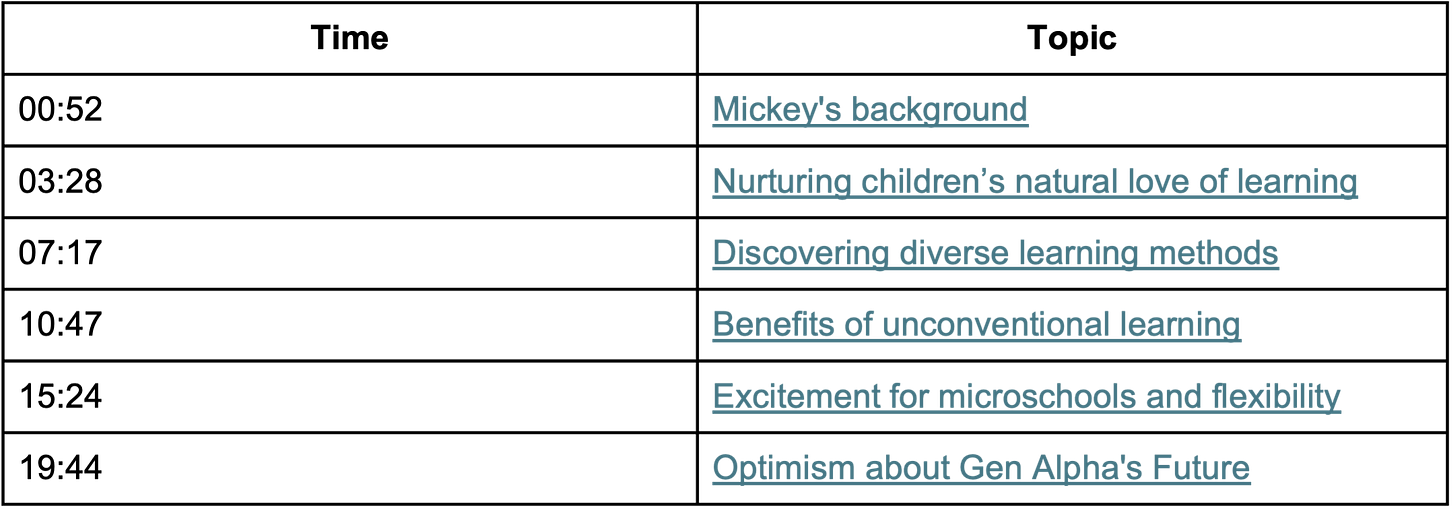
- In her debut book School's Out: Why Families Are Choosing Unconventional Education, Connections Academy co-founder Mickey Revenaugh argues AI now gives educators the tools to evaluate student portfolios against rubrics, finally making authentic, output-based assessment viable — and more necessary as standardized tests, Carnegie units, and seat time lose relevance; she expects public funding through ESAs and a forthcoming tax-credit scholarship program to force this reckoning with how learning is measured .
- Revenaugh says pandemic-era "Zoom school"/emergency remote instruction was the "lowest common denominator virtual education" and still shapes what people see as online learning, where she attributes many poor results; virtual-education technology is "still a work in progress," and many students attended virtual schools mainly because no other unconventional option existed .
- Families increasingly "switch and mix" schooling arrangements year to year — homeschooling, Montessori, charter, district, microschools, and online courses — making portable evidence of mastery (e.g., portfolios) more relevant than standardized test scores, and pressuring traditional districts to adopt new models as enrollment falls .
- Revenaugh contends passion-driven models (project-based learning, unschooling) build a love of learning, self-motivation, and resilience that will serve kids better than traditional schooling, and credits Gen Alpha's curiosity partly to growing up with powerful tools for learning about anything in the world, including online .

Khan Academy released a new free AP Physics C: Mechanics course, ready for teachers to assign, featuring seven units, videos, PhET simulations, exam-style practice, quizzes, unit tests, and step-by-step explanations . More details are available in a linked blog post .
Khan Academy launched a free SAT Reading and Writing Challenge unit designed so the hardest SAT Reading and Writing questions are not a test-day surprise, giving students who completed Advanced practice six mastery-enabled exercises to stretch their skills . Details are in a linked blog post (https://blog.khanacademy.org/sat-reading-writing-challenge-unit/) .
Ethan Mollick: AI research using older models (e.g., GPT-4) remains valid when showing AI can do something — once an ability is gained, it generally does not regress in later generations . Negative capability claims need more caution: a GPT-4 failure does not prove AI is bad at a task . Valid alternatives include: explicitly framing results as "GPT-4 could not do X" with reproducible details as a progress benchmark ; measuring trends across model generations, ideally including at least one reasoning model ; making a grounded argument for a natural limitation ; studying moderators/mediators such as prompting, social context, or connections ; and focusing on human reactions, failures, and impacts . Negative capability claims have generally been much less durable than positive ones . This is directly relevant to interpreting AI-in-education research, which often evaluates older LLMs on teaching, tutoring, and assessment tasks.
Ethan Mollick pushed back on "ELI5" as the default way to make AI explanations easy, arguing LLMs work best as "universal translators across topics" and that personalized prompts — "explain to me drawing on what I know" — beat generic dumbed-down explanations . In a reply, he cites research that drawing connections to prior knowledge improves memory and context-building, and says adults "don't need things dumbed down, you need things explained differently" — a capability he calls one of LLMs' most exciting features . The exchange responds to a widely viewed post describing a skill Anthropic employees use: "/eli5 <what you want explained>", which generates an HTML artifact with big pictures and few words .

Stanford SCALE's new brief "AI Tutoring Is Not a Monolith" sorts tutoring models by relational intensity and concludes evidence remains strongest for live, human-led high-impact tutoring; AI-led tutors may offer supplemental practice but do not yet inherit the definition or evidence base of high-impact tutoring . Meta-analyses estimate tutoring raises achievement by 0.29–0.37 SD; strong programs share frequent 1:1/small-group sessions, curriculum alignment, evidence-based adjustment, a consistent tutor over time, and tutor training/support — features AI tutor designers should replicate, including pedagogical preparation beyond the foundation model . In two randomized trials with 355 elementary students, independent use of an AI literacy platform led nearly half to never use it (users averaged 2–5 minutes/week); adding an in-person engagement-focused tutor raised engagement 71–80% but use stayed low and reading achievement did not improve — access alone is not enough . A randomized field experiment with ~1,000 high-school math students found access to general GPT-4 raised practice performance by 48% vs 127% for a guardrailed GPT Tutor (teacher-written solutions, hints); after AI removal, the general-chatbot group scored 17% below control while the guardrailed group matched control — unrestricted help creates "cognitive debt" . A working definition: "A student-facing AI tutor pursues a defined learning objective, elicits evidence of the student's understanding, adapts its next move, and keeps the student responsible for the thinking" . Benchmarks show models still fall short as tutors: the best of 16 frontier models scored ~56/100 on TutorBench (adapting explanations, actionable feedback, hints); in a Comprendo simulation, six frontier models given generic helpful instructions revealed answers in 97% of conversations with simulated 8th-graders, and a tutoring prompt improved but no model consistently identified misconceptions while withholding reasoning; EduClaw-Bench found almost no model sustained strong tutoring over a simulated 30-day relationship . Product and lab shifts toward structured, curriculum-aligned tutoring: Rori, a WhatsApp math tutor, produced an estimated 0.36-SD gain across 11 Ghanaian schools (uncertain due to small sample/attrition); Eedi and Google tested LearnLM in a constrained UK math platform with human tutors supervising AI-drafted messages; OpenAI's ChatGPT Study Mode, Anthropic's Claude Learning Mode, and Google's Gemini Guided Learning each aim to scaffold and delay answers . Shared infrastructure is emerging: Digital Promise's $26M K-12 AI Infrastructure Program first grantees include a science-misconception benchmark, simulated student models, a National Tutoring Observatory speech-recognition project, and KB-TutorBench; Learning Commons is building open knowledge graphs and evaluators linking AI outputs to curriculum and standards . The U.S. Department of Education released guidance on responsible use of edtech, urging schools and providers to evaluate the learning problem, evidence, educator judgment, transparency, and student outcomes, and to remove technologies that repeatedly fail . A new Economist analysis of 27,000 students ages 12–18 in China found AI-assisted students' homework scores rose 18% with less time spent, but they scored 20% worse on exams than non-AI students — a short-term performance vs deeper-learning tradeoff . OpenAI launched ChatGPT for Teens (ages 13–17) with Study Mode, homework reminders, quizzes, learning visualizations, Study Hours, parent controls, and a CodeAI partnership for AI literacy . Reach Capital raised a $265M Fund V to invest in ~50 early-stage companies across learning, health, and work, focused on AI that "expands human potential" .
A new study on student AI use in China (highlighted by @nxthompson via The Economist) finds homework grades may now mean the opposite of what they once did — good homework used to predict good test grades, but possibly not anymore . Ethan Mollick calls the paper good and argues AI has made the cheating problem worse, while cautioning that pre-AI cheating was already substantial: doing homework improved final test grades for 86% of college students in 2008 versus only 45% in 2017, when they were copying from the internet .