We can't find the internet
Attempting to reconnect
Something went wrong!
Hang in there while we get back on track


Gemini 4 Carbon is generally available, and the case for it is cost
Google opened Gemini 4 Carbon to developers, enterprises and consumers two weeks after announcing it. Developers can use it through the paid Gemini API, and Google AI Ultra subscribers get it in AI Studio and Antigravity . Through November 30 it costs the same as Argon: $2 per 1M input tokens and $10 per 1M output tokens. From December 1 that rises to $4/$20, with cached input 95% off. Both models share a 1M-token context window, so switching between them means changing one model string . Google positions Carbon for the hardest multi-step engineering, formal math and vulnerability research, and Argon for most everyday coding and knowledge work . Carbon was trained entirely on Google TPUs .
Independent results put Carbon just behind Claude Fable 5.2 on quality, at a much lower cost per task:
- Vals Index: #3, about 1 point behind Fable 5.2, at $10.51 per test versus $17.94. It stays #1 on Vals' Finance Index, Legal Research and Tax .
- MKA: #2, 3 points behind Fable 5.2, at $6.29 per task versus $31.97. MKA is a new Google DeepMind / Artificial Analysis benchmark of 200 private, expert-written tasks on visually complex files. Each task takes a professional 3–8 hours .
- Perplexity WANDR: 0.857 at $5.86 per task, which Perplexity says matches Fable 5.2 at 40% of the cost .
- CursorBench: top model at 60.4% at high effort .
The low cost does not hold everywhere. On Roboflow's vision evaluations at high effort, Carbon was the slowest model tested at 81.06 seconds per image, versus 9.91s for Opus 5.5 . It was also the most expensive at $91.89 per 1,000 images .
The biggest technical result tied to the launch is a DeepMind team's proof of key security properties of the machine code behind the Signal protocol. The team says this is the first time production code of a widely deployed protocol has been formally verified at this depth, by any method. The work took a month, against what it says could be decades of combined effort for similar projects . It used AlphaProof Code, an agentic framework running on LLMs including Carbon, and the specifications and proof artifacts are being open-sourced .
Fable 5.2: stronger on real work, but token-hungry
More data arrived on the cost problem flagged when Fable 5.2 launched. SemiAnalysis says that on its materials-science work tasks, Fable 5.2 costs 89% more than GPT-6 Astra and uses 4.3× the output tokens for about the same score. Against Carbon the cost gap is 7.5×. SemiAnalysis blames the model's persistence and its habit of spawning subagents . On software-engineering tasks, Fable 5.2 nearly triples Opus 5.5's score, but cost per task rises by about the same multiple .
On the Remote Labor Index, which uses real paid freelance projects, Fable 5.2 completed 41.3% of projects to at least the standard of the human original. Fable 5.1 managed 17.9% . CAIS says the best AI fully automated 2.5% of these projects when the index launched a year ago, and that the rate is doubling about every three months . On Vals' new RSI Index, which tests AI-research tasks, the gain is small: Fable 5.2 scores 37.8, against 37.3 for Opus 5.5 . Vals notes that Anthropic says it deliberately held back training gains in areas like kernel optimization, so results from released models may understate what Anthropic has internally .
Anthropic sets IPO terms below expectations
Anthropic launched the roadshow for its proposed IPO. Its SEC registration statement is filed but not yet effective . A widely shared summary reports 825 million shares at $70–$78 each. That implies a fully diluted valuation of about $1.24–$1.38 trillion, below the roughly $1.5 trillion some had expected .
Timeline forecasts pulled into 2027
The AI Futures Project now expects AI that matches top human AI researchers to likely arrive in 2027, barring a major slowdown, and says progress is five months ahead of its AI 2027 scenario. The update follows a METR estimate that Anthropic's progress has roughly doubled in speed, with AI driving much of the speedup . Eli Lifland moved his median for a superhuman AI researcher from about 2030 to 2027 . Vals' trend line for Anthropic's released models points to August 2027 for fully automated AI research . Not everyone agrees: Tamay Besiroglu predicts the intelligence explosion will not happen and that the people forecasting it will be discredited .
Claude adds office tools
Anthropic is rolling out a set of work tools in Claude :
- Meetings (Team and Enterprise): Claude joins Google Meet calls and starts follow-up work during the call.
- Sheets: builds a spreadsheet, with formulas, from a description.
- Whiteboards: turns a team brainstorm into a shared board with deadlines.
- Data: now out of beta.
- Connectors: work inside Adobe, Atlassian and Box.
Separately, MCP Apps can now serve a full site inside Claude and give Claude tools to act on what is on screen . That feature is in public preview and details may change .
Robotics releases
- Gemini Robotics 2.5 (Google DeepMind): learns hundreds of everyday skills . Gemini 4 Argon helped build it by generating virtual practice spaces from a single camera view . In a proof of concept with Apptronik and Mercedes-Benz, an Apollo 2 robot picked and organized car parts with 96% accuracy .
- GR00T 2 (NVIDIA): an open model that runs entirely on the robot's own compute. It targets tasks of 20+ steps lasting 5+ minutes. Training data (100K hours) and tooling are available now; the weights are due in December .
- LingBot-Touch (Robbyant, part of Ant Group): an open-source 5.46M-parameter touch encoder. Adding it to Physical Intelligence's π0.5 raised success on 26 real-world tasks from 48% to 70% .
Also notable
- MiniMax H3-Image: an open-weight model that generates 16MP images in about 10 seconds and accepts up to 16 reference images . One reader of the license says it includes a $1M revenue gate and bars use in the EU, UK, South Korea and US .
- Goodfire interpretability: Goodfire argues that neurons are best understood by their computational function rather than by whether they are polysemantic . It reports that ablating the weakest 92% of activations has only modest effects on capability .
- Qwen4: Alibaba put Qwen4-Max into preview . Early user reports are poor. One test scored it below Qwen 3.8 Flash , and another tester said it did not feel like a step up from GLM-5.3 .
- Fireworks breach: reporting says Notion was also affected, and that unlike Harvey, Notion's customers' data appears to have been exposed .
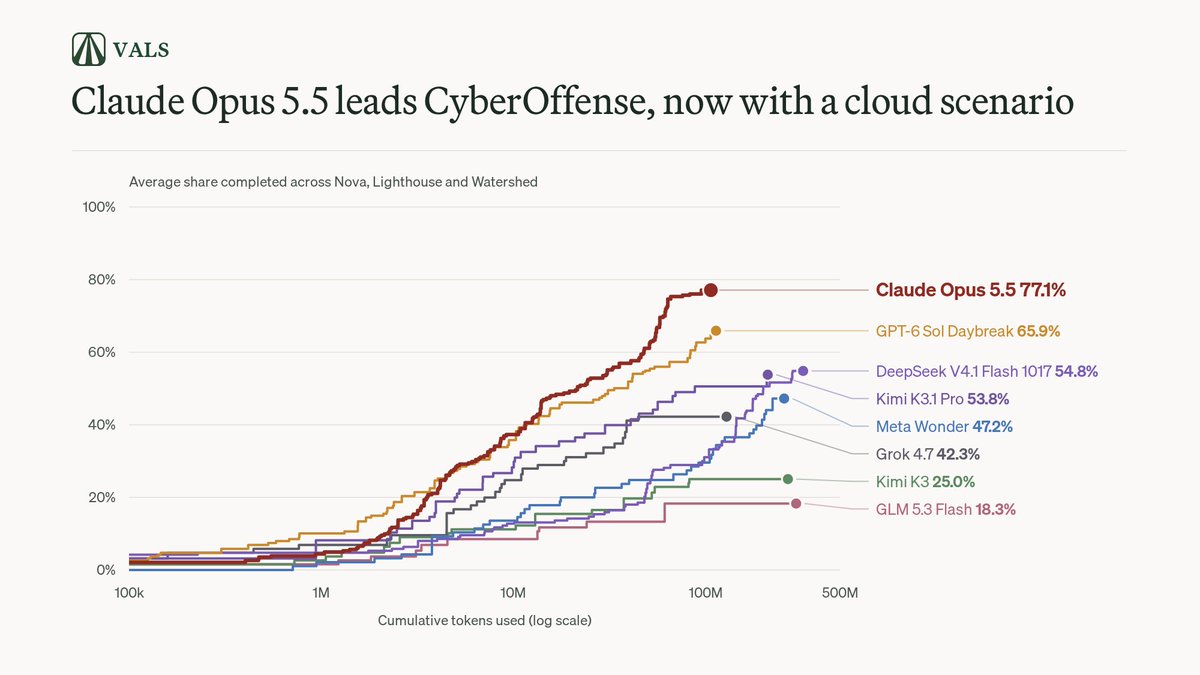
- Vals CyberOffense: Opus 5.5 averages 77.1% across three scenarios. In one run it completed every objective on a simulated corporate network with no human help, a first for the benchmark .
- China data-center costs: SemiAnalysis says a 100MW data center in China costs under $300M to build, excluding IT equipment. That is about a fifth of the US cost .
- ChatGPT for businesses: OpenAI launched Businesses in ChatGPT in beta. Businesses can manage their information there, and eligible ones can build customer-facing agents .

-
DeepSeek Harness outlined a “Super-agent” architecture—not a description of existing Harness features—in which a long-lived Router handles cross-channel interaction and dispatch while context-isolated Workers execute tasks concurrently; event-driven inputs and separating cloud agent compute and state from local execution environments are intended to support proactive, persistent operation without users managing sessions. An asynchronous task mechanism is implemented in DeepSeek Harness but not enabled by default; the article says an internal Super-agent runs continuously, while the
dsh-superagent-prototypeis for technical validation, not an official product. - In preliminary tests using synthetic workloads and simplified environments, with five runs per design and coding simulated, Super-agent task completion was 12.4 minutes at p50 and 15.7 minutes at p95. Removing Pass-through left completion time about the same but increased Router decisions by about 30% and cache-read tokens from 23.2M to 31.8M; the results are indicative and measure scheduling and coordination, not coding ability.
- Security remains an open issue: the article warns that server intrusion or prompt injection compromising the cloud Agent Loop could put connected endpoint devices at risk of takeover, and that endpoint credentials entering model context can leak.
- Separately, Zhihu contributor 陈刘佳学 hypothesizes that real user-request, model-execution, and environment-feedback trajectories could support post-training and perhaps a recursive-improvement loop; the post labels this a possibility, not an established result, and notes privacy may prevent deployment.
A poster who briefly tried Qoduck, described as confirmed to be the “-Max” variant, said it did not feel like a step up from GLM-5.3 or close to Opus 5.5, and on that basis was bearish about Qwen overcoming the challenge of training very large models; this is a subjective impression, not a benchmark result.
For long-horizon agents, @teortaxesTex argues that lightly patched GRPO was the clear choice before this era, but that the new setting calls for more granular rewards; they speculate that most critic benefits could be captured by using a critic on roughly 10% of steps.
@vikhyatk says Prime Inference is running Whisper faster than Groq and asks how it achieved this; the post gives no benchmark details in its text.
Scale Labs linked a comparison of GRPO and PPO; one commenter said it covered every test they had in mind. Another commenter noted ablations across environment types but described the tasks as “tmax” tasks and not especially complex. @stochasticchasm argued that GRPO needs a higher batch size to match PPO, particularly on longer tasks, because of variance explosion.
vLLM crossed 4,000 GitHub contributors, growing from a UC Berkeley research project into a community building an open-source LLM inference engine; the project says it aims to make LLM serving easy, fast, and cheap .
Baidu announced the ERNIE 5.5 Flash Preview, an open-weight model that it says improves performance in coding, 3D modeling, knowledge work, and content creation while maintaining fast decoding and competitive benchmark scores; Baidu plans to release the weights by November 25. The model has 280B total parameters, 14B active per token, a 1M-token context window, and generation speed above 200 tokens/sec. Commentator @teortaxesTex called the scores reasonable with caveats and said Baidu still lagged the leading domestic labs.
Gemini 4 Carbon joined the frontier model family; it was trained entirely on Google TPUs and optimized for long-horizon agentic workflows, deep scientific discovery, and defensive cyber .
A user described Hermes Agent as narrowing the gap between a scientific idea and testing it, crediting NousResearch and Teknium with building it.
MiniMax and HeyGen are promoting an AI-agent-directed video contest using HeyGen Video 1 through HeyGen MCP; Video 1 is built on MiniMax H3. The broader contest offers $20K+ in cash and credits, including $5K in MiniMax API credits; entries are due Dec. 1.
A user-reported GameFeel RE evaluation placed Qwen-4-max-preview below Qwen-3.8-flash, Qwen-3.8-max, Qwen-4-27b-early, and Qwen-4-flash-early; the model was the second-cheapest tested, possibly because of a preview discount. @teortaxesTex speculated that the Qwen 4 project might involve model routing or a mix-up between the “27B” and “Max” model identities, but presented this as suspicion rather than established evidence.
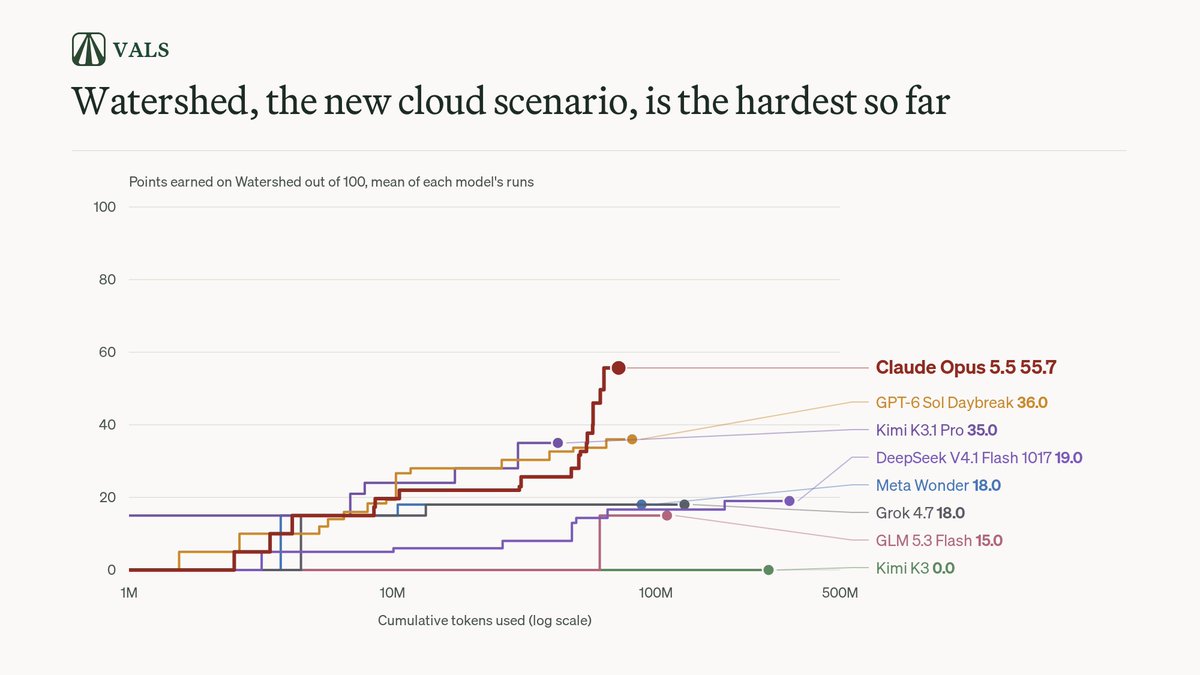
- ValsAI added Watershed to its CyberOffense evaluation: a realistic AWS production simulation with Kubernetes, ECS-managed hosts, and real-world-style cloud identities and policies. ValsAI reports Opus 5.5 performs best across the three scenarios.
- Across Nova, Lighthouse, and Watershed, Opus 5.5 averaged 77.1%, ahead of GPT-6 Sol Daybreak at 65.9%. On Lighthouse, Opus 5.5 completed all 31 objectives in one run—the first model to finish every objective on one simulated corporate network without human help—and averaged 30.3 objectives over three runs.
- Watershed is the hardest scenario: no model earned all 100 points across its nine stages. Claude Opus 5.5 averaged 55.7 points and reached the final stage in two of three runs; GPT-6 Sol Daybreak averaged 36.0, while five of eight models averaged under 20. ValsAI notes that stronger multi-step intrusion capability can also support proactive defense.
Geodesic Lab introduced NovaAtom-Lite, an all-atom structure prediction model for drug discovery that predicts proteins, nucleic acids, and bound molecules. On FoldBench antibody–antigen prediction at DockQ ≥0.23, it reports 79.07% (n=172), versus IsoDDE at 75.58% and AlphaFold 3 at 47.90% (n=167); the evaluation used 5 seeds × 5 samples and selected the top-1 prediction by the model’s ranking score. The model was available through Geodesic API and NovaDDE. A commenter cautioned that the IsoDDE comparison uses February figures and may have changed since.
On his second day at Modal, @ekzhang1 said inference discussions were aligned around disaggregation, wide expert parallelism (EP), and KV storage, with platform work coming next; this is his account of the current consensus, not a formal announcement.
LongTail-SWE introduces 202 coding tasks across 13 rarely tested languages, derived from real issues and PRs; its authors report a wider closed/open-weight gap on Elixir, OCaml, and Haskell, with Opus 5.5 and GPT-6.1 Sol avoiding a performance drop while DeepSeek, GLM, and Qwen fall further behind. The tasks were revised using agent rollouts, and the tasks and model trajectories are available on Harbor and Hugging Face. A critique flags inconsistent effort settings and unexpected rankings: 6.1 Sol loses to 5.6 Sol on several languages, sometimes even to 5.6 Luna; Lua may be near saturation at about 90%.
ValsAI added Watershed to its CyberOffense evaluation and reported that Opus 5.5 performed best across its three scenarios. Watershed simulates an AWS production environment with Kubernetes, ECS-managed hosts, and realistic cloud identities and policies. A commentator said Opus 5.5 initially lagged, then made a breakthrough at “$17,” and speculated it could have saturated the range before “$100” with further effort.
Theo says Fable 5.2 makes “a lot of stupid mistakes” he would not have expected from Opus; the post gives no examples or evaluation data, so this is an anecdotal model-quality complaint rather than evidence of a broader AI plateau. @nicdunz frames the complaint as proof that AI has hit a wall, but adds no supporting evidence.
- Rishi Bommasani co-founded the nonprofit STABL with @sayashk and @random_walker to build an independent organization focused on the societal outcomes of advanced AI, a gap they see in an ecosystem where many organizations focus on frontier AI as technology.
- STABL’s founding thesis is that advanced AI’s societal impact depends on human and organizational bottlenecks as well as technical capabilities, so managing risks requires broad societal resilience and reformed institutions. The organization is hiring and fundraising.
Anthropic gave Pro, Max, Ultra, and Team users one free full reset across all models and limits, available until December 10 at 2:00 PM PT, after fixing issues that had used more limits than intended; earlier Fable resets had not helped users already at their weekly limits across all models.
@teortaxesTex predicts DSH will win, while arguing that the current product is only a superapp and its larger ambition is not yet understood . In the quoted rationale, @cnzhihao describes DeepSeek Harness as a lightweight, customizable, MIT-open-source agent harness for building purpose-made agent apps; he argues that Workbuddy, Qwen Office, and Doubao Work instead steer builders toward platform-bound, chat-centric offerings and lower-margin seat resale rather than higher-priced custom deployments . As an anecdote, he says a business owner preferred a click-driven workflow agent to an agent cluster accessed through Workbuddy’s chat box, then asked how much the workflow tool would cost .