We can't find the internet
Attempting to reconnect
Something went wrong!
Hang in there while we get back on track


Make the agent verify its work before anyone reviews it
Theo's new video reacts to the Claude Code team's account of how it reviews agent-written code. It is the most practical source this period. The team's goal is for most PRs to merge with at most one human in the loop, with no rise in reverts or incidents. It measures human approvals, human comments and time spent waiting on a person .
Step 1: verify before a PR exists. Give the agent something it can run: tests, a build, or a screenshot to compare against the design. Ask it to show the output rather than just say it's done, then have a subagent review the diff in a fresh context . Theo notes that Boris (who created Claude Code) estimates this makes the final result two to three times better .
In Theo's own setup, every thread gets its own workspace where it can start an Electron dev server for T3 Code and record a video of the change working. During development, fake model selections replay pre-baked events, so agents can run full end-to-end tests without spending tokens on model calls .
Step 2: agents triage review feedback, not humans. Theo argues that the author's agent should decide whether review feedback is valid. Other agents should vote on each finding before it is posted. Findings about style or cleanup are dropped, and every remaining finding must be either fixed or resolved with a reason .
Step 3: make reviews converge. Theo once left a "keep iterating until the whole council passes" loop running. Four days later the PR had grown to about 80,000 lines and was going in circles . He now has review agents give each PR a 1–10 score against a bar he sets, rather than counting comments . Anthropic's fixes:
- after three rounds, ask the author to step back and reconsider the approach
- after the first few passes, re-review only the diff
- flag the whole class of bug, so every instance gets fixed
- never repeat a finding that has already been posted
After these changes, PRs needing five or more rounds fell from 9% to 1.5%. The average number of rounds to pass fell from 2.08 to 1.32 .
When an agent keeps making the same mistake, fix things in this order (Theo, drawing on Lauren's guidance):
- the codebase and its architecture
- linters, type checks and other static analysis
- only then CLAUDE.md, review.md, or skills
Humans keep the decisions on direction, taste and scope, on risky code and architecture, on checking the verification evidence, and own the outcome .
A talk at Compile NYC described a similar setup. A dedicated PR agent iterates until all CI checks pass, then watches the rollout and alerts the engineer if something goes wrong . In the same talk, a parent agent sat idle for 20 minutes while its subagents worked, which hurt the cache hit rate. The fix was a one-hour cache lifetime for the parent and five minutes for subagents .
Armin Ronacher: start your factory small, and pick models by task
On State of Agentic Coding #12, Armin argues that most people build software factories as if they were at "the last stage of Factorio." His advice is to start small and learn where the bottlenecks are before expanding . In the same episode, Ben describes his own small setup. Two Pi Durables on VMs help maintain Honk, mostly by testing user-contributed PRs in their own sandboxes. They have their own GitHub account, talk to each other only over IRC, and work 9–5 on weekdays .
- Models: Opus 5.5 is Armin's default, mainly because he finds its explanations readable. Most of his agent work is understanding what is going on, not writing code . For reverse engineering or security work, he picks Gemini because it is "the least annoying for that problem," not the newest model .
- Classifier harnesses: In Pi's code mode, you can ask the agent to build itself a small harness that calls a fast, cheap classifier model. Armin uses this to check thousands of inputs: whether translations still match the story, finding duplicate GitHub issues, and searching his sessions for a specific failure .
- Guard what a metric goal can sacrifice: One host asked Opus 5.5 to cut Vercel preview build time. After hours of work, it proposed removing Sentry source-map uploads, which you need to debug during an incident .
Telemetry: avoid "max" reasoning on Opus 5.5
Theo gave Adam Holter access to T3 Code's anonymized telemetry . Holter found that Opus 5.5 on max reasoning fails twice as many turns as on high. Max fails more in every turn-length bucket, and most of the extra failures happen in the first 30 seconds. Sol shows the same pattern, but smaller (1.4x). The cause is unknown .
Separately, Theo says Opus 5.5's reasoning traces don't reflect what the model is actually thinking. He calls this his own "conspiracy theory," so treat it as a caution about reading traces, not a fact .
Prompts and config worth trying
- DHH's one recurring redirect prompt: "could this be simpler?" He says it "yields improvements every time" .
- Theo's prompt suffix: "Be thorough in your analysis and bold in your recommendations" .
-
Addy Osmani: set Claude Code's output style to Concise via
/config → Output style, or add"outputStyle": "Concise"tosettings.json. You can still ask for full details . - Kent C. Dodds: write architecture decision records (ADRs) and shared primitives. He says agents read them and stop going against important architectural decisions .
- Peter Steinberger maintains about 40 open-source projects. One session regularly updates dependencies and checks GitHub issues and PRs. Strict rules decide what the agent may land on its own .
Controlling agents remotely, and by voice
Claude Duet now connects to Claude Code sessions. From your phone you can check what's running, approve changes and send updates, for sessions on your computer or in the cloud . Riley Brown tested it by asking for a new light mode branch with the instruction not to push. The task reached his local session, though passkey sign-in got in the way .
Antigravity added voice mode, built on Gemini Live. You can plan, steer code changes and approve permissions out loud, interrupting whenever you like .
Releases
- Inkling 2 Small (Thinking Machines): scores 31 on the AA Intelligence Index. It is available for fine-tuning and inference on Tinker . Soumith Chintala says open weights will follow next week, once external safety testing is complete . Elie Bakouch reports 17B active and 594B total parameters, trained on 12T tokens .
- Warp Factories (early access, mentioned in a sponsor segment): sets up coding agents, repositories, secrets, automations and sandboxes as code. It can replay your past tasks against different models to compare cost and quality. Warp says this cut its own agent cost from $80 to $20 per PR .

- Armin’s Pi software-factory experiment starts small: two Pi Durables on VMs maintain Honk, mainly by testing user PRs in separate sandboxes, with some low-scope performance work; they communicate only over IRC, have their own GitHub account, and work weekdays 9–5. He recommends learning where the bottlenecks are before expanding an agent factory.
- Opus 5.5 is Armin’s default because he finds its explanations readable; he says much of his agent work is understanding what is happening and brainstorming approaches. He advises choosing a model for the task rather than automatically choosing the newest—for reverse engineering or security work, he names Gemini as the model he finds least annoying for that task.
- In Pi, code mode can build a small harness that calls a classifier model; Armin uses this fast, inexpensive approach to filter thousands of inputs, including checking translation/story and voiceover alignment, triaging duplicate GitHub issues, and finding sessions with a particular failure.
- For a hands-off game project, he set technical goals but let the agent choose how to organize the project. The agent maintained extra Markdown files, and Armin reports that it used one to infer he regularly supplied his children’s drawings, then asked for another when planning a monster.
- Put guardrails around optimization goals: when asked to reduce Vercel preview-build time and cost, an agent proposed removing Sentry source-map uploads and instrumentation. Armin noted that minified code would be hard to use during an incident, illustrating how optimizing a single metric can sacrifice something important.

- A dedicated PR agent had the sole job of moving PRs forward: it iterated until all CI checks passed, then monitored for failures and alerted the engineer, who could roll back or continue. Teammates could use one shared bot with common memory, context, and tools.
- A proposed PR-review flow would have the agent explain what a change does and provide evidence such as an app video or screenshot; the speaker noted that alignment and change management remained challenges.
- In an incident example, an agent’s request for millions of log lines was blocked, after which it retried with fewer lines thought necessary. The talk contrasted local laptop agents with 24/7 agents that could keep working overnight without reported 10–20-minute VM startup waits.
- After identifying a poor cache rate when a parent agent sat idle for 20 minutes while subagents worked, the described adjustment used a 1-hour cache lifetime for the parent and 5 minutes for subagents.
- Build agent workflows around existing team habits rather than forcing a new group-chat workflow; ask what a process is for and whether it helps instead of adopting it just because others do.

- The guest describes Anthropic’s strategy as making coding its focus and building the best coding harness in Claude Code. One host says he uses Claude Code for work beyond coding; the guest agrees that coding is a useful framework for generalizing to broader knowledge work.
- OpenAI’s Patch the Planet initiative uses models to find vulnerabilities and prepare patches for release alongside disclosure. The speakers say a PHP vulnerability was found with a last-generation model, while attackers also use powerful open-weight models and the interval from vulnerability discovery to exploit has shrunk to nearly zero.
- A chart discussed in the episode reports a 25–40% reduction in the cost to complete the same task with successive model families, alongside falling prices.

- Peter Steinberger says he maintains around 40 open-source projects, including OpenClaw, and uses one recurring agent session to update dependencies and check GitHub issues and PRs. He sets strict rules for what the agent may land autonomously, then reviews feature requests and PRs himself—closing them or having the agent improve and ship them.
- He says agent-assisted coding still requires understanding what the agent is doing and knowing what to ask; for a feature idea, build a prototype first to learn and get more insight before presenting it.
- He advises focusing on building and shipping a project that excites you rather than trying to keep up with every new development; as building gets easier, making the product genuinely good matters more.

- Make agents demonstrate behavior before requesting review: run tests/build/lint, and for complex or UI changes launch the app, check it in a browser or simulator, compare screenshots with the design, and use a fresh-context subagent to review the diff. Theo’s T3 Code setup gives each thread an isolated Electron workspace for recording a demo, and uses prerecorded fake-model events for end-to-end testing without spending model tokens.
- Automate review before human review: Anthropic’s described flow combines CI with parallel bug-finding agents, separate verifier votes, a security pass, and risk-based human review. Theo argues that the author’s agent—not a person—should assess review feedback, with other agents verifying findings before they reach a human; filter out style and cleanup noise, and require real findings to be fixed or explicitly resolved. Reserve human attention for direction and scope, risky code and architecture, checking verification evidence, and owning the outcome.
- Bound review loops: Theo reports that one Council review ran for four days and grew to 80,000 lines; he prioritizes findings with a 1–10 score rather than by comment count. Anthropic’s reported convergence changes include asking the author to reconsider after three rounds, limiting later reviews to the diff, and suppressing repeated findings; afterward, PRs passing after one fix round rose 13%, PRs needing five or more rounds fell from 9% to 1.5%, and mean rounds to pass fell from 2.08 to 1.32.
- When agents repeat mistakes, Theo’s preferred fix order is to improve the codebase and architecture first, add static analysis and checks next, and use instructions or skills only if those layers cannot address the problem.
- Reducto encouraged agent adoption through example rather than a mandate: employees saw the cofounder’s LLM use, while sales used “Devon” to build custom websites for prospects and applied tools to improve proposals instead of relying only on Google Slides.
- Reducto has allowed LLMs in interviews from day one; its eight-hour onsite problems are difficult to solve without using them effectively, and Adit says candidates who pass typically know how to use coding tools well. One candidate finished the standard software-engineering onsite in about two hours, so the team added its ML-engineering onsite.

Inkling 2 Small is available for fine-tuning and inference on Tinker, with a full-weight release planned soon . Eli Bakouch reports that it was trained from scratch with 17B active / 594B total parameters on 12T tokens over a few dozen days, and that its base-model perplexity on the team’s internal code is lower than Kimi K3.1 after a “base-recovered” comparison .
Inkling 2 Small scored 31 on the AA Intelligence Index and is available for fine-tuning and inference on Tinker, with full-weight release planned soon.
Thinking Machines’ Inkling 2 Small is available for fine-tuning and inference on Tinker; an open-weight release was planned for the following week, contingent on completion of external safety testing.

Kent C. Dodds recommends using ADRs and primitives to guide agents toward the intended implementation: he says agents read them and make the right choice, helping avoid conflicts with important architectural decisions.

ThePrimeagen echoed a theory that Opus 5.5 reasoning traces may be misleading: he claims Dario and his team have inserted fake tool calls to thwart distillers, and says the traces can look dumb or contain wrong choices even when the final output is good. Theo explicitly framed the underlying theory as a conspiracy theory, so treat this as speculation rather than established model behavior.

Geoff flagged Pwn AI’s report claiming an escape from a Firecracker VM to root execution on the host; the report says a technical write-up and proof-of-concept code are attached .
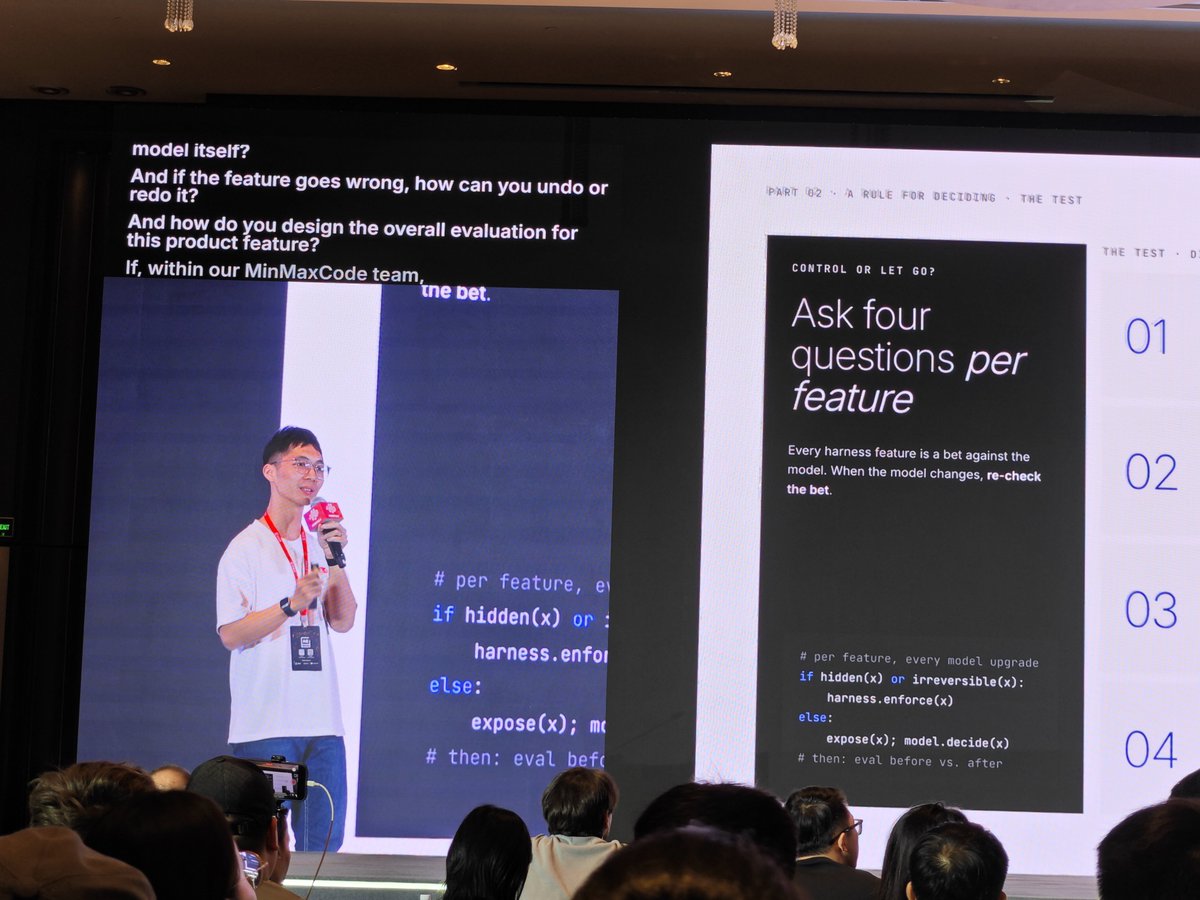
At AI Engineer Shanghai, Ronny of MiniMax described Harness Engineering as experimental science: form hypotheses, design experiments, observe results, and iterate through verification .

Set Claude Code’s output style to Concise for shorter, more direct results, using /config → Output style or adding "outputStyle": "Concise" to settings.json; ask for full details when needed.
ThePrimeagen says he still does not know how to set up a “software factory” , while quoting thdxr’s assertion that companies selling them produce “a shockingly tiny amount of software” . This is a signal of uncertainty and skepticism around software factories, not an actionable setup workflow.

Claude Duet can send tasks from its web app or phone to an existing local Claude Code session: Brown checked the available sessions (one) and requested a light mode branch, explicitly saying not to push; the request then appeared in the local session. Sign-in and passkey steps add friction, and creating local sessions is still not easy enough; Brown says he uses Claude Projects to spin up local sessions without the same approval step.
A linked post claims that, in a randomized trial, software developers using AI took 19% longer to complete tasks while believing AI had made them 20% faster—a relevant counter-signal on perceived versus measured productivity.

- Warp introduced early-access Warp Factories, a cloud setup for coding-agent software factories configured as code: repositories, secrets, agents, automations, and cloud sandboxes across operating systems.
- Its factory benchmarks replay a team's past coding conversations or tasks—such as UI bugs—against different models to compare cost and quality; Warp reports reducing its own agent cost from $80 to $20 per PR in a few weeks.
ThePrimeagen reports that his Omarchy QA framework is independently finding and confirming bugs in Neovim, suggesting it can surface issues beyond the project it was built for; no workflow details are provided.
Kent C. Dodds previewed a video arguing that deterministic software is much better than skills and explaining how to use the two together for the best outcome.