We can't find the internet
Attempting to reconnect
Something went wrong!
Hang in there while we get back on track

Meta acquires Sundial
Julie Zhuo announced that Meta acquired Sundial. She and cofounder Chandra Narayanan are joining Meta along with other members of the team . Sundial automated much of the work that comes before useful analysis, such as cleaning data, building semantic layers, writing SQL and telling the story. Its customers included OpenAI and Gamma . Zhuo says the company started before the AI wave and rebuilt itself to be AI-native . At Meta, it will keep working on "the quality and velocity of business decisions" .
AI-drafted PRDs need an owner
An r/ProductManagement thread asked how PRDs can stay the source of truth now that AI makes them easy to generate. One PM warned that an AI-generated PRD "rots faster than a handwritten one." It looks complete and contains "decisions nobody actually made," so teams keep trusting it while it drifts from reality . Their suggested fixes:
- Keep the PRD next to the code.
- Keep an ADR-style decision log.
- Map each PRD section to acceptance criteria in tickets.
- For AI features, include evals in the PRD: what good output looks like, how it's measured, and who checks it.
Their rule: "AI is the typist, never the author," with one named owner for each epic . Another commenter keeps the problem, constraints, evidence and decisions in the PRD and execution in Jira or Linear. They argue that "the owner and update trigger matter more than where the file sits" .
AI assistants are quoting your old prices
A founder tested what ChatGPT, Claude and Google AI Mode say about the pricing of 17 SaaS products. After a commenter flagged a scoring inconsistency, the corrected results were Claude 16/17, ChatGPT 13/17 and Google 8/17 . It was one run per product from Brazil, so the author calls it a snapshot, not a rate . The failures included:
- renamed plans the assistants hadn't caught up with
- yearly rates quoted as monthly
- retired plans pulled from review sites
- the companies' own help centers contradicting their pricing pages
Their advice: ask the AI tools what you cost after every price change, put the billing period next to every price, and clean up old plan names . On SaaStr's agents show, the hosts made a related point. Agents favor facts they can verify, such as public pricing and renewal numbers, over testimonials, and they "ding you" when pricing isn't published . The hosts suggest asking a set of third-party agents what they'd recommend in your category, weekly or at least monthly .
Jassy: smaller teams, reimagined products
Amazon CEO Andy Jassy said a team of four or five people turned an idea agreed on Thursday into a prototype that was about 80% shippable by Sunday . He expects smaller cross-functional teams where people don't "only own one sliver" . He warned that incumbents who treat AI as an incremental improvement "will very likely not have the winning experiences 3 to 5 years from now" . Amazon has teams building fully reimagined versions of retail, Prime Video, Fire TV and Prime Music .
PM hiring is raising the bar
Exponent reports that some big-tech companies now have an AI product-sense round where candidates build a working prototype with an AI coding tool, and interviewers watch how they use the tool . In strategy answers, distribution has replaced building as the moat. A balanced answer with no point of view is now "the benchmark for rejection" . Tokens, latency, retrieval and hallucinations come up as standard follow-ups even for roles not focused on AI . On take-homes, AI "raised the floor": what stands out is proof you used the product, talked to users or built something .
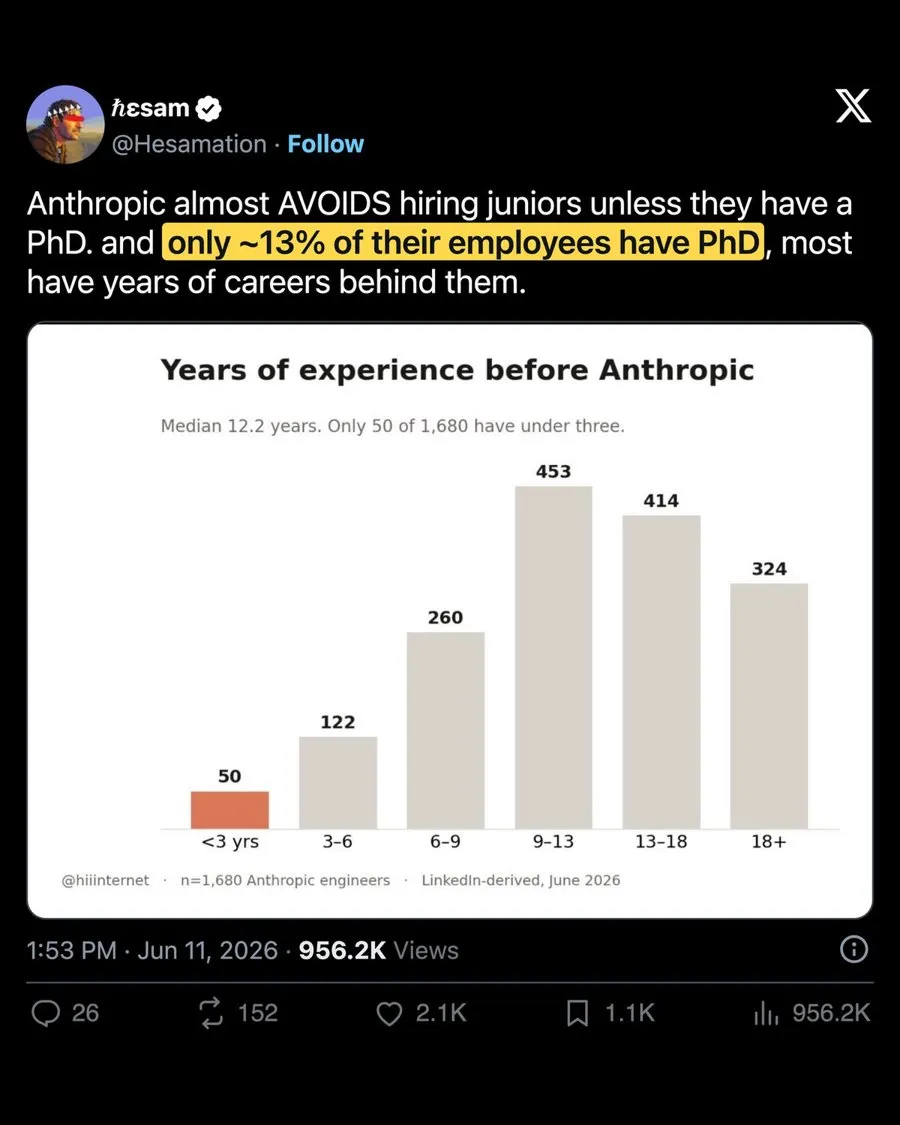
On seniority, Aakash Gupta analyzed 46 Anthropic PMs. None had under three years of experience, and the most common band was 9–13 years (37%). Posted base pay is $305K–$460K . A PM manager on Reddit said the most junior PM they had ever hired had five years of non-product experience. They also no longer see program management as a reliable way into PM, since that work is increasingly automated .
Also notable
- Launch on retention, not views: Farza (YC) said one demo video got nearly 3M views and about 7,000 downloads. What kept him building was the roughly 100 people who used the product every day for five days, each of whom he interviewed .
- Speed as a moat: Scott Belsky endorsed the argument that users won't want to wait on agents for complex tasks . The essay he shared argues that delays compound across an agent's many model calls, and that faster responses lead to habits and switching costs. It also notes that websites and tools add delays that faster models can't remove .
- Hype(less): Lenny Rachitsky is collecting AI workflows that have proven repeatable for product, design and engineering teams. Submissions are due Friday, Oct 30 .

- Roll out agent workflows incrementally: 10K grew from a narrow helper over 16 months, and the speakers recommend piloting one tool or use case, then adding more when gaps appear rather than copying a large stack. Centralize work in a shared queue, set explicit goals and human-escalation paths, and retain approval guardrails; the team said work fell through the cracks across its three humans and 21 agents.
- First-party data can differentiate agent-enabled workflows: the speakers found outbound messages became more useful when agents could use proprietary customer and account history, rather than relying mainly on scraping and limited CRM data.
- Treat agent recommendations as a discovery surface: test how independent assistants answer cold prompts about your product, then fix inconsistent site facts and make useful information accessible to crawlers. The speakers also recommend publishing verifiable facts—including pricing and measurable customer evidence—because agents use these when making recommendations.

- For PM career pivots, commenters emphasize showing customer-problem discovery, business outcomes, and the reasoning behind product choices and trade-offs—not only project execution or certifications.
- One PM manager says they would have recommended a Program Manager role as a bridge to internal product scope before 2025, but sees program demand declining with automation; they view PM as non-entry-level and say their most junior PM hire had five years of non-product experience.
- Resume feedback favors clearly stating actual responsibilities and using a few credible metrics or projects; commenters warn that dubious, metric-heavy bullets and AI-style bolding can obscure what a candidate actually did.

Sam Asante is building a product to help the team build its other products; Hiten Shah says a demo impressed him and they had just settled on a name and domain, but gives no shipping timeline. Shah says AI agents now need managing, drawing on a year of building agents and learning where they break and what makes them useful repeatedly.
- One product designer describes moving from Cursor toward Claude, connected to domain code repositories, Sigma, PostHog, Databricks, GitHub, Figma and a hosted prototype environment; 25 skills cover checks such as accessibility, UX, brand and voice, while critique and handoff skills generate ticket acceptance criteria and code links and track design-system changes. The designer says Figma use fell to about one-fifth of its level six months earlier.
- The same designer says faster Sigma and PostHog queries inform design decisions and that the workflow makes it possible to manage multiple projects while spending more time on discovery and concept validation.
- Other practitioners report two discovery and prototyping tactics: piping session recordings into a tool that flags rage clicks and dead ends reportedly halved discovery time; Dessn was used to prototype UI changes against a real codebase and design system, accelerating iteration and handoff to engineers using Claude Code.
- A counterpoint is that AI-assisted PM and engineering prototyping can still produce off-pattern UI and weak user-value judgments, while designers contribute systems thinking and cohesive UX judgment.

- Work backward from a recurring product demo or launch: decide how to explain a feature—the hook, caption, or video—while building it, because communicating the product matters as much as building it.
- Judge launches by product use, not views: after a Clicky video drove 7,000 downloads, about 100 people kept using the product daily for five days; interviews with those users revealed unexpected use cases and helped motivate continued development.
- Measure qualified acquisition and conversion, not just reach: TikToks aimed at design-agency founders averaged about 4,000 targeted views and generated roughly 50 leads. Farza also reported very low conversion from millions of Twitter views versus 20% download conversion for one YouTube video, and described tracking channel results with a distinct Instagram link.
- In one reported case, PRD changes were not reflected in epics and development issues; the tickets reportedly remained unready for nearly nine months before a two-week deadline for a multi-application, multi-team feature, and the developer team was blamed during a stakeholder presentation.
- One proposed lightweight change-control pattern is to keep a PRD changelog, require a Definition of Ready with acceptance criteria and a link to the current PRD before sprint entry, update the epic and then its tickets when requirements change, and hold a weekly PM–tech lead spec sync with clear ownership. The commenter cautions against making the process so heavy that it slows the team.
- For complex products, a commenter notes that the PRD may fall out of sync once development starts: tickets can serve as the working source of truth during implementation, with the feature or system documented after completion. Make that shift explicit.

Lenny Rachitsky and Noam Segal are collecting genuine, impactful, repeatable AI workflows used by product, design, and engineering teams for a planned three-part newsletter series; submissions are open until Friday, Oct. 30.
- AI-generated PRDs can look complete and confident while recording decisions nobody made, and can drift as engineering or discovery changes; commenters recommend tying them to code and evidence rather than trusting polished text.
- A suggested workflow keeps problems, constraints, evidence, and decisions in the PRD; execution in Jira or Linear; and changes in a short decision log linked to both. Store the PRD in the repo or link to it from the repo README, map PRD sections to ticket acceptance criteria, and assign an owner and update trigger. For AI features, define what good output looks like, how it is measured, and who checks it; AI can draft, but the PM and tech lead sign off.
-
One team’s implementation uses Linear with MCP, links the PRD to the Linear project, keeps deeper decision and evaluation documents in the repository’s
/docsfolder, and pins that link in the Linear overview.
Hiten Shah identifies deciding what work to delegate as the hardest part of using an AI agent. He said he had narrowed delegation to nine jobs and planned to compare Muse, Grok Bot, and dots using examples of what worked and what went wrong.

Meta acquired Sundial, and cofounders Julie Zhuo and Chandra Narayanan are joining Meta with other team members. Sundial automated steps in business analysis—including data cleaning, semantic-layer creation, SQL writing, and storytelling—and Zhuo says the team aims to bring its work on improving the quality and speed of business decisions to Meta.
- A PM’s response to hard-to-review, AI-generated specs is an editable visual story map that doubles as a software spec and tracks human and AI decisions, so peers can review it before engineers generate code. The free tier creates story maps; the paid tier adds BYOK and code generation.
- A PM-created SaaS dashboard critique blog uses before-and-after redesigns to discuss information hierarchy and how poor UI can hurt feature adoption.
- AIxPM offers a 12-scenario self-assessment covering metrics, evals, discovery, strategy, influence, and AI judgment, with area scores, strengths and weaknesses, a diagnosis of miss patterns, and a seven-day plan. Its creator is soliciting feedback on avatar accuracy, question fairness, and whether multiple-choice questions can assess PM judgment.
- For a BIM professional already producing technical specifications, investment papers, roadmaps, and process improvements, a commenter recommended presenting that work as PM experience and targeting mid-level roles at construction-tech or AEC software companies, using domain knowledge as an advantage rather than pursuing junior roles.
- Other commenters cautioned that this niche may have few, intermittent openings; one described the broader PM market as highly competitive and cited 400 applications arriving on the first day for some roles. These are commenters’ assessments, not independently verified market data. Another suggested an alternative route of software tester to product owner to product manager.

The episode presents a framework for B2B product management: consider the layers embedded in a B2B business, the distinct value propositions and time horizons for each layer, and how to drive adoption among nested personas; it also contrasts using the broad term “B2B” with labels such as SaaS, PLG, and Enterprise.
The OP, a physical-product PM, says sales-heavy work and client demands—including requests for free work or infeasible changes they considered liabilities—contributed to burnout, despite product changes they say drove record growth and went unrecognized. A commenter contrasts a physical-product organization with separate pricing, sales, finance, and client teams (the PM helped with demos and RFPs but did not sell) with a SaaS role spanning pricing, documentation, demos, technical support, and retention demands. Another commenter argues that moving to digital may not ease the burden if the organization still fails to separate product from sales.

- Amazon originally conceived AWS after finding that product teams spent 70–80% of their time on non-differentiating infrastructure; shared compute, storage, and other building blocks were meant to free teams to build customer-facing products faster.
- Amazon chose fast fulfillment-network expansion to serve customers and sellers despite higher costs and imperfect optimization, then used metrics and candid issue-sharing to identify what needed productivity fixes versus architectural rework.
- Andy Jassy expects AI to enable smaller, cross-functional teams with broader ownership; as an example, four or five people turned an idea agreed on Thursday into a working prototype described as 80% shippable by Sunday.
- Jassy argues that established products cannot rely on incremental AI improvements: teams need to reimagine customer experiences, then iterate toward what works; Amazon is developing redesigned versions of businesses including retail, Prime Video, Fire TV, and Prime Music.
- Jassy says inference remains about an order of magnitude too expensive for pervasive enterprise use; lowering its cost would reduce the hurdle to updating CPU-based applications to use AI accelerators.

An analysis of 46 Anthropic PMs found no one with under 3 years’ experience; 4% had 3–6 years, 9% had 6–9, 37% had 9–13, 30% had 13–18, and 20% had 18+ years. The author identifies 9–13 years as the mode and encourages candidates in that band with a prominent profile in their area to consider applying.
The post recommends learning model PM, building synthetic experience, and learning AI evals , and reports posted Anthropic PM base pay of $305K–$460K .

- In a one-run test of 17 SaaS products, the author later corrected the comparison to ChatGPT 13/17, Claude 16/17, and Google AI Mode 8/17, counting Google’s link-only/no-answer results against it; the test was a small snapshot from Brazil, not a stable error rate.
- Reported failure modes included renamed plans, yearly rates presented as monthly, outdated third-party prices, and stale or contradictory company-owned pricing information in help centers and pricing pages.
- For SaaS product teams, the practical lesson is to audit pricing information across help centers, blogs, and review sites after changes; put the billing period beside each price and periodically check what AI tools report.
A CV reviewer recommended framing experience around vision, mission, and impact; quantifying outcomes more clearly; and considering a two-page CV with a professional summary, details on current work, and projects. These were one reviewer's suggestions, not general hiring guidance.

- The video argues that product strategy answers should explain why a product can win when competitors can build quickly—especially by articulating a distribution advantage; a balanced framework without a point of view may not be enough.
- The video reports that some big-tech product-sense interviews now include building a working prototype with an AI coding tool, and that working knowledge of AI trade-offs—including tokens, latency, retrieval, and hallucinations—is expected even for PM roles not focused on AI.
- Analytical and execution interviews are often combined; the video highlights defining North Star metrics, handling conflicting signals, and clarifying what a metric means before responding.
- For PM take-homes, AI-polished decks are described as the baseline; evidence of actually using the product, speaking with users, or building something is presented as a differentiator.
A hyperscaler employee and colleague say they identified a data-center safety gap they expect to worsen with AI buildout; company-funded vendor work produced a stopgap for one data center, and they are considering a broader, improved product with another vendor while drawing on qualitative learnings from the original work. A commenter suggests asking the employer about building the solution or investing, potentially creating an initial customer/funder, but flags the previous vendor relationship as a major complication.