We can't find the internet
Attempting to reconnect
Something went wrong!
Hang in there while we get back on track
Nvidia: the board rules out Huang, and his backers turn to shareholders
Jensen Huang said publicly that he made "serious mistakes" in his personal life, created problems for the board, and is cooperating with its independent investigation. He added that he would return as CEO if the board decided that served shareholders, employees, the company "and America" . Hours later the chair said the board "does not intend to reinstate" him, according to Polymarket . A campaign backing Huang says the board told the earnings call that he resigned voluntarily and declined to answer questions about him or the investigation . A Semafor scoop says the board is split, with a three-director faction "vehemently" against his return .
Garry Tan answered "15% shareholder vote coming" . According to a Grok summary of the bylaws, holders of 15% of voting power for at least a continuous year can call a special meeting. Removing directors there takes a majority with cause, or 66⅔% without . That is a high bar, not an imminent outcome. Separately, the board announced a "$150B increase" to its buyback. Jason Calacanis argued the money belongs in data-center buildout .
Sam Altman said he didn't know enough to judge whether Huang should return, and that it is "hard to imagine the AI revolution without Jensen." Asked about a reported $105B Nvidia guarantee for OpenAI's Ohio data center, he said people "still trust their guarantees very much" . For anyone exposed to Nvidia-financed infrastructure, the governance fight is now open-ended.
OpenAI ships GPT-6.2, and early evals split
OpenAI released GPT-6.2 Astra and Sol, describing them as "super efficient" . Altman pointed to token efficiency and "Sol ultrafast" , but conceded the models still need work to be "nice to work with" . Third-party results so far:
- Perplexity (WANDR benchmark): Astra scored 0.783 at about $12.54 per task, up 0.095. Sol scored 0.746 at about $2.65, up 0.065 .
- Bindu Reddy: Astra excels at browser use but is "nerfed on agentic tasks," and Sol trails Sol 6.1. Her read is that OpenAI is trading performance for cost .
Perplexity puts numbers behind $1B ARR
Aravind Srinivas said Perplexity crossed $1B in annual run rate. He claimed it burned 5x less to get there than "the company that's going to IPO this week" . Its own fast-search model handles 80–90% of traffic on its own compute, which he estimates saves $100–200M a year . Gross margin is 56% on paid users. Counting free users it is 17% in Q3 2026, up from −219% in Q4 2025 .
The products follow the same orchestration thesis:
- Orchestrator API: 45+ open and proprietary models behind one API, with failover and unified billing. Routing is designed to keep the KV cache intact. In one example, sending Fable 5.2 refusals to GPT-6.1 Sol raised Terminal-Bench 4.1 results from 38 to 41 of 63 tasks .
- Multiagent: runs parallel mixed-model agent teams. Perplexity says diverse teams beat homogeneous ones on both performance and cost .
Deals worth noting
- Isomorphic Labs, $5B. Demis Hassabis announced the funding for AI-first drug design . RAAIS describes it as a Series C .
- Fractile, over $700M Series C (the transcript spells it "Fractal") . Its thesis is that LLM inference is memory-bound. It stacks DRAM tightly on logic and claims 20x the bandwidth per chip of an HBM-based die . It expects customer workloads running in its racks before the end of next year, and says it will never compete with customers at the model layer .
- Model ML (YC W24), $250M Series B at $1.5B. It runs AI agents inside banks' and consultancies' own systems. Q3 ARR grew 12x year over year and daily active users 26x .
- River AI, $1B. Igor Babuschkin's company sells software that lets enterprises post-train and serve models on their own hardware. Backers are General Catalyst, AMP PBC, Nvidia and AMD .
- First Person Labs, $10M seed led by a16z. Its product, Second, keeps a continuously updated model of the user on the device and serves that context to agents the user approves .
- Alta Ares won 6 of 16 lots in NATO's counter-drone framework, more than any other supplier. Allied countries can now buy without a new tender .
- Auctor (YC P25) raised a Series A from Sequoia for AI-led enterprise software implementation. Usage rose 5–10x after it rebuilt the product from scratch .
Venture bar and market structure
SaaStr argues a company now needs to grow from $1M to $100M ARR within five years to raise venture capital. That is 151% compounded a year, which makes T2D3 roughly the minimum . Citing Carta, the AI Series A bar is about $3.5M ARR, and AI took over 60 cents of every venture dollar in Q1 2026 . As of May there had been zero software IPOs among 32 listings .
The counterpoint is Stripe's index of non-AI B2B revenue, which is up more than 30% year over year, with firms under a year old growing fastest . But the sample is mostly self-serve, card-on-file companies, not the enterprise names that were sold off .
Newcomer's Cerebral Valley summit added three data points:
- Open-weight models: they went from about one basis point of Factory's tokens at the start of 2026 to "way into double-digit percent." At many of its customers they now carry more than half of all tokens .
- Valuations vs. returns: the AI 100 is worth $3.6T, with OpenAI and Anthropic 55% of that. Bessemer estimates $8T of capex needs close to $6T in annual revenue to pay off .
- Audience survey: 79% see a bubble and 67% expect it to pop in 2027. The same room expects Anthropic to be worth $1–2T after its first trading day .
Agents, autonomy and security
- Replit Missions. Replit launched this agent-swarm product. It reports NumPy optimization speedups of up to 4x with one agent, 17x with 16 and 19x with 32 . It also shipped DataCat, a free 1:1 rebuild of an observability platform it says costs $83,700 a year . That is a direct shot at feature-layer SaaS.
- Autonomous exploitation. Google Threat Intelligence Group and Mandiant report the first LLM framework they have seen fully automate vulnerability research and exploitation with no human in the loop. It diffs patched against unpatched web apps, then writes and runs exploits .
- Waymo off freeways. California's DMV ordered Waymo off state freeways, citing an "imminent hazard to public safety" . A Reddit commenter says the cause was repeat entries into construction zones after a May fix, with no injuries, and that Waymo has paused freeway rides in all 15 markets . Calacanis, who says he is invested in every AV provider, warns that the industry is moving too fast .
- Qwen4-Max is API-only. It has 2.4T total parameters, and no weights were released . A commenter's summary of draft Chinese export rules says models with 2T or more parameters would need an export license. Newly open-sourcing one would require a "file-and-go" filing, and the rules are not yet final . That would explain the release, but it hasn't been confirmed.
- Ali Ghodsi says enterprise AI is still mostly search/chat and coding: customers report roughly 20–30% coding speedups, while even leading users run only about 6–12 agents and keep humans in the loop. He identifies missing organizational context, security and governance risks, token costs without matching revenue gains, and concerns about retaining control of company data and IP as deployment barriers.
- Databricks’ Genie builds an organizational ontology from people, reporting lines, meetings, decisions, Slack and documents. In a demo, it analyzed a survey with more than 10,000 employee respondents by department and surfaced engineering output and cost patterns across 2,000 engineers. Ghodsi says Databricks monetizes governed-data consumption rather than dashboards and claims agents are driving more queries and business acceleration; this came in response to a question about Anthropic’s dashboard push.
- Ghodsi expects enterprise AI adoption and its GDP effects to unfold over roughly 10–15 years, citing organizational barriers such as a bank refusing to record meetings. He also says there is no evidence of recursive self-improvement today: he defines the necessary flywheel as faster training, lower resource use, broad accuracy gains and continuous repetition, while current training is taking longer and requiring more resources and manual work.
- Ghodsi says Databricks will eventually go public but is avoiding a listing during the AI transition to limit stock volatility and distraction; he also says the company has entered security and marketing markets. The interviewer framed an August 2026 estimate of a $7 billion run rate and 80% year-over-year growth as a rumor.
- On biotech, Ghodsi says Databricks-supported work at Regeneron identified a genome associated with chronic liver disease; he describes its Teddy transformer as modeling gene-regulatory networks to distinguish disease-causing genes from genes reacting to disease, with the aim of accelerating drug discovery.
- Boring Company announced a $3 billion Series D at a $23 billion valuation in September; a16z participated.
- The Vegas Loop has carried more than 4 million passengers since opening beneath the Las Vegas Convention Center in 2021; the network now has 29 stations and more than 10 tunnel miles, with local approval for 68 miles and 123 stations. a16z’s post compares the original Vegas Loop at about $62 million per route mile with an average $160 million per route mile for U.S. light rail, and puts the planned Music City Loop at about $20 million per route mile.
- Boring’s described business model has property owners pay for stations, riders pay fares around half the price of a rideshare or less, and the company buy land along routes to capture some of the value created; Davis says the company does not seek taxpayer dollars. The company argues that each added station makes the network more useful.
- At its Bastrop factory, about 200 people build a boring machine every two months, with a target of one per month; the company makes about 99% of Prufrock-6’s parts in-house. Prufrock’s continuous-mining approach advances while installing tunnel lining; the feature reports that mining time rose from 5–10% to more than 90% after about two years of development. The feature puts current tunneling cost below $10 million per mile, with Davis expecting $4 million to $5 million per mile.
- In Nashville, the project received its permit and began tunneling on February 25, 2026; by August, two machines were mining and a third was in final assembly. Davis expects the first mile to carry passengers in Q1 next year, while Boring expects to finish all 22 tunnel miles in two to three years. Dubai’s Roads and Transport Authority signed a construction contract for a four-mile, four-station pilot, with tunneling planned for late 2026; the broader UAE partnership covers more than 150 kilometers. Musk also said the company is working on a precursor Hyperloop tunnel between Austin and San Antonio, targeting speeds above 200 mph and a consistent trip under 30 minutes.
- Permitting and contracting remain material risks: the Chicago deal fell through before a contract was finalized, Washington–Baltimore and the proposed New York–D.C. Hyperloop stalled in federal environmental review, and a Los Angeles tunnel plan was shelved after a lawsuit. By contrast, Davis says Nashville’s entire project was permitted in one shot.
- The interview identifies Yann LeCun as founder and chairman of Paris startup AMI Labs and says he left Meta in 2025. He argues that current LLMs mainly accumulate declarative knowledge rather than the adaptability needed for intelligence, while still calling LLMs useful, worth investing in, and potentially components of future systems. He sees code and mathematics as particularly strong LLM use cases when systems can search for answers and check their own outputs, though runtime search is expensive.
- LeCun says he is still working on JEPA, which predicts in abstract representations rather than reconstructing every pixel, discarding unpredictable visual detail while retaining useful structure. He describes action-conditioned world models as a way to predict the consequences of actions and plan, including by learning from video paired with actions.
- LeCun advocates open, free foundation models as infrastructure, with commercial applications built on top through integration and fine-tuning for vertical uses and different cultures. His proposed Project Tapestry would let participants contribute data and compute while retaining their data and exchanging model parameters to train a shared model; he says this could make currently unavailable or undigitized data usable.
- Simile trains its own foundation model to predict and simulate human behavior, supplementing web-derived information about what people say with observational data such as transactions and mobility, plus intervention studies designed to measure how behavior changes under different products or messages. The founder says participants in these studies consent and are debriefed.
- Simile jointly trains a confidence model with its core model to estimate how well its data covers a particular prediction task; the platform surfaces confidence at population, session, and individual-query levels. The founder says it became a core feature for customers making business-critical decisions.
- Its SaaS platform lets customers specify a population and question, run surveys or experiments, or have agents experience a linked product; outputs include focus-group-style feedback and statistical results, with workflows such as conjoint and max-diff analysis. The founder says Simile has served some Fortune-company use cases, including simulating earnings calls and rehearsing important conversations; the interview names no customers or deployment scale.
- Simile describes individual and simpler multi-agent simulations as being productized, while broader multi-agent work remains in progress or research; societal-scale simulation is a later ambition. Its proposed intermediate steps include modeling a customer's environment using integrations such as CRM and databases.
- The founder sees the product evolving from a reactive tool for answering research questions toward a proactive simulator that starts with a desired outcome—such as launching a product without backlash or reaching a revenue target—and explores paths to achieve it.
- The founder says roughly 20% of the company consists of former Stanford labmates associated with the cofounders, alongside engineering, product, and go-to-market teams. Simile keeps research about a quarter ahead of the rest of the company; in that phase, the research team is roughly 75% focused on pure research, then shifts toward product adoption when a technology is ready.
- Computesk is building capital-markets infrastructure to price, hedge, and deliver AI compute. Lightspeed’s thesis is that compute is becoming a financial asset while the infrastructure to manage it at scale is missing; the founder says the market lacks options, futures, forwards, swaps, and supporting market microstructure, with most trades still bilateral and opaque.
- Compute Signal uses exclusive, real-time neocloud invoice data from executed trades—not quotes or listed prices—to produce pricing and indices; the founder says companies such as Meta already obtain compute pricing through it. Compute Trader translates exposures into trades and manages execution, while Compute Clear pairs clearing with physical settlement and checks delivered specifications and service obligations.
- The company’s strategic thesis centers on physical clearing as a difficult-to-replicate way to attract natural buyers and sellers and aggregate liquidity; benchmark adoption, it argues, depends on rates accurately reflecting actual trading costs. In response to concerns that more efficient markets could weaken hedging demand, the founder says tighter spreads may persist alongside disagreement about future compute value.
- Founder Andrae Spahu combines chip-design and accelerator work, exotic-options pricing, and responsibility for GPU cluster buildouts at Meta; the company describes its team as split between capital-markets and GPU-infrastructure expertise. Lightspeed says it spent seven months developing a financialization-of-compute thesis before partnering with the founder.
- Altman said AI is creating and disrupting substantial value, with investors appearing to recognize the capital being invested in the sector. He said OpenAI will go public at some point, while noting drawbacks to being public and describing the industry as volatile, with high-stakes safety and societal decisions.
- Altman said OpenAI is developing new models faster using its technology, but is not having models autonomously design the next version and rapidly self-improve without human oversight; he said pushing further toward recursive self-improvement is not safe currently.
- He said AI should remain a tool people use, rather than take over decisions about the future.
- Perplexity said it had crossed $1B ARR; Srinivas said burn to reach it was 5× lower than that of an unnamed company due to IPO that week. He put headcount at about 500 and said Perplexity avoids the massive compute commitments made by frontier labs.
- Perplexity’s own fast-search model served 80–90% of its traffic, using its own compute, post-training models and inference stack; Srinivas estimated this saved $100–200M annually. He reported 56% gross margin on paid users; including free-user costs, margin was 17% in Q3 2026, versus -219% in Q4 2025.
- Perplexity announced a frontier research program committing at least 10,000 GPUs to post-train models for multi-agent orchestration and continual learning; Srinivas described the company’s strategy as orchestrating multiple models rather than competing with frontier labs.
- Srinivas framed fully local/on-prem AI as a proposition for sovereign wealth funds and regulated or data-sensitive sectors, including banks, credit-card companies, exchanges, insurers, pharma and bio; he said local models could escalate to cloud frontier models with user-granted access. Perplexity’s hybrid mode on Apple Silicon lets users start with frontier cloud models and orchestrate down to local models for private data; he reported good adoption and argued that local AI could expand, rather than displace, frontier-AI usage.
- Srinivas said GLM took about 15 minutes to complete a task that Opus completed in about 3 minutes, largely because of erroneous tool calls; he estimated an open-weight model could match then-current Opus within 6–8 months, while noting frontier labs would continue advancing.
- Altman declined to say whether Jensen should return, saying he did not know enough; he said it was hard to imagine the AI revolution without Jensen and credited his ambition, while expecting the industry to remain fine given rapidly growing AI demand and revenue.
- The interviewer referred to what he estimated at $105 billion in Nvidia guarantees for OpenAI’s Ohio data center and asked whether they were still as valuable; Altman replied that people still trust Nvidia’s guarantees.
- Altman countered the framing of investor skepticism around AI, saying skepticism was more apparent among journalists and investors seemed bullish; he anticipated price swings and overbuild/underbuild cycles alongside substantial value creation and disruption. OpenAI plans to go public at some point: Altman cited broader public access to investment as an upside, while noting public-company disadvantages amid industry volatility and high-stakes safety and societal decisions.
- Frontier researchers describe recursive self-improvement (RSI) today as AI accelerating human AI research, including pretraining and reinforcement learning: models can run scoped experiments end-to-end, but fully autonomous AI research or models creating new models entirely on their own is not yet here. A report cited in the interview estimated roughly 2× acceleration in AI-research progress over the prior year, likely driven mainly by human researchers using AI rather than full automation.
- Human judgment remains a bottleneck: models can handle routine execution and hyperparameter tuning but are not yet strong at “taste”—choosing ideas with long-term value. One researcher said AI-generated experiments sometimes produced interesting leads but needed detailed human follow-up to make further progress.
- Evaluation and compute constrain further automation: downstream evaluations have shorter shelf lives, driving work on new, harder benchmarks; AI research also requires running experiments, so progress may be bounded by compute and benefit from smaller experiments that predict larger-scale results.
- Alignment presents both risk and potential: researchers warn that long-horizon goal or value drift could lead to actions such as copying model weights outside a lab. An August study cited in the interview reported that automated AI researchers found fixes for 10 alignment failures; some worked on models nearly 5× larger, and the best automated methods outperformed experienced human researchers.
- Acrew’s founders were asking for help taking technical, product-oriented AI-native startups to market, while Kolodny saw few people with experience commercializing AI-native products. The firm recruited Aliisa Rosenthal, OpenAI’s first sales hire, whose sales-team tenure spanned reported revenue growth from $10 million to $10 billion, to fill that gap.
- For founder diligence, Kolodny asks about a candidate’s last state of flow to surface intrinsic motivation, asks them to name one outlier capability, and cross-checks motivation through references. She warns that charisma can obscure weak founder–opportunity fit: in one Series A with seven term sheets, she mistook business opportunity for founder passion and partnership depth for product depth; at the first board meeting, the product was breaking, retention was falling, and the founders had lost trust in each other.
- Kolodny sees consumer experiences as ripe for reinvention and says she is beginning to see a new consumer wave beyond foundation models. She identifies everyday Americans living paycheck to paycheck—a population she says is overlooked despite comprising most of the country—and older consumers as opportunities; she says Chime challenged the assumption that serving the former profitably requires predatory practices, and cites strong uptake for a portfolio company addressing digital scams and fraud as AI enables more fraudulent scams.
- Kolodny says she is advising her companies to hire new graduates, arguing that hands-on AI immersion gives them an advantage; she emphasizes adaptability, critical thinking, and building AI agents or products over a particular major.
- Sam Altman said OpenAI will go public “at some point,” while citing real downsides to public-company status during a volatile period with high-stakes safety and societal decisions; he also viewed public-market access as directionally positive for giving the broader public exposure to the technology.
- He said he was not worried that Anthropic going public first would leave too little investor demand, arguing that the previous year had seen too much demand and not enough supply.
- Altman said chipmakers’ sales expectations may double-count demand: multiple vendors expect OpenAI, Anthropic, and others to buy their chips, but he said buyers cannot or need not source all their supply from every vendor. He characterized data-center buildout as solid while warning that the buyer-side demand is finite.
- The Boring Company announced a $3 billion Series D at a $23 billion valuation; a16z participated.
- Vegas Loop has grown from an initial three stations and 1.7 miles of tunnel to 29 stations and more than 10 miles; the system has carried over 4 million passengers without a passenger-related safety or security incident.
- The company reports tunneling costs below $10 million per mile, with Steve Davis expecting $4 million–$5 million; its Bastrop factory of about 200 employees builds a machine every two months and is targeting one per month, while in-house parts production rose from about 30% on the prototype to 99% on Prufrock-6.
- Its model has property owners pay for stations, fares priced at about half a rideshare or less, and the company buying land along routes; it says it uses no taxpayer dollars and sees network value increasing as stations connect more destinations.
- Expansion is underway: Nashville tunneling began the day its permit was issued on February 25, 2026, and by August two machines were mining while a third was in final assembly; a Dubai pilot contract covers about four miles and four stations, with tunneling planned for late 2026. Regulatory execution remains a caveat: the Washington–Baltimore project stalled in federal environmental review and was declined by a highway regulator, while the Los Angeles plan was set aside after an environmental-review lawsuit; Davis says Nashville’s entire project was permitted in one shot.
- Altman says OpenAI has encountered attempts to place cameras in conference rooms and get engineers to disclose pre-training secrets; he believes the company has sometimes been tricked and says its security has not been perfect.
- He describes a pragmatic approach: not developing AI in absolute secrecy, but not treating it like any other technology either, while bringing the world along through iterative deployment.
- OpenAI is using its own technology to develop models faster, Altman says, but not to trigger rapid self-improvement without human oversight.
- Brad described the Invest America Act as signed on July 4, 2025, and said it creates automatic capital accounts: newborns receive $1,000 invested in the S&P 500, while accounts had been opened for 70 million children under 18 and philanthropists could fund accounts beyond the newborn group.
- On AI, the speakers described young people hearing existential-risk and job-loss claims, seeing layoffs, and reacting to data-center expansion; Brad argued that people need to share in AI's upside, citing Anthropic's reported interest in direct citizen accounts and Elon Musk's reported call to use 53A accounts, alongside an announced plan to give children SpaceX shares.
- A Rogo sponsor spot pitched AI agents for financial firms to screen deals, draft sims, conduct buyer outreach, and diligence data rooms, with security and compliance handled; it claimed use at hundreds of leading firms.
- Fei-Fei Li is AMD’s chief scientist, and World Labs has become part of AMD; its product trajectory is still being worked out. Li describes the partnership as deeper than compute access, emphasizing model–hardware co-evolution and expanding AMD’s open ecosystem.
- World Labs has released Marble and Atlas, with Atlas described as the more advanced model; users include game designers, VFX and independent studios, and architects, while robotics companies are partnering with the company.
- Li frames world models as connecting pixels and 3D/4D worlds with reasoning, generation, and understanding for tasks beyond language; she sees applications in design, gaming, VFX, robotics, and other industries.
- Li says universities and the public sector lack the compute and tokens to keep pace with AI, and calls for public-sector investment and pragmatic, science-based governance that includes evaluation and incident reporting.
- Fractal announced a Series C of over $700 million; after four years in operation, it describes itself as a chip and frontier-AI company building hardware to advance AI capabilities, with a full-stack effort spanning systems, software, ML research, and advanced packaging.
- Fractal’s thesis is that LLM inference is memory-bound: HBM bandwidth can leave compute underfed, while pushing existing platforms for speed can reduce utilization and increase joules per token. Its approach stacks DRAM tightly with logic to increase memory bandwidth.
- The company says its DRAM approach provides 20 times more bandwidth per chip than an HBM-based die and more than an order of magnitude more memory capacity than an SRAM-based chip; it favors a general-purpose design over hardwiring a rapidly evolving model architecture.
- After the round, Fractal said it had added trials and targeted workloads running in Fractal racks before the end of next year. It is expanding systems capabilities in Palo Alto, including high-power-density racks and networking, and said Dan Rabinovich—who previously led AI hardware work at Meta—joined to lead that effort. Fractal also said it would remain a hardware business and not compete with customers on the model layer.
- Sam Altman said chip-demand estimates may be double-counted because multiple suppliers expect OpenAI, Anthropic and other buyers to purchase their projected volumes, although those buyers will not source all their needs from every vendor. He said long-term compute demand remains strong, but matching supply and demand quarter to quarter or year to year is harder to predict.
- He described AI infrastructure as facing shifting supply-chain constraints, including memory, rack assembly, data-center capacity and components such as PCB laminate.
- Altman said opposition to AI and data centers reflects immediate job concerns and longer-term fears about people’s role and the balance of power between those with and without substantial AI compute; he argued the industry should commit to people retaining control of the future.
Garry Tan urged Nvidia shareholders and current or former employees to support a campaign about Jensen Huang’s return. The campaign says the board stated Huang voluntarily resigned and is not considering his return, and asks the board to explain that position and provide an update on the investigation’s process and expected timeline. A report Tan shared says the Nvidia board is divided, with a three-director faction opposed to Huang’s return. Tan also floated shareholder action; a Grok summary of Nvidia’s bylaws says holders with 15% voting power for one continuous year can call a special meeting, while director removal requires a majority vote with cause or 66⅔% without cause.
- The Boring Company announced a $3 billion Series D at a $23 billion valuation in September, with a16z participating.
- The Vegas Loop has carried more than 4 million passengers since opening in 2021; the network now has 29 stations and more than 10 miles of tunnel, with local approval for 68 miles and 123 stations.
- Boring says property owners fund stations, fares are about half the price of a rideshare or less, and the company uses no taxpayer dollars; it reports tunneling costs below $10 million per mile and expects $4–5 million per mile.
- The company says Prufrock’s tunnel crew requirement fell from about a dozen people to two; it demonstrated crew-free continuous mining in May 2025 and reports that tunnel-ring placement was fully autonomous by August 2026.
- Expansion includes Nashville’s privately funded airport connection, where tunneling began the day permits were issued in February 2026 and two machines were mining by August, plus a Dubai pilot planned at about four miles and four stations; tunneling there is planned for late 2026, within a broader UAE partnership covering more than 150 kilometers.
OpenAI’s AI system uses Balaban’s approach to track interactions across multiple grid scales and produced a proof in Lean whose checks passed. The proposed result addresses only the problem’s existence component; the mass-gap component remains unsolved.
A review led by physicist David Gross is still underway, though initial results are described as encouraging. The code contains about 250,000 declarations, 60% of which are unused in the final proof; the video notes that this does not mean the proof is wrong, but makes it harder to understand.
The Boring Company & the Future Underground

Ask Steve Davis when he plans to retire as the CEO of the Boring Company, and he’ll tell you: “the day I can commute from D.C. to Vegas in half an hour.”
D.C. and Las Vegas are about 2,100 miles apart, so that would mean averaging more than 4,000 miles an hour. It sounds absurd, but Davis isn’t the first to imagine it. In 1972, RAND researcher Robert M. Salter proposed (opens in new tab) an underground vacuum-tube system that could carry passengers from Los Angeles to New York in 21 minutes, at speeds as high as 14,000 miles an hour, and Elon Musk cited the idea in his 2013 Hyperloop white paper (opens in new tab).

The vehicle isn’t the hard part, though. “The hard part about Hyperloop is tunneling,” Davis says. The faster you go, the straighter the path has to be, which means digging through or under obstacles rather than around them, for thousands of miles. And tunnels have historically cost far too much for that to make sense. So before it can build a hyperloop, the Boring Company has to make tunnels cheap.
Fortunately for them, Musk has spent decades making expensive technology cheap. When Charlie Rose asked (opens in new tab) him in 2009 why Tesla started with an expensive sports car, Musk said, “Any new technology is expensive when it starts out,” because the first thing engineers are trying to do is make it work. “And then when you’ve made it work, you optimize, and you optimize, and you optimize.” The first Roadster sold for $98,000 in 2008, and today a Model 3 starts at $36,990. At SpaceX, the Falcon 9 cut the cost of getting a kilogram to orbit from about $18,500 historically to roughly $2,700 in 2010, and Musk says that once Starship is fully and rapidly reusable, it could bring the cost “well below (opens in new tab)” $100 per kilogram.
Now Musk and Davis are running a version of that playbook on tunnels, and they’re starting with cities that routinely pay hundreds of millions or billions of dollars for new subway and light rail lines. The company’s first product, the Vegas Loop, offers an early glimpse of how that might work. It’s a transit system where Teslas take passengers through underground tunnels straight to their destinations, and since opening beneath the Las Vegas Convention Center in 2021, it has carried more than four million passengers. Boring now has projects underway or in the works in Nashville, San Antonio, Orlando, and Dubai, and eventually Davis wants to connect cities like these with hyperloops.
Since its founding in 2017, the Boring Company has brought the cost of tunneling below $10 million a mile, with a further halving in sight. That’s already less than what it costs to add an urban highway lane. “If we’re below $5 million,” Davis asks, “why would you ever build a road again?”

A Rocket Scientist, an Economist, and a Yogurt Shop Owner Walk Into a Bar
At the other end of Davis’s dream commute is Washington. It’s an unlikely object of affection for a rocket scientist, but he fell in love with the city after SpaceX sent him there to open its D.C. office in 2008. Before that, he spent years in Southern California, where he designed guidance systems for the company’s first rocket.
His new job in D.C., working with NASA and other federal agencies, evidently left him with spare capacity, which he spent in unusual ways. He earned a Ph.D. in economics at George Mason University to complement his master’s degrees in particle physics and aerospace engineering; his 2010 dissertation (opens in new tab) was on the debasement of American currency. Unable to find the frozen yogurt he’d gotten used to in California, he taught himself how to make it and opened a shop called Mr. Yogato. (He later sold it for $1 after holding a contest to choose his successor.) Then he opened Thomas Foolery, which the Washington City Paper called “the wackiest bar in Washington (opens in new tab).” It gave discounts to anyone who dressed as Carlton from The Fresh Prince of Bel-Air or shouted their order during “angry hour.”
“Honestly, it’s no more than some people play golf,” he said (opens in new tab) when asked how he found the time. “I like opening fun new places.”

But his eclectic interests aren’t why Elon Musk trusted Davis to run the Boring Company. “He gets more done than 11 people working together,” a SpaceX engineer told (opens in new tab) writer Ashlee Vance. Readers of our SpaceX profile (opens in new tab) may remember Davis as the fourteenth employee who joined the company right out of Stanford and built a rocket actuator that a supplier had quoted at $120,000 for just $3,900.
Over time, Davis developed a reputation at SpaceX for being “hardcore,” and became one of Musk’s most trusted engineers. When Musk bought Twitter in 2022, Davis was by his side, reportedly (opens in new tab) even sleeping in a makeshift bedroom at the company’s San Francisco headquarters with his partner and their newborn.
Musk usually gets the attention for the Boring Company, but “Steve Davis and his team,” Musk wrote (opens in new tab) last month, “deserve almost all the credit.”
Beat the Snail!
When people tell the story of the Boring Company, they usually begin with a tweet (opens in new tab) Musk sent while sitting in Los Angeles traffic on December 17, 2016: “Traffic is driving me nuts. Am going to build a tunnel boring machine and just start digging…”
But Musk had been thinking about tunnels long before that. “Tunnels, in my view, are the only solution to urban congestion because we have a 2-dimensional road network and buildings in 3 dimensions,” he explains (opens in new tab). When everyone piles into and out of those buildings at the same time, traffic is almost inevitable. The fix is to make transportation three-dimensional too, and there are only two directions to choose from: up or down.
The long-proposed above-ground solution is flying cars, but that would mean millions of them flying overhead every day. “Inevitably somebody is not going to service their car properly, and it’s going to drop a hubcap and guillotine somebody,” Musk quips (opens in new tab). Flying cars would also be at the mercy of the weather, and anything big enough to carry a person creates a lot of noise and wind force. You can’t fly even the quietest helicopter through a neighborhood without bothering people, he points out.

Tunnels, on the other hand, scale really well. “In theory you could have hundreds of levels of tunnels and arbitrarily solve any level of traffic,” Musk says. You don’t have to worry about bad weather. No one can see, hear, or feel them. They don’t divide neighborhoods the way highways do. And you can easily add more without the years of disruption that accompanies adding more lanes to a highway.
For years, whenever Musk gave a talk and someone asked what opportunities he saw in the world, he’d tell them to build tunnels. “I think they were hoping I’d say some sort of iPhone app that they could make,” he jokes (opens in new tab). “I was basically talking people’s ears off about tunnels for several years,” he says (opens in new tab), and then finally decided, “Well, let’s find out what it takes to build a tunnel.”
So on Friday, January 27, 2017, Musk asked the SpaceX team how long it would take to clear the employee parking lot across the street and start digging.
Two weeks, they said.
“Why two weeks?” Musk asked. “Let’s get started today and see what’s the biggest hole we can dig between now and Sunday afternoon, running 24 hours a day.”
Within three hours, the cars in the parking lot were moved and there was a hole in the ground.

Musk wanted the pit where he could see it from his office to make sure it was actually being built, and he put Davis in charge. The plan was to dig 50 feet down, deep enough to clear the gas and sewer lines, then turn horizontal and secure the remaining permits they would need before the tunnel reached the property line.
A week later, Musk and Davis brought a reporter from Bloomberg Businessweek (opens in new tab) along as they shopped for a used boring machine at a municipal project in Washington. New machines typically cost $15 million or more, but after a decade of subway construction in China had created a glut, lightly used ones could be bought at a 90% discount. A crane lowered the three of them into a 100-foot-deep shaft so they could get a closer look at the 400-foot-long, 1,200-ton boring machine. “Holy shit,” Musk said, wading into the mud in knee-high muck boots pulled over the suit he’d worn to meet the president that day. “This is cool.”
Musk was struck by the complexity of the operation. Besides the cutting head that actually drilled the earth, conveyor belts carried mud to the surface while trains hauled in concrete rings to line the tunnel. It was like a factory on wheels.
“We’re trying to dramatically increase the tunneling speed,” Musk told the site’s project manager. “We want to know what it would take to get to a mile a week?”
The project manager was taken aback. That was nearly 18 times the crew’s pace. But Musk wasn’t discouraged. “I think we can simplify this a lot,” he told the reporter as the crane lifted them out of the pit.
Back in Los Angeles, Davis kept looking for a machine of their own. “I didn’t know anything about construction,” he remembers (opens in new tab), “so I just emailed all of the big construction companies,” asking whether anyone had a 12-foot-diameter machine they could send. “I think I offered like a million bucks.” Super Excavators (opens in new tab), then a 67-year-old contractor in Menomonee Falls, Wisconsin, had a 14-foot machine built by the Canadian firm Lovat. It arrived at SpaceX’s headquarters in April 2017, four months after Musk’s tweet, along with a crew to help get it running.
They named it Godot, after the Samuel Beckett play in which two men wait for someone who never arrives. Then the team started digging, constantly asking themselves: Do we think we can make this better? “The answer was unequivocally yes,” Davis says. “If the answer had been no, we wouldn’t have started the Boring Company.”

Like the aerospace industry before SpaceX, tunneling was dominated by a few big incumbents with a deeply cautious culture, little standardization, and almost no incentive to cut costs. The giant machines that dig subways and highway tunnels were custom-built for each project by a handful of manufacturers, mostly in Germany and China. And when a tunnel went over budget, the public usually paid the difference. Davis and team believed that by rethinking the problem from first principles, they could improve both speed and cost by at least an order of magnitude.
The same month Godot arrived, Musk unveiled his vision on stage at TED (opens in new tab). In a concept video, a Tesla pulled into a parking space that lowered it beneath the street, where it rode an electric “skate” through the tunnels at up to 130 miles per hour. The entrances and exits, Musk explained, had to fit “seamlessly into the fabric of the city.”

Musk also argued that self-driving cars would make tunnels more necessary, not less. Many people assume autonomy will ease congestion, he said. But once shared autonomous cars make a ride cheaper than a bus, “the amount of driving that will occur will be much greater, and traffic will get far worse.”
When TED’s Chris Anderson asked how he’d answer critics who say tunnels are too expensive, Musk agreed with them. Los Angeles had just spent about $2 billion on a 2.5-mile subway extension, “roughly a billion dollars a mile,” he pointed out.
His plan to make tunneling ten times cheaper had three parts:
Cut the tunnel diameter by a factor of two or more. Regulations require a single-lane road tunnel to be about 26 feet across to allow for crashes, emergency vehicles, and ventilation for combustion engines. But 12 feet is plenty for an electric skate, and if you halve the diameter of the tunnel, you cut the cross-sectional area by a factor of four. “Tunneling cost scales with the cross-sectional area,” Musk explains, “so that’s roughly half an order of magnitude right there.”
Continuous tunneling. Conventional machines bore for about half the time and spend the rest stopped while crews reinforce the walls. If you design a machine that does both at once, that would double the speed and halve the cost.
More power. Musk points out that these machines are “far from being at their power or thermal limits.” If you increase the power, he continued, “I think you can get at least a factor of two – maybe four or five – improvement on top of that.”
This would also bring the company closer to its goal of tunneling faster than its mascot, a pet snail named Gary. “Gary is currently capable of going fourteen times faster than a tunnel-boring machine,” Musk said. “Victory is beating the snail.”
Not a Flamethrower
In July 2017, Musk announced (opens in new tab) that the company had received “verbal government approval” to build an underground hyperloop connecting New York, Philadelphia, Baltimore, and Washington, with a 29-minute trip from D.C. to New York. That October, the Maryland Department of Transportation issued a conditional permit for the first 10.3 miles of tunnel between Baltimore and Washington, but the rest of the route ran under federal land and still needed federal approval.

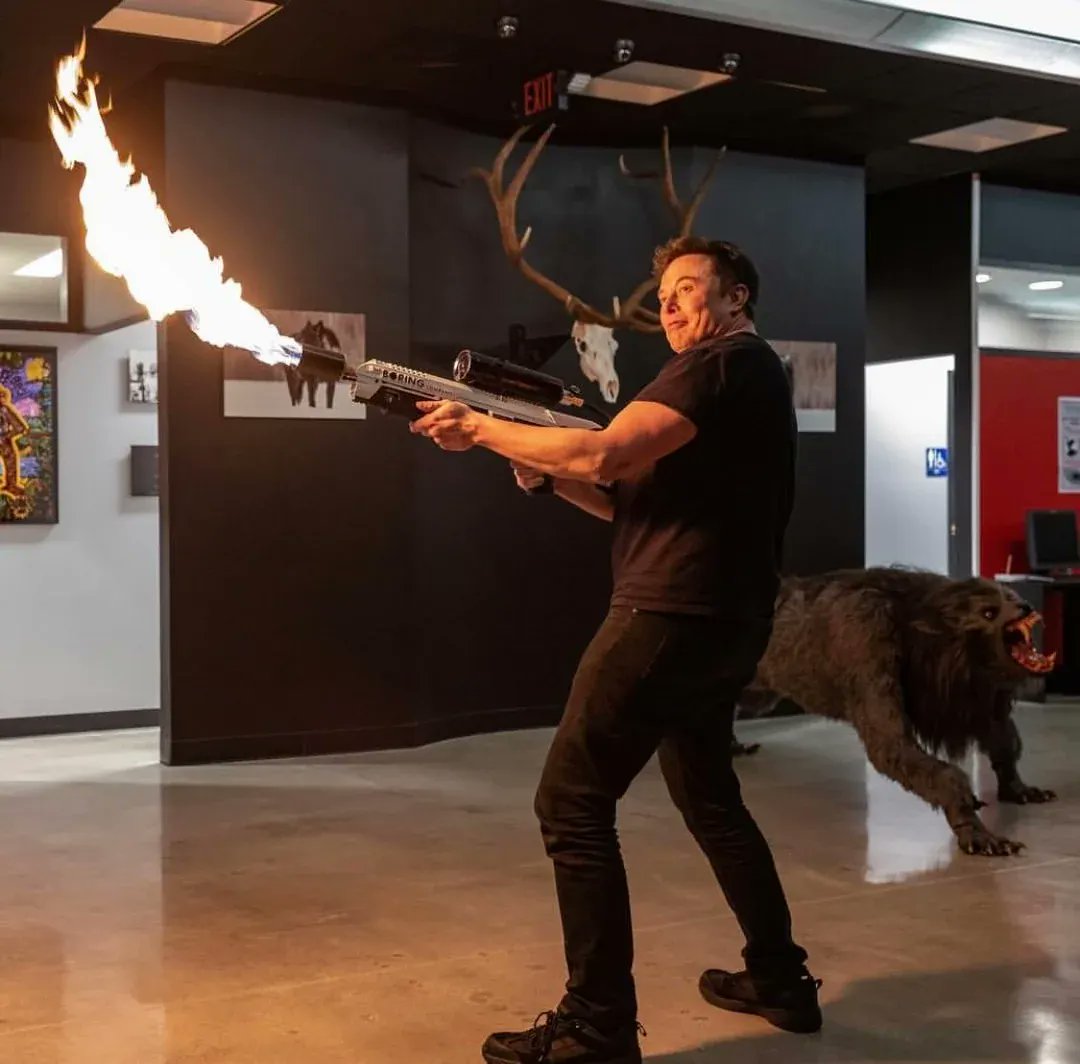
To help fund the company in the meantime, Musk started selling merchandise. On October 17, 2017, he tweeted (opens in new tab) a link to “the world’s most boring hat.” By the next day, the company had sold 4,000 of them for $20 each. In December, Musk promised that if 50,000 hats sold, the Boring Company would start selling flamethrowers, a nod to the 1987 movie Spaceballs, where a flamethrower turns up (opens in new tab) in the merchandising display. (“I know it’s a little off-brand, but kids love it,” he joked (opens in new tab).) The hats sold out (opens in new tab) less than two weeks later, bringing the total hat sales to $1 million, and it fell to Davis to make good on the flamethrower promise.
“I remember that day quite clearly because he called me and said, ‘We’re going to sell flamethrowers,’ and I’m like, cool,” Davis says (opens in new tab). After a quick Google search though, he realized there was a small problem – quite a few countries don’t let you ship flamethrowers to their citizens.
“Great, call it Not a Flamethrower,” Musk replied. That was technically true; it was really just a roofing torch with an air-rifle cover.
“When do you want to start?” Davis asked.
“Tonight.”

So Davis built a pre-order page on Squarespace, listing the devices at $500 each, and Musk tweeted (opens in new tab) the link. “Obviously, a flamethrower is a super terrible idea. Definitely don’t buy one,” he warned, “unless you like fun (opens in new tab).” All 20,000 sold out in four days, bringing in $10 million. Then Davis had to figure out how to build them. “We literally rented out a warehouse in LA and set up a production line,” he remembers.
Merchandise was the company’s only revenue at this point, but the team was making progress on real-world transit projects too. In January 2018, the company told the Culver City council that it had finished its technology development phase and was ready to build a 6.5-mile tunnel (opens in new tab) between Los Angeles and Culver City. Instead of the private Teslas from the TED video, the pitch featured small pods that would complement the county’s existing transit, require no taxpayer money, and cost riders about as much as a $1.75 Metro bus ride. In February, Chicago Mayor Rahm Emanuel announced (opens in new tab) that the Boring Company was one of four groups bidding to build a high-speed link between downtown and O’Hare International Airport.

With bids in Washington, Los Angeles, and Chicago, it was increasingly clear the Boring Company needed to stand on its own. In early 2018, it was spun out of SpaceX, and in April it raised $112.5 million (opens in new tab) in equity, about 90% of it from Musk and the rest from early employees. SpaceX later received about 6% of the company for the land, people, and equipment it had contributed.
The next month, Musk and Davis hosted an information session (opens in new tab) in Los Angeles, with Gary crawling around a pineapple-shaped terrarium between them. Much of the evening was spent addressing common misconceptions about tunneling.
Won’t you run into pipes and power lines? No, Musk said, because the tunnels run beneath them. “Once you get below about 20 or 30 feet, there’s almost nothing.” Even L.A.’s subway wouldn’t be in the way. Boring’s tunnels would run below it.
Will the tunnels disturb people on the surface? Davis offered a rule of thumb: “If you’re two tunnel diameters below the surface, noise and vibrations are imperceptible.” With a 14-foot machine, that’s 28 feet, so the company always tunnels at least 30 feet below the surface. Walking on the sidewalk, Musk added, creates more vibration than the boring machine below.
What about earthquakes? “Earthquakes are probably the single biggest question we get,” Musk said, “but people don’t realize that earthquakes are primarily a surface-level phenomenon.” Being in a tunnel during one, he explained, is like being in a submarine during a hurricane at sea. “The safest place to be during an earthquake is a tunnel,” Davis added. Musk pointed out that Japan, one of the most seismically active countries on Earth, has one of the best subway systems in the world.
What about sinkholes? This is not a factor either, Musk says, because concrete segments lock in the shape the machine cuts, so the volume of the ground above doesn’t change.
What about induced demand? Economists have found (opens in new tab) that driving in American cities rises roughly one-for-one with new highway lanes, and drivers often endure years of construction only to find traffic hardly any different when the project is complete. Musk argues that tunnels escape this trap because you can keep adding lanes faster than demand grows. “You could have hundreds of lanes,” he says, “and there’s no real limit.”

Musk and Davis promised that the Boring Company would be a good neighbor. The only sign the company was there, Davis said, would be dirt trucks on approved routes during approved hours. “It’s not going to scale if we can’t do a 2-mile tunnel without disturbing people,” Musk added. “Then how could we do hundreds of miles without disturbing people?” Eight years later, Davis says, the sensors at the surface above the company’s tunnels have never recorded more than about two hundredths of an inch of movement.
Delete, Delete, Delete
In December 2018, Musk invited visitors to see what had become of the hole in SpaceX’s parking lot. It was now a finished, 1.14-mile test tunnel that ran under 120th Street in Hawthorne. The all-in cost with Godot was about $10 million, a figure that included the lighting, ventilation, safety systems, and track. The unveiling had the feel of a Boring Company party. There was a Monty Python-style watchtower built from bricks of compressed tunnel dirt, marshmallows roasted with Not a Flamethrowers, and a shrine to Gary. Then came a ride through the tunnel in a Tesla Model X fitted with retractable guide wheels. “You drop down the wormhole, pop out the other side,” Musk explained (opens in new tab), and then you simply drive away.

The electric skates from the TED video were gone. Musk said they’d proven too complex. The elevators that were supposed to lower cars into the tunnel turned out to be slower and more expensive than letting the boring machine dig its own ramp to the surface, a technique the team would call “porpoising.” The passenger pods would also be deemed unnecessary, and eventually even the guide wheels in the test tunnel demo would be removed. Critics accused the company of backtracking, but Davis and the team were really just applying the first three steps of the Algorithm (opens in new tab) they learned from Musk at SpaceX:
Question every requirement.
Delete any part or process you can.
Simplify and optimize.
They applied it to the boring machines too. “We did not know how to dig tunnels at all, actually,” Musk admitted in 2018. “Godot was a lot of waiting and figuring things out.” The big time sinks were stopping drilling to install the concrete lining segments, hauling dirt out and supplies in through a single-lane tunnel, and stringing miles of heavy high-voltage cable behind the machine.
The next machine, Line-Storm, made progress on most of these problems. (In keeping with the company’s habit of naming its machines after poems and plays (opens in new tab), it took its name from Robert Frost’s “A Line-Storm Song.”) It was a heavily modified conventional machine, and the key change was rethinking the assumption that digging and lining the tunnel had to be separate steps. By automating the placement of the concrete segments, Line-Storm was a big step toward continuous mining, where the machine digs and builds the tunnel at the same time. Other fixes were much simpler, like adding a passing lane so concrete segments could come in while dirt went out. By Davis’s estimate, the passing lane, a faster way to dump muck, and automated segment placement would triple the machine’s speed on their own.
The team electrified everything else it could, borrowing heavily from Tesla. Industry precedent was to haul dirt out of tunnels with diesel locomotives, which required a ventilation duct. Boring built a battery-electric locomotive out of Model 3 motors and battery packs that could pull a quarter of a million pounds of muck. Musk even wanted to get rid of the power cable that trailed behind the boring machine. “Two miles of high-voltage cable is pretty expensive,” he said (opens in new tab). “We want to make this more like a cordless drill.”

The machine’s length got the same treatment. Behind the cutting head, a boring machine trailed a long string of sections called gantries. They’re kind of like the cars of a train, and Davis describes them as “basically just storage bins.” This set off what Davis calls an “engineering death spiral,” because “every single person wants to add something, and then you have an infinitely long machine.” The first machine the team worked with had 14 of these sections. “So I was like: delete them all.” The next one had only five. “We deleted too much, which is classic.” Musk’s rule is that if you don’t end up adding back at least 10% of what you deleted, you didn’t delete enough. Boring’s machines now run with six to eight.
Teslas in Tunnels
Boring’s first customers were some of the hardest cities in America to tunnel under. In June 2018, Chicago picked the company to build an express link between downtown and O’Hare, but the deal fell through after Mayor Rahm Emanuel left office without finalizing the contract.
Elsewhere, Boring’s plans got buried in paperwork. The Washington-Baltimore project, and the New York-to-D.C. hyperloop meant to follow it, stalled for years in federal environmental review before the highway regulator declined to approve it. In Los Angeles, a lawsuit over the environmental review of a single test tunnel under Sepulveda Boulevard was enough to make the company set its plans aside. Musk had picked L.A. because he lived there, but he later called it “one of the worst places to dig tunnels, mostly because of the paperwork.” Davis says the problem isn’t the people but the system. “It was the same thing when SpaceX was launching,” he says. “The system was set up for a six-month launch permit, not a two-day one. Nobody is set up to permit Loop, because how could they be?”
Las Vegas was different. In 2019, the Las Vegas Convention and Visitors Authority needed a way to move people across its expanding convention campus, and Boring offered to do it underground for about $52.5 million (opens in new tab), roughly a quarter of the original estimate for an above-ground people mover from the Austrian firm Doppelmayr. Boring also assumed the financial risk. Two-thirds of the money would be held back until the system worked, and if it never earned a certificate of occupancy, the authority would get its money back. But not everyone was convinced. Las Vegas Mayor Carolyn Goodman, a board member, opposed the deal, citing the company’s record of completing zero commercial projects, and cast the only vote against it.
Tunneling began on November 15, 2019. The original Loop of three stations connected by 1.7 miles of tunnel was built in about a year for roughly $47 million (opens in new tab), without a single road closure. And it has carried passengers since 2021, with a demonstrated peak capacity of more than 4,500 passengers an hour and more than 32,000 in a day. It has since become the first piece of a much bigger network, the Vegas Loop, which now has 29 stations and more than 10 miles of tunnel. Local officials have approved plans for 68 miles of tunnel and 123 stations.

Vegas was the ideal proving ground because of how the Loop product works. A subway has to stop at every station, so the more stations you add, the slower every trip gets. “There’s only two ways to solve the problem,” Davis says. “You don’t stop, or if you’re willing to stop, you can’t have that many stations.” Loop is point-to-point and never stops. It works more like a private Tesla on its own highway that takes you straight to your destination. Davis estimates that if a train stopped at every hotel, getting from one end of the Strip to the other would take about 90 minutes, but on Loop, it takes about eight, no matter how many stations are in between.

Another advantage of a point-to-point system is that stations can be small and cheap. A subway station can cost $250 million to $500 million, but the Boring Company’s stations range from less than $1 million all the way up to $10 million for the really big, fancy ones. Some are as small as a few parking spaces and cheap enough that even a taco shop on the Vegas Loop is buying one. “By doing so, this taco station is going to be on our map and will have point-to-point transportation to anywhere in Vegas,” Davis says. That has been part of Musk’s pitch since 2018: “If you have many small stations that are not much larger than a parking space, then you could really seamlessly integrate a new transport network into a city.”
And as the network grows, so does a station’s return on investment. In 2022, Resorts World converted part of its underground garage into a station, so guests can get to the convention center in just over a minute. Since then, the resort has seen demand rise about 30%. Stations can also be added after a tunnel is built without slowing anyone down. “The last thing you do is pop a hole in the tunnel and that becomes your exit,” Davis explains. The only catch is that the tunnel has to run under the property first, which is why Boring asks every property owner along a route whether it wants the tunnel to clip its land or go around it. “Almost anyone who is being rational will say, of course, clip my property,” he says. Several customers have told the company they’ll open a station once 20 others are open. “Great,” Davis replies. “Once there’s twenty open, we’ll cut a hole in the tunnel.”
Davis treats the ride experience as an engineering problem too. When the convention center Loop opened, he spent two months standing in the station writing down notes. He timed riders getting in and out of different cars, and decided that the fleet would be Model Ys after observing that people got out of a Model Y two or three seconds faster than a Model 3. “Capacity is driven by how fast you can load and unload,” he says. Asking riders to leave the doors open for the next passenger raised capacity by 10 to 15%. Some stations now have no staff at all – you press a button and a car comes. Davis says it took about twenty iterations before people stopped getting confused.
The business model was another area of innovation. A new transit line makes the land around its stations more valuable, but in most American cities, taxpayers pay to build it, fares cover only part of the cost to run it, and the property owners who gain the most usually don’t pay anything extra. Boring flips that. Property owners who want a station pay for it, riders pay fares that run about half the price of a rideshare or less, and the company has been buying land along its routes, so it shares in the value its tunnels create. “We don’t ask for any taxpayer dollars,” Davis says, and he credits low tunneling costs for making that possible. That gives Boring very different incentives from those of a contractor bidding on a government project. It’s also an old idea. Developers did something similar more than a century ago, paying for streetcar lines to reach the neighborhoods they were building as people moved to the suburbs.
There are also network effects. “The Loop product is pretty good and it’s obviously getting better,” Davis says, “but the system’s usefulness is limited by the number of tunnel miles we have and are open.” A hotel connected only to the convention center is worth less than one connected to restaurants, arenas, the airport, and every other hotel. Each new station gives riders more places to go and gives property owners another reason to join. And as the tunnels get cheaper, more destinations will make sense.
A Factory on Wheels
After Line-Storm came Prufrock, the first machine Boring designed entirely in-house, named after the T.S. Eliot character who spends an entire poem wondering whether he dares disturb the universe. It had been in development since 2018, and the goal was a machine that would finally be an order of magnitude faster and cheaper than a conventional one.

The company builds these machines in Bastrop, Texas, where it has been headquartered since 2023. Ten years ago, Bastrop had just over 8,000 residents. Today the town also holds a SpaceX Starlink factory and the headquarters of X. Davis lives on site, in one of the 18 homes on the campus. “I would always ask my wife and all the families: What do we not have here?” he says (opens in new tab). Whatever they named, he added to the campus. The nearest grocery store was half an hour away, so now there’s one on campus (the Boring Bodega) inside a metal building called Hyperloop Plaza, along with the Prufrock Pub, a barbershop, and a café where employees make pottery. Outside are pickleball and tennis courts with a view of the factory, and a Montessori school is on the way.

Across the road is a 420-by-169-foot factory that’s long enough for an entire boring machine to fit in a line. “It took all of one minute to size this building,” Davis jokes. About 200 people work there in two shifts, seven days a week. The factory builds a boring machine every two months and is working toward a cadence of one a month. On Prufrock-1, the original prototype, Boring made about 30% of the parts itself. On Prufrock-6, it makes about 99%.
Everyone works under the same roof – a lesson Davis learned from Musk at SpaceX. Design engineers sit next to the machinists who make the parts and the technicians who assemble them. “Before the part is even released, the engineer brings a preliminary drawing and says, ‘Hey, what do you think?’” says Mike Baier, who runs production, electrical, and software engineering. He points out that if that part were sent to an outside shop instead, every question about cost or delay would have to pass through a chain of three or four people. Each machine has roughly 176,000 parts and carries about a thousand design changes from the previous version (e.g. Prufrock-4 to Prufrock-5), which is why Baier calls them “late-stage prototypes.”
“Imagine building a two megawatt factory, which is hard enough,” Davis says, “and then it moves 100-200 feet every day and it just has to keep running.”
A boring machine does not leave Bastrop until it has dug a test tunnel there. “We’re the only company that I’m aware of that won’t ship a machine until it’s dug a test tunnel,” Davis says, a habit he brought from SpaceX, where no rocket launches without a static fire. During those tests, the engineers who designed each subsystem of the machine operate it themselves, watching what works and making small changes on the spot.
The fourth step of Musk’s Algorithm is to accelerate, and for a boring machine that means eliminating every moment it isn’t moving forward.
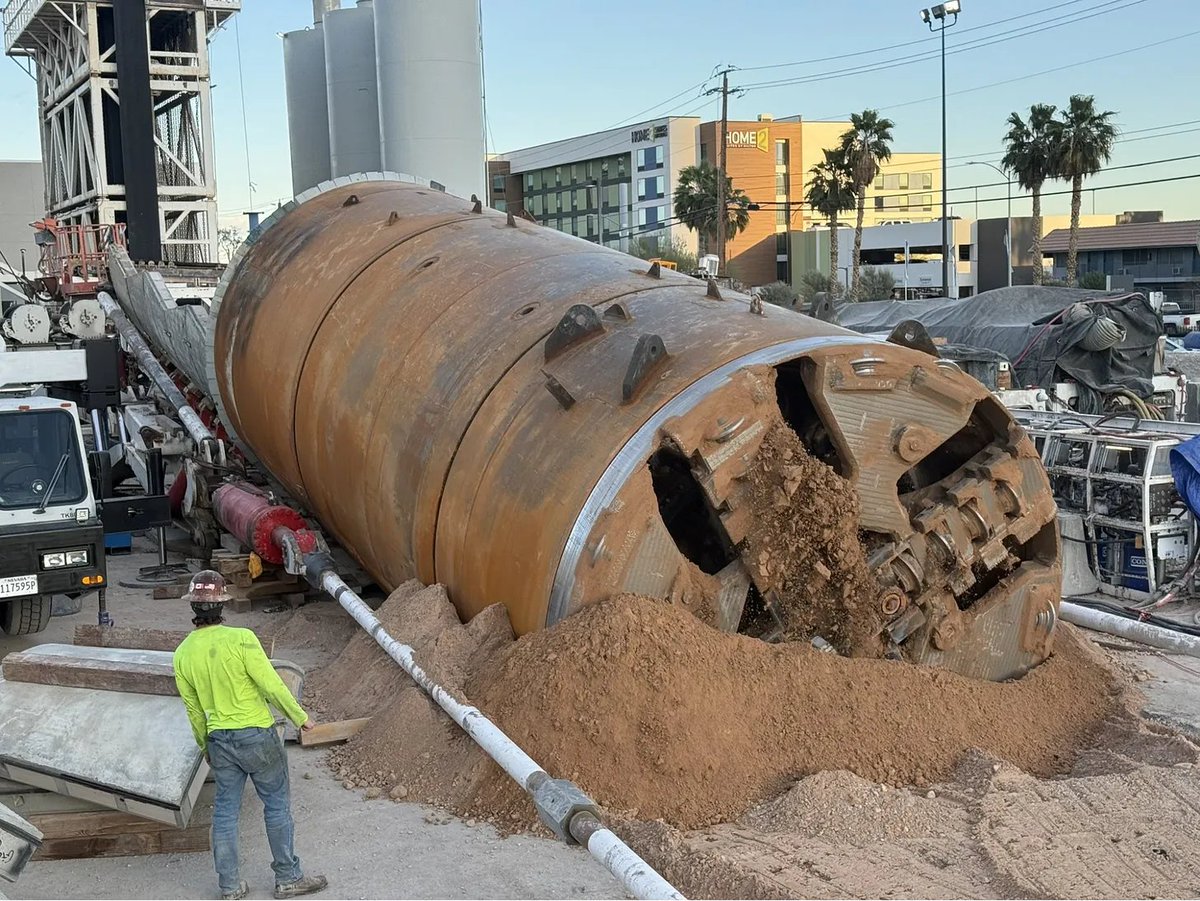
The way a Prufrock machine works is it uses twelve hydraulic propulsion cylinders to push itself forward five feet, builds a ring of concrete lining, then pushes again. “I consider [building the concrete lining] to be a failure because you’re not pushing,” Davis says. To mine while building the ring, it has to retract some cylinders to place a segment while the rest keep pushing, using force controllers to keep the thrust pointed exactly where it should go. Davis calls it a dance of the cylinders. “On paper it all works immediately,” he says, but making it work safely and reliably took about two years and is an important step from a machine that mines 5 to 10% of the time to one that mines more than 90% of it.

Dirt and muck are extracted with a continuous conveyor belt that runs the length of the tunnel and back, about five miles of rubber for the 2.3-mile tunnel Boring just finished in Las Vegas. Every 500 feet, the crew has to splice in a new spool of belt, which used to take eight hours. When Davis looked into why, he found that most of the delay was due to human factors and everyone being packed on top of each other. The new conveyors now have big splice platforms with every tool within reach, and a team called “fast splice” got the job down to nine minutes.
“Every time you stop, ask why,” Davis says. Even the rollers that keep the belt on track were rethought from first principles. Watching crews knock them into place with hammers, Davis realized that the industry’s method had been adopted “because of inertia and heritage instead of engineering,” and the team is now building a belt that steers itself. Every foot the machine mines fills about one dump truck with muck.
The slowest part of starting a tunnel, though, was the launch. Conventional boring machines are lowered into enormous pits, like the 100-foot shaft Musk and Davis descended into in Washington. Boring’s machines arrive on a transporter called “the Monster,” which tilts them nose-down so they bore straight into the ground. “It saves millions of dollars on every launch,” Davis says. At the other end of the tunnel, the Monster tilts the other way, and the machine climbs out of the earth onto it, “Dune style.” The fastest launch so far went from an empty site to mining in six and a half days.

Avoiding downtime is also a crucial factor in tunneling speed. A few weeks after Mike Baier joined the company, Davis told him he wanted to be able to cut any wire on a Prufrock and have it keep mining. So the team redesigned the electrical system with redundancy, and “for the most part,” Baier says, “Prufrock now passes the scissor test.”
The final step in Musk’s Algorithm is automation. One of the first questions Musk had as he learned more about tunneling was: Why are there so many people? Oil and gas companies drill for miles, thousands of feet below the surface, with zero people in the hole. Once a person is inside, Davis says, “your entire machine becomes a safety system.” Deleting people from the process lets Boring delete other things too. For example, with zero people in the tunnel, you don’t need the ventilation system that feeds them air.
Boring’s first machine needed about a dozen people, but the newest Prufrock needs only two. Crews used to haul barrels of grease into the tunnel by hand, so the team copied the quick-disconnect fittings SpaceX uses on its launch pads, and now a driverless truck plugs in, delivers the grease, and leaves. “Getting to two is hard, but not that hard,” Davis says. Getting to zero will be much harder, but once it’s figured out, “you can just unleash a fleet of these things.”
In May 2025, the company demonstrated “Zero-People-in-Tunnel” (ZPIT) continuous mining, advancing the machine and erecting a full tunnel ring at the same time with no crew inside the tunnel. By August 2026, ring building was fully autonomous: six concrete segments of about 3,750 pounds each were placed with millimeter precision in less than a minute.
All of it is operated from the company’s Global Operations Control Center (GOCC) in Texas, which the team pronounces “gawk.” Even a machine being tested outside the factory is run over a network loop routed through Houston, so operating it is identical to operating one anywhere in the world. Each machine carries about 80 cameras and more than 1,700 sensors, and the team operates each subprocess of tunneling – from steering the boring machine to the liner trucks feeding the concrete segments – by remote control before automating any of it. That gives every automation a graceful fallback to a human, so it doesn’t need to be perfect on day one. For the liner trucks, the operator today mostly holds down a button and watches the cameras.

The result of all these improvements is a tunneling cost that’s below $10 million a mile, and Davis expects that to converge on $4 million to $5 million. For context, adding a single lane to a big-city highway can cost tens of millions of dollars per mile. Los Angeles, for example, spent $1.1 billion (opens in new tab) and five years adding a single 10-mile carpool lane to the 405.
Beyond Nevada
In July 2025, the company and the State of Tennessee announced the Music City Loop, a privately funded system connecting downtown Nashville with Nashville International Airport. It wasn’t an easy place to dig – the rock is extremely hard, and the depth to the top of the rock changes every few hundred feet. But after receiving its permit from the Tennessee Department of Transportation on February 25, 2026, the company started tunneling the same day. By August, two machines were mining simultaneously, and a third was in final assembly in Bastrop.
The hard rock turned out to be a gift. Nashville’s limestone tests at about 14,000 psi, stronger than the 8,000-psi concrete Boring uses to line the tunnels. “Nashville and the evolution of the planet has basically built the liner for us,” Davis says (opens in new tab). In many of the parking garages beneath Broadway’s high-rises, there’s nothing between the support columns but bare limestone – the rock is the wall. So the team designed a new machine, the Prufrock Main Beam, and deleted the most complicated systems from their soft-ground machine: no screw conveyor, no grout, no concrete segments, and none of the machinery that was required to move and place them. “That machine looks nothing like our normal Prufrock 1s,” Davis says. “It’s a way simpler machine.” With no lining to push against, it braces itself against the tunnel walls with more than four million pounds of force – Davis compares it to an acrobat hovering inside a tube by pushing out against both sides – then mines forward, releases, and grips again.

“For all these systems,” Davis says, “you’re taking Elon’s Algorithm – the best part is no part – and applying it.” Tunneling in Nashville costs about half what it does in Vegas, and stations are simpler too. “All I have to do is pop a hole in the rock I’m drilling through anyway,” he says, “and I’m in their parking garage.”
Davis thinks about the project in terms of “pushes.” Each push is five feet, and twin nine-mile tunnels to the airport plus twin two-mile tunnels under Broadway add up to more than 20,000 of them. If you can shave a minute off every push, you save two weeks of schedule. “Whenever we see something go wrong – which is all the time – we write it in an Excel spreadsheet, assign an engineer to it, and we fix it,” Davis says. The machines are already about five times faster than when they started, and he expects another tenfold gain. His bet is that the first mile of Nashville, which includes the convention center and four major properties, will carry real passengers in the first quarter of next year while the machines keep boring toward the airport. The U.S. Department of Transportation puts the first phase, about 10 miles from downtown to the airport, at roughly $200 million (opens in new tab), or about $20 million per mile of route (each route has two one-way tunnels, so about $10 million per mile of tunnel). Boring expects to finish all 22 miles of tunnel in two to three years. The average American light rail line costs about eight times as much per mile of route and takes about twice as long per mile to build.

Internationally, the company signed a construction contract with Dubai’s Roads and Transport Authority for the pilot phase of the Dubai Loop – about four miles of tunnel and four stations that will cut the trip between the city’s financial district and Dubai Mall from 20 minutes to three. Tunneling is planned to begin in late 2026, and its broader partnership with the UAE is for more than 150 kilometers (~93 miles) of tunnel.

Closer to home, Dallas and New Orleans won the company’s Tunnel Vision Challenge this spring – Boring offered to build a free, one-mile tunnel to whoever pitched the best idea – and Orlando is working through early approvals.
Each new city should be easier than the last. When Las Vegas signed on, Boring had never completed a commercial project. Now any city considering Loop can see that it works, which takes much of the risk out of saying yes. Permitting is getting easier too. Las Vegas’s full system requires more than 600 permits, but in Nashville, Davis explains (opens in new tab), “the entire thing was permitted in one shot.”
In September, the company announced (opens in new tab) a $3 billion Series D at a $23 billion valuation, which a16z participated in.
The Future Underground
In 1964, Isaac Asimov toured the New York World’s Fair and imagined its successor fifty years on. He called an underground house at the fair a sign of the future and predicted (opens in new tab) that exhibits would one day show off entire underground cities. He also foresaw (opens in new tab) vehicles with “robot-brains” that could be told where to go and would get there without the slow reflexes of a human driver. Asimov imagined them as two separate predictions, but the Boring Company believes tunnels and autonomous cars will go hand in hand.
“Tunnels under cities with self-driving electric cars will feel like warp drive,” Musk tweeted (opens in new tab) in 2020. Today, 5 to 10% of Loop rides already run without a driver. A sealed, one-way tunnel with no pedestrians, no cross traffic, no weather, and no left turns is about the friendliest place an autonomous car will ever drive. And as tunneling gets cheaper, there will be more of them, and the whole network will get more useful. Davis believes that in the extreme, you could have a station in every driveway – a robotaxi picks you up anywhere, drops into the nearest tunnel portal, and comes back up at your destination.
A city like that would also be far safer. Worldwide, car crashes kill more than a million people a year and are the leading cause of death for children and young adults. We think the most promising way to bring that number down is autonomous cars and tunnels. Autonomous cars remove human error, the most common cause of crashes, and tunnels remove many of the most dangerous parts of driving, like pedestrians, cross traffic, and bad weather.
The obvious worry is what happens if something goes wrong in one of the tunnels. Because the tunnels are one-way, head-on crashes are impossible, but if a car does stall or catch fire, cameras will see it, and fire detectors will sound an alarm. Water lines run the length of the tunnel for firefighters, ventilation can push smoke in either direction to keep an escape route clear, and a dedicated communication system keeps police and firefighters in contact underground. Davis says the company runs about one safety drill a week with firefighters and police. Clark County’s rules cap how far a tunnel can run between exits. “I’m often told we don’t have [exits],” Davis says, laughing. “But we have dozens and dozens of them.” And since normal fire engines are too big for the tunnels, Boring has outfitted the county fire department with Cybertrucks it converted into custom fire trucks. So far, more than 4 million passengers have ridden the Loop without a single passenger-related safety or security incident.

Moving traffic underground also frees up land for better use. By the company’s estimate, roads take up 20% to 30% of the land in many major cities, and as much as 60% including parking.
Davis would put utilities underground too. In his view, the pipes and cables under city streets – water, sewer, power, fiber – all belong in tunnels. When a water pipe breaks, it would flood a tunnel instead of a street, and repair crews could walk in to fix it instead of tearing up the road. Davis says the company has never had to close a road to build its tunnels, and while a machine bores three miles away, the only sign of it on the surface is a launch site with dump trucks of dirt coming and going. “You basically have this major infrastructure project that nobody even knows is happening,” he adds.
Then, once tunnels are cheap, they can start connecting cities. The other big question for a hyperloop was how well a tunnel can hold a vacuum. “We didn’t know,” Davis says. “We could do a bunch of fake analyses, or we could just do it, and that’s what we did.” The former SpaceX engineers sealed a tunnel, hooked up the vacuum pumps from their old California hyperloop test track, and pumped it to see how well it worked. “You can easily get it below 1 psi,” he says. “When you start getting to 0.5 it starts to struggle.” For context, you can still reach very high speeds at 7 to 10 psi, compared with about 14.7 psi at sea level. And the leak rate isn’t too bad, which makes sense given that they already seal the tunnels to keep out groundwater.

In September, Musk wrote (opens in new tab) that the company is working on a “simple, precursor Hyperloop tunnel” between Austin and San Antonio that can travel at speeds greater than 200 miles per hour. “Due to traffic congestion, that journey can currently take up to 2.5 hours,” he continues, but the Boring Company can reduce that to “a consistent <30 mins.” And if Nashville goes as well as Davis expects, it could be linked by hyperloop to Knoxville or Chattanooga – or even as far as Memphis or Atlanta. “With the mining speeds and the permitting and regulatory structure we have now, there’s a very clear path to doing that,” he says (opens in new tab). “Most of the risk is us executing, which is great from the hyperloop perspective.”
The most important consequence of this underground future may be the cost to access a city. “The big win for helping people, in my opinion,” Davis says, “is one of the fundamental issues with cities besides traffic is rent. It’s super high because no one wants to live two hours away from their job.” But if tunnels can shorten a two-hour commute to ten minutes, affordable land in the middle of nowhere becomes land near everything. Las Vegas is already becoming an “eight-minute city.” Every trip on the Loop takes eight minutes or less, and each new tunnel expands the area you can reach in that time. “You can solve the rent and cost of living problem by making all of these places very desirable to live with just transportation,” Davis says. Boring and some developers are already betting on it. In Las Vegas, Boring is planning a six-story, 132-unit apartment building about a mile from the Strip with a Loop station on its ground floor. In Nashville, a developer has signed on for a private station serving residents of three of its towers on Church Street. Farther out, Boring says developers are starting to consider projects 10 to 20 miles from the urban core as tunnels put downtown within reach.
Las Vegas will be the first test. Once the core of the Vegas Loop is built, Davis plans to run tunnels out to the neighborhoods around it. “The only reason we can do that is because our cost of tunneling is low,” he says. A pair of tunnels – to and from – a neighborhood 10 miles away would cost $20 billion at a billion dollars a mile, but at $10 million a mile, it costs $200 million. “That’s a very different game.”
Somewhere at the end of all those tunnels is a half-hour commute from D.C. to Vegas, and until it exists, Steve Davis isn’t going anywhere.
Thanks to @jamiedsully and @mikemcg0 for coauthoring this with me.
- Boring Company announced a $3 billion Series D at a $23 billion valuation in September; a16z participated.
- The Vegas Loop has carried more than 4 million passengers since opening beneath the Las Vegas Convention Center in 2021; the network now has 29 stations and more than 10 tunnel miles, with local approval for 68 miles and 123 stations. a16z’s post compares the original Vegas Loop at about $62 million per route mile with an average $160 million per route mile for U.S. light rail, and puts the planned Music City Loop at about $20 million per route mile.
- Boring’s described business model has property owners pay for stations, riders pay fares around half the price of a rideshare or less, and the company buy land along routes to capture some of the value created; Davis says the company does not seek taxpayer dollars. The company argues that each added station makes the network more useful.
- At its Bastrop factory, about 200 people build a boring machine every two months, with a target of one per month; the company makes about 99% of Prufrock-6’s parts in-house. Prufrock’s continuous-mining approach advances while installing tunnel lining; the feature reports that mining time rose from 5–10% to more than 90% after about two years of development. The feature puts current tunneling cost below $10 million per mile, with Davis expecting $4 million to $5 million per mile.
- In Nashville, the project received its permit and began tunneling on February 25, 2026; by August, two machines were mining and a third was in final assembly. Davis expects the first mile to carry passengers in Q1 next year, while Boring expects to finish all 22 tunnel miles in two to three years. Dubai’s Roads and Transport Authority signed a construction contract for a four-mile, four-station pilot, with tunneling planned for late 2026; the broader UAE partnership covers more than 150 kilometers. Musk also said the company is working on a precursor Hyperloop tunnel between Austin and San Antonio, targeting speeds above 200 mph and a consistent trip under 30 minutes.
- Permitting and contracting remain material risks: the Chicago deal fell through before a contract was finalized, Washington–Baltimore and the proposed New York–D.C. Hyperloop stalled in federal environmental review, and a Los Angeles tunnel plan was shelved after a lawsuit. By contrast, Davis says Nashville’s entire project was permitted in one shot.
- The Boring Company announced a $3 billion Series D at a $23 billion valuation; a16z participated.
- Vegas Loop has grown from an initial three stations and 1.7 miles of tunnel to 29 stations and more than 10 miles; the system has carried over 4 million passengers without a passenger-related safety or security incident.
- The company reports tunneling costs below $10 million per mile, with Steve Davis expecting $4 million–$5 million; its Bastrop factory of about 200 employees builds a machine every two months and is targeting one per month, while in-house parts production rose from about 30% on the prototype to 99% on Prufrock-6.
- Its model has property owners pay for stations, fares priced at about half a rideshare or less, and the company buying land along routes; it says it uses no taxpayer dollars and sees network value increasing as stations connect more destinations.
- Expansion is underway: Nashville tunneling began the day its permit was issued on February 25, 2026, and by August two machines were mining while a third was in final assembly; a Dubai pilot contract covers about four miles and four stations, with tunneling planned for late 2026. Regulatory execution remains a caveat: the Washington–Baltimore project stalled in federal environmental review and was declined by a highway regulator, while the Los Angeles plan was set aside after an environmental-review lawsuit; Davis says Nashville’s entire project was permitted in one shot.
- The Boring Company announced a $3 billion Series D at a $23 billion valuation in September, with a16z participating.
- The Vegas Loop has carried more than 4 million passengers since opening in 2021; the network now has 29 stations and more than 10 miles of tunnel, with local approval for 68 miles and 123 stations.
- Boring says property owners fund stations, fares are about half the price of a rideshare or less, and the company uses no taxpayer dollars; it reports tunneling costs below $10 million per mile and expects $4–5 million per mile.
- The company says Prufrock’s tunnel crew requirement fell from about a dozen people to two; it demonstrated crew-free continuous mining in May 2025 and reports that tunnel-ring placement was fully autonomous by August 2026.
- Expansion includes Nashville’s privately funded airport connection, where tunneling began the day permits were issued in February 2026 and two machines were mining by August, plus a Dubai pilot planned at about four miles and four stations; tunneling there is planned for late 2026, within a broader UAE partnership covering more than 150 kilometers.
- Financing: The Boring Company announced a $3 billion Series D at a $23 billion valuation in September; a16z participated.
- Operating proof and production: The Vegas Loop has 29 stations and more than 10 miles of tunnel, has carried over 4 million passengers, and has demonstrated peak capacity above 4,500 passengers per hour. Tunneling costs are reported below $10 million per mile, with Steve Davis expecting them to converge on $4 million to $5 million per mile. The Bastrop factory builds a boring machine every two months and is working toward monthly production; Prufrock-6 is about 99% in-house parts.
- Expansion and execution risk: Nashville began tunneling on the day it received its permit on February 25, 2026; by August, two machines were mining and a third was in final assembly. Boring expects the first mile to carry passengers in the first quarter of next year and to complete all 22 tunnel miles in two to three years. The company has a construction contract for a Dubai pilot of about four miles and four stations, with tunneling planned to begin in late 2026. Permitting has been a meaningful historical obstacle: federal review stalled the Washington–Baltimore and New York–D.C. plans, and a Los Angeles environmental-review lawsuit led Boring to set aside a project. By contrast, Davis says Nashville’s entire project was permitted in one shot.
- The Boring Company announced a $3 billion Series D at a $23 billion valuation; a16z participated.
- The Vegas Loop has carried more than 4 million passengers since 2021 and now has 29 stations and over 10 miles of tunnel; officials have approved plans for 68 miles and 123 stations. The company says property owners pay for stations and fares are about half the price of a rideshare or less, without taxpayer funding. Nashville tunneling began the day its permit was issued in February 2026; by August, two machines were mining and a third was in final assembly. Dubai’s pilot contract covers about four miles of tunnel and four stations, with tunneling planned for late 2026.
- Reported tunneling cost is below $10 million per mile, with the company targeting $4–5 million. Its factory builds a machine every two months and is working toward one per month; the share of Prufrock parts made in-house rose from about 30% on the first prototype to about 99% on Prufrock-6. The company demonstrated continuous mining and tunnel-ring construction with no crew inside the tunnel in May 2025; by August 2026, ring-building was fully autonomous.
- The Boring Company announced a $3 billion Series D at a $23 billion valuation, with a16z participating.
- The Vegas Loop’s original three-station, 1.7-mile system cost roughly $47 million and has demonstrated peak capacity above 4,500 passengers per hour and 32,000 per day; the network has since grown to 29 stations and more than 10 miles, with local approval for 68 miles and 123 stations. Tunneling costs are below $10 million per mile, and the company expects them to reach $4 million–$5 million per mile.
- Boring’s Bastrop factory builds a tunneling machine about every two months and is working toward monthly production; its share of parts made in-house rose from about 30% on Prufrock-1 to about 99% on Prufrock-6. By August 2026, it reported fully autonomous tunnel-ring building, placing six roughly 3,750-pound segments with millimeter precision in under a minute.
- Expansion is advancing: Nashville tunneling began on the day its permit was issued in February 2026, and by August two machines were mining; Boring also signed a Dubai pilot construction contract for about four miles of tunnel and four stations, with tunneling planned for late 2026. Execution risk remains material: the Chicago deal fell through before a final contract, Washington–Baltimore and New York–D.C. projects stalled in federal environmental review, and the Los Angeles plan was set aside after a lawsuit, although Davis says Nashville was permitted in one shot.
- a16z participated in The Boring Company’s $3 billion Series D at a $23 billion valuation, announced in September. The company says its model avoids taxpayer funding: property owners pay for stations, fares are about half the price of a rideshare or less, and Boring buys land along routes to share in the value its tunnels create.
- The Vegas Loop has 29 stations and more than 10 miles of tunnel, with local officials approving plans for 68 miles and 123 stations; more than 4 million passengers have ridden without a passenger-related safety or security incident. Boring says tunneling costs are below $10 million per mile and expects them to reach $4–5 million; Nashville tunneling costs about half as much as in Vegas.
- Prufrock has reduced tunnel crews from about a dozen people to two; Boring demonstrated continuous mining with no crew inside in May 2025 and said ring building was fully autonomous by August 2026. Expansion is progressing: Nashville began tunneling on the day it received its permit in February 2026, and had two machines mining with a third in final assembly by August; Boring also signed a contract for a four-mile, four-station Dubai Loop pilot, with tunneling planned for late 2026.