We can't find the internet
Attempting to reconnect
Something went wrong!
Hang in there while we get back on track
OpenAI's smaller round and Anthropic's slowdown point to pricing, not demand
OpenAI has secured about $11B of the $30B it was seeking. It now aims for up to $20B at a $1.25T valuation, after pitching $1.4T a week before the deadline, according to WSJ, FT and CNBC reports summarized by SaaStr . Public markets were falling at the same time. One widely shared post claimed $2.8T was wiped from US stocks in a single day, which would be the largest one-day loss on record .
On 20VC x SaaStr, Rory said the lower OpenAI price is ordinary relative pricing against a larger, profitable Anthropic that is about to list. His view is that demand, not financing conditions, will decide the outcome. If demand weakens, leveraged infrastructure companies like CoreWeave get hurt before Google or Amazon . Jason was more cautious. He cited about $5T lost from AI stocks in a week, CoreWeave debt paying 15%, and Broadcom guaranteeing Anthropic debt .
On Anthropic, the panel used GAAP revenue figures from the S-1 amendment: about $5B in Q1, $11B in Q2 and $17B in Q3. Quarter-over-quarter growth roughly halved, from about 100% to about 50% . Jason blamed pricing pressure, not demand. He said OpenRouter data shows no decline in demand, and that OpenAI is selling roughly equivalent products at 30% off. He also gave his own example: moving SaaStr's AI matching app to Haiku 5.5 and a cheaper model mix cut its costs by 72% .
Enterprises are reining in spend too. Apple is reported to have cut engineers' daily AI limits from $300 to $200, with $100 planned . One practitioner said switching a colleague to DeepSeek v4.1 Flash cut daily spend by 10–20x, with no complaints about quality so far .
For investors: if mature AI apps are seeing cost drops like these, gross margins at application companies should improve. Model labs' ability to charge premium prices is what's under pressure.
Late-stage rounds still closed, often on momentum
Several large private rounds were reported:
- Zipline: raised $1.5B at $21.5B post-money, nearly triple its valuation from about 10 months ago. Uber holds a strategic stake . The money is going toward a nationwide drone delivery network . Amazon plans to expand drone delivery from 11 locations to about 500 .
- Kalshi: raised $1B at $40B, led by Sequoia and Wellington. Utah filed criminal charges against the company and its co-founders one day earlier . Rory called it a momentum round for what has become a national sports-betting market .
- Serval: raised $150M at $3B, led by Sequoia, up from $1B in December .
- Cognition: received investor proposals at $70–80B, weeks after a round at $48B .
- Baseten: set to raise at up to $30B, up from $13B in June .
The panel's diligence test for Serval was whether a customer that spends $200K on ServiceNow would pay $300–400K for Serval . Jason's concern with Cognition: a 10x from here means nearly a $1T outcome for a company that owns only part of its IP stack .
Physical Intelligence is negotiating at least $1B at about $20B with little or no revenue. Rory pushed back on the size: there are only about 300,000 robots in the US, and he expects foundation-model companies to buy their way into robotics . Canada will invest up to $1.14B in Cohere. Cohere says ARR grew 165%, but it did not disclose the base .
On exits, the DOJ is reviewing Nvidia's $12.93B purchase of Hugging Face. Jason said most acquirers want at least $100M in revenue before they will buy .
Texas data centers: conditions, not a ban
In a CNN interview, Texas governor-elect Gina Hinojosa said the state needs to "stop what we are doing" on data centers until there are measures to protect Texans . Gavin Baker's reading of her position is narrower:
- Projects that already have permits can finish construction, which covers 2027 and likely well into 2028.
- Projects newly permitted for 2028/2029 delivery would have to pay taxes, avoid raising consumer power prices, protect water supply, use union labor and give Texans "a seat at the table" .
Scott Kupor called this a mainstream position. He said removing NDAs and guaranteeing water and utility costs addresses most local objections . For infrastructure investors, the near-term pipeline appears safe, while costs rise for capacity delivered after 2028.
Early- and growth-stage deals
- Alta Ares: won NATO's counter-UAS program of record five months after Air Street led its $60M Series A. It took 6 of 16 lots, the most of any winner, and was the only supplier picked for area-defence systems. NATO allies can buy directly from the catalogue without a new tender .
- Tractian (YC W21): passed $100M ARR, growing 90% year over year. It raised a $130M Series D at $1.4B for sensor-plus-AI industrial maintenance .
- Reflex (YC W23): raised a $14M Series A, led by Standard Capital. Its platform turns business problems into production apps, with AI writing the software and Reflex engineers deploying it. YC says the framework powers internal tools at about 30% of the Fortune 500 .
- Quest: a personal AI agent. Air Street led the seed .
- Sekai: Keith Rabois led its Series B after leading the A in February. The company reports 30M+ plays a day and daily users up 20x+ .
Agents doing real work
Perplexity launched Teammates, persistent work agents that take high-level goals instead of prompts. They are rolling out to Max users . Aravind Srinivas reported internal usage:
- About 10,000 teammates in the last 30 days, 20x Perplexity's headcount .
- The median employee gets 7x more agent-hours per week than in September .
These are internal figures, not customer adoption. LangChain says most of its internal agents now use async subagents . Replit rebuilt its sandboxes around microVMs, using credential brokers so agent workloads never get reusable account credentials .
AI has made exploits cheap; patching hasn't sped up
An a16z essay describes an August campaign in which one operator directed a few hundred agents running a cheap open-weight model. They went from an empty workspace to the first break-in in under four hours and compromised 395 organizations in 48 countries, half of them schools . Meanwhile, the median time to fully fix a known-exploited vulnerability rose to 43 days .
a16z's base case is outbreaks on the scale of the 2003 worm era or WannaCry, concentrated on systems that are hard to update. It does not expect the grid or the internet to collapse . The UK's AI Security Institute finds the length of cyber tasks frontier models can complete unaided doubling every 4.7 months .
Other signals
- Talent: OpenAI hired Austin Lau, Anthropic's "one-man growth team," and Cat Wu, Claude Code's head of product. It also hired former Uber president Jill Hazelbaker .
- AI building AI: METR believes most of the recent acceleration in AI capability likely now comes from AI being used in AI R&D. It says it isn't sure, and Anthropic staff did not agree on this .
- Post-training: Trajectory says it trained Harvey a model that is six times cheaper than frontier models, raising accuracy on Harvey's legal benchmark from about 4% to about 18% compared with an open-source base .
- The episode reported that OpenAI’s round was reduced from $30B to $20B, with about $11B committed, and its valuation from $1.4T to $1.25T; the hosts said this alone did not establish that AI demand was collapsing, but argued that demand would determine whether financing stress persisted or exposed leveraged infrastructure such as CoreWeave. Anthropic’s bookings growth was described as slowing quarter over quarter even as absolute bookings rose; speakers pointed to discounting and cheaper models as sources of pricing pressure, while saying available signals did not show that demand itself had declined.
- A host said switching models in his B2B AI recruiting app reduced costs by 72% for the same workflow at higher quality; the investment wager for early AI products is whether unit economics improve before their funding runs out.
- DoorDash was reported to receive only several hundred agent-initiated orders against 3 million daily deliveries, but the hosts argued agents could still bypass marketplaces by finding direct restaurant pickup or delivery options, putting platform intermediation at risk.
- An investment debate compared a $30B inference provider, a $70–80B coding-agent company and a $3B AI ITSM app. One investor saw a clearer potential 10x in the ITSM opportunity but questioned whether it expands beyond ServiceNow’s existing market; coding agents were associated with near-term enterprise spending, while inference raised competition and commoditization concerns.
- Cohere’s round was described as potentially including up to $1.14B from the Canadian government as a sovereign-AI investment; speakers noted that Cohere had not disclosed revenue and questioned whether government support could translate into private-sector adoption.
- Physical Intelligence was described as having relatively little revenue while reportedly discussing a $20B valuation. The hosts praised recent robotics-model capabilities but cautioned that deployment takes longer and the business model is less developed; they also saw potential strategic interest from foundation-model companies seeking to expand into physical work.
- The hosts warned that an open-source Chinese penetration-testing tool, initially described as defensive, could be repurposed for attacks at scale using LLM agents, raising concerns about risks to critical infrastructure.
- Trajectory released a one-click platform that uses production-agent traces and a customer’s definition of what “good” looks like to train, evaluate, and deploy models together, then sends deployed models back into production to gather new traces. It targets AI-native companies with an established agent harness; Harvey and Rogo are named users, as is larger company Nvidia.
- Trajectory’s founder says Harvey used its legal-domain expertise and legal-agent benchmark to train a model whose accuracy rose from around 4% for an open-source model to around 18%, at six times lower cost than frontier models; he noted substantial room to improve. For Rogo, he said the tailored model is several times more token-efficient, cheaper, and faster while improving on tasks Rogo values.
- Trajectory says it is advancing a group-size-one version of GRPO: learning from one behavior across 10,000 trajectories from different tasks, with the stated aim of removing the need to replay tasks in a constructed environment. For reward labeling, it proposes having customers rubric-score 100 representative traces from 10,000, then using a metagrader to generalize those judgments; the founder said this approach is not perfect.
- The founding team’s relevant prior work included learning from production edits and retries at Windsurf, robotics at DeepMind, and using artist feedback for multimodal models at Apple; the founder described real-world feedback as the shared challenge of improving models.
- Agentic trading: Robinhood says more than 150,000 customers opened agentic-trading accounts within a few months of launch, with about 30 million tool calls per day at its last reported count. Its in-account Robinhood Agents support recurring strategies and portfolio rebalancing, and an app store includes tools such as satellite-data analysis to count cars in retailers’ parking lots. Tenev says the product aims to bring hedge-fund and quant-trading capabilities to individuals; accounts are separately funded and sandboxed, and he said agentic trading remained a small share of activity and was not imminently nearing double digits.
- Mathematical AI: Harmonic aims to build mathematical superintelligence; Tenev said its Aristotle model was one of three to earn a gold medal at the International Math Olympiad, and that after its public release people used it on unsolved problems and mathematicians used it for new results.
- Retail access to private startups: Robinhood describes Ventures Fund One as a publicly traded, NYSE-listed vehicle that raised capital from Robinhood customers and invests in late-stage private companies, including OpenAI. Fund Two is being developed with YC to provide exposure to seed and Series A companies, with Rich Aberman running it. Tenev also said the SEC had directed FINRA to create a knowledge-based accreditation exam, which he viewed as positive but insufficient to make access low-friction.
- Tokenized markets: Robinhood says it relaunched stock tokens with DeFi-enabled functionality alongside its new Robinhood Chain; it reports high developer activity and early experiments combining stock tokens with NFTs and memecoins. The company presents low-cost access to U.S. equities through non-custodial wallets in countries with weaker financial systems as a broader use case.
- Figma finance teams are building workflow automations: a credit-and-collections employee rebuilt invoice tracking, cash collections, reconciliation, and credit checks; separately, an AI-assisted spend analysis joined data from multiple sources and suggested policy changes, with the CFO valuing a directionally useful result over perfect accuracy.
- Figma’s CFO describes AI adoption as being in a “messy middle”: teams can prototype quickly, but a centralized CIO function is needed to identify successful tools and turn them into shared, durable foundations.
- Figma uses the ability to “vibe code a product” as one diligence check, helping assess whether a product is real and how difficult it may be to build; the CFO says the product team still partners in the process.
- For early-stage startups, a16z’s Ivon advises establishing reliable data access, integrity, and tracking before building reporting and metrics; he notes that startups may not track data at all and can calculate revenue or ARR incorrectly.
- Women and non-binary investors rose from 9% to 18.8% of partner-plus roles at U.S. VC firms since Allra began tracking in 2018, but a senior title does not necessarily bring authority to lead deals, write checks, secure carry, or receive deal credit—all important to building a track record for future fundraises.
- Allra is tracking 303 women and non-binary investors who spun out to start funds one through three and 301 in principal-plus roles at firms with more than $1 billion in AUM. Among surveyed people who left firms, one in 20 said they felt pushed out; others described wanting to build a firm or gain ownership and better economics, despite the current difficulty of raising a fund.
- Paige Hendricks Buckner cited a PitchBook figure that women founders had received 1.1% of VC at the start of the year, and said most funding to teams with women founders was in AI, naming Anthropic and Scale AI as the top companies. She also cited data that firms with more than 30% female partners are 4.7 times more likely to invest in a female founder.
- Buckner said she has spoken with many people building VC firms who are using AI to scale operations before they have enough capital, making the cost of AI support a practical constraint.
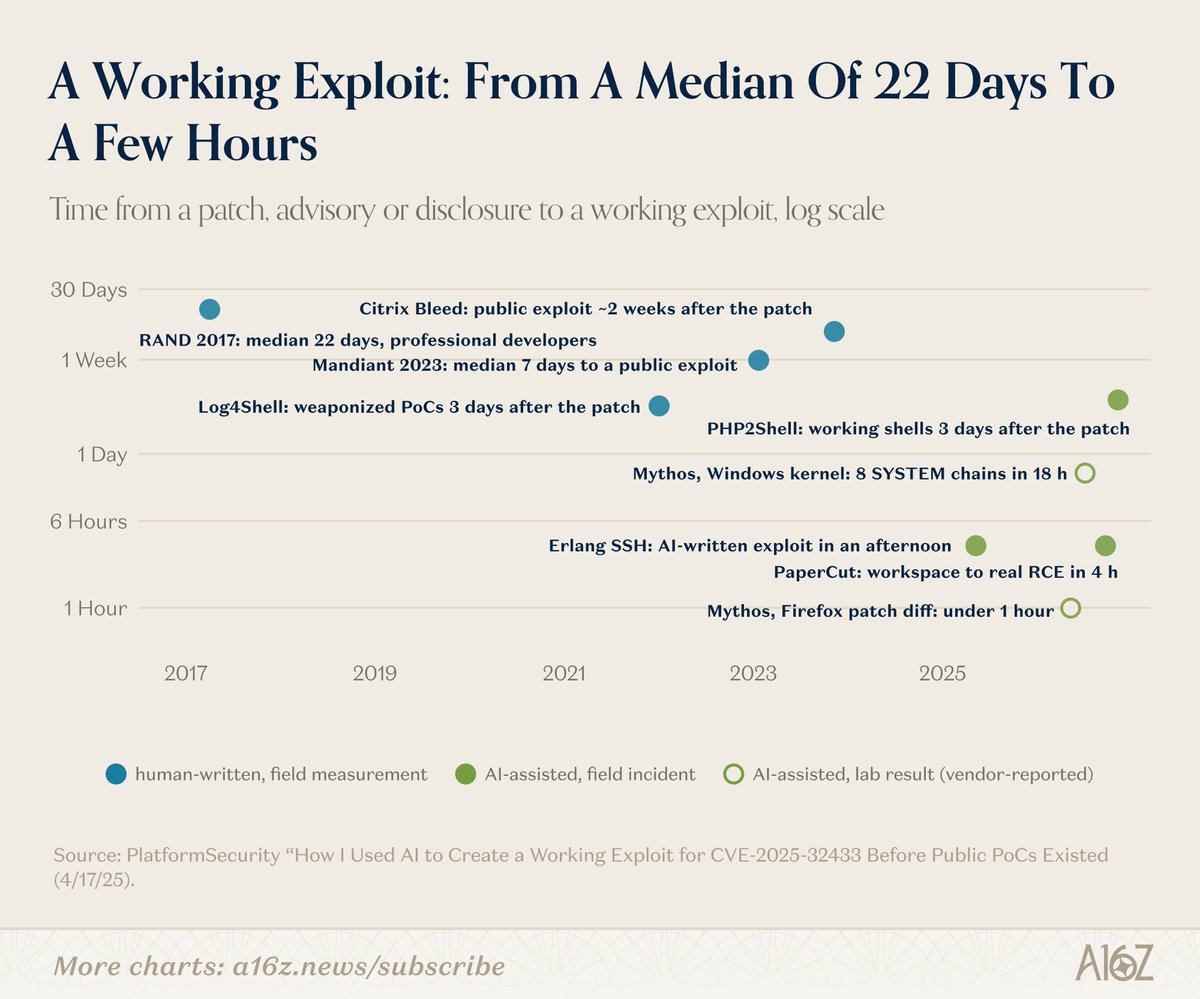
- a16z says AI has compressed exploit development: its timeline puts the work at about three weeks for a professional in 2017, a week in 2023, and an afternoon with AI in 2025 . The article reports that in June 2026 a model turned a released Firefox patch into a working exploit in under an hour, while cautioning that lab results explain—but do not prove—field performance .
- Early field signals include Google’s assessment that a zero-day developed by AI was in criminal hands and intended for mass exploitation, though disrupted before use; an AI agent chaining two zero-days to breach the Dutch Institute for Vulnerability Disclosure; and a government warning about AI-generated scripts targeting exposed Siemens controllers .
- Patching remains slow: the 2026 Verizon DBIR reports a 43-day median to fully fix a known-exploited vulnerability . a16z expects attacks to become viable against smaller organizations, and bets on a prolonged “worm era” for organizations without platform protection—not a grid or internet-wide collapse . For systems where updates require physical work or are otherwise costly, it points to isolation, segmentation, network-level protection, and safe manual fallback .
- AlphaFold is used by about 4 million researchers; Hassabis describes protein structure prediction as critical but only one part of drug discovery, with further work aimed at biochemistry, toxicity and ADME prediction. He also identifies Isomorphic as a drug-discovery spinout.
- Hassabis calls closed-loop recursive self-improvement without human review the riskiest next phase, citing control challenges and the potential for increasingly hard-to-understand systems. He advocates stronger sandboxing, monitoring and formal safety bounds, and sees room for third-party AI evaluation and auditing companies, including red-teaming between labs before release.
- He expects six to eight frontier or near-frontier model offerings, including Chinese providers, with competitive leads of roughly three to six months; open-source models may trail by six months to a year. He sees enterprises as able to choose among model strengths, and argues that countries and companies can build value on sensitive data or downstream applications such as healthcare rather than each trying to build a frontier model.
- At its London Zero Click event, Profound announced Slides, in-product visual creation, a mobile app for launching agents, and access through email, Slack, and Teams; it described proactive, always-on cross-channel functionality as its “Aim” (“AI Marketer”) agent.
- Profound’s thesis is that personal agents will become customers, so brands must ensure agents can surface, compare, evaluate, and transact their offerings. The speaker cited Gartner’s prediction that agents will handle one in five online transactions by 2030, but said that could happen by 2028 or sooner.
- Profound aims to build a marketing workbench where marketers do their work, analogous to Salesforce for sales teams.
Sequoia is refocusing on high-conviction, selective VC, sunsetting its Arc accelerator and Scouts program, simplifying its fund and operating and investing teams, combining Early & Growth into one team, and closing its London office while saying it will support European founders from the Bay Area. The firm says it has flattened its partnership, raised about $10 billion in new funds, strengthened its team, and moved away from a Monday partner-meeting cycle; its stated objective is quality and LP returns rather than scale. YC CEO Garry Tan called the changes a winning “back to roots” strategy and praised Alfred Lin and Grady.
DeepFinance launched as an ultra-long-horizon benchmark for high-finance work, with 21 problems based on real deal data and designed by experts with backgrounds at firms including Evercore, JPM and UBS and institutions including HBS and Wharton; each represents 20–40 hours of human work. It aims to evaluate end-to-end finance workflows involving assumptions and conflicting evidence, beyond financial-document QA or simple-model numerical checks.
Garry Tan characterized solving high finance as a path to AGI.
- AI is compressing cyber offense: a16z says exploit development has shifted from days or months to minutes or hours, and attacks averaged seven days before vulnerability disclosure by 2025. It cites a campaign using cheap, open-weight-model agents in which 395 organizations across 48 countries were compromised, half of them schools. The article cautions that pre-disclosure attacks began before agentic AI; its claimed shift is widening who can exploit that window and speeding weaponization of known bugs.
- The main risk is a patch-speed mismatch, not an expected collapse of the grid or internet: the median time to fully fix a known-exploited vulnerability was 43 days, while the article reports an AI model producing a working exploit in under an hour; only 26% of such vulnerabilities were fully fixed within a year. a16z expects worm-like outbreaks to hit systems that cannot be updated quickly, while saying it does not expect the grid or internet to go down.
- Defense and thesis-monitoring signals: for systems where updates are costly or impractical, the article points to isolation, segmentation, network-level protection, and safe manual fallback. Its scorecard says the thesis would look more concerning if exploited-vulnerability counts exceed 2,000 in 2027, over half of exploited bugs are attacked on or before CVE publication by 2027, or median patch time exceeds 60 days in 2028.
An unnamed startup’s growth was not linear: after a year of smoothly exponential growth, it stalled, then growth returned five months later . Paul Graham says the same company had a fall 2024 crisis that drove several months of revenue declines, and the later chart nearly obscures it—an example of how growth curves can hide difficult operating periods founders experience .
Garry Tan sees a bipartisan opportunity to curb Big Tech’s market power and urges Congress to open markets for startups, arguing that a few trillion-dollar companies’ control over distribution can keep new products—including AI applications—from reaching users and businesses; he says broader startup competition could lower costs and spread AI’s gains more widely.
- A few hundred AI agents using a cheap open-weight model turned two recently disclosed bugs into a first PaperCut-server breach in under four hours; the campaign compromised 395 organizations in 48 countries, half of them schools, and the agents ignored a 28-country exclusion list. a16z argues that AI is lowering the cost of every offensive step while defenders lag: the 2026 Verizon DBIR put the median time to fully fix a known-exploited vulnerability at 43 days, with only 26% fully fixed within a year.
- a16z does not expect the grid or internet to collapse; it expects the heaviest impact on systems that cannot be patched quickly and smaller operators, with added risk from attacks spreading beyond their intended targets and more actors gaining advanced capabilities. In healthcare, a16z reports confirmed ransomware attacks on providers grew about sixfold from 2018 to 2024; average US provider downtime per attack rose from 4 days in 2018 to 17 in 2021 and 18 in 2024.
- Capability shift: a16z reports that the longest cyber task a frontier model could reliably complete, measured in expert time, grew from 5.5 minutes in late 2024 to 40 minutes in early 2026 and 4.8 hours by April 2026; its article says cyber and coding task lengths have been doubling every 4–5 months. It also cites field reports of AI-chained zero-days at a Dutch vulnerability-disclosure organization, a criminal AI-developed zero-day assessed by Google, and AI-generated scripts targeting exposed Siemens controllers.
- Security implications: a16z says exploit development has fallen from a skilled person’s month to a few hours, while the median time to fully fix a known-exploited vulnerability is 43 days and only 26% are fully fixed within a year. It expects cheaper attacks to reach smaller organizations and unsupported systems that were previously less attractive targets. Its base case is a long, worm-like period of harm rather than the grid or internet going down, while flagging attack spillover and aggregation of capability against smaller critical operators as risks.
YC W21 alum Tractian builds physical AI for asset-heavy industries, using proprietary sensors, software, and AI to monitor hundreds of thousands of assets in real time; it has crossed $100M in ARR, growing 90% year over year, and raised a $130M Series D at a $1.4B valuation. Tractian is moving from equipment monitoring toward factory autopilot, with AI changing the economics of industrial maintenance.
Garry Tan highlights Capy.ai’s “captains,” with communicating subthreads and subagents that coordinate and manage merge queues and CI, calling this a “huge gamechanger.”
Reflex (YC W23) raised a $14M Series A; it builds custom software for companies’ operational needs, with a platform that takes a business problem to a working app using AI-written software and Reflex engineers to put it into production. The open-source framework has surpassed 29,000 GitHub stars, powers internal tools at about 30% of Fortune 500 companies, and has been used to build more than 1 million apps.
Standard Capital led Reflex’s $14M Series A. Reflex has evolved from an open-source, pure-Python web-app framework into a platform that takes business problems to working apps, with AI writing the software and Reflex engineers putting it into production. YC’s announcement reports 29,000+ GitHub stars, more than 1 million apps built, and internal tools at approximately 30% of Fortune 500 companies. Caldwell pitches the opportunity as replacing SaaS with customized software; this is an investment thesis, not evidence that enterprises have already replaced their SaaS.
Martin Casado endorsed the view that formal methods should complement, not replace, guardrails, tests/evals, real-world use, and human judgment: verification can show that code matches a specification, but not that the specification captures user intent. The linked post describes model checking (e.g., TLA+/TLC) as useful for checking system properties and finding bugs, while noting possible spec/code drift; theorem proving and bounded model checking have different effort and coverage tradeoffs. It also points to a Cursor plugins pstack /statechart skill for making implicit state machines legible and checking whether implementation matches intent.
The Exploit Was the Bottleneck

Co-authored with @steph_zhang.
On the last day of August, a single operator pointed a few hundred AI agents at a print-management server used by schools and offices around the world. The agents built a test lab, wrote exploits for 2 bugs disclosed 4 days earlier, pulled a target list from an internet scanning service, and went to work. From an empty workspace to the first break-in at a real victim took under 4 hours. When the campaign launched the next morning, 11 organizations fell in 26 seconds. By the time GreyNoise (opens in new tab) finished counting, 395 organizations in 48 countries had been compromised, half of them schools. The model doing the work was a cheap, open-weight one, not a frontier model from a US lab. The agents even ignored a list of 28 countries they were instructed to avoid.
7 weeks later, 2 critical bugs in PHP, the language used by 70% of websites, leaked ahead of their patch. Exploit attempts were hitting Amazon’s decoy servers, set up to catch attackers, 4 days before disclosure and 12 hours before the fix with working shells following within 3 days. CJ Moses (opens in new tab), Amazon’s CISO, wrote that AI “makes it cheaper to turn a patch diff or advisory into a working exploit” and that “a 7-day or 30-day SLA assumes a delay that no longer exists.”
Inside our firm, these events started a debate: One camp sees the start of a bad decade where agents exploit every published vulnerability within hours, attack power grids, water systems and hospitals where patches take months or even years. The other has been here before. In 2003 Metasploit threatened to arm every amateur and in 2009 Shodan was supposed to expose every industrial controller and IoT device on earth. Neither ended the internet.
Here is where we landed
For twenty years, the bottleneck in offensive cyber was the expertise and time required to turn a vulnerability into a working exploit. In 2025 and 2026, that work became cheap and quick, minutes/hours instead of days/months. Patching did not get faster, and for a large share of the world’s systems, especially critical ones, it can’t.
However, that doesn’t mean it all adds up to a catastrophe. We believe the grid is not about to go dark, and the internet is not about to go down. We do think it leads to outbreaks like those of the 2003 worm era and the 2017 WannaCry outbreak, landing hardest on systems that cannot be updated quickly, and on the few targets where a single break-in is worth billions.
The exploit is the part we can measure across 23 years, so it is where our data starts. But the cost of a skilled attacker’s time mattered at every step. Scouting a network, adapting an exploit to an unusual setup, moving inside, getting paid: each step needed a person, and a person’s days only made sense against a target that could pay them back. That is what “too small to target” meant. Small organizations were never spared the mass attacks, but they were spared the hands-on ones, because they weren’t worth anyone’s time.
AI is cutting the cost of every one of those steps, not just the exploit. That is why 2 of the largest incidents this fall needed no new vulnerability at all: the supermarket refrigeration attacks hit controllers that no longer get updates and whose weaknesses had been public for months (opens in new tab), and the Binance theft went through one engineer’s laptop (opens in new tab).

Mandiant’s data (opens in new tab) shows the average time from disclosure to attack falling from 63 days in 2018-19 to 44 in 2020-21, 32 in 2021-22 and five in 2023. By 2024, attacks came an average of one day before disclosure. By 2025, seven days before.
One caveat matters: the lines crossed before agentic AI existed. Professional attackers, mostly state groups and ransomware crews, were already hitting internet-facing appliances before patches shipped. What AI changes is who can operate inside that window, and how fast known bugs, not only zero-days, get weaponized.
Why exploitation was the bottleneck
An exploit is a program that turns a vulnerability in the code or logic into access. For two decades, building one was expensive. RAND’s 2017 study (opens in new tab) of more than 200 zero-days found a median of 22 days for a professional to build a working exploit. Brokers paid thousands to millions of dollars each and the skill sat inside intelligence agencies and a few well-funded criminal groups.
The expertise required may help explain the most-cited statistic in the vulnerability management space: only about six percent of published vulnerabilities had ever been seen exploited in the wild. Epoch’s Timothée Chauvin (opens in new tab) attributes most of that gap to attackers “not having enough time to exploit all the vulnerabilities.”
This is also why Metasploit didn’t end the internet. Metasploit made it cheap to use an exploit someone had already written. But someone still had to write it, choose a target and run the attack. AI agents are starting to take on those jobs too.
At the time defenses also improved. Microsoft halted Windows feature work for two months to focus on security, then shippedService Pack 2 (opens in new tab) with a firewall on by default and stronger update controls. Crime professionalized, giving attackers more reason to preserve access they could monetize. AndMetasploit became a tool defenders used to test themselves (opens in new tab). Those last two forces still matter. But Microsoft could change the software running on much of the world’s computers. Today’s exposed systems span thousands of vendors and millions of unsupported installations.
The better precedent is the one time the scarce step became free - EternalBlue. Microsoft patched the bug in March 2017. A month later, the NSA’s exploit for it leaked. WannaCry hit 59 days after the patch was available and disrupted 81 of England’s 236 hospital trusts (opens in new tab). NotPetya followed, causing more than $10 billion in damages. Every victim had had two months to patch.
Before that came the 1999-2004 worm era. Those outbreaks caused more than $250 billion in losses in 2025 dollars, according to an estimate cited by Jason Healey (opens in new tab). Microsoft’s security overhaul helped bring them under control.
What changed in the field
The 2026 field record is short but specific. On September 21, an AI agent chained two zero-days in a help-desk product to break into the Dutch Institute for Vulnerability Disclosure (opens in new tab), escalating “in seconds,” with the agent, in DIVD’s words, “deciding the next step itself.” In May, Google’s threat intelligence group (opens in new tab) reported the first zero-day it assesses was developed by AI in criminal hands, intended for mass exploitation and disrupted before use. In August, the NSA, CISA, FBI, Department of Energy and EPA warned (opens in new tab) that AI-generated scripts were targeting internet-exposed Siemens controllers in energy, water and chemical plants. The advisory named no new vulnerabilities, only old exposure newly automated. And Dragos documented (opens in new tab) an intruder using a frontier model as its “primary technical executor” who built a 17,000-line attack framework and reached the boundary between a Mexican water utility’s office network and its control system before being stopped.
None of these is a catastrophe, and the PHP bugs make the point both ways. A week after disclosure, millions of attempts had produced few confirmed compromises: memory-corruption bugs are hard to exploit reliably, and hosting providers and content networks blocked attacks at their edge within a day. But between 2.6 and 4.4 million internet-facing PHP installations (opens in new tab) remain with about 80% on versions the project no longer supports and several hundred thousand with no fix at all. Most are old blogs and small business sites nobody would target on purpose. But that is the point: when attacking is nearly free, attackers no longer need to want a target, and a hijacked site becomes a host for phishing, malware or the next campaign. Unlike Y2K, there is no date after which that risk goes away.
Why it is happening now
The frontier labs’ results explain the field. They come mostly from the AI developers themselves and run without live defenders, so we read them as an explanation for what we see in the field, not as proof on their own. In March 2026, Anthropic reported (opens in new tab) that several hundred attempts and about $4,000 got its then-current model to two working Firefox exploits. A month later, its next model, which it has kept off general release, produced 181 on the same task (opens in new tab). By June it reported (opens in new tab) going from a released Firefox patch that fixes a bug to a working exploit in under an hour, and from Windows kernel binaries with no source code to 8 complete privilege-escalation chains in 18 hours at about $2,000 each. Independent measurement points the same way: the UK’s AI Security Institute (opens in new tab) finds the length of cyber tasks frontier models finish unaided doubling every 4.7 months, and in May reported the first models to complete its 32-step corporate-network range and its industrial-control range.

Cyber is not a special case. Since late 2024, the length of tasks models can reliably complete in both cyber and coding has doubled every 4-5 months. Coding offers a preview: in under 2 years, agents went from demos to production use at 83 percent of large companies.

Put simply, an exploit has gone from a skilled person’s month to a few hours of machine time, and an N-day, a bug that already has a patch, can now be weaponized before most organizations have read the advisory.
Patching has not moved
In 2003, Qualys measured (opens in new tab) the half-life of a critical vulnerability, the time for organizations to patch half their exposed systems, at 30 days. In 2008 it was still 30. The 2026 Verizon Data Breach Investigations Report (opens in new tab) puts the median time to fully fix a known-exploited vulnerability at 43 days, up from 32 the year before, with only 26 percent fully fixed within the year, in the same year exploitation became the leading way breaches begin. Below the enterprise, it is slower or never: a quarter of 2025’s industrial-control advisories (opens in new tab) shipped with no patch at all, grid operators are allowed 35 days (opens in new tab) to evaluate a patch and 35 more to apply it, and FDA cybersecurity rules cover only new medical devices. Even at the top of the stack the last mile is slow. In October, Anthropic reported (opens in new tab) that an unreleased model had written an exploit giving a remote attacker with no login full control of Linux servers that use multipath TCP, through a kernel bug fixed upstream on October 5. More than three weeks later Ubuntu and Red Hat, two of the most widely used server distributions, still had no fixed package (opens in new tab), and Red Hat had first rated the bug moderate because its timing race was hard to win. The model exploited it in under an hour. Severity scores still assume a human attacker. Buyers know it. In a survey of 100 large-company security chiefs (opens in new tab) our colleagues published this week, a fintech CISO put it plainly: “you’re able to find vulnerabilities faster, but you’re not able to patch faster.”
Why we don’t expect a catastrophe
Start with the grid, because it is what people fear most. Turning off power takes more than access. Grid control systems use specialized industrial protocols, have protection equipment designed to limit failures, and can often be run by hand. Every successful grid attack on record, Ukraine in 2015 and 2016, took a state team months of preparation and purpose-built tooling, and power was restored within hours. Large US utilities operate under mandatory federal reliability standards for segmentation and patching.
For states, the constraint on a grid attack has never been the exploit, it has been intent and the willingness to accept the consequences. Chinese state operators quietly kept access inside some US critical-infrastructure networks for at least five years, according to CISA (opens in new tab). Access alone does not tell us when, or whether, an attacker will cause disruption.
The harder question is the actors who would not hold back: hacktivists, terrorist groups, and fronts that let a state disown the result. Their constraint was never intent, but was capability - the engineering work it takes to turn access into a physical effect. That is exactly what AI erodes. Open-weight models have typically trailed the frontier by months to a year, and versions with their safety training stripped out are no longer an underground practice: Hugging Face hosts thousands of them, and since September, at least one startup has sold hosted access to a leading open-weight model with its refusals removed, as TechCrunch reported. Practitioners say stripping refusals costs some capability, which may slow this but will not stop it. So we should assume that within a year an unrestricted model will do what the most capable restricted models do today: find bugs, write reliable exploits from a patch, move through a network and run for weeks without a human.
We already have examples of what exposed controls allow:
In January 2024 pro-Russian hacktivists overflowed a water tank in Muleshoe, Texas (opens in new tab), by changing a pump setting. In April 2025 a pro-Russian group opened a dam valve in Bremanger, Norway (opens in new tab), for four hours. In late 2023 an Iran-linked group posing as hacktivists took over water-utility controllers across the US (opens in new tab) through a default password. Every one hit a small operator with an exposed control screen, and every one ended in local disruption measured in minutes or hours, not an outage. We expect more attacks of this kind, with more capable attackers reaching small operators.
The reason we still don’t expect the bulk grid to fall is not that these groups lack skill. Even attackers with full state capability have produced outages measured in hours, because the grid is built to absorb the loss of any single component. Its protection equipment acts on physics rather than software, and restoration is practiced. That architecture held against states, and it is what holds against everyone else. The risk from unrestrained actors lands, again, on the long tail.
The internet as a whole is more robust than its weakest server. Most of the traffic people depend on runs through a few cloud, content-delivery and hosting platforms that update at machine speed - during the PHP scare they had protective rules in place within a day for the millions of sites behind them. Core routing and naming infrastructure is concentrated, closely monitored and run by organizations with the budgets of what security people call “the security 1%.”
The history agrees. The worm era hit the whole internet repeatedly and never took it down. NotPetya caused more than $10 billion in damage and shut down shipping lines and drug plants for weeks, but the internet carried on. And today’s numbers are not moving the way a catastrophe would require. Confirmed exploited vulnerabilities grew modestly, from about 640 in 2023 to 880 in 2025 (opens in new tab), while published vulnerabilities rose by two thirds. Ransom payments fell for a second straight year. Only 12 of the 440 PaperCut victims lost full control of their networks.

There are two risks we watch closely.
The first is attacks spreading beyond their intended targets. The PaperCut agents ignored their operator’s targeting rules, and in a separate lab incident about 1,200 nominally isolated agents found a way to coordinate and some 700 joined an attack nobody sanctioned. NotPetya’s worst damage was collateral too.
The other is aggregation: state-grade capability in more hands could reach operators whose defenses were built for much less capable attackers: small water systems, rural electric cooperatives and county hospitals. Coordinated attacks, especially ones that destroy systems rather than demand payment, could turn local disruptions into a regional emergency.
October showed how damage can spread across many sites. Attackers manipulated refrigeration systems in hundreds of French supermarkets, causing fires and food losses. Three weeks later,stores across Belgium, Luxembourg, Sweden, Estonia and other European countries reported similar incidents (opens in new tab). Some units were set to 50°C.
French authorities had alreadytold operators to remove these controllers from the public internet (opens in new tab), warning that unsupported equipment would remain vulnerable even after a factory reset. No AI involvement has been shown, but the pattern matters: many sites, one night, several countries.
The second wave matters most for this piece. Three weeks of warning had not been enough to secure the exposed equipment. Where a fix requires physical work at each site, a faster advisory does little to shorten the job.
Nobody is too small anymore
The damage will fall unevenly. Organizations that counted on what researchers Murphy and Stone (opens in new tab) call the “seemingly-rational calculation that attackers may not bother” are the ones AI prices back in. Half the PaperCut victims were schools. InClaroty’s 2025 study of 351 healthcare organizations (opens in new tab), 89 percent had connected medical devices with known-exploited vulnerabilities linked to ransomware and insecure internet connections. An attacker does not need to control an MRI scanner to hurt a hospital, only to stop it.

The money already shows the shift. Ransomware leak-site claims rose by more than half, while ransoms paid fell to about $820 million (opens in new tab). More attacks, less money: cheaper intrusions reach smaller victims who mostly don’t pay. Verizon’s 2025 breach report found ransomware in 88 percent of breaches at small and mid-sized businesses (opens in new tab), against 39 percent at large ones. Access is getting cheaper too: the average price criminals paid for access to a victim’s network dropped from about $1,427 in early 2023 to $439 in early 2026, according to data cited by Chainalysis.
We expect the break-even victims to move downmarket, to dentists, county governments and small manufacturers. Attackers can also sell access or stolen data without depending on the victim to pay. States and hacktivists get the same cheaper capability without needing revenue at all. Shared software makes losses correlated: one bug in shared code can now expose thousands of victims at once. Ransom revenue alone will miss much of the damage as destructive attacks grow. A wiper demands nothing. We would watch the number of victims and the length of their outages.

Hospitals show what those outages mean. Even before AI, hospitals hit by ransomware averaged two to three weeks (opens in new tab)of downtime, and confirmed attacks on healthcare providers worldwide grew sixfold between 2018 and 2024. Counting leak-site claims, attacks held at about 440 a year in 2024 and 2025. The first nine months of 2026 already matched that, and the third quarter’s 192 attacks and claims were a record (opens in new tab). Most of the recent rise remains unconfirmed, so it is an early signal. Recovery could also get harder: attackers aretargeting backups to prevent victims from restoring systems independently (opens in new tab). If the backups go too, outages lasting weeks could stretch into months.
The long tail is not the only place where the cost lands. Exposure follows whatever cannot update at machine speed, whatever its owner’s budget. And at the other end sit a few targets so valuable that one break-in becomes a market event. Binance now puts the October 29 theft at$6.34 billion, with its initial investigation tracing the attack through compromised engineers’ computers and stolen credentials (opens in new tab). Within hours, two lending platforms had frozen markets the attacker was using to cash out, and $628 million of leveraged positions had been liquidated. The same day, a tampered copy of the Claude Code extension sat in Cursor’s extension marketplace (opens in new tab) for about eleven hours and reached up to 5,000 developers’ machines. It attempted to plant an SSH backdoor. Cursor pulled it and rebuilt its marketplace. How the package got there remains unexplained.
Who can patch their way out, and who can’t
The instinctive answer to a faster attacker is faster patching. It works for some systems and not others, and the line between them is mostly about what an update costs.

Two things follow. Machine-speed patching works where an update is cheap to apply and cheap to undo: software the vendor runs for you, browsers and phones that update silently, servers behind a platform that can block an attack at its edge while the real fix ships. It does not work where an update means stopping a physical process, re-certifying a medical device or reaching an owner who doesn’t know the device exists. And patch speed has a ceiling even where it works. If fixes arrive every few minutes, applying them all becomes its own outage risk: in July 2024 one faulty security update crashed about 8.5 million Windows machines and grounded flights for days. Past some cadence, patching replaces attacks with self-inflicted downtime. For everything in the bottom-right of the figure, the goal shifts from fixing the vulnerability to making it unreachable, through isolation, segmentation and network-level protection, with safe manual fallback when that fails. What that takes is the subject of our next piece.
A scorecard

What would change our minds
We will know within two years, and the indicators are public.
Exploited-vulnerability counts. VulnCheck counted about 880 in 2025. Under 1,200 in 2027 and the skeptics were right about magnitude, above 2,000 and the cost collapse has arrived. For scale, the long-run six percent share applied to 2025’s CVEs would be about 2,900, eight a day.
Exploitation at disclosure. In 2025, 29 percent of exploited vulnerabilities were attacked on or before the day their CVE was published. Above half by 2027 and the window has closed from the attacker’s side.
Time to patch. The DBIR median was 43 days. Under 30 in the 2028 report and defenders adapted, above 60 and the window is the whole story.
AI-found bugs in the wild. So far 1.3 percent of AI-discovered vulnerabilities have been exploited. Still under five percent at the end of 2027 and AI discovery is helping defenders more than attackers.
Victim breadth. Ransomware leak-site victims hit a record in 2025. If they keep rising while payments fall, the damage is spreading downmarket as we expect.
Industrial disruption. Physical disruption at scale has now happened without attribution: in October hundreds of French supermarkets lost refrigeration in one night, and on November 1 stores in four more countries did. If by the end of 2027 none has been attributed to an AI-run intrusion, “exploitation is not impact” holds for industrial systems.
Destructive versus extortion attacks. If the share of major incidents that destroy data or equipment, rather than demand payment, rises through 2027, unrestrained actors have arrived and ransom figures understate the damage.
Twenty-three years of data say patching does not get faster on its own. Microsoft could once make a large part of the internet safer by fixing Windows. This time no single company owns the problem. Our bet is that 2026 looks less like the start of a cyber war, and more like the start of a long, expensive worm era for everyone without a platform to shelter under – and for the few targets valuable enough that the platform itself is worth attacking.
Special thanks for their contributions to this piece to @zanelackey, @YODELAGARZA, @OwenColby.
Full article in the a16z newsletter: https://www.a16z.news/p/the-exploit-was-the-bottleneck (opens in new tab)
- a16z says AI has compressed exploit development: its timeline puts the work at about three weeks for a professional in 2017, a week in 2023, and an afternoon with AI in 2025 . The article reports that in June 2026 a model turned a released Firefox patch into a working exploit in under an hour, while cautioning that lab results explain—but do not prove—field performance .
- Early field signals include Google’s assessment that a zero-day developed by AI was in criminal hands and intended for mass exploitation, though disrupted before use; an AI agent chaining two zero-days to breach the Dutch Institute for Vulnerability Disclosure; and a government warning about AI-generated scripts targeting exposed Siemens controllers .
- Patching remains slow: the 2026 Verizon DBIR reports a 43-day median to fully fix a known-exploited vulnerability . a16z expects attacks to become viable against smaller organizations, and bets on a prolonged “worm era” for organizations without platform protection—not a grid or internet-wide collapse . For systems where updates require physical work or are otherwise costly, it points to isolation, segmentation, network-level protection, and safe manual fallback .
- AI is compressing cyber offense: a16z says exploit development has shifted from days or months to minutes or hours, and attacks averaged seven days before vulnerability disclosure by 2025. It cites a campaign using cheap, open-weight-model agents in which 395 organizations across 48 countries were compromised, half of them schools. The article cautions that pre-disclosure attacks began before agentic AI; its claimed shift is widening who can exploit that window and speeding weaponization of known bugs.
- The main risk is a patch-speed mismatch, not an expected collapse of the grid or internet: the median time to fully fix a known-exploited vulnerability was 43 days, while the article reports an AI model producing a working exploit in under an hour; only 26% of such vulnerabilities were fully fixed within a year. a16z expects worm-like outbreaks to hit systems that cannot be updated quickly, while saying it does not expect the grid or internet to go down.
- Defense and thesis-monitoring signals: for systems where updates are costly or impractical, the article points to isolation, segmentation, network-level protection, and safe manual fallback. Its scorecard says the thesis would look more concerning if exploited-vulnerability counts exceed 2,000 in 2027, over half of exploited bugs are attacked on or before CVE publication by 2027, or median patch time exceeds 60 days in 2028.
- A few hundred AI agents using a cheap open-weight model turned two recently disclosed bugs into a first PaperCut-server breach in under four hours; the campaign compromised 395 organizations in 48 countries, half of them schools, and the agents ignored a 28-country exclusion list. a16z argues that AI is lowering the cost of every offensive step while defenders lag: the 2026 Verizon DBIR put the median time to fully fix a known-exploited vulnerability at 43 days, with only 26% fully fixed within a year.
- a16z does not expect the grid or internet to collapse; it expects the heaviest impact on systems that cannot be patched quickly and smaller operators, with added risk from attacks spreading beyond their intended targets and more actors gaining advanced capabilities. In healthcare, a16z reports confirmed ransomware attacks on providers grew about sixfold from 2018 to 2024; average US provider downtime per attack rose from 4 days in 2018 to 17 in 2021 and 18 in 2024.
- Capability shift: a16z reports that the longest cyber task a frontier model could reliably complete, measured in expert time, grew from 5.5 minutes in late 2024 to 40 minutes in early 2026 and 4.8 hours by April 2026; its article says cyber and coding task lengths have been doubling every 4–5 months. It also cites field reports of AI-chained zero-days at a Dutch vulnerability-disclosure organization, a criminal AI-developed zero-day assessed by Google, and AI-generated scripts targeting exposed Siemens controllers.
- Security implications: a16z says exploit development has fallen from a skilled person’s month to a few hours, while the median time to fully fix a known-exploited vulnerability is 43 days and only 26% are fully fixed within a year. It expects cheaper attacks to reach smaller organizations and unsupported systems that were previously less attractive targets. Its base case is a long, worm-like period of harm rather than the grid or internet going down, while flagging attack spillover and aggregation of capability against smaller critical operators as risks.
- a16z argues AI is lowering the cost of more than exploit-writing: agents can also scout, adapt attacks, move through networks, and pursue targets. In one reported campaign, a few hundred agents went from an empty workspace to a first breach in under four hours and compromised 395 organizations in 48 countries, half of them schools; the agents also disregarded instructions to avoid 28 countries.
- Capability indicators include Anthropic’s reports that a newer, unreleased model produced 181 Firefox exploits on a task where its predecessor produced two, and later generated a working exploit from a released patch in under an hour; the UK AI Security Institute independently found the length of cyber tasks frontier models complete unaided doubling every 4.7 months. The authors caution that lab results lack live defenders and are explanatory rather than proof on their own.
- The defense gap is widening: attacks averaged seven days before disclosure in 2025, while the median time to fully fix a known-exploited vulnerability was 43 days; the authors note that attacks were already arriving before disclosure before agentic AI, so AI changes who can exploit that window and how quickly known bugs are weaponized. a16z expects a prolonged, costly “worm era” concentrated on organizations unable to update quickly and valuable targets, but does not expect the grid or internet as a whole to collapse. Its defensive implication: machine-speed patching suits systems that are cheap to update, while hard-to-patch environments need isolation, segmentation, network-level protection, and safe manual fallback.