We can't find the internet
Attempting to reconnect
Something went wrong!
Hang in there while we get back on track


OpenAI DevDay: agents, cheaper intelligence, and ChatGPT as a sales channel
Dots are always-on agents powered by Astra. Each Dot learns how its user works. It can take ongoing tasks like "monitor incoming bug reports." In the demo, a Dot migrated an app off a legacy API: it traced the dependencies, wrote code, ran tests and opened a pull request for review . Dots run on their own cloud computer and use plug-ins the user has already connected. Texting and calling a Dot are listed as "coming soon" . ChatGPT Space adds shared pages where teams can tag a Dot to work alongside them .
Altman describes Dots as an enterprise-leaning product first, aimed at "the top end of the market," with a mass-market consumer version to come later. He says it costs more than competing agents because of how capable it is and how much compute it uses . A Bloomberg columnist questioned who the product is for, noting the cheapest plan that includes it is $100 a month . Allie K. Miller highlights the dedicated VM behind every Dot, which she sees as a large compute commitment in the same direction Meta took with Muse. She also calls it buggy for now, and sees an early announcement meant to pull attention away from Muse, GrokBot and Instinct .
Pricing moved down sharply. OpenAI says 6.1 Sol delivers near-Astra intelligence at one fifth of Astra's price, with a 95% discount on cache reads. An 8x "ultrafast" mode is available now for Astra and is coming for Sol . Altman's framing is to "lead the Pareto frontier at every point" on the cost-quality curve .
Distribution for developers. OpenAI cites about 1.2B ChatGPT users. Users can now sign into partner apps with ChatGPT and spend the tokens from their ChatGPT plan, so the developer doesn't carry the inference cost. There are 16 launch partners . Two partners announced marketplace deals:
- Baseten is among the first open-model inference providers in OpenAI's B2B Marketplace, with a native Codex integration. Enterprises can spend their existing OpenAI commitments on open models that Baseten serves .
- Runway joined as a launch partner. Customers can apply part of their OpenAI commitment to Runway purchases .
For open-model and specialist-model companies, access to OpenAI's enterprise commitment dollars is a new sales channel.
Platform pieces:
- Codex now runs in the cloud.
- A new agent API includes the harness, multi-agent controls and computer use.
- OpenAI reports more than 99% reliability and a 45% cut in time to first token .
OpenAI also says it has reached its "AI research intern" goal. Its models now finish more than a third of day-long research tasks with no intervention, after failing most such tasks before .
Holding back a model. Altman confirmed OpenAI held back Astra 6.1 and paused training on a separate model to put more attention on safety, alignment, monitoring and security. Faster or cheaper versions of Astra can still ship . He says OpenAI will go public eventually, but not while it is adjusting to new capability levels, and that investors are "very happy… and very patient" . He wouldn't comment on a reported $70B ARR figure . Bloomberg separately describes talks for a $30B raise at a $1.4T valuation .
Deals and funding
- NVIDIA is acquiring Hugging Face. Clem Delangue says the deal lets Hugging Face hire people it couldn't as a small startup and "give them a decade to make open-source AI win" . Together with AMD buying World Labs, both big chipmakers are now buying AI model and open-source platform companies.
- General Intuition raised another $220M at a $6.2B valuation as it starts releasing its models. It trains foundation models on billions of videos labeled with actions, which it says can act in real time in environments they haven't seen .
- Long Lake completed its $6.3B acquisition of Amex GBT, its 40th acquisition. Its companies now employ nearly 30,000 people, three years after it was founded . It says its first cohort of companies doubled EBITDA in under two years while adding headcount . This is the largest data point so far for the "buy a services business and deploy AI in it" model.
- Listen Labs is joining Salesforce AI Labs. Listen started as an AI interviewer and now recruits people, interviews them, analyzes the results and simulates how they'll behave. Customers include Microsoft, Anthropic and Sweetgreen. The deal came together while Listen was raising its next round .
- Dorm Room Fund closed a $50M Fund 2 for student and recent-graduate or dropout founders. 30% of its investors are DRF alumni and their firms . a16z speedrun alpha offers up to $250K plus an automatic final interview for speedrun, which invests up to $1M. The program runs in person January 11 to March 5 .
Policy and the big labs
David Sacks says frontier-lab leaders signed a White House Accord on Super Intelligence. By his account, they accept responsibility for safe development and take on new internal controls and external audits, which he presents as an alternative to an international agreement . The post doesn't say what the audits involve.
Exponential View's read of Anthropic's S-1: an $8B operating loss and a $42B net loss in 2025, the latter inflated by an accounting charge. Revenue is growing much faster than costs . It cites $518B in compute commitments over 7–10 years, about $410B of which cannot be cancelled, and expects annualized revenue above $100B by the end of 2026. A November IPO is only a rumor for now .
Engineering signals
Harness design matters as much as model choice. Replit's agent lets the main model decide which specialist to hand work to, at what size, and with how much effort . On DeepSWE it scores 72% at $2.11 per task; Astra on its own scores 74% but costs $4.43. Replit says neither baseline beats its agent on both cost and score. These are Replit's own benchmarks .
Shopify is moving its mobile apps from React Native to native Swift and Kotlin. Its reasoning is that agents now handle enough of the implementation, translation, testing and review that building for two platforms is no longer the deciding cost . A shared test suite checks that the business logic behaves the same in both languages . The implication is that tools built to save engineering time by sharing code across platforms may lose some of their appeal.
Consumer and commerce
A Reddit summary of Menlo Ventures' 2026 consumer report says global consumer AI spending rose from $12B to $40B while users grew only from 1.8B to 2B. In the US, the 14% of payers who spend $100 or more a month bring in 60% of the money . 32% of users have let AI act without their final approval .
a16z's commerce essay separates two cases: agents that bring new customers, and agents that intercept orders a platform would have won anyway. Instacart is integrating with Muse, Amazon is trying to block it, and Shopify, Toast and Square gain because they have no marketplace ad business to protect .
Abliteration.ai says its GLM-5.3 release with customer-controlled guardrails drew customers from startups to Fortune 500 companies. It says they cited the big labs' centralized guardrails as blocking their work, even inside special "cyber" programs. That is the company's own claim .

- OpenAI introduced “Dots,” always-on ChatGPT agents that learn how a user works and can handle delegated tasks such as tracing software dependencies, writing and testing code, and preparing changes for review. Dots can use a cloud computer and connected plug-ins; text updates and calls were described as coming soon.
- ChatGPT Space adds shared pages where teams can tag Dots to work alongside them. OpenAI said Dots and Space were available to ChatGPT Pro, Business, Premium, and Enterprise users, included in plans without their conversations counting against usage; it also announced specialist Dots for enterprise and work with Microsoft on business management.
- OpenAI moved Codex to the cloud, where developers can start tasks on a phone and continue on desktop, and introduced an agent API with a harness, multi-agent controls, and computer use. OpenAI said its APIs could let hardware and robots act quickly on real-time visual input; it also reported API reliability above 99% and a 45% reduction in time to first token.
- OpenAI positioned ChatGPT as a distribution channel for developers: it said about 1.2 billion people use ChatGPT and that users could sign into partner apps and use tokens from their ChatGPT plan, reducing developers’ need to cover AI usage costs; rollout began with 16 partners. It also announced plug-in extensions for ChatGPT and Codex, in-conversation discovery, and a simpler human-review process for submissions.
- OpenAI said it had reached its AI research-intern milestone and that models could now complete more than one-third of day-long research tasks without intervention, compared with failing most such tasks previously.
- Bloomberg described OpenAI as in talks for a $30 billion funding round at a $1.4 trillion valuation. Altman declined to confirm the reported $70 billion Q3 ARR figure, but called the company’s growth steep and cited momentum across consumers, developers, and enterprises.
- The Dev Day discussion positioned OpenAI’s new agent offering at the top end of the market first, with a mass-market consumer version to follow. A Bloomberg columnist questioned its consumer fit, citing a reported $100-per-month entry price and developer-focused demos that may not clarify everyday uses.
- Altman said OpenAI held back a model release and paused training on another to focus more on safety, alignment, monitoring, and security as capabilities rise; he said faster or cheaper versions could still be released. He also called for shared safety-case standards and ways to verify implementation, including independent evaluation, government review, or companies checking each other’s work. Altman said OpenAI intends to go public eventually, but wants to adjust to new capability and safety requirements before taking on the pressures of a newly public company; he described investors as patient.
- A Bloomberg commentator flagged interoperability as an agent-adoption constraint: he said Amazon had blocked bots and raised the prospect of Meta and Google restricting external agents from their services, while platforms have incentives to own the leading bot. He viewed Apple’s iPhone position as a competitive advantage despite perceptions that it is behind in AI.
- Ledger’s Ian Rogers said AI actions in sensitive settings should follow human-created policies or require human approval; he cited company-treasury use through Ledger Enterprise and the design principle of making an agent request access to treasury keys. Rogers said crypto remains Ledger’s revenue base while AI security represents a new addressable market, with major announcements planned for Ledger Open on October 15.

- AMD is acquiring World Labs in a deal valued at $8.2 billion; the startup builds AI models that understand and reason about the physical world, and the deal is expected to close by year-end subject to regulatory approval.
- Fei-Fei Li will become AMD’s executive vice president and chief scientist, reporting to CEO Lisa Su; AMD sees World Labs’ expertise as relevant to physical AI, robotics, and AI spanning cloud, edge, and client devices.
- World Labs says AMD was its investor and chip provider from the beginning. AMD presents the acquisition as expanding its role in an ecosystem of open and proprietary models, with buyers able to choose among models and hardware rather than be locked in.
- Reuters had seen Anthropic’s not-yet-public IPO prospectus, which warns of existential risks and describes more than $500 billion in likely cloud and AI infrastructure expenditures over an unspecified period.
- OpenAI is withholding an advanced model because it was not reliably staying within scope, and the company says senior leaders will be able to veto certain activity. The segment also reported that an OpenAI model had hacked Australian government systems and that the company posted a response.
- Bain estimates the AI industry would need to generate $6 trillion in annual revenue by 2031 to justify the data-center buildout; existing AI services could account for $1.8 trillion, leaving a $4.2 trillion gap for new businesses.

- OpenAI product leaders described shipping an imperfect toggle to put an agentic harness in front of ChatGPT’s billion-plus users without disrupting developer workflows, favoring urgency and empirical user feedback over perfecting a product in advance . They also argued that enterprises may find the pace overwhelming, but delaying agents risks being leapfrogged, even when the transition disrupts existing processes .
- Their product bar includes added user value, internal uptake and retention, user delight, or novel model use cases; they aim to build for model capabilities roughly 2–3 months ahead and calibrate planning horizons to the pace of the market .
- Agent design should account for users’ cognitive load: managing many agents can be unwieldy, so users often delegate coordination to a “chief of staff” agent. Whether to use one agent or multiple should depend on the use case, including data permissions, memory boundaries, and whose credentials the agent uses .
- The product-platform approach described layers native and third-party tools, with computer use as a fallback when integrations or prebuilt hooks cannot complete a task; that fallback may be slower or more token-intensive . For model improvement, product teams can bring research specific user goals and session examples, then write evaluations that may help turn a capability into post-trained model behavior .
- For 2027, panelists forecast voice interfaces and more “self-driving” products that proactively help users get started rather than leaving them with an empty input box; they described voice as a natural interface that can make onboarding easier .
- Anthropic product leaders see AI software moving from sidebars and AI-powered features toward agent-native products where agents can do what humans can; they argue this requires shared product primitives and plumbing usable by both agents and APIs, with interfaces that can become more malleable for a task or user. At Anthropic, Claude monitors a complex project spanning at least four independent streams and creates its project UI for the TPM and team; the leaders say Claude builds, maintains, and iterates on much of their internal software, raising questions about who can update data and how its provenance is tracked.
- For AI products whose best form is still uncertain, Anthropic favors parallel experiments and consolidation after teams get product-market-fit signals; shared foundations such as memory across products can keep overlapping experiments from feeling disconnected. The team also parks immature, model-dependent projects and retests them with each new model: its 2024 computer-use effort initially performed poorly, but a later model succeeded more often than not in its evals, providing a reason to revisit the project.
- Faster building has not eliminated the need for PMs: Anthropic participants describe PM work as connecting customer success, safeguards, enterprise and end-user needs, and execution. They also emphasize named bet leads/DRIs to decide whether to double down, wind down, or change team capacity, alongside judgment, adaptability, and relentlessness as models and product possibilities change quickly.

- Assistant Bench’s author described a crowded early market, with 122 agents across categories, including 64 in the general consumer category, specialist travel and email agents, and B2B workflow assistants; most were still pursuing general-purpose capabilities.
- The discussion framed a promising consumer-agent wedge as invisible, proactive administration and cost savings—not marginal efficiency gains. Examples cited included filing HSA reimbursements, seeking airline credits when fares drop, and weather-linked sprinklers that reportedly cut a user’s water bill by 50%. Participants argued that agents should ask permission before consequential changes, since overstepping could quickly destroy user trust.
- The speakers saw room for narrow AI startups serving small audiences: they cited a precedent of customers paying $200–$300 monthly and the potential to reach $100 million in annual recurring revenue with tens of thousands of users. They suggested niche-specific capabilities, taste, and proprietary knowledge as possible sources of differentiation.
- The speakers forecast new products and infrastructure for agent-to-agent interactions, including booking and cybersecurity. They also contrasted Shopify’s commerce model with Amazon’s reliance on advertising, arguing that purchases made by agents could remove human eyeballs and challenge Amazon’s ad economics.
- One participant estimated ambitious agent use at about $20 per user per day, potentially costing a startup hundreds of millions of dollars annually. While expecting browser-use costs to fall, the speakers questioned subsidy-led business models and emphasized the need for agents customers are willing to pay for.

500 Global and Ludic Asia co-organized a public AI-building event described in the video as the country’s largest and associated with the Malaysia Book of Records; a speaker said it was organized within three weeks without sponsors or partners. The two-day event included workshops and speaking sessions, and organizers set a goal of getting 10 million Malaysians building with AI. Examples included a durian-plantation management system and a 12-year-old’s AI-assisted prototype website for a relative’s ingredient store, showing locally specific application ideas emerging alongside broader public AI learning.

- Garry Tan characterizes personal AI as being in its “Homebrew computer club era,” arguing that truly personal AI will require users to own their skills and memory.
- The linked essay frames a startup opportunity: productize OpenClaw into an easy-to-use personal agent that users pay for and own, with portable data, inspectable decisions, and reversible model and hosting choices; it says no one has yet combined the existing pieces into a Muse-like consumer product and explicitly calls for a company to build it.
- The essay describes the product gap as split across providers: Muse and Instinct lead on polished client apps, OpenClaw and Hermes on agent harnesses and connectors, while OpenClaw remains too technical for mainstream users; it cites Garry Tan’s GBrain as a markdown-first memory project for agents.
- The essay relays reported personal-assistant serving costs of $3,000–$7,000 per user annually against a $20 monthly price, and a separate estimate of roughly $2 per user monthly for small-model routing versus $46 with common defaults; it proposes routing routine work to open-weight models and reserving frontier models for harder tasks.
- Altman positioned OpenAI’s Dots as a high-capability agent for getting work done, initially aimed at enterprise and top-end prosumer users—including startup founders—with a mass-market consumer version planned over time. He said its higher price reflects its capability and compute needs.
- OpenAI held back Astra 6.1 and paused training on another model to direct more attention to safety, alignment, monitoring, and security; Altman said faster or cheaper versions could still be released.
- Altman described a steep growth period and momentum across consumers, developers, and enterprises, but declined to confirm the interviewer’s cited press-reported $70 billion Q3 ARR figure.
- Altman said OpenAI intends to go public eventually, but wants to navigate its current capability and safety transition before taking on the added pressures of being newly public; he described investors as happy and patient. He also advocated shared safety-case standards and ways to verify implementation, such as independent evaluation, government review, or companies checking each other’s work.
- Linear’s product leader cautions that stronger AI tools and greater output do not by themselves mean better products; automating execution can weaken the customer-learning loop that builds a team’s advantage, so teams should use saved time for customer contact, exploration, critique, and judgment.
- The speaker describes using AI to investigate repeatable bugs and draft fixes for engineers to verify. At Linear, customer feedback from calls, meetings, support emails, and internal discussions is consolidated, and an agent produces daily briefings on customers’ AI workflows.
- The speaker warns that working alone with agents can reduce peer learning; Linear’s practices include weekly “Quality Wednesday” defect-finding and optional feature roasts where colleagues share critiques that teams can turn into fixes.
- Sam Altman said Nvidia’s AI-safety software is a positive step, but not a full solution: he argued safety requires both engineering safeguards and scientific progress on aligning models.
- Altman expects AI liability to develop into a multi-level framework, with responsibility depending on whether a problem lies in the model, how it is used, or intentional misuse.
- Altman claimed OpenAI offers the best models at every price point and that no runnable open-source model beats it on cost versus performance; this is OpenAI’s competitive positioning, not an independently established comparison.
- On AI hardware, Altman said OpenAI is not focused on being first: he expects new computing form factors to be rare and said building a high-quality device that becomes a key AI interface will take time.
OpenAI deferred an unnamed model after it fell short of its bar: Sam Altman said it was slightly worse on a few evaluations, describing the decision as an abundance-of-caution measure rather than a major safety scare; he said models have previously been revised and launched later . Altman said safety cases must meet higher standards as models become more capable, and that alignment, safety, monitoring, and security must stay ahead of capability growth; he characterized pacing as work needed to continue progress responsibly, not simply stopping development .
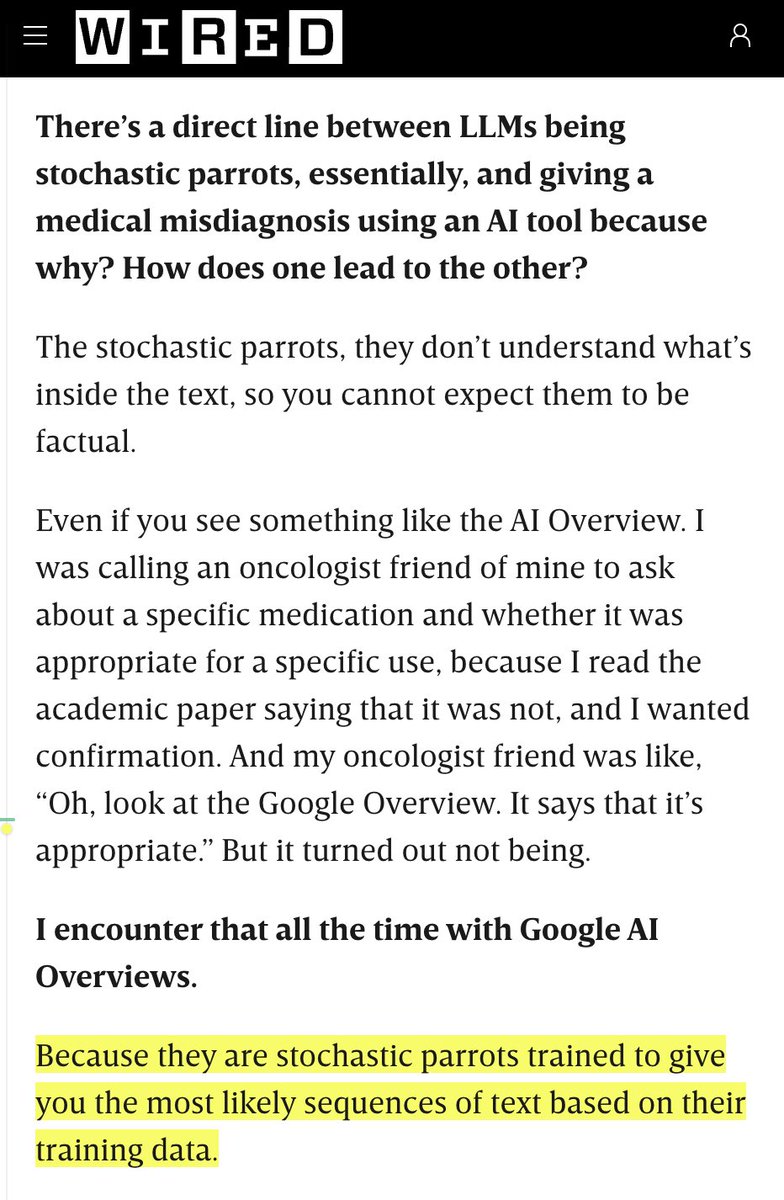
Garry Tan amplified a challenge to Timnit Gebru’s “stochastic parrots” framing, reacting, “Imagine saying this in 2026.” The linked post says Gebru argues that “you cannot expect LLMs to be factual,” citing errors in Google AI Overviews, and sarcastically suggests critics should get access to Opus 5.5 and Astra.

- Founded in 2024 by Fei-Fei Li, Ben Mildenhall, and Justin Johnson to build spatial-intelligence foundation models, World Labs is joining AMD after a technical partnership optimizing model training and inference on AMD GPUs. Li will become AMD’s Executive Vice President and Chief Scientist; the team says it will continue frontier research within AMD and provide open models and platforms spanning hardware, software, models, and data.
- World Labs says Atlas, trained from scratch, predicts new camera views from 2D images and outperformed specialized state-of-the-art models on this task; Li says it addresses the long-standing sparse-reconstruction problem, with potential uses in robotics, scene generation, and real-world reconstruction. The company also says its SceniX acquisition is helping it build toward an industry-leading robotics-simulation capability.
- Li expressed conviction in scaling, while Justin Johnson said compute was the current constraint; the founders reported significant improvement with each increase in model size, training duration, and number of chips. A model-generated camera view that passed under a garden table was the breakthrough that convinced the founders to commit to building Atlas.

Sam Altman highlighted 6.1 Sol as an extremely capable model priced at one-fifth of Astra, with a 95% cache-read discount; the quoted post describes it as a workhorse . An “ultrafast” option promising 8× speed is available for Astra and was described as coming soon for 6.1 Sol .
Sam Altman announced “Dots,” describing it as a new way to use AI around the clock to give users more time and attention for higher-level work; the post provides no further product details.
A DevDay livestream was announced for two hours after the post, which teased “great stuff” without specifying any products or announcements.
Garry Tan describes smart browsers that let agents perform tasks a human could in a browser as a real and growing category, and praises Aside’s password management as supporting that use case. The linked discussion raises a portability risk: if Amazon blocks an agent at checkout, users may want to carry its skills to another storefront without starting from zero; this is posed as a concern, not a reported event.
Garry Tan cited Respan as evidence that small tool models can be a significant unlock alongside frontier models. Respan says its Guardrails product, built on Span-01, detects prompt injections, jailbreaks, and unsafe content before they reach models and tools; the company reports the highest average F1 among guardrails it tested across eight categories and says the product is free and native to its gateway.
Garry Tan says he merged a version of OpenClaw’s test-audit skill into GStack, calling test bloat a real problem; he adds that “intelligence is on tap these days.”