We can't find the internet
Attempting to reconnect
Something went wrong!
Hang in there while we get back on track
The math release gets organized pushback
The day after OpenAI published results from an unreleased frontier model, the response turned from awe to opposition. Exponential View put the release at 722 manuscripts in 372 families, averaging the equivalent of three hours of ChatGPT Pro thinking each. It noted that many results have been verified in Lean, but not all . The same post floated a split into "machine mathematics," verified but mostly read by AIs, and a smaller human "effective theory" of what people can understand .
Terence Tao reposted a statement from the Association for Human Mathematics . It urges mathematicians to "discontinue their work with OpenAI and to return to a vision of science that centers human understanding" . One commenter pointed out that the repost does not necessarily reflect Tao's own view .
The investor angle comes from Leo Polovets. He asks whether organizations will start "tokenmaxxing" research, for example a seed fund spending $50K or UPS spending $500M on tokens to find better routing algorithms . His reasoning: AI's R&D impact so far has been mostly on development rather than research. If compute can produce genuinely novel results, the right AI budget for some organizations could be much larger than they now assume .
A related data point: P0 Research reports that frontier models' "experimental research taste" has doubled roughly every three months since December 2025. It says Opus 5.5 now beats its expert human baseline, though most of those experts have not worked at a frontier lab .
Models: GPT-6 for everyone, cheaper Haiku
OpenAI is rolling out GPT-6 and "Intelligent UI" to all ChatGPT users. The new UI turns answers into interactive visuals and tools .
Anthropic released Claude Haiku 5.5, saying it costs about 75% less to run than Haiku 4.5 . Early reviews are mixed:
- Jerry Liu: for document parsing it costs about $1.20 per 1,000 pages and handles tables and reading order well for that price. It is weaker on charts, semantic formatting and bounding boxes .
- Bindu Reddy: calls it "MUCH worse than DeepSeek" and worse than Luna, but gives no benchmarks .
Separately, Anthropic's startup program offers up to $7,000 in Claude credits for a year . A Reddit commenter flags terms worth reading before applying. These reportedly allow Anthropic to develop competing technology, bar using the services to build competing products, and let Anthropic change the terms without notice. This is one commenter's reading of the terms, not verified here .
Power is the bottleneck: Texas freezes data-center permits
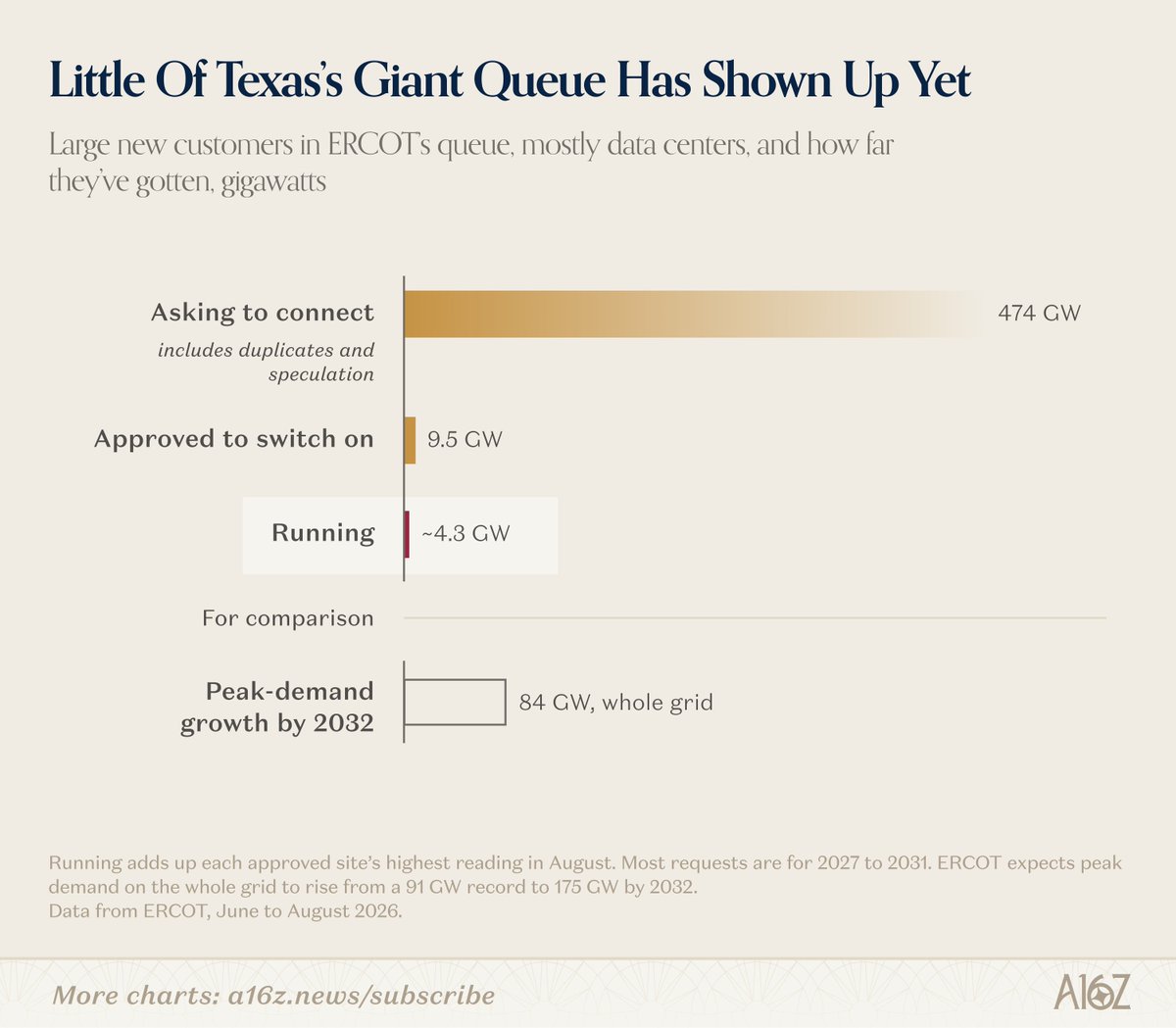
a16z reports that Texas has frozen new data-center permits. The large-load queue went from 63 GW to 474 GW in 18 months, more than 5x record peak demand. Only 9.5 GW is approved and about 4.3 GW is running . ERCOT has also paused approvals for data centers of 75 MW or more to switch on, including 17 that had finished every other step. The timeline is "TBD," and full grid connection can take 5–10 years .
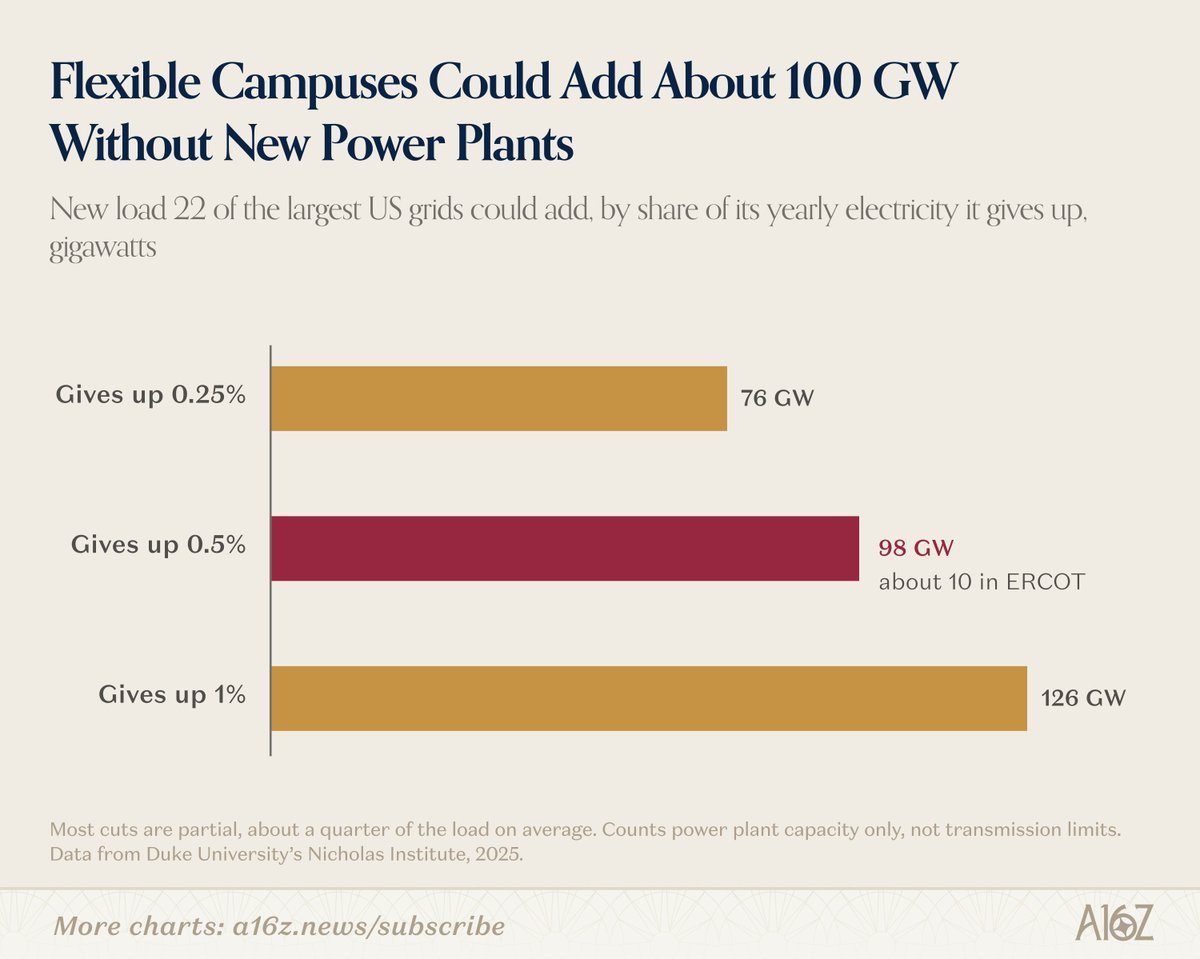
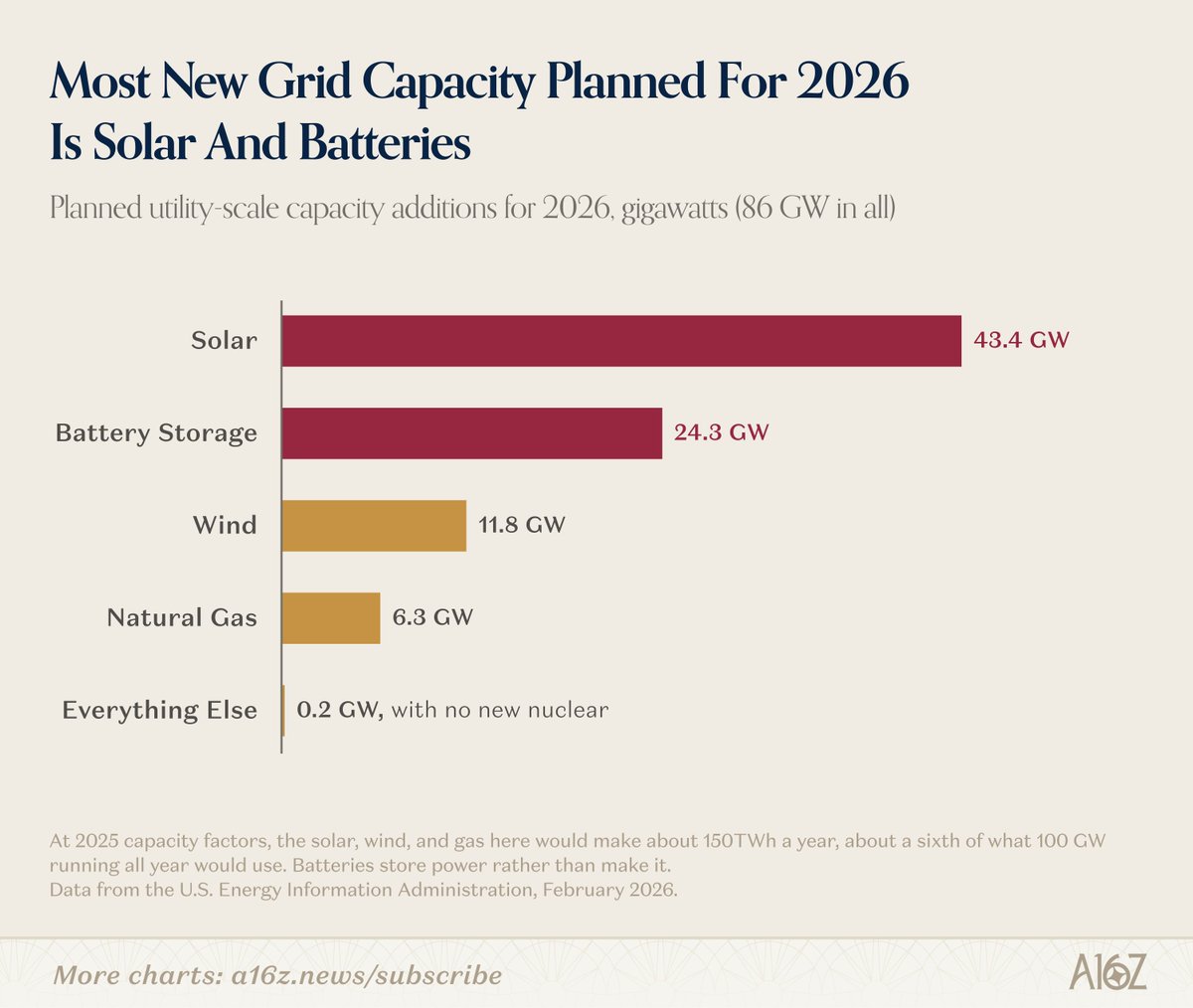
Behind-the-meter power is a bridge rather than a replacement. SemiAnalysis tracks 75 GW of equipment orders for on-site power, but sites still plan to connect to the grid because on-site power almost always costs more . a16z also argues that data centers willing to cut usage at peak hours could add 100 GW to US grids without new plants . For scale, US grid additions planned this year total 86 GW: 43.4 GW of that is solar and none is new nuclear .
a16z's Ryan McEntush sees two ways for startups to break in: winning on integration or business model (Base Power), or bringing better technology (Heron Power's solid-state transformers) . His diligence point is that big firm orders rarely go to equipment without thousands of operating hours. So getting designed into a real project "matters far more than early deposits or revenue" .
The same day, a16z said Base Power raised $2.5B. Three years in, the company says it built a battery factory in 8 months, installs 100 batteries a day and powers more than 30,000 homes .
Agents move to the desktop, and gatekeepers resist
Sriram Krishnan described Microsoft's new Windows agent features :
- MXC containers: a local sandbox where agents run.
- Hybrid routing: actions can run on local models or be sent to cloud models.
- Copilot agents: one demo did taxes with no remote models.
- Hardware: a new generation starting with Surface Laptop Ultra and Nvidia RTX Spark.
Replit launched a Windows desktop preview that builds apps locally, with each build sandboxed using Microsoft Execution Containers and Nvidia OpenShell . Amjad Masad cites supply-chain attacks and catastrophic agent mistakes as the risks this design addresses .
On consumer agents, a guest on an Alexandr Wang–hosted interview described Muse's plan to bring agents to non-coders, whom the industry largely overlooked . Muse is free with subscription tiers and is exploring small fees on purchases or savings it facilitates rather than ads .
Paul Graham argues that Amazon banning agents is the first opening he has seen for a startup to build an Amazon competitor . More generally, he says any business that bans agents shows there is demand for a competitor that allows them .
Deals and funds
- HealthLeap: raised $38M across Seed and Series A from Sequoia, First Round and Hummingbird. It reports 39% more appropriate diagnoses with the same staff at Cedars-Sinai, and growth from 3 to 50+ hospitals in a year .
- Vitalize Care (YC W23): raised a $31M Series A for hospital staffing software. It says it manages millions of shifts a week across 15+ health systems, and that St. Luke's cut overtime and agency spend 54% in 12 weeks .
- Preference Model: a16z invested. The company builds RL environments for AI research and ML engineering for leading labs, and is open-sourcing Karotte, a framework it says was hardened over more than 1M evaluation runs .
- Sriram Krishnan: raising a $500M VC fund, per Axios via Dan Primack .
- a16z Japan: a16z opened a Japan office led by Hitoshi Yoshida, former president of Microsoft Japan and HP Japan. It is targeting AI, cybersecurity, robotics and defense .
Early-stage market read: Hustle Fund's September numbers
- Volume: Hustle Fund passed on 1,901 of 1,922 pitches, with 21 still in progress .
- Top pass reason: incorporation, at 47%. The firm wants Delaware C-corps or Canadian or Singaporean equivalents .
- Valuations: about 70% of founders sought valuations under $10M .
- Categories: 38% self-identified as AI/ML .
Tooling and science
- Perplexity: open-sourced pplx-embed-v2-late, multimodal embeddings in 9B and 0.6B sizes that share one embedding space. It enables OCR-free PDF search and querying on the device .
- OpenDocRouter: LlamaIndex launched a unified document-parsing API that serves models at cost plus a small transaction cut .
- OCR copying allegation: Vik Paruchuri alleged that Interfaze's new open-weight model copied and relicensed Chandra OCR 2 . This is an allegation, not established.
- AlphaGenome: DeepMind says it matched or beat the strongest comparison model on 25 of 26 variant-effect benchmarks . Its Atlas precomputes effects for about 9 billion single-nucleotide variants and is 30x the size of the AlphaFold database . Linking these molecular predictions to disease risk still needs more research .
- Angel Studios’ AI workflow includes vibe-coding product prototypes, using a collaborator to take promising experiments to MVP before handing them to the product team, and applying brand-guide harnesses across models; engineering adds harnesses when experiments break things. The team also built a tool that randomly serves different movie trailers to measure responses, and Harmon said AI speeds attrition and lifetime-value modeling when the data is clean.
- Harmon framed agentic shopping as a possible distribution opportunity: he said he was searching with Grock rather than Google and argued that businesses with APIs AI agents can use may reach shoppers who prefer buying through bots.
- Angel used a 19-minute skippable YouTube ad to pitch The Chosen; 17,000 people invested $11 million, with $800,000 in ad spend—described as just under 8% of the raise—and livestream pop-ups showing contributions as social proof. The roughly 3-million-member Angel Guild votes on films, can veto titles and gives feedback on rough cuts; Harmon said it had paid $300 million to filmmakers. As a financial caveat, the host cited a roughly $50 million loss the prior year; Harmon said marketing was a big expense and acquiring members was not cheap.
- The interview presents Muse as a breakout consumer launch: its opening touts 5 million downloads in 22 days, the host calls it the fastest-growing consumer tool since ChatGPT, and the guest says the team did not expect it to become a hit.
- Muse’s product strategy is to bring agent task completion beyond coders through a polished consumer experience; the guest reports use cases including cutting subscription costs, finding unused gift cards, navigating DMV and healthcare/medical-claims processes, and helping with small-business or social-media work. The longer-term ambition is a general-purpose assistant that helps people accomplish goals large and small.
- Muse is free and has subscription tiers; the guest says the team is exploring small fees on transactions where Muse helps users buy, save, or earn money, and is not spending much time on advertising currently.
- The guest says agent memory remains an unsolved problem and describes Muse’s current safeguards as a sandboxed secure VM, a sentinel monitoring information sent outside it, and user approval prompts for new websites or information sharing; a more confidential VM was planned, with possible speed trade-offs. He agrees that consumer trust can matter more than further increases in raw capability.
- On the broader AI ecosystem, he identifies safer, more generalizable algorithms as a promising direction with multiple startups working on it. He said broader AI-leader discussions were not happening in a private room at the time, while describing a White House accord for company-defined controls with internal, external-auditor, and board-level verification.
- Beyond consumer chatbots, Ng sees substantial enterprise opportunity in selecting and implementing AI workflows: banks may automate parts of loan underwriting and KYC, but identifying valuable, feasible uses and building reliable, tested, compliant, secure, private systems takes considerable work. He expects this implementation work to continue for at least a decade.
- AI-assisted coding is lowering the barrier to building custom software; Ng says software-engineering job postings are up and that AI-native engineers are scarce, while the required skill set has changed.
- Ng says open-weight models are widely used in developing countries to provide access without large budgets or dependence on continued outside access; they also let universities and local teams study models and adapt them to regional languages and use cases.
- Capability caveat: Ng says AI progress is faster on verifiable tasks such as coding, math and factual answers than on judgment-heavy work, which is also harder and more expensive to benchmark. He cites a task-based estimate that perhaps 30–40% of work in many jobs could be automated, while the remaining human work may become more valuable, increasing the need for upskilling.
- In education, Ng says chatbot use for homework can raise homework scores while lowering final-exam scores or measures of long-term learning; he is optimistic about AI learning products built on sound pedagogy and more personalized, one-to-one instruction instead.
- Ng argues that data centers are an important enabler of AI adoption and calls AI key economic infrastructure, making this a time to invest in technology.
- Texas’s large-load queue grew from 63 GW at the end of 2024 to 474 GW by June 2026, about 90% of it data centers and more than five times record peak demand. The state moved from directing data centers to pay for grid upgrades to freezing new permits; ERCOT also paused activation of data centers at least 75 MW pending an audit, including 17 projects that had completed its other steps.
- a16z presents peak-hour curtailment as a way for data centers to connect sooner, claiming U.S. grids could add 100 GW of such load without building a new plant. Separately, the accompanying article cites a Duke estimate that ERCOT could add about 10 GW without new generation if loads gave up 0.5% of annual grid electricity, setting transmission limits aside. ERCOT’s Batch Zero process offers large loads options to bring their own power or accept automatic curtailment when lines are full.
- Behind-the-meter power is a growing infrastructure market: SemiAnalysis is tracking 75 GW of equipment orders, although the article says sites generally intend to connect to the grid when available because on-site power usually costs more. The article identifies startup openings in integration and business models, exemplified by Base Power’s aggregated home batteries, and differentiated hardware, exemplified by Heron Power’s solid-state transformers. It cautions that first-phase adoption is difficult for new vendors: buyers favor equipment with thousands of operating hours, making design-in to a real project more important than early deposits or revenue.
- Texas froze new data-center permits after its large-load queue grew from 63 GW to 474 GW in 18 months—more than five times record peak demand. Only 9.5 GW was approved and about 4.3 GW was operating; a16z says the remaining requests include duplicates and speculative projects, some from developers who have never plugged in a GPU.
- Power availability is a deployment bottleneck: full grid connections can take 5–10 years, and ERCOT paused approvals for data centers of 75 MW or more to switch on—including 17 that had completed other steps—pending an audit, leaving the timeline TBD. Developers are pursuing behind-the-meter power; SemiAnalysis was tracking 75 GW of equipment orders, though a16z says the sites it knows generally still plan to connect to the grid because on-site power usually costs more.
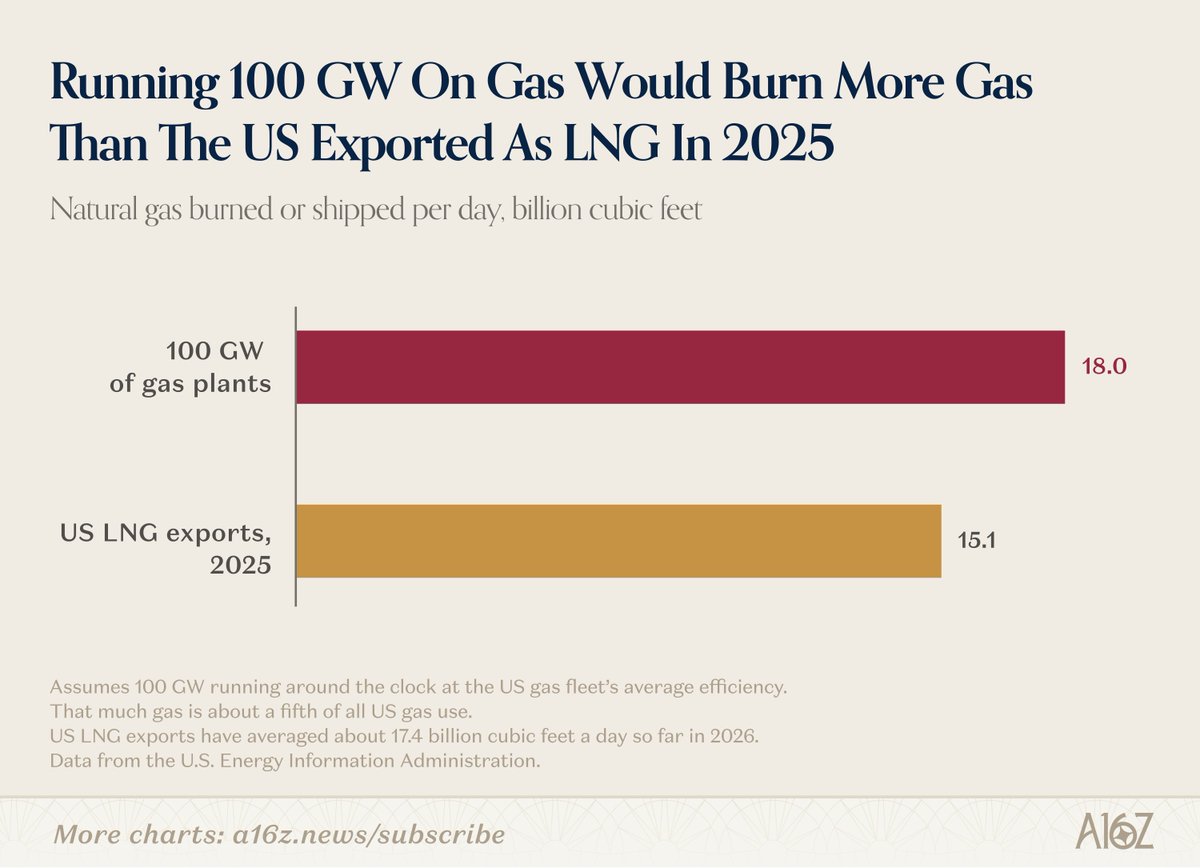
- The potential buildout is large: a16z’s illustrative scenario of 100 GW running year-round equals 876 TWh, about one-fifth of 2025 U.S. electricity use; planned 2026 solar, wind, and gas additions would produce about 150 TWh annually at the cited capacity factors. The article argues that flexibility can help, but cannot eliminate the need for more generation and wires.
- Startup openings include integration/business models and differentiated grid hardware: Base Power’s fleet passed ERCOT pilot tests on its first attempt and was expanding to 50 MW; Heron Power’s solid-state transformers were set for a West Texas pilot with RWE. The source cautions that new power-equipment vendors face a hard qualification hurdle: large firm orders rarely come before thousands of operating hours, making design-in to a real project more consequential than early deposits or revenue.
- Texas illustrates a near-term AI infrastructure bottleneck: ERCOT’s large-load queue grew from 63 GW at the end of 2024 to 474 GW by June 2026, about 90% of it data centers; the state’s response escalated from requiring projects to pay for grid upgrades to freezing new data-center permits. ERCOT also paused energization approvals for data centers of 75 MW or more pending an audit, leaving the Batch Zero timeline “TBD” and the load forecast on hold; full grid connection can take 5–10 years.
- Developers are pursuing behind-the-meter power to accelerate time-to-power: the article says SemiAnalysis was tracking 75 GW of equipment orders for these assets, while noting that known projects generally still intend to connect to the grid because on-site power usually costs more. Flexible demand—such as cutting load or shifting computing—could help accommodate new data-center capacity.
- The analysis identifies power equipment as a startup opportunity through either integration and business-model innovation (such as aggregated home batteries) or differentiated technology (such as solid-state transformers). It cautions that shortage-driven “worse but faster” offerings may lose out if supply catches up, and that new vendors face a track-record hurdle: getting designed into a real project matters more than early deposits or revenue.
- a16z’s post cites a U.S. study finding that each 10% increase in data-center capacity corresponded to a 40-basis-point decrease in residential rates, reasoning that large customers can spread fixed grid costs across more electricity sales. The benefit depends on who pays for grid upgrades, however, and 56% of Texas voters say more data centers would raise their power bills.
- AlphaGenome predicts the effects of genomic variants. It operates at base-pair resolution across a context window of up to one million base pairs; the interview reports it matched or beat the strongest comparison model on 25 of 26 variant-effect benchmarks.
- AlphaGenome Atlas precomputes molecular-effect predictions for roughly 9 billion possible single-nucleotide variants in a petabyte-scale dataset, described as 30 times the size of the AlphaFold database. The Atlas is made available to the scientific community; AlphaGenome model weights are available for academic research and fine-tuning.
- A key translational caveat is that AlphaGenome predicts molecular phenotypes; connecting these to whole-organism traits or disease susceptibility still requires further research. The team also identifies cell-context awareness, more training data, and linking molecular predictions to organism-level effects as ongoing work.
Paul Graham says Replit is more important than he had previously thought: AI-powered apps can make organizations somewhat aligned with AI, but he sees code as the route to the deepest organizational change.
- Paul Graham argues that Amazon’s ban on agents creates an opening for an Amazon competitor: he expects agents to become a major way people buy goods and says shoppers may not want an Amazon-supplied agent doing it for them.
- More broadly, he treats companies’ agent bans as a startup opportunity, reasoning that restrictions imply users want agents and may create demand for competitors that allow them; a nested reply sums up the thesis as “Your usage restrictions are my opportunity.”
- Texas is a major AI-infrastructure bottleneck: ERCOT’s large-load queue grew from 63 GW at the end of 2024 to 474 GW by June—more than five times record peak demand, with about 90% attributed to data centers. Speculative multi-site applications and concern that ratepayers could fund upgrades for projects that never materialize contributed to a pause that escalated to a freeze on new data-center permits. ERCOT also paused approvals for data centers of 75 MW or more to switch on pending an audit; 17 projects that had completed other ERCOT steps were caught in the pause, with timing listed as “TBD.” Full grid connection can take 5–10 years.
- Developers are turning to behind-the-meter power to reduce time-to-power, but the article says sites generally still plan to connect to the grid because on-site power almost always costs more; islanded power also brings reliability and fuel-supply challenges.
- Startup opportunities include grid flexibility and differentiated power hardware: a Base Power fleet with GVEC passed ERCOT pilot tests to sell into the wholesale market and is expanding to 50 MW, while Heron Power is set to install solid-state transformers at a West Texas battery site with RWE. The article identifies integration/business-model innovation and new technology as startup entry points, but cautions that commercialization depends on getting products designed into real projects and proving reliability, competitive pricing, and service; large firm orders for unproven equipment are difficult to secure without substantial operating history.
- a16z says Base Power has raised $2.5B to build a nationwide power company; three years in, it says the startup built a home-battery factory in eight months, installs 100 batteries a day, and powers more than 30,000 homes.
- Base was founded in 2023 by Zach Dell, who worked at Blackstone and Thrive Capital, and Justin Lopas, whose experience includes manufacturing at Anduril and building rockets at SpaceX. Its residential-battery approach uses homes’ existing grid connections to bypass interconnection queues and transmission congestion.
- Base Core is a 39.2-kWh home battery; in markets where customers can choose providers, Base offers electricity for three years at a fixed rate plus delivery fees, with typical bill savings of 10–20%, and uses the batteries to trade power with the grid. It charges batteries when power is cheap and sells it back when prices are higher.
- Utility partnerships rose from less than 5% to more than half of Base’s sales volume in a year; Austin Energy contracted for 40 MW of home batteries and CoServ for 100 MW.
- U.S. grid additions planned for this year total 86 GW: 43.4 GW solar, 24.3 GW batteries, 11.8 GW wind, 6.3 GW gas and no new nuclear; AI labs are planning for hundreds of gigawatts. Solar is the only source already produced at that scale, but most production is in China, while scaling firm non-gas power is more complicated.
- Texas shows the deployment bottleneck: ERCOT’s large-customer queue grew from 63 GW at the end of 2024 to 474 GW by June, about 90% of it data centers; the source says many applications are speculative and lack customers. Texas has frozen new data-center permits, and ERCOT paused approvals for projects of 75 MW or more pending an audit, including 17 that had completed other ERCOT steps; connecting a large data center can take 5–10 years. Behind-the-meter equipment orders offer a bridge, but sites generally still aim to connect to the grid because on-site power is usually more expensive.
- The shortage creates startup openings in integrating existing hardware and business models, such as Base Power’s aggregated home batteries, or in new technology, such as Heron Power’s solid-state transformers. For investors, the source flags a cold-start risk: project design-in matters more than early deposits or revenue, and new vendors must prove reliability, competitive pricing and service capability.
OpenAI is rolling out GPT-6 and Intelligent UI in ChatGPT for everyone; the UI provides fast, interactive answers, makes everyday questions more visual and complex topics easier to grasp, and offers task-specific interactive tools on the spot. Sam Altman called the change long-awaited and said he would hate to return to the old version of ChatGPT.
Paul Graham says successful founders he has spoken with wish they had hired fewer senior managers from outside, while he has not encountered one who wished they had promoted fewer people internally . One founder’s explanation was that external hires may be a different kind of person, with loyalty to their career rather than the company .
Scott Kupor joked that OPM was coming after Sam Corcos to take his title as the government’s biggest USTechForce employer . In the linked post, Corcos said they still need more engineers and invited interested people to DM him .
Dan Primack reported that @sriramk is raising a $500 million new VC fund . Scott Kupor praised him and asked for a running total of AUM for the “a16z mafia” .
Scott Kupor highlighted a Washington Post perspective that “SI” is generating so many new jobs that a slowdown is a concern; his post does not clarify what “SI” means, so it is not an unambiguous AI-labor signal.
Scott Kupor highlights a historical shift in tech talent: women made up as much as 40% of the early programming workforce, while female employment in programming peaked in the 1980s and has not returned to that level.
Tech Force held an event with OPM Director Scott Kupor, tech founder Joe Lonsdale, and Under Secretary of War Michael on how technologists can serve America, advance “SI,” and build tools to strengthen national security; the post gives no further details on specific programs or tools.
Vitalize Care (YC W23), which is building an AI operating system for hospital staffing, scheduling, and capacity, raised a $31M Series A. The company says it manages millions of shifts per week across 15+ health systems and saves clinical leaders over 2,000 hours daily; St. Luke’s Health reduced overtime and agency labor spend by 54% within 12 weeks.
Why Texas Is Making Data Centers Wait

At the end of 2024, Texas’ grid operator had 63 GW of large new customers (opens in new tab) in its queue. By this June, that figure reached 474 GW (opens in new tab), more than five times record peak demand, about 90% of it data centers.
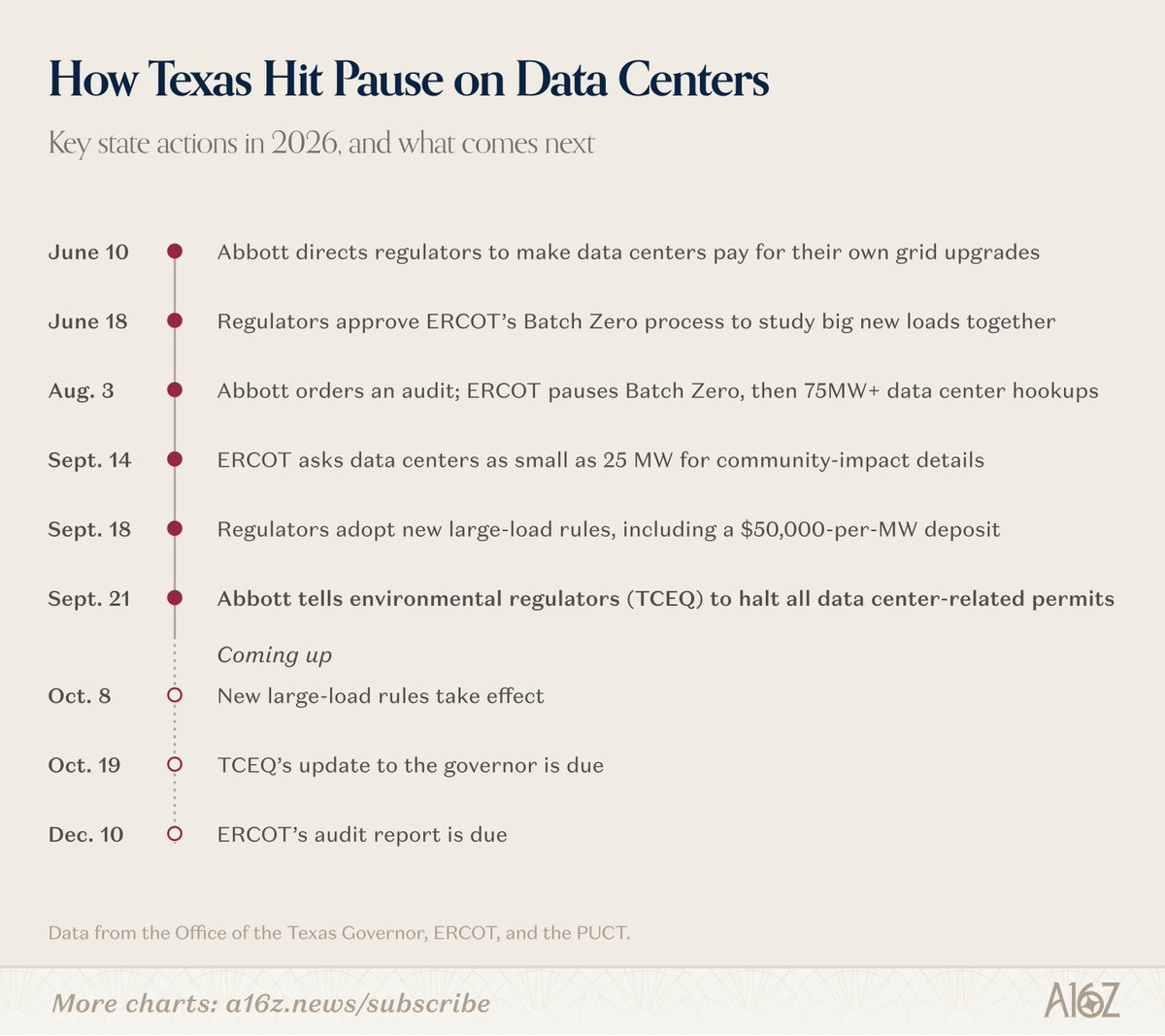
Then Texas hit pause (opens in new tab). What began as directions (opens in new tab) for data centers to pay for their own grid upgrades has since escalated to a freeze (opens in new tab) on all new permits. If you care about AI and American reindustrialization, this is important to understand. Why did it do this?

The upcoming election (opens in new tab) is part of it, but the underlying issues are worth digging into. The first is the interconnection queue. This pause is just as much about how projects apply for approval as it is about the projects themselves. Developers routinely spam requests across several sites, and many are speculative (opens in new tab) builds with no customer yet. Often these new developers have never even plugged in a GPU, let alone a power plant. So dealing with these low-quality submissions puts ERCOT, which runs most of the state’s grid, in a tough spot (opens in new tab). Planners can’t tell which are real, and they don’t want ratepayers covering upgrades built for projects that never show up.

The second issue is community alignment. Noise, water, emissions, and power bills are top of mind (opens in new tab) for anyone who lives nearby. And regardless of the reality (opens in new tab) of these issues, people deserve straight answers (opens in new tab) when a data center comes to town, and they haven’t always gotten them (opens in new tab) (as of June, only 28 of 377 companies (opens in new tab) had answered a state survey on their resource use). In Hood County, commissioners were asked to support a tax waiver for “Project Patriot” without knowing who it was (opens in new tab). To be fair, code names are common while companies shop for sites since a famous buyer can drive up prices, but that logic becomes tougher to defend once officials vote on tax breaks.
This broader political backdrop is important, but I’ll be focusing on just the energy (opens in new tab) side: why it’s so hard to power a data center, all the ways developers are trying to do it anyway, and where things are likely headed from here.
What connecting to the grid actually means
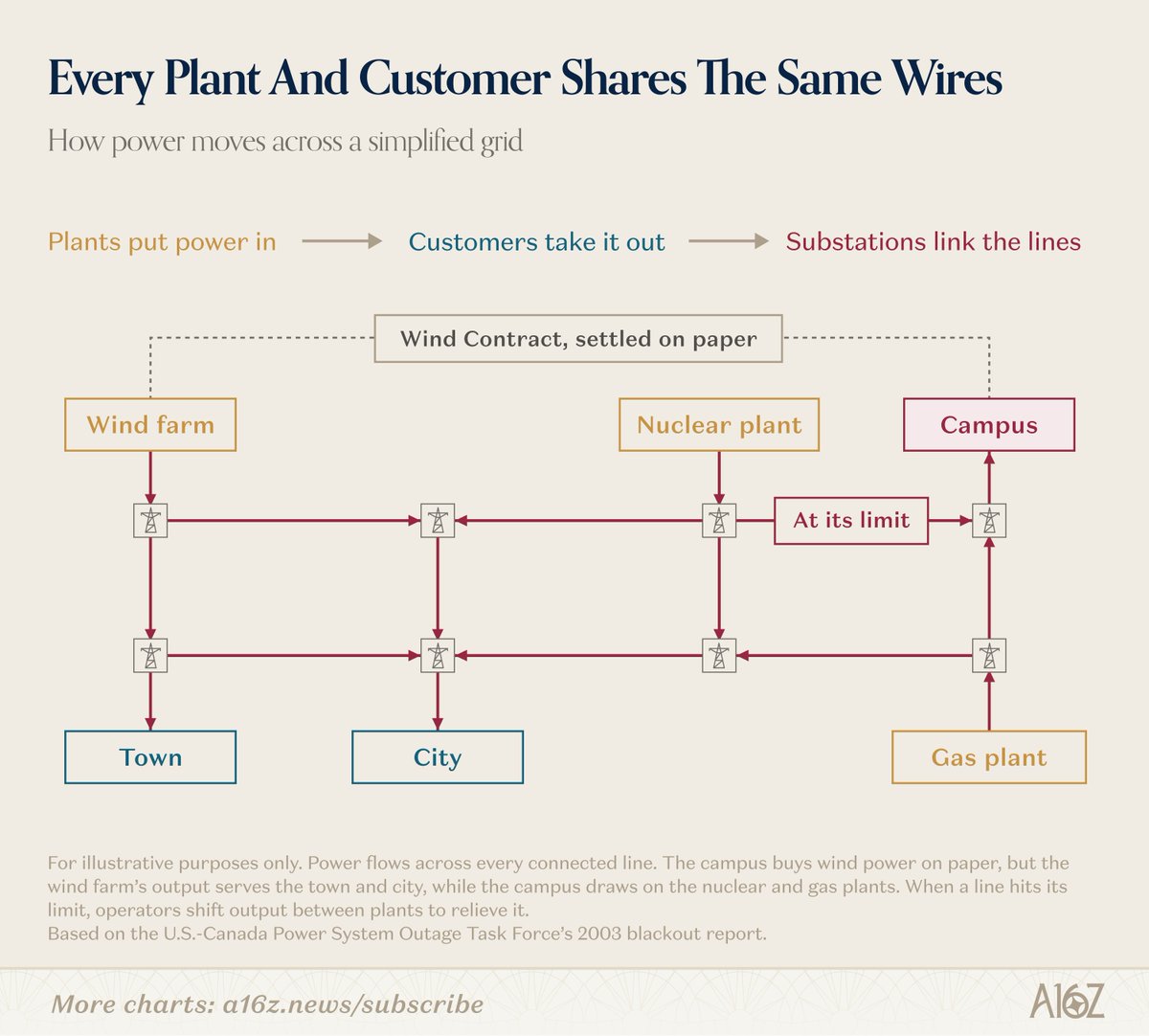
How Amazon purchases power helps illustrate what’s changed. For the last decade, they’d find a utility with network capacity, sign up as a large load, then enter long-term contracts to match (opens in new tab) their use on paper. These were often purely financial (opens in new tab), meaning you didn’t always have to prove the power could reach you, and the grid connection was easy because utilities typically had spare network capacity.
That’s no longer true. The grid is stretched thin, and almost any new large load or generator now requires an upgrade. Power flows across every connected path (opens in new tab), so buying from one plant doesn’t reserve a route to your building (there are even markets for transmission congestion rights (opens in new tab)).

So buyers first went after firm power (available around the clock) they could claim more directly, typically by restarting retired plants (opens in new tab) or by building next to existing ones. Neither was a true escape (opens in new tab), and some of the loudest fights are over “colocation,” which ERCOT describes (opens in new tab) as drawing power from a neighboring plant before it reaches the grid:
Susquehanna: Amazon bought a campus (opens in new tab) next to Talen’s nuclear plant, but FERC, the federal grid regulator, rejected Talen’s bid (opens in new tab) to send it more power directly. Utilities had argued it would let the campus dodge grid fees and push fixed transmission costs onto everyone else. Under the restructured deal (opens in new tab), Amazon pays for delivery like any other customer (opens in new tab).
Freestone: CyrusOne’s 760 MW campus beside Constellation’s gas plant needed approval from the Public Utility Commission of Texas (PUCT) (opens in new tab), since it effectively takes much of the plant’s output from everyone else. The PUCT said yes (opens in new tab) in May, as long as the campus can cut its use (opens in new tab) or switch to backup power within 30 minutes of an ERCOT call.
Armstrong County: Two Crusoe data centers, of 265 MW and 260 MW, share a wind farm that can produce at most 265 MW. Both got the same rule as Freestone, so each must shed its entire load when ERCOT calls. Together, they’d cut nearly twice what the wind farm can actually produce, which Crusoe called excessive (opens in new tab), but the PUCT kept it.
Interconnection studies are how grid planners identify the wires and substations that need upgrades for any addition to the network. ERCOT used to review studies individually under rules built for up to 50 large loads at a time (opens in new tab), but 2025 brought 225 new requests by mid-November. So this June, the PUCT approved a new batch approach (opens in new tab). Under “Batch Zero,” ERCOT studies large loads of 75 MW or more together and allocates grid capacity among them.
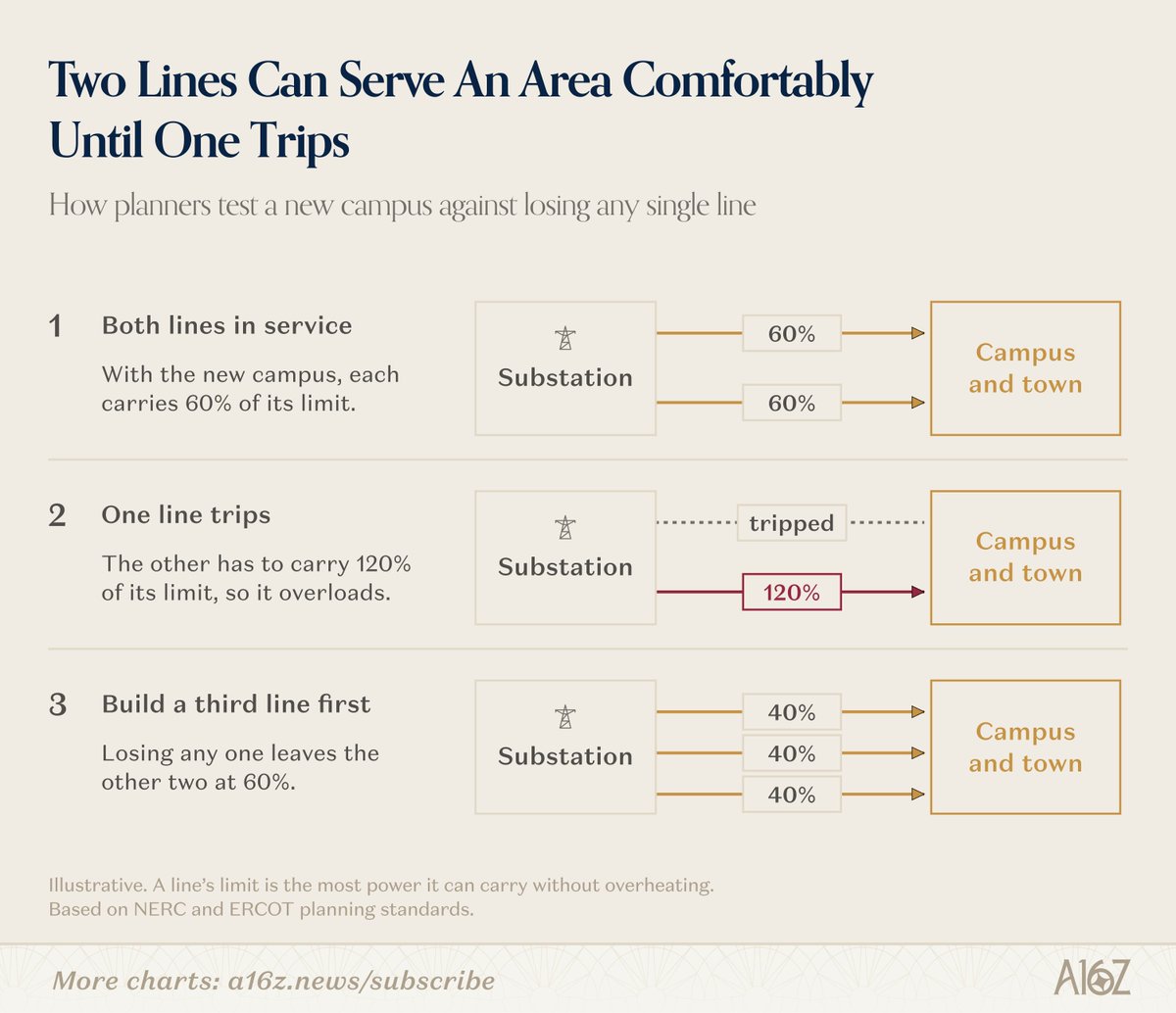
Primarily, the studies ask what happens when something breaks. NERC’s standard (opens in new tab), the baseline for reliability across North America, covers a broad set of outage scenarios, with ERCOT adding its own requirements (opens in new tab). Planners might simulate a transformer outage, then knock out a line or generator on top of that. Maintaining that reliability standard without shedding more load often means building additional infrastructure.

A newer risk is load unexpectedly dropping off the grid all at once. Many data centers switch to backup power at the first voltage dip to protect their hardware, so one bad fault can pull an enormous load (opens in new tab) off the grid in seconds. This happened (opens in new tab) earlier this year in Virginia, but was fortunately handled well.
Texas has even less room for error since ERCOT’s grid is largely isolated (opens in new tab). Under some conditions, ERCOT can lose only about 3.2 GW (opens in new tab) of load at once before causing serious issues. A new voltage ride-through rule (opens in new tab) now requires new data centers to stay connected through routine faults, and I’ve even heard of labs running dummy jobs after a training run fails just to keep load from dropping abruptly.

All of this can sound overly conservative, but the system was designed to put reliability ahead of cost. Put simply, the grid is built for the hot summer days and frigid winters when failure can mean life or death. That duty is what makes sizing the grid so hard; you build for a few peak hours but pay for it all year.

So who does pay for all this resilience? Texas typically splits transmission costs by each large customer’s demand during the grid’s summer peaks, so a big load that ramps down on the hottest afternoons can skip much of its share of the transmission bill. In July, regulators proposed (opens in new tab) counting all 12 monthly peaks instead and charging (opens in new tab) large loads as if they ran at full size. In other words, large buyers would pay in proportion to how big their electricity pipes need to be, not how much is flowing through them.
Sounds simple enough, but splitting up costs is often the slowest part of interconnection. An upgrade built for one campus may also improve reliability for existing customers or make room for future growth that’s hard to value up front. And if any new development runs over budget or its load never shows up, everyone else is forced to cover whatever the developer’s commitments didn’t.
And those commitments are surprisingly cheap to make. The PUCT’s new large-load rules (opens in new tab), effective October 8, charge a flat $100,000 study fee plus a $50,000-per-MW deposit. The deposit weeds out some speculative projects, but it’s a thin filter. ERCOT can reassign a project’s capacity if it falls two years behind, but even a project that loses its capacity forfeits just 20% of the deposit (~$10 million on a 1 GW campus), plus whatever the utility has already spent. Most importantly, the deposit typically only backs the upgrades built for that project, not the more expensive regional lines whose cost everyone on the grid shares.
Fully connecting a large data center can take 5 to 10 years (opens in new tab). So to accelerate deployment, a phased connection approach (opens in new tab) is becoming more common (opens in new tab), which gives the utility more gradual targets to plan around, as well as a way for the developer to prove they can handle everything they’ve asked for. All of this also assumes Batch Zero is moving, which it isn’t right now. ERCOT has even paused approvals (opens in new tab) for data centers of 75 MW or more to switch on, including 17 that had finished every other ERCOT step. Until the audit’s December report settles which projects are eligible, ERCOT can’t study them together, so the timeline is “TBD” (opens in new tab) and the load forecast is on hold (opens in new tab).
What bringing your own power solves
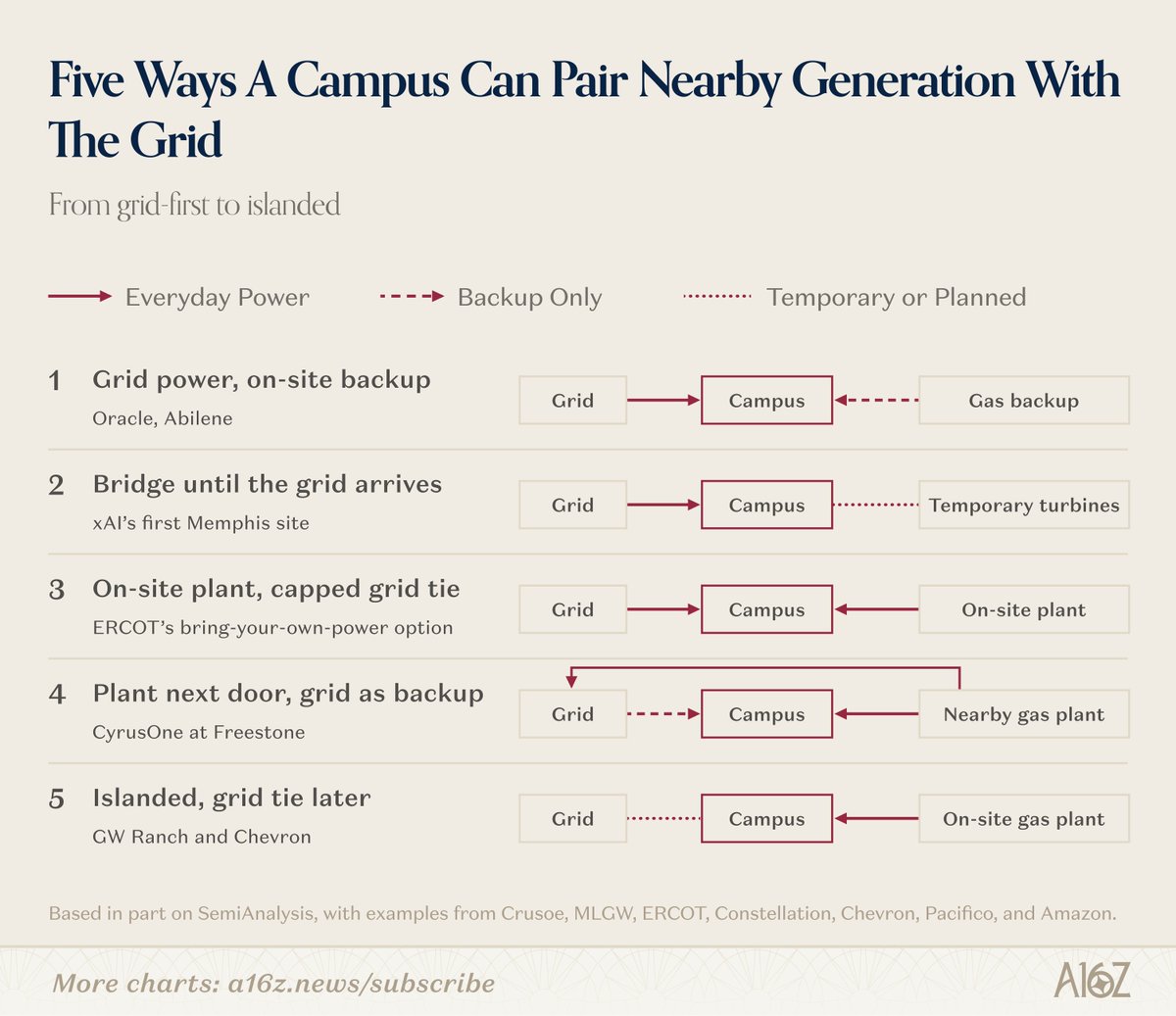
For a developer facing the interconnection queue, skipping the grid entirely looks appealing. Idle GPUs cost (opens in new tab) far more than the electricity to run them, so speed matters most — what folks call “time to power.” That’s why developers are planning to bring their own power on site (“behind-the-meter”), but almost always alongside a connection to the grid, or as a bridge to one:
Abilene: The Oracle campus runs on grid power with gas backup (opens in new tab). Next door, Crusoe announced a 900 MW Microsoft campus with its own on-site plant (opens in new tab), but the CEO of Lancium, Crusoe’s partner on the site, has described gas generation as backup (opens in new tab).
Shackelford County: Vantage is building a campus with 1.4 GW of compute for Oracle and OpenAI, designed to run off-grid with on-site gas (opens in new tab). But its site plan (opens in new tab) includes a switchyard beside a high-voltage line — curious!
Pecos County: Pacifico describes its planned microgrid (a behind-the-meter setup) at GW Ranch as never drawing from ERCOT (opens in new tab), yet the site’s new owner, Amazon, says it’s designed to join the grid (opens in new tab) once it can connect.
West Texas: Under a 20-year agreement (opens in new tab), Chevron plans to build a dedicated gas plant beside a planned Microsoft campus that won’t initially touch the ERCOT grid, though Chevron has applied for a connection. Chevron now says the permit freeze could push its final investment decision into 2027 (opens in new tab), but it still expects first power by 2028.
Armstrong County: The Google campus Crusoe is building beside a wind farm is tied to both the farm and the grid from day one (opens in new tab), with Crusoe calling it “across the meter (opens in new tab),” which I’ll admit is catchy.
SemiAnalysis is already tracking 75 GW of equipment orders (opens in new tab) for behind-the-meter assets, but every site I’m aware of intends to connect to the grid as soon as it can, chiefly because on-site power almost always costs more. So, once the grid is available, say in year five, you switch.

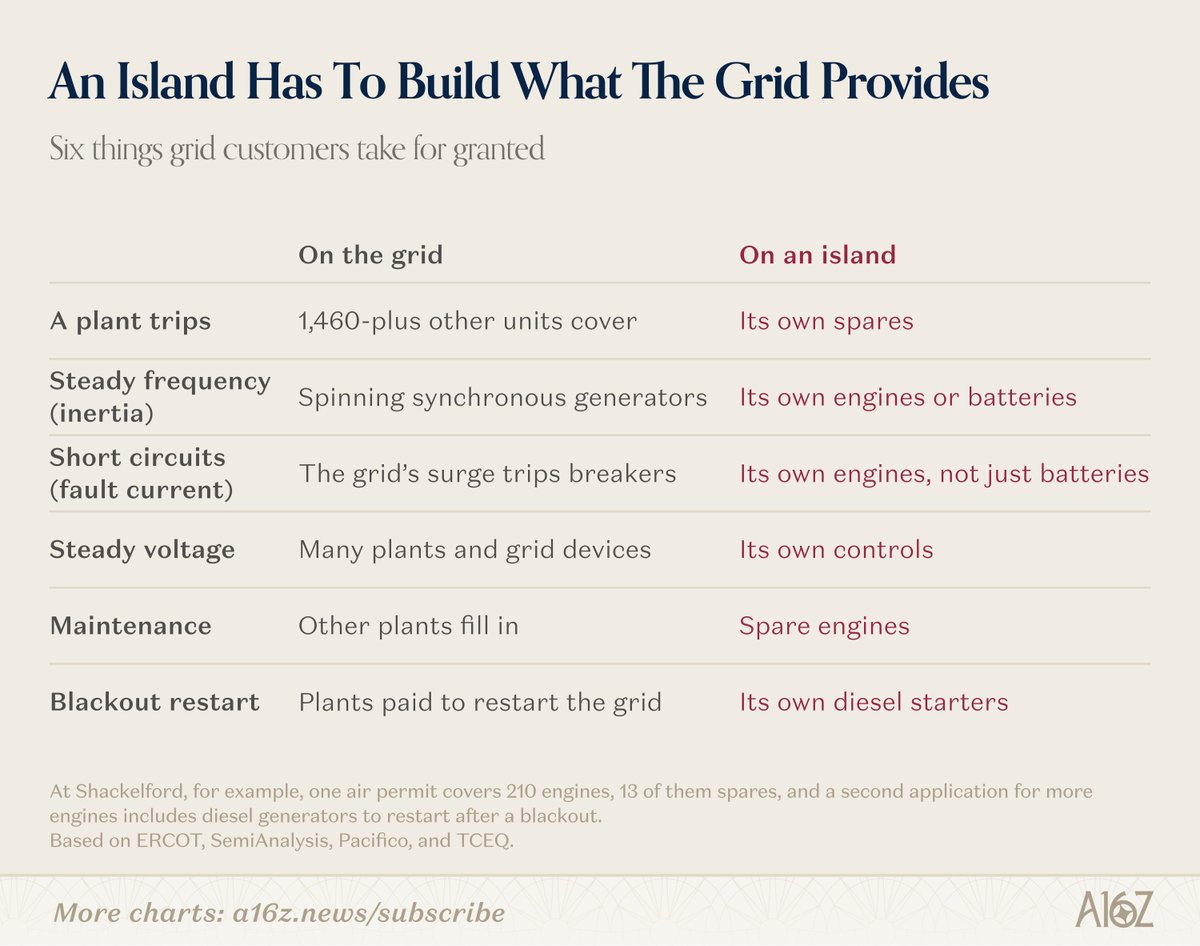
In the meantime, pairing on-site assets with even a partial connection is smart for the same reasons we built a grid in the first place. When one plant trips, the rest of ERCOT’s 1,460-plus generating units (opens in new tab) cover for it, but an islanded load (cut off from the grid) doesn’t have that luxury. The grid also provides things we take for granted, like inertia (opens in new tab), fault current (opens in new tab), steady voltage, and black start (opens in new tab). An island has to supply all of that itself — power systems folks know how hard this can be.

AI workloads make the job even harder. At xAI’s first Memphis site, swings of 10 to 20 MW several times a second were wearing out turbine shafts (opens in new tab) until xAI added 150 MW of Tesla Megapacks. A grid ERCOT’s size dilutes swings like that, but on a private plant the turbines really feel it. Expect more batteries and other energy storage as rack-level power density grows and swings become more dramatic.
Then there’s fueling a site. Winter Storm Uri’s (opens in new tab) lesson is that gas plants can fail together (opens in new tab). And since they tend to keep little fuel on site (NERC calls gas a “just-in-time” fuel (opens in new tab)), spare turbines don’t always help. Sometimes the pipeline doesn’t even exist yet (opens in new tab). Solar trades that fuel risk for the sun and weather, and at gigawatt scale, you need a lot of batteries. Keeping a 1 GW campus running through one 14-hour winter night takes 14 GWh from batteries, about half of all the battery storage on ERCOT’s grid (opens in new tab) as of June. For an island seeking 100% uptime, covering rare events like a cloudy week or another Uri gets expensive.
Whatever the fuel, you want an island that fails gracefully and predictably, with no single point of failure. Even nuclear, about as reliable as power plants get, runs only about 92% of the time (opens in new tab), mostly because each reactor goes offline for weeks to refuel. Redundancy in this case means effectively an entire second power plant. Thus, behind-the-meter setups favor modularity, like the more than 500 gas engines (opens in new tab) of about 4 MW each planned for Shackelford, though hundreds of engines can be a pain to maintain.
Full reliability for an island is very, very hard, but some labs and hyperscalers have shown that, forced to choose between reliability and speed, they’ll pick speed. Meta has turned to tents with no backup generators (opens in new tab), and SemiAnalysis finds buyers growing more willing to accept outages (opens in new tab), with some island designs aiming for as little as 99% uptime, or about 88 hours of downtime a year. With GPU time this expensive (opens in new tab), that still beats years of waiting, so for many buyers a temporary island makes sense even if it’s messy.
A “private grid” that ties several plants and campuses together can take back many of the benefits a lone island gives up, at least in theory. But today Texas, like most states, only allows building your own power within tight limits:
Supplying yourself: You aren’t a utility (opens in new tab) if you supply only yourself, your employees, or your tenants, and nobody resells the power.
Running a private use network: You can also run on colocated generation, sell the surplus into the grid (opens in new tab), and draw from it when you fall short. This is the model for the Armstrong County campus, and for the West Texas one once it connects.
Selling to a neighbor: If you sell to the factory across the road, you need a retail electric provider certificate (opens in new tab).
Stringing a wire: Build your own line, and you’re probably running into the local utility’s service territory (opens in new tab).
The Cato Institute’s consumer-regulated electricity (opens in new tab) proposal would loosen those limits by allowing private utilities to serve multiple customers across their own network. This isn’t an entirely new idea; Utah’s SB 132 (opens in new tab) lets loads of 100 MW or more contract for a fully off-grid system. Texas currently doesn’t let a network like this serve multiple customers, but if the demand for power remains insatiable, I’d expect the more permissive states to win larger chunks of the buildout with this “Wild West” utility structure. (However, you may also risk a utility “death spiral (opens in new tab),” with the grid’s fixed costs falling on fewer and fewer customers.)
The flip side is a utility building the island itself. Outside ERCOT, El Paso Electric plans to put 813 small gas generators from ERock (opens in new tab) (366 MW in all) beside Meta’s new campus and run them as an island, on Meta’s dime, for up to five years. This is an option because, unlike the transmission and distribution utilities inside ERCOT, it still owns power plants. After the island period, it would connect the plant to its grid and could seek to spread the cost across all its customers, though in September administrative judges recommended (opens in new tab) approval only if those customers are protected.
Anything that runs on fuel also needs an air permit that matches how it operates, so a diesel generator permitted only for emergencies can’t run all the time. Optimistically, permits can come fast (opens in new tab) when things work. Sometimes they don’t (opens in new tab), though. In Texas, the freeze now blocks them for data centers until the audit is done.
We should also ask what instances of behind-the-meter “bridge” gas are actually bridging to. xAI’s first two Memphis data centers answer that in different ways. The first ran temporary turbines off an existing gas main (opens in new tab) until the grid arrived, then began removing them (opens in new tab). Along the way, it ran dozens without air permits (opens in new tab). For the second, xAI built its plant across the state line (opens in new tab) in Southaven, Mississippi, but a July order requires all 69 turbines to retire (opens in new tab) by mid-2027 as a permanent 1.2 GW plant goes up in their place. One bridge led to the grid, and the other to a power plant of xAI’s own.
In August, though, the federal Tennessee Valley Authority (TVA) agreed (opens in new tab) to serve that data center directly, too. Turns out it’s hard to stay away from the grid!
What flexibility can buy
A campus that can keep itself running can also be easier for the grid to accommodate, even welcome. It’s a large paying customer whose demand can “flex” when power is tight, whether by cutting its draw or exporting surplus power. This is how xAI got approved for grid power at its second Memphis site. What made its promise to flex credible was its ability to carry its entire load for four hours on its own power, and what the CEO of Memphis Light, Gas and Water called “the world’s largest grid-connected battery system.” (opens in new tab)
Batteries are only one way to flex. A campus can also shift computing (opens in new tab) to other hours or data centers, or switch to its own generators. So how much room could flexibility open up? Tyler Norris and colleagues at Duke (opens in new tab) estimated that, setting transmission limits aside, ERCOT could add about 10 GW of new load without new generation if that load gave up 0.5% of its yearly grid electricity. Since the average cutback lasts about two hours, it’s also conveniently battery-shaped. Building on this, a study of PJM (the largest US power market) by Camus, encoord, and Princeton (opens in new tab) found that for each GW of new data center load, making 20% of that load flexible would save other customers $78 million a year, while bringing its own capacity for the other 80% would keep another $326 million off their bills.

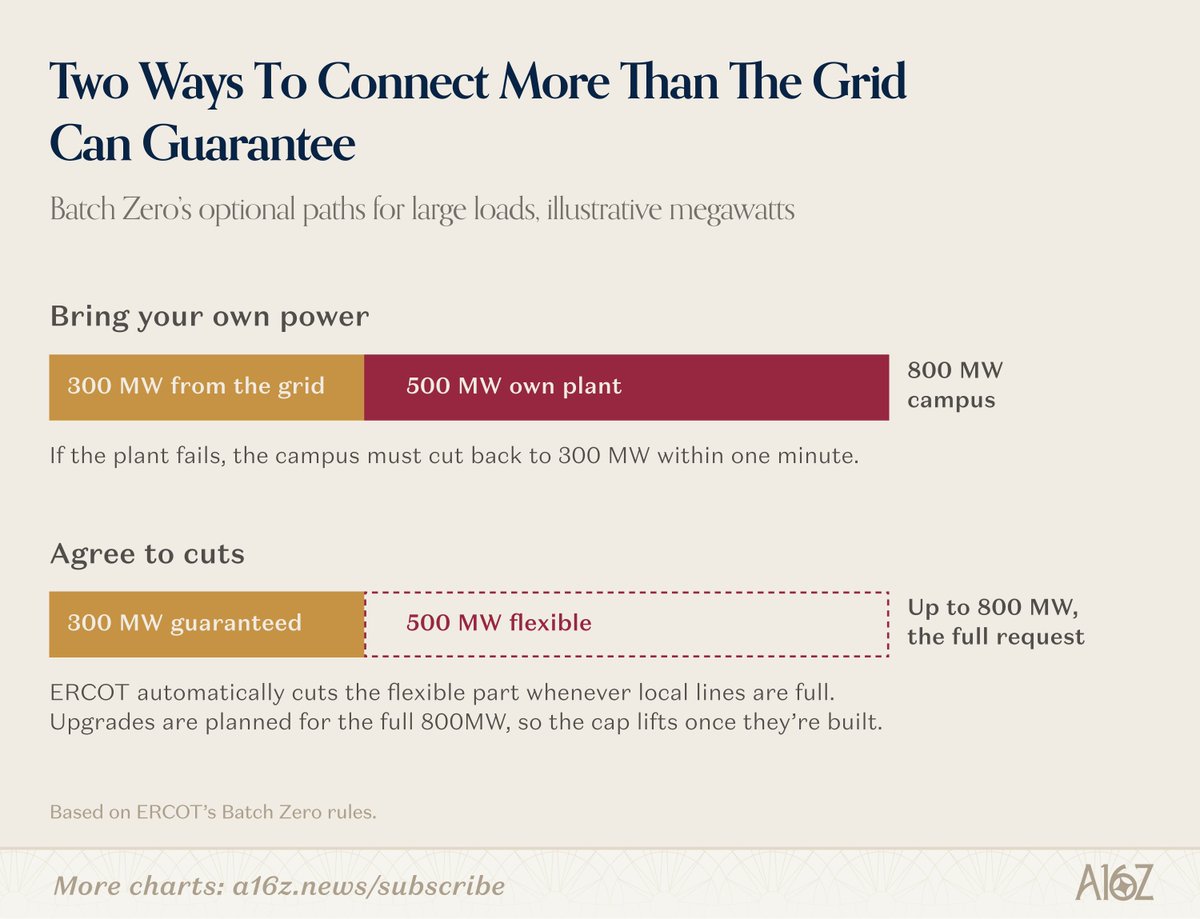
For flexibility to be valuable, it’s important that it’s always available when operators need it. In Texas, generators already work this way under connect-and-manage (opens in new tab). Put simply, they can hook up early as long as ERCOT can cut them down when lines are congested. Generators can live with that because at worst they sell less for a while, but a data center that has promised its customers uptime is more challenging. Some loads, like Bitcoin miners (opens in new tab), have made the trade anyway. Batch Zero (opens in new tab) gives large loads two optional paths here:
Bring your own power: A campus can count its own power plant toward its size as long as it can cut back within one minute (opens in new tab) if the plant fails. So far, 11 Batch Zero projects have picked this path.
Agree to cuts: A campus can draw up to the full amount it asked for, but ERCOT can automatically cut anything above its guaranteed share whenever lines are full.

A campus could also pay its neighbors to cut their load instead. In PJM, Google is funding Voltus (opens in new tab) to pool up to 100 MW of batteries, thermostats, and other flexible devices across a territory. But PJM only counts what it trusts the pool to deliver, and it’s a capacity deal (opens in new tab) that helps the whole grid at its peak, not a fix for any one congested line. That’s a harder sell in Texas, an energy-only (opens in new tab) market where transmission is the main bottleneck. Texas has also barred (opens in new tab) colocated campuses from getting paid for similar services (opens in new tab), since under SB 6 (opens in new tab) they already have to shut off when ERCOT tells them.
Even so, Texas has been a leader in distributed resources. One Base Power (opens in new tab) fleet, run with the co-op GVEC (opens in new tab), passed ERCOT’s pilot tests to sell directly into the wholesale market on its first attempt, and is now expanding to 50 MW. These pilots are important; planners need that kind of proof before they’ll design around these fleets. But once trusted, distributed resources can rapidly add capacity without waiting for an expensive new “peaker (opens in new tab)” power plant, lines, substations, or a lengthy interconnection process.
Other hardware can help, too. Unlike legacy steel units, a solid-state transformer uses semiconductor switches, so software can measure and steer the power flowing through it. Alongside network upgrades like reconductoring (restringing lines with higher-capacity wire) and dynamic line ratings (rating lines for actual weather instead of worst-case conditions), that greater visibility and control can squeeze more out of wires ratepayers already funded. It’s a big reason we backed Heron Power (opens in new tab), which is set to install its solid-state transformers at a West Texas battery site with RWE (opens in new tab).
The problem is that most of these tools help operators keep things running day to day, but planners don’t always count them when they size upgrades. Nothing in physics forces that, though. A September study by Piq Energy (opens in new tab), using Base Power (opens in new tab)’s data on potential fleets, found that about 80 MW of home batteries, strategically sited to relieve transmission constraints, could resolve all overloads triggered by a hypothetical new 100 MW data center near Fort Worth.
Batch Zero doesn’t consider things like this yet. It still plans upgrades for a flexible campus’s full planned load (opens in new tab), since that path is a bridge to firm service, and there’s no option to stay flexible for good in exchange for smaller upgrades. Planners could instead size the upgrades smaller by crediting flexibility and other resources that relieve the same bottlenecks, assuming they’re measured in real time and perform reliably.
All of this saves time and money by getting more out of what’s already in the ground, but no amount of flexibility gets the grid out of building more generation and wires for all the demand coming down the pipe.
Getting to hundreds of gigawatts
On-site power and flexibility will decide how the next few campuses energize, but the labs and hyperscalers I talk to worry most about scale. Their power teams tend to split in two: one picks sites and equipment for the next couple of years, and the other asks how to connect hundreds more gigawatts after 2030.
This is a lot! Run, say, 100 GW all year and it’s 876 TWh, about a fifth (opens in new tab) of what the country used in 2025. Here’s what power developers told the Energy Information Administration (opens in new tab) (EIA) they planned to add in 2026 across the entire grid.

Every source helps, and much of it is headed to Texas anyway. But at last year’s average capacity factors (how much plants actually produce versus their maximum), the planned solar, wind (opens in new tab), and gas plants (opens in new tab) would make around 150 TWh a year, or about a sixth of that 876 TWh.
To be fair, that gas bar likely understates what’s being built (opens in new tab), since EIA’s survey only counts plants tied to the grid (opens in new tab). In this way, much of the 75 GW of on-site power equipment already on order could be ghost capacity that charts like this one will miss. Still, gas remains popular because it generally runs whenever you need it. And because of that, the constraint is mostly getting the equipment (opens in new tab) in the first place, so buyers are turning to alternatives that can be easier to find (opens in new tab), like reciprocating engines (opens in new tab) and fuel cells (opens in new tab).
That said, gas feels like an incomplete answer to me. I’m no Greenpeace warrior, but running 100 GW around the clock at gas plants’ average rate (opens in new tab) would release nearly 8% of the country’s energy-related emissions (opens in new tab). Often the easiest equipment to get is even less efficient (opens in new tab), too. Moreover, operating such a fleet could seriously test our gas supplies.

Solar is compelling because it already has the production scale the labs are aiming for. The problem is that it’s mostly in China. The world added more than 600 GW (opens in new tab) in 2025, but China alone makes more than 80% of the world’s solar components (opens in new tab) and battery cells (opens in new tab). From what I can tell, Chinese suppliers don’t mind selling to us that much, at least partly because they see our scale-up as “cute.” However, China reportedly weighed (opens in new tab) curbing exports of specific solar manufacturing equipment. Washington has also put on pressure, with forced-labor shipment holds (opens in new tab), new tariffs (opens in new tab), and a phaseout of wind and solar credits (opens in new tab). Despite this, Elon is aiming for 200 GW a year (opens in new tab) of US solar manufacturing on his own, obviously (opens in new tab) solar-pilled.
Scaling firm power that isn’t gas is much more complicated. Uprates (opens in new tab) and restarts can squeeze (opens in new tab) a little more from the existing nuclear fleet, but the real upside is new reactors, as we’ve argued before (opens in new tab). Meta (opens in new tab) and Amazon (opens in new tab) have signed big deals, but much of the capacity is still options and targets. So far, the military has been a stronger buyer (opens in new tab) to build microreactors on its bases, which is how factory-built reactors can learn to get faster and cheaper (blame EPC as much as the NRC). Geothermal could also leverage drilling (something Texas knows well) for repeatable power — Google (opens in new tab) and Meta (opens in new tab) appear quite interested.
Regardless of the power source, it all still ends up waiting on other equipment like transformers and switchgear, and all the crews to install them. Large power transformers now take more than two years (opens in new tab) to arrive, and the FCC has limited new foreign-made inverters (opens in new tab) alongside an August emergency order (opens in new tab) that could further bar Chinese-made equipment from the grid.
Someone also has to build the wires. In 2008, Texas regulators ordered the CREZ lines (opens in new tab) to carry West Texas wind, then spread their $7 billion cost across every ratepayer. Now they’re approving even bigger 765 kV lines (opens in new tab), but it’s going slower (opens in new tab) than many would like. Some of that is just (unfortunately) typical construction, which is slow and expensive anywhere, but there’s also a myriad of additional regulatory hurdles on top. The federal permitting deal taking shape in Washington (opens in new tab) could help move things along if Congress can pass it.
Admittedly, I’m more confident that we’ll need a lot of power than I am about the exact shape it takes. My bet is that a handful of setups, depending on geography and flexibility, get built over and over. Maybe on-site gas and batteries carry a campus until its grid connection shows up, then stick around as backup to flex when the grid is tight. Solar gets layered on now where it fits, and geothermal and reactors come in once they prove out.
Past 2030, it’s even harder to say who ends up building and owning all that power. One answer is that the same company builds both the plant and the campus, which Google’s purchase of Intersect (opens in new tab) may signal. Another is that oil and gas companies, like Chevron or Williams, become broader grid builders (opens in new tab), and it isn’t hard to picture them, or “neo-utilities” like NRG and NextEra, building private grids that serve several campuses, assuming the law enables it.
I don’t know which way it goes yet, but they’ll likely all be buying from the same equipment makers. That market is huge and surprisingly ill-equipped to meet inflecting demand. Given that, I see two major ways for startups to break in:
Integration: Some take familiar hardware and win on integration or business model, the way Base Power runs home batteries as a trusted aggregated resource.
Technology: Others bring new, superior technology that early adopters will take a chance on in a constrained market, which is what Heron Power is aiming to do with solid-state transformers.
A third pitch, crudely put as “worse but faster,” sells well in a shortage and can be immensely profitable, but I’d ask what those profits are being reinvested in, because it might get hard to compete if broader supply catches up.
Indeed, shortages like these are an opening for startups, but it helps to understand why incumbents aren’t quick to fill them. The last bet on a turbine boom ended in a $22 billion GE Power write-down and helped cost GE’s CEO his job (opens in new tab). A startup has to survive the busts incumbents are planning around, as well as compete globally with Siemens Energy, Mitsubishi Power, and all sorts of suppliers in places like India and China. Customers may pay for speed today, but keeping them will take reliable, competitively priced equipment and a service team that knows what it’s doing.
Every step of site development is hard. Vendors like GE Vernova now take nonrefundable deposits (opens in new tab) just to reserve a manufacturing slot, leaving developers with a chicken-and-egg problem (opens in new tab). Lenders want a long-term contract with a solid customer, who wants a credible timeline, and that timeline takes deposits the developer usually needs lenders to fund. Bring in an unproven vendor and the loop gets even harder to close (and markets notice fast when it breaks (opens in new tab)). Once it closes, everything else still has to go right (opens in new tab).
For a new vendor, even getting into a campus’s first phase is difficult. As far as I know, hardly anyone has placed a large, firm order for data center power equipment without thousands of hours of operation. For example, FTAI’s big order (opens in new tab) rests on the CFM56, a jet engine that has logged more than a billion flight hours (opens in new tab), while Crusoe stepped back from Boom (opens in new tab) as Boom’s first engine core was still gearing up for tests (opens in new tab). So even credible teams building awesome technology face a cold-start problem. Thus, getting your product designed into a real project matters far more than early deposits or revenue.
After the pause
Let’s get back to Texas. I think it’s fair to check that projects in Batch Zero are what their developers swore (opens in new tab) they are, and credible projects should move ahead soon. The broad permit freeze is harder to defend, though I see the state’s logic if the goal is to approve nothing until the audit is done. That said, I don’t like that it makes a developer that has funded its first phase, even one bringing its own power, wait like a speculator. Texas should narrow it now by exempting generators permitted only for emergencies and projects that have funded their first phase. The October 19 update to the governor from the state’s environmental regulator is the obvious place to start this conversation.
Once the audit is done, the ongoing tests can be more straightforward. A developer that posts its security deposit, pays for the capacity it reserves, and hits phased milestones should get a connection date it can plan for. It should also connect sooner if it agrees to cut back when the grid is tight (Batch Zero already does some of this (opens in new tab)). Going further, the utility building upgrades should probably answer for delays much like a developer does. Perhaps Texas could (opens in new tab) open lines to competitive bids (opens in new tab) with cost caps and penalties.
Whatever Texas decides, power will likely stay tight for years while the bottleneck keeps moving. Importantly, data centers are not that unique in the equipment they need; they just hit these limits first. In this sense, they’re the perfect rehearsal, because much of what we want to (re)build in this country will run on the same stuff.
That also makes it an opportunity I’d hate to waste. AI companies will pay nearly any price for power and can build almost anywhere, so they can help fund upgrades the grid needs anyway. Analyst Hans Royal estimates inference could pay an absurd $5,600 per MWh (opens in new tab) for power and still earn a decent return, nearly 60 times what the average US industrial customer pays (opens in new tab). That can strain local prices for gas, power, labor, and materials, but the infrastructure it funds can be worth far more. Admittedly, that argument can be a hard sell right now. In an August poll, 56% of Texas voters (opens in new tab) said more data centers would hurt local energy bills.
The worry is fair since the honest answer is that it depends on who pays. In a perfect world, developers cover all related upgrades and pay for the capacity they reserve, supporting shared infrastructure construction that improves the grid for all of us. Even just by buying a lot of power, a campus spreads a service territory’s fixed costs over more sales, shrinking everyone else’s share. Berkeley Lab found (opens in new tab) that from 2019 to 2025, the states with the most load growth generally saw average prices fall after inflation. Imagine all the money racing into AI helping the next factory connect and the next household electrify without an unaffordable bill (or a grid too tight for an EV, or a home robot). That household may never open a chatbot and still come away far better off. We’re already seeing early versions of this:
Indiana: The utility serving Amazon’s New Carlisle campus proposed using data center revenue to cut household bills by about $100 a year (opens in new tab).
Alabama: A Tuscaloosa County campus will pay $270 million in community benefits (opens in new tab) over 20 years. In return, it gets about $314.5 million in tax breaks, though school taxes (about $131.5 million) aren’t abated.
Pennsylvania: One developer offered every household in Hazle Township $10,000 (opens in new tab) if its campus gets approved, which some residents (perhaps correctly) called a bribe.
I would not be surprised to see hyperscalers covering a whole town’s power bills as part of hosting a local campus. Most states, Texas included (opens in new tab), don’t let a utility single out one town, but at a small utility where data centers use most of the power, like Oregon’s Umatilla Electric (opens in new tab), covering a typical household’s (opens in new tab) bill for each of its roughly 17,000 meters (opens in new tab) would only cost about $30 million a year. Such an agreement could pencil because that’s less than 0.5% of what a 1 GW campus costs to own and run (opens in new tab).
It’s also important to read the fine print when deals are made. In Arkansas, Google agreed to pay $443 million (opens in new tab) up front toward an Entergy solar plant for its data center. The catch is that Entergy counted it as prepayment for power (opens in new tab), so it can still seek the plant’s full cost plus a return from all its customers. And Entergy sued two newspapers (opens in new tab) to stop them from reporting on the contract, then dropped the suit after a judge refused. Even if the deal is legal, this isn’t how you build trust with the community.
A campus that levels with its neighbors and actually follows through keeps people on its side, and the next one gets easier to welcome. Get that wrong and everyone else can end up paying for it. In PJM, the market monitor says data centers account for 38% of the latest capacity bill (opens in new tab), some $6.3 billion. Let me be clear: none of that justifies a blanket pause. But it does mean getting the rules and incentives right as we scale up development. AI companies have pledged to pay their way (opens in new tab), and most would rather connect to the grid than avoid it. It seems ideal for everyone that we let them do so instead of driving that spending into private islands, or pushing the infrastructure upgrades that we’ll need anyway onto everyone else’s bills.
Texas created the energy fast lane first; now it has the opportunity to show us a better one, and I expect it will. Power is where America finds out whether it can still build.
If you’re working on energy problems, I’d love to learn from you. Please reach out.
Read it in the a16z Newsletter: https://www.a16z.news/p/why-texas-is-making-data-centers (opens in new tab)
- Texas’s large-load queue grew from 63 GW at the end of 2024 to 474 GW by June 2026, about 90% of it data centers and more than five times record peak demand. The state moved from directing data centers to pay for grid upgrades to freezing new permits; ERCOT also paused activation of data centers at least 75 MW pending an audit, including 17 projects that had completed its other steps.
- a16z presents peak-hour curtailment as a way for data centers to connect sooner, claiming U.S. grids could add 100 GW of such load without building a new plant. Separately, the accompanying article cites a Duke estimate that ERCOT could add about 10 GW without new generation if loads gave up 0.5% of annual grid electricity, setting transmission limits aside. ERCOT’s Batch Zero process offers large loads options to bring their own power or accept automatic curtailment when lines are full.
- Behind-the-meter power is a growing infrastructure market: SemiAnalysis is tracking 75 GW of equipment orders, although the article says sites generally intend to connect to the grid when available because on-site power usually costs more. The article identifies startup openings in integration and business models, exemplified by Base Power’s aggregated home batteries, and differentiated hardware, exemplified by Heron Power’s solid-state transformers. It cautions that first-phase adoption is difficult for new vendors: buyers favor equipment with thousands of operating hours, making design-in to a real project more important than early deposits or revenue.
- Texas froze new data-center permits after its large-load queue grew from 63 GW to 474 GW in 18 months—more than five times record peak demand. Only 9.5 GW was approved and about 4.3 GW was operating; a16z says the remaining requests include duplicates and speculative projects, some from developers who have never plugged in a GPU.
- Power availability is a deployment bottleneck: full grid connections can take 5–10 years, and ERCOT paused approvals for data centers of 75 MW or more to switch on—including 17 that had completed other steps—pending an audit, leaving the timeline TBD. Developers are pursuing behind-the-meter power; SemiAnalysis was tracking 75 GW of equipment orders, though a16z says the sites it knows generally still plan to connect to the grid because on-site power usually costs more.
- The potential buildout is large: a16z’s illustrative scenario of 100 GW running year-round equals 876 TWh, about one-fifth of 2025 U.S. electricity use; planned 2026 solar, wind, and gas additions would produce about 150 TWh annually at the cited capacity factors. The article argues that flexibility can help, but cannot eliminate the need for more generation and wires.
- Startup openings include integration/business models and differentiated grid hardware: Base Power’s fleet passed ERCOT pilot tests on its first attempt and was expanding to 50 MW; Heron Power’s solid-state transformers were set for a West Texas pilot with RWE. The source cautions that new power-equipment vendors face a hard qualification hurdle: large firm orders rarely come before thousands of operating hours, making design-in to a real project more consequential than early deposits or revenue.
- Texas illustrates a near-term AI infrastructure bottleneck: ERCOT’s large-load queue grew from 63 GW at the end of 2024 to 474 GW by June 2026, about 90% of it data centers; the state’s response escalated from requiring projects to pay for grid upgrades to freezing new data-center permits. ERCOT also paused energization approvals for data centers of 75 MW or more pending an audit, leaving the Batch Zero timeline “TBD” and the load forecast on hold; full grid connection can take 5–10 years.
- Developers are pursuing behind-the-meter power to accelerate time-to-power: the article says SemiAnalysis was tracking 75 GW of equipment orders for these assets, while noting that known projects generally still intend to connect to the grid because on-site power usually costs more. Flexible demand—such as cutting load or shifting computing—could help accommodate new data-center capacity.
- The analysis identifies power equipment as a startup opportunity through either integration and business-model innovation (such as aggregated home batteries) or differentiated technology (such as solid-state transformers). It cautions that shortage-driven “worse but faster” offerings may lose out if supply catches up, and that new vendors face a track-record hurdle: getting designed into a real project matters more than early deposits or revenue.
- a16z’s post cites a U.S. study finding that each 10% increase in data-center capacity corresponded to a 40-basis-point decrease in residential rates, reasoning that large customers can spread fixed grid costs across more electricity sales. The benefit depends on who pays for grid upgrades, however, and 56% of Texas voters say more data centers would raise their power bills.
- Texas is a major AI-infrastructure bottleneck: ERCOT’s large-load queue grew from 63 GW at the end of 2024 to 474 GW by June—more than five times record peak demand, with about 90% attributed to data centers. Speculative multi-site applications and concern that ratepayers could fund upgrades for projects that never materialize contributed to a pause that escalated to a freeze on new data-center permits. ERCOT also paused approvals for data centers of 75 MW or more to switch on pending an audit; 17 projects that had completed other ERCOT steps were caught in the pause, with timing listed as “TBD.” Full grid connection can take 5–10 years.
- Developers are turning to behind-the-meter power to reduce time-to-power, but the article says sites generally still plan to connect to the grid because on-site power almost always costs more; islanded power also brings reliability and fuel-supply challenges.
- Startup opportunities include grid flexibility and differentiated power hardware: a Base Power fleet with GVEC passed ERCOT pilot tests to sell into the wholesale market and is expanding to 50 MW, while Heron Power is set to install solid-state transformers at a West Texas battery site with RWE. The article identifies integration/business-model innovation and new technology as startup entry points, but cautions that commercialization depends on getting products designed into real projects and proving reliability, competitive pricing, and service; large firm orders for unproven equipment are difficult to secure without substantial operating history.
- U.S. grid additions planned for this year total 86 GW: 43.4 GW solar, 24.3 GW batteries, 11.8 GW wind, 6.3 GW gas and no new nuclear; AI labs are planning for hundreds of gigawatts. Solar is the only source already produced at that scale, but most production is in China, while scaling firm non-gas power is more complicated.
- Texas shows the deployment bottleneck: ERCOT’s large-customer queue grew from 63 GW at the end of 2024 to 474 GW by June, about 90% of it data centers; the source says many applications are speculative and lack customers. Texas has frozen new data-center permits, and ERCOT paused approvals for projects of 75 MW or more pending an audit, including 17 that had completed other ERCOT steps; connecting a large data center can take 5–10 years. Behind-the-meter equipment orders offer a bridge, but sites generally still aim to connect to the grid because on-site power is usually more expensive.
- The shortage creates startup openings in integrating existing hardware and business models, such as Base Power’s aggregated home batteries, or in new technology, such as Heron Power’s solid-state transformers. For investors, the source flags a cold-start risk: project design-in matters more than early deposits or revenue, and new vendors must prove reliability, competitive pricing and service capability.