We can't find the internet
Attempting to reconnect
Something went wrong!
Hang in there while we get back on track


php2shell: AI-found PHP bugs become a global patch emergency
OpenAI disclosed php2shell, a 14-year-old PHP flaw that it says lets any attacker execute code on "nearly all deployed PHP application[s]." Researchers at Calif, working inside OpenAI's Patch the Planet initiative, used GPT-5.6 Sol to find a version of the bug in August, and OpenAI's own team independently found a more complete version in September . OpenAI estimates PHP runs about 70% of websites. It spent two months coordinating fixes because the patch needed a major change to the PHP engine . The Rundown reports that Wiz found the same bugs independently . Peter Wildeford's summary credits a mix of GPT-5.6 Sol, Gemini 4 Argon and human expertise. He says an unauthenticated attacker can run code or read server memory, and that the trigger is corrupted state left behind after an out-of-memory crash, which a crafted upload can force .
The disclosure did not go as planned. Greg Brockman says the release was set for Oct 22, but details leaked, so PHP's maintainers moved it up to Oct 21 . The NSA told organizations that cannot update immediately to take their systems offline . One widely shared roundup says the FBI, CISA, the UK, CERT-EU and Japan's prime minister repeated that advice. It cites Censys counting about 1.5 million servers still running unfixed versions, and lists government sites, Wikipedia and Archive.org among those that went down . That account is secondhand. OpenAI published a Codex skill that checks whether a site is affected .
Brockman says the classic process of managing one bug at a time was "slow and manual" and "won't scale for the agentic era." He floated the idea that authorized defenders, such as governments, could scan for vulnerable hosts and, in extreme cases, patch them remotely . He also mentioned a Node.js remote-code-execution bug announced the same day . One researcher credits OpenAI's Daybreak access to GPT-5.6 Sol for a string of recent findings, including GitLab RCEs, a Chrome full chain and a WordPress RCE . Nate Soares (So8res) drew the opposite lesson. He sees a bug of this size surfacing only now, six months after Mythos, as "a heavy strike against the 'defense will run ahead of offense' theory" .
Attacks are also arriving.
- Storm-0940: Microsoft says this China state-aligned actor used ARTEX, an agentic AI pen-testing framework, to automate attacks on hundreds of organizations. Microsoft also attributes the ConnectWise supply-chain compromise to the same group .
- Japan: 18 companies have disclosed breaches since Sept 25, including up to 22.5M Sourcenext records. JPCERT/CC found the attackers used AI to scan for known vulnerabilities and to attack APIs, often by pulling endpoints and keys out of the companies' Android apps .
- CrowdStrike: a roundup says CrowdStrike documented four successful AI-agent campaigns, one of which hit at least 15 Argentine healthcare organizations .
- LiteLLM: JFrog found malicious code in the LiteLLM 1.107.0 PyPI release .
Sarah Guo (@saranormous) says CVEs have gone from about 4k a month to about 15k since April . She adds that HackerOne customers halved their fix times over two years, yet their backlogs grew 131% .
Automated AI research ships real models
Recursive released Flint, its first model, with open weights. It is a local coding model built with the Eureka Machine, Recursive's automated research system, in under four months. Recursive says it runs at 125+ tokens/sec on a MacBook Pro . According to Recursive, the system contributed a sparser model shape, custom kernels and low-bit training that shrank the model by 71% with almost no quality loss . vLLM gives the size as 40B total parameters with 2.5B active, and reports 500 TPS on a single GB200 at 100K context . Cline reports 54.9% on Terminal-Bench 2.1, ahead of every other small MoE, running in about 24GB .
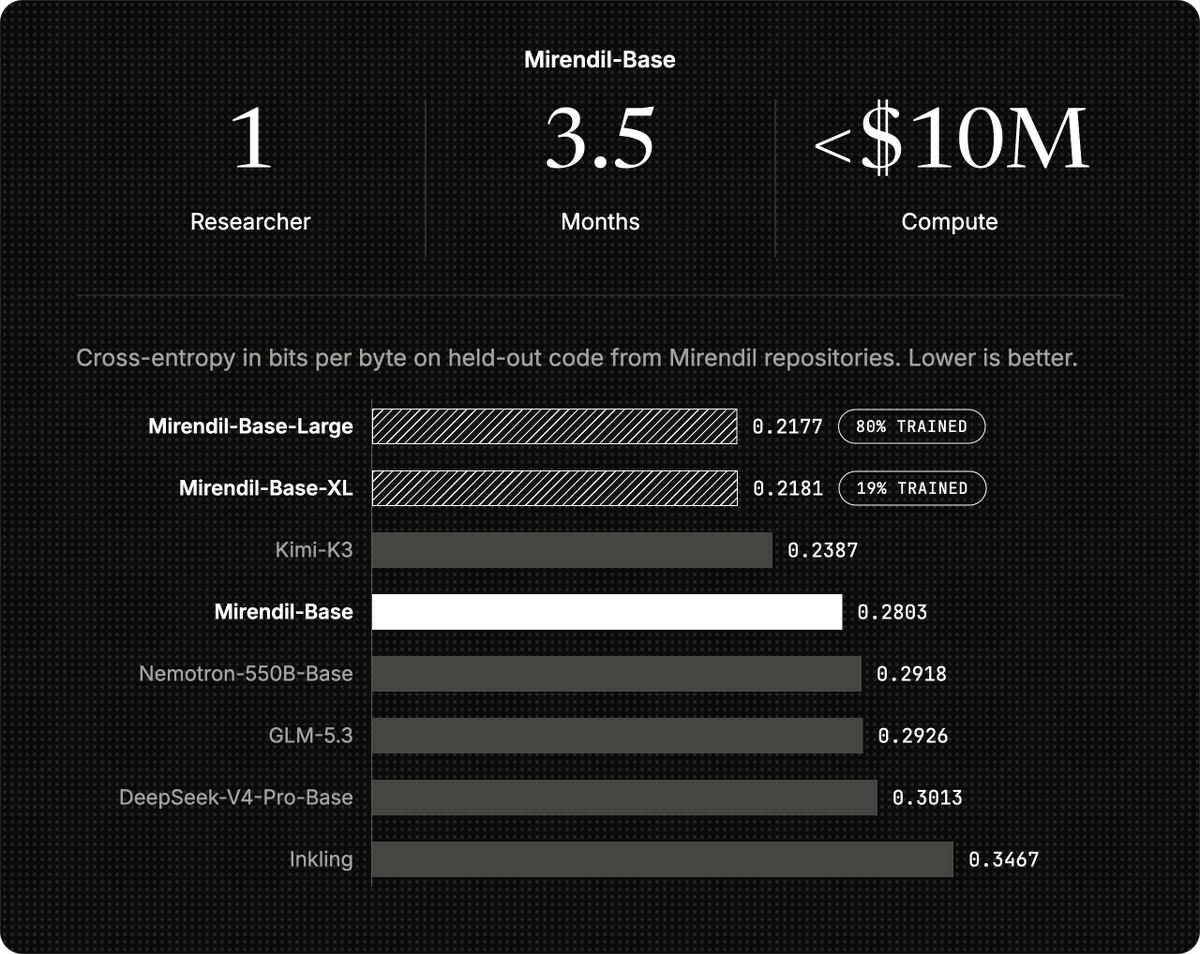
Mirendil says one researcher built Mirendil-Base, a pretrained coding model in the 100B–500B parameter range, in 3.5 months for under $10M in compute, research included. It says the recipe holds at larger sizes . Independent evaluations and API access have not been released yet . Read together, these are early, mostly self-reported evidence that AI-assisted research can cut both team size and time.
Anthropic: proactive agents and a versioned API
Anthropic opened a research preview of Claude Duet, an app where Claude brings you what needs attention, keeps working while you are away, and checks with you before it acts . It runs on Opus 5.5 and is available through a waitlist for US Pro and Max users. Anthropic cautions that it can misjudge what is urgent . Stripe says Duet uses Link's agent wallet and Stripe MCP to handle business tasks .
Separately, Anthropic released API version 2026-10-21, its first official version since 2023. It plans to version more often, and 2023-06-01 is not deprecated . The new version removes temperature, top_p and top_k from the Messages API .
DeepSeek follow-through
Last cycle's DeepInfer release drew a qualifier from SemiAnalysis. It says the code supports only offline, single-turn inference, so it cannot be benchmarked on InferenceX . SemiAnalysis also estimates that at 60% utilization a GB300 earns $50/GPU-hour in profit at OpenRouter prices, compared with DeepSeek's $39 off-peak . DeepSeek ("the Whale") reportedly raised another $15B . teortaxesTex puts the total at RMB 150B over four months .
Inference engineering is moving fast more broadly. SemiAnalysis counts three megakernel decode advances in one month: Inferact on TPUs, AMD, and NVIDIA on GB300 . NVIDIA's trace cuts one Kimi-K3 layer block from 130 to 69 microseconds .
Briefly
- OpenAI on Google Cloud: OpenAI's frontier models and Codex workflows are coming to Google Cloud's Model Garden .
- Flappy Airplanes: raised a $1B Series A, co-led by Index and Lux, to build new GPU primitives .
- Kling 4.0: the API is rolling out . fal hosts the model too, claiming better stability on complex motion .
- Perplexity JOLT: in this post-training method, one model acts as both teacher and student. On MATH it matched GRPO with 6.5× fewer training tokens .
- Vals Finance Index: Opus 5.5 leads at 65.6%, with Gemini 4 Argon at 64.9%, within the margin of error. Even the leaders fail more than half of the tax questions .
- Google contracts: Google employees told the BBC that their contracts bar them from publicly criticizing the company, which keeps them from speaking out on AI safety and military uses. Former employee Sofia Liguori: "In principle I'm not allowed to criticise Google for the duration of my life" .

Microsoft says China state-aligned Storm-0940 used the agentic AI penetration-testing framework ARTEX to automate attacks on hundreds of organizations worldwide, and assesses the group was responsible for the recently disclosed ConnectWise multitenant-application supply-chain compromise. AI-accelerated follow-on activity used applications already granted access to operate without interactive user sign-in, and included reconnaissance, application-credential changes, and attempts to modify privileges for expanded or persistent access.
Kimmonismus reports that CrowdStrike documented four operators running successful AI-agent campaigns; one compromised at least 15 Argentine healthcare organizations. The post also says AI helped turn longstanding PHP flaws into working PHP2Shell exploits, while AI's role in the millions of exploitation attempts reported by Cloudflare's CEO is unknown.
Rumors put Zhipu’s GLM 5.5 at 2.5T–3.5T parameters with significant architecture changes . The same post says Zhipu reported preliminary validation of Looped Transformers in its August HKEX interim filing, but whether the technique will appear in GLM 5.5 is speculation . A commentator says scaling GLM 5.3-Flash could itself be enough architectural innovation, describing Zhipu as historically conservative on architecture and saying it had just been outdone by “Whale” .
Whale was reported to have raised another $15 billion . @teortaxesTex says its total reached RMB 150 billion over four months ($22.45 billion at RMB 6.68 per US dollar, or $19.46 billion counting non-Wenfeng capital only), describes its API business as highly profitable, and calls Whale probably China’s most cash-rich AI startup .
- Saranormous reports CVEs rising from roughly 4,000 a month to roughly 15,000 “since April,” and says most newly disclosed CVEs are not yet exploited—but warns that window could close if frontier-class models are applied to the vulnerability backlog.
- Saranormous described an NSA alert about two PHP vulnerabilities as involving “AI-found RCEs”; the quoted NSA notice called them two critical vulnerabilities and advised preparing an update, or taking systems offline if immediate updating was not feasible.
- Remediation capacity is under pressure: HackerOne customers reportedly halved fix times over two years while their backlog grew 131% amid a threefold increase in intake; Oracle’s quarterly patch drop rose from 374 to 1,283, with manual regression testing identified as a bottleneck. Saranormous argues security spending should “vastly outstrip” software spending and proposes agents handle reproducing, patching, testing, and shipping, leaving engineers the cases requiring judgment.
An OPD/JPC analysis finds that top-k residual score-centering changes the gradient through an advantage-weighted tail-KL term; matching the tail’s total probability mass alone does not remove the discrepancy. A full-vocabulary implementation reconstructs the behavior distribution from rollout hidden states and a frozen LM-head snapshot for the matching weight version, avoiding tail-approximation bias and sampling variance in the centering calculation, subject to numerical accuracy. On dapo-math-17k, actor-training time per 1,000 response tokens was 161.2 ms for head-only, 168.6 ms for full-vocabulary, and 180.3 ms for tail sampling (K=64, M=10); the author reported no clear evaluation gain, with the top-64 tokens already covering 99.76% of behavior probability mass. The estimated 4.6% full-vocabulary overhead compares separately computed medians despite substantially different response lengths, so a matched-length experiment is needed to isolate the algorithmic cost.
DeepSeek launched its Search API on Oct. 17; in Artificial Analysis’s Stirrup benchmark using GPT-5.6 Luna (medium), it scored 69 on the Search Index (17th of 27), a 36-point lift over the same model without search, and charged $0.75 per 1,000 successful searches—the lowest price among paid APIs tested.
Performance was uneven: DeepSeek scored 70% on AA-Omniscience (10th of 27, three points behind the leaders) but 63% on BrowseComp (25th of 27), its weakest benchmark for multi-hop browsing. Its cost was about $0.032 per task, fifth-lowest of 27, but it fell below the cost frontier: Octen scored 77 for about $0.024 per task. DeepSeek’s large search results (about 7,000 tokens) drove model costs to about $0.023 per task. The API rejects queries longer than 128 characters; 6% of benchmark searches hit the limit, and a first shorter rewrite worked for 87% of those cases.
Theo, who says he fundamentally disagrees with Anthropic, claimed its spending exceeds what it is getting back and is creating a compute crisis; he speculated that training costs could exceed eventual revenue, including opportunity cost. He warned that only a few model iterations may separate current systems from the compromise of widely used software, citing a 27-year-old OpenBSD zero-day he says could be found by running a for-loop. He said Anthropic was absorbing the cost and giving the software world a few weeks to prepare; he later reiterated the warning.
François Fleuret floated an evolutionary agent-selection scheme: each person gets six agents, keeps their favorite every six months, then the selected models’ weights are slightly randomized and mixed with other people’s selections for another cycle. This is a conceptual proposal, not a reported implementation.
China’s reported smart-computing capacity reached 2,592 EFLOPS by the end of September, up 146% year over year, according to the Ministry of Industry and Information Technology . The figure is FP16-based; @teortaxesTex estimates it corresponds to about 2.6 million H100-equivalents or 645,000 Rubin GPUs under that accounting, while noting that Nvidia FP8 and FP4 are usable—an important precision caveat for interpreting comparisons .
Learn DeepInfer is an independent, open-source, 12-chapter guide in English and Chinese for understanding DeepInfer, using architecture diagrams, interactive demonstrations, pseudocode, and links to upstream code. It covers request flow, batching and scheduling, KV caching, paged memory, prefix reuse, DSpark, execution overlap, expert routing, and EPLB; the demos use preset states and teaching pseudocode, so actual interfaces, edge cases, and configuration branches still require checking the source, with links pinned to upstream commit 8b16149.
Kling 4.0 is now live on OnSolo . OnSolo says it generates native 30-second video in one take, with steadier motion through fast action and large camera moves, stereo sound and sharper lip sync, 21:9 widescreen, and support for up to 15 references and 10 keyframes per job .
A software-security roundup listed malicious PyPI and Docker releases for LiteLLM and exposed OpenCode AI API keys; its takeaway was that trusted code may pose a major security risk, beyond code developers write themselves.
DeepSeek Search launched on October 17 and debuted 17th of 27 at 69 on Artificial Analysis’s Search Index, versus 33 for the same model without search in its Stirrup evaluation using GPT-5.6 Luna (medium). At $0.75 per 1,000 successful searches, it was the lowest-priced paid Search API benchmarked, with empty results not billed. Results were uneven: it scored 70% on AA-Omniscience (10th/27) but 63% on multi-hop BrowseComp (25th/27); its roughly 7,000-token search results also made model cost the second-highest on the board.
AMPD, an ICML 2026 approach to multi-turn agent inference, adaptively routes prefill work between prefill workers and the decode worker holding a session’s KV cache, using TTFT/ITL headroom and KV-transfer costs; it also reorders a small prefill-queue window around TTFT deadlines and plans prefill/decode GPU allocation under a fixed budget . In evaluations using Qwen3-32B, Llama3.1-70B and Mixtral-8x7B across agent and iterative-RAG traces on 8–32 H20 GPUs, AMPD reported average relative SLO-attainment improvements of 67.29% over Dynamo and 339.74% over vLLM; these are not percentage-point gains or inference speedups . The authors flag that long local prefills can still block decoding and the offline plan assumes stable workloads and hardware; chunked prefill and replanning remain future work .
Hermes Agent added an official Meshy plugin that creates 3D models through Meshy’s MCP server, including game assets and printable models. Hermes Desktop renders models, animates rigged characters inline, and saves models and prompts in a gallery; messaging apps receive preview videos.
Kling 4.0 is now available in Adobe Firefly, where Adobe invited users to try it .
Mirendil says it pretrained a strong coding model from scratch without a pretraining team: its first model, Mirendil-Base, was built by one researcher in 3.5 months for less than $10M in compute, including research, small-scale experiments, and the final training run. The company says the recipe holds up at larger scales and lists parameter ranges of 100B–500B for Mirendil-Base, 500B–2T for Base-Large, and 2T–10T for Base-XL. Independent evaluations, post-training benchmarks, and API access are still forthcoming, according to Mirendil.
Flint is presented as a local coding LLM developed through “RSI loop(s)”; its builder calls it “best-in-class” and says it could complete simple coding examples in under 10 minutes. The post describes it as “0 endpoint. 0$. Full CoTs.”
Microsoft Threat Intelligence says China state-aligned actor Storm-0940 used ARTEX, an agentic AI penetration-testing framework, to automate attacks against hundreds of organizations globally; Microsoft assesses Storm-0940 was responsible for the recently disclosed ConnectWise multitenant-application supply-chain compromise. ARTEX accelerated abuse of applications that already had access to target environments, allowing activity without an interactive user sign-in; follow-on actions included reconnaissance, application-credential changes, and attempts to modify privileges.
Together promoted a post-training cookbook that lets users define the data, rewards, loss, optimizer, and whether to use LoRA or full weights, while Together handles GPU setup and infrastructure; it points users to recipes to get started.