We can't find the internet
Attempting to reconnect
Something went wrong!
Hang in there while we get back on track


Hiring now rewards judgment, not just execution
Shreyas Doshi says something has "changed rapidly in the past year." PMs who see their main job as execution are finding it "way harder to get hired at top companies" than PMs who see it as making the product successful . He adds that execution is essential but was never the PM's main job .
Two other sources point the same way:
- Job postings. On Aakash Gupta's podcast, Ankit Shukla had Claude and GPT read 12,500 PM job descriptions from top companies. More than 30% asked for AI skills, and the most-requested skill was judgment about "which problems deserve AI" . The episode says AI-skilled PM roles pay 15–20% more in the US and Europe and 30–50% more in India. It also notes that LinkedIn replaced its APM program with an Associate Product Builder program .
- Interviews. Exponent, an interview-prep company, says some big tech companies now run a dedicated AI product-sense round. After 30 minutes of normal questions, candidates vibe-code a working prototype while interviewers watch how they use the tool . In strategy questions, a balanced answer with no point of view "is the benchmark for rejection" . AI makes polished take-home decks the baseline, so what stands out is evidence AI can't fake: you used the product, talked to users, built something . Questions about tokens, latency, retrieval and hallucinations now come up even in roles that aren't AI PM jobs .
Faster isn't better
Marty Cagan points to the "AI productivity paradox," which he says McKinsey and Atlassian have measured: teams move faster but don't get better results. In a project model, AI just makes "garbage in, garbage out" faster, which puts the weight back on product craft . Linear CEO Karri Saarinen adds to the skepticism he voiced earlier this week. Building gives you two things, the product and the learning, and there's now a "danger of losing that direct connection with the learning" .
Deb Liu gives a concrete case. A startup replaced a product marketer with more than ten years' experience after his positioning and launch docs kept reading like LLM output . Her rules are "own every word" and "think first, prompt second," meaning you write down what you believe before opening a tool . Hiten Shah makes the strategic version of the point. Every competitor gets the same cost curve, so "a feature that once bought you a year might buy you a quarter" . When teams build faster, "a bad assumption can make its way into the product faster too." Each decision needs its own evidence standard: pricing needs different evidence than a battlecard .
How teams are reorganizing
- Agent managers. Sachin Rekhi says the most AI-heavy teams are turning designers, researchers and analysts into "agent managers." Instead of doing the specialty's work, they maintain agents for it. Designers make design systems machine-legible. Researchers automate interview guides and feedback synthesis. Analysts build self-serve data agents using golden examples and a semantic layer .
- Smaller pods. AWS CEO Matt Garman says a capability that once took 10 people can now take three or four. AWS is experimenting with moving those pods between problems, though it hasn't worked out how to maintain what they build .
- Mandated adoption. Cisco's Jeetu Patel told employees that if they don't use AI, "you will lose your job," and gave everyone unlimited tokens . He expects to need more engineers, not fewer, because the bottleneck keeps moving: from coding, to code review, to "judgment on what to build" .
- Elena Verna argues that if AI really changes how work gets done, ICs should be paid more than managers .
A roadmap reset, in practice
A first-time CPO at a 50-person company says their 8-person product team started many things and finished none of them in six months. The team underestimated the work, left no slack for two major unplanned items, and found that "agentic development can't accelerate everything." They deferred about half of the next six months' plan . The top replies said to plan jointly with Engineering, because "a less ambitious roadmap that actually gets delivered is worth far more" . A three-time CPO said they share only a prioritized list of problems outside the team, never features promised by a date .
Forward-deployed PM: check the business model
Several threads looked at forward-deployed roles. One commenter warns that engineering speed doesn't mean customers or go-to-market teams can keep pace. Building bespoke solutions for each customer is a services business unless it rests on shared components . One suggested setup: work with 3–4 customers who have similar problems for 2–3 months, then decide what goes into the core product. Otherwise you become "the account's feature guy" . An FDE warns that companies that cut PMs and pushed backlog work onto FDE teams usually saw it end badly. If you interview for one of these roles, ask who owns the backlog .

- Replace feature-led project roadmaps with problems for cross-functional product teams to solve. Product discovery uses prototyping and testing to check value, usability, feasibility, and business viability; Cagan says project-model requirements often fail to solve the problem and cites an HBR estimate that roughly 80% do not generate ROI.
- Cagan cited McKinsey and Atlassian findings describing an “AI productivity paradox”: teams move faster without getting better results. He argues that AI can accelerate a project model’s “garbage in, garbage out,” making product craft—not speed alone—critical.
- Cagan expects engineering, design, and product management to remain core roles for the foreseeable future, though their tools and work change; he ties them to technology, usability, and business-viability constraints. For PMs, he emphasizes product judgment and understanding customers, business, value, and viability over backlog ownership; interviews can test this with a problem-and-outcome exercise and a prototype/testing walkthrough.
- An MVP should be the smallest prototype that tests risks, not a weak product shipped early. In regulated or sensitive settings, discovery experiments can use opt-in, controlled trials rather than launching unready work; an internal customer-discovery group might include 6–15 employee volunteers who try versions and give feedback daily.
- Treat customer feature requests as signals to investigate, not automatic roadmap items: ask why the person wants the change and what problem, usability, or value gap it reveals, then assess whether the proposed solution is appropriate and compliant.

- Build value propositions from customers’ ranked jobs, pains, and gains—not product features—and validate those needs: evidence that a solution works or that customers say they might use it does not establish that the underlying needs are real.
- Strategyzer’s value stack separates a primary customer outcome from reinforcing benefits and expected table stakes. In coaching approximately 10 product teams over four weeks, the teams found that what they considered differentiators were often table stakes.
- For B2B propositions, map the broader buying ecosystem—including decision makers, budget holders, influencers, end users, and channel partners—and consider what else competes for the budget.
- A practical GenAI workflow is to give the model a segment-specific customer profile, alternative solutions, and value stack, then ask it to draft a hero line, paragraph, and three customer-valued outcomes; Strategyzer used this approach for solo practitioners and entrepreneurs.
- Strategyzer developed six “patterns of value creation” with 27 flavors, packaged in a playbook and used in client engagements and master classes.
- Treat value proposition and business model design as iterative: move between the two and adjust the level of analysis rather than assuming a fixed order, checking both customer value and the ability to capture value.

- Product leaders must set strategy, prioritize, and execute; to align teams without direct authority, define what game they are playing and how success is scored. Nash says a new PM who fails to deliver a win within the first two quarters may lose the team's moral authority.
- Balance prioritization across metric movers, customer requests, and delight: Nash recommends roughly 70% of time on metric movers and at least 10–20% on customer requests, labeling the two categories in feature specs. Reserve room for delight ideas, which are difficult to produce on demand.
- Teams tend to favor measurable friction reduction, but product research and initiative kickoffs should surface customers’ underlying positive and negative emotions; for LinkedIn’s Apply flow, Nash describes the goal as raising hope and reducing fears.
- Fight for simplicity without making a product so minimal that it becomes hard to use: feature accumulation can make products difficult to change, while excessive simplification can create confusing, mode-dependent interactions.
- Nash argues that business models shape long-term product direction, so CEOs should align the mission, product, market, customers, and business model. At Daffy, he says the company chose membership pricing rather than fees based on assets, with free entry, most members paying $3/month and families $5; donations do not reduce its revenue. He reports net revenue retention above 170%, while noting the numbers were small.

- Nir Eyal distinguishes habit-forming design from addiction: Hooked is meant to help products cultivate beneficial habits, while he defines addiction as a persistent, compulsive dependency that harms the user; he cites Fitbod as a product that helped him build a gym habit.
- Eyal defines distraction by the user’s prior intent, not by the product or activity: an action is distracting when it pulls someone from what they said they would do, while planned use is traction.
- Eyal proposes that platforms use their usage data to identify potentially pathological overuse and offer a respectful prompt and support options, possibly including circuit breakers; he gives 30, 40, and 50 hours per week as example thresholds to consider, not a settled standard.
- Eyal points to a product-goal mismatch at Tinder: although the stated goal is for users to delete the app, he says new users see more offers before their messages and matches; he reports that Tinder’s product head acknowledged the question and said they were working on it.

- Ankit Shukla’s analysis of 12,500 PM job descriptions found that more than 30% ask for AI skills; the most-requested skill was judgment about which problems to solve with AI. The article describes a “Product Builder” as a PM building with AI today, distinct from AI PMs building AI models or features and forward-deployed engineers implementing customer-specific deployments. It reports AI-skilled PM roles pay 15–20% more than traditional roles in the US and Europe, and 30–50% more in India.
- Shukla’s POWER framework starts by cataloguing AI capabilities and examples, then mapping company opportunities; it cautions against choosing a single use case too early and recommends prioritizing frequent problems. Before choosing tools, map the actual workflow and interview the people doing it, distinguishing task optimization from processes newly enabled by AI; review results and improve the approach over time.
- For PMs pursuing AI roles, the article recommends comparing 25–30 job listings by qualifications rather than title, building a real project they can defend (ideally with users), and tailoring a deck or prototype to target companies. Interviews may test domain fit, product judgment, and whether candidates understand their projects’ failure modes and evaluations.

- Hipcamp’s first product, California Camping, consolidated fragmented public-campground information and camper knowledge; its founder also used in-person outreach to learn what campers wanted and what was missing. A prompt reply to a customer’s pet-filter request was shared by someone with a large Twitter following, driving a traffic spike and leading to an investor who funded the company later that month.
- Promoting available campground spots drew complaints that revealed a genuine supply shortage, not just customers gatekeeping favorite sites. Hipcamp chose private-land bookings after evaluating business models against long-term impact: the approach addressed the root problem of too few campsites and could expand supply.
- Hipcamp used public campground data to bootstrap supply, then added private land as more bookable inventory while existing demand was in place. A host-recruitment newsletter test grew from roughly four or five sign-ups to hundreds, validating landowner interest; the founder said demand was already there and supply was the next need.
- Hipcamp’s North Star is “nights outside”; bringing teams to campsites lets them see hosts, campers, and the product in use, which the founder said helps motivate the team and reveal ways to improve the product.

- For Cisco’s product turnaround, Patel says leadership set direction, hired people into the right roles, and created mechanisms for choosing markets; his founder-mode approach adds cross-functional ownership during fast market shifts, balanced with scale operators, outside systems thinkers, and acquired-company founders in roughly equal thirds.
- Patel frames AI adoption as a way to generate new insights and solve problems teams could not previously imagine, rather than simply improve efficiency; he expects engineering needs to grow as automation shifts bottlenecks from coding to code review and then to deciding what to build. Cisco provided AI tools and unlimited tokens while making AI use an explicit job expectation, with adoption progressing from familiarity to proficiency to efficiency.
- Cisco’s full-stack planning horizons differ sharply: five years for silicon, 18–24 months (sometimes 30) for hardware, 12–18 months for software and operating systems, and three months to weekly for models, agents, and apps; Patel says coordinating these layers is strategically important and expects AI to compress the cycles.
- Cisco says its AI Defense product, launched about 18 months earlier for the chat era, is available in the market and has been extended to agents with dynamic monitoring; described capabilities include model visibility, non-human identity and agent inventory, model red-teaming, and runtime guardrails.

Every says it has built Checks, a personal benchmarking platform for measuring how well new AI models perform on people’s real work, and is hiring someone to help develop it further; Lenny shared the opening as a PM job alert.

- Product Builder hiring signal: A scan of 12,500 PM job descriptions at top companies found that more than 30% asked for AI skills, with choosing which problems merit AI identified as the most-requested skill. The article defines Product Builders today as PMs building with AI, distinct from AI PMs focused on AI models or features and forward-deployed engineers implementing deployments for customers; it also reports AI-skilled PM roles pay 15–20% more in the US and Europe and 30–50% more in India, and that LinkedIn replaced its APM program with an Associate Product Builder program.
- POWER framework for AI product discovery: Map AI capabilities and real-world examples, then identify company opportunities without committing to the first use case and prioritize frequent problems; interview workflow owners to understand actual steps before choosing tools; after deployment, inspect outputs and gaps to improve future iterations.
- Build only as much as the use case requires: Start at the lowest level that solves the problem and increase complexity only when it breaks. In a comparison building four kinds of sites with Claude Code, Codex, Cursor, and DeepSeek, every setup produced a working site; the interviewee said the tool choice did not matter for 90% of use cases.
- Private-equity offer heuristic: Don’t value a private grant at its quoted face value: Gupta’s formula is quoted value × payout odds ÷ 1.15^years until sale, with working payout-odds ranges of 70–90% for late-stage companies with real revenue and tender history, 40–60% for growth stage, and 20–40% for Series B or earlier. Private shares may remain unsellable until an IPO, acquisition, or tender; Gupta recommends asking for the valuation, shares outstanding, four-year projections, and leaver terms.
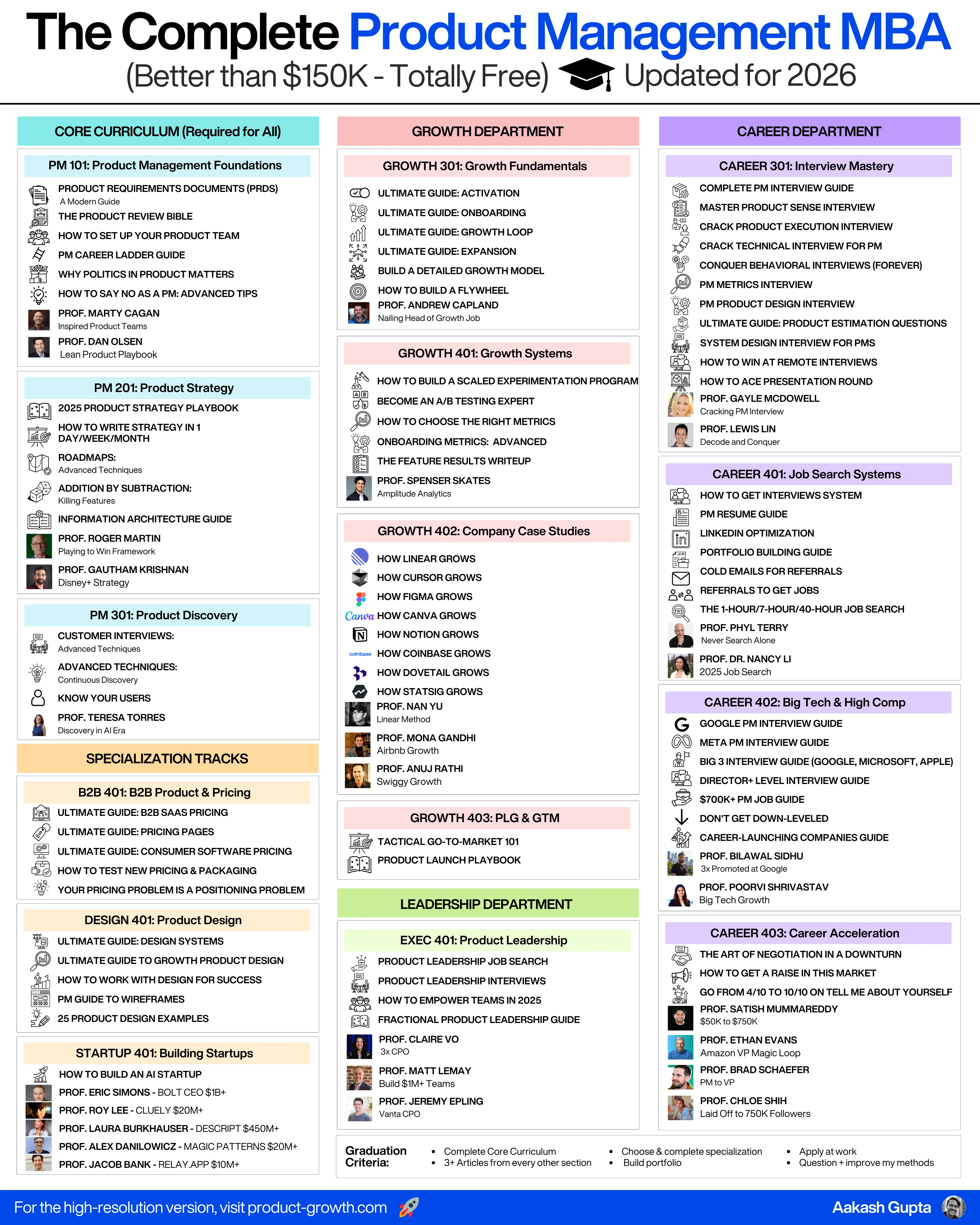
- Gupta assembled a PM curriculum of 15 courses and 112 classes, covering foundations, strategy, discovery, B2B pricing, design, startups, growth, leadership, and career development; the post provides a direct index to the material.

- Treat product marketing as a product-learning loop: buyer comparisons, recurring sales questions, competitor pricing changes, and lost deals can prompt changes to messaging, sales responses, pricing, the roadmap, or the product itself.
- Cheaper, faster software development lets competitors move quickly too, shortening the life of feature advantages and increasing the value of learning what the market needs next.
- Use AI-generated competitive analysis to identify questions to investigate, not as decision-grade proof: polished but weak work can turn guesses into accepted “knowledge.” In a Linear-versus-Jira test, public research surfaced possible reasons for losses; the win/loss method reframed them as things to investigate and specified what evidence was needed. Evidence and stopping criteria should fit the decision—for example, pricing and battlecards need different evidence.

- AI products should distinguish between users who want to build a skill and users who want to finish a task: AI can support learning in one context but shortcut the practice in another, so the right level of assistance depends on what the user wants to get good at.
- Zhuo proposes “mental gyms” that make cognitive practice intentional, combining games and puzzles with learning, creative projects, coaching, peer practice, and progress tracking.

Shreyas Doshi says PMs who see execution as their main job are finding it much harder to get hired at top companies than PMs whose primary aim is product success; he stresses that execution is essential, but not the PM’s main job. He defines the PM role as defining the product and coordinating the organization to enable its success, measured by user adoption and satisfaction plus business impact. He identifies critical thinking, cognitive empathy, influential communication, openness, deep care, and high agency as key PM skills and traits.
Sundrop launched as a private photo app for parents: it selects standout photos and turns them into keepsakes such as same-age comparisons, children’s growth timelapses, and weekly family recaps. Photos stay on the iPhone and never reach the company’s servers, with the founders citing distrust of companies handling personal photo libraries. Lenny Rachitsky said he had been loving the app.

Kevin Weil highlights Yann LeCun’s boat analogy for AI: a technology can reduce the importance of an existing capability while enabling new possibilities, here in mathematics and science.
Elena Verna argues that if AI changes how work is done, individual contributors should be paid more than managers, on the premise that an IC can drive more impact than a manager could in the pre-AI system.
- A startup replaced an experienced product marketer after his positioning documents, go-to-market processes, and launch plans repeatedly read like LLM output; the founders wanted his judgment, not AI-generated copy.
- For AI-assisted product work, write down your own view before prompting and use AI to sharpen it rather than supply your point of view; submit only work you can stand behind, and build the expertise to judge quality through repeated practice and feedback.
- A 54-person MIT Media Lab essay study cited in the article found that 83% of the ChatGPT group could not quote a sentence from their essay just after writing it, versus 11% in the other groups; participants who began with LLM assistance also showed lower mental engagement after switching to writing unaided.
Linear’s CEO argues that building and designing a product yields both the product and learning about the problem and what customers want; he warns of a danger of losing that direct connection between making and learning.

A company described by Kenan Saleh reportedly grew from $0 to $60M in three months and was expected to reach a $100M run-rate that month by selling “frontier data” to AI labs and model developers; Saleh argues this reflects data becoming a first-class input alongside compute and algorithms. Andrew Chen highlighted Saleh’s post with an 👀 reaction.

Anecdotal hiring signal: An India-based PM with eight years in consumer tax/fintech reported two months of full-time job hunting, dozens of applications and almost no shortlists despite recruiter outreach, repeated résumé rewrites, PM writing, and a live AI mutual-fund research app. Replies described an 11-month search by a seven-year PM whose last role was at a Fortune 50 company, and a seven-month search in Spain by someone who said they had 2.5 times the poster’s experience and had delivered AI products. These are individual reports, not market-wide data.
Respondents suggested targeting smaller startups and fintech-adjacent products, and demonstrating AI-enabled execution through dashboards and data queries via external APIs. One commenter also said companies are exploring whether AI can take on more product-function work, a potential hiring pressure rather than an established trend.
For win/loss analysis, treat AI-generated explanations as hypotheses—not findings—when they rely only on public research; in a test asking why Linear loses deals to Jira, Claude identified reasons but also specified what evidence was needed before making a decision, despite having no buyer interviews, call notes, or deal records .