We can't find the internet
Attempting to reconnect
Something went wrong!
Hang in there while we get back on track

Agents are taking share of existing budgets: Sierra vs. ServiceNow
SaaStr compared two vendors that reported in the same week. ServiceNow grew subscription revenue 21% to $3.99B and raised its 2026 AI target to $1.7B. Even so, the stock had what may have been its worst day since the 2012 IPO . SaaStr names three reasons. Current backlog growth is expected to slow to 18.5% from 21%, and about half of the Q3 cRPO beat came from renewals pulled forward. Gross margin fell to 70.5% from 77.3%, partly from acquisitions and partly from the cost of serving AI. And the AI payoff keeps getting pushed into next year .
Sierra, about 2.5 years old, went from $200M to $400M ARR in five months and added more than $150M in Q3. Nearly half the Fortune 50 are customers, and one retailer with $40B+ in revenue went from first meeting to a live agent in 27 days . Sierra charges for outcomes, not tokens .
SaaStr's main argument is that agent spending comes out of existing CX, IT and ops budgets rather than new money. It cites Gartner: total software spend grows 15.1% in 2026 while agentic AI spend grows 141% to $201.9B. SaaStr warns this is a rough estimate because the two forecasts come from separate models . For portfolios, it matters whether a company sells seats or prices on outcomes, and whether it is gaining share or just shipping AI features.
Cheaper tokens, bigger bills
The prior brief covered the "rack spread": GPU rental prices rising while token prices fall. a16z added the demand side this period. Since May, average token prices are down 67% but token spend is up more than 120% . Moses Sternstein and Alex Danco say open competition and the labs' own price cuts are pushing token prices down. They also caution that the spread is not anyone's net margin, though it helps when asking whether a given model makes money .
Founders describe the same squeeze. One says a co-founder shut down an AI product because token costs and API changes kept shifting the unit economics . A commenter says the products that hold up use usage- or credit-based pricing and route most requests to cheaper models. In their words, "If your price can't absorb a 2x change in API cost, the unit economics are really just a bet on vendor pricing" . Two builder projects point the same way:
- Cheap Agent lets Opus plan while DeepSeek V4.1 Flash writes code. The maker reports Opus token use down 55–63% on SWE-bench Verified tasks, but the hardest bugs were solved 6/9 vs. 7/9 for Opus alone .
- Gear, an open-source framework for agents that improve their own harness, reports gains on several benchmarks. It also estimates per-task cost about 95% below Astra when both use the same optimized harness, excluding optimization and infrastructure costs .
Seed pricing: David Tisch on why large rounds can still pay off
On 20VC, BoxGroup's David Tisch says $10–20M seed rounds are now normal for good companies with pedigreed founders. He thinks that can still work for two reasons. Outcomes are bigger, with $10B now a plausible target. And fast-growing companies raise Series B–D at 3–8% dilution instead of the historical 12–20% . He argues that waiting for the A or B no longer works because those rounds go fast to multi-stage firms . He also says concentrated funds that claim a 90% win rate win closer to 20%, offering to 120–150 companies to land 30 .
BoxGroup's own setup is a $275M seed fund aiming for about 150 companies, plus a $275M fund for follow-on checks . His evidence that the market misprices companies is Rogo, an AI-for-finance company that 39 of about 40 Series A leads passed on before it became a consensus deal . He finds today's founders more technical and less sales-led, and suggests backing go-to-market strength now in case it becomes the differentiator in a couple of years . Elizabeth Yin adds that some of her portfolio companies reached $10M in revenue and profitability, then lost to competitors and never recovered: "product market fit isn't permanent" .
Agent builders: proactive agents raise new oversight problems
Harrison Chase says practices like summarizing long threads, using subagents and making Bash the main tool are now fairly standard. He says nearly every agent builder he talks to is now working on proactive, always-on, goal-oriented agents . He lists open problems: how often to notify the user, what to remember, how to coordinate asynchronous work, and how to stop agents from gaming their goals . Allie K. Miller gives an example. Her assistant saw an email, logged into a video system with her credentials, checked playback and drafted a reply, all without being asked. She now has to check the assistant's history whenever an action looks out of place .
Two security items point toward agent identity and behavior monitoring:
- A Reddit post alleges that an Accenture contractor connected a personal Claude Code agent to a secure Pentagon network. It says the agent inherited the contractor's full admin rights and that the DoD had no record of it . This is unverified. The post argues that enterprise identity controls are built for humans, not agents .
- In a Reddit summary of new Anthropic Alignment Science work, thousands of Claude agents searched for fine-tuning datasets that would pass a production-style monitor while making a research model misaligned. Every completed run found one, often by hiding the behavior in fiction or roleplay . Anthropic notes the setup favored the attacker and that this says nothing about how deployed Claude behaves .
Separately, a Tom's Hardware report says Claude now blocks attempts to clone video games, and users claim non-malicious reverse-engineering requests are blocked too .
Labor and adoption signals
a16z says the AI jobs panic peaked in May. News reports on AI job loss are down about 65%, and layoff announcements citing AI are down about 90% . Job postings vs. pre-pandemic are roughly +45% in engineering, +30% in healthcare and +25% in manufacturing . Sternstein notes this is one dataset (Indeed) and calls the hiring strength coinciding with AI, not caused by it . On the other side, Comcast is cutting 634 headquarters jobs as it cuts costs and invests in AI . Bindu Reddy argues that AI is hitting a "human wall": most organizations restrict it and are not automating workflows, which she says cannot support $1T valuations . Google DeepMind's Gemini-built PlanAssist shows narrower gains. It is expanding to 12 more English planning authorities after pilots cut officer time on householder assessments by 58% .
Infrastructure and market structure
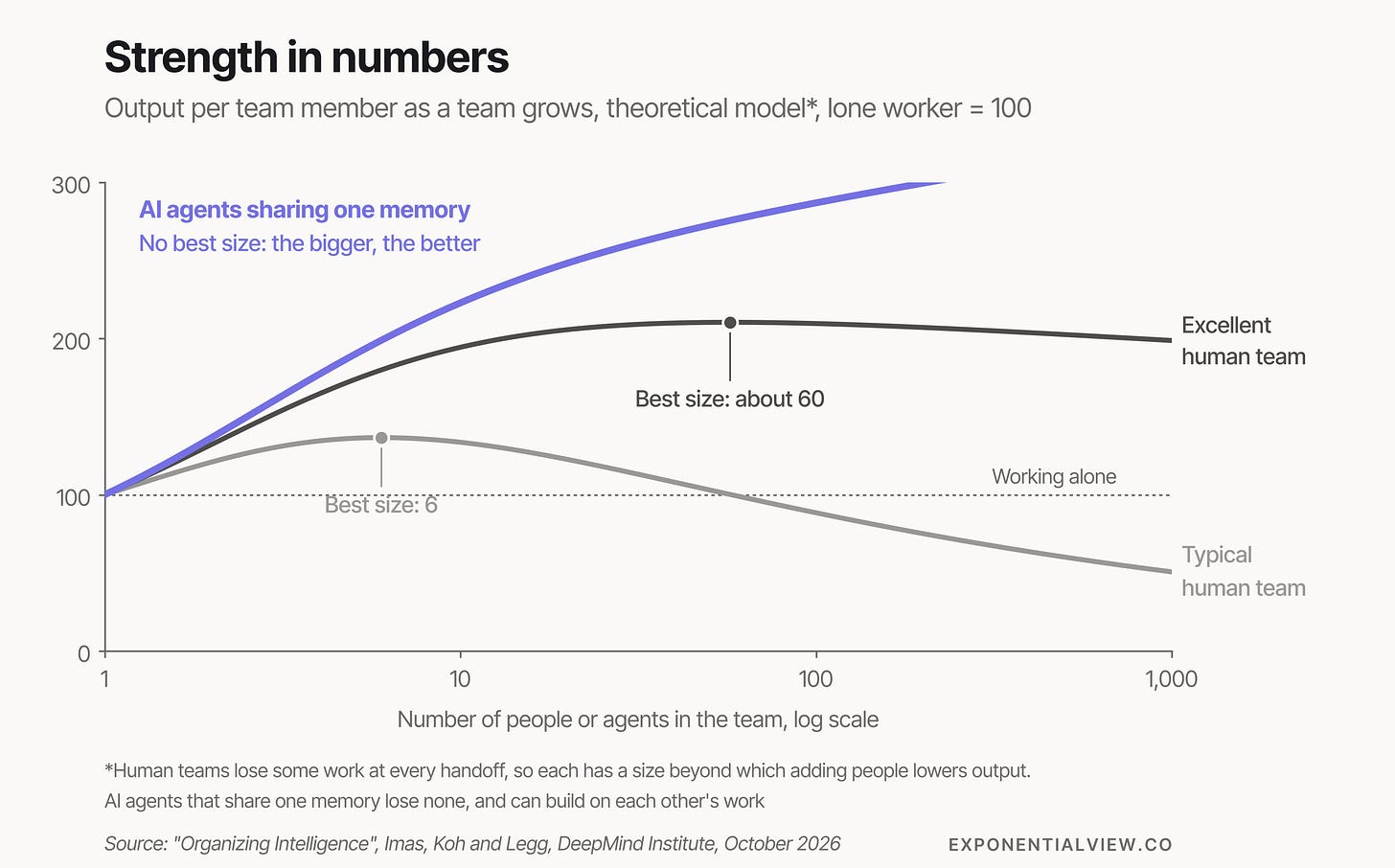
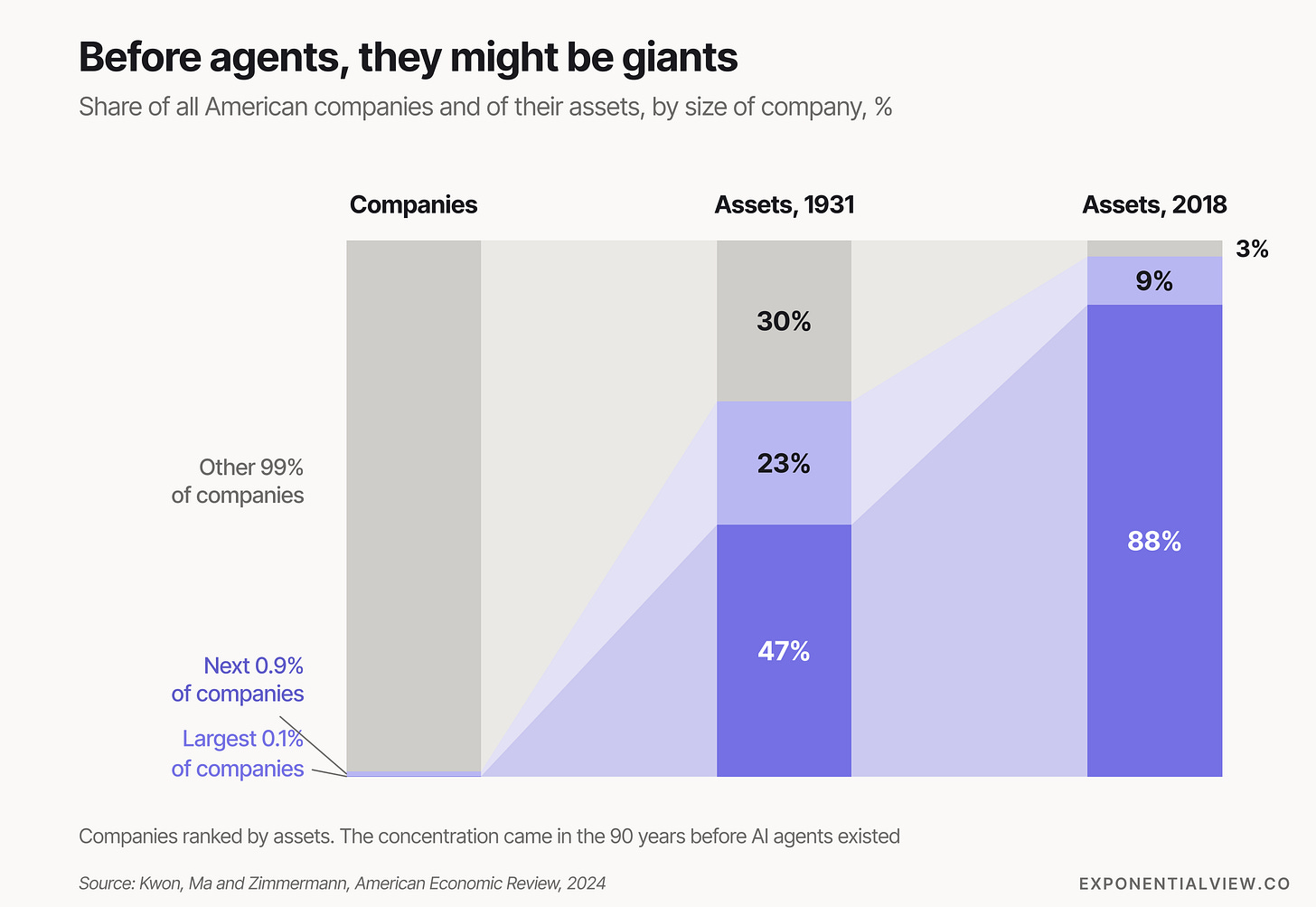
An Axios report says more than 300 local moratoriums on data centers are in place, yet SemiAnalysis estimates the industry may add more than 50 GW of capacity in 2027 . Intel is moving some capacity from client CPUs to data-center CPUs and expanding Fab 24 in Ireland for Xeons. It is also installing equipment early at Fab 62 in Arizona and expanding advanced packaging . Exponential View, citing DeepMind researchers, argues that agents sharing model weights and working state could produce "supercooperative firms" that keep getting more efficient as they grow, concentrating markets beyond today's level. Today the largest 1% of US firms hold 97% of corporate assets .
Deadlines
- YC W27 applications close Nov 2. Founders get $500K, $12M+ in credits and deals, and introductions to enterprise buyers through the Early Access Network .
- a16z Speedrun invests up to $1M plus $10M in credits; Andrew Chen said the deadline was the next day .

- The guest describes the current AI cycle as distinct from 2021 and says the deployment of this horizontal technology is still early; model releases, vertical-AI growth and M&A are creating mini-cycles as short as two to three months. AI adoption will vary, and not every company needs a cutting-edge model, while AI is opening up applications in physical-world industries and science amid uncertainty around compute, energy, data centers and policy. He sees founders’ ability to navigate rapid change as crucial; today’s founders are more technical and less often sales-led, though he suggests go-to-market could become a differentiator as companies mature.
- The guest says $10–20 million seed rounds have become common for good companies with pedigreed founders. For fast-growing companies, he contrasts 3–8% dilution in later rounds with 12–20% historically, arguing that lower dilution and larger potential outcomes can help offset high entry prices; he recommends balancing entry prices across a portfolio. He also sees multi-stage firms competing earlier, making it riskier for investors to wait for later rounds, while founders have leverage to choose investors and prices.
- Investors can overlook strong companies outside favored categories: the discussion names AI-for-X, compute, inference, data centers and chips as areas drawing investor attention. The guest recounts that AI-for-finance startup Rogo was passed over by 39 of roughly 40 Series A leads he approached, then kept building and became a consensus company.
- Box Group describes a broad seed strategy: its $275 million seed fund plans to invest in about 150 companies, with a separate $275 million follow-on fund making 20–30 lean-in investments, mostly in portfolio companies; initial ownership can range from 1% to 10%. The guest says Box Group invested in Cursor at the earliest stage and calls its outcome generational; he contrasts that with companies such as Clay, which took a bumpy four-year path to explosive growth, and Base10, whose opportunity developed as inference emerged as a market.

Speedrun is accepting startup applications and says it is investing up to $1M in new startups, offering $10M in credits, and coworking at its new SF offices; the application window was in its “last 48 hours” . An associated post said the deadline was tomorrow and linked to the application .

Michael Seibel argues that people who made their money in San Francisco have an obligation to reinvest or contribute there, citing responsibility to current and future generations . He clarifies that, for people wealthy enough, this means contributing beyond paying taxes .

A Reddit poster says an open-source MVP generates synthetic trajectories for autonomous-navigation models using deterministic nonlinear drag mechanics and tunable atmospheric noise, aiming to address edge-case degradation and high-speed aerodynamic insensitivity in recursive training loops. The post links a Streamlit simulator and GitHub repository. A commenter says the efficacy claim needs quantified sensitivity sweeps, tests on held-out coefficient ranges, and identification of the evaluated vehicle platform.

Martin Casado says @bot is now the most-used app on his phone and the way he accesses most other apps; he is seeking embodiment ideas and cites Holly from Red Dwarf as a reference point.

Scott Kupor held up an outgoing NDS contributor as an example of merit over credentials, saying the federal government needs skilled people even without a degree. The contributor’s farewell described NDS engineers and designers building and improving America.gov, with a mission of making government easier to use and serving hundreds of millions of Americans.

YC’s Winter 2027 batch application deadline is Nov. 2. The accelerator advertises $500K in funding plus $12M+ in tokens, credits and deals, and offers founders access to enterprise buyers, hiring candidates, and investors through its Early Access Network, Work at a Startup, and Demo Day.

- Job postings over the past 12 months rose 30% for engineering, 26% for software development, and 13% for manufacturing roles.
- AI-related job-loss signals receded: a16z said the panic peaked in May, with news reports on AI job loss down about 65% to year-ago levels and layoff announcements citing AI down about 90%, near the year's low.
AI compute showed a widening “rack spread” since mid-July: B300 GPU rental prices rose 106%, B200 prices 66%, and H100 prices 17%, while average token prices fell 58%. a16z attributes the opposing movements to open competition and labs cutting prices; it cautions that the spread is not model net margin, but can help investors assess whether an individual model is making money.
a16z’s Moses Sternstein says current evidence does not show AI is already killing jobs; he points to Indeed job-opening data, a single dataset, in which engineering/software and manufacturing hiring are running hot while HR has returned to baseline. Compared with pre-pandemic levels, postings are roughly 45% higher in engineering, 30% higher in healthcare, and 25% higher in manufacturing, with HR back to even. Sternstein describes the hiring strength as at least coincident with AI, not proof that AI caused it.
Martin Casado replied “Same” to @cb_doge’s claim that Grok Bot was the most useful app on their phone, offering a positive but anecdotal product-use signal rather than evidence of broader adoption.
Scott Kupor praised a conversation with Brian Chesky and Patrick O’Shaughnessy for its perspectives on founder mode and discussion of external accolades versus intrinsic rewards .
a16z reports job postings above pre-pandemic levels in engineering (+45%), healthcare (+30%) and manufacturing (+25%), with HR back to even. It also says reports about AI-related job losses have fallen about 65% to year-ago levels, while layoff announcements citing AI are down about 90% and near the year’s low—suggesting the AI jobs panic has receded.
Martin Casado agreed with the view that a major product mistake is underestimating what agents can do .
Since May, average token prices fell 67% while token spend rose more than 120%, indicating that lower per-token prices have not translated into lower aggregate spend . Separately, since mid-July, GPU rental prices rose 106% for B300s, 66% for B200s, and 17% for H100s, even as average token prices fell 58% .

Perplexity showcased Computer building Pathways, an interactive museum with 821 images across 40 subjects from open collections including NASA and the Met; clicking a tile reveals what it is, who made it, when, and a link to its source record. Aravind Srinivas amplified it as a prompt-driven creation example: “Computer, build me an interactive museum.”
- A poster says they built a platform for “granular investigation and operations” and reports “remarkable results,” but the post gives no measurements; the author later says the tests are ongoing.
- Replies identify related approaches as training dynamics/example forgetting (tracking per-sample loss or correctness across epochs), data maps, data pruning or online batch selection, and older analogues such as hard-example mining and curriculum learning; focal loss reweights samples rather than dropping them.
- The proposed sample-selection approach faces cost and reliability issues: per-sample logging adds work, augmentation changes examples, high loss can reflect mislabeling, and apparently learned examples may still matter for robustness; single-epoch training also provides no trajectory. A commenter says a referenced 95% FLOPs-saving result needs replication outside its setup and validation before generalizing. Another reply warns that difficult or apparently irrelevant training examples may represent test cases, so removing them can weaken generalization; using the test set to guide removal would cause leakage.
Martin Casado says AI policy chatter seems to have died down and speculates that concrete cybersecurity issues may be taking the edge off existential AI-policy discourse; this is an observation and hypothesis, not evidence of a measured shift.
AI agents may enable “supercooperative firms”: they can share model weights and working state, potentially reducing information loss at handoffs and making scale advantageous even at very large sizes, including in deep, large markets. AI-capable firms may also expand across sectors and scale horizontally beyond traditional firm boundaries; Anthropic is cited as active in coding, bio, legal, and finance. This could intensify an existing concentration trend: the largest 1% of US firms held 97% of corporate assets in 2018, and the article raises the prospect of new rules for very large entities.

Product-market fit is not permanent: companies can find it after a pivot and grow rapidly, then lose it through competitor entry, market shifts, or execution failures. Yin says she has seen portfolio companies reach $10M in annual revenue and profitability, only to be overtaken by competitors and never recover—so those milestones alone do not guarantee durable fit.