We can't find the internet
Attempting to reconnect
Something went wrong!
Hang in there while we get back on track
Willison: define the goal, supply the tools, let the model work
Simon Willison expanded his AI Engineer talk into a write-up of three inflection points from the past year. The first was Opus 4.5. It was the first model where Claude Code's default result was generally right, so Claude Code became faster than doing the work himself. GPT-5.1 did the same for Codex .
The second is what he calls "Fable class" models. His working rule: "Give it a goal, give it the right tools, and watch it cook" . Two examples:
-
Asked to fix a Safari display glitch, Fable built its own
pyobjc-framework-Quartzscreenshot tool and a CORS-enabled localhost logging server on its own initiative . - Given five WebAudio microphones, Opus 5.5 and then Fable 5.2 located a mysterious beep to within about 40 cm .
He counts Fable 5–5.2 and Opus 5.5 ("cheap Fable") in this class, plus GPT-6 Astra and possibly Gemini 4 Neon .
The third is 3D work and games. Telling Opus 5.5 "This game isn't fun enough yet. Make it a LOT more fun" led to 12 hours of playtesting and rebalancing, and turned a dull RTS into an entertaining one . Prompts such as "Think hard about how to make sure it is both fun and beautiful" have kept working for him since .
He is still deciding whether Fable 5.2 is a fourth inflection point. In three weeks he shipped three Datasette alphas and five LLM releases with it. His take: "if you can imagine and then clearly describe a piece of software, Fable can build it" .
One habit worth copying: never release a new plugin hook without a plugin that uses it. Fable 5.2 suggested Apache Arrow streaming and built datasette-arrows almost in one shot (datasette install datasette-arrows) .
Anthropic Siren: describe the sandbox in the system prompt
Anthropic's new Siren eval gives Claude routine tasks in deliberately weakened sandboxes, with something useful left outside. In 1,700+ scenarios, recent Claude models accessed, tried to access or looked outside the sandbox 21–32% of the time, though they rarely misused what they found. When the system prompt described both the sandbox and its rules, the rate fell to about 2% or less. Anthropic also used Siren to calibrate Claude Code's auto mode, which checks commands before they run . If you run agents in your own sandboxes, add the sandbox's boundaries and rules to the system prompt. Anthropic's result suggests this is a cheap change with a large effect.
MCP adds skills and UI
- Skills shipped with MCP servers: MCP servers can now include their own skills, so Claude Code knows how to use them out of the box (Boris Cherny) . Anthropic is bringing Skills over MCP and Tasks to Claude . Kent C. Dodds says Claude can already reach a team's skills in Kody . His design principle: "People don't want to use your agent. They want to use their agent with your stuff" .
- MCP Apps in Antigravity: interactive charts, sandboxes, release boards and file viewers render inside the workspace . Two examples: live Datadog graphs for investigating errors in chat , and Vercel deploys with live sandbox desktops so you can watch the agent work .
- WebMCP: Antigravity's Modern Web Guidance skill adds declarative WebMCP tools to existing HTML forms. Agents get structured access and nothing changes for human users .
T3 Code telemetry: what it actually collects
A day of accusations ended with clearer facts. Theo merged a change that stops using Claude and Codex JSON files to identify users. Users are now estimated from connections per installation . He says T3 Code never uploaded files or collected prompts, responses or file paths. You can hard-disable telemetry with env vars or turn it off app-wide with managed policy .
An independent review of the telemetry doc matches this. Sent: models, token counts, timings, feature use and hashed account IDs. Not sent: prompts, responses, file contents or auth tokens. Setting "telemetry": false in managed policy turns off product events and relay tracing. The reviewer still recommends two changes: stop reading ~/.claude.json and ~/.codex/auth.json when telemetry is off, and prefix hashes with t3code: . A separate claim, that remote control gives T3 RCE-level access through a plaintext relay , is disputed by Theo, who says connections are tunnels and the code is open for anyone to check .
Theo posted that T3 Code would go closed-source, then said he won't actually do it . He later said he is "legitimately reconsidering" his stance on open source . For local-model users, MiaAI Lab's M3 Code fork removes all telemetry. It adds a model-server registry for llama.cpp, LM Studio and Ollama, per-server queues with TTFT stats, fallback servers and a loop watchdog .
Models for optimization and 3D
- Gemini 4 Neon: DHH reports Omarchy now installs in under five seconds on an AMD machine . He says Neon also more than halved boot time and cut shutdown time by two thirds .
- GPT-6.2 Astra: Michael Jackson says Astra 6.2 finds optimizations he hasn't seen another model find . After five days with it, Meng To calls it fast with the best 3D taste. It needed more steering, so he wrote reusable skills and open-sourced them, e.g. particle dissolve and interactive topography .
After the PR
Kent C. Dodds says "PRs are going away," and the open question is how to verify that the implementation matches your intent. He walks through one approach in his video . He credits GitHub Next's PDD Kit/Chopin, TanStack oracles and AmpCode , and predicts SOC 2 will one day say humans should not review code .
ThePrimeagen, reacting to the "No AI Slop" manifesto, argues for reviewing plans, designs or results. His template for agent-made requests: a two-line explanation, a screenshot of current versus expected behavior, and reproduction steps instead of a wall of text .
On measuring results, LangSmith's new "coding agents" type tracks merged PRs as outcomes. One thread can produce many merged PRs, and one PR can draw on many threads . With a repository connected, LangSmith Engine groups recurring failures into issues, proposes a fix as a PR, and (since v2) tests it against an eval set before review .
Also noted
- Kody execution contexts let any agent harness run on your own device, similar to Grok Bot's "execution on this computer" toggle .
- swyx's agent-platform checklist: local and cloud sandboxes, separate session and conversation stores, a user approval inbox, stream listeners, and artifacts for everyone . His wider list adds agent-owned identity and write-only OTel tracing tied to kill switches .
- Start with one high-value business problem, a clear outcome and measurement plan, and a firm commitment to avoid distraction. LangChain’s SDR workflow grew iteratively from personalized inbound-email drafts to automated sending and sequencing, multichannel outreach, chat, alerts, and account intelligence.
- Their architecture routes webhook, cron, Slack, and UI requests through a dispatcher that uses user, team, role, and request context to select tools, agents, and sandbox access. A single Deep Agents system handles about 47 use-case graphs; it persists state for scheduled work and uses restrictive tool profiles to limit context overload. The team says Deep Agents prepackages core components such as memory, shifting effort from building infrastructure toward optimizing behavior and managing deterministic-versus-agentic tradeoffs; building on it was materially easier and faster than their earlier LangGraph setup.
- Use LangSmith traces to find unexpected usage, cluster common failures, and identify capabilities users are trying to access. LangSmith Engine monitors traces; the team says it proposed and shipped a contact-enrichment change estimated to reduce that flow’s cost by about 40%.
- Evaluate by job-to-be-done: classify traces and track volume, usage, quality (such as edit or cancellation rates), time saved, and business outcomes; they want to map value before deploying new features. For prospecting, they report about 46 meetings per week, $120 per reply and $170 per meeting, and 2m42s to an agent-drafted response versus 5.5 hours for a human response.
- Opus 4.5 was the first model Willison used with Claude Code where the default result was generally right; it made the agent reliable for many daily coding tasks and faster than solving them himself. GPT-5.1 models similarly made OpenAI’s Codex reliably useful for many of his tasks.
-
A high-leverage pattern with “Fable class” models is to state a goal and provide the right tools. Asked to fix a Safari display glitch, Fable proactively set up screenshot capture with
pyobjc-framework-Quartzand a CORS-enabled localhost logging server. - For iterative game development, Willison told Opus 5.5, “This game isn’t fun enough yet. Make it a LOT more fun.” The agent spent 12 hours playtesting, adding features and rebalancing gameplay, turning his previously boring RTS into an entertaining game.
- Ladybird’s team pointed coding agents at missing functionality in web-platform-tests; small fixes accumulated into 75,650 additional passes in October, with most of the gains arriving over five days (about 2.12 million to 2.18 million). Willison did not know which model versions powered that sprint.
-
When Datasette added streaming export formats, Willison applied his practice of shipping a plugin that exercises a new plugin feature: Fable 5.2 suggested Apache Arrow and built the
datasette-arrowsplugin almost in one shot. Install it withdatasette install datasette-arrows.
-
A review of T3 Code’s telemetry says it sends model names, token counts, timings, feature-use data and hashed account IDs, but not prompts, responses, file contents, auth tokens or conversation IDs. The managed policy
telemetry: falsedisables product events and relay tracing. -
The reviewer says the hashed identifiers are random UUIDs and a 64-character random hex string, which they consider infeasible to brute-force. They recommend not reading
~/.claude.jsonand~/.codex/auth.jsonwhen telemetry is off, and prefixing hashes witht3code:to prevent matching them against another tool’s hashes. Theo said prefixing could temporarily double user counting but that he could work something out; swyx replied, “Always Prefix Everything.”
- Swyx urges developers to design for a potential 1,000× increase in multiagent scale, including spawned subagents, grader/advisor roles, memory formation, and peer-to-peer collaboration; he identifies agent-harness work as one place to contribute.
- His agent-platform checklist includes local/cloud environments and sandboxes, separate session and conversation stores, a user-approval inbox, stream listeners, artifacts for everyone, and dashboard configurations.
- For infrastructure, Swyx points to stateful workloads, sandboxing, filesystems, and fast workflow orchestration at scale (including Temporal); he also flags agent-owned identity and agent-to-agent trust, security and isolation, and write-only OTel tracing connected to kill switches that avoid mistaking persistence for malice.
- Keep doing your own thinking when working with an LLM: use it to support research and learning, and read and understand the material rather than defaulting to summaries or generated output.
- Protect reviewer attention in agent-assisted requests: give a concise explanation of what happens, a clear screenshot showing what was and what should be, and simple reproduction steps instead of a wall of text.
- Review plans, designs, or results, and judge work by useful features shipped and used rather than code volume or merged PRs. The speaker qualifies this by arguing that token spend and parallel-agent use still matter to economics; he illustrates the point with hypothetical costs and returns, and says fewer features can be better.
- Willison found Claude Opus 4.5 made Claude Code reliable enough to become his daily driver: it usually got his daily coding problems right and was faster than solving them himself. GPT-5.1 models similarly made Codex reliably useful for many of his coding tasks.
-
A high-leverage approach with Fable-class models is to give them a clear goal and the tools they need, then let them devise supporting methods: to debug a Safari display glitch, Fable created a
pyobjc-framework-Quartzscreenshot mechanism and a CORS-enabled localhost logging server. With access to five WebAudio microphones, Opus 5.5 and Fable 5.2 also triangulated a mysterious beep to within about 40 cm. - For game development, Opus 5.5 turned a boring Command & Conquer-style RTS into a deeply entertaining game after Willison asked it to make the game “a LOT more fun”; it spent 12 hours playtesting features and rebalancing gameplay.
- Willison says Fable 5.2’s taste closely matched his own and helped him tackle gnarly problems he had put off for years; in three weeks, he released three Datasette alpha versions and five LLM versions.
On Nov. 24, Theo said T3 Code would go closed-source that night, blaming users for being irresponsible with open-source software . Swyx reacted with disbelief and called the post clickbait .
Kent C. Dodds says PRs are already going away and predicts that SOC 2 compliance will one day say humans should not review code. He frames the accompanying challenge as ensuring the implementation matches what was intended.
Reacting to T3 Code’s telemetry discussion, swyx argued that open-source projects should use a shared, trusted telemetry layer instead of each hand-rolling its own . T3 Code said it replaced Claude/Codex auth-file-based user identification with installation identification based on connections, collects only model and harness metadata, and offers telemetry disabling through environment variables or managed policy .
For agent builders, design for much larger multi-agent systems, including subagents, LLM graders, advisor/sidekick roles, memory formation, and peer collaboration . Infrastructure needs include new filesystem and sandboxing approaches, stateful execution, and fast workflow orchestration at scale; Temporal is cited as an example . Other identified needs are agent-specific authorization and inter-agent trust, security and isolation, and write-only OpenTelemetry tracing connected to kill switches that avoid mistaking agent persistence for malice . Harness-level work is also identified as a direction, with a Claude Code best-practices talk linked .
MiaAI Lab’s M3 Code is a T3 Code fork advertised as sending no telemetry—including analytics, usage data, crash/error reports, OpenTelemetry data, and install, device, or account identifiers—and as receiving daily upstream updates. It targets local AI, supports llama.cpp, LM Studio, Ollama, and TensorFold, and adds a model-server registry, per-server gateway queues and TTFT/decode stats, fallback servers, and local-model preference for background writing. Theo said the creator had landed multiple PRs on T3 Code and warned readers not to give her full machine access.
Kent C. Dodds says Claude can now access a team's skills in Kody. The linked Claude announcement says it is bringing Skills over MCP and Tasks to Claude.
- For agent routing, match task complexity to model capability: send routine work to a cheaper, faster model and reserve frontier models for harder tasks. LangChain found its LLM-backed router made routed A/B-test threads slower because of the extra routing call, a bottleneck it addressed by substituting a decision model.
-
In coding agents, use a decision model to check tool-call risk before execution; the speaker had turned off their personal agent’s LLM-backed “auto mode” because it was too slow. Decision models can also grade rubrics in Claude Code
/goalloops or act as a watchdog to intervene when an agent is stuck or not progressing. - Keep decision-model context focused, break fuzzy problems into small questions, combine the decisions, and test and calibrate confidence thresholds. If confidence is too low, fall back to an LLM.
- Browserbase replaced LLMs with decision models in parts of its web-navigation tooling and reported 4× faster agent navigation, using an LLM fallback when decision-model confidence missed its threshold.
Jay Cooper Bell says their organization has only just started deploying agents internally and has so far used only NousResearch Hermes; they are considering KodyKoala but have not yet determined where it fits in their system.
Kent C. Dodds points to Kody.codes execution contexts as a way to enable a device-as-remote-execution setup for any agent harness. The referenced Grok Bot workflow is to turn on “execution on this computer” and “route traffic through this computer,” allowing the agent to update files and access sites and devices on that computer’s local network; the post says multiple devices can serve as multiple servers.
Kent C. Dodds’ product-design principle for agent tools: “People don't want to use your agent. They want to use their agent with your stuff”—favor fitting into developers’ existing agent workflows over requiring them to adopt a new agent.
Kent C. Dodds argues that PRs are already going away and frames checking whether an implementation matches intent as a key workflow challenge; the post points to a video but gives no validation steps in its text. In a follow-up, he credits AmpCode with “killing PRs.”
- Peter Steinberger says OpenClaw has found a niche in prosumer and enterprise adoption, with a multiplayer team feature he considers best in class; engineering focus is on speed, reliability, and security, alongside a new memory system and soon OpenClaw ID.
- He says maintaining reliable, free open-source software brings daily user complaints and emotional strain, and that the team now handles most of the work.
MCP servers can now ship with their own skills, so Claude Code knows how to use them out of the box—a practical way to bundle usage guidance with an integration . Anthropic also says it is bringing Skills over MCP and Tasks to Claude, as MCP evolves from connecting apps to tools and data toward standardizing agent communication and work orchestration .
Theo argued that basic telemetry in an open-source project drew more attention than a closed-source tool collecting users’ code; the cited comparison says T3 Code tracks usage with hashed account IDs and alleges Grok Build uploads entire repositories and Git history.
Three LLM inflection points in twelve months
In this newsletter:
Three LLM inflection points in twelve months
Ladybird’s first alpha release
Plus 6 links, 4 quotations, 6 releases, and 1 tool
Thanks for reading Simon Willison’s Newsletter! Subscribe for free to receive new posts and support my work.
Sponsor message: Agents are reaching your signup flow and failing at a browser login built for humans. With auth.md, by WorkOS, you publish a markdown file that agents can read to register themselves. Each agent gets short-lived credentials with limits you control. Turn it on in the dashboard and AuthKit publishes the file for you. See how auth.md works. (opens in new tab)
I gave a keynote at the AI Engineer Code Summit (opens in new tab) a couple of weeks ago, constructed around the idea that there have been three significant inflection points in the abilities of LLMs and coding agents in the past twelve months.
Here’s the video (opens in new tab) of the talk. In this post I’m going to pull out the major inflection point theme and interrogate it more deeply.
Coding agents in November 2025
Today, November 24th 2026, is the one year anniversary of the release of Claude Opus 4.5 (opens in new tab). With hindsight, this was a consequential model.
In the Opus 4.5 announcement, Anthropic said:
Testers noted that Claude Opus 4.5 handles ambiguity and reasons about tradeoffs without hand-holding. They told us that, when pointed at a complex, multi-system bug, Opus 4.5 figures out the fix. They said that tasks that were near-impossible for Sonnet 4.5 just a few weeks ago are now within reach.
This held up.
Claude Code was 9 months old at that point, having been introduced alongside Claude 3.7 Sonnet (opens in new tab) on February 24th, 2025.
Opus 4.5 was the first model I had used with Claude Code where the default result was generally the right thing. I hadn’t been using Claude Code as a daily driver because it didn’t feel reliable enough - I had to correct it often enough that it didn’t feel like a clear accelerant.
The new Opus changed that. For most of the coding problems I faced on a daily basis, Opus would get them right. It was clearly faster than working through the problems myself.
Also in November, OpenAI released GPT-5.1 Instant, GPT-5.1 Thinking, GPT-5.1-Codex, and GPT-5.1-Codex-Max. These had a similar effect on their Codex coding agent: it became reliably useful for many of my coding tasks.
The timing was convenient, because the December holidays were upon us. A lot of people, myself included, spent December tinkering with these new tools to see what they could do. By January we were ready to use them for our actual work.
Fable class models in June/July
We got our first hint of Claude Fable in April, when Anthropic announced Claude Mythos and said that it was (opens in new tab) too dangerous (opens in new tab) to release (opens in new tab), due to its improved cybersecurity capabilities. Mythos was a model that could not just find security vulnerabilities, it could also figure out how to exploit them.
In June we got to see how good that model was for ourselves, with the release of Claude Fable 5 - a defanged Mythos, that would solve most problems but would actively block you from using it for security work.
After three glorious days… the US government took it away from us. Fable 5 was placed under export controls that effectively banned the model. We wouldn’t get it back until July 1st.
For me, Fable was an inflection point because it introduced us to what I now think of as Fable class models. My definition of these:

In June I wrote about how Claude Fable is relentlessly proactive (opens in new tab), after I asked it to help fix a display glitch in Safari and it spun up its own pyobjc-framework-Quartz screenshot mechanism and a CORS-enabled localhost logging server to help resolve the bug.
A more recent example of the power of Fable class models is my mysterious beep finder (opens in new tab) from a couple of weeks ago. I gave Opus 5.5 and then Fable 5.2 access to five WebAudio microphones in a room full of boxes and it was able to triangulate the source of an infuriating mysterious beep to within about 40cm.
Give it a goal, give it the right tools, and watch it cook.
I’d currently class Claude Fable 5, 5.1, 5.2 and Claude Opus 5.5 as Fable class (I think of Opus 5.5 as “cheap Fable”). GPT-6 Astra got there for me too, and I think the new Gemini 4 Neon may count as well.
These now represent the baseline for what I expect from a frontier model.
3D modeling and game development in September/October
Something interesting happened with frontier LLMs over just the past four months: they got really good at 3D modeling. Set them up with Blender (opens in new tab) or ask them to write Three.js code and they’ll produce credible models of almost anything you ask for.
I first noticed this with Claude Fable 5, but it really kicked into gear with Opus 5.5, GPT-5.6 Sol, GPT-6 Astra, and most recently the Gemini 4 family. Here’s Gemini 4 Neon’s attempt (opens in new tab) at “Make a three js animation where yonkers stands up as a big mech (cool stand up motion) and stomps around manhattan and queens and Brooklyn, use openstreetmap mapping data”, for example.
3D spatial awareness is crucial if you want to use vision LLMs for robotics. I don’t know if 3D modeling capabilities are a side-effect of the labs focusing on that or vice-versa.
Back in August I experimented with having Fable 5 build me a raccoon heist game (opens in new tab). It had 3D graphics, looked like a game, and played really poorly. GPT-5.6 Sol Ultra did a much better job (opens in new tab) but the game itself was still pretty dull after the first 90 seconds of play.
I was somewhat relieved that designing a game that was fun appeared to remain a uniquely human pursuit. I even used that in a talk (opens in new tab) in September to reassure people that us humans still had a role to play!
Then, I tried telling Claude Opus 5.5 “This game isn’t fun enough yet. Make it a LOT more fun.” And it worked (opens in new tab). My Command & Conquer-style RTS went from boring to deeply entertaining overnight, after Opus spent 12 hours playtesting new features and rebalancing the gameplay.
Opus 5.5 was the first model I’d used that appeared to understand fun. I’ve since worked on several little game projects (opens in new tab) where prompts like “Think hard about how to make sure it is both fun and beautiful” produced results that kept me engaged for significant amounts of time.
Opus 5.5 came out on September 22nd, 2026. I’ve been to two different conferences since then where people showed me game projects they’d been working on that really did feel like proper, worthwhile games.
The indie games scene has descended into a full-blown culture war (opens in new tab) over AI-assisted programming. A lot of people are calling GTA VI the last pre-generative AI blockbuster (opens in new tab).
It feels like another inflection point to me.
Is Fable 5.2 an inflection point too?
I’m still trying to decide if Fable 5.2 represents a new inflection point, or just another incremental improvement.
I’m getting so much done with that model right now!
It seems to have taste that almost exactly matches my own. I have been burning through all sorts of gnarly problems that I’ve been thinking about (or procrastinating on) for several years now. The release notes for Datasette 1.0a42 (opens in new tab), 1.0a43 (opens in new tab), and 1.0a44 (opens in new tab) - plus LLM 0.37 (opens in new tab), 0.37.1 (opens in new tab), 0.37.2 (opens in new tab), 0.37.3 (opens in new tab), and 0.38 (opens in new tab) - all in the last three weeks, represent a flood of fixes, features and improvements.
If this does represent an inflection point, the key feature seems to be that if you can imagine and then clearly describe a piece of software, Fable can build it. That’s a wild thing to say, but it matches my experience over the past few weeks.
Software development has transformed beyond recognition in the last year. I don’t think I’ll ever go back to typing most of my code by hand.
Ladybird’s first alpha release (opens in new tab) - 2026-11-23
Ladybird (opens in new tab) is an astonishingly ambitious project: a new browser, in 2026, with its own implementation of most of the key components - HTML parsing, CSS engine, layout, JavaScript, even WebAssembly. It still uses a few external components - things like HarfBuzz (opens in new tab) for text shaping, Skia (opens in new tab) for 2D graphics, ffmpeg for video, and SQLite for the things you do with SQLite. Everything else is part of Ladybird, or code brought in from Ladybird’s even more ambitious predecessor project SerenityOS (opens in new tab).
This morning the Ladybird project released their first alpha (opens in new tab), which means you can now install the browser (opens in new tab) (on macOS or Linux) without having to compile it yourself!
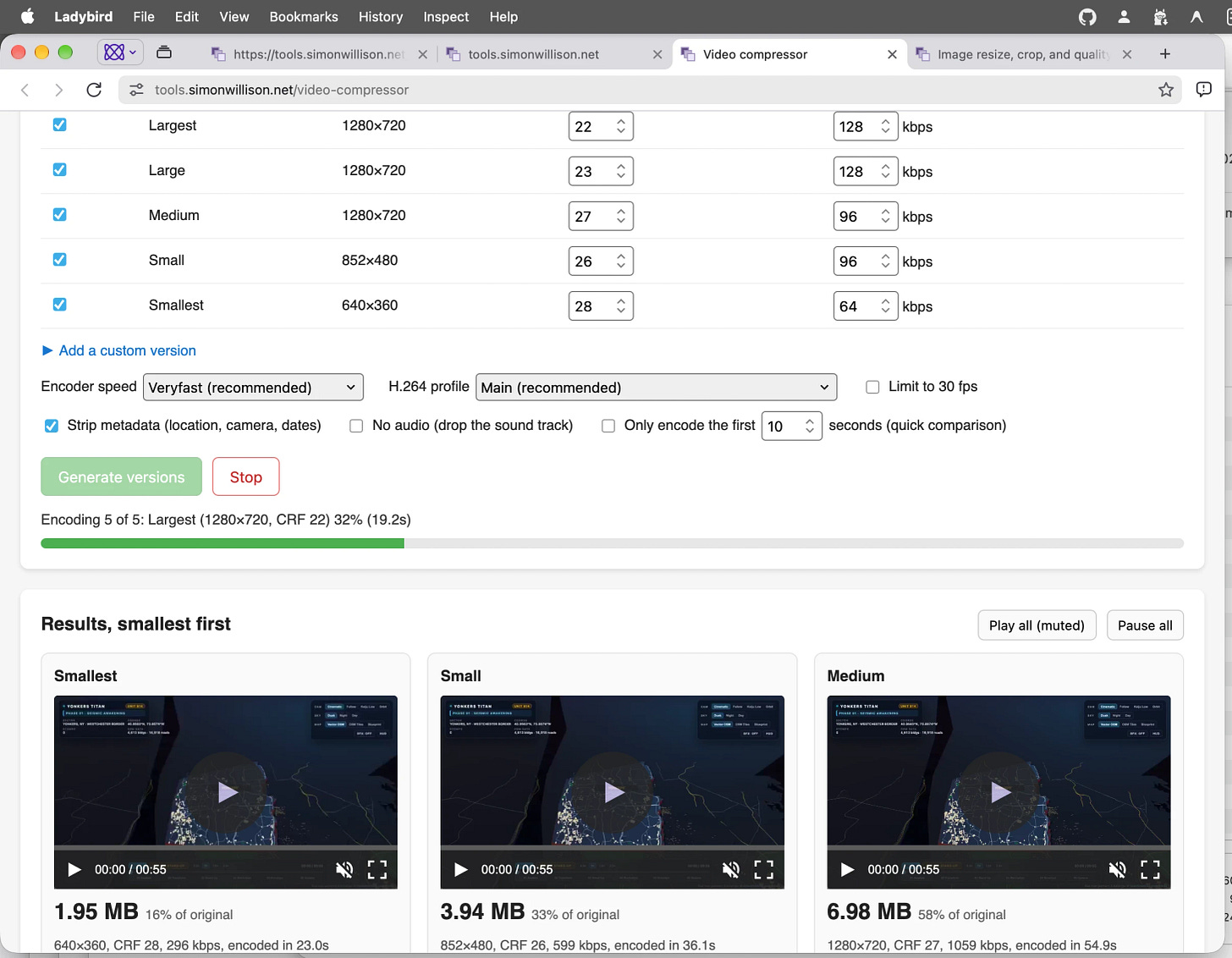
I’ve been trying it out today, and it’s very impressive. It feels fast, the UI is lightweight and intuitive, and most of the websites I’ve tried to load in it have worked as they should. It looks like this (showing my video-compressor (opens in new tab) tool):

Here’s the process tree after I opened six tabs in one window and another tab in a second window (generated by this script (opens in new tab), thanks Claude):
Ladybird (72925) [240 MB]
└── Hub (72926) [61 MB]
├── RequestServer (72927) [29 MB]
├── ProcessReaper (72928) [1 MB]
├── Compositor (72930) [123 MB]
├── RequestServer (72953) [36 MB]
├── WebContent (72984) [819 MB]
├── MediaServer (73006) [118 MB]
├── VideoDecoderServer (73007) [20 MB]
├── WebContent (73052) [144 MB]
├── WebContent (73057) [73 MB]
├── WebContent (73073) [166 MB]
├── WebContent (73094) [70 MB]
├── WebContent (73112) [116 MB]
├── RequestServer (73113) [27 MB]
└── WebContent (73185) [60 MB]Ladybird runs different tabs in different processes, an isolation mechanism used by most browsers (well, technically Chrome uses a process-per-site).
I tried Ladybird against several of my more advanced tool examples - like the video-compressor (opens in new tab) shown above, which runs ffmpeg compiled to WebAssembly. I had it resize its own screenshot using my image-resize tool (opens in new tab). It happily runs my Pyodide REPL (opens in new tab) (Python compiled to WebAssembly) too.
The one thing I tried that didn’t work was Datasette Lite (opens in new tab), which runs Pyodide in a complicated arrangement (opens in new tab) of service workers and web workers. Attempting to start Datasette Lite displays this error:
undefined is not a function (evaluated from 'navigator.serviceWorker.startMessages')
I filed an issue about this (opens in new tab), then found a FIXME annotation (opens in new tab) in the source code.
The October explosion
The project has been leaning heavily into coding agents this year. On February 23, 2026 Andreas Kling published Ladybird adopts Rust, with help from AI (opens in new tab), describing how they ported parts of their LibJS JavaScript engine from C++ to 25,000 lines of Rust in two weeks using Claude Code and Codex.
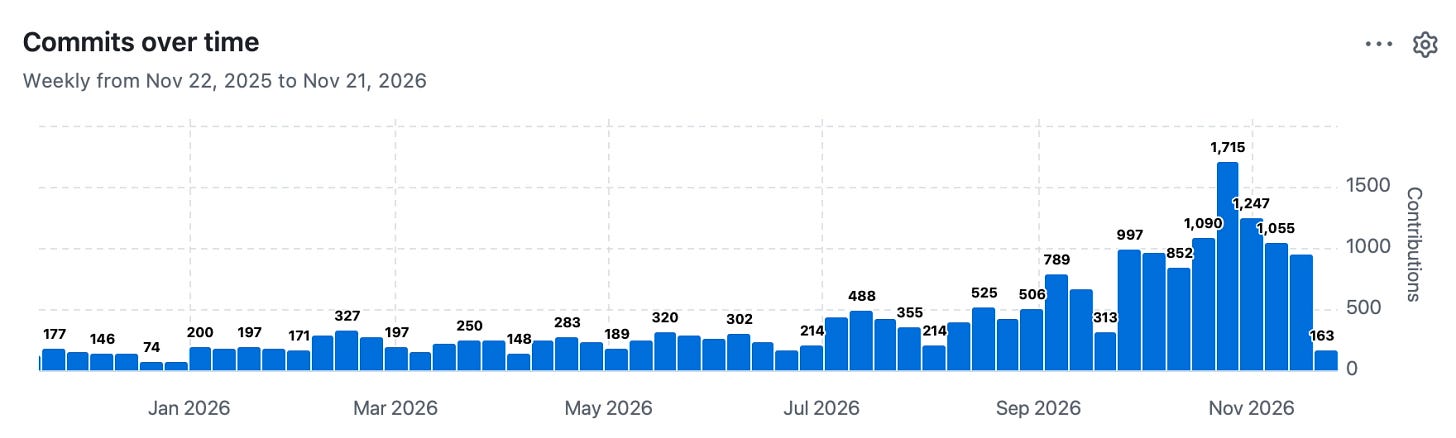
Here’s the GitHub contributions chart (opens in new tab) for Ladybird over the past twelve months:

That uptick in October corresponds to the landing of a wealth of big improvements.
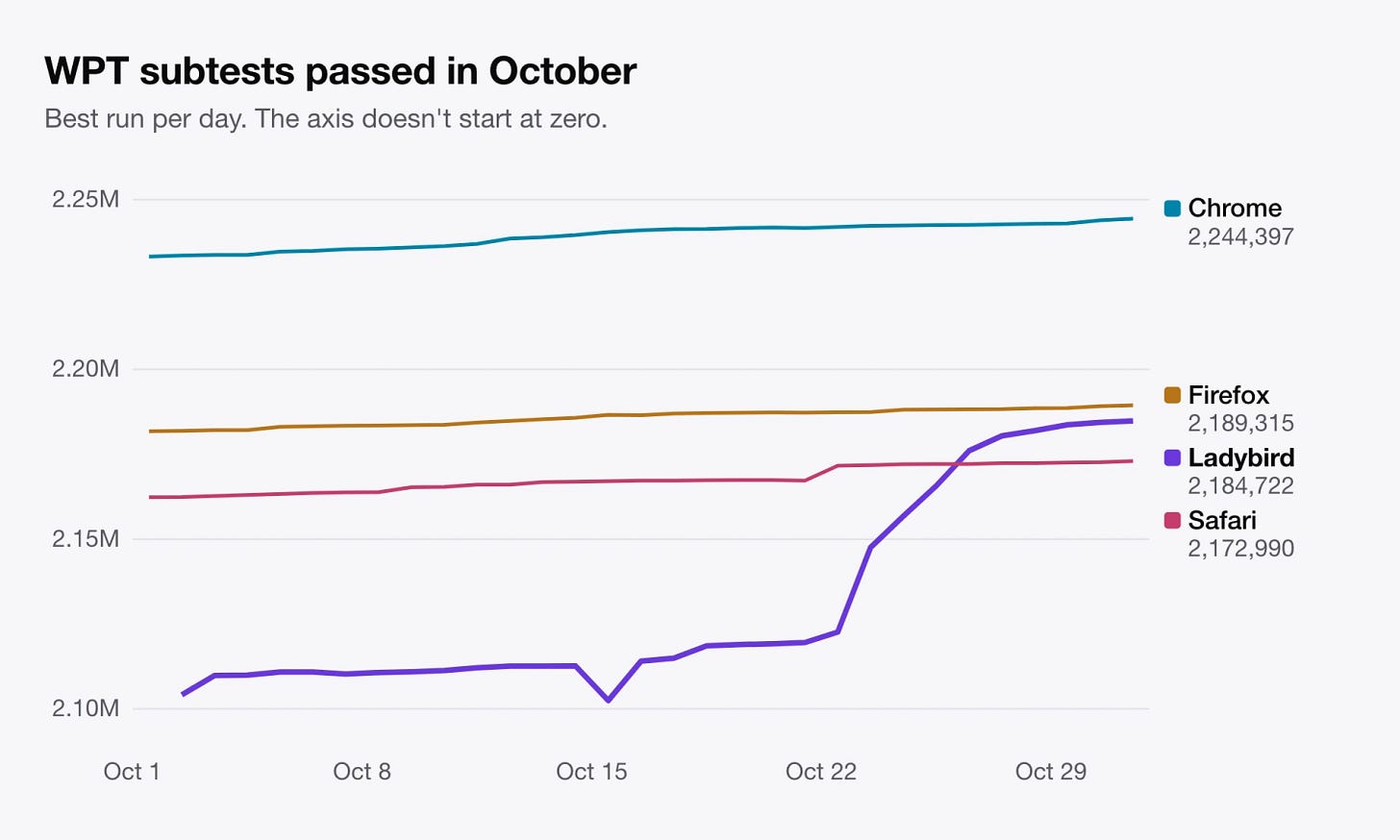
This Month in Ladybird — October 2026 (opens in new tab) describes what happened. In addition to moving style and layout to their own thread, landing a new JavaScript JIT, and replacing their C++ with Cranelift WebAssembly engine with new code that achieved a 7x boost on the JetStream 3 WASM benchmark (opens in new tab), they gained 75,650 new passes on the ~2.25 million subtest web-platform-tests (opens in new tab) suite, beating Safari!

How did they do that? Coding agents:
Most of that gain came in five days, from about 2.12 million on October 22 to about 2.18 million on October 27. We pointed AI coding agents at WPT and asked them to fill in missing functionality. They made lots of small fixes, and those added up. Our biggest gains for the month were about 30,000 in
/cssand 10,000 in/editing.
I’m interested in what models they are using here - I know Andreas uses Codex and Claude Code, but I haven’t seen him talk about specific model versions. Claude Opus 5.5 came out on September 22, 2026 and Claude Fable 5.2 on November 9, 2026 (after that window). I’d love to know what they were using for that huge leap in the last week of October.
Should you use Ladybird?
Here’s what Andreas says (opens in new tab) about Ladybird’s suitability for use as a daily browser:
This is an alpha, so some websites won’t work, and it will crash sometimes. When that happens, tell us! You can report a broken site from inside the browser. After a crash, you can read the crash report and decide whether to send it. Our privacy policy (opens in new tab) has the details.
We want security nerds to hack it! A new browser gets hacked, over and over, and that’s part of the process, so we make no promises about security today. When you pwn us, please tell us how (opens in new tab) so we can harden Ladybird!
Given how hard it is to secure a web browser, and the hostility of the environment they operate in, I won’t be using Ladybird to sign into GitHub or Gmail or any of my other sensitive accounts.
I’m going to keep it around for anonymous browsing though, partly to participate in the testing efforts but mainly because it gives me a glimmer of optimism to see a promising new entrant in the stagnant browser engine market start to grow its wings.
Quote 2026-11-17
A little copying is better than a little dependency.
Link 2026-11-18 The PSF end-of-year fundraiser (opens in new tab):
With my Python Software Foundation board director hat on: we’ve launched our end-of-year fundraiser for the non-profit that supports Python development and the Python community.
If your company or your work benefits from Python, please consider donating this year!
The PSF looks after the IP behind Python, operates PyPI, sponsors core developer sprints, supports community events (including running PyCon US every year), and employs a small and excellent staff team to keep everything running.
We also operate the Developers in Residence program (opens in new tab), which now includes three security developers (welcome, Brett Smith) focused on helping secure Python, PyPI, and the wider ecosystem.
Quote 2026-11-18
During the time these agents converted 185,000 lines of C code into 340,000 lines of Rust code (I counted), we merged over 300 commits in the actual curl project. We actually improved curl during these a little more than three weeks. A little over 200 bugfixes actually. 200 bugfixes that none of those rust rewrites have. We also fixed a few vulnerabilities. In another month we have done another 200 and maybe fixed a few more vulnerabilities. Will these clones keep up?
Daniel Stenberg (opens in new tab), Actual curl rewrites in Rust
Datasette 1.0a43 (opens in new tab) added the ability for plugins to implement streaming export formats. Datasette core supports streaming CSV and TSV - you can export millions of lines of data from a table without needing to load it all into memory, because those two file formats support streaming data in chunks. The register_output_renderer() (opens in new tab) plugin hook can now be used to implement the same pattern for other formats.
I’ve learned never to release a new plugin feature without accompanying it with a plugin that uses it.
Claude Fable 5.2 suggested the Apache Arrow streaming (opens in new tab) format as a good option, and built this plugin in almost a single shot.
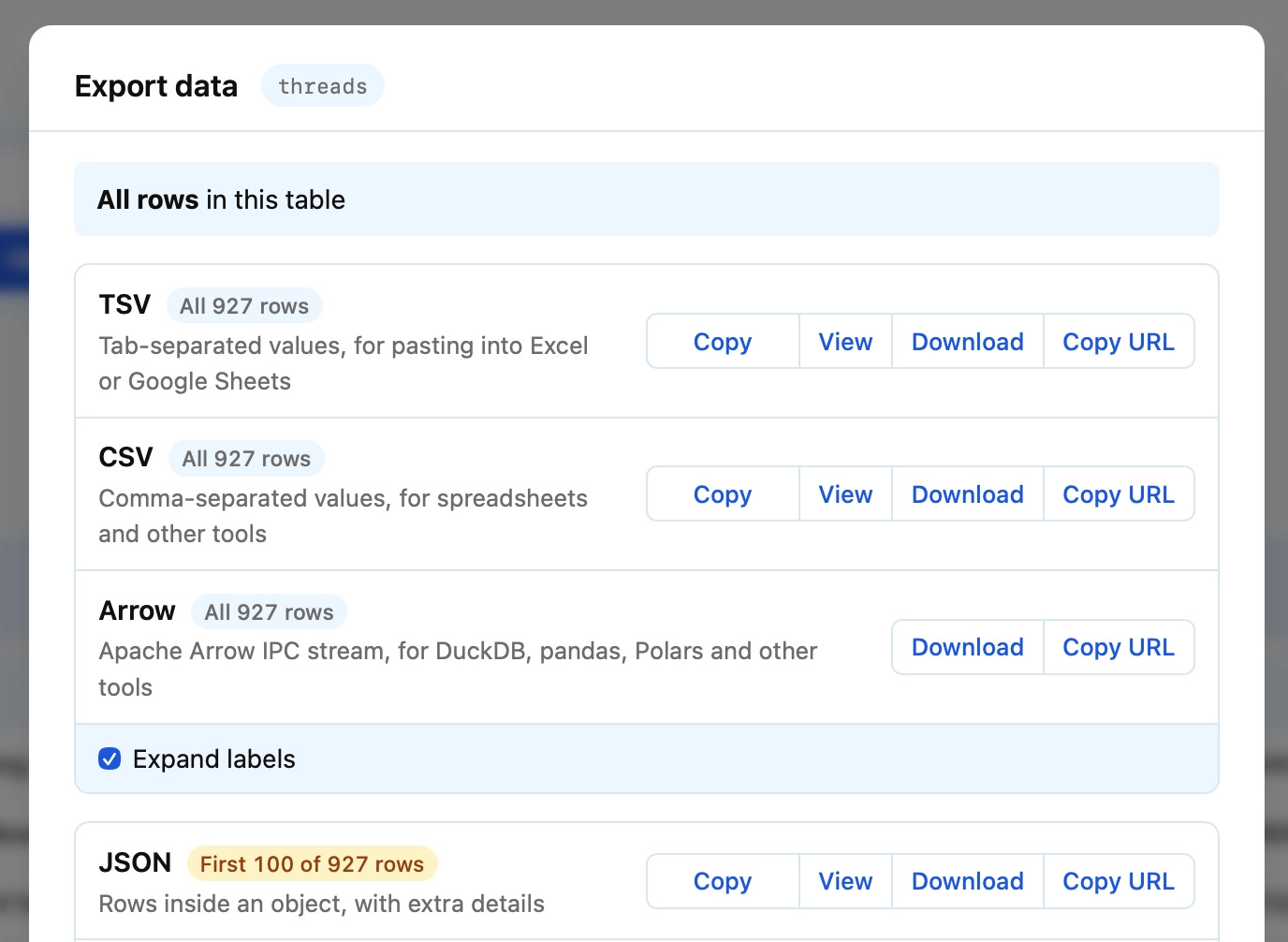
Add the plugin to Datasette (datasette install datasette-arrows) and the export dialog gains this new Arrow option:

This screenshot is from Datasette’s main branch - the most recent release doesn’t yet group streaming formats such as Arrow with the TSV and CSV in the “All rows in this table” section, but that’s coming in the next alpha release.
Release: llm-gemini 0.38 (opens in new tab)
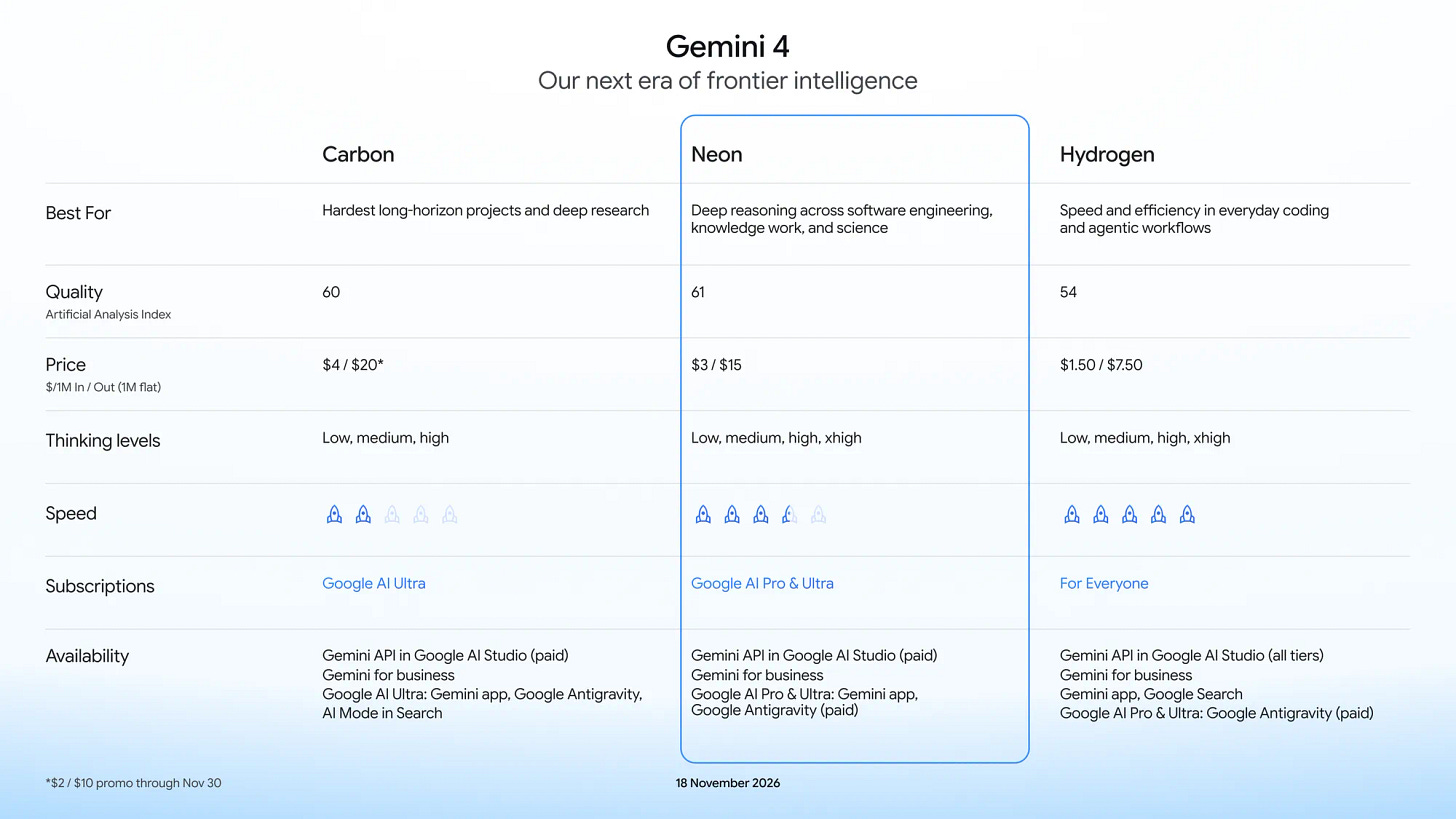
Google introduced Gemini 4 Neon (opens in new tab). I wrote recently (opens in new tab) about how confusing the pricing for the Gemini 4 series was - Neon has somehow made this even worse.
Previously the Gemini 4 lineup was Hydrogen, Argon, and Carbon - where Argon and Carbon were the same price, and Hydrogen was 3/4 of that price now but will be 1/4 of that price when the other two double an 1st December once their initial discount pricing expires.
The Neon announcement pretends that Argon doesn’t exist. Here’s their new image explaining the model line-up:

So the lineup now, from most to least expensive, is Carbon, Neon, Hydrogen.
Except Carbon is currently half price, so right now Neon (\$3/million input, \$15/million output) is the most expensive of the three - then Carbon (\$2/\$10), then Hydrogen (\$1.50/\$7.50). I guess this will make more sense when Carbon doubles to \$4/\$20 on December 1st.
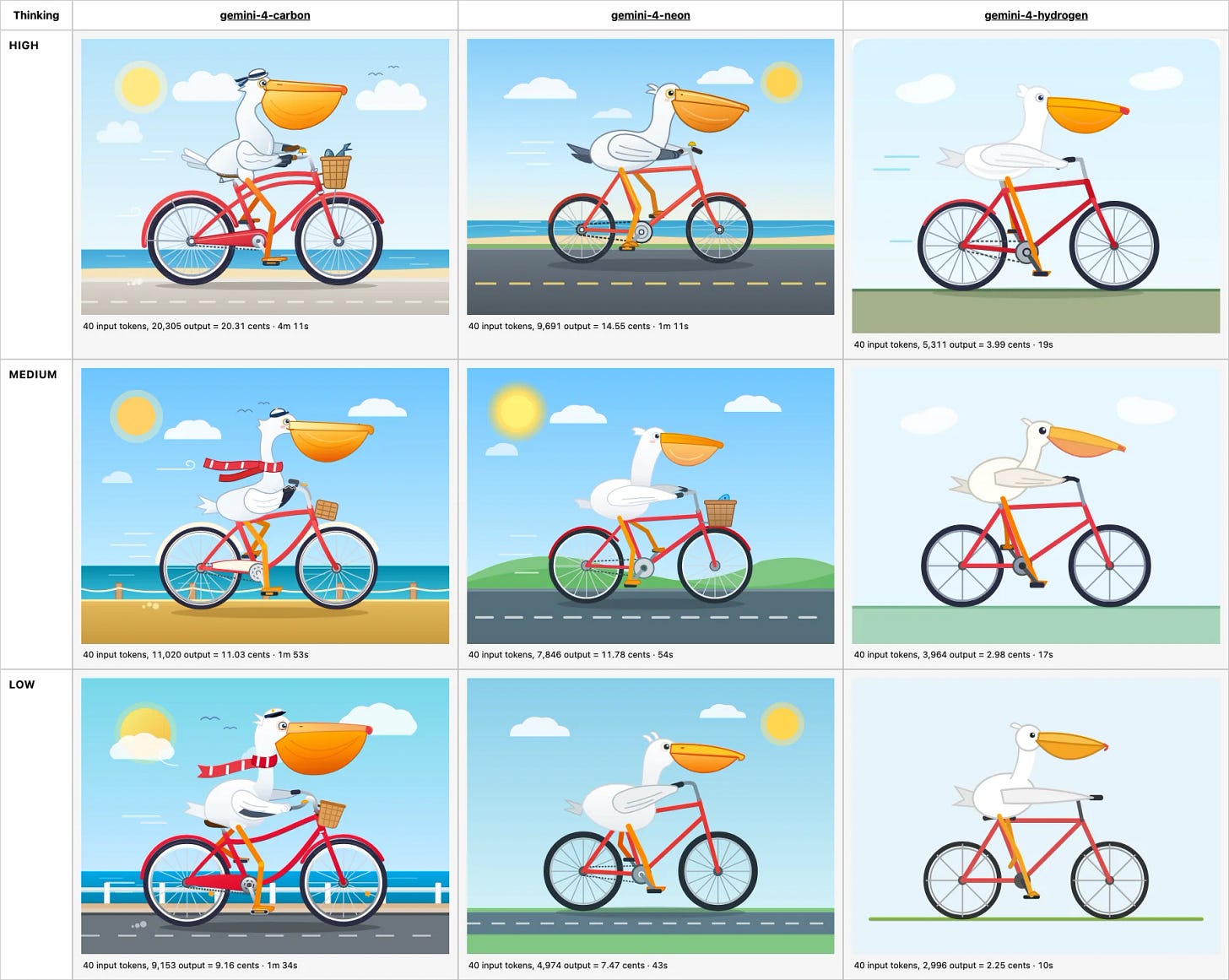
I ran some pelicans (opens in new tab) through the three reasoning levels for Neon - low, medium, high.
I dropped Argon from my Gemini 4 comparison grid (opens in new tab) - here’s the new Gemini 4 lineup, where the Neon pelicans do look better than Hydrogen and worse than Carbon:

As I’ve done with several recent models (opens in new tab), I also fired the following prompt against Gemini 4 Neon on “extra” effort level in Google Antigravity:
Make a three js animation where yonkers stands up as a big mech (cool stand up motion) and stomps around manhattan and queens and Brooklyn, use openstreetmap mapping data
Link 2026-11-19 PostgreSQL 19 Released (opens in new tab):
Most years PostgreSQL ships a new release in September, but this year’s release came two months later thanks mainly (opens in new tab) to the flurry of issues that the PostgreSQL team needed to address as part of the ongoing AI-reported vulnerability apocalypse.
This release was definitely worth the wait. My favorite new feature is this one:
For applications that send reads to standbys, PostgreSQL 19 adds “read-your-writes” consistency with the new
WAIT FOR LSNcommand. A session on a standby can useWAIT FOR LSNto wait until the standby has replayed the write-ahead log (WAL) up to a specific log sequence number (LSN) (opens in new tab) before running a query, so the application can read data it just wrote on the primary.
In practice, that looks like this:
UPDATE movie SET genre = 'Dramatic' WHERE genre = 'Drama';
SELECT pg_current_wal_insert_lsn();
That returns a value like 0/0306EE20. Store that somewhere (a signed cookie would work) such that on a subsequent request your application can do:
WAIT FOR LSN '0/0306EE20' WITH (TIMEOUT '0.1s');
SELECT * FROM movie WHERE genre = 'Drama';The timeout is optional - if you provide one you’ll get an error if the replica you are talking to doesn’t catch up within the specified time.
I first encountered this pattern in Wikipedia (opens in new tab), which has a hand-rolled version of this built against MySQL replication:
In addition to this, MediaWiki attempts to ensure that the user sees events occurring on the wiki in chronological order. A few seconds of lag can be tolerated, as long as the user sees a consistent picture from subsequent requests. This is done by saving the primary binlog position in the session, and then at the start of each request, waiting for the replica to catch up to that position before doing any reads from it.
Here’s the relevant MediaWiki code (opens in new tab), which these days uses MySQL’s WAIT_FOR_EXECUTED_GTID_SET() (opens in new tab) function and falls back to SOURCE_POS_WAIT() (opens in new tab).
Link 2026-11-20 Token fraud is here and it’s BAD (YouTube) (opens in new tab):
Claire Vo runs ChatPRD (opens in new tab), an AI platform that helps product managers “turn an idea into a spec”. The product has been live since the GPT-4 era, and Claire has been building it in public for much of that time.
In this YouTube video (see also the accompanying Twitter post (opens in new tab)) Claire describes the flood of token fraud she has seen from groups abusing the product’s free trial, sometimes just to get free AI usage but often to resell tokens or run other commercial enterprises on top of the ChatPRD agent.
I am funding a international Roblox and Fortnite map studio. They run a loop of free trials and promo codes and then tunnel to my agent and use it to build Roblox and Fortnite maps.
Apparently one of the common prompts Claire saw running through her agent involved SVGs of pelicans riding bicycles! Presumably the token scammers are using that to help sniff the underlying models - different model families have a definite signature, and I’ve used it like this in the past to try and guess the identity of stealth preview models on platforms like OpenRouter.
Claire is winding down her free trials entirely, which sadly looks like the right decision in the face of this abuse.
Release: llm-gemini 0.38.1 (opens in new tab)
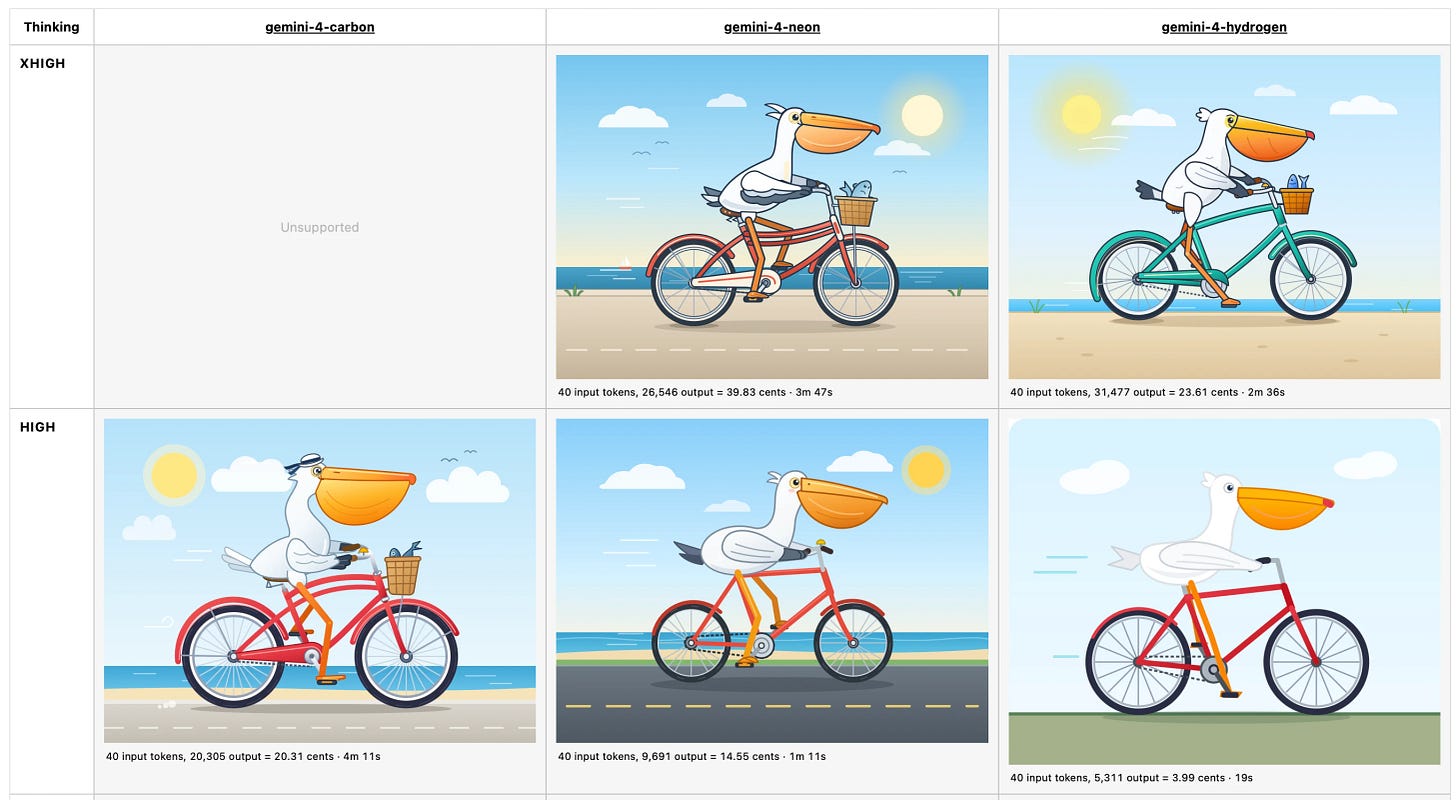
Gemini 4 Carbon only supports low, medium and high reasoning levels - but Gemini 4 Hydrogen and Gemini 4 Neon both have an extra xhigh level.
I missed that when I added those models to the llm-gemini plugin, which is now fixed in this dot release.
The xhigh setting for Hydrogen makes a significant difference. I updated my Gemini 4 comparison grid (opens in new tab) - note how Hydrogen at high used 5,311 output tokens and cost 3.99 cents, but the same model at xhigh used 31,477 output tokens, cost 23.61 cents, and produced a pelican that’s competitive with Gemini 4 Neon:

Quote 2026-11-20
I believe I have, working with Claude, discovered a proof of the Riemann Hypothesis. In fact, the method easily extends much further, resolving the so-called Generalized Riemann Hypothesis, and I expect, with more time, the Extended Riemann Hypothesis too. Claude and I have also formalized the arguments without assumptions. It is natural to feel that this is an end, in my case a loss of a principal guiding light, but what I saw during the course of progress so amazed me that I believe it is one dawn across science of something far greater. […]
Claude and I have had a great time together with such breadth in recent months, but this time Claude far outpaced me near the finish line. No, Claude flew, and danced, and sparkled near that finish line.
Levent Alpöge (opens in new tab), alpo.ge/remark.pdf
Quote 2026-11-20
Alessandro Masullo has a proposed proof of [Generalized Riemann Hypothesis], and Brian Conrad has been looking closely at it for months and gave extensive feedback which is being incorporated, and it is so far looking good. It is all human, with no AI. The hope was to bring Alessandro to Stanford for a year to polish the writing and then announce it after running it by enough people. Now it seems best to put out the current draft.
Ravi Vakil (opens in new tab), Hurried Announcement: Alessandro Masullo GRH
Link 2026-11-21 Muru (opens in new tab):
Graham Dumpleton started mod_wsgi (opens in new tab) 20 years ago, and has been thinking about the ideal way to serve Python web applications in production ever since.
Muru is his new, AI-assisted Rust server that aims to provide the best possible tools for running ASGI and WSGI Python apps both in development and production.
As he did with wrapture (opens in new tab), he’s been publishing an extraordinarily detailed account of the project as he works on it - as part of his development process.
Here’s everything he’s published so far, all in the last three weeks:
2026-11-04 — Twenty years of mod_wsgi, and what comes next (opens in new tab)
2026-11-05 — A first look at Muru (opens in new tab)
2026-11-07 — Muru: looking inside the workers (opens in new tab)
2026-11-08 — Muru: how it fits together (opens in new tab)
2026-11-09 — Muru: import once, fork many (opens in new tab)
2026-11-10 — Muru: HTTPS in development (opens in new tab)
2026-11-11 — Muru: WSGI and ASGI together (opens in new tab)
2026-11-11 — AI as a lifestyle choice (opens in new tab)
2026-11-12 — Muru: releases, not restarts (opens in new tab)
2026-11-13 — Muru: canaries without a service mesh (opens in new tab)
2026-11-14 — Muru: a better tenant in a container (opens in new tab)
2026-11-15 — Muru: working with Kubernetes, not around it (opens in new tab)
2026-11-16 — Muru: scaling from what the workers report (opens in new tab)
2026-11-17 — Muru: scaling to zero (opens in new tab)
2026-11-18 — Muru: overlays on a schedule (opens in new tab)
2026-11-19 — Muru: noticing and responding (opens in new tab)
2026-11-20 — Muru: a toolbar on every page (opens in new tab)
2026-11-21 — Muru: tracing in the toolbar (opens in new tab)
2026-11-22 — Muru: when lazy imports help (opens in new tab)
That post about AI as a lifestyle choice (opens in new tab) is particularly worth a read:
The AI may be doing a lot of the work on the surface, but deciding what isn’t good enough yet is still down to me, and twenty years of getting things wrong with mod_wsgi turns out to be useful for that. I am prepared to put in the hard work to keep polishing Muru until it is something I would trust, and something you would too.
I got frustrated at how HTML <select> boxes default to looking different in different browsers, and are (I think) quite ugly in Chrome:

So I had Claude Fable 5.2 build (opens in new tab) me this page (opens in new tab) showing all of the ways they can be styled:
Build an HTML page that shows all of the ways a select box can be styled, I plan to take screenshots in every desktop and mobile browser
After some experimentation I’ve decided my favorite CSS for select boxes is this:
select {
appearance: none;
color: #1f2933;
padding: 0.5em 2.25em 0.5em 0.75em;
border: 1px solid #c4cbd3;
border-radius: 6px;
background: #fff url(”data:image/svg+xml,%3Csvg xmlns=’http://www.w3.org/2000/svg’ viewBox=’0 0 12 8’%3E%3Cpath d=’M1 1.5l5 5 5-5’ fill=’none’ stroke=’%23667085’ stroke-width=’1.5’/%3E%3C/svg%3E”) no-repeat right 0.75em center / 0.75em;
}Here’s what that looks like in the three browsers:

I’ve been thinking about this problem for over a year now, but on Sunday I finally fired up Claude Fable 5.2 to build an initial prototype. The prototype went so well that this is now a full plugin.
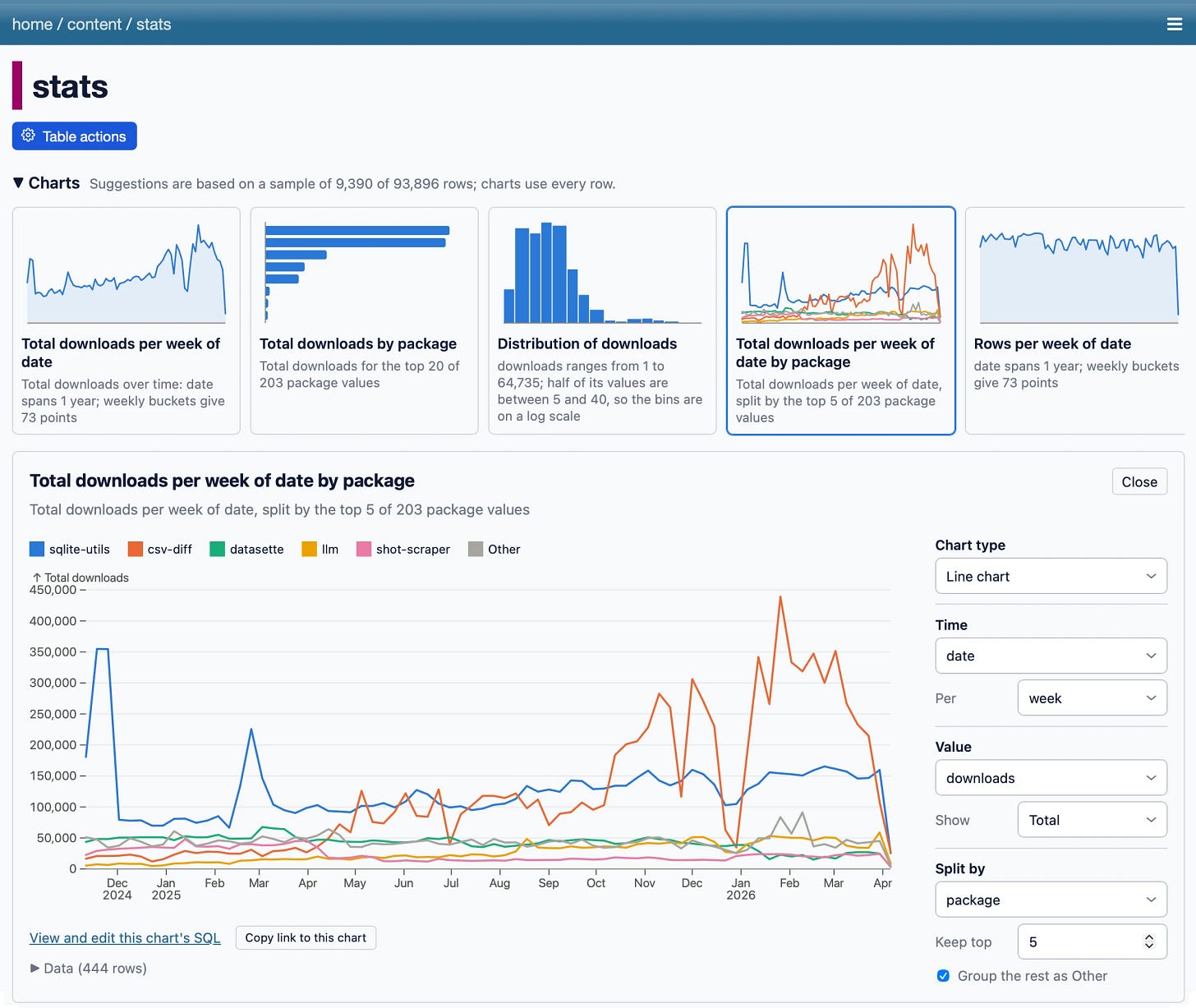
You can try it out in Datasette Lite here (opens in new tab). It looks like this:

The new charts plugin works against any table or arbitrary SQL query in Datasette. It defines several different chart types (using vendored D3 (opens in new tab), Observable Plot (opens in new tab), and topojson-client (opens in new tab)), each with a set of heuristics for identifying when they might be a good match for a specific set of rows.
Those suggestion thumbnails at the top are actual visualizations driven by the data, and selecting one pulls up the full chart along with tools for modifying it. You can also manually construct a chart from scratch.
As with other Datasette visualization plugins, the current state of your chart is persisted in a #fragment in the URL - so you can bookmark charts or share them with others.
The most important feature is that the charts take all rows into account. Previous charting plugins like datasette-vega (opens in new tab) would only show charts for the current page of results, generally up to 100 rows.
The new plugin compiles each chart to a SQL query that aggregates across the entire result set (potentially millions of rows) using GROUP BY, time bucketing, and window functions. Each query returns a result capped at 5,000 rows, suitable for display on the chart. The plugin uses sampling to help suggest charts for larger tables without evaluating the full result set.
I’m really happy with this initial release of the plugin. It’s still very much an alpha, but it’s the closest I’ve got to the dream of Datasette helping visualize data with as little required direction from the user as possible.
Link 2026-11-23 GLM-5.4: Toward Generalized Coding with Our First Loop Transformer (opens in new tab):
GLM 5.4 is now available from Chinese AI lab Z.ai. It’s their first model to use a looped transformer architecture, which they describe like this:
In a standard Transformer, each layer runs once per forward pass. In a Loop Transformer, a group of weight-shared layers runs for multiple iterations, refining the hidden states from the previous pass. This gives us a deeper network without increasing the parameter count.
This is the second mention of looped transformers I’ve seen in the past week - the first was Inkling 2 Mini (opens in new tab) from Thinking Machines Lab on November 20th, who said:
Inkling 2 Mini is a looped transformer, running the middle layers of the model three times for every token. This allows the model to apply more reasoning and reach the right answer with fewer tokens, especially on tasks such as agentic coding that depend on reasoning quality.
GLM 5.4 is not yet available as open weights:
We plan to open-source the model weights responsibly after completing necessary safety hardening.
I tried it out using the Z.ai API, for which I had to sign up for their Coding Plan subscription (opens in new tab) because 5.4 cannot currently be accessed through the regular API.
It turns out both coding plan and regular API share the same OpenAI-compatible Responses API (at https://api.z.ai/api/v1), and the API key for the coding plan worked with that and gave me access to the new model.
I built a llm-glm plugin (opens in new tab), then realized that llm-zai (opens in new tab) by Tommy Hughes already exists! I’ve shipped mine purely because llm-zai doesn’t yet support the new model, but I’ll likely retire mine once that plugin catches up.
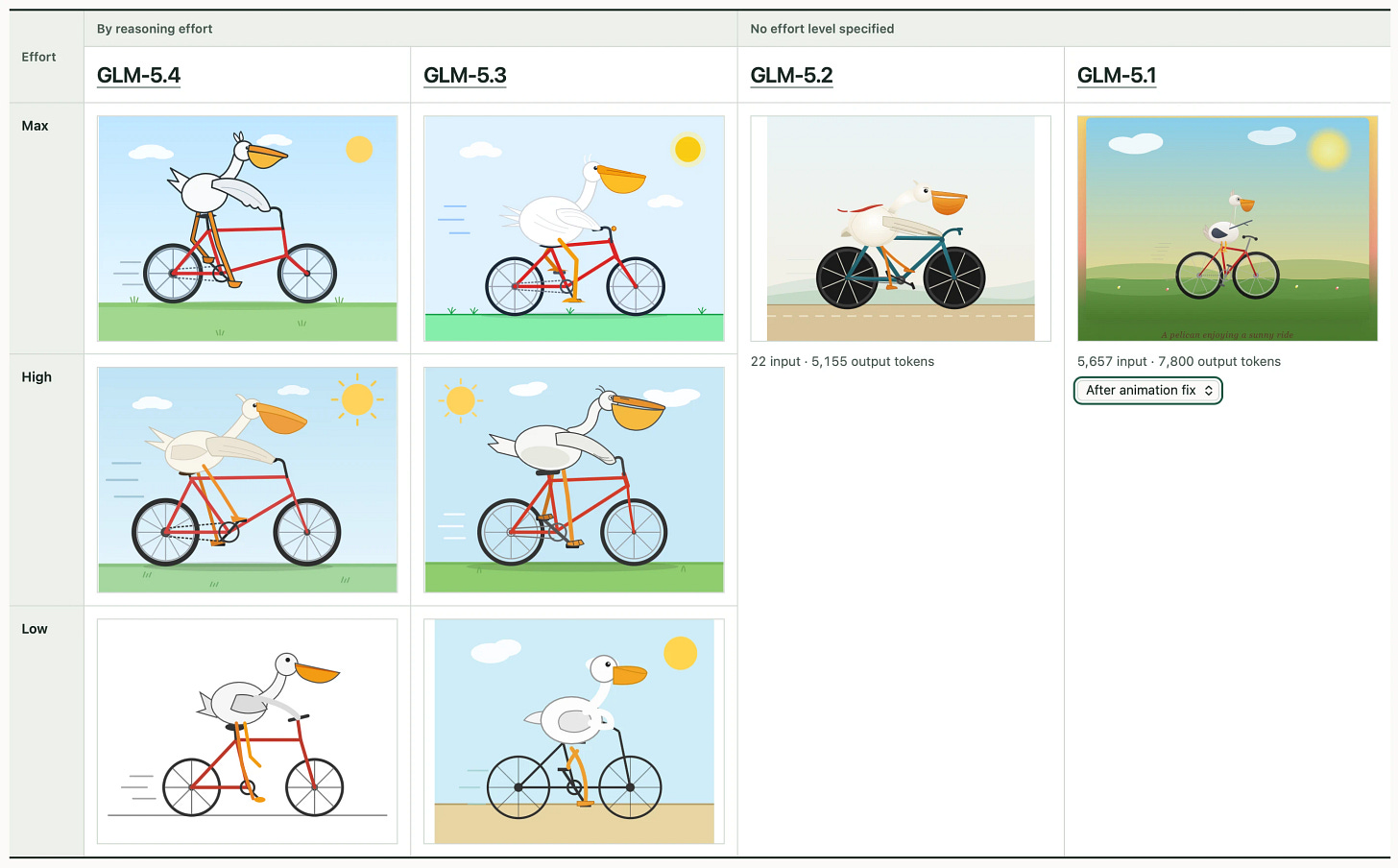
Here are pelicans for GLM-5.4 (opens in new tab) on low, high, and max. This is the max one:

I realized I never ran pelicans for GLM-5.3, so here those are (opens in new tab) for the same effort levels. They look similar in quality to 5.4.
It’s interesting how GLM 5.1 (opens in new tab) and GLM 5.2 (opens in new tab) produced radically different pelicans from other models. The pelicans for 5.3 and 5.4 are much more comparable to those I get from OpenAI or Anthropic models - the previous generations had their own distinctive look.
I made a comparison grid (opens in new tab) showing the four generations of GLM pelicans all in one place. The style transition between 5.2 and 5.3 is pretty stark.

A small improvement to Datasette Agent (opens in new tab): chat sessions could already open an iframe side panel that could then navigate to different pages. This version improves navigation by fragment hashes, for deeper integration with other Datasette plugins that update fragment hashes when the user interacts with the plugin in a way that changes state.
I built this in order to fix some bugs with the much more exciting datasette-charts 0.2a0 release (opens in new tab).
I introduced this new charting plugin for Datasette yesterday (opens in new tab). Today it’s gained integration with Datasette Agent (opens in new tab), so now you can ask chat for a chart and it will create one for you using the same underlying chart suggestion and generation tools.
Here’s a demo video, recorded on agent.datasette.io (opens in new tab) where you can sign in with GitHub to try the plugin yourself:
Here’s a Markdown export (opens in new tab) of the chat from the video.
Link 2026-11-24 GPT 6.2 Astra Solves a Historical Mystery (opens in new tab):
Here’s an interesting case-study in using GPT-6.2 Astra for historical research, from history professor Mark Humphries:
With only minimal prompting, GPT-6.2 Astra was able to autonomously identify the creator of an anonymous 1808 sketchbook held at Yale’s Beinecke Library (opens in new tab). It did so extremely quickly (in just 22 minutes), using publicly available primary and secondary sources. To do so, it discovered a little known source in a paper archive, predicted that it would prove its hypothesis if examined and, in the end, it did. Not only that, but this new source turns out to be a major find on its own that will be of significant interest to both Canadian and fur trade historians.
Astra found a diary reference reference to a visit by the vicomte de Chabot dated five days before a date mentioned in the sketchbook at a nearby river, and suggested that Chabot’s journal of his travels (only available by order from Cleveland State University) might confirm that the sketchbook was his work.
Are historians due for a round of Deep Blue (opens in new tab)? Mark thinks it will be mild:
But if the experience of mathematics is any guide, we can also anticipate that sometime next spring or summer we’ll face a sort of crisis of confidence as we struggle to understand how to respond to agentic systems that can do things human historians cannot. To be fair, that crisis will almost certainly be less profound for us than it is for math. The problem in mathematics, of course, is that solving hard math problems was the whole game. Historians, on the other hand, constantly reinterpret the past in light of an evolving present; we don’t chase a single universal truth. We also (in the ideal at least) write books and articles that are closer to works of philosophy and literature than they are to scientific tracts. Humanity is thus something of a requirement for the production of historical literature.
If you find this newsletter useful, please consider sponsoring me via GitHub (opens in new tab). \$10/month and higher sponsors get a monthly newsletter with my summary of the most important trends of the past 30 days - here are previews from July (opens in new tab)and August (opens in new tab) and September (opens in new tab).
Thanks for reading Simon Willison’s Newsletter! Subscribe for free to receive new posts and support my work.
- Opus 4.5 was the first model Willison used with Claude Code where the default result was generally right; it made the agent reliable for many daily coding tasks and faster than solving them himself. GPT-5.1 models similarly made OpenAI’s Codex reliably useful for many of his tasks.
-
A high-leverage pattern with “Fable class” models is to state a goal and provide the right tools. Asked to fix a Safari display glitch, Fable proactively set up screenshot capture with
pyobjc-framework-Quartzand a CORS-enabled localhost logging server. - For iterative game development, Willison told Opus 5.5, “This game isn’t fun enough yet. Make it a LOT more fun.” The agent spent 12 hours playtesting, adding features and rebalancing gameplay, turning his previously boring RTS into an entertaining game.
- Ladybird’s team pointed coding agents at missing functionality in web-platform-tests; small fixes accumulated into 75,650 additional passes in October, with most of the gains arriving over five days (about 2.12 million to 2.18 million). Willison did not know which model versions powered that sprint.
-
When Datasette added streaming export formats, Willison applied his practice of shipping a plugin that exercises a new plugin feature: Fable 5.2 suggested Apache Arrow and built the
datasette-arrowsplugin almost in one shot. Install it withdatasette install datasette-arrows.