We can't find the internet
Attempting to reconnect
Something went wrong!
Hang in there while we get back on track
Nvidia: a key-person risk at the center of AI
The WSJ reported that Nvidia's board is preparing to oust CEO Jensen Huang after "two extramarital affairs, including one with a suspected Chinese spy" . This follows the internal probe covered in earlier briefs. Venture investors quickly sided with the founder:
- Garry Tan called an ouster ill-advised and said it would be "hard to believe a transition happens without massive market cap implosion" .
- Naval cited Steve Jobs and Travis Kalanick: "one does not just simply replace the founder" .
- Suhail suggested boards wait two weeks after a PR crisis before moving on a CEO, unless criminal acts are involved .
- Jason Calacanis wants a summary of the investigation released to shareholders so they can vote. He predicts the board will act in "CYA mode" .
- Elad Gil used the episode to advise founders to keep boards small and high-trust, and to resist the "governance experts" who push outside directors at IPO .
Two related policy items. Axios reports that President Trump authorized a crackdown on companies suspected of diverting Nvidia's advanced chips to China, and that Commerce Secretary Lutnick "repeatedly stood in the way" . An unconfirmed rumor, labeled "wild" by the account that posted it, says DeepSeek is pretraining a ~2T-parameter V5 on Huawei Ascend 950 chips . Taken together, the headlines raise both the governance risk and the geopolitical risk around the AI supply chain's most important vendor. None of this is a confirmed leadership change yet.
Funding
- Fractile raised a $720M Series C led by Thrive, Founders Fund, Lightspeed and Redpoint . Sarah Guo describes the approach as stacking DRAM directly on top of the processor to meet frontier models' memory-bandwidth needs, "in close partnership with some of the top labs," which sets it apart from incremental chip bets .
- Imprint, a co-branded card fintech, raised $130M at a $1.88B valuation. It aims to double revenue to $400M while growing headcount only 30%, using AI internally and in agentic commerce .
- Nuance Labs raised a $50M Series A led by Lightspeed . The founders are ex-Apple researchers building a unified, full-duplex foundation model for real-time text, speech and video expression . They argue that cascaded avatar pipelines lose emotional cues and add latency . The team has reached 27 people; the original plan was about eight .
- Index Industries came out of stealth with a $50M seed to power USHP, pitched as the first investable index of US residential real estate. The CEO is former Polychain president Josh Rosenthal .
- Higgsfield reports annualized run rate rising from $1B in September to $1.35B in October, with a target of $2B by year-end . Two caveats. The figure is the last four weeks of revenue × 13, and about 60% of revenue is credits and usage, which can swing month to month . SaaStr, which reported it, is an investor .
- Standard Capital opened its next Series A cycle. Applications are due Dec. 1, with decisions by Dec. 11 .
Model capability and cost
Allie K. Miller highlights Fable 5.2 scoring 41.3% on the Remote Labor Index, up from 17.9% for Fable 5.1 and 2.5% a year ago. By her reckoning, that is a doubling time of about three months . Pushing the other way on price, Bindu Reddy says that in her blind tests DeepSeek matches Carbon/Opus on 95% of agentic loops at about 40x lower cost. It degrades faster on very long loops . These are one tester's results, but they support last brief's point that model routing is eroding frontier pricing power.
Runway released Praxis-1, a world action model that turns video pretraining into control for real robots. The weights are open under Apache 2.0 . Cristóbal Valenzuela says it ranks #1 on NVIDIA's RoboLab-120 leaderboard . Separately, experts OpenAI appointed to vet its AI-generated proof of the existence of quantum Yang-Mills theory say they have verified it, per Scientific American . That verification comes from OpenAI's own reviewers, not open peer review.
Suhail says his five-person startup "maxed out all our inference compute in 2w across customers." He is offering a $20K referral bonus for post-training or inference-optimization hires .
Infrastructure economics: GPUs holding value, data-center queues inflated
a16z data show GPU rental rates as of Oct. 19 sitting above a six-year straight-line depreciation path: A100s by 9%, H100s by 54% . Mike Volpi explains it as scarcity. Demand is high enough that even inefficient chips get used, and that benefits anyone financing the assets. He adds that once there are enough Vera Rubins, running H100s stops making sense . Neocloud lenders should note that the residual-value assumption depends on chip manufacturing staying constrained.
On power, Ascend Analytics' Brent Nelson says ERCOT's large-load queue is about 400 GW against a roughly 90 GW system peak. He thinks realistic buildout is "a tenth to a fifth" of raw queue figures . Hyperscalers can't find capacity for 2027, he says, but by around 2030 many data centers may be competing for tenants. He also expects many VC-backed AI tenants to disappear . Senator Josh Hawley is backing a nationwide data-center moratorium , which adds a political risk to that picture.
Agents as buyers
a16z argues that agents will increasingly choose products, subscriptions and spending on users' behalf, and that the business models this enables "mostly aren't visible yet" . Its evidence includes Shopify's AI-driven store traffic up 8x year over year in Q1 '26, with AI-search orders up nearly 13x . It also cites agents accounting for nearly 40% of Stripe documentation traffic and 70% of CLI requests for API resources . The firm's investment map covers agentic models, agent-native businesses, incumbents optimizing for agent-led purchasing, and agent infrastructure. It notes that payments, fraud, identity and communications are already strained at low agent volumes .
SaaStr offers a firsthand example. Its AI marketing agent went straight to Higgsfield and Gamma over MCP and never connected to Canva. SaaStr's conclusion: "the window to get picked is when an agent is first wired into a workflow" .
Agent security
- Lazarus (Microsoft Research): editing fewer than 10 dormant neurons can plant a trigger-activated backdoor in an agent's LLM that still passes standard safety evaluations . The attack requires write access to the weights, and Microsoft has seen no use in the wild . Microsoft's detector flagged 91.4% of edited checkpoints, with a 9.7% false-positive rate . This makes model signing and weight provenance an emerging product area.
- Perplexity SPACE: Perplexity red-teamed its open-source agent sandbox. It says non-cyber models found exploits better than cyber-tuned ones, the sandbox held against isolation escapes, and it found and fixed a DNS-spoofing network bypass .
- Fortinet: a commenter citing Fortinet's own post says its patches of nearly 100 vulnerabilities included fixes from a frontier-AI testing program with Anthropic, OpenAI, Google and SpaceX. The same post warns these tools can turn patches into exploits within hours or days .
- 1Password: the company says it has passed $500M ARR and that Q3 net-new ARR grew about 90%, driven by AI use cases . It reports "explosive adoption" of 1Password for Agents, a zero-knowledge way to give personal agents access to credentials .
Operator and investor lessons
Ro says it went from about $270M run rate growing ~9% in 2021, which it calls a "zombie company," to $3B+ in 2026 . Headcount fell from 596 at its 2022 peak to 406 . Elizabeth Yin listed Hustle Fund's misses, starting with passing on Shield AI at pre-seed; Shield AI is now valued near $30B . Her conclusion: "sometimes you should just invest in your super entrepreneurial friends even if you don't like the idea" .
- Ascend Analytics power-market forecaster Brent Nelson says large-load queues are poor proxies for actual construction: ERCOT's queue is about 400 GW versus a roughly 90-GW system peak. He estimates plausible builds at only around one-tenth to one-fifth of raw queue totals, which are inflated by normal project duplication and speculative entrants; forecasts already discounted for plausibility should not be discounted again.
- Nelson expects political slowdowns to delay data-center development by roughly one to two years, affecting 2027 more than 2032, while access to power is a separate bottleneck. Long-lead gas projects also face political and permitting risk. Solar and storage are poorly matched to long overnight winter reliability needs, helping make gas the default despite constrained generation equipment, pipeline challenges, and fuel-delivery risks during winter storms. Nelson argues that a curtailable grid connection paired with behind-the-meter batteries could be a comparable, potentially cleaner, cheaper, and faster alternative to gas, while noting this is not a consensus view. Paying for grid upgrades is necessary but may not secure community support, given concerns about affordability, water, noise, emissions, and AI more broadly.
- AI-infrastructure demand depends on timing and customer durability: hyperscalers reportedly struggle to find capacity for 2027, but around 2030 many data centers may compete for tenants, while some AI startups may fail or be acquired, changing who needs compute. Banks generally require a creditworthy tenant lease to finance a data center, though the adequacy of lender due diligence is an open question; the interview cites a Meta-leased data center that struggled to close without substantial concessions amid a tightening debt market. A strong neocloud anchor tenant can make a project more reliable but creates concentration risk, so investors should assess who will pay the rent rather than relying on capacity plans alone.
- Theranos’s pitch was that a single drop of blood could support central-lab testing in settings from homes to battlefields . Schultz says there were no tests validated when the Walgreens product launched, patient samples instead went to other labs or third-party equipment, and only seven tests were validated by the time he left . He also recounts that a syphilis test initially showed 65% sensitivity; after that data was deleted and the study repeated, sensitivity was 80%, while more than 20% of assumed-negative colleagues tested positive before a doctor signed off .
- Schultz describes an 11-year culture of fear in which employees who questioned the CEO were fired and sometimes sued; he says people who knew the device was inaccurate stayed silent . He says employees might have raised concerns with the board if they had trusted that they could do so safely and confidentially .
- Schultz recounts that Khosla’s investment process led the firm to pass, and says he heard similar accounts from Sequoia and Google Ventures; Tim Draper was an exception, making a $500,000 angel investment .
- One Password’s CEO warned that AI agents’ need for secrets is colliding with growing exposure from long-lived credentials scattered across devices, while the cost of finding and exploiting them is rapidly falling. The company said it had built a zero-knowledge framework for agent access, announced One Password for Agents, and saw “explosive adoption” on platforms where it was released.
- The interview reports that One Password protects over 200,000 businesses and recently crossed $500 million in ARR. Its CEO said Q3 net-new ARR growth was about 90%, with AI-oriented use cases driving growth rather than token resale. He attributed the business’s ability to fund product and distribution investment while remaining profitable to strong retention and a profitable core consumer business.
- For early-stage diligence, the CEO recommends testing funnel progression and real customer pull before scaling, then examining gross/net retention and expansion across customer segments; he cautioned that sales through founder, portfolio-company, or board networks can give a false signal.
- The interview presents Nuance Labs’ $50 million Series A as led by Lightspeed. Founders said the team had reached 27 after initially planning for about eight hires over six to eight months; they attributed the expanded scope to building custom inference and orchestration systems as well as the model and its personality and emotional-intelligence capabilities. They said the round would accelerate work on talent, data and compute. Fong Chong Ma described prior Apple work on Vision Pro digital personas, and Karen Yang cited audiovisual research experience at Adobe, Meta and Apple.
- Nuance Labs is building a unified foundation model for real-time understanding and generation across text, speech and video. The founders’ proposed differentiator is full-duplex operation—attending to a user while generating the system’s response—rather than a turn-taking pipeline; they argue that existing cascaded systems lose expressive cues when they are reduced to text and incur latency.
- The founders describe natural conversational dynamics as a data bottleneck: they say suitable data is not available at internet scale, and podcasts or interviews often differ from direct conversations because they are edited or audience-facing. They also say simulation is unsuitable for this problem, leaving data gathering as a core challenge.
- The founders said their immediate focus was releasing a research demo, with a consumer-facing interface as a path to enterprise use. At company launch, they reported inbound interest in customer support, user and market studies, and training and coaching; this was reported interest, not evidence of deployed customers.
- Loyal founder Celine Halioua was introduced as having raised over $200 million; she described Loyal as a Series C company pursuing the first FDA-approved lifespan-extension drug, beginning with dogs. At the time of the talk, she said its first drug had cleared efficacy and safety approvals, with manufacturing approval remaining.
- Loyal’s dogs-first thesis uses shorter dog lifespans and cash-pay owners to avoid a human-development bottleneck: proving lifespan extension in people could take decades, nearly matching a 20-year patent term. The company’s “save the dog, save the world” thesis is that dog-longevity work could establish regulatory, social and biological precedent for humans.
- Loyal abandoned its original gene-therapy approach about six months in after its team cited safety, cost-of-goods and technical risks, switching to another way of targeting the biology. Halioua described a portfolio of about five drugs at different stages; one had recently been dropped over a theoretical safety concern, illustrating the company’s effort to avoid dependence on any single drug.
- Halioua sees opportunities for AI in clinical development and operations, and cautions that some AI-for-bio work may focus on areas that become commoditized without enough understanding of drug-development bottlenecks. Loyal’s veterinary trial team has built “vibe-coded” interface skins over difficult existing study software to reduce user errors, which she cited as an example of unmet workflow needs.
- Ro reported growing from about $250M to more than $3B in run rate over four years while employing fewer people than in 2021; GLP-1s were its fastest-growing category. Its CEO credited a major GLP-1 tailwind but said credit-card data showed Ro signing up roughly 2–3 times as many patients as peers.
- The 2022 refounding followed a 9% growth year after a $500M raise at a $5B valuation; the CEO said the company had tried to do too much and hire too broadly. The reset included moving on from seven VPs and about 20% of staff, unifying brands under Ro, and clarifying the company culture; Ro later reported a 10x larger business with about 30% fewer people. The CEO also described prioritizing sequential execution and dropping long-term roadmaps in fast-changing markets.
- Ro said it routes every patient message through an LLM to analyze the issue; reported side effects become structured tasks for a healthcare provider with an SLA, and the company claimed 24/7, sub-30-minute response times.
- The CEO sees healthcare-AI opportunities in combining newly available symptom, lab, genetic, and wearable data with AI and new treatments; he pointed to variable GLP-1 responses as a potential personalization use case. He also cautioned that medicine is difficult for AI because much of its data is unstructured and outcomes such as heart disease take a long time to observe.
- a16z frames the B2A economy as an emerging distribution shift: as agents move from answering questions to completing tasks, they may choose products, subscriptions, and purchases for users. The business models enabled by this shift are mostly not yet visible, making this an early thesis rather than a mature market.
- Early signals include Shopify-reported 8x year-over-year growth in AI-driven store traffic in Q1 2026 and nearly 13x growth in orders from AI-powered searches; Human Security also saw agentic-browser traffic grow 8x from August to October, with Muse driving 60% of activity and OpenAI products 30%. The article says AI-referred consumer traffic has higher engagement and conversion and lower bounce rates than non-AI traffic, and estimates that 11% of U.S. shopper journeys visited AI before a transactional site. Coding agents offer a separate adoption precedent: as of September 2026, upwards of 40% of GitHub PRs started with an agent draft, versus 17% six months earlier.
- a16z identifies potential opportunity areas in agent models and harnesses; agent-enabled businesses such as self-running SMBs, AI-intermediated marketplaces or network products, and auto-optimizers; incumbents adapting for agent-led product evaluation and purchasing; and agent infrastructure. Payments, fraud, identity, and communications are already experiencing strain at relatively low agent volumes.
- The guest sees silicon—not power—as the main AI-capacity bottleneck, with fab capacity likely to remain a governing constraint for the next two to three years; he expects demand to become more price-sensitive as buyers route work to cheaper models.
- He expects an economic correction and flagged weak neocloud balance sheets, but believes the underlying compute assets will remain useful. GPU longevity depends partly on ongoing scarcity: abundant newer, more efficient GPUs could make older hardware uneconomic.
- He argues AI infrastructure should be designed as an integrated system, increasingly at rack or row scale; he sees patchwork systems as less efficient. Because AI data-center traffic is highly utilized and more predictable than conventional network traffic, he sees an opening for cheaper, purpose-built networking, although adoption requires coordination across the system and its buyers.
- For startup exit decisions, he emphasizes the founding team's appetite to continue and whether the business could plausibly grow 10×, rather than merely double. He advises founders to maintain regular conversations with large companies and competitors for market intelligence and relationship-building, not necessarily to signal a sale.
- Index Industries emerged from stealth with a $50 million seed round to build a platform for index assets. Its first product, USHP, is a token tracking broad U.S. home-price indices and backed by real-estate-related and liquid assets; an income-bearing variant, USHPI/USHP Income, is designed to pay holders yield generated by reserve assets.
- CEO and cofounder Josh Rosenthal previously led at Polychain Capital and joined the company after investing; cofounder Brian Hardeker brings residential real-estate acquisition and operating expertise through a firm described as having deployed about $2 billion in U.S. residential assets. The execution caveat is substantial: Rosenthal says tokenized real estate had yet to produce a breakout product by 2026, citing both challenging tokenization UX and the difficulty of scaled real-estate asset management.
- Rosenthal's timing thesis is that tokenization technology is now usable, large financial institutions including BlackRock and Fidelity are adopting tokenized assets, and housing's rising barriers to ownership create demand for easier investment access. The company says the seed capital will fund legal/regulatory work and product structuring, a functional launch product, and hiring; it reported about 10 employees and hiring across core functions.
- Robert Greene says public fear and anger over AI are widening the gap between the public and those controlling the technology; he sees demands for AI laws and data-center restrictions as a potential source of major change.
- He warns that AI could enable dangerous misuse, citing rising phishing and scams on phones and speculating about access to information for making biological or other weapons. He also fears that reliance on AI could weaken young people’s ability to write, read deeply, and think independently, while acknowledging possible benefits such as cancer treatment and climate solutions.
- Reducto’s sponsored launch of r-1 mini offers document parsing from $1 per 1,000 pages, preserving reading order, tables, and layout; Reducto says it processes more than a billion pages monthly for AI teams at Scale AI, Harvey, Toast, and Vanta.
- The essay argues that AI’s utility, revenue growth, and lab profitability do not rule out a bubble: those conditions can draw in capital and competitors, leading to overbuilding and price collapses even as consumers benefit. The scale of the compute bets is substantial: Anthropic reported $900.9 billion in commitments through 2045, about half expected before 2030 ends; OpenAI’s compute-spending target for 2030 was about $600 billion, down from a previously touted $1.4 trillion. Anthropic had operating profit in Q2 and, according to the essay, would have had it in Q3 excluding roughly $2 billion in noncash donation-matching charges.
- Packy’s investment lens is to favor durable competitive advantages, scale and cost advantages, and companies able to adopt better technologies rather than be displaced; he warns AI may accelerate both imitation and advantage-building, citing Claude’s weakening of NVIDIA’s CUDA moat. A cited Nordhaus study estimated that producers captured about 2.2% of innovation’s social surplus in 1948–2001, versus roughly 97–98% for consumers—an example of transformative technology creating value without equivalent producer returns.
- Andrew Ng says software engineering is among the roles most affected by AI, but software-engineering job postings are up as AI makes engineers more productive and companies want to hire more of them. He says his teams would not hire an engineer who cannot use a coding agent because their productivity is much lower; he also criticizes universities for graduating computer-science students without experience using coding agents or calling AI APIs.
- Ng distinguishes AI’s ability to get work done from its ability to support learning: he says students using AI for homework can earn better homework grades but learn less and perform worse on closed-book finals. He says Learn Vector, backed by Coursera, is working on AI that helps people learn and scalable learning experiences.
- On AGI, Ng argues that human-level AI capable of any intellectual task is not here yet and may be decades away; he notes that current AI still cannot perform some tasks humans can, while broader definitions of AGI vary.
- Jason endorsed the post as hard-fought founder advice.
- Ro says its 2022 refounding followed 2021 growth of ~9% YoY at a $270M run rate while burning after raising ~$800M; by 2026, it reported a $3B+ run rate and revenue growth above 100% CAGR over the prior three years. The company says it nearly 10x’d since the reset while headcount fell from 596 at its May 2022 peak to 406 in October 2026; ARR per employee rose more than 10x and People & Opex fell below 15% of net revenue.
- To narrow its focus, Ro shut down 10+ products, cut ~$50M+ in DTC revenue it described as vanity revenue with upside-down unit economics, and ended B2B and external API efforts. It also consolidated its health offerings under one Ro brand, aiming to provide a single trusted place for patients across health categories.
- The operating reset required business cases and functional-lead, CFO, and founder approval for headcount, ended automatic backfilling, and replaced detailed long-term roadmaps with annual priorities and precise 90-day planning. The account cautions that its lessons come from one company and one founder’s experience, with survivorship bias and no guarantee they generalize.
- a16z’s B2A thesis is that agents are moving from answering questions to completing tasks and choosing products, subscriptions, and purchases; the article says agents already account for most web traffic and production code, while noting that the business models enabled by this shift are still largely unseen.
- Early commerce signals include Shopify-reported AI traffic to stores growing 8× year over year in Q1 2026 and orders from AI-powered searches growing nearly 13×; the article also says AI-referred consumer traffic has higher engagement and conversion and a lower bounce rate than non-AI traffic.
- Coding agents offer an adoption precedent: as of September 2026, more than 40% of GitHub pull requests reportedly started with an agent draft, up from 17% six months earlier; reported infrastructure spillovers include AI tools launching over 60% of new Supabase databases and agents accounting for nearly 40% of Stripe documentation traffic and 70% of CLI requests for API resources.
- The article’s opportunity map includes agent models and harnesses; agent-enabled businesses such as self-running SMBs, AI-intermediated marketplaces, and auto-optimizers; incumbents optimizing beyond discovery for agent-led evaluation and transactions; and agent infrastructure. It flags payments, fraud, identity, and communications as strained even at relatively low agent volumes, while many enterprises still block agent traffic over fraud and chargeback concerns.
YC resurfaced a Social Radars interview recorded December 4, 2024, in which former Theranos employee Tyler Shultz describes discovering that the lab’s reality differed from the company’s claims, identifying failed blood tests and other red flags, facing a culture of fear, trying to raise concerns internally and with regulators, and encountering legal pressure after speaking to The Wall Street Journal—a cautionary case on technology validation and startup governance.
Andrew Chen congratulated Azra Games and its leader Mark Otero on UnGodly, saying he looked forward to playing it on iPhone Duo . The game's account said it made UnGodly after tiring of waiting for God of War on mobile and urged users to download it .
- Stebbings now sees AI sovereignty as a strategic imperative and describes Mistral as Europe’s remaining frontier-model hope. Mistral says capital—not energy—is its main constraint on adding compute: energy is about 10% of compute’s total cost of ownership, Europe lacks capacity, customers may need thousands of GPUs as use cases scale, and Mistral is investing equity ahead of demand.
- Mistral characterizes inference as a commodity-like market with price-sensitive on-demand sales and a premium tier for mature customers seeking SLAs, reserved physical capacity, and latency and generation-speed guarantees; more precisely specified demand helps Mistral price that capacity.
- Mistral says ambiguous enterprise problems and human-in-the-loop objectives resist self-improving loops, so it uses forward-deployed engineers (FDEs) to define problems better.
- Mistral warns that reliance on two or three centralized model providers could give them significant leverage and let them use customer-generated data to improve systems and compete for those customers’ business; Arthur Mensch reportedly considers that outcome already priced in.
- Mistral says models’ ability to carry out cyberattacks makes security of supply for both infrastructure and model IP important to customers.
- Mistral argues it can go public in Europe, citing worldwide investor appetite for European private and public equity, and says it is preparing for public-company operating constraints while pursuing commercial milestones.
As renewed attention turns to Elizabeth Holmes, Jessica Livingston urges people to hear the story of Tyler Shultz, whom she identifies as the original whistleblower .
Garry Tan argues that Nvidia’s board would be ill-advised to oust Jensen Huang, saying his leadership is central to the company’s operations and that a transition could cause a massive market-cap decline; this is a hypothetical warning, not a reported leadership change.
Standard Capital opened applications for its latest Series A funding cycle, with applications due December 1 and applicants hearing back by December 11 . Applications and additional information: https://www.standardcap.com/ .

Of Miracles and Moats
Welcome to the 1,974 newly Not Boring people who have joined us since our last essay (opens in new tab)! Join 282,985 smart, curious folks by subscribing here:
Hi friends 👋,
Happy Wednesday!
A consistent theme of this newsletter is that we are fortunate to be living in an Age of Miracles. To whit, I’m sending this over Starlink on a United flight, surrounded by regular people who also received access to free WiFi beamed down from the heavens with their few hundred dollar ticket to fly at 30,000 feet and span the country in mere hours. The Louis CK joke (opens in new tab) is no longer applicable.
Airlines and internet are a good reminder, though, that a miracle technology does not guarantee a miraculous business. In fact, the more incredible and useful a technology is, and the more you can throw money at scaling it once it works, the more likely it is to attract hordes of competitors who, in aggregate, build too much supply and crash prices.
Let’s get to it.
Today’s Not Boring is brought to you by… Reducto (opens in new tab)
Meet r-1 mini: High-quality document parsing from \$1 per 1,000 pages
AI products get more useful when they can work with more of a customer’s documents. Reducto’s new r-1 mini (opens in new tab) makes that practical for larger workloads, with pricing starting at \$1 per 1,000 pages (opens in new tab).
r-1 mini preserves reading order, tables, and layout, so search, extraction, and agents can use the structure of a document alongside its words. Teams can bring historical archives and everyday uploads into their workflows while using r-1 for files where additional accuracy matters.
Reducto already processes more than a billion pages a month for AI teams at Scale AI, Harvey, Toast, and Vanta. If you’re using another parser, apply for up to \$5,000 in migration credits (opens in new tab) and compare the results on your own documents with help from our team.
On Miracles and Moats

Cover Image by Runway (opens in new tab)
It is neither productive nor becoming to call a bubble. Most people who do it are innately pessimistic curmudgeons left out of the fun who believe that the technology underlying the asset in question is overhyped and that those excited about it are rubes. For me, personally, calling a technology bubble would also seem to be pretty off-brand.
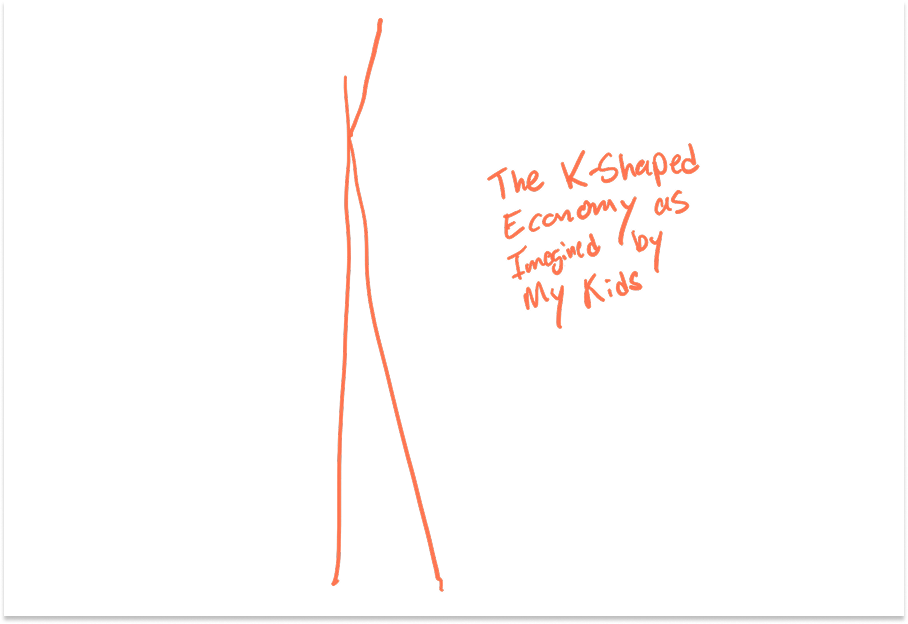
Anthropic will probably end its first week of trading at a much higher market cap than it goes out at, and it may well proceed to eat the entire economy en route to becoming the world’s first quadrillion dollar company. The economy very well may end up looking K-shaped in the way that my kids write K’s, with no sense of proportion, a few Anthropic employees at the tippy top each controlling one Bay Area fiefdom/polycule and the rest of us treating Claude with the proper respect in order to continue receiving our allowance from the Machine of Loving Grace (that or somehow outsniping Duet on Kalshi enough to eat).

While I have written that AI is more Oil than God (opens in new tab) (funny title image choice in retrospect), and I still believe that, it is also true that oil does not produce its own oil (opens in new tab), that you can’t replicate Microsoft Office (opens in new tab) with oil, and that oil is yet to produce a solution to Navier-Stokes (opens in new tab).
There is a world in which we look back at Anthropic’s IPO price and laugh at the idea that we ever valued an old school commodity LLM at ~\$1.4 trillion. Maybe there’s no new S-curve as intense as coding, because in hindsight, duh, the computers were really good at speaking computer and that didn’t transfer. Or maybe there is, but competition from OpenAI, Google, SpaceXAI, Meta, Chinese open source models, and the neolabs slows revenue growth just enough that compute commitments made in the boom times force the company to sell itself to Amazon or Apple or whoever.
There is another in which Dario has decided that laughing hurts the models’ feelings and well, he’s allowed to tell us not to laugh anymore, since he is the economy. A very real bull case for Anthropic goes something like: it has the best models and they are now improving themselves faster than ever, growing the lead in what may be a winner-take-all market, and unlike other winner-take-all markets, this one extends to all markets, because Anthropic can win whichever markets it chooses to point its smarter-than-anyone models at, from productivity software to medicine to … anything.
Anyone who tells you they know which of those two outcomes will come to pass is full of shit, and I am many things, but I hope not to be full of shit.
There are three arguments against this being a bubble more broadly, though, which are oft-repeated, sound right, and are exactly the things you’d expect to see in a bubble.
Note: I’ll use bubble here as the broad term but I might mean something closer to commodity cycles, and I certainly don’t mean manias, which are when price becomes totally divorced from reality, as with tulips.
The three arguments are:
Unlike other bubbles (lol WebVans and crypto), AI is actually an incredibly useful technology that is being widely and productively adopted in the economy.
These companies are generating real revenue, and growing incredibly fast.
The labs have shown they can be profitable, and any losses are just them investing to capture future growth.
Grant all three! In doing so, however, you’d be saying that the situation is exactly the situation that creates and then deflates bubbles.
A miracle technology arrives.
Early suppliers earn real profits because supply is short.
Demand looks bottomless, which is obvious to everyone in the early numbers.
The demand and profits pull in capital and competitors.
Everyone builds at once, even those who see the glut coming, locking in commitments at scarcity prices just to get capacity online.
Supply arrives, the technology gets better, and prices collapse.
Capital loses, consumers win, and the technology chugs on.
Capital flees, so new entrants can’t get funded.
A survivor or outsider with capital consolidates and becomes the low-cost provider.
Demand catches up, the technology proves bigger than anyone imagined, and the survivor ends up larger than all the failed companies combined.
None of this is new. It’s close to Carlota Perez’s Technological Surge Cycle (opens in new tab) and Edward Chancellor’s Capital Cycle (opens in new tab). Byrne Hobart and Tobias Huber wrote a whole excellent book (opens in new tab) in praise of bubbles and their role in ending stagnation. What is interesting, though, is that three of the main arguments you hear against AI being a bubble are steps one, two, and three.
The pattern keeps playing out precisely because each new technology really is so impressive that people believe this time, finally, is different.
The first seven steps are pretty consistent, like some law of human nature and capital markets. Steps 8-10 often, but don’t always, play out. Sometimes consumers simply dine on the industry’s corpses.
Take airlines. If ever there was a miracle technology, it was the ability for humans to fly through the air like birds. Flight seemed so improbable beforehand that The New York Times famously predicted it would take 1 million to 10 million years to figure out, just two months and change before the Wright Brothers figured it out.
So did the Wright Brothers get filthy rich? Did those companies that could fly humans through the air like birds become great businesses?
Well, here’s what Warren Buffett had to say on the matter in a 1999 talk at Sun Valley:
“Karl Marx couldn’t have done as much damage to capitalists as Orville did.”
In his 2007 letter (opens in new tab), he explained the logic behind the zinger:
The worst sort of business is one that grows rapidly, requires significant capital to engender the growth, and then earns little or no money. Think airlines. Here a durable competitive advantage has proven elusive ever since the days of the Wright Brothers. Indeed, if a farsighted capitalist had been present at Kitty Hawk, he would have done his successors a huge favor by shooting Orville down.
It is unpopular to say it now, perhaps, when everything is moving so fast, but in the long run, a business needs both a product that customers want to buy, and a durable competitive advantage to protect its margins from all of the other companies that want to fulfill those customers’ demands, too. They need moats, and airlines didn’t have them.
Even The Oracle himself, however, couldn’t stay away. In 2016, Berkshire took stakes in American, Delta, Southwest, and United to the tune of roughly \$7-8 billion. At Berkshire’s 2017 Annual Meeting (opens in new tab), he admitted, “It’s a fiercely competitive industry. The question is whether it’s a suicidally competitive industry, which it used to be.”
He sold all four at a loss in April 2020. He got hit by a Black Swan - COVID - but he pointed to the laws of supply and demand in his decision. “If the business comes back 70 or 80%,” he said, “the aircraft don’t disappear.”
So while not every industry based on a miraculous and broadly useful technology becomes a great industry or produces enduring businesses, they all end up having a bigger impact on the world than anyone could have imagined. Consumers end up winning, and humanity progresses.
There is nothing more optimistic, in fact, than believing that capital will fuel an oversupply of any new miracle technology humans can concoct and in so doing, make the technology cheap enough for everyone to benefit from. Miracles without moats, if you will.
It’s not that capital is stupid, quite the opposite. It takes a pretty spectacular technology indeed to rally the world’s capitalists to invest a significant percentage of global GDP behind a given technology. Oil, railroads, cars, internet. Each of these ended up being even more impactful than their most fervent boosters predicted. In the early days, for example, oil was used to replace whale oil in lamps; it went on to make cars and planes and modern life possible.
And it’s not like those involved don’t see that they might be overinvesting and creating the conditions for their own downfall, but like game theoretically, what are you supposed to do?
The British railways are a great example.
On my birthday, many years before my birth – January 26, 1846 – Charles Russell, chairman of the Great Western Railway, stood in Parliament and urged his colleagues to “expose and discountenance every bubble scheme.” He wanted Britain to slow down the approval of new railways.
In 1842, the first British railroads, including Russell’s, were phenomenal businesses. The Liverpool & Manchester, the London & Birmingham, and a few other early entrants were paying dividends of at least 10%. Great Western, a slightly less good railroad, paid between 6-8%.
Demand for rail transportation seemed bottomless, and there were only so many railways to serve it, at first, when building railroads was hard and prospects were uncertain, but over the next couple of years, entrepreneurs of varying degrees of seriousness introduced hundreds of proposed new railways, each hoping to cash in on those sweet early rail economics.
By the autumn of 1845, Britain was so consumed with railways that the Railway Times spent nine consecutive weeks using its lead article to attack The Times for warning about the speculation in railway shares. On November 17th, The Times published a special supplement tallying the capital required by 1,263 proposed railway schemes. In 1846, Parliament passed acts authorizing 4,540 miles of new track.
Of course Russell wanted to “expose and discountenance every bubble scheme.” Each one brought new competition, which he saw would drive down prices.
Clearly, he was not opposed to railway investment per se, for he himself was playing the game. At an 1848 shareholder meeting in Paddington, he explained why his own railway had taken on such extensive commitments in snatching up rival lines. The Great Western had acted, per (opens in new tab) The Times (opens in new tab), “in self-defence.”
New entrants have nothing to lose and incumbents have everything to lose and both get you to the same place: you have to invest.
That’s how Google is thinking about it today. Founder Larry Page reportedly said, “I’m willing to go bankrupt rather than lose this race.” CEO Sundar Pichai, on the company’s Q2 2024 earnings call (opens in new tab), told investors that “the risk of underinvesting is dramatically greater than the risk of overinvesting.”
Zuck agrees. In September 2025, on Alex Heath’s Access podcast (opens in new tab), he admitted that “it’s quite possible” that AI is a bubble. “If we end up misspending a couple of hundred billion dollars, I think that that is going to be very unfortunate, obviously,” he added. “But what I’d say is I actually think the risk is higher on the other side. The risk, at least for a company like Meta, is probably in not being aggressive enough rather than being somewhat too aggressive.”
History rhymes.
Earlier this year, Anthropic CEO Dario Amodei told Dwarkesh Patel (opens in new tab) that he believes a country of geniuses in a data center is coming soon, but that “If you’re off by only a year, you destroy yourselves.” To put a finer point on it, he said, “I could buy a trillion dollars a year of compute that starts at the end of 2027. And if my revenue is not a trillion dollars, if it’s even 800 billion, there’s no force on earth, there’s no hedge on earth that could stop me from going bankrupt if I buy that much compute.”
At the time, Anthropic had committed about \$100 billion to compute, a relatively sensible number. Competitors (cough, OpenAI) were being reckless, he thought: “I kind of get the impression that, you know, some of the other companies have not written down the spreadsheet that they don’t really understand the risk they’re taking.” For context, the following week, OpenAI told investors (opens in new tab) it was targeting about \$600 billion in compute spend by 2030, down from a \$1.4 trillion number it had previously touted. Whatever, horseshoes and hand grenades.
Anyway, in its S-1 (opens in new tab), Anthropic reported that it has now committed to \$900.9 billion worth of compute through 2045, about half of which is expected before the end of this decade.
This may be the absolute right move! 1. Who am I to say it’s not? 2. Revenue is growing fast. 3. If they don’t, someone else who is less spreadsheet-literate will. 4. They even make their own spreadsheet software now, and 5. This math is likely being run by a combination of incredibly smart humans and models so advanced that they’re too dangerous to release. Plus, Anthropic actually generated an operating profit in Q2 and would have done so again in Q3 excluding roughly \$2 billion in noncash donation-matching charges, so they may have their hand firmly on the tiller.
But like, sounds risky, per Dario. And sounds an awful lot like the British railways, then the American railways, even… cannabis?
Thank you Writing Gods. The growers got hit by the same oversupply issue, and now some of them are flying to AI data centers for safety.
Sounds like fiber, too.
We tend to dismiss comparisons between the dot com boom and bust and the AI boom because there were so many obviously dumb, revenue-less companies getting funded and adding dot com to their stodgy businesses’ names and popping 420% that that one was clearly a mania, right?
It’s worth separating the internet stock mania from the bandwidth bubble - overbuilding capacity based on optimistic early demand signals. We look back on it all as silly, but while things got heated, many of those businesses laying fiber were acting rationally, at least independently.
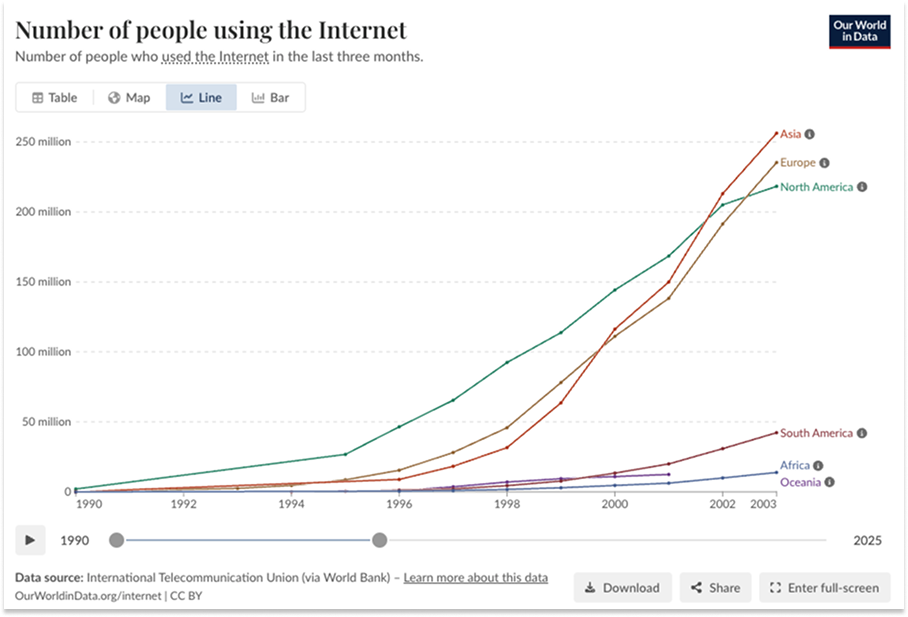
Internet traffic really was exploding. In 1990, basically no one was using the internet. By 1995, 9% of Americans were, and by 2000, 43% were.

And that was just Americans. The world came online, too, adding new growth S-curves. And that was just the current uses with low-bandwidth internet! I used early dial-up internet. It was painfully slow. It took a minute to get a picture to load, and anywhere from 20 minutes to forever to download a song, assuming someone in your house didn’t get a call. Imagine all of the new use cases that would be unlocked when everyone had access to practically unlimited bandwidth, on-demand. We would watch movies and TV on the internet. We would attend events on the internet. We would do business and buy things and come up with entirely new things to do on the internet once we had the bandwidth.
No less of a luminary than Bill Gates himself made this argument, back in his 1995 book, the #1 New York Times Bestseller, The Road Ahead (opens in new tab). And he fucking nailed it. Read that excerpt I just linked. He was totally right, and not even right enough. He wasn’t alone. Qwest Communications, a long-distance fiber optic carrier, made an ad that asked viewers to imagine a motel in which “All rooms have every movie ever made in every language, any time, day or night.” That motel was the internet, baby, and it was available right in your home.
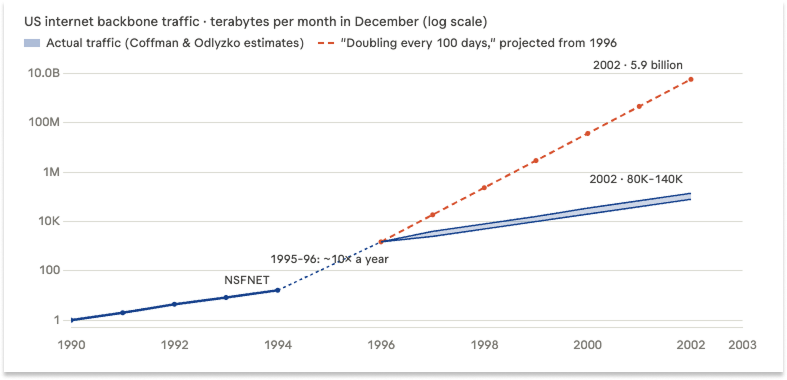
It was hard to imagine where and when demand for the internet would possibly saturate. A 1998 US Commerce Department Report, The Emerging Digital Economy (opens in new tab), stated that internet traffic was “doubling every 100 days.” Turns out, it got that number from a 1997 Inktomi white paper, which in turn cited Mike O’Dell, Chief Scientist of bandwidth-seller WorldCom’s UUNET, which, Andrew Odlyzko later figured out was a reference to WorldCom’s buildout pace - supply - and not demand, but no matter! The internet was ripping.
In a 1998 meeting (opens in new tab), Qwest CEO Joseph Nacchio responded to an investor question about Qwest and its competitors all laying fiber at once by pointing out that, “The explosive demand driven by the Internet phenomenon ensures there won’t be a glut of bandwidth.”
“If we were even modestly competent executives,” he added, “we’d do well.”
Qwest, which had begun as a division of the Southern Pacific Railroad and laid fiber on the routes the railroad owned, did do well, for a while.
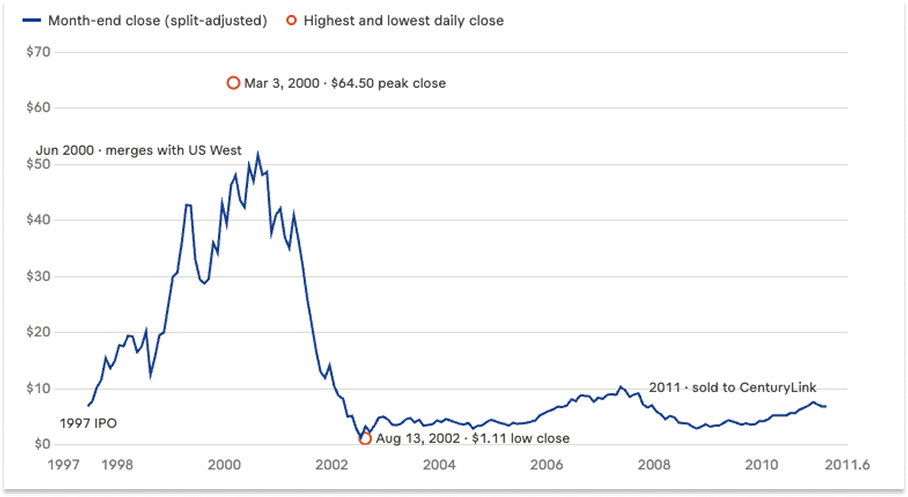
Qwest grew reported revenue from \$2.24 billion in 1998 to \$3.93 billion in 1999, thanks in part to its June 1998 acquisition of long distance carrier LCI, and its operating profit grew from negative \$754 million in 1998 to positive \$324 million in 1999. (Well, that and maybe some accounting fraud, per the SEC.) Its market cap rose to \$91 billion in 2000. Then it did less well. By August 2002, it had fallen to \$1.9 billion.

Qwest stock price data from companiesmarketcap.com (opens in new tab)
What happened? You’re reading this on the internet right now, from one of the at least two and probably a lot more internet devices that you use nearly all day, that you’re so addicted to, in fact, that you keep trying to stop using them so much.
After growing 10x in 1996, internet traffic really did double frequently – every year! – but it didn’t keep doubling the every 100 days that the broken telephone Commerce report suggested it was.

Data from Coffman & Odlyzko
Meanwhile, U.S. long-haul fiber mileage roughly doubled from 1996 to 2001 post the 1996 Telecommunications Act, from 100k miles to 200k miles, while upgrades to the electronics let each strand carry up to 40 times as much data, from 2.5 Gbps to 100 Gbps. In total, telcos spent something like \$500 billion on the buildout.
With all that supply, a 2002 TeleGeography report (opens in new tab) said that bandwidth prices on major U.S. and European routes had fallen about 70% annually for three years. In one example, a 155 Mbps circuit between New York and Los Angeles, a connection that cost \$1.8 million a year in 2000 could be leased for under \$150,000 by early 2002.
Humanity ended up putting that bandwidth to good use, and needing a lot more, but that was cold comfort to those who’d built out the network. WorldCom filed for Chapter 11 in 2002 amid fraud allegations. Williams Communications filed for Chapter 11 the same year under a \$5.9 billion pile of debt. Global Crossing did too, and emerged in late 2003, with its debt load lightened from \$11 billion to \$200 million. Preferred and common shareholders received nothing.
In the year that Global Crossing emerged from bankruptcy, it had explosive growth. Traffic on its network grew 130%! Problem was, bandwidth wasn’t worth what it once was. Its revenue fell 6% (opens in new tab).
The biggest winner – Level 3 – which had raised money at just the right time before the markets shut in February 2000, which had built a cost advantage by laying 12 conduits where others laid one or two, which had the post-crash backing of none other than Warren Buffett, and which rolled up many of its competitors’ corpses at advantageous terms, sold to CenturyLink in 2017 at a price 97% below its peak. Even identifying the eventual winner might not matter if you pay entry prices that assume away the corrosive forces of competition.
But again, what are you going to do? Not play ball? The internet is a fucking miracle. You can chat with anyone in the world, face-to-face, on your computer, or even on a piece of glass in your pocket. Unless you’re a local models guy, you access the country of geniuses in a data center via the internet. You buy things on the internet. You listen to things on the internet. You can watch every movie ever made on the internet, in any language, day or night, and you can even watch a bunch of movies and TV shows that were made specifically because the internet exists and demands more content than even Qwest Communications could ever have hoped the internet would demand. I don’t know what I would be doing without the internet, but it certainly wouldn’t be this. Thank god for the internet.
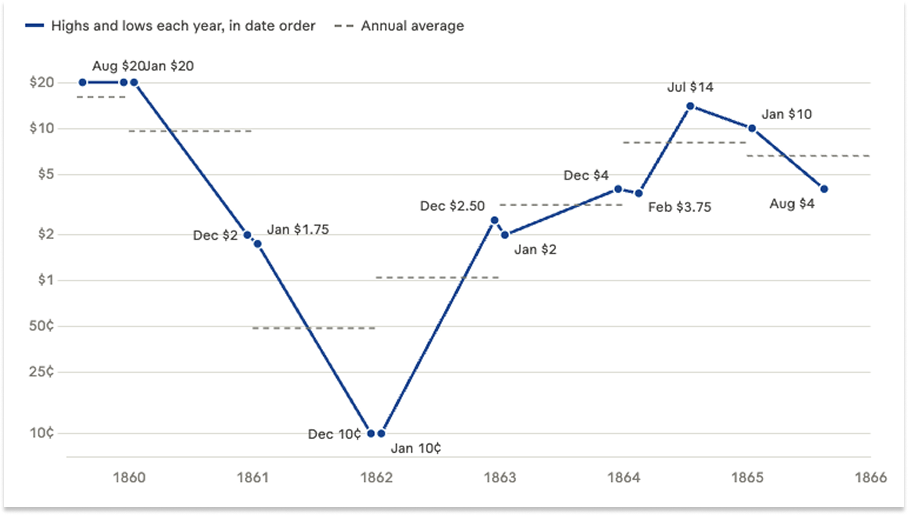
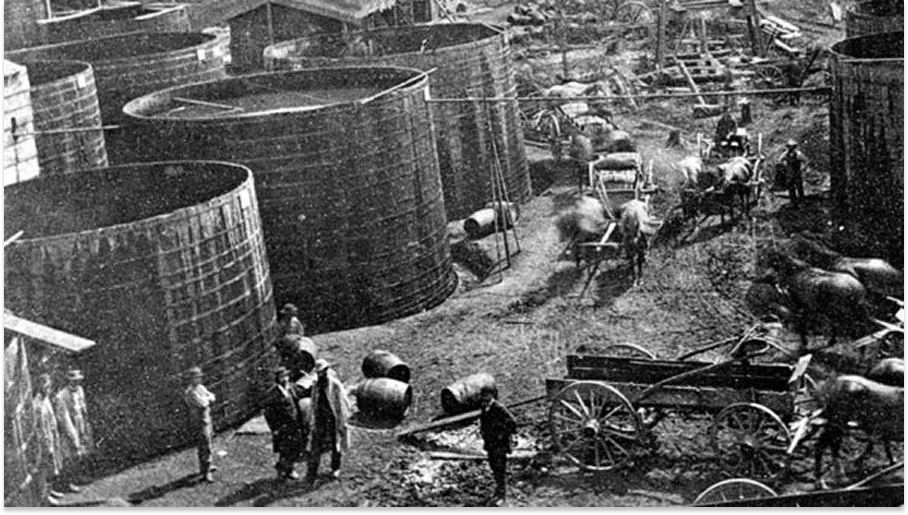
The fiber companies got a little carried away, sure, but they weren’t idiots. Neither were the people prospecting for oil back in 1860, the year after Colonel Drake (who would end up dying penniless) discovered it in Titusville, PA. Oil was going for \$20 a barrel, real money! Problem was, so many people saw that there was black gold in them there hills that the price of a barrel fell to 50 cents by June 1861, and to 10 cents by December, wiping out a ton of prospectors.

Numbers from Ida Tarbell’s History of the Standard Oil Company (1904), Appendix 57
This was not a demand problem, really, although I guess every supply glut is technically a demand problem. Even in the early days, when oil was used only for illumination, demand was practically bottomless. After the gusher-led fall-off in 1861, early wells depleted, demand spiked, and prices rebounded above \$8 a barrel in 1864 … which attracted more drillers and an even more frenzied atmosphere.
At Pithole, PA, some once-worthless farmland sold for \$1.3 million in July 1865 and resold for \$2 million in September. By Christmas 1865, almost 20,000 people lived there. By the Census in 1870, only 237 remained and by 1878, the \$2 million farmland was sold back to the county for \$4.37.

No Pacing on the Frontier: Pithole in 1865
Per PT Barnum (yes, that PT Barnum) in his 1865 Humbugs of the World, roughly 600 petroleum companies sought a combined \$500 million of capitalization. “Petroleum exists, no doubt, and is an important addition to our national wealth,” he wrote. “But the petroleum humbug… is a humbug.”
Investors were not wrong on the size of the opportunity. Oil was real, and a single oil company would come to support a market value greater than the entire \$500 million.
They got the market sizing right and ignored the competitive dynamics.
John D. Rockefeller did not. The man was too attuned to competitive dynamics, if you believe Ida Tarbell, Theodore Roosevelt, and the US Justice Department.
As we covered in Power in the Age of Intelligence (opens in new tab), Rockefeller, who started refining crude in Cleveland in 1863 and would incorporate Standard Oil in 1870, recognized that the constraint to the profitable growth of the oil industry was its volatility, that the way to tamp down on volatility was through scale and control, that to get scale and control, he’d need to drive down costs and capture market share, and that to do that he’d have to improve kerosene yield, sell what others threw away, and aggressively vertically integrate.
By the 1880s, Standard Oil controlled 90% of American refining, which fell to 64% by the time it was broken up in 1911, when its \$1.1 billion market cap represented about 6% of the entire US stock market and more than twice the entire industry’s capitalization in 1865.
Where others sought quick profits, Rockefeller sought durable competitive advantage. He won, and consumers certainly won - our world still runs on refined oil to this day - but countless others who totally nailed the scale of the opportunity died in pursuit of it.
Rockefeller was exemplary of the type of entrepreneur who typically comes out of these things on top. He anticipated the glut, and positioned himself to benefit from it.
Whether he’d put it in the same terms, Henry Ford did the same thing. There were something like 2,000 automakers in the first couple decades of the automobile’s existence in America, and from 1900 to 1919, as car ownership grew from roughly 0% to one-third of American households, nearly all of the 2,000 automakers that made those cars failed.
By the early 1940s, when more than half of American households owned a car, just three companies - Ford, GM, and Chrysler – sold 90% of them.
What Ford realized was that in a glut, being the low cost provider of quality, using low prices to get to scale, and using scale to get even lower prices and more scale was how you win.
Cornelius Vanderbilt, who TJ Stiles called “The First Tycoon” and who was the biggest American winner in railroads, didn’t even really care about railroads. His goal was to get as many people and parcels from one place to another as quickly and cheaply as possible, using the best technology available for the job.
Vanderbilt started with sailboats, made a fortune in steamships, and then made a bigger one in railroads. Across the latter two, he looked for routes with advantages in speed and cost. His route to California through Nicaragua was hundreds of miles shorter than the competition’s through Panama, which gave him an advantage so strong they had to buy him out. When the railroad looked like it would be a better way to move things cheaper and faster, he donated his biggest steamship to the Union Navy, got out of shipping, and rolled his capital into rail. But not just any rail - there was plenty of that. He bought the struggling Harlem Railroad, which had valuable access into the heart of Manhattan, reduced its operating costs, then connected it to lines he bought by the Hudson River and then on to Chicago. Amtrak still mostly runs on that same route today, that’s how ideal it was.
Vanderbilt was willing to change technologies, but consistently looked for durable competitive advantages. And while scores of his competitors, who’d rightly recognized that steam and then rail were the future too, lost their shirts, Vanderbilt died with a net worth of about \$100 million in 1877, which sounds like a moderately sized seed round, but for context: if he’d sold everything that day, he’d have taken one of every twenty dollars in circulation in America.
Today, Americans have access to relatively cheap flights, logistics, cars, oil, and internet, even if the people who paid in blood, sweat, and capital to make those things abundant didn’t end up surviving. That’s capitalism, baby.
As Yale economist William Nordhaus found in Schumpeterian Profits in the American Economy, “only a miniscule fraction of the social returns from technological advances over the 1948-2001 period was captured by producers, indicating that most of the benefits of technological change are passed on to consumers rather than captured by producers.” He calculated that producers captured only about 2.2% of the total social surplus from innovation, while consumers captured roughly 97–98%. That 97-98% shows up as lower prices, better products, and higher real incomes for consumers rather than as excess profits.
Hell yeah.
A 2004 NBER summary of the paper (opens in new tab) includes Nordhaus’ interpretation of the recent bust: “Part of the New Economy bubble might have arisen because investors overestimated the appropriability of innovations in that sector.” In other words, it’s not that what was built wasn’t valuable; it’s just that investors overestimated how much of the value they’d be able to capture for themselves.
Plus ça change.
Nearly every promising and ultimately transformational technology goes through this cycle. It’s practically a requirement for being a promising and transformational technology, with a few exceptions.
As I wrote in When to Dig a Moat (opens in new tab), startups need to develop moats before they run out of uncertainty. Normally, moats take time to develop, which is why a lot of ultimately successful startups emerge from categories that were highly non-obvious. In categories like oil and AI, the enormous potential demand is obvious to everyone. If you build it, they will come. When demand is near-certain, the only categories that avoided this cycle are ones in which entry was highly regulated like pharma, airlines under federal route regulations pre-1978, Bell Telephone until its patents expired in 1894, or Alcoa with its patented aluminum process. These are Cornered Resources, and when they lapse, competition floods in and the same dynamics play out.
Other edge cases include situations where demand is not certain, like when people don’t realize how good the business is (Amazon didn’t break out AWS profits for nine years, and cloud had killed companies pre-AWS), and when Process Power built on risky bets compounds over decades, as was the case with ASML.
Opportunities where you can’t just throw money at the problem in order to compete, for one reason or another, are somewhat protected. Everything else is subject to the laws of the jungle, and on a long enough timeframe, the jungle favors consumers.
One of the things that investors love about AI is that you can just throw money at it.
It also makes a lot of other things easier to build, which should set this cycle running across industries. Anthropic itself used frontier Claude models to weaken NVIDIA’s CUDA moat so that they and others can more easily… cheat on the world’s largest GPU supplier.
The net of it all is that I think we are entering an age of consumer surplus the likes of which humanity has never seen. We have focused on AI in this piece, but there is a boom underway in sectors from robotics to power to manufacturing to biotech.
Categories that once seemed impossibly sci-fi - from flying cars to robots - are now being pursued by so many smart, well-funded players, that the question seems to no longer be if, but how soon, and who will capture the profits? As we speak, there are companies devising cures for cancer that until recently would have been miraculous, but now get outcompeted by newer technologies within months.
As a human and consumer, I am so psyched to get to live through this Age of Miracles.
As an investor… I think it is simultaneously one of the most fraught and most exciting times to get to invest. There exist companies (opens in new tab) that, in my opinion, stand to benefit if the boom continues and if there is suddenly a fire sale on miracle technologies.
I like companies that are like Vanderbilt, Rockefeller, or Ford – there will be some bumps, but if a better technology or model becomes available, they can plug it in to deliver a better product more cheaply as opposed to being threatened by it. While the internet thrived on network effects, I suspect scale economies and cost advantages will be critical as technology once again reaches out into the physical world.
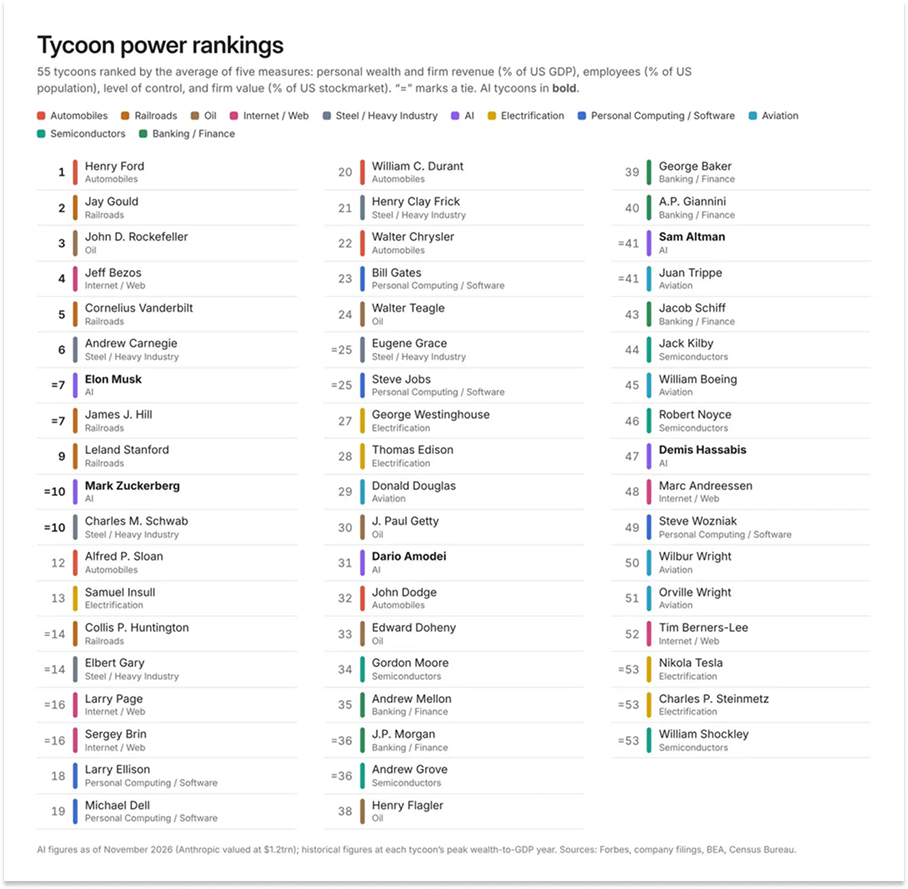
Coincidentally, after writing this, I saw a tweet (opens in new tab) with The Economist’s Tycoon Power Rankings (opens in new tab), and the leaders are exactly who this piece would predict: those Industrial Age businessmen who consolidated after the busts and created cost leaders, a Vertical Integrator in a non-obvious market (Musk), and people like Zuck, Bezos, and Sergey & Larry who took advantage of abundant internet fiber. The Wrights come in considerably lower, at 50 and 51, respectively.

The Economist via Callum Williams (opens in new tab)
And as for the Anthropic IPO, and the AI bubble more broadly? No fucking idea.
In AI itself, and in categories beyond, AI may simultaneously accelerate imitation and the accumulation of advantage. No matter how futuristic the technology in question, it is the presence or absence of durable competitive advantage that determines whether a business and its investors will profit from its proliferation. That, and the price you pay to get in.
The more miraculous your technology, the more crucial your moats.
That’s all for today. We’ll be back in your inbox Friday with a Weekly Dose.
Thanks for reading,
Packy
- Reducto’s sponsored launch of r-1 mini offers document parsing from $1 per 1,000 pages, preserving reading order, tables, and layout; Reducto says it processes more than a billion pages monthly for AI teams at Scale AI, Harvey, Toast, and Vanta.
- The essay argues that AI’s utility, revenue growth, and lab profitability do not rule out a bubble: those conditions can draw in capital and competitors, leading to overbuilding and price collapses even as consumers benefit. The scale of the compute bets is substantial: Anthropic reported $900.9 billion in commitments through 2045, about half expected before 2030 ends; OpenAI’s compute-spending target for 2030 was about $600 billion, down from a previously touted $1.4 trillion. Anthropic had operating profit in Q2 and, according to the essay, would have had it in Q3 excluding roughly $2 billion in noncash donation-matching charges.
- Packy’s investment lens is to favor durable competitive advantages, scale and cost advantages, and companies able to adopt better technologies rather than be displaced; he warns AI may accelerate both imitation and advantage-building, citing Claude’s weakening of NVIDIA’s CUDA moat. A cited Nordhaus study estimated that producers captured about 2.2% of innovation’s social surplus in 1948–2001, versus roughly 97–98% for consumers—an example of transformative technology creating value without equivalent producer returns.