We can't find the internet
Attempting to reconnect
Something went wrong!
Hang in there while we get back on track

Big Ideas
AI is exposing the parts of product that code cannot solve. A ProductTank Auckland talk described the Makers Manifesto, created by 45 practitioners and modeled as a starting point on the Agile Manifesto, as an end-to-end view of making: commercial viability, build, adoption, and growth—not build alone. Its principles call for purpose over possibility, explicit context, value measurement, pace matched to customer and GTM readiness, evidence-based learning, and ethical human accountability. As agents absorb build-cycle management, PM leverage shifts toward direction, adoption, and consequence ownership.
Selection is becoming a core product capability. Hiten Shah’s warning is that AI will generate more software, content, designs, and ideas than people can process. His hands-on Ori Eval test—416 calls across more than 20 models—produced different winners for coding, tool use, and vision, leading to a routing policy with guardrails based on how each model failed. The PM question is therefore not just “what can we generate?” but “what deserves to ship, under which quality bar?”
Tactical Playbook
Use an AI shipping gate, not a demo:
- Discover the problem. Ask users what problems they have, not only what features they want, and expect multiple ask-and-build cycles.
- Externalize context. Put customer evidence, domain assumptions, constraints, and success measures where agents consume them; context left in people’s heads will not travel fast enough. EasyVet’s PRDs combine architecture knowledge, clinical expertise, and an actual customer-interview repository.
- Evaluate on real work. Define quality dimensions with domain experts, compare LLM judges with manual evaluations, and report scores as learning signals until validated—not as settled scientific facts.
- Delegate reversibly. Let agents prepare or recommend; require a named owner to approve money movement, deletion, or other hard-to-unwind actions. Log inputs and outputs, a stop condition, an alert path, and recovery steps.
- Scale scrutiny to stakes. When teams shrink, deliberately add perspectives—people or different models—and match review standards to risk. Humans still sign the work.
Case Studies & Lessons
EasyVet used AI to buy back product time—and tie speed to user outcomes. The IDEXX team uses AI and forcing functions to split large “container ship” enhancements into smaller batches, balancing speed with quality and stability to increase learning. Reportedly, reduced PM busywork let a PM spend a week in an Australian clinic, feeding real observations into the PRD. In an ambient medical-notes workflow, the heat map of vets documenting at 8 p.m. moved into standard working hours, with a genuine lunch break appearing. The lesson is to use AI acceleration to increase customer contact and reduce a measurable pain, not merely to produce more artifacts.
Career Corner
For AI PM roles, show lived practice. One AI-PM mock-interview panel explicitly framed its view as non-industrywide but argued that side projects and AI use beyond the day job are becoming more important than scripted STAR-style conflict or negotiation stories. Its indirect questions test empathy, innovation, impact, and whether candidates can identify their own problems; senior candidates are expected to carry work through build, shipping, feedback, and adoption. Build a small AI product and document the problem, metric, evaluation or safety choices, and what user feedback changed.
Tools & Resources
Benchmark model choice on your own work. OpenRouter’s Ori Eval evaluates models against tasks in a codebase; Shah’s test shows why task-specific routing beats a single “best model.” Not Diamond Code is another new router that says it selects model and reasoning effort per step and claims 20–65% lower costs without quality loss. Treat that savings claim as a hypothesis to test against representative tasks, not a procurement fact.

New framework: the Makers Manifesto for AI-era product making
- Anthony Mart (chief of staff for product at Aura; ProductTank Auckland organizer and chair of Product Aotearoa, a nationwide community he co-created) presented the Makers Manifesto — deliberately named 'makers' rather than 'product,' because making spans the full product cycle from commercial viability through build, adoption, and growth, while AI's biggest acceleration so far is only in the build phase .
- The manifesto was created by 45 practitioners from around the world — mostly product people, plus engineers and designers, several of them published product authors, led by Faith, an Australian based in the UK — as a starting point for organizations navigating the AI shift; it has four values and 16 principles, deliberately modeled on the Agile Manifesto, whose creators were consulted .
- First value: purpose over possibility — "just because you can doesn't mean you should." Early principles: understand the problem worth solving; seek opportunities opened by new capabilities; build for durable advantage — the classic moat of "we spent 25 years building this product" has largely evaporated in the last 6–12 months now that anyone can build fast; and be more ambitious — none of this is an excuse to slow down .
- Further principles: harness speed with clear intent (accelerating in the wrong direction, or in all directions, helps nobody); make context explicit (AI answers improve with more context, so context must live at the point of consumption, not in people's heads); measure what drives value; match pace to readiness (shipping faster than GTM readiness creates an accumulating queue); learning loops over launch plans; make for adoption (human attention is finite — Aura's giant retail customers, including Walmart shop-floor staff, push back on faster shipping because training overhead is enormous); build on real evidence; reorient continuously (OODA loops now run much faster); and be ethical — speed raises the odds of accidental mistakes and "compounding disasters," and "AI did it" is never an acceptable excuse .
- As the unit of making shrinks from two-pizza to half-pizza teams of 1–3 people, the manifesto calls for deliberately replacing lost diversity of perspective (e.g., building with Claude and checking output with a ChatGPT-based engine) and for matching standards to stakes (low-stakes UI tweaks vs high-stakes facial-recognition features at Aura's retail crime platform). Most important principle: humans sign the work — a human must remain accountable at the end of any chain of agents, because the value created is ultimately for humans .
- Validation: a first draft was road-tested before CPOs, VPs and heads of product at the Leading the Product leaders forum in Melbourne (they "tore it to shreds"); the published version is the second/third iteration, and the group keeps retesting and collecting feedback (makersmanifesto.org), aiming for something general enough to endure but specific enough to use . When a workshop respondent said their organization wasn't mature enough to adopt it, Mart's retort: "your organization might not be mature enough, but your competition is" — AI is driving change much harder and faster than agile did .
- Use/adoption frame: much of it is "isn't this just good product management?" — but velocity makes previously ignorable weaknesses fatal: missing strategy and direction, uncodified context, weak test automation, and undocumented architectural patterns (AI agents can't extract knowledge from the architect's head). He sees the manifesto as a lens held up against an organization's ways of working to find what's overlooked; even if consultants co-opt it, that's acceptable if it helps organizations adopt it .
Case study: IDEXX/EasyVet — AI across the product development process
- EasyVet (cloud veterinary practice-management platform, founded 2006, acquired by IDEXX in 2021; IDEXX has 11,600 employees and ~10% year-over-year growth) started its AI journey with an executive mandate to experiment — monthly product guilds to share learnings and an annual in-person PM summit — using tools including Lovable, Cursor, and Claude within guardrails; it has since standardized on Claude and added enterprise guardrails without stifling experimentation .
- Guardrails: enterprise agreements with OpenAI and Anthropic so data is used only for transportation, not the vendors' learning, plus internal security so no PII or IDEXX IP reaches the models; AI vendors are vetted like any other data processor for GDPR and privacy compliance .
- AI-generated PRDs: a Claude skill writes PRDs straight into repositories for engineering agents, fed by an architecture agent, a clinical-domain expert agent, and real customer voices from Marvin.ai (the repository of all customer calls and interviews, segmented by theme and persona). The AI asks clarifying questions the PM hadn't considered, and the PM keeps the underlying customer data current .
- "Boats in canals" model: every enhancement is a boat that only delivers value once it reaches customers; AI and forcing functions split historically huge "container ship" features into smaller batches, optimizing for faster feedback and learning, balanced against quality and stability. The knock-on effect: PM busywork (user stories, Confluence docs, Slack, feature flags) dropped sharply, freeing PMs to return to first principles — e.g., a week on-site at an Australian clinic, feeding real-time observations into the PRD .
- Ambient medical-notes case study: vets with 15-minute back-to-back consults wrote notes in "pajama time" (~8 PM), hurting note quality and mental health; the solution is ambient in-room recording → transcription → model → notes saved to the medical record. Result: the heat map of note-recording times moved from an 8 PM "big red blob" into standard working hours, including a genuine lunchtime gap .
- Enterprise advantages over startups: an installed base giving daily feedback, an early availability group for fast iteration before GA, and historical data for baseline metrics (pajama time, profitability, patient care) .
PM role and career signals
- Build-cycle management is going away — "the agent herders are bots now"; PMs stuck there should move end-to-end into GTM, commercial strategy, upstream discovery, and growth. The valued profile is breadth across commercial → build → GTM → metrics → adoption, possibly as a "product engineer"; the talk relayed one industry speaker's take that "engineers are screwed, product managers are going to inherit the earth" .
- Cautionary signal: one unnamed company fired all its product managers believing AI could do the job; Mart's counter is that the product principles still have to be done — engineers will have to learn the discipline, including getting products adopted. Accountability also concentrates as teams shrink: a PM who ships code is accountable for it, and delegating accountability is no longer viable .
- Customer proximity must be continuous: "if you're a product manager who hasn't been talking to your customers in the last six months, you're kind of screwed." Aura's big retail customers now say they could "vibe code" what Aura builds — a sentiment that did not exist 3–4 months earlier — and much of today's capability didn't exist in November of the prior year, so customer expectations and competitive baselines are shifting rapidly .

Job-search case study: A 4+ YOE enterprise workflow-automation B2B SaaS PM in India, laid off the previous October with close to ten months of unofficial searching , has applied to ~3-4K jobs in 6-7 months and gets 1-2 interviews/week . He clears HR, hiring-manager, product, and case-study rounds but consistently loses final VP/Head/founder/CXO rounds on domain-specific questions (fintech, ad tech, etc.) , where interviewers expect industry-native knowledge he believes is normally learned on the job . Early on he declined two APM offers ; he now sits between APM roles (overqualified) and PM/SPM roles (lacking domain depth) . Rebranding his background as technical B2B SaaS / workflow automation / integration-heavy / AI-assisted helped pass earlier rounds but not final conversions .
Community diagnosis: Reaching final rounds consistently means companies already believe he can do the job — the candidate with direct domain experience usually wins . Another commenter sees the inability to connect across domains as a product-sense/positioning gap, and argues 4 YOE is not SPM level — aim for PM/TPM/PO roles instead .
Job-search strategy advice: If money is running out, take any job (even lower-paying/operations); otherwise keep applying broadly — it's a numbers game . In a contracting market, take any role offered . Alternative: narrow your search to industries near your niche and deep-prepare each final interview . Counterweights: one PM held out after layoff and landed a better role, advising an 'incremental win' ; another took a double demotion but finds it worth the salary loss .
Interview prep tactics: Keep answers short and clear ; tailor resume/talking points per company and ask clarifying questions ; research each target industry/company with AI to learn key metrics , but don't give AI-slop answers — an interviewer asked for 'the crux' ; use AI transcripts to review post-interview mistakes ; explicitly connect past experience to the role with specific examples in final rounds ; highlight transferable skills like conflict resolution and getting teams to deliver .
Market signals: Roles get halted, moved to another country, or deprioritized ; some believe management thinks AI can replace PMs ; employers are in a position of power and can add requirements to narrow the pool .

A founder whose startup collapsed after about five years of blockchain, AI, and full-stack development work names "having something that generates cash flow while you're building gives you a lot more room to make better decisions" as his biggest lesson, and is rebuilding through client work so his next product starts from a stronger foundation .
A commenter argues the idea → build → validate → make money → scale path is a dead end for most founders and instead recommends a hybrid business: make money from day 1 by delivering services while developing your own workflows, software, or business processes in parallel — called the only way to bootstrap without investor money .
One founder bridged the gap with 7-8 months of consulting, deliberately earning as much as possible to fund the next 12 months of building (plus a hiring commission from his network), then returned to building .
Client-work acquisition tactics: a job or temp work is the fastest bridge; freelance only closes quickly with existing skills, experience, and a network — otherwise plan for 3-9 months to close (3-8 weeks best case with a strong network and in-demand skill) . Sell a specific niche fix, e.g. "I can fix your [software] analytics integration in 48 hrs, as I already did for [past client]", with social proof — an acute, painful problem can close in 2-3 weeks; outreach funnel: talk to 100 people in 3 days → 5-10 calls → 1-3 closes . Prefer warm-network referrals/intros over cold email, which only works hyper-targeted with strong social proof ; one founder found referrals drying up forced a rebuild through cold email and founder outreach .
Post-failure career advice: review mistakes so you don't repeat them, but don't dwell — startup failure is often outside your control; "the startup failed, but you are not a failure" . To recharge between ventures, one founder took a deliberately non-manager university role, negotiated a 4-day week (5 days' hours in 4) plus 3-4 days WFH by consistently finishing ahead of deadlines, and advises listing priorities because time is a key asset .
- A PM who left a mature SAFe-based product org for a PE-owned startup-like role (first PM, outsourced engineering, no prioritization process, 3.5-year project with year-end deadline) developed shingles from stress and is reconsidering PM entirely, weighing a local PO role .
- Community consensus: such environments are the problem, not the person. "It's not that you are not cut out for PM, it's that you are not cut-out for the cutthroat world of PE-managed entities" — find a stable org that values the PM function . A PO "promoted" to PM by PE owners without a raise said anxiety/stress took a huge toll and left for a different role .
- Tactics for surviving high-pressure PM roles: turn off Slack after hours, make overtime a choice; ruthlessly prioritize and do only what you do best; remember "nobody is going to die if this project isn't finished and guess what the next one will be just as urgent" ; ask what actually happens if the project slips, and be willing to be fired for boundaries rather than sacrifice health ; keep pre/post-work routines (walking the dog, exercise) and hobbies to compartmentalize .
- Established larger companies are a proven lower-stress alternative: "Modernizing things to be slightly less out of date makes you look like a wizard because everything's been tried and tested to death elsewhere" — pay may be lower but WLB and mental health are priceless ; a PM who saw health issues at a PE-backed company and at an agency found Fortune 500 roles seldom tested their health , and large global firms allow sick/stress leave .
- SAFe critique: at large orgs SAFe can be "an excuse for the org to say they are 'doing agile'" with toxic management hidden in ceremony, stifling talented people; "AI-native SAFe" is seen as a bid for relevance — "command and control framework dressed up as agile" . Counterpoint: its structured PI planning reduces chaos, though with overhead .
- Job-search tactics: leverage network, use AI to optimize resume because AI will likely screen it, apply as a numbers game; be cautious about moving laterally out of PM unless intentional .

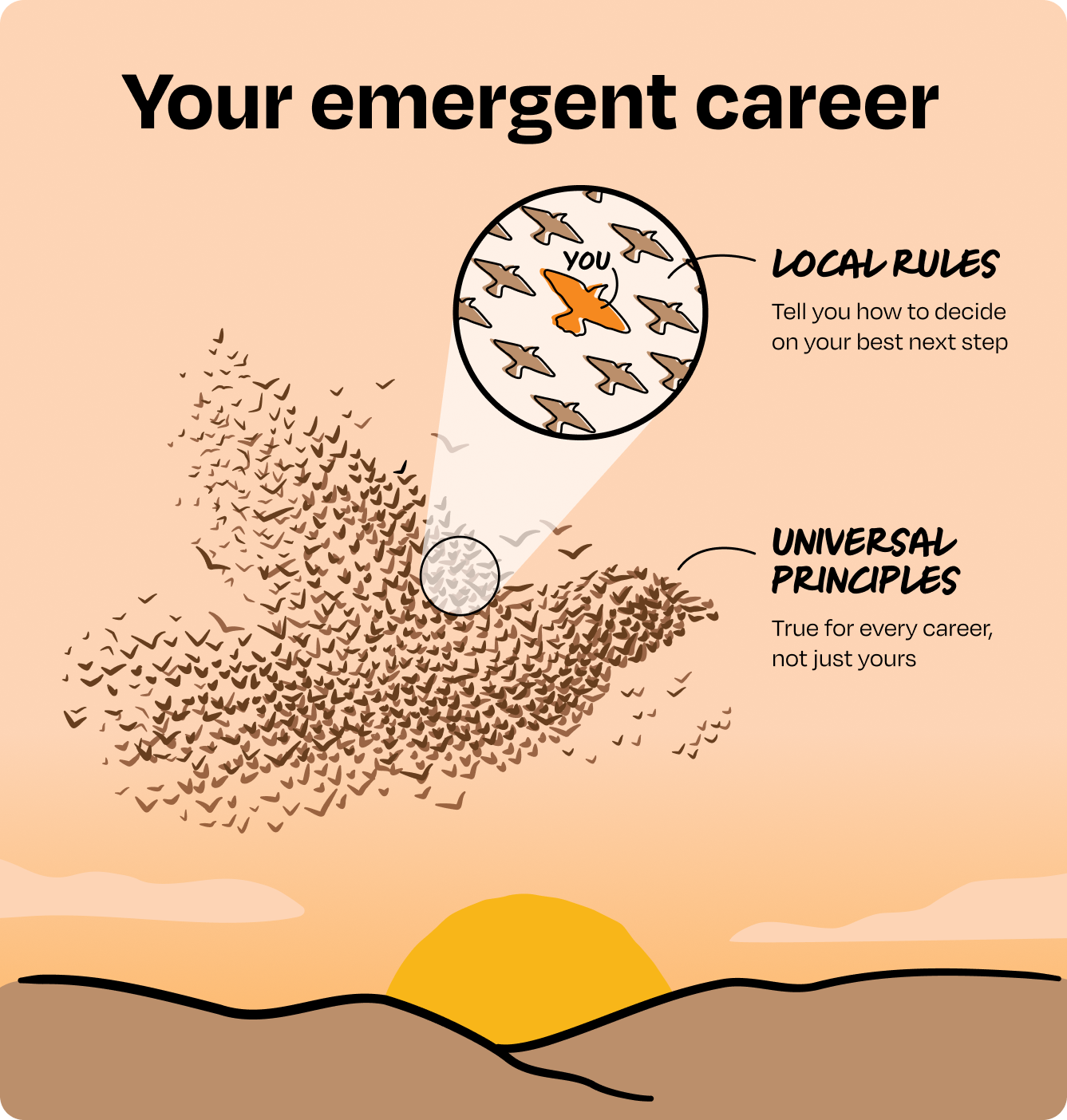
Guest author Molly Graham introduces 'emergence' as a career-building model: instead of long-term plans, get clear on personal principles ('local rules') and focus on the right next step, trusting the path to reveal itself . She contrasts this with Sheryl Sandberg's two-year/20-year plan advice, noting she never had a career plan . Mark Rober (YouTube creator) exemplifies this: no long-term plan, just principles and next-step focus . The two keys: define/redefine your local rules and follow universal principles that increase the odds of 'magic' .
Local rules from successful leaders:
- Mark Rober: content that teaches, quality over quantity, sustainability
- Claire Hughes Johnson (ex-Stripe COO): learning and impact
- Patty Stonesifer: love and be loved, seek justice, learn, laugh
- Adam Grant: interest, importance, impact
- Lenny: follow energy, keep quality bar high, be useful
- Molly early: learning, people, mission
To discover your rules, use energy as the signal—ask what lights you up —and try two exercises: (1) score each 30–60-minute block of your day for a week on a 1–10 energy scale ; (2) identify peak moments by recalling when you felt at your best, proudest work, and time-flew activities . Rules evolve; Molly later added 'seek joy' . Claire Hughes Johnson says she still doesn't know her life's work—she just optimizes for learning and impact . Molly's own path: stepped off the COO track four years ago, followed energy, built communities, and was offered hosting of TED's WorkLife podcast . The post lists universal principles for increasing 'surface area for magic', starting with 'Be the person everyone wants to work with again' .

- AI PM behavioral interviews are shifting to indirect, non-scriptable questions that map personal qualities to PM competencies: empathy/human touch in an AI world, innovation (anticipating user needs before users know them), and impact (metrics thinking); inability to show AI use in personal life is a red flag, and questions are designed so AI assistants can't answer for the candidate .
- Traditional STAR/behavioral interview stories (conflict, negotiation) are losing relevance for AI PM roles; side projects and demonstrated passion beyond the day job are now decisive, and general PM resumes are "not up to date with AIPM needs." Candidates need to live AI daily to envision product change .
- Principal/senior AI PM expectations: define your own problems rather than wait for assigned ones, think big-picture impact, own the full iteration loop (build → ship → gather feedback → improve) and act as brand ambassador, and brainstorm/build on others' ideas in vague problem spaces .
- Eval practice for generative-AI PMs: define quality dimensions with domain experts (e.g., designers), use meta-prompting to teach LLM judges those dimensions, validate LLM evals against manual evals, iterate until trusted, and report scores with context because they are a learning process, not objective facts .
- Safety is a gating condition at Microsoft for AI products: if safety evals fail, teams meta-prompt to fix or block the failing use case, and they will not ship an ethical risk; testing includes harmful/bad prompts .
- Side-project case study (children's book): a PM used ChatGPT for brainstorming/writing and OpenAI's image generator (referred to as "Dolly") for illustrations, chose a non-human main character (wheat sprout) because human illustration/consistency was poor, spent ~10 days writing and ~20 days on publishing margins, then presented in classrooms and used feedback as a product loop .
- Side-project case study (personalized math lessons): a PM built an MVP with Claude Code generating interactive math lessons framed in each child's obsession (e.g., WWII, Rubik's cube); engagement was high, but the lack of emoji/visuals for the obsession was a personalization gap that drove the next iteration (generating custom visuals) .
- AI PM "taste building" is emerging as a core skill: use meta-prompts to create a personal aesthetic rather than accepting off-the-shelf AI output; small elements like icons/emojis can make or break personalization, and current AI outputs look templated (e.g., purple gradients), so PMs can differentiate with human touches and micro-imperfections .

A contract solo marketer working with a bootstrapped father/son SaaS launched a lean Moodle-based LMS ('LMS Light') priced at $100–300/month versus $30K+/year enterprise alternatives, targeting B2B SaaS customer-success teams with the message that manual onboarding drains team time and drives churn. An early ad test on 'stop running manual onboarding' resonated, but the full LinkedIn campaign produced ~$600 in spend with high clicks and bounce and zero demo bookings — prompting the question of whether the problem is marketing or the product .
Messaging/category confusion was a leading diagnosis: commenters initially read the product as employee-onboarding training because LMS is an internal-learning category typically bought by L&D/HR, and the customer-onboarding intent wasn't clear until below the fold; the marketer reviewed the ads and agreed they could be confused with employee training — suggesting the category name itself may mislead .
The ICP was flagged as too broad: original LinkedIn targeting covered ~20 titles (VP/Head/Manager of CS down to CS analysts and support ICs, plus two L&D titles), company sizes 2–200, US only, ~61K audience, 87% CS/Support by function; advice was to drop IC titles and build a more concrete ICP . After the revision (management/exec titles plus Account Manager; 2–10-employee companies dropped), the audience grew to ~120K, and the marketer questioned whether that was too large .
Community framing: if people click but don't buy, it's likely the right product marketed to the wrong audience or the wrong product marketed to the right audience; ad engagement is not purchase intent — buying demands different, repeated tests; and the landing page copy read as generic .
Proposed experiments: land on 3–5 hypotheses and test — e.g., multiple landing pages each focused on a single value prop (such as pricing) instead of one page carrying every benefit, or routing ads to the homepage .
A funnel-isolation test to decide marketing-vs-product: send one narrow audience (senior customer-success leaders at SaaS companies that already create onboarding content) to a page that says 'customer onboarding' in the first line and shows the before/after workflow before the demo form; if that narrower traffic still bounces, the promise or proof is weak; if they engage but avoid the form, test the offer and demo trust before changing the product .
Sector caveat: the category is competitive and business flows through word of mouth, so network effects don't favor the vendor .

Teresa Torres endorsed Hiten Shah's statement that there is a right way and a wrong way to learn from the people you want to serve .
Commenters on a r/startups thread about getting first users without an existing audience converged on customer-discovery-first tactics:
Find the 20 people with the exact problem and talk to them one by one — "that's just conversation", not promotion — DMing them without mentioning the product until you've asked what they've already tried . Many already exist in your network; start with one no-pitch DM referencing a past complaint . The hard part is naming who they are by the specific situation that makes the need urgent today (e.g., "ops people who just hired their first SDR and realized they have no process"), not a broad persona .
Run customer discovery before launch and gather LOIs — receipts of interest and a call-back list . Some advise building nothing but a landing page until users put a credit card on it, calling that "the only strong signal that leads to idea finding a buying customer" .
At zero, treat distribution as research: find where people complain about the problem, note what made it urgent today, talk to those people transparently, and use the conversations to learn their language, alternatives tried, and which channel to scale .
Early users come from replies and conversations, not posts: answer questions where the problem is discussed and mention the product rarely — "every single person who's cared came from a conversation" . Tactics include searching complaint keywords on Twitter and DMing , and avoiding scale before finding a message that resonates, since early users with a real problem are the best referrals and testimonials .
Supporting practice: build a detailed customer profile (who, what, where, budget, goals) to decide where to meet them , and advocate as "champion of the problem, not just the product" .

Lenny Rachitsky promoted a guest post by Molly G arguing against long-term career plans: among the most successful people she has studied and worked with, none had a career plan; their paths emerged . The 'emergent career' approach: get clear on your principles, learn to follow your energy, and trust the path will reveal itself; uncertainty and faith create room for opportunities you couldn't have seen coming . Full essay: https://www.lennysnewsletter.com/p/what-if-youre-not-supposed-to-have.

OpenRouter launched Ori Eval, pitched as the easiest way to write your first eval; its premise is that there is no definitive best model, only the best model per task, and it uses OpenRouter APIs to evaluate results against tasks in your codebase.
Hiten Shah tested it against local models: he ran 416 calls across 20+ model variants on coding, tool use, and vision, and each task produced a different winner. The winners were GPT OSS 20B for coding, Qwen 3 14B for bounded tool work, and Nemotron 3 for vision.
Eval-driven testing exposed failure modes that simple benchmarks missed: Cascade passed tool checks but failed all five coding runs, and at 32K context GPT OSS broke the tool policy to get the right answer while Qwen followed the policy and got it wrong. It also surfaced trade-offs — GPT OSS 120B matched the 20B model on coding with fewer tool calls but used five times more memory.
The result was a local AI routing policy: GPT OSS for code, Qwen for tools, Nemotron for images, with guardrails based on how each model actually fails. Ori made model selection testable against his own work — a pattern product teams can reuse when choosing models for AI features.
Design sign-off is a formal approval practice most common in heavily regulated industries or high-risk contexts; in financial services, nothing can be released until compliance, risk, and security sign off . A PM at a 2000+ employee financial services firm is shifting sign-off from the feature definition stage to the production code stage, with ongoing design engagement beforehand to de-risk; designs currently aren't approved, only product requirements, as the firm moves from project-mode to product-mode . In unregulated contexts, sign-off often means senior people who don't trust product teams or processes needing to approve releases . For PMs, sign-off can also mean documenting risks when senior leaders override subject-matter experts, forcing them to own the consequences with their signatures .
Practical approach for getting sign-off: list all identified stakeholders and whether they've seen the design and approved, check with your manager for missing departments, then email the final list and approvals to all parties to formally mark the sign-off; keep written records as evidence . Sign-off should be a formality after stakeholders are already aligned, not the alignment mechanism itself . In health IT (HIT), software is treated as a medical device regulated by the FDA in the US, so lack of sign-off on features/functions/designs is critical when software could be a root cause of medical injury — document risks and get sign-off as a CYA tool .
Caveats: sign-off is an old practice in sectors like R&D/construction that has struggled to keep up ; it can devolve into a meaningless checkbox with no accountability, e.g., shipping software that misses design and deferring fixes until a major client threatens to churn .
An r/startups thread on choosing between product- and service-based businesses for fast revenue (founder context: software/agentic-engineering skills, goal of 5–7k MRR at 70–80%+ margins, no scaling or hiring ambitions ) surfaces a consistent service-first heuristic: pick service when cash flow is the priority, product when leverage, scalability, or recurring revenue is — but don't let fast cash alone drive a five-year commitment . Service wins on speed: immediate money, near-100% margin if self-delivered, and the revenue goal reached with 2–3 clients, whereas a product must be built first and needs 100+ users ; a product priced at ~$1k/mo takes ~10x longer to deliver than the equivalent service , and $500–1.5k/mo pricing makes it an enterprise-level sale that closes over months . Recommended path: start as a service to test willingness to pay, then productize the offering into a self-serve tool . Market narrowly even for services — a tight niche is easier to market and to manage demand in ; differentiation requires real domain expertise (e.g., no marketing tool without marketing experts) .
Hiten Shah predicts that the coming flood of AI-generated software, content, designs, and ideas will make selection one of the most valuable skills — i.e., a product manager's ability to choose among abundant options becomes core to the craft .

- A QA Lead with 11 years in QA/ETL testing and Agile/Scrum experience is seeking to transition to Technical Program Manager (TPM), asking for advice on skills, certs, and resume positioning .
- A commenter advises: TPMs often come from QA/dev; rewrite resume around ownership, delivery, and cross-functional alignment rather than bugs/test cases; volunteer to drive cross-team projects end-to-end, handle timelines and risks; certifications are marginal, maybe PSM; the job market is currently very difficult for getting interviews .
- The OP reports that after rewriting their resume they still cannot find product/program manager roles, illustrating the tough market .
- AI replacement pitfall: Founders frequently assume one AI agent can replace an entire business unit — e.g., replacing a whole sales team with an AI BDR tool like Artisan — a mistake seen across multiple startups .
- Better AI usage: Best results come from AI as a constrained mechanism doing one narrow thing with minimal oversight, or from assisting humans in decisions/speed; avoid applying "vibe coding" across design, sales, marketing — instead use human gates, layering prompts, and contextually seeding inputs .
- Case study: A team given a code zip with no design/requirements were told to upload it into Claude to "figure it out"; Claude-generated requirements, acceptance criteria, and tickets were so generic they could apply to any project, and Claude-written tests passed but failed when actually calling AWS APIs .
- Workflow redesign, not headcount removal: Companies getting the most value from AI redesign workflows around it; AI removes repetitive work but not judgment, context, and ownership — the best teams use AI to make good people more effective, not eliminate them .
- Support as signal: Removing support people removes the early warning system for everything wrong in the product; a bot that smooths over issues with polite apologies means the underlying product never gets fixed .
- QA caution: Replacing QA with AI failed at one startup because the QA team became lazy — not because people were fired .
- Safety framework for AI delegation: Use reversibility as the boundary — let the agent prepare/recommend, require a named owner to approve anything hard to unwind (money movement, deletion); keep a trace of agent input/output, define a stop condition and owner alert, and write a recovery step for the last action. If any is missing, the workflow isn't ready to replace the human exception handler .
- Constrained-agent example: One startup built a sales team around an Open Claw agent that only handles first contact, then feeds BDRs for follow-up .
An r/prodmgmt discussion surfaced the open question of how PM internship programs treat graduate students with prior full-time work experience—whether experience is seen as advantage or overqualification, whether programs have informal experience limits, whether experienced grad students are evaluated differently from direct-from-undergrad candidates, and whether ATS systems screen out based on years of experience . One commenter reports applying to PM internships with ~5 years of experience and receiving mixed reactions—some loved it, others saw them as a flight risk—and says it is now even harder given weak hiring conditions .
In an r/ProductManagement thread, a product manager sought a rich push notification tool for 70k active app users with minimum developer reliance . Community guidance: most customer engagement platforms support this capability, with Customer.io suggested ; direct experience with Braze and Airship showed initial app/SDK integration needs engineering support but ongoing use is largely self-service . Another user noted Braze was also recommended elsewhere , and selection depends on the specific push notification goals .
- A PM with a Wharton product management certificate, working in the credit union industry, is weighing further education (product-related, leadership, or project management) for 2027 and asks what career investments paid off most .
- Before paying for education, clarify the goal — the missing skill or next career step — otherwise it's spending money for no reason .
- PMI certification is viewed as a plus for PMs, but choose it based on goals (career advancement, skill-building, deficit-plugging) and interests .
- To explore the PMI path cheaply, study the PMBOK via a free online PDF, then decide on formal membership and the test .

An anecdotal report from a PM building a product observes that AI-era individual speed makes team coordination worse: work ships fast, then support/ops discover problems the hard way, no one holds the full story, and the burden of explaining changes and why they matter lands on a single person .