We can't find the internet
Attempting to reconnect
Something went wrong!
Hang in there while we get back on track
Hiring now tests the judgment AI can't supply
Aakash Gupta estimates that 40–45% of PM job seekers face at least one take-home or past-project presentation, and that 16–31% of PM hiring processes ask for one. His sources are his own interviews and cohorts of 160 job seekers . Anthropic's candidate rules say not to use Claude unless the company allows it . According to Gupta, graders ask three things: does the work beat the documents already circulating inside the company, does it contain an insight a chatbot wouldn't give everyone, and who put in the most effort. Some run submissions through AI detectors. The real test, he says, is "whether your judgment adds something that AI can't produce for anyone else with the same prompt" .
Mind the Product makes the same point from the hiring manager's side. If a candidate could pass your case study just by using ChatGPT, the round is measuring chatbot access, not the person . One suggested format is the "audit interview": give the candidate flawed AI-generated work, such as a metrics plan that tracks the wrong thing or a launch plan that skips a team that must approve, and see what they catch. Write the rubric first, or you risk hiring whoever sounds most like you .
Gupta also covered offer math. Annualize the sign-on bonus over how long you expect to stay. Value private stock as quoted value × odds of payout ÷ 1.15^(years until you can sell) . In his Series C example, the recruiter's $370K first-year figure works out to about $270K a year. That assumes a two-year stay, 40% payout odds and five years to IPO . If you plan to stay 2–3 years, negotiate on sign-on and front-loaded vesting. For 4+ years, negotiate on base and equity .
Observed, believed, tested
Ravi Mehta defines data fluency as turning data into insights that change what the team does, then tying them to business outcomes. "Activation fell" is an observation, not an insight . His warning for AI products: if users send more messages because the assistant's answers need correcting, engagement goes up while value goes down . The core skill is knowing whether you've observed something, believe it, or have tested it .
Hiten Shah's early-access essay applies the same discipline. Each kind of evidence answers a different question: a signup, a task done with the founder's help, an attempt the user makes alone, and a payment. Even payment doesn't prove the product keeps delivering value . Superhuman's "very disappointed" score went from 22% to 33% just because the team narrowed who it surveyed, before any product changes . On feature requests, Shah asks what the user was trying to do, what stopped them, and how often it happens. He warns that following a few highly engaged users can make the product harder for everyone else .
When Customer Success wants the redesign rolled back
On r/ProductManagement, a PM shipped a v2 that changed a legacy workflow. Analytics suggest most users adapted, but Customer Success wants a revert . The strongest reply pointed out that adapting isn't the same as being satisfied, since users may have found workarounds or just stopped complaining. It suggested separating three questions: is v2 better at the task, did the migration add avoidable friction, and is that friction big enough to justify a product change . Another commenter recommended agreeing with CS, in writing, on what would trigger a rollback. Examples: an account up for renewal that cites the change, or a task that measurably takes longer in v2. Anything below that bar gets enablement, not a reopened decision .
Building AI features and agents
- Proven/Better/New. Gupta, citing someone he calls Mark, sorts features into three groups: proven (copies what already works), better (rebuilt for the new platform) and new (never done before). Because AI is already new, keep the "new" share small. A new use case, built a new way, with AI added on top is "too much new" .
- Snaptrude Agent takes building design from a site to a construction-ready model and lets designers decide where cuts land when a budget shrinks. The company reports that more than 2,000 early-access designers ran more than 25,000 tasks. It also built AECBench, its own benchmark, because "an almost correct answer is still wrong" .
- SuperMe raised a $20M Series A led by Forerunner. It turns operators' work into profiles that help you work through a problem, available in group chats, Claude and ChatGPT .
- Treat early access as structured discovery, not just a signup count: find people already facing the problem, study their existing workflows before pitching a proposed solution, and use interviews, prototypes, MVPs, and alpha tests to answer different questions. Crazy Egg drew more than 23,000 prelaunch signups, but that did not establish whether its software helped; at KISSmetrics, roughly 18 months spent pursuing two misdirected product directions preceded workflow research that changed the direction.
- Select early testers whose work fits the product, but keep asking whose work is missing: a well-matched initial cohort can validate the core experience while remaining forgiving. Beam’s early testers exposed pointer offsets, display-size difficulties, permission and sleep issues, and keyboard/display problems; the team responded with input and sizing improvements, unattended-Mac support, and whole-desktop control. Beam reached #1 on Product Hunt on October 19; launch made demand for Intel Mac support more visible, and support for Macs running macOS 14 or later shipped on October 22. The ranking was a launch outcome, not evidence of repeat use.
- Translate feature requests into the underlying task: ask what the user was trying to do, what stopped them, and how often it happens rather than letting isolated requests set priorities. Assess value when the task next arises and how much help it takes; signups, founder-assisted success, independent use, and payment provide different evidence. Superhuman’s “very disappointed” score rose from 22% to 33% when the measured audience narrowed, then to 58% during later product development; the audience change came before that product work, and the survey was not a direct measure of retention or willingness to pay.
- Make beta expectations explicit: explain what works now, what may change, what feedback is wanted, and how users can get help; calling a product a beta does not make failures inconsequential. Gradually reduce founder-led onboarding to test whether users can reach value independently, and widen access to learn under less controlled conditions.
- AI can make a working first version possible in hours, but it does not shorten the wait for another meaningful opportunity to observe infrequent tasks. Working software can look complete before its assumptions are tested; synthetic interviews can help prepare, but real users’ work is still needed to establish whether the product solves a problem.
A roundup of 22 remote roles includes three senior product openings: 1Password’s Senior Director of Product Management – Developer & AI ($267K–$401K), Superhuman’s Head of Growth Product, Mail ($302K–$370K), and Affirm’s Senior Director of Product Management, Financial Platforms ($340K–$375K). A reply clarifies that the 1Password and Superhuman figures are base salaries and exclude equity.
- Treat early access as discovery plus real-world testing: find people already doing the job, study their current workflow before pitching a solution, then observe them using a working product. Choosing users who fit the initial use case can sharpen feedback but leave other teams, tools, and expectations untested; widen access to learn what happens in less controlled conditions.
- Prioritize the problem behind a feature request: ask what the user was trying to do, what blocked them, and how often it happens. Following a few unusually engaged users too closely can make the product harder for everyone else to use.
- Match evidence to the question: a signup, a task completed with founder help, an independent attempt, and a purchase each reveal different things; payment does not prove continuing value. For recurring products, evaluate use when the task next arises—not necessarily the next day—and test whether people can succeed without founder assistance.
- AI can speed up building and iteration, but real-world learning still depends on when users next have the task. For background agents, look for evidence that the work was completed rather than relying on dashboard visits; synthetic interviews cannot show what an actual person did.
- Make unfinished-product expectations explicit: describe what works now and what may change, provide support, and tell users what feedback is sought and what happens when something breaks. Calling a product a beta does not make failures inconsequential.
- PM take-homes or past-project presentations are common but not universal: the author’s interviews and job-seeker cohorts suggest 40–45% of PM candidates face at least one, while 16–31% of hiring processes request one.
- The author reports that Amazon, Airbnb, Anthropic, Uber, Intuit and Databricks assign them regularly, while several other large companies do so depending on role; Series A–D companies and AI-native firms may be more likely to use them. Common formats include PRDs, strategy or roadmap work, case studies, past-project presentations and AI prototypes, so candidates should tailor each response rather than reuse one submission.
- In the AI era, the author says hiring managers look for work that surpasses internal examples, offers a distinct insight rather than a generic AI-generated answer, and demonstrates effort through research and polished writing; the core test is whether the candidate’s judgment adds something AI cannot produce from the same prompt. Anthropic’s candidate guidance is cited as disallowing Claude use unless explicitly permitted.
a16z Speedrun’s SR008 residency is aimed at founders from the earliest stage—even before they have a company or settled idea—and runs Feb. 1–Apr. 18, 2027, in San Francisco. The program offers up to $1M and access to a talent network of 171,000+ engineers, designers, and product people; it reports 230+ hires through the network with no fees.
- In a hypothetical OpenAI product exercise, Bala proposed starting with animal-to-human translation for companion animals—initially dogs and cats—because she said human-to-animal audio lacked science-backed validation and could create safety and trust risks if wrong. Her opportunity case cited a $4–5 billion companion-animal technology and wearables market growing 15–20% year over year; she described Pet Chat’s 95% accuracy claim as self-reported and unverified, and said it had no physical product yet.
- To test demand, she proposed measuring how many ChatGPT users already ask it to interpret pet health or behavior, as a proxy for interest in an animal-focused model. She would target owners who treat pets as family, proactively invest in their well-being, are financially comfortable, and adopt technology early; the initial problem to solve would be triaging discomfort and detecting chronic illness early, since animals may mask pain and the outcomes are more verifiable than interpreting everyday wants.
- Her proposed MVP was an Animal GPT within ChatGPT, using smartphone audio/video alongside physiological data from existing wearable partners via APIs, rather than requiring OpenAI to build hardware. She positioned a more agentic product that takes actions based on its interpretations as a later step.
- Trust and safety guardrails included grounding accuracy claims in peer-reviewed research and third-party verification, routing at least 5% of outputs to board-certified veterinarians and behaviorists, and measuring success by positive outcomes from interventions rather than engagement. For health-related use, she recommended directional guidance rather than diagnosis and prioritizing high recall to reduce false negatives; on-device processing of raw media with only metadata sent to the cloud was proposed as a privacy measure.
Julie Zhuo says Jason Yuan’s theater background comes through in how he tells stories and creates visions . The episode describes Yuan’s path from playwright to Apple designer to Hivemind founder .
SuperMe is positioning operator expertise as AI-assisted problem solving: it says operator profiles can work through users’ problems in group chats with Claude and ChatGPT, and Brian Balfour invited users to use the group-chat experience to debate their problems.
SuperMe positions its product as making operators’ insights accessible without requiring users to have a strong network: it turns operators’ work into profiles that help work through problems, now in group chats and Claude and ChatGPT. The company announced a $20 million Series A led by Forerunner, with Greylock participating.
- Matt Angel argues that trust is more durable when grounded in a business model than in individual leaders: Paradromics’ implantable BCIs are prescribed by doctors, paid for by hospitals, and reimbursed by payers, which he says aligns the business with delivering for patients; platforms paid for by someone other than the user can instead be steered toward that payer.
- As BCIs move from decoding attempted speech toward inner monologue, signals may include private or automatic thoughts; a proposed safeguard is to separate what users want to say from what they want to keep private and let them control how each stream is used. Farahani also says patients have been denied access to neural data and offers have been made to acquire it, making data access and ownership material trust risks.
- In a speech prosthesis, a wearable transmitting 2 bits per second would leave AI to fill about 38 bits of the roughly 40 bits per second needed to transcribe speech; the speakers argue that higher data rates let users steer the system more directly and preserve agency.
- PM interview loops should assess judgment, not just the ability to produce a deliverable: one proposed exercise is to have candidates audit flawed AI-generated work, such as a metrics plan tracking the wrong thing or a launch plan missing a necessary team, then assess what they catch and how they explain it. Set a rubric beforehand to reduce bias. The intended signal is whether candidates can make progress on a messy problem, challenge AI output, and notice what is missing.
- LinkedIn renamed its entry-level APM program “associate product builder,” removed resume upload, and now asks for a 60-second video about a product people use plus answers to six questions. But AI makes polished prototypes easier to produce, and a demo alone may not show whether someone chose the right problem, would abandon a bad idea, or can work with others; taste is also subjective without a scoring rubric.
- Felix Reezberg’s product-relevant advice is to prioritize business impact over backlog throughput, choose one good idea, and build a working prototype over a weekend rather than write a PRD; he also argues newcomers may try things experienced people assume are impossible.
- As zero-click search reduced referral traffic to Philippine news sites by 85% and Facebook’s news distribution had fallen at least 60–70% by 2024, Rappler responded to a 49% advertising-revenue drop by building tech and data capabilities through its sister company Nerve. Its tools identified clusters of attacking messages and the networks spreading them; the tech/data business now contributes roughly 40% of Rappler’s revenue.
- Rappler launched a chat app in 2023 using the Matrix protocol, with 65 Filipino news groups and a rollout into Southeast Asia. The federated product is intended to avoid manipulation and protect information integrity, though Rappler cautions that it may feel “boring.”
- A cross-company trust-and-safety effort gathered tools from companies including OpenAI and Discord, refined them, and made them available free to everyone.
- Ravi defines data fluency as turning data into actionable insights, using them to achieve product goals, and connecting those goals to business outcomes; more activity is not necessarily more value—for example, repeated corrections to AI answers can raise engagement while reducing value.
- Use a four-rung ladder: report what happened, analyze where the pattern occurs, form a possible explanation, then decide what to change and test. Check whether the change produces expected outcomes; distinguish what is observed, believed, and tested, since a pattern or explanation alone does not prove causality.
- AI makes it easier to query structured data and analyze unstructured customer evidence, but wrong data definitions, flattened customer differences, and correlation can mislead. Use analyst and data-science expertise on data trustworthiness, hypothesis testing, and interpretation rather than treating experts as a report queue.
- Data-fluency expectations grow with scope: APMs instrument launches and question metric meaning; PMs investigate behavior and evaluate outcomes; senior PMs frame investment decisions; leaders establish shared standards and an evidence-led culture.
A free session on deciding what to improve before launch once people are trying a product is scheduled for tomorrow at 10am PT; Hiten says it will show the early-access process behind the latest launch. Registration: https://www.hiten.com/early-access-101
Hiten Shah announced a session for AI app builders, scheduled for the next day at 10am PT, on reaching people who need the app and learning what would make them use it again; the announcement links to an early-access page.
Hiten Shah said one X post helped his team find early users before a launch; their feedback surfaced missed problems and changed what shipped. He previewed sharing the research, decisions, and a six-play process for applying the approach to a product.
- For AI features during a platform shift, apply Proven/Better/New: reuse proven patterns, adapt them for the platform, and limit genuinely new elements because AI is already novel; combining a new use case, implementation, and AI can stack too much novelty.
- PM take-homes are common in the author’s samples: 40% (8/20) of interviewed candidates had faced a take-home or past-project presentation, 31% (4/13) of interviewed hiring managers assigned them, and 45% of job-seeker cohort members had faced at least one; the author estimates 40–45% of job seekers and 16–31% of processes encounter them. Assignments include PRDs, strategy or roadmaps, case studies, past projects, and AI prototypes; evaluators look for work that beats internal examples, offers insight beyond generic AI output, and shows effort through research and strong writing. Anthropic’s cited candidate rule is not to use Claude unless explicitly allowed.
- For PM compensation negotiations, annualize sign-on pay over expected tenure and value private equity as quoted value × odds of payout ÷ 1.15^(years until sale). In the example, a $200K base, $30K target bonus, $40K sign-on, and $400K in RSUs work out to about $270K in effective annual compensation—not the $370K first-year figure—under the author’s assumptions of a two-year stay, 40% payout odds, and five years to liquidity. For a 2–3-year stay, prioritize sign-on and front-loaded vesting; for 4+ years, prioritize base and equity.
Before FYI existed, the team’s survey asked respondents how they could participate in building the software; 653 people answered, and the team conducted 52 interviews. Hiten Shah also previewed a session on finding early users and deciding what to build.
For a candidate with 10 years of fintech experience moving toward AI product management, commenters advised targeting AI-PM roles at fintech companies, arguing that domain knowledge may be more valuable than another certificate and can make a stronger pitch than entering a new sector . Another commenter recommended hands-on practice with AI assistants such as Claude, Grok, and ChatGPT rather than relying only on coursework or established learning tracks .
A thread about DoorDash buying Instacart asks what the deal could mean for the companies’ PM organizations . One commenter predicts that many PMs would work on integrations for 3–6 months before layoffs, viewing an acquisition as a poor sign for employees .
What is early access?
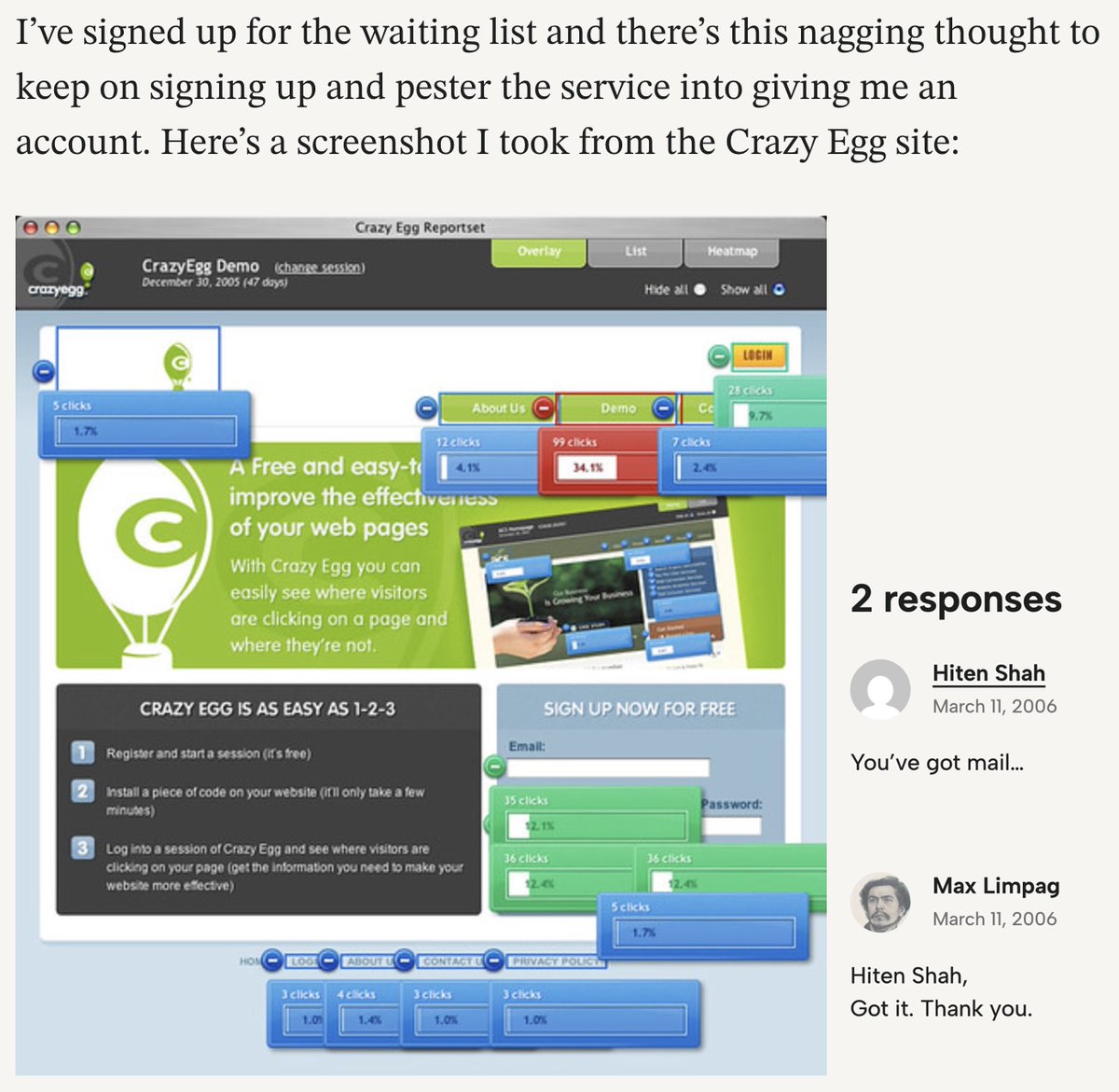
Before Crazy Egg launched in 2006, more than 23,000 people signed up for early access. One of them wrote a blog post asking to get in sooner. I replied with three words: “You’ve got mail…”
His name was Max Limpag. He’d joined our waiting list, but he wanted access sooner. He called the post “I want my Crazy Egg.” Max got his invitation, and the exchange is still online (opens in new tab).

Neil Patel and I were building Crazy Egg to show people where visitors clicked on their websites. More than 23,000 people had signed up before the public launch. We had reached many of them through web design communities and ads on CSS galleries. Over the months leading up to launch, we gave early versions to people in our target audience and watched how they used them.

Early access means letting people use a product before it’s generally available. It could be a private invitation, a public beta, or a paid product still under development. What these have in common is that people get to experience something the team is still improving.
When I run early access, the work often starts before there’s anything to use. I look for people who already have the problem, study how they handle it, and invite them to help shape what we’re making. That’s customer discovery. Once they can use the software, I want to see what happens in their actual work and let that evidence influence what we build next.
I’ve been doing versions of this for more than twenty years. Some experiences helped us find a better direction. At other times, we spent too long pursuing assumptions that should have been questioned much earlier.
This Friday at 10 AM PT, I’ll show how we used early access to learn from real users and change what we built before launching our latest product. Join Early Access 101 for free. (opens in new tab)
The work starts before the invitation
The original Crazy Egg landing page (opens in new tab) was an invitation to people who cared about how their websites performed. Those email addresses told us we’d found substantial interest. We still needed to see whether the software helped people improve their sites.
I saved that page and several other early product pages in an old Hitenism article about validating business ideas (opens in new tab). It has the original landing pages and surveys for Crazy Egg, KISSmetrics, KISSinsights, ShareFeed, and projects that never became recognizable companies. Looking at them now, I’m struck by how much of the work involved finding the right people and asking about what they already did.
ShareFeed began with a simple tool we were already using to find and share links on Twitter. We asked other people about their sharing habits before growing it into a small SaaS product, which Buffer later acquired (opens in new tab).
At KISSmetrics, the consequences of misunderstanding what people needed were much more expensive.
We spent roughly eighteen months pursuing two directions that missed the mark. One was analytics for Facebook application developers who weren’t in a position to support the business we wanted to build. The next required people to invest too much effort in setup before seeing value. We had software to show and people who could react to it, but important assumptions about the customer were still wrong.
I wish we’d studied their existing workflows earlier. We eventually did, particularly how people were using Google Analytics and where it was failing them. That changed the product direction, but we’d already spent a lot of time.
By March 2011, when I presented the KISSinsights story at SXSW, we’d developed a more deliberate process. The original slides (opens in new tab) record about twenty phone interviews, three paper prototype tests, two landing pages, a rough MVP on the KISSmetrics website, and eight alpha testers.
Each gave us something different to work with. Interviews helped us understand the difficulty of getting useful customer feedback. Paper prototypes let us test possible approaches. The rough MVP showed what happened when a feedback tool became part of a real website.

Finding people who can show you the problem
We used a similar approach when Marie Prokopets and I started researching FYI in 2017. We spent five hours writing a six-question survey about people’s work with documents. We avoided describing the product we imagined because we wanted to learn how they currently found and organized files.
The last question asked how they could participate in helping us build the software. People could volunteer to talk, review screenshots, or try an early version. We received 653 survey responses and conducted 52 interviews. Those were two different steps in the research. The interviews helped us understand what people were struggling with and find participants for the next stage.

You don’t need an existing audience of thousands to start this way. Look for the places where people already discuss the job your product could improve. Ask about the last time they did it and what they used. Someone who has worked around a problem for years can often teach you far more than somebody who says a new idea sounds interesting.
The people you invite determine which problems you’ll get to see first.
When Linear was preparing its first product, the team screened people on its waitlist (opens in new tab). It had built an issue tracker aimed initially at small software startups, with GitHub as an early integration. Inviting teams whose work already fit those capabilities gave Linear a way to learn about the core experience before expanding the product.
That gave the team useful feedback on the product it had actually built. It also meant learning from a fairly forgiving group. As Linear expanded access, it would encounter other teams, tools, and expectations.
When your first users love what you’ve built, it’s worth asking whose work hasn’t been represented yet.
A working product changes what you can learn
After the FYI survey and interviews, we built a search-focused MVP in five days (opens in new tab). It connected document services so people could search across them. We tested it over the following month with two groups of ten.
The test exposed a problem that was difficult to settle in an interview. People often couldn’t remember the file title or the keywords they needed. They were more likely to remember who had shared something or what they had been doing when they saw it.
We started exploring ways to find documents through people and activity, not only search terms. That was a product decision shaped by people trying to finish a real task.
I saw the same kind of learning with Beam this fall.
Sam and I kept opening Screen Sharing to reach one application running on another Mac. We built Beam to bring that window onto the computer in front of us. It worked on our machines. On September 5, I asked people on X about their multi-Mac setups (opens in new tab) and invited some of them to try what we’d made.
One early tester liked how little of the Mac’s resources Beam used compared with Screen Sharing. Their mouse clicks also landed a few pixels away from the pointer. They had a 50-inch display attached to the other Mac, and getting the window to work comfortably from a laptop was difficult.
We could bring over the window. The tester was still struggling to use it for their task.
Others ran into permission dialogs outside the remote window, sleeping machines, and keyboard or display behavior we hadn’t seen on our own setups. Sam kept improving the product as those reports came in. We worked on input and sizing, added support for more situations involving unattended Macs, and eventually provided a way to control the whole desktop when a single window wasn’t enough.
The environments people bring into early access are part of what you’re testing. That applies well beyond desktop software.
Before eero released its home Wi-Fi system, the team ran a six-month beta across different kinds of homes (opens in new tab). The beta included different layouts, internet providers, devices, and levels of technical experience. One participant even wanted Wi-Fi in a treehouse. A router that works in an office doesn’t establish that it will work in someone else’s home.
These are exactly the kinds of failures I want to discover before opening a product to everyone.
The hard part is deciding what to change
Once real people start using a product, suggestions come quickly. Many are reasonable. They don’t all belong in the product.
A request for more search filters might mean someone can’t find an important document. A request for another dashboard might come from a question a customer needs to answer every week. I try to understand what happened before deciding whether the requested feature is the right answer.
Following those requests too closely creates another problem. A few unusually engaged users can persuade a team to build for their specific habits. Each feature looks justified when considered alone. The result can become harder for everyone else to use.
I’ve learned to ask what the person was trying to do, what stopped them, and how often the problem comes up. Then we have to decide which problem we’re actually trying to solve. Sometimes that means building the requested feature. Sometimes it means choosing a different solution or explaining why we’re not going to do it.
Supergiant Games went further with Hades. The studio designed it around early access from the beginning (opens in new tab). Players used the game while the team developed it, and the release approach influenced the game’s structure and even how its story unfolded. Version 1.0 arrived in September 2020.
Early access can shape a release plan. In some products, it changes the product’s design. The essential work is deciding which observations deserve a response and what that response should be.
What happens when the person needs it again?
The first experience can tell you whether someone gets value. For a product used repeatedly, I also want to understand the next opportunity.
With Beam, the question was which tool someone opened when they needed an app on another Mac again. Some people came back with problems and tried newer builds. A few told us they had started choosing Beam over Screen Sharing for parts of their work. One early user publicly recommended Beam (opens in new tab) after describing nearly a month of beta testing.
That was encouraging evidence about particular people. We couldn’t turn those reports into a retention rate for the entire early group.
A person might not return because your product failed them. They might also have no reason to repeat the task yet. A monthly reporting tool shouldn’t be judged by whether someone opens it the following morning. An AI agent might perform its job successfully while the user never visits a dashboard.
I want to know whether the product delivered when it was next needed. And I want to know how much help it took to make that happen.
Rows provides a revealing example of that second question. During its beta, the spreadsheet company spent years onboarding people individually (opens in new tab). Those calls helped the team understand the work and get people to their first useful result. Rows also recognized that the users were unusually motivated and often received personal attention.
When Rows gradually opened access without onboarding calls, it was testing something new. Could a person who’d never met the team get value on their own?
That transition matters for any product whose founders are manually setting up accounts, adjusting data, writing prompts, or fixing problems behind the scenes. Helping people succeed can be the right thing to do early on. Eventually, you need to know what happens without that help.
Be careful what you count as proof
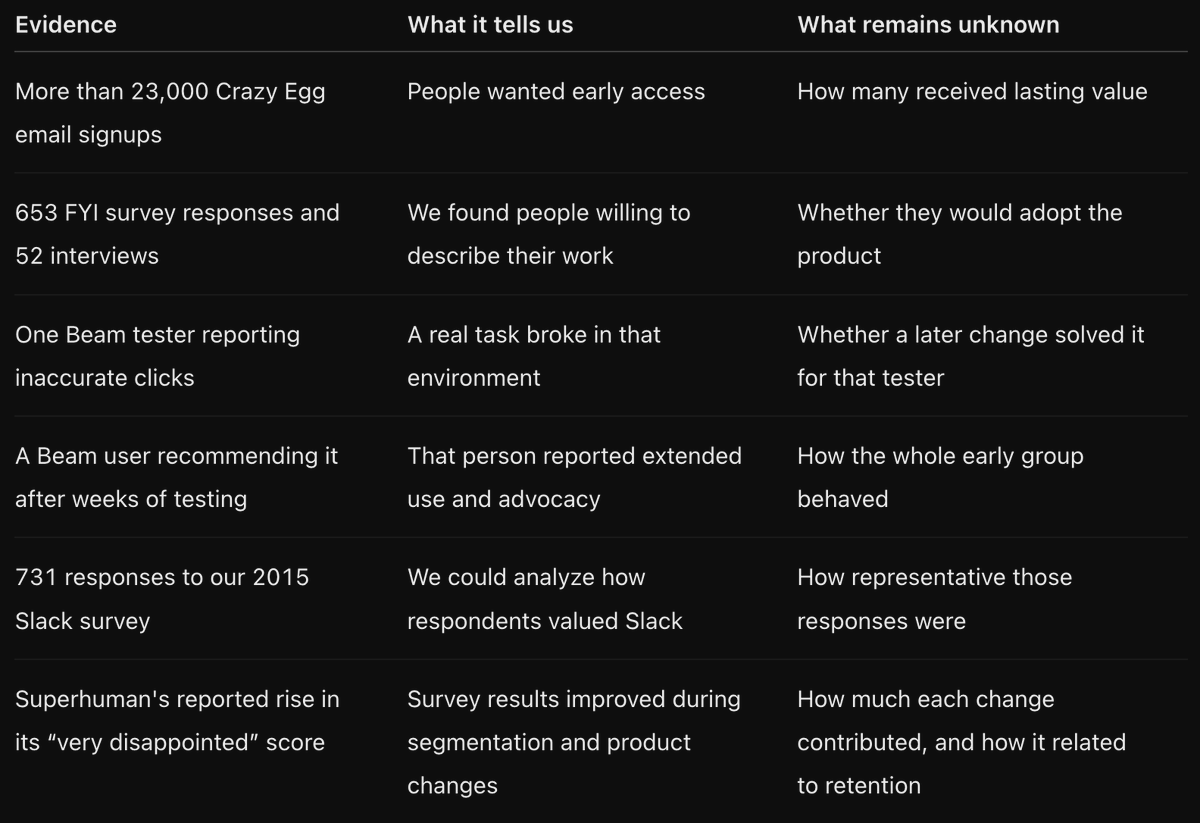
I’ve seen founders celebrate large waitlists and worry about small betas. The numbers deserve a closer look before they drive a decision.
Here are a few from products I’ve worked on or studied:

The Slack example connects to an earlier experiment of mine. In 2015, I worked with volunteers on an open research project about Slack (opens in new tab). We received 731 survey responses. Fifty-one percent of respondents said they’d be very disappointed if they could no longer use Slack.

Rahul Vohra later referenced that research when explaining Superhuman’s approach to product-market fit (opens in new tab). His team surveyed users, studied the group receiving the most value, and worked on the problems standing between other relevant users and that experience. Superhuman reported its “very disappointed” result moving from 22% to 33% when the team narrowed the audience being measured, and later to 58% during further product development.
That survey helped the Superhuman team make decisions. The numbers still need their context. Narrowing the audience changed the score before the subsequent product work; the survey wasn’t a direct measurement of retention or willingness to pay.
The same reasoning applies to early access. A signup can identify somebody worth talking to. A task completed with the founder’s help shows what’s possible under those conditions. An independent attempt tells you something else. A person paying to solve a problem introduces an economic commitment, though it doesn’t prove continuing value.
I prefer deciding what question needs an answer before choosing a metric. The next useful piece of evidence is often more specific than a dashboard number.
Access creates expectations
People who try unfinished products are giving you their time. They may also be handing over data, changing a workflow, or spending money. They need to know what they’re getting.
Steam has unusually explicit rules for paid early access (opens in new tab). A game should offer value in its current state. Developers shouldn’t sell it on promises about features they may never ship. People should be able to understand what works now and what is likely to change.
I think the underlying principle applies to every product category. Describe the state of the product clearly. Make support available. Tell people what feedback you hope to get and what will happen when something breaks. Don’t assume that calling something a beta makes failures inconsequential to the person trying to use it.
We learned that in a very ordinary way while preparing Beam’s commercial release. We introduced accounts and plans. Some existing early users ran into sign-in loops or access they hadn’t expected. We’d spent weeks improving how people reached another Mac, and then our own account system made it harder for some of them to get there.
The account system wasn’t separate from their experience of Beam. It was now part of the product they had to rely on.
Those are the moments when early access can earn trust or lose it. People don’t need you to build every feature they request. They do need an accurate understanding of what they’re using and a reasonable way to get help.
Opening access to everyone changes the test
At some point, the next useful step is to invite people who haven’t been carefully selected or personally helped.
Linear gradually expanded its beta and experimented with an optional paid plan before opening more broadly. Rows reduced its dependence on individual onboarding. In each case, the team could observe what happened under less controlled conditions.
A public release also changes the stakes. Someone using a feature inside an existing product may need a way back to the old workflow. A product handling important operational work may need a higher reliability standard than a reversible experiment. And a product can be useful to employees while still lacking a buyer willing to pay for it.
There’s no universal number of interviews, signups, or happy users that tells you it’s time. You need to decide whether the current product delivers enough value, what failures remain, and what you’ll be able to learn by widening access.
Beam reached #1 on Product Hunt (opens in new tab) on October 19. It was gratifying to see people who’d spent weeks using it recommending it publicly. The launch also exposed us to new questions and setups. Demand for Intel Mac support became more visible, and we shipped it for Macs running macOS 14 or later on October 22.
The ranking was a launch outcome. We were still working on the product, and we still needed to learn what people would choose when they next had the problem.
AI changes the time between building and learning
In 2005, producing a usable product could take a long time. Today I can build a working first version with AI in hours. I can try another approach after an afternoon of research and make a change as soon as someone encounters a problem.
The time it takes to build software has dropped dramatically. The chance to see whether it works in a person’s real job still depends on when they need it.
If your product helps with a monthly financial report, you can rebuild it ten times today. You won’t get ten new month-end reporting cycles to observe. If an AI agent runs in the background, opening its dashboard may tell you very little about whether the work is being completed correctly. You’ll need evidence from the work itself.
For tasks that happen frequently, AI can make the learning loop much faster. A problem observed this morning can become a better version someone tries this afternoon. For infrequent tasks, the wait for another meaningful opportunity remains.
Steve Blank recently wrote about the Initial Untested Product (opens in new tab): software that looks complete before anyone has tested the assumptions behind it. I think it’s a useful description of the risk. Something running on your laptop can feel finished, even when nobody has established whether it solves a problem people care about.
I use AI to organize research, look for competing explanations, and make it easier to prototype changes. Synthetic interviews can help me prepare. They can’t tell me what an actual person did when they needed the product.
We can put working software into people’s hands earlier than ever. We need to be just as deliberate about learning what happens once they have it.
After the invitation
I like that the little Crazy Egg exchange from March 2006 is still online. Max wanted to try the product, and I could let him in.
Since then, I’ve built products where early users helped us find a better direction, and others where we spent too long following our own assumptions. We can build software much faster now. We still need to find out whether it works for people doing the job.
I could send Max an invitation in three words. We still had to build something he’d want to come back to.
This Friday, October 30 at 10 AM PT, I’m opening up the six weeks of early access behind Beam.
I’ll show the original X post that helped us find early users, what happened when they tried the product, and which reports influenced what we shipped. I’ll also share the problems we introduced ourselves and what we still needed to learn at launch.
You’ll get the six-play process and a one-page field card you can use for your own product, whether you’re starting with an idea or already have customers.
I also wrote The Early Access Playbook v2.0 (opens in new tab) as a practical companion to this essay, and documented the six-week Beam story in Would anyone use our product again? (opens in new tab)
- Treat early access as structured discovery, not just a signup count: find people already facing the problem, study their existing workflows before pitching a proposed solution, and use interviews, prototypes, MVPs, and alpha tests to answer different questions. Crazy Egg drew more than 23,000 prelaunch signups, but that did not establish whether its software helped; at KISSmetrics, roughly 18 months spent pursuing two misdirected product directions preceded workflow research that changed the direction.
- Select early testers whose work fits the product, but keep asking whose work is missing: a well-matched initial cohort can validate the core experience while remaining forgiving. Beam’s early testers exposed pointer offsets, display-size difficulties, permission and sleep issues, and keyboard/display problems; the team responded with input and sizing improvements, unattended-Mac support, and whole-desktop control. Beam reached #1 on Product Hunt on October 19; launch made demand for Intel Mac support more visible, and support for Macs running macOS 14 or later shipped on October 22. The ranking was a launch outcome, not evidence of repeat use.
- Translate feature requests into the underlying task: ask what the user was trying to do, what stopped them, and how often it happens rather than letting isolated requests set priorities. Assess value when the task next arises and how much help it takes; signups, founder-assisted success, independent use, and payment provide different evidence. Superhuman’s “very disappointed” score rose from 22% to 33% when the measured audience narrowed, then to 58% during later product development; the audience change came before that product work, and the survey was not a direct measure of retention or willingness to pay.
- Make beta expectations explicit: explain what works now, what may change, what feedback is wanted, and how users can get help; calling a product a beta does not make failures inconsequential. Gradually reduce founder-led onboarding to test whether users can reach value independently, and widen access to learn under less controlled conditions.
- AI can make a working first version possible in hours, but it does not shorten the wait for another meaningful opportunity to observe infrequent tasks. Working software can look complete before its assumptions are tested; synthetic interviews can help prepare, but real users’ work is still needed to establish whether the product solves a problem.
- Treat early access as discovery plus real-world testing: find people already doing the job, study their current workflow before pitching a solution, then observe them using a working product. Choosing users who fit the initial use case can sharpen feedback but leave other teams, tools, and expectations untested; widen access to learn what happens in less controlled conditions.
- Prioritize the problem behind a feature request: ask what the user was trying to do, what blocked them, and how often it happens. Following a few unusually engaged users too closely can make the product harder for everyone else to use.
- Match evidence to the question: a signup, a task completed with founder help, an independent attempt, and a purchase each reveal different things; payment does not prove continuing value. For recurring products, evaluate use when the task next arises—not necessarily the next day—and test whether people can succeed without founder assistance.
- AI can speed up building and iteration, but real-world learning still depends on when users next have the task. For background agents, look for evidence that the work was completed rather than relying on dashboard visits; synthetic interviews cannot show what an actual person did.
- Make unfinished-product expectations explicit: describe what works now and what may change, provide support, and tell users what feedback is sought and what happens when something breaks. Calling a product a beta does not make failures inconsequential.