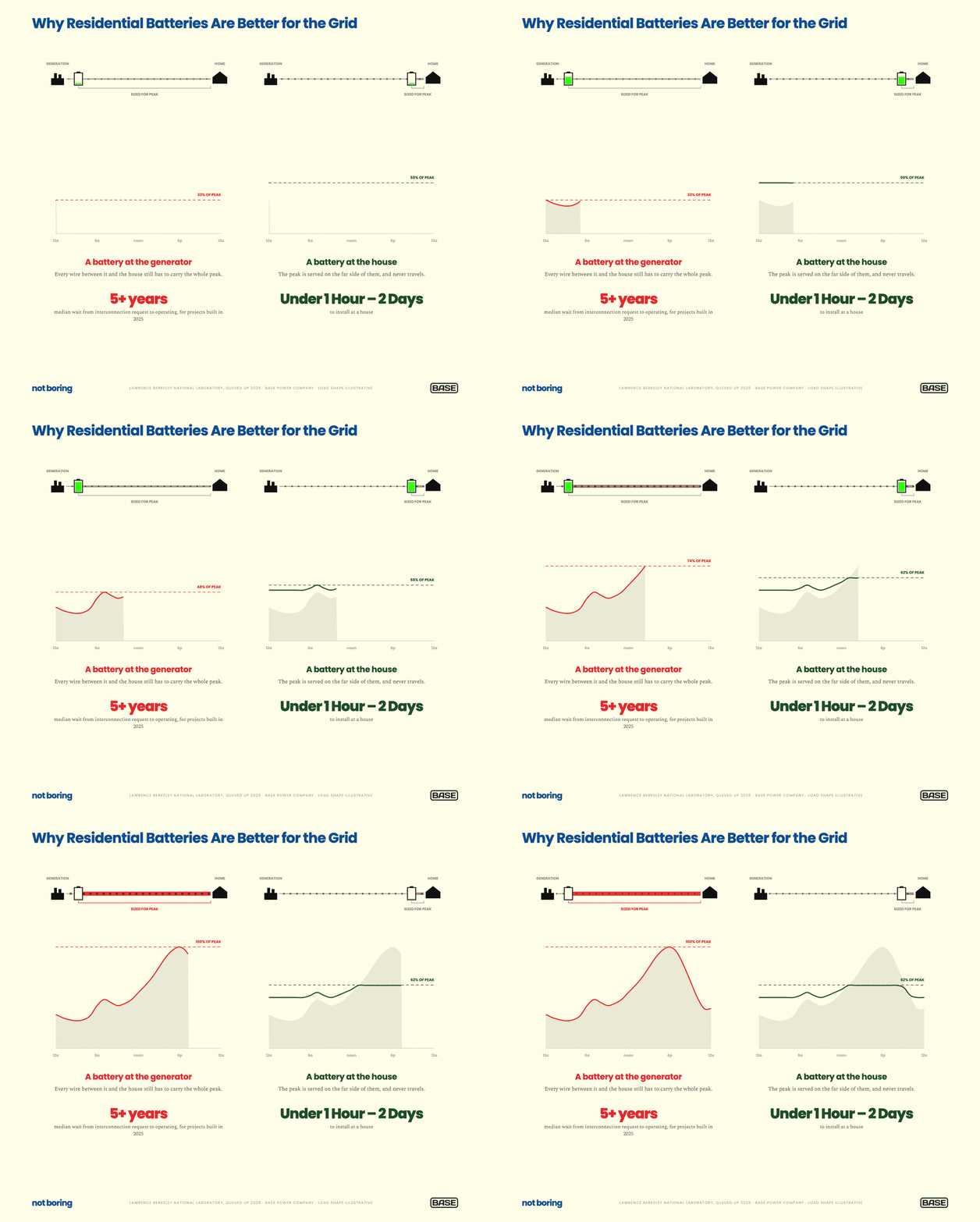
There are only two companies on which I’ve written multiple Deep Dives.
In the intro to the last Ramp piece, Ramp at \$1 Billion (opens in new tab), I wrote that “One of my goals for this newsletter (and Not Boring Capital) is to find a handful of generational companies as early as possible, write their story in chapters over time, and then publish the whole thing as a book when they IPO.”
That is certainly my aim with Base Power Company, which I’ve both invested in and plan to keep writing about through and beyond IPO.
This is the third chapter in the Book of Base. There will be many more to come.
If you want to help write the Base Story, and I think you should, because I think it’s going to be one of the most important of our generation, my advice is to get yourself on the next flight down to Austin and join them (opens in new tab).
One Friday night earlier this summer, Base Power Company CEO Zach Dell (opens in new tab) and Ribbit Capital founder Micky Malka (opens in new tab) agreed to terms on a \$1 billion Series D at a \$13 billion post-money valuation. By Saturday, the round, co-led by Ribbit, Valor Equity Partners, Addition, and JPMorganChase’s Strategic Investment Group, was fully subscribed. By Sunday, it was multiples oversubscribed.
\$13 billion is, to be sure, a hefty price tag for a toddler, no matter how precocious. Base is less than three years old, and it is now the second most valuable energy startup in the world, behind Helion, and the most valuable that is selling a product today.
It is a bet, I think, that Base can become the largest energy company in the world.
That seems crazy, I know, but it’s been my working thesis for a while - that Base has the opportunity to do to energy what SpaceX did to space, what Anduril is doing to defense - namely, win a large, old, incumbent-dominated market.
It’s also the company’s ambition.
Last November, before Base had decided to expand to Chicago, before it had produced its first Base Core, Zach came to New York to do a fireside at Thrive Capital’s office.
After the conversation, we were chatting with a small group and someone asked whether there was still upside in going to work at Base, to which Zach replied, “Base can become a \$400 billion company.”
It was offhand and automatic, but what struck me was that Base had just closed a \$1 billion round the month before that valued the company at \$4 billion. As the valuation grew, the ambition did too, at exactly a 100:1 ratio. I suspect no matter how highly valued Base becomes, the goal will always be 100x higher.
When we caught up last week, I asked Zach about that conversation at Thrive, and whether now that investors had valued the company at \$13 billion, in his mind, Base was now a \$1.3 trillion company in the limit.
He didn’t remember saying \$400 billion at Thrive, and said that he doesn’t necessarily think about it that way… before laying out exactly how it could happen:
I think about it more in terms of the scope, the size, the total opportunity, and how big a part of the energy market we can be.
A trillion dollar company is pretty big today. I don’t think it’ll be that big in 10 years.
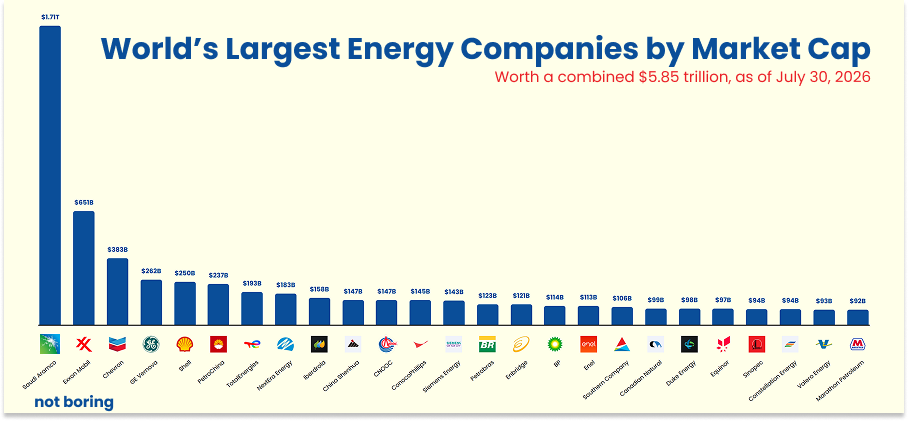
So I mean if you believe that energy is going to remain one of the world’s largest industries, or even get bigger as a percentage of total GDP, and you look at all the largest energy companies in the market, you stack rank them by market cap and you stare at it and you say, ‘Which one of these can be trillion dollar market caps? And you think okay there might be one or two in here.’
And then you look at that list and you’re like, ‘Do we think Base is going to crack this list? And where on it do we think they will be?’ I think we will crack that list and I think we can be near the top over time. I think we will be at the top.
So. Biggest industry in the world. We want to win it. You tell me how big that would be.
Energy is an enormous industry, and arguably the world’s most important. It sits at the base of everything. The world’s largest energy company today, Saudi Aramco, is worth \$1.7 trillion. Exxon Mobil is second at \$650 billion, a cool trillion dollars less. What is remarkable about the energy industry, though, is that there are 18 energy companies worth more than \$100 billion, and 55 worth more than \$50 billion. At its current \$13 billion valuation, Base would rank 182nd among publicly traded energy companies, between China’s COSCO Shipping Energy and Norway’s Vår Energi.
Data from CompaniesMarketCap as of 7/30/26
This is a top-down view of the situation, basically just confirming that it is indeed very possible to build a very large energy company. What’s notable about the list, though, is just how old the companies on it are. These companies were largely built around the winning assets of the previous energy system: oil fields, refineries, pipelines, tankers, centralized generation, poles, and wires.
The energy transition that’s been underway has already created new bottlenecks – the grid struggles matching variable supply with unpredictable demand, for example – and therefore new valuable positions.
Then the most ravenous consumer of electrons in history entered the market in the form of data centers. If a new energy winner is going to be born, now would seem to be the time.
The question is: how? In an industry dominated by well-established and literally well-resourced companies, how might a new entrant break into the top group, or even take the top spot?
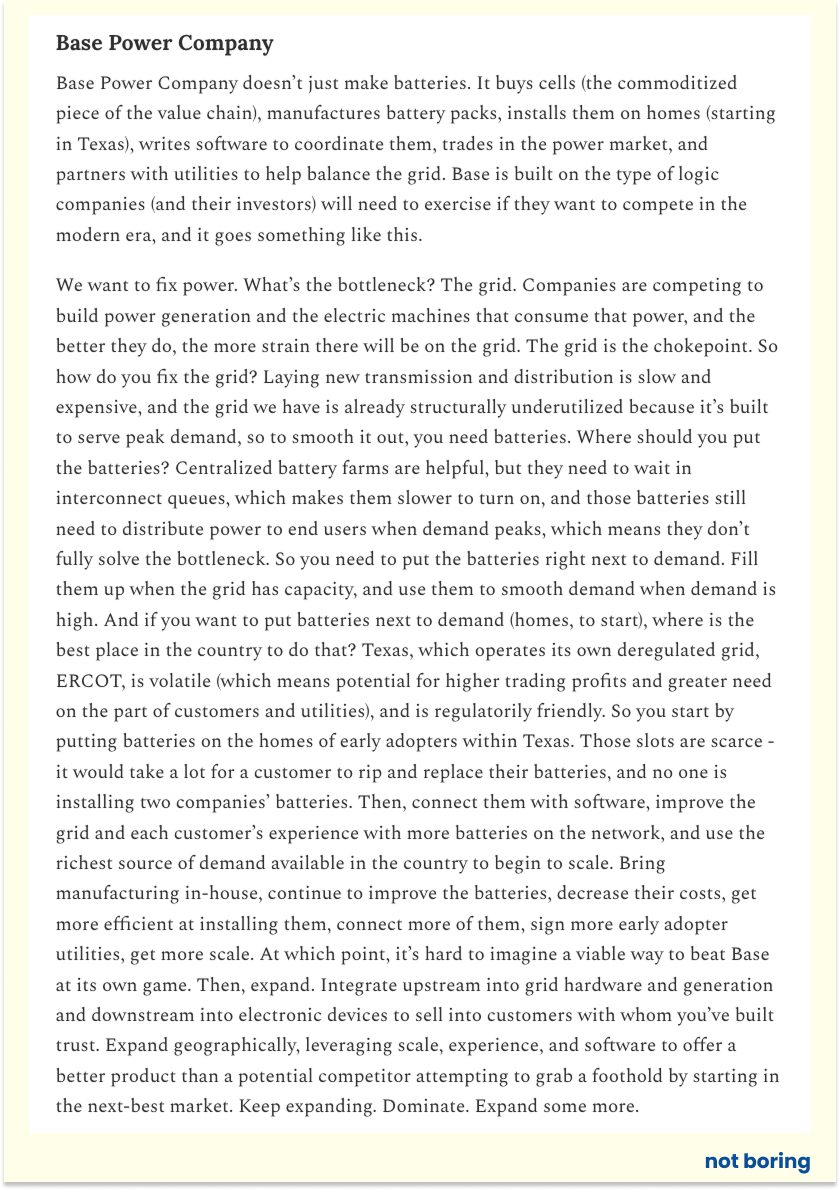
This is the question I tackled in Power in the Age of Intelligence (opens in new tab) in February. My hypothesis was that a company needs to identify the constraint holding its industry back and focus everything on breaking it in order to win the High Ground with a scarce, defensible asset. Then, use that position and its capabilities to integrate outward.
This is what Standard Oil did, and Ford Motor Company, Carnegie Steel, and Swift Meats. The case study I used to show this idea in motion was, of course, Base Power Company (opens in new tab).
Base picked the right energy bottleneck - the grid - and the right technology to unblock it - batteries. They picked the right place to put the batteries, right next to homes, in the right starting state, Texas. They vertically integrated, assembled the right team to own each chunk it bit off, and got to work.
“In 2023,” Zach told me, “we had this very opinionated view that batteries were this unique unlock to scaling energy consumption. And we thought that in a commodity business where cost is everything, to win, you had to vertically integrate and you had to leverage technology, because you needed to combine those things to get a structural advantage.”
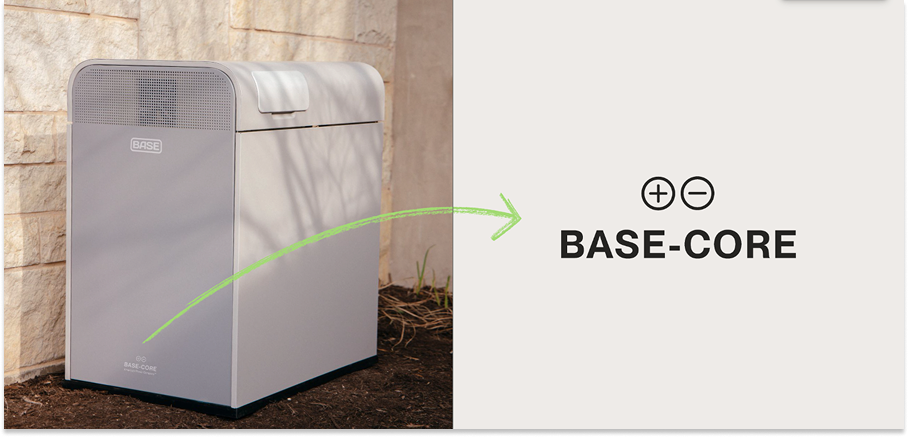
With Base Core, Base has won the High Ground: the ability to make the cheapest residential battery and deploy a growing network of them in the most valuable place on the grid, next to homes, starting in Texas, the state where batteries currently make the most sense.
Owning the High Ground doesn’t mean Base has won, of course. Not even close. The High Ground is simply a strategically advantageous position from which to attack (“Job’s nowhere near finished,” Zach confirmed).
What it means, though, is that it will be a lot harder for any new entrant, or even any incumbent, to try to attack the bottleneck in the way that Base has, or to try to beat Base at its own game. Their customers will be harder to acquire, their electrons more expensive, and their ability to impact the grid less sophisticated.
As important as the position itself is what Base has learned capturing it.
“Our first three years were basically learning a bunch of hard lessons about how to scale, build a brand, build a team, raise capital, manufacture and design products, optimize the supply chain, and the output of all of that is Base Core,” Zach said.
Base’s young life has been a process of figuring out how to do a really hard thing, earning the right to make it a company capability, using it and other capabilities to do the next really hard thing, and turning that into a capability, too.
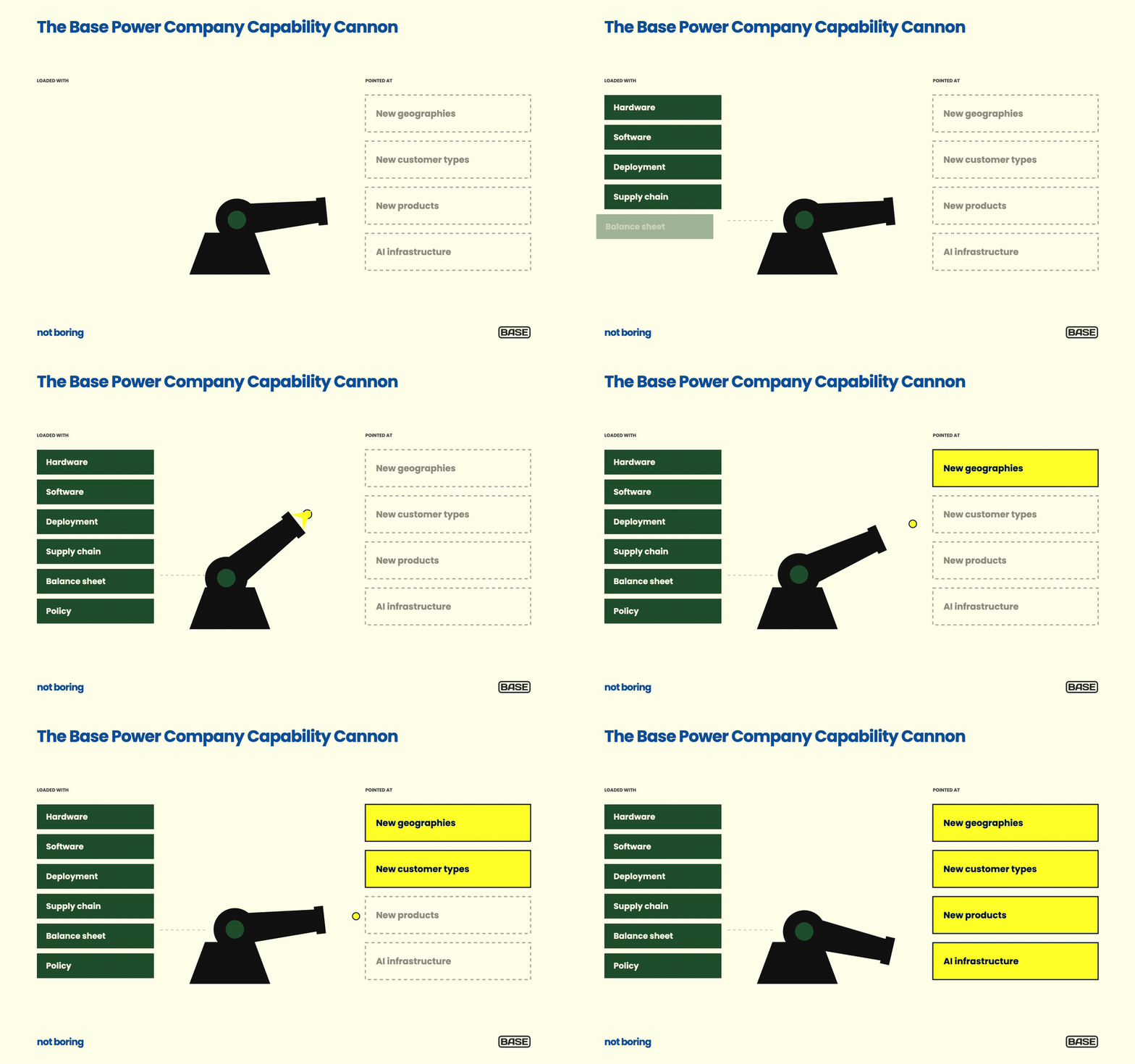
Collectively, Zach calls all the things Base has learned to do its “Capability Cannon”: the deployments and engineering and electrical services and manufacturing and brand and balance sheet and policy chops that Base has earned along the way.
The Capability Cannon is the most important thing Base builds, more important than any single product, as long as the opportunity ahead remains larger than its past accomplishments, which it should for a long time. Base can point its Cannon at the next opportunities it attacks.
It is already pointing it at new geographies and new customer types.
When we last saw Base, in Chapter 2 (opens in new tab), they operated in one state. Now they’re in two, having launched Illinois in June. Back then, fifteen months ago, its regulated utility business existed as one pilot. Last month, more than 50% of its installs were on regulated utility customers’ homes for the first time.
It learns lessons from these expansions, too, and it will apply them to the next state and the next utility, and the ones after that, until there’s a Base Core on homes in every state, every neighborhood, and maybe even in foreign countries, too.
It can also point the Cannon at new products, and at the AI infrastructure buildout.
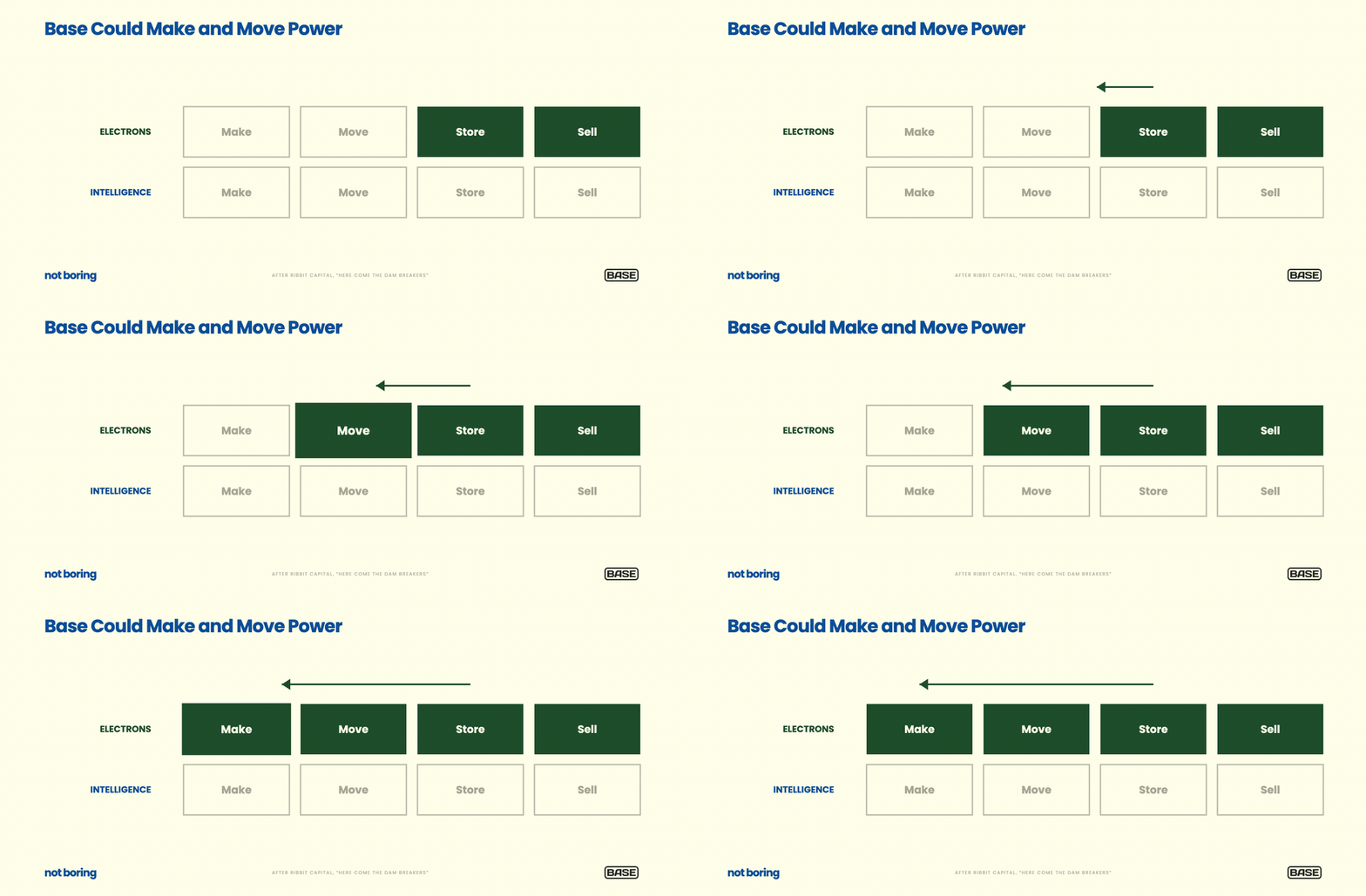
The way Zach sees it, there are four things you can do with power: you can make it, move it, store it, and sell it. Make, Move, Store, Sell.
“There are massive opportunities across the whole stack,” he explained to me. “You think about the stack and power, it’s really four things: you have to make it (generation), you have to move it (transmission and distribution), you have to store it (batteries) and you have to sell it (retail and wholesale markets).”
A couple of the other people on the team mentioned it too, as in, “Has Zach talked to you about his Make, Move, Store, Sell framework yet?” It seems to be an animating framework.
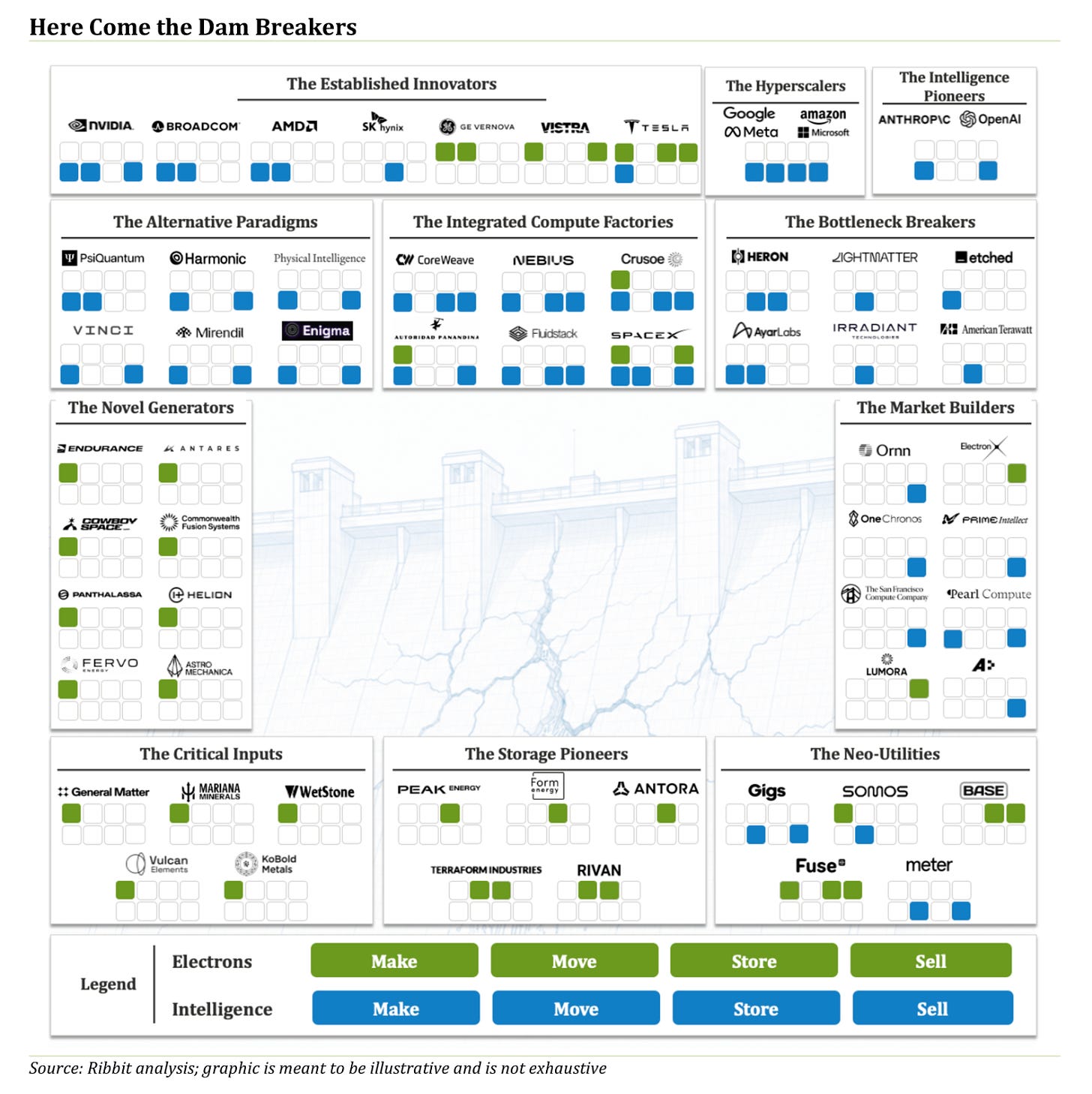
Ribbit took it a step further, actually, applying MMSS to both electrons and intelligence, and grouping “Dam Breakers” by which of those functions they did to which commodity.
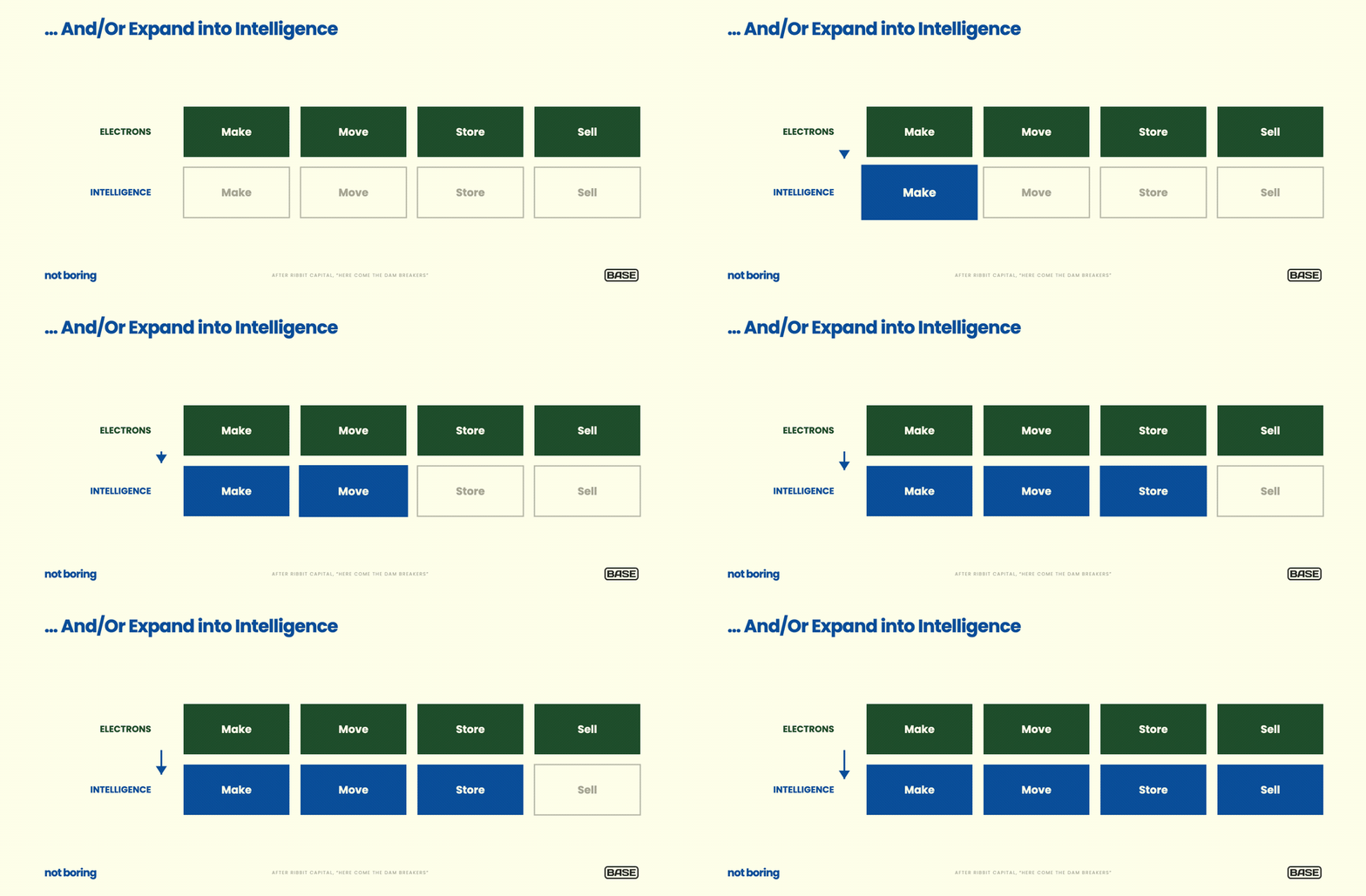
This is “capture the High Ground and integrate outward” in a picture, and the question is: which squares give you the best starting point from which to expand, and how far? This is why we get out of bed in the morning here at not boring HQ!
Maybe they move left and start to Make or Move electrons.
Maybe, just maybe, they even move down into intelligence to capture some of those blue squares.
“There’s a tendency for a company of our scale now to be like, ‘Oh, well we’ve got 500 people now so we can go and do more things,’” Justin told me, when I asked what they might do next, “But I still think - Zach and I talk about this all the time - that focus is extremely key.”
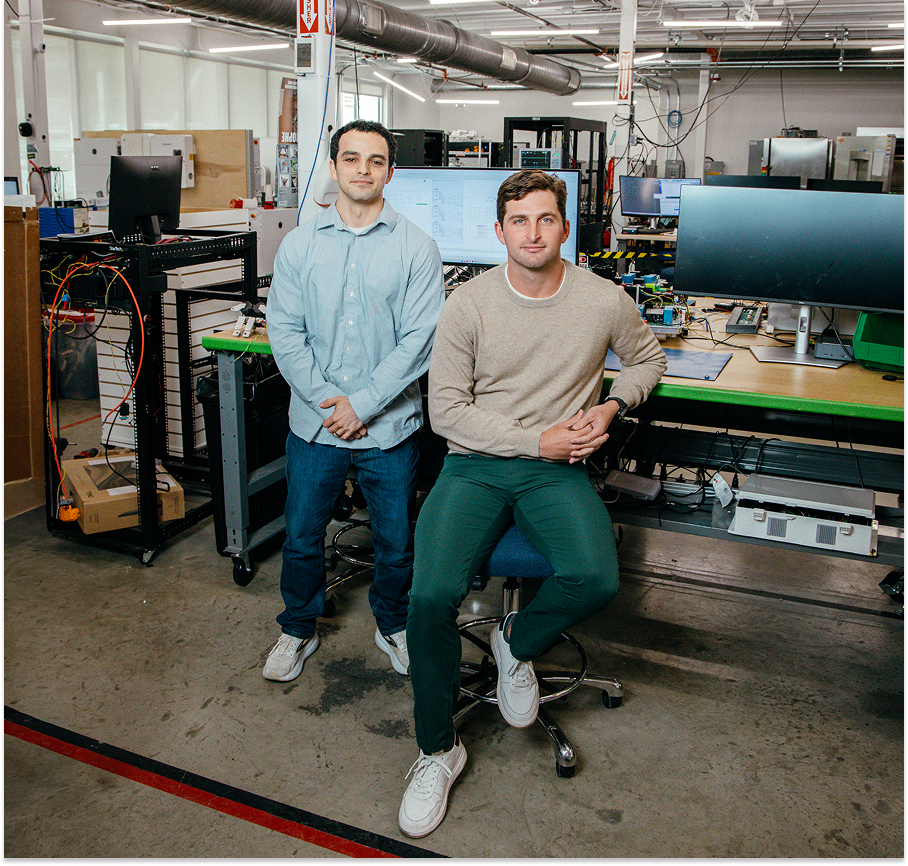
Justin Lopas (l) and Zach Dell (r) in Focus
If what Base sells is batteries next to Texan homes, then any deviation from that - selling batteries outside of Texas when there are so many Texans left, or selling something besides batteries or electrons altogether - might count as a lack of focus.
But that’s not what Base sells, what it is building, or where its ambition ends.
Base exists to fix the grid and sell affordable, reliable power to those who consume it, and it is building a set of capabilities that it can deploy at the best opportunities to do that.
Three years ago, it had a very opinionated view that batteries were the best way to do that, and they nailed it. They nailed the strategy, and they’ve nailed the execution. No one brings batteries online faster, and no one makes batteries that deliver cheaper electrons.
“Now,” Zach told me, “it’s time to scale the fuck out of that.”
Along the way, they’ve learned a ton about how the industry works, and they’ve earned the knowledge that there are way more opportunities beyond making batteries to store and sell electrons.
“And so we’re going to do all of that,” Zach said… “And then we’re going to take that massive Capability Cannon and we’re going to point it at AI.”
And we’ll get there, I promise, but all of Base’s best laid plans, up to and including becoming the world’s largest energy company, rely on its ability to build its capabilities, to build the Core and then build outward from there.
Which is one of the reasons that Base started manufacturing its own batteries.
Manufacturing the Core
The plan, when I spoke to Base’s Head of Hardware Dino Sasaridis (opens in new tab) for Chapter 2, was to not manufacture batteries for a little while. Crawl, then walk, then run.
The Gen 1 battery, the one Base has been installing on customers’ homes, was a basically off-the-shelf battery system.
Gen 2, he told me, was being designed to Base’s requirements and manufactured by partners (one battery partner, and two inverter partners). That was the focus at the time of writing.
Then, once they’d worked out the kinks, they’d make the battery they really wanted to make, Gen 3, the vertically integrated, Made in Texas, absolute best battery in the world.
Gen 3 is why Dino joined Base, after thirteen years at Tesla, where he led mechanical engineering on Powerwall 3.
“I decided that whatever I did there I can do it again,” he told me, “and I can do it better here, and then Base Power Company can have the absolute best residential battery in the world. And I think we’re going to easily achieve that, honestly.”
“That best residential battery is Base’s Gen 3, which it’s planning for now. Gen 2 is up next, later this year,” is what I wrote then, in April 2025…
“Actually, the first time I recommended we cancel Gen 2 was right after I joined [in May 2024],” Dino admitted when we caught up a couple of weeks ago. “And I was like, these suppliers do not care about our success as much as we do. We should not do this.”
He actually looked into canceling the contracts then, but for a number of reasons, including the fact that the \$15 million in cancellation penalties would eat a big chunk of the money Base had raised, they couldn’t get out. So he turned his focus to making Gen 2 as good as it could be.
The idea of just canceling it kept nagging at Dino, though, “Because at the end of the day it was still just buying a product from someone else, money transacted at day zero. And the reason that ends up being a problem – I’m sure I’m the 50th person to tell you this today – is that if you don’t own the stack of the technology, you’re absolutely not empowered to fix it when it breaks.”
“So I took a hard look at the design, mechanically and electrically, and asked, ‘Is this thing going to break?’ And I was like, ‘Yep, it’s probably going to break.’ It was in a lot of ways more complicated than our Gen 1 product.”
Worse, Dino suspected that Base wouldn’t actually learn anything new from Gen 2, which is why you’d ever waste time walking before you run in the first place. Focus means focusing on things that grow your capabilities, and Gen 2 just wouldn’t.
Everything was pointing in the same direction: Dino had gotten himself to about 80% confident that Base would move faster if it just cut Gen 2.
Then he went to Zach Dell, Base’s CEO (opens in new tab) and suggested that “Hey, crazy idea, I’ve looked into it for almost a year and I really do think we should cut Gen 2 and just do it ourselves,” to which Zach responded something like, “Woah, that’s big, I need to think about this.”
He did, and when they spoke two or three days later, they’d both walked it back a little, and they kind of nervously laughed, like “That was crazy, right?”
But you know how this works. You’ve felt it. Once you get that feeling in your gut, whatever the details, the only thing that will resolve it is just cutting bait? That’s where Dino was.
Which is why, even though they’d put the cancellation on pause, Dino kept talking to people about what if.
In a one-on-one, he mentioned to Jared, that “Yeah, I was talking to Zach about how we should probably just cancel Gen 2, but never mind, that’s crazy.”
“And Jared looked at me and said, ‘Oh my God, you’re right. We need to cancel Gen 2.’ And I was like, wait, *am* I right?”**
And whether he was actually right or not, it ping-ponged from that conversation to a leadership team meeting within the week, right around April 2025, right when the Liberation Day tariffs made it that much more attractive to make as much as possible in the US anyway, at which point Base’s leaders decided, “Okay, fuck, we need to do this. Let’s rip the Band-Aid off.”
On May 1, right on schedule as always, two weeks after I’d published Chapter 2 with a few hundred words on the merits of Gen 2, Zach sent out the monthly investor update.
Everything had moved in the right direction in April. Monthly installs crossed 400, with a new high day of 26. Closed customers grew 30% MoM. Austin Energy had selected Base to move on to the next stage of its RFP process.
*We made the decision to cancel our Gen 2 program and accelerate Gen 3, a lower cost, Base designed and manufactured (in Texas) home energy system. We’ve re-allocated all internal engineering resources from Gen 2 to Gen 3, worked with our Gen 2 suppliers to wind down all work with them, and focus 100% of our hardware & supply chain efforts on accelerating Gen 3 development.*
“It might have changed the game,” Dino tells me. “It might have pivoted the success of the business, honestly.”
“We had dozens of people immediately stop working on it and start focusing on Gen 3. There was a bunch of throwaway work we avoided. And the number of meetings per week talking about the day-by-day slip of one inverter supplier versus the other… all that shit just turned off.”
“Then, because we had all the resources freed up, we did a big architecture week,” he continued. “The power electronics team is in San Carlos, so I invited them here. We gathered the desks in a big circle and sprinted toward a concept for Gen 3. Then we got Zach and Justin and Jared, the whole team, together and looked at it. And we were like, ‘Oh man, we can make this so much better than it was going to be.’ I think at that point we all felt like we’d dodged a bullet. And then we went and made it.”
“And then we went and made it” sounds so simple, but making batteries was not something Base actually knew how to do back then. So they called Andy.
After eight years at Tesla, where he left as the Director of Battery Manufacturing Engineering, Andy Ross (opens in new tab) decided to take his talents to General Motors as Director of Manufacturing Optimization. General Motors is a very large company and there is a lot to optimize.
Just one week into his new role, in August 2024, Justin and Dino reached out to Andy to talk about Base. At the time, Base wasn’t manufacturing its own batteries, and wasn’t planning to for another generation.
“The timing isn’t great for me,” Andy told them, “and you don’t need anybody who does what I do either. But feel free to use me as a resource.”
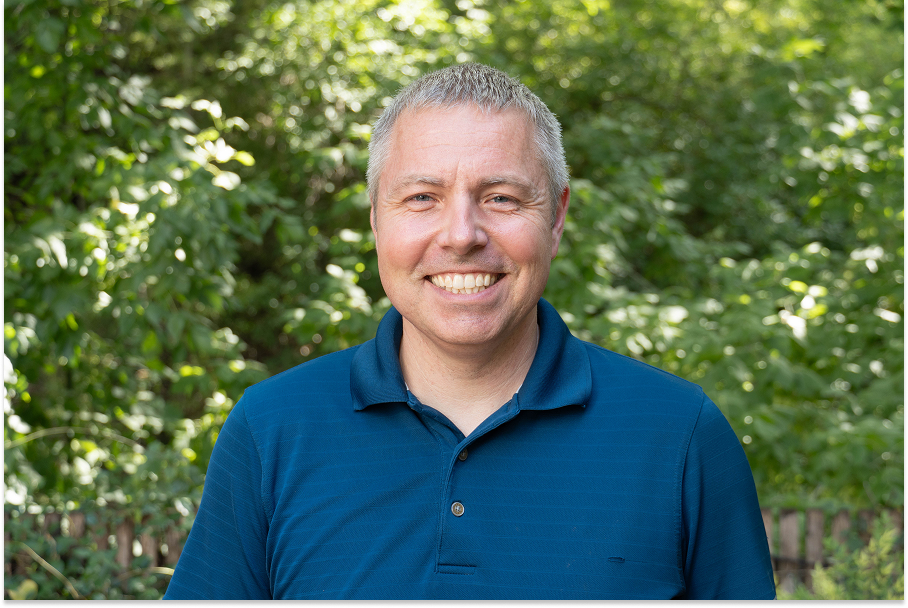
Andy Ross, Base Head of Manufacturing
Andy joined Base in March 2025.
Has it been more fun than GM? I asked.
“Oh my God, so much more fun.”
Base people have their own definition of fun. In Andy’s case, “fun” meant:
He joined in March,
They decided to cancel Gen 2 and manufacture Base Core in-house in April,
They signed a lease in the old Austin American Statesman building in June,
They got the keys in September, and
By March 2026, his one year anniversary, he and the team had landed two production lines and begun putting Base batteries in the field.
The company refers to this level of speed as Base Pace, and it runs on a mix of process and elbow grease.
When I asked Andy to describe the culture of the factory team today, now that it’s grown from four to one-hundred-and-thirty-four, he said, “We want people that can solve tough problems but don’t really care where that problem is, people that don’t care what the nature of the problem is they just want to be a part of fixing it.” That comes from the top.
As soon as Base took possession of the old building, they wanted to get to work. But it was late summer in Texas, very hot, and there was technically cooling tower infrastructure in place but it hadn’t been cycled in seven years and they weren’t going to be able to get it recommissioned in time, and they’d quoted some retrofits to be temporarily installed but they were outrageously expensive, like \$1 million, and they wouldn’t be ready for seven months, and the plan, at the time, was to only stay in Base Factory 1 (BF1) for thirteen months anyway, so that wasn’t going to work.
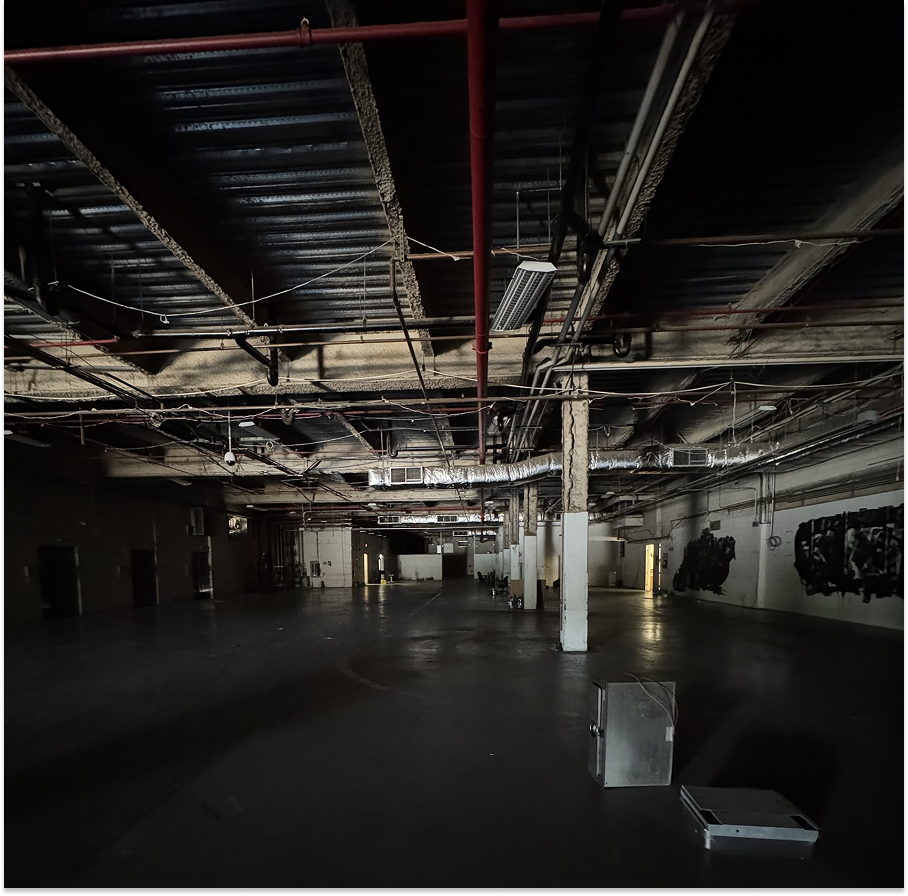
BF1 Before Base Got Its Hands On It
“So I just started fielding local rental companies,” Andy recounts, the way you recount war stories from the good ol’ days, when there were just four engineers on the team and no maintenance leader and so you just figured it out yourself, “to just start landing some chillers outside the building. Good, bad, or otherwise, the door-opening mechanisms on the dock overhead doors were broken, and they’d be outrageously expensive to repair too, so I was like, ‘All right, we’re just gonna land them in front of the dock doors’ and me and one of my NPI guys were just sawzalling holes in the dock doors to get ducting into this place because it was late summer so it was like 95 degrees in the building and we wanted to get to work.”
“The first night they showed up, I was here until about midnight on a Friday with the rental HVAC company just trying to get this building less hot,” he remembers, with that glint. “I never thought I’d be sawzalling dock doors to duct tape and chewing gum some air conditioning into a building, but everybody was very happy when they weren’t dying of sweat on Monday.”
He applied that same elbow grease to the facility’s compressed air system. When Andy realized that he wasn’t going to be able to get the leftover 1980s-level factory compressor system working himself, he “went on Tractor Supply and bought the largest, but also 120V, compressors that I could find, and I was in the ceiling making up a makeshift pneumatic system for all of our pilot systems, so running pipe and dropping lines and everything.”
Andy calls these his “hacky redneck” fixes. They’ve largely been replaced at this point, now that Andy has a team. But because he’s done many of the hard jobs himself, when he asks his team to do the same, he can tell them with a straight face: “Sorry it sucks, but it isn’t going to exist otherwise.”
“When I was at Tesla,” he told me, “it was a passion of mine to personally operate every station on every line on every continent that my team deployed things to, because a good solution to an engineer might not be a good solution to the person that has to use it.”
Which is probably why, as Andy grew the team from those initial four engineers to the one-hundred-and-thirty-four people that make it up today, 80% of the salaried team members are people that Andy has worked with before, which I suggested must feel pretty darn good.
“The thing that’s been special about manufacturing in particular is the amount of great people that have been,” he searches for the right combination of words, “bold enough, hopefully not foolish enough, but ambitious enough to pick up my call and hear me say, ‘You want to go do something crazy?’ and they say, ‘Yeah.’”
“Bold enough, foolish enough, ambitious enough… doesn’t matter. They want to go solve big problems and we had big problems.”
“We had no factory, we solved that problem, we got a factory. We had no team, we were solving that along the way. And we had no concept of a manufacturing strategy yet, then it was all just philosophical, on the computer, and then we went out there and found new machines, new vendors, new equipment from all over the world to go achieve it.”
When Base started sourcing the equipment for BF1, it was just Andy and one other manufacturing engineer. By the time they were ready to start placing purchase orders, a few others had started to trickle in. Andy would tell them, “Welcome, this is the thing we’re going to buy tomorrow, you’re going to be in charge of executing this project now.”
Those early days in BF1 might not have been pretty, and will certainly look downright primitive compared to BF2, BF3, BF…X. That’s great. At Base, you figure something out, and then you turn it into a capability. Your best laid plan needs to face harsh reality, so you can learn, improve, and try again.
Plus, whatever the Manufacturing team had to do, it worked. Fast.
In Austin, Texas, right down the street from Base HQ, “We landed two battery module manufacturing lines and one inverter manufacturing line (the ratio is because there are four battery modules per inverter).”
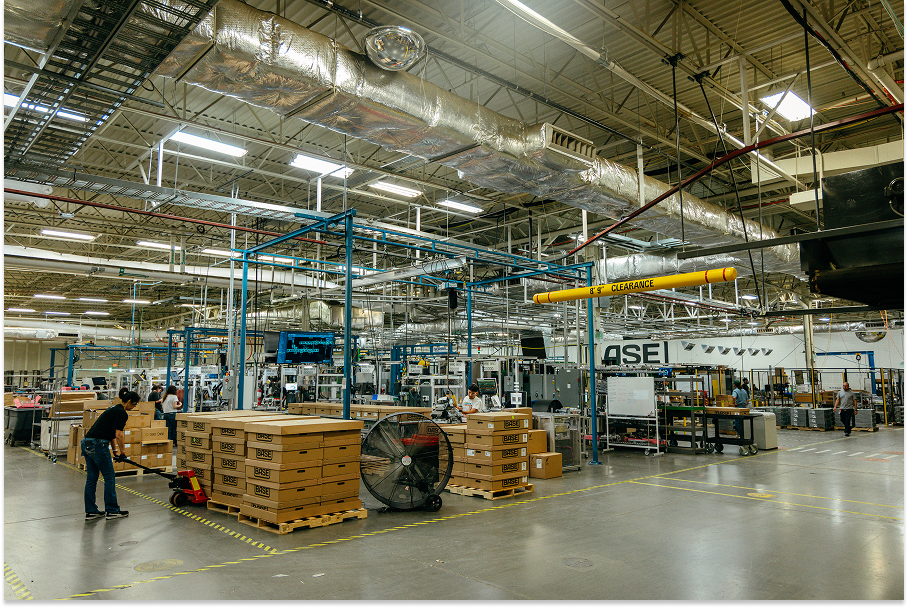
Base Factory 1 in July 2026
By January, a little over one business quarter after taking possession of the space, Base’s pilot battery module line was up and running and the team started pre-production builds.
All told, over the course of the last fifteen months, Base got out of Gen 2 contracts with only \$1 million in penalties, built out a manufacturing team, opened a factory in the old Austin American-Statesman press building, figured out how to add a generator hookup to the battery, stood up a supply chain, built the first Gen 3 batteries, tested them in as much as three feet of water, rewrote software and firmware to match their new capabilities, built more Gen 3 batteries, began installing them on employees’ homes, then friends’ homes, and then all sorts of Texans’ homes, and renamed the battery system Base Core.
All that done, Base now offers what Dino is “quite confident is by far the cheapest residential battery on the market.”
By February, it had its first Base Core system ready to install.
The Day The Team Installed the First Base Core
Manufacturing is a scale story. You certainly don’t set up a whole factory to make one battery. But you don’t scale up a whole business without stopping to appreciate one battery every once in a while, either, especially when it’s an important one.
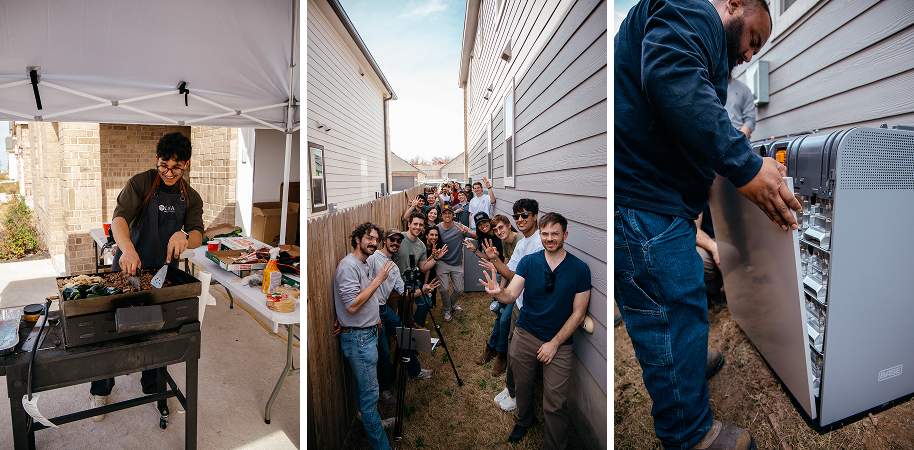
That first Base Core, which people from almost every Base team gathered to install on a teammate’s house in February, was an important one.
Dana Paz (opens in new tab), the Anduril alum who is Base’s Head of Deployments, responsible for the multi-state logistics and installation network that Base is growing, told me that it was the highlight of this chapter in the Base story.
The Base Team at the First Gen 3 Install, before it was called Base Core
For those, like Dana, who had been there from the beginning, it was an opportunity to reflect, briefly, on how far they’d come. “The first Gen 1 install was me and Cole with the Craigslist electrician. It took over two days to hack the thing together and it was just pure chaos,” Dana remembered. “And then this one was chaos but in a much better way”:
We now have an entire support system, so you have the engineers on-site, the hardware, the firmware, the electricians were there, the deployments people were there. We were finishing stuff in the factory, off the line, functional tests, like throw it in the back of a person’s car, drive it over to the same house to do the install. We had a blackstone out, we were cooking tacos. It was just way better vibes on Gen 3 than Gen 1, which was cool.
“It set the stage well for us to then go out and do something hard,” Dana said. “We had a bunch of pilots that we had to go rework a bunch of times, because we would try something new out and it wouldn’t work, so people would be going back to the same house like six times. So you’re like, ‘Is it really working?’ I don’t know, you have your doubts. But being able to anchor on that super epic first install… yeah, that was the highlight for me over the past year.”
This month, only fifteen months after it decided to make the thing in the first place, Base will install more Base Core systems than Gen 1 systems.
How to Build Your First Battery Factory
There’s been a lot of learning in between that first Base Core install and the thousandth, naturally and on purpose.
Base likes to make a thing, get it out in the field, hook it up, and learn from it as quickly as possible, so that it can tweak its design, maybe supply chain, and manufacturing lines as quickly as possible, so that it can keep compounding as quickly as possible.
For the Hardware and Deployments teams, that meant getting the first one out and hooked up to a house, to see where it broke and tweak the design accordingly.
For Andy and the Manufacturing team, that early iteration loop meant that they needed to keep the pilot facility, BF1, as manual and flexible as possible.
“What bites you in manufacturing is you design a thing that you think is going to be the thing you launch on and then you launch with a mildly different, sometimes radically different, product architecture and you’re scrambling from a manufacturing engineering and equipment standpoint to try to recover the machine to match the thing you need to go build,” he explained. “And the thing that Tesla taught me was to try to limit the amount of one way doors, or the inflexibility, as long as you can from a manufacturing line standpoint.”
This is why automation comes last in Elon Musk’s five-step algorithm. Automation is inflexible.
“That’s one reason that we kept it pretty manual to start out at this factory, was to enable a higher amount of flexibility in both process and in design as long as we could,” Andy said.
Another reason was that Base’s systems weren’t set up to handle much more than manual.
The Manufacturing Execution System (MES) - the software that tracks, monitors, documents, and controls the manufacturing process - that Base had been using was “originally built to do retail clothing inventory tracking. It was something you would use in a job shop where you’re making 50 of a thing and then you’re making a new thing, not where you’re making 1,000 of a thing per day.” It was a low-volume tool where Base needed a high-volume one.
At first, the team tried to redneck hack it by building an architecture in which the original software system might work. Maybe at the first level it didn’t look good, but at the second…
“No, when we dug into it, it still wasn’t very good.”
They presented their findings to Justin, and told him they felt confident they should go build their own MES, a significant undertaking that would require going slow for a while to go fast later.
“One of the things I appreciate about Justin is that he values and appreciates the experience the members of my team bring,” Andy said. “And when we presented the idea of making our own MES to him, he looked at the team and said, ‘Yep, make it so.’”
So they did. They released the first version of the system in January, right as the line got up and running. By April, it was the system of record at every station. By June, the manufacturing software team was integrating live controls for the factory’s 21 robots. (Being smart about when to automate doesn’t mean no automation, as Justin describes to Molly O’Shea during their BF1 walkthrough.)
Then they built Whimsy, which stands for “Where the heck is my stuff y’all,” to track inventory from the moment it arrives at BF1 until it leaves for one of Base’s six-plus warehouses around the country, and they built a bespoke Quality Management System, to handle supplier quality, production approvals, and non-conforming parts.
In each case, from the first install to the flexible manufacturing line to the internal tools, what Base is becoming excellent at is the process of going from “We’ll figure it out” to encoding the solution in process or software as quickly as possible.
Figure It The Fuck Out
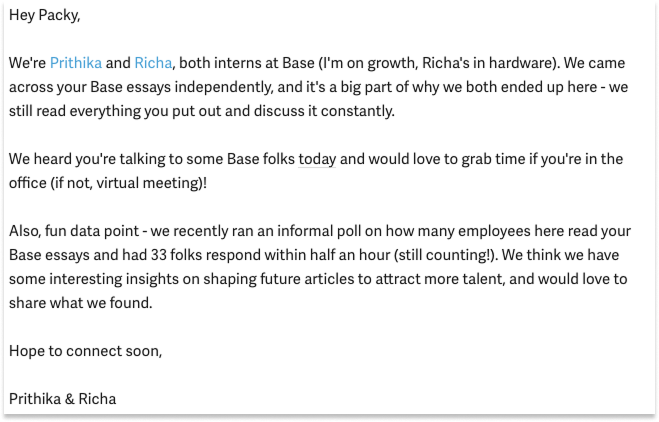
Turns out, they’d each seen my meetings with their respective bosses on their calendars and decided to take the initiative and reach out. Also turns out that taking initiative is a big part of the culture at Base, and when we spoke the next day, Richa and Prithika each had stories.
Richa, a University of Toronto electrical engineering student working on Dino’s Hardware team during her eight-month co-op, has mostly been focused on the inverter, on field returns, and on new designs for the battery management system.
But as soon as she got to Base, she started looking through the Google Drive, where she found [REDACTED UPCOMING BASE PRODUCT] and thought, “This is the coolest thing I’ve ever seen.” She told Dino she wanted to work on [REDACTED UPCOMING BASE PRODUCT] and he said, “Great, write me a proposal,” and he meant like a proposal of what she’d work on, but Richa came back with a 10-page report on what the commercial version of [REDACTED UPCOMING BASE PRODUCT] could possibly look like, and Dino said, “This is really cool, you should keep pressing,” and so now Richa is working on that, too.
Prithika, a University of North Carolina-Chapel Hill student (there really is talent everywhere I guess), is working on Gabe’s marketing team, on some SEO stuff, and on the vision and design for a commercial energy product that’s launching soon, and even spent two weeks boots-on-the-ground in El Paso, on which more in a second.
But she was also fascinated by the company’s utility partnerships, and noticed that Base didn’t have a map of all the batteries in Texas and whether they were charging or discharging, like Powerwall does (opens in new tab), and so she made a quick MVP and brought it to Lauren Thomas on the Utility Partnerships team. Lauren looked at it and said, “Actually, this is fricking sick. I don’t really care that you’re an intern, I want you to go figure this out and make it better and come back to me as soon as possible with it.” Which she did.
This kind of openness and cross-pollination is part of the culture, too. There are fifty-five (55!) interns at Base this summer, and they all work on different teams and hang out all the time, which means they all have visibility into all the different areas of the business.
It sounds like a ton of fun, but when duty calls, the interns are expected to do their core jobs, whatever it takes. For example…
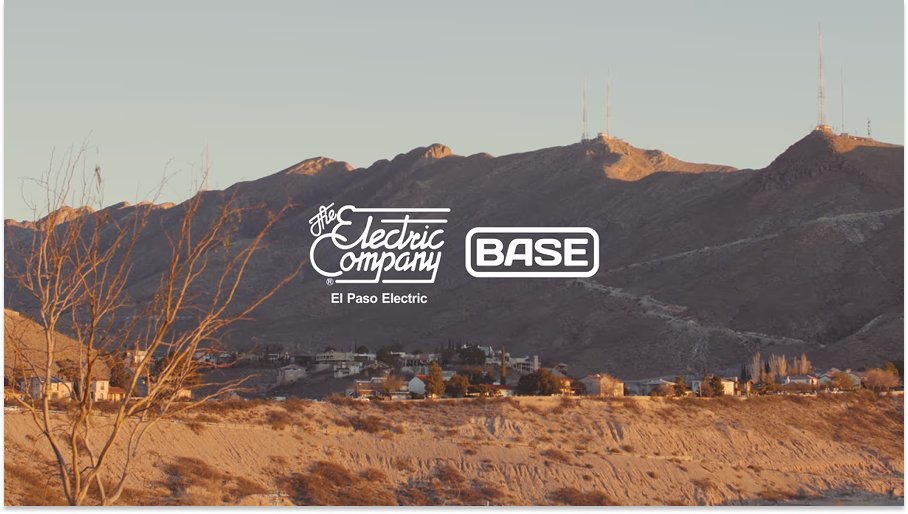
What that required was installing 10MW behind a particular substation, which meant getting roughly 10% of all the homes behind that substation installed, all before a September deadline. It was a higher penetration rate, and a more targeted one, than Base had ever attempted.
Prithika was tasked with helping make that happen.
“In El Paso, we had to deploy 10MW of batteries,” she told me. “So they sent me and Olive (opens in new tab), another marketing intern, to El Paso.”
While Base has signed up thousands of Texans, many through utility partners, the level of geographic precision needed in El Paso was new.
“Tim was like, ‘You need to figure it out,’” Prithika said, “And so we did. It was 104 degrees, we were there for two weeks, we knocked on doors, we hosted happy hours at coffee shops, we showed up at farmers markets, and we were able to pull it off and end up two weeks ahead of schedule.”
In the end, one-third of the neighborhood signed up and 10% got installed (many didn’t qualify). Cole, who has overseen every customer acquisition effort in Base’s history, confirmed that those numbers are “freaking crazy.”
Part of the lesson, she said, was that “we will figure it the fuck out no matter what,” but the other part is that you need to turn that into learning how to do a process well. “The next utility will be such smooth sailing now that we’ve figured it out.”
“A lot of how we think about things here,” Richa added, “is as a factory. The focus from the beginning of anything is how we’ll be able to standardize it and turn it into a factory, which influences how you design the product in the first place.”
Then she said something that describes Base in 2026 as well as anything I’ve heard, how it’s able to maintain its culture and grow really fast and not stagnate but not descend into chaos, how it can compound on the core and hold the High Ground and expand out.
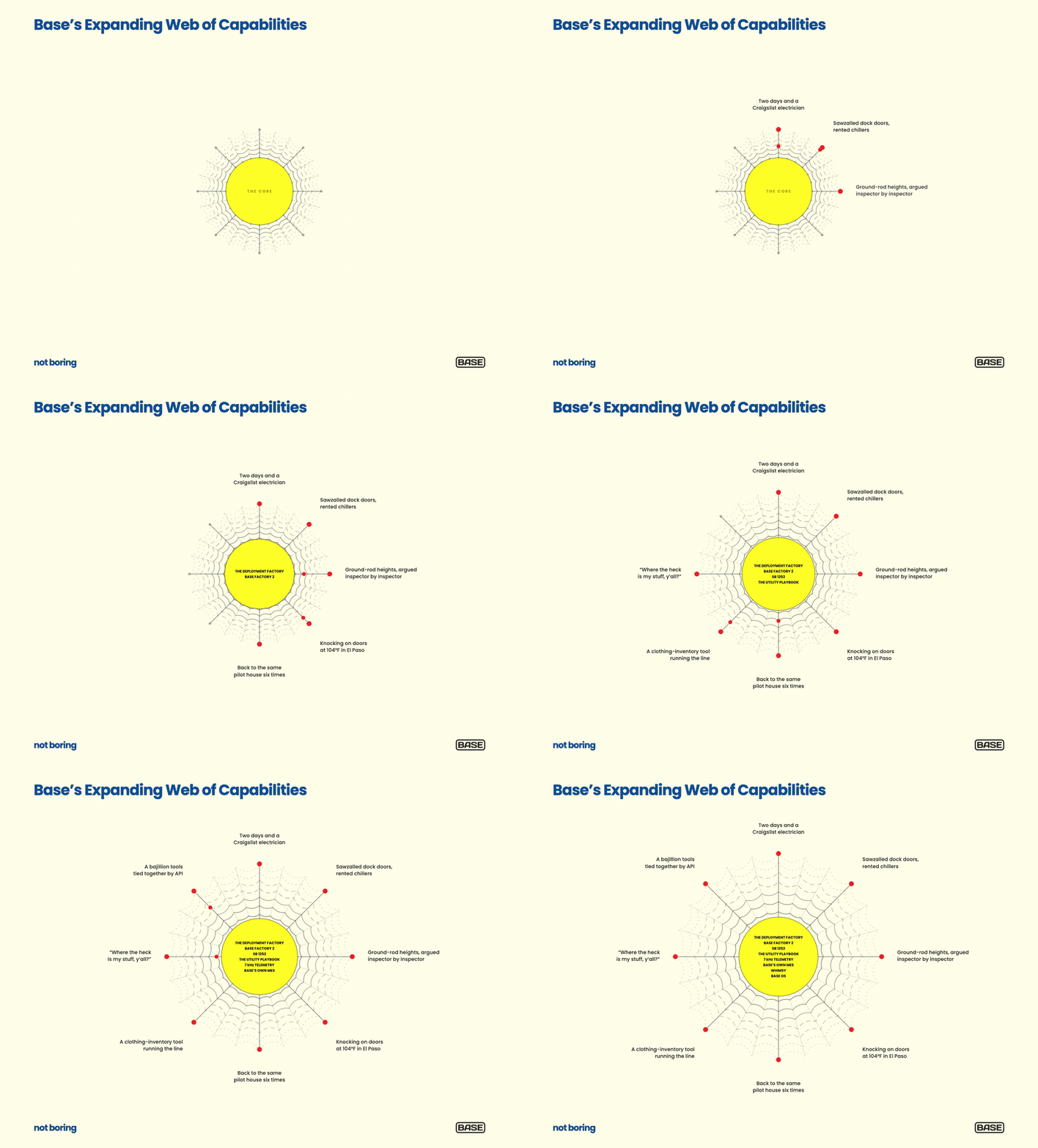
“Imagine Base sort of like a web. It’s expanding outwards, and all of our new ideas are at the edge, and all the scrappiness is at the edge, and in the center, we’re trying to take in new things once they’ve been processed at the edge and standardize them into processes and software and make them more efficient.”
To synchronize our metaphors, the Cannon is the result of the Web.
Learn something, then turn it into a process or encode it in software, and as a result, the team is experimenting with new tools every day, they told me. Where the factory has its MES and logistics has Whimsy, for example, the Software team has been working on building out Base OS, which takes customers from top of funnel down to getting their install scheduled.
Historically, this has been a bajillion tools tied together through APIs and now they want to do it through one homegrown system.
“So it’s constantly failing, but it’s also constantly getting better,” which is a beautiful metaphor, too.
Build, fail, get better, own that capability, build on it, fail, get better, outward until the web envelops the industry.
That is what Andy and team are doing in BF1, too.
By the end of the year, they’ll need to be pumping out about 1,300 Base Core systems, consisting of four 10-kWh modules each, every week. That’s roughly 5x from today, with those gains to come from adding a night shift, and from “attacking all of the uptime problems, the cycle time opportunities, and standardizing a lot of the workflows.” Take some scrappy redneck process, figure it out at the edge, and standardize.
The year after that, they’ll need to 3x, and then they’ll need to 2x again, at least on the current trajectory. That means that in 2028, they’ll be producing 30x more batteries each day than they do today, from the comfort of the bigger, more automated Base Factory 2.
From 2028, today’s production numbers will look tiny, but today, they’re cause for (brief) celebration.
“You should see an all-hands,” Richa and Prithika told me.
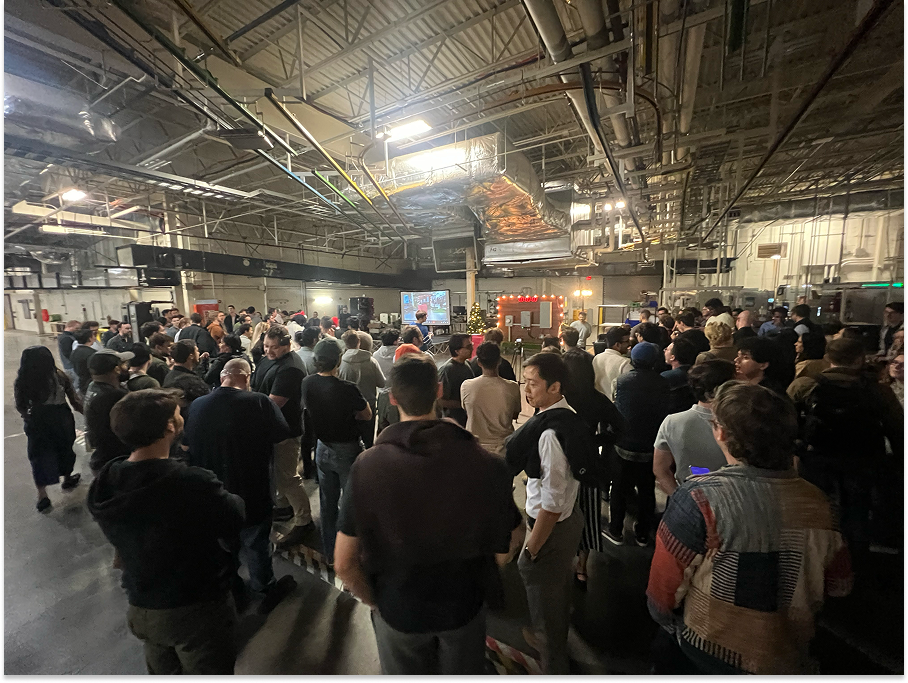
The All-Hands Where Dino Debuted Base Core in a Live Demo pre-Holiday Party
“It’s literally just Justin and Zach saying some KPI and everyone starts shouting and clapping, everyone, every time there’s a win. Recently, in the factory, they’ve been hitting records on how many modules and inverters they produce. Every time we hit some kind of record, everyone is just so, so into it and excited.”
Last month, the factory made 295 10-kWh modules in a single day. The crowd went wild.
Unbelievably Fast
The thing about constraints is that they move.
Figure out the factory, and something else becomes the thing standing between Base and flawless execution.
When I asked Justin which team currently had the Turtle (opens in new tab), the stuffed animal turtle that sits on the desk of the person most responsible for clearing the critical path, he didn’t hesitate: “Squarely on the Supply Chain. Basically, we’ve been able to ramp our factory faster than four or five of the key suppliers we’re sole sourced to right now.”
Because Andy and his team ramped up the factory so fast, the Turtle now falls to the team whose job it is to fill it with parts.
Colby came over from Tesla, too, where he worked on the Vehicle program, unlike a lot of the Tesla refugees at Base, who worked on Energy there before working on Energy here. But Colby did work on batteries for vehicles, most recently as the Senior Manager on Technical Programs for Cell Manufacturing Engineering, and on every factory launch other than Fremont, which predated his 2017 start date. During his eight years there, Tesla got bigger, and more bureaucratic, and he got tired of that, so he looked for something smaller, spent a bit of time at Form Energy in Pittsburgh, and then jumped to Base.
Colby joined to work for Dino in Hardware, working on program management, compliance, and sourcing. When he joined in July 2025, there was no factory; there was a program and an early design for Gen 3 and that was about it.
“And we’ve been kind of push-pull-flipping it up the hill ever since.”
When Colby started at Base, one of the first problems he was tasked with was “picking a supply chain, so roughly 20 vendors to make 40 parts.” I figured he was the right person to ask about the challenges Justin brought up about vendors not working at Base speed, and how you solve those.
He gave me some technical reasons.
Like, Base has something about its design that’s hard that they didn’t realize would be hard and now the vendor is having yield issues. As we speak, Base is ramping more than ten supplier lines alongside its own, sending engineers to supplier floors to develop processes, install hard tooling, and project-manage the move from bridge suppliers to production suppliers.
Or, Colby adds, at the “commercial interface, at the speed that Base moves, it’s pretty much impossible for us to tell them exactly how this thing’s going to be made in high volume. By the time we need them to start, they’ve got to start with quite a bit of ambiguity still in the product design and in the program, and removing that ambiguity without losing commercial leverage on price or schedule is a very hard problem with vendors.”
This kind of stuff is new for the company, and the people who started it. Justin admitted that he had kind of a blind spot, because high volume manufacturing is very different from low volume manufacturing, and at SpaceX and Anduril, he “had done mostly low volume manufacturing.”
“And in low volume, you can kind of brute force almost anything. ‘Oh, we didn’t get the part done Friday? We’ll just work this weekend to finish the machine part for Falcon or Starship or whatever.” But, he said, in high volume, “you plan production once in advance, you sign long-term contracts, you reserve long-term capacity. All of these are concepts that are intellectually obvious but when you actually go do them in practice, it’s a bit different.”
But you do it, you make contact with reality and you learn and you earn the right to get to scale and to hire even more great people like Colby, and then you continue to figure it out.
You can figure out all of the hard technical stuff, but maybe the biggest thing you have to solve, Colby told me, is something softer.
“I speculate that some of our bigger vendors just didn’t expect us to execute,” he told me.
“We showed them a timeline and they said, ‘Yeah we work with a bunch of startups, we’ve seen this movie before, you’re going to come back and push the schedule on us.’ But plus or minus a month or two, we’re on the same schedule we published 18 months ago.”
“Some of them have had their little ‘Oh Shit’ moment, that this is really happening at the rate that we said it was going to, and are trying to play catch up because they didn’t really start out of the blocks.”
So you have to prove to them that you’re going to do what you say, which you can only do with time, and which Base has now done, and you have to sell them on a vision of what happens when you continue to do what you say.
“Base as a customer maybe isn’t a big deal now,” Colby said, “but they’ve got to understand the opportunity and the ambitions of Base as a whole and of the Base Core battery so that they’re incentivized to grow with us.”
In short, Base needs to get its suppliers even half as excited about Base Core as its employees are.
The Platonic Ideal of a Battery
Just as Dino wasn’t excited about Gen 2 from an engineering perspective, “Dana wasn’t excited about it from an operations perspective, I wasn’t excited about it from our members’ perspective,” Cole told me.
“We’re like, ‘Wait, what are we doing? This doesn’t make nearly as much sense as it would if we were to build the platonic ideal of a battery.’”
Cole is *very *excited about Base Core.**
“Base Core has been the company’s big bet, to make it real. And now it is very real,” he said. “It’s the biggest, best thing for the energy world, ever maybe. In my opinion, it is the key to energy abundance.”
In terms of its specs, Base Core is the best battery on the market.
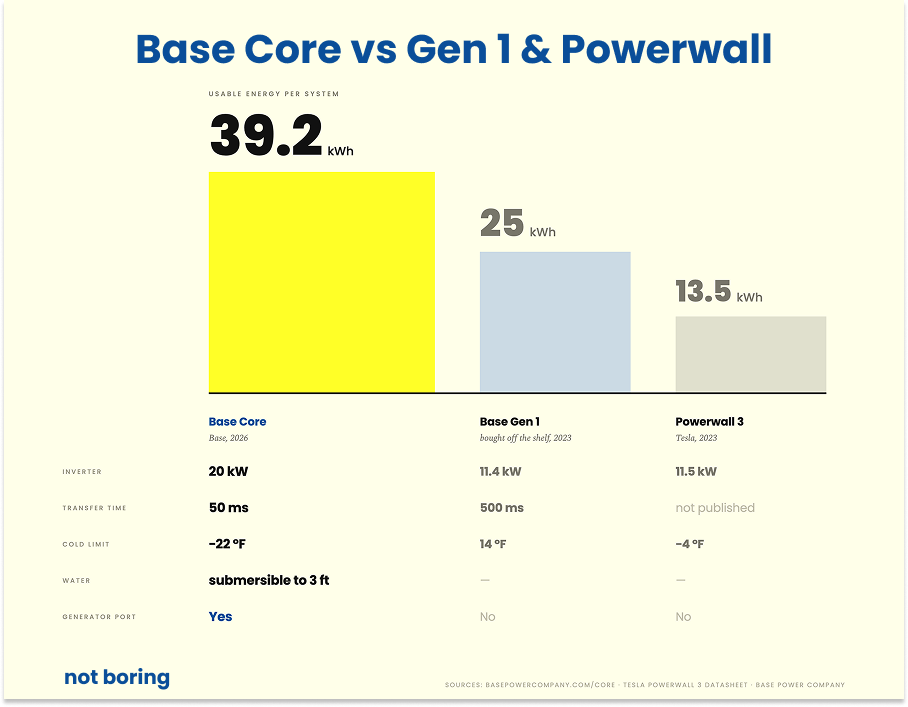
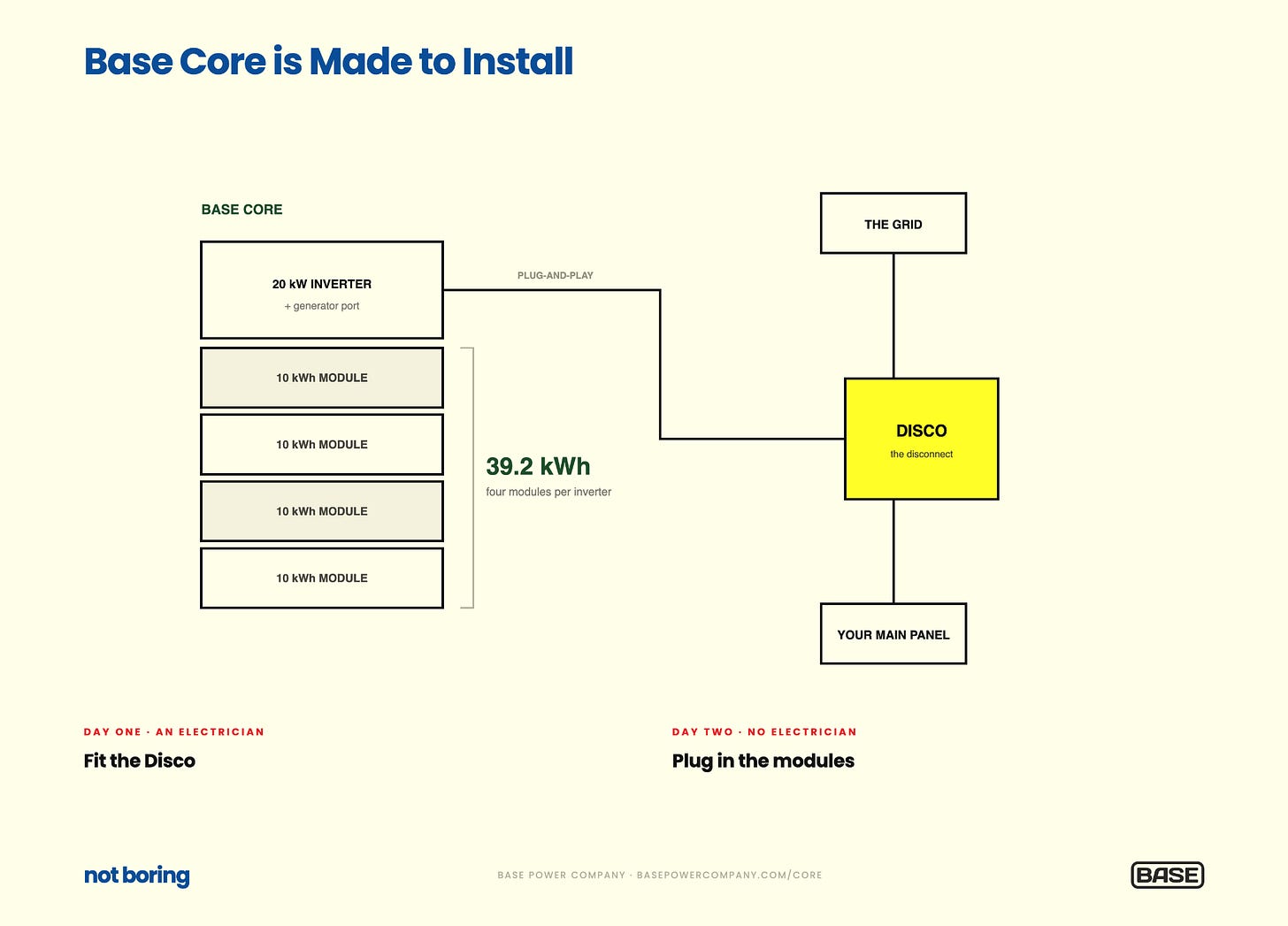
Base Core is the highest-capacity battery on the market, with 39.2 kWh of energy capacity, compared to 25 kWh for Gen 1 and 13.5 kWh for Tesla Powerwall 3. Many customers get two Base Cores, for nearly 80 kWh of capacity, which gives Base more ability to balance the grid, and room to add energy-consuming products to the offering.
It has a 20 kW inverter, which is crazy powerful and means that Base can push out a lot of power very quickly to support the grid. Justin tweeted that they believe the inverter is one of the most American-made on the market, which is particularly important now that the FCC has added foreign-made inverters to the Covered List (opens in new tab) since they’re vulnerable to being shut off remotely.
Base Core operates in temperatures as low as -22°F, much colder than Gen 1’s 14°F, which will come in handy (necessary) in Illinois and other cold-weather markets. It is physically smaller, and its volumetric energy density is nearly 2x that of Gen 1, meaning it packs more energy in a smaller package. Its transfer time - how long it takes to turn on when needed - is 10x faster than Gen 1, at 50ms instead of 500ms, the difference between noticing a flicker when the power goes out and not noticing it at all.
Not only is it the best battery on the market generally, it is custom-built to do what Base needs it to do.
Dino told me that the priority ranking when designing the battery was: 1. Safety → 2. Function → 3. Reliability (All Must-Haves) → 4. Cost (why we’re going to win) → 5. Install (why we’re going to win) → 6. Serviceability → 7. Beauty → 8. Delight.
Base optimized for landing a lot of relatively inexpensive energy capacity at each home in order to spread inverter, customer-acquisition, and installation costs over many more kilowatt-hours (kWh). Accomplishing that means it’s the cheapest residential battery on the market, and is ideal for long backup duration, and for buying, storing and trading more grid energy.
The more kWh (and MWh and GWh) Base controls, the more money it can make. Base aims to roughly breakeven on the batteries themselves - it charges members a few hundred dollars upfront, to cover the install costs, and \$19 monthly fee in some areas. It makes most of its money today by storing power when it’s cheap and selling it back to the grid when it is expensive. Every battery is a time machine.
Increasingly, Base makes money by helping utilities put more storage capacity online, as well, in order to better balance and get more out of their grids in order to delay capital investments.
In both cases, more capacity directly translates to more revenue. And given that customer acquisition and install costs are roughly the same whether you’re installing 39.2 kWh or 20 kWh, the more you can pack in each system, the better the unit economics.
This is one of the benefits of vertical integration: you can design your hardware to do exactly what both your customers and your business need it to do. Base Core has a little something for everyone.
For Dana and Deployments, this is a battery that was designed to be installed.
“The hardware was designed to install with ease,” Colby told me, “because we knew emotionally that we were going to have to be the ones to install it and didn’t want the pain and complexity of a hard battery install. I think if Base weren’t as vertically integrated as it is across the whole business, not just the hardware stack, those dependencies are less obvious to optimize for.”
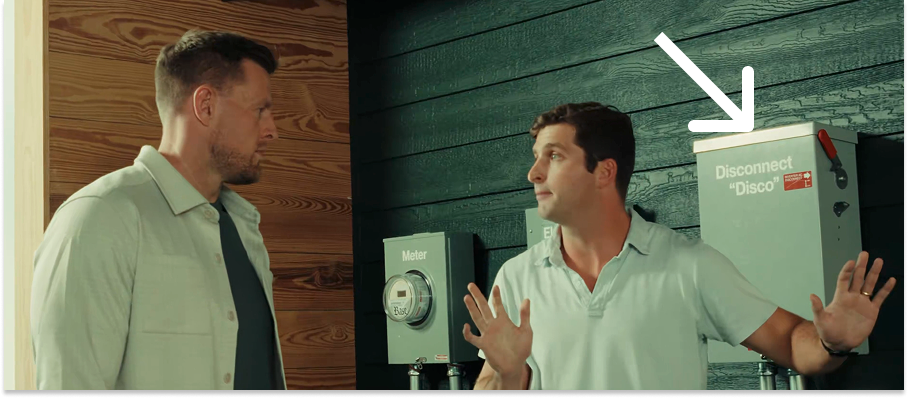
The biggest change is to Disco, so named because it’s an internal disconnect that sits between the grid, the home’s main panel, and Base Core. It allows Base to split the install into two stages: electricians do the detailed electrical work when they disconnect the home from the grid with Disco, and installers come to plug in the module the next day.
“Install basically goes from three steps down to two steps,” Dana told me, and importantly, it decreases how much scarce electrician time Base needs to use.
Designing for install does mean making trade-offs. For example, Dino told me, they could have squeezed in more energy per module, “but it would have been a trade: now every single time we lift the battery, it would have to be done by a piece of equipment and it can never be lifted by a person.”
Vertical integration allows you to control that trade-off. One of the things I’ve appreciated about Base from the very beginning (opens in new tab) is that it optimizes for the whole deployment instead of any one spec. They call it the Deployment Factory, and the more Base controls, the better a factory it can design.
Base Core comes with features that help the Software team, too. The same Disco has new telemetry on it, which helps them get to base truth on any issue very quickly.
“For Gen 1, sometimes people would call us and say ‘my lights are flickering’ and we’d try to diagnose it based on information you give us and our one-hertz telemetry,” Jared told me, referring to the fact that it ran 1 time per second, a huge upgrade from the every five minutes utilities are used to but still too slow for the precision Base wants. “Now, we implemented new telemetry on the Disco, which at seven kilohertz (7,000 times a second) is running analysis on the actual waveform.” With that, the team can diagnose, and then fix, most issues remotely and near-instantly.
The new battery is flash-flood tested and can be submerged in three feet of water, too. Dino mentioned that they “welded the lid on like a submarine. We hardened the crap out of it because we wanted them to be able to work underwater. And then we tested it, with water all the way up to the top of the inverter, and it just works. Full submarine mode unlocked.” This sounds like it’s a cool-to-have, but it also expands where Base can operate to include low-lying flood zones.
Then there was the big one for Cole, the feature that answered the most common customer question: “How long is this thing going to last?”
So Dino and his team added a generator port, and now Cole and his team can honestly tell customers, “We have this generator port, so it lasts as long as you need. Obviously, you can use the battery as your first line of defense, but in the event of a winter storm, you’ve got this thing included, and it’s only a few hundred bucks to add a generator to it.”
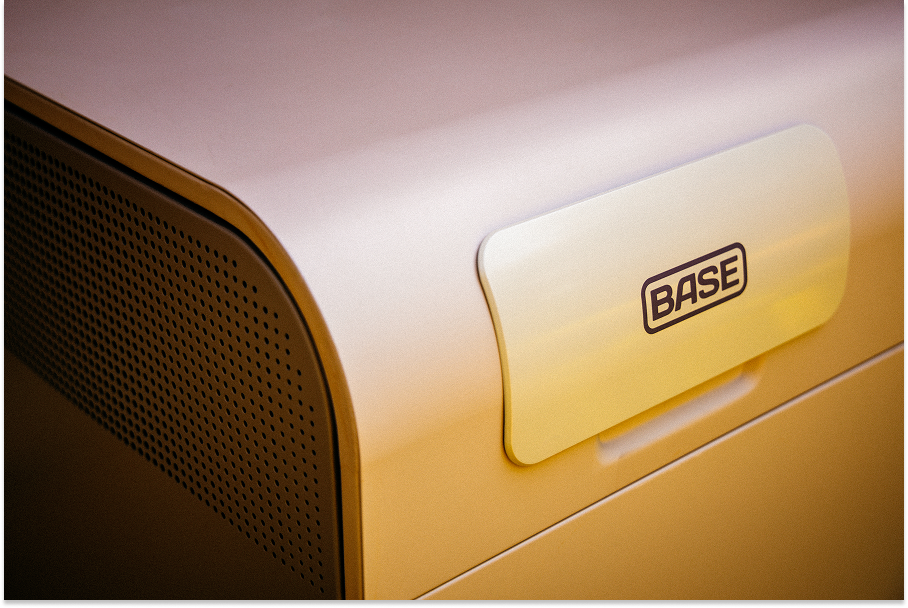
Generator Port (Behind the Base Flap)
Think of it like adding a gas tank to a Tesla to eliminate range anxiety. Most of the time, you’re golden with the battery, but if you can’t find a charging station and you just need to fill ‘er up quickly, you can. “I think it’s the best feature, honestly.”
As Dino pointed out when deciding to kill Gen 2, though, this thing is going to break. The thing I heard from multiple people that makes making Base Core in-house so great is how fast you can fix it, which Dana said means that “The iteration loop is much faster.”
That is the biggest benefit to vertical integration: the speed of the feedback and iteration loop.
On an early install she went to, “One of the installers, the electrician, was like, ‘Why did we do this thing that way?’ And I turned to the designer and was like, ‘Yeah, I don’t know, designer, why did you do that thing that way?’ And the designer was like, ‘Oh, shit.’ And so all that stuff just makes the feedback loop much tighter, which just makes it a little bit better.”
“Because we’re so vertically integrated, if something’s broken in another org, I can go fix it” Colby agreed. “I don’t have to argue with people outside my organization and work through a commercial interface. That’s a speed enabler, which I think is huge.”
Put all of it together, and you have what the team is quite certain is the best and cheapest residential battery on the market, a killer combination that, once installed, will protect you from outages and save you money on your electricity bill, and it keeps getting better as the team learns from contact with reality.
Which is why everyone seems to want a Base battery.
More Demand Than We Can Meet
At the end of each of my conversations, I asked people what they would title this chapter in the Base story.
Zach asked to come back to me with a title, but said “The subheader of mine is: commercial validation, just rip-roaring product-market fit, more demand than we can meet.”
Base’s demand has come from what Cole calls the three-headed monster: homebuilders, utilities, and direct deregulated customers. Each has been humming, with utility surging to become the largest source of demand over the past few months.
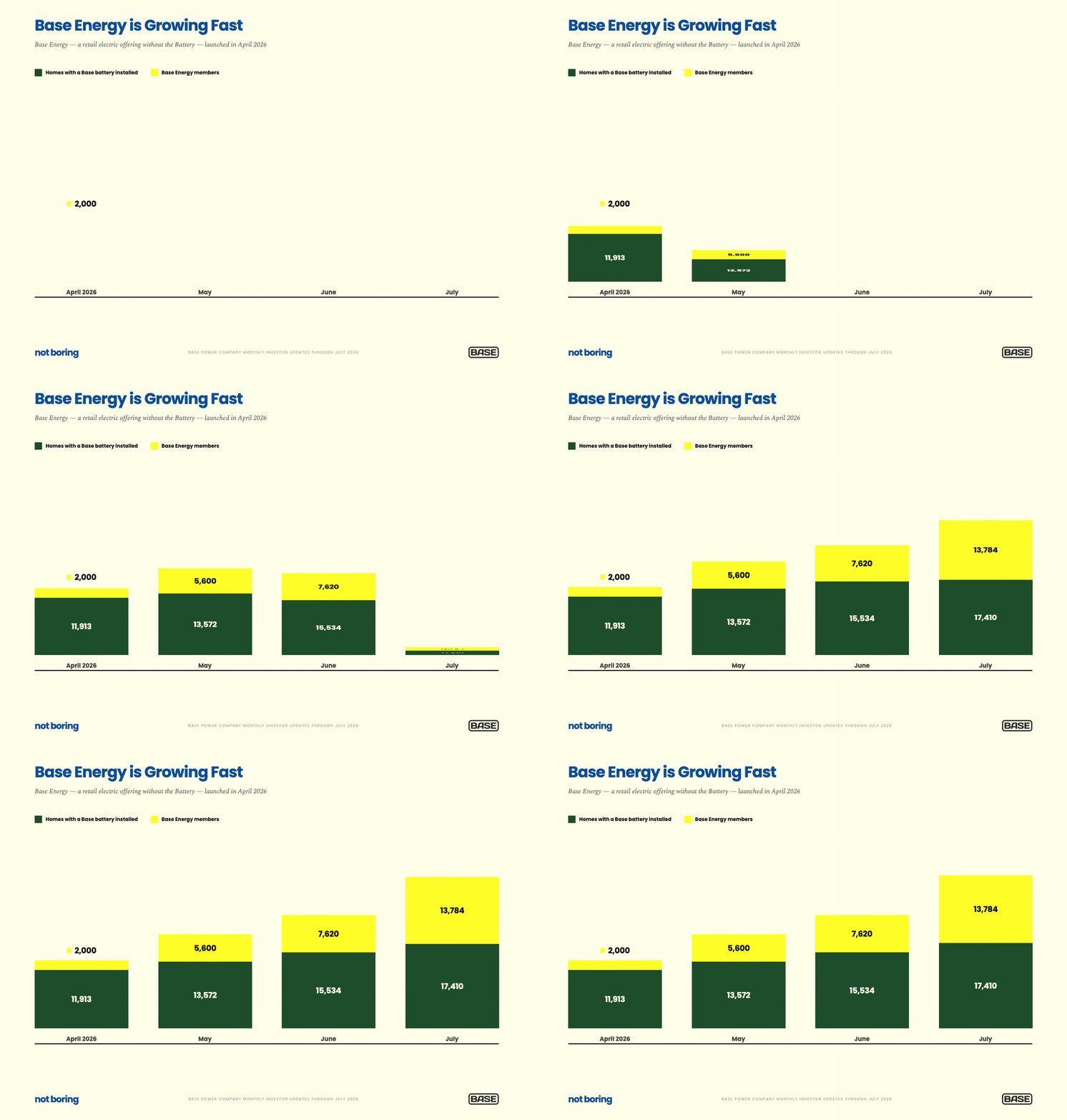
In July, Base signed over 6,000 new Battery members, roughly 40% more than in June, while installing a record of more than 2,000 systems. For every battery it installed, more than three new Battery members signed up.
Despite the manufacturing ramp, Base is still supply constrained, which is why Andy is so focused on increasing production 5x and why the Supply Chain team has the Turtle. As many Base Cores as the team makes, there will be demand.
But recently, for the first time, being a Base Member doesn’t necessarily mean installing a battery. In April, the company launched Base Energy (opens in new tab), “an energy plan with guaranteed below-market rates,” for renters, apartments, and other Texans “who might not be ready for a battery just yet.”
The battery means that Base can offer customers a lower price on their electricity. The reason is counterintuitive.
Selling electricity in a deregulated market is a low-margin, high-risk business. It’s low margin because it’s competitive, and REPs have to buy from generators and sell to price-sensitive consumers. It’s high risk because prices can fluctuate wildly. For most REPs, that makes selling electricity even lower margin, because they need to hedge their risk with financial instruments for which they pay a premium.
“The hedge is a financial battery,” as Jared described it. “The battery is a technical hedge.”
Since Base can hedge with technology instead of options, it can pass the savings it would have otherwise spent on premiums back to customers.
Base Energy shows that that’s true on a network-level, not just member-by-member. With its fleet of batteries, Base is long power: when electricity is valuable, it has stored electricity it can dispatch. A retailer, like Base Energy, is short power: it has promised to serve customers and must procure that power. Combining the two can reduce risk and improve economics, and can also serve as top-of-funnel, a way to build member trust, and a word-of-mouth engine. “How is it that you’re paying 10% less than me for the same electricity?”
Three months after launch, Base Energy had reached more than 14,000 members, bringing Base’s total membership across both offerings above 30,000.
The direct business - with or without Battery - is growing, as is the homebuilder business. Lennar accounted for roughly 2,500 homes, or 30% of Base’s 2025 installations, and by March 2026, Base was available in 77 Lennar communities with a take rate above 65%.
The biggest growth engine, however, has been utility partnerships.
Providing Utility to Utilities
Fifteen months ago, we focused the entire “Expansion (opens in new tab)” section on regulated utility partnerships, of which Base had just signed its first, with Bandera Electric Cooperative.
When asked how Base might fail to become what it could become, one of its investors told me, “If Base doesn’t work outside of deregulated markets, if it can’t break into utilities, it becomes a less good business. The size of the prize is smaller, and it’s more competitive.”
The good news is: Base has been able to break into utilities.
Tim Pianta (opens in new tab), Base’s Head of Utility Partnerships, told me back then that while Base had the best battery technology, and believed it offered the fastest speed to capacity and highest reliability compared to grid-scale batteries and Virtual Power Plants (VPPs), the whole game was to “chop wood, carry water,” to take the time required to prove to utilities that it could do what it said it could.
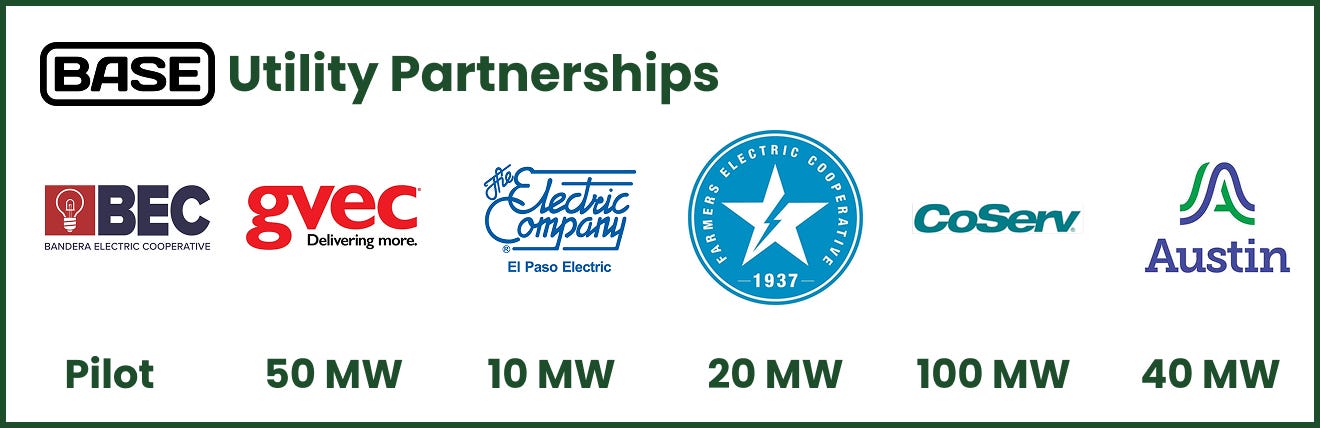
Since then, Base has been proving itself. That initial Bandera pilot has turned into five larger utility partnerships, totaling 220 MW:
“When I last talked to you,” Tim remembered, “I think the regulated part of our business was quite small. In 2025, I think we were on the order of a couple percent of the business. This month and through the end of the year, about 50% of the installs that are happening are regulated utilities installed. So we’ve kind of caught up with the deregulated side to some extent.”
In fact, a full 58% of Base’s July installs were in regulated utilities’ territories.
This makes Cole’s job easier, at least from a customer acquisition standpoint. “From a go to market motion, the utility world is quite simple,” he told me. “You get like 5% of the addressable market signed up just by the utility sending an email. It’s a free CAC. I love it.”
It’s “free,” of course, only after the months or even years of work that Tim and his team put in to sign a utility partnership, which is a long sales cycle in its own right. But as Base continues to prove that it can get capacity online faster than centralized solutions, even utility partnerships are becoming lower cost to acquire.
When I spoke with Zach, he was on his way out for a road trip to three of the largest investor-owned utilities (IOUs) in the west.
“All the big utilities are calling us and they’re saying, ‘Please help us,’ basically,” Zach told me. “That was just not true fifteen months ago.”
There are different types of utilities, each of which might want something different from Base, which means that while Base manufactures one battery, it can monetize it in a number of ways.
In a deregulated market like Texas, it owns the battery, sells electricity to members as a REP, and monetizes the fleet. With co-ops and municipal utilities, Base deploys a contracted fleet that the utility can use. With investor-owned utilities, the IOU might buy the assets through a build-transfer contract, because they can place the batteries in rate base and earn an allowed return on the approved investment, and pay Base for software and services.
Base’s innovation, from its initial decision to own the batteries instead of selling them to retail customers, has always been a business model as much as a technical one.
It has been able to meet customers, whether retail or utility, where they are, and as a result, Base is well on its way in Texas.
Its batteries backup early adopters’ homes in Dallas-Fort Worth, Greater Houston, and parts of the Austin metro. It has partnered with the state’s forward-thinking utilities, including recently signing its home utility, Austin Energy, through which it signed up more than 1,000 of its neighbors in the first month.
Base, however, does not want to simply become Texas’ largest REP. It wants to be America’s Next-Generation Power Company, and America is bigger than Texas.
So in June, for the first time, Base pointed the Capability Cannon north and fired.
Daaaaaaaaa Batteries
On February 1, 2026, right on schedule as always, Zach and Justin sent the monthly update to its investors. In it, they shared that Base had decided on its second market: Illinois.
Illinois is large, with roughly 4 million single-family homes, deregulated like Texas, and has become one of the most battery-friendly states in the country. The same month Base decided to launch in Illinois, Governor Pritzker signed the Clean and Reliable Grid Affordability Act (opens in new tab) (CRGA, or SB 25). Base is so key to the state’s energy plans that Governor Pritzker cited Base’s decision to launch in Illinois as evidence that the Act was working.
Tactically, CRGA establishes a 3 GW battery storage target by 2030 and gives residential batteries access to the PJM wholesale capacity market.
PJM is the Regional Transmission Organization (RTO) that covers parts of Illinois, including Chicago, and the Mid Atlantic. PJM’s high capacity prices (opens in new tab) make stored power particularly valuable, while Illinois’ aging infrastructure and time-varying distribution rates create the opportunity to get paid for relieving stress on the local wires, a value stream Base cannot currently monetize in deregulated Texas.
Illinois is also well-positioned as a potential … base … of expansion to the northeast and midwest.
These are all specific reasons to choose Illinois once Base decided it was time to expand, but not reasons to expand in the first place.
I asked Justin how they decided the time was right to make the Lone Star State less lonely.
His answer was that the process was “perhaps too scientific,” but basically, they look at the penetration rate of eligible single-family homes in a given metro, and how expensive it would be to increase the slope of expansion within that metro. It gets expensive at a certain point, near where they’re at in Texas.
“So we think the economic optimum is to expose ourselves to more TAM over time,” or in English, to enter new markets.
Less scientifically, while everything is bigger in Texas, Base’s ambitions are even bigger than that. The only way to prove that it can expand outside of its home state is to expand.
Base can take the capabilities it has built in Texas, and turn them on the next best market, where it can, as with the battery itself, see what breaks in the new context, fix those things, and apply them to the next market, and the next one, so that it iterates on go-to-market and deployment faster than everybody else, too.
All of which means tweaking and testing.
On the Growth side, Cole said that a lot of the early marketing was very Texas-focused, but, “We’re shifting to becoming America’s Power Company, which requires you to kind of localize your approach.”
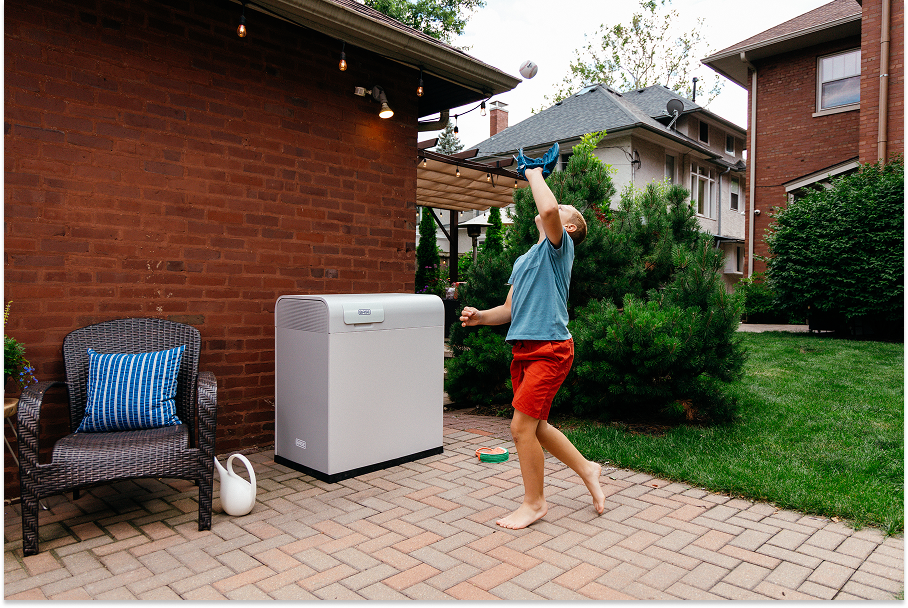
“So if you look at our Illinois website (opens in new tab),” he continued, “it has a classic Midwestern brick home with a kid playing baseball in the backyard. The approach and how we think about photography, how we think about design is expanding.”
“What we learned in Texas is that you need to earn trust and you need to humanize energy,” he said, “but the way you humanize it is obviously going to change region-by-region. You’re seeing this with the Illinois launch, and you’ll see this with a few other launches we’re cooking up over the next few months, as well.”
The value prop people care about in each region differs slightly, too.
Base’s core offering, everywhere, is “affordable, reliable power,” but, Cole said, “some will veer more affordable, for example Chicago, and others will veer more reliable, for example Texas.”
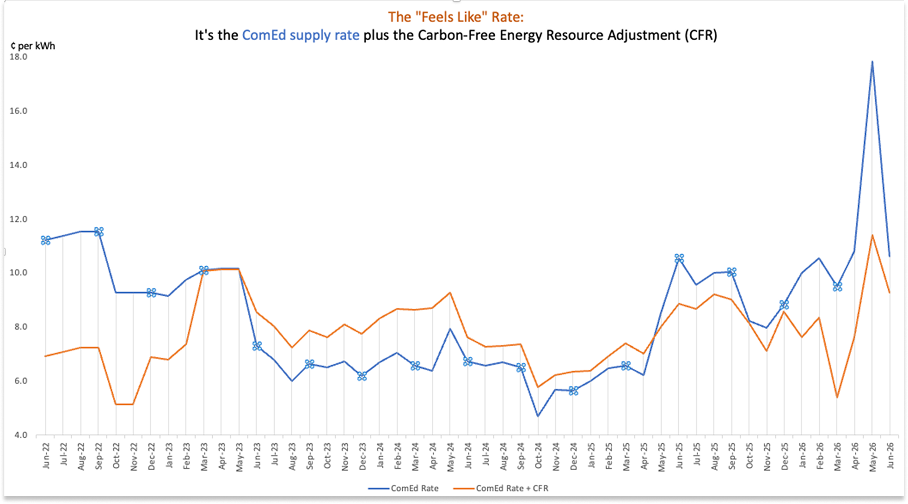
This makes sense - Texas has been rocked by outages, and PJM wholesale power has gotten dramatically more expensive recently. ComEd, the utility that covers Chicago, has seen its all-in residential rate jump to 17.07¢/kWh, up roughly 90% from ~9¢/kWh in 2021. Brian Potter talks about why PJM and others have gotten relatively more expensive compared to ERCOT here (opens in new tab).
What is true across all of Base’s customers is that they would like to pay less money to receive more reliable power.
Another thing that seems to be true among Base’s customers is that they trust local news. “Our target audience watches the local news at 5pm, and so getting Zach on TV with a reputable local TV station is a good strategy,” Cole said.
Local newspapers work, too.
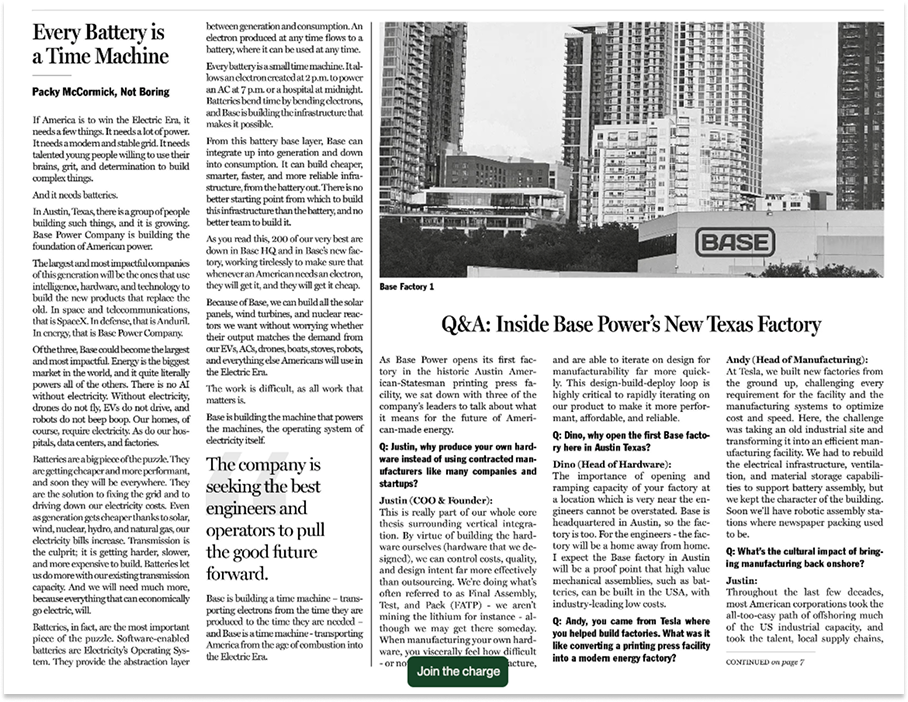
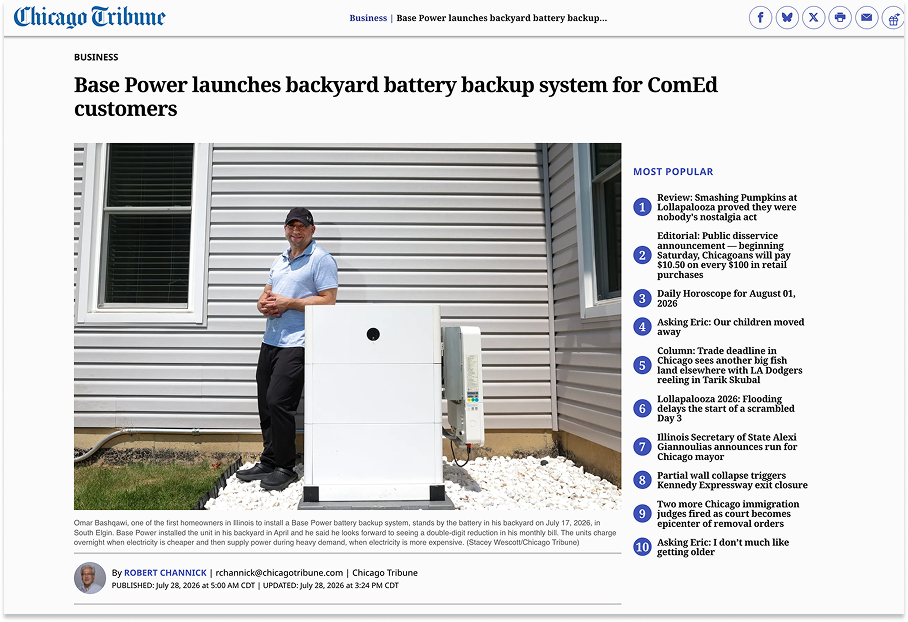
Chicago Tribune, July 28, 2026
That day, 1,437 leads came in in Chicagoland, five times the previous best day, and 172 of them signed that day, nearly double the previous daily record of 90 and almost a quarter of the new Chicagoland members signed up in all of June.
In Illinois, too, it seems that Base will have more demand than it can meet, which means it falls to Dana to meet it.
Deploying a New Market
It should be easier to launch a second market than it was to launch the first. Base knows what it’s doing now. It knows how to talk to potential members and how to walk them from top of funnel through signup with BaseOS. It knows how to make batteries, how to get them to warehouses, and how to get them from warehouse to house. It knows how to install them, now with less electrician time. It knows the type of people it needs to hire, and roughly how many. In many ways, a new market is just doing those things in a new place.
To be sure, there are differences, too, new problems to be solved, or old problems, already solved in Texas, to be solved anew.
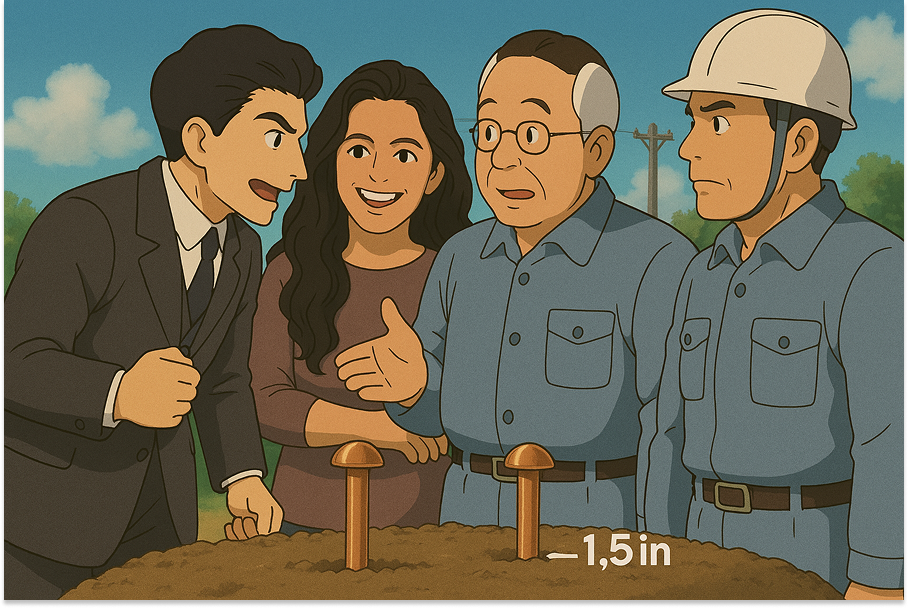
Take permitting. In Chapter 2, we talked about the fact that each Authority-Having Jurisdiction (AHJ) in Texas could supersede the National Electric Code (NEC) with its own rules, which meant that each new neighborhood was a new adventure, and whether Base was able to install smoothly or not often came down to the whims of each particular inspector.
Franz Kafka and Dana discussing ground rod heights with AHJ inspectors, colorized
It was Kafkaesque and annoying, but Dana and her team figured it out case-by-case, and it was another source of advantage “if you think about Base as a machine that eats complexity and turns it into moats.”
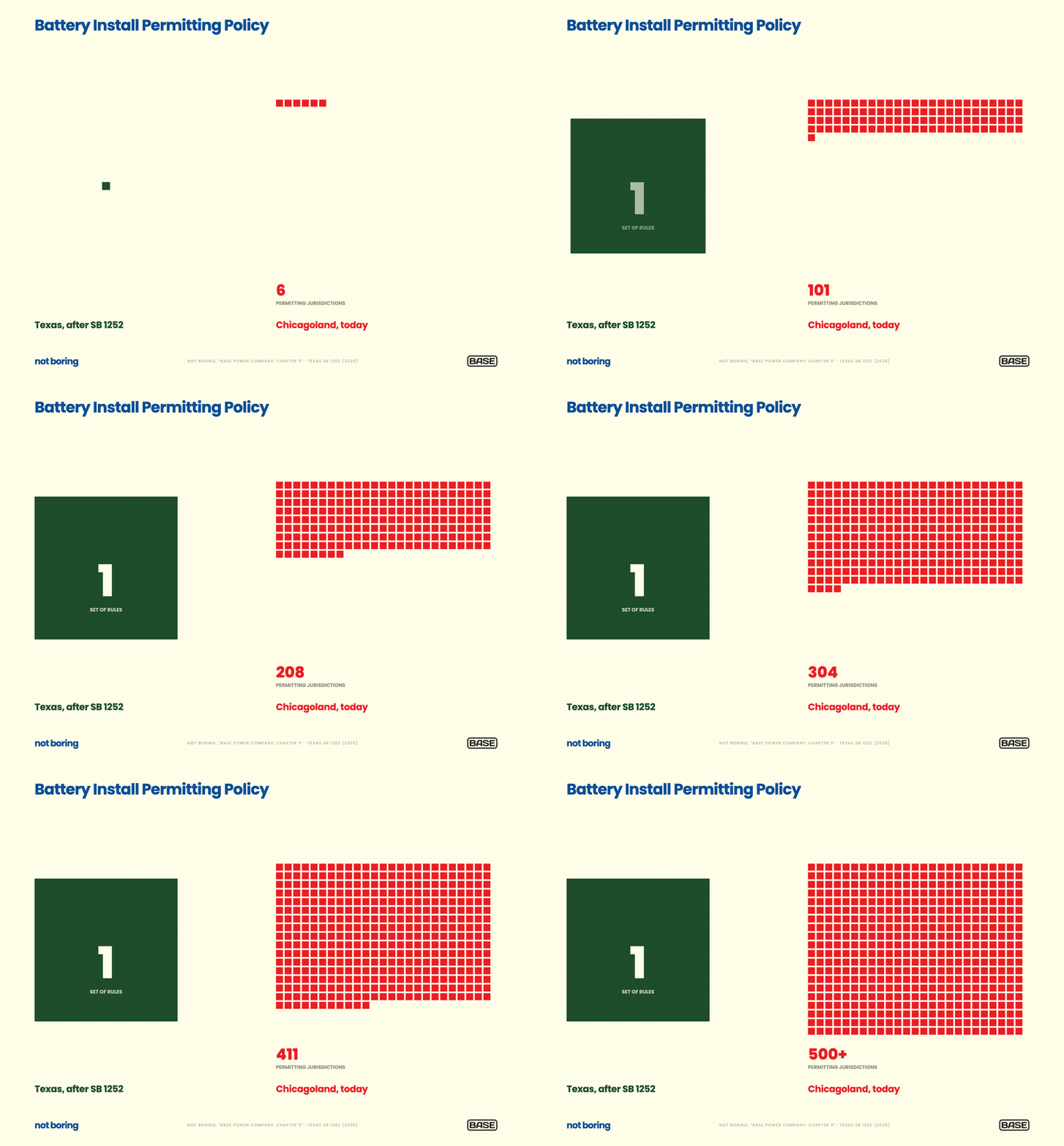
Then, Base ate complexity and turned it into law. In August 2025, thanks in large part to work by Base’s policy team, Texas passed SB1252 (opens in new tab), a standardized code framework that said, “a municipality may not adopt or enforce an amendment to the National Electrical Code, or adopt or enforce an ordinance, rule, or other measure, that would regulate the installation or inspection of a residential energy backup system.” The framework said that the rules had to be the same throughout the state.
That made Deployments’ job much more predictable, if not easy, and it was one of a million little things they figured out to make Texas go more smoothly.
But Illinois is not Texas, and its municipalities are not subject to SB1252. Chicagoland has more than 500 permitting jurisdictions. Base is back to negotiating with individual inspectors in each about small differences. There are different labor and union dynamics there, too.
In each state Base enters, it will have to push for policies that make permitting easier to navigate, and that generally support affordable, reliable energy, unless it can make the National Electric Code… national.
“As of 2025, Texas is the only state where the state itself controls permitting, because of SB1252,” Justin told me. “We’re trying to do that elsewhere, but there’s a federal permitting bill very slowly making its way through Congress, and we’re trying to get language on that bill that is basically supportive of a similar path to what we did here in Texas.”
Justin is very serious about this, because it slows Base down, hurts the grid, and hurts Base’s customers. Plus, it’s an unnecessary headache when there are so many other hard things to worry about. When we saw each other at Reindustrialize in June, we were talking Illinois permitting within 60 seconds. Last week, he wrote an op-ed for Utility Dive titled America’s permitting crisis lives at City Hall (opens in new tab)making the case that local permitting discrepancies are slowing the transition to clean, cheap, reliable energy and calling for federal or state-level action to standardize the process.
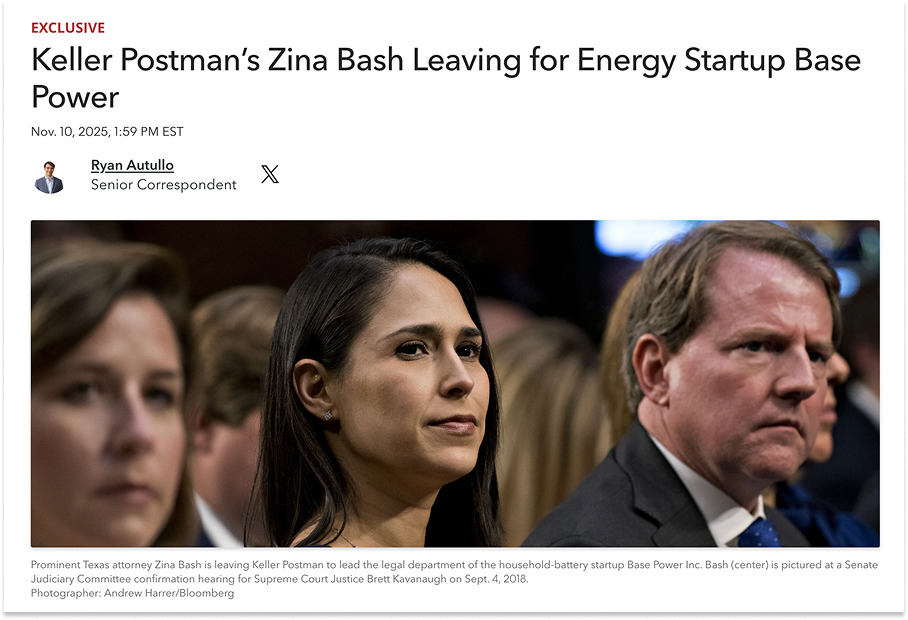
To that end, in November 2025, Base hired Zina Bash (opens in new tab) as Chief Legal Officer. Bash is a huge get and a perfect fit, having clerked for Justice Samuel Alito, served as a Special Assistant to the President for Regulatory Reform, and as Senior Counsel to the Texas Attorney General before going into private practice.
Bash’s hiring is a sign of how important the company expects policy to be going forward, and another example of figuring something out at the edge of the web (SB1252) and turning it into a core capability.
There are a lot of new things to figure out in Illinois, but this time, Base is doing it with more resources, a more experienced team, and stronger brand awareness.
“When we were trying to hire people in Dallas with no warehouse and no footprint, people were like ‘You’re a scam for sure, like this is not a real company,’” Dana recalled. That made hiring tough. Now, people know that it’s a real company. They may have read about it in the Chicago Tribune, the WSJ (opens in new tab), or Not Boring, which seems to be making hiring easier, even in new markets.
A couple of weeks ago, Dana flew into Chicago on one of her frequent trips up to launch the market. Her plane diverted to Indianapolis to refuel, and by the time she got to Chicago, she’d missed the rental car window and they canceled her car. So Dana goes to the rental car window and tells them, politely, that it’s not like she chose for her flight to be delayed…
So we’re chatting with the guy, and I’m like, ‘It’s midnight, I really just need you to give me a car. If you tell me I need to take an Uber an hour to my hotel I’m gonna be very sad.’ And he was like, ‘Okay, I don’t like that, let me see what we can do.’
And then he asked, ‘OK, what’s your email?’ and I told him, ‘Oh it’s whatever at basepowercompany.com’ and the other guy goes, ‘Oh my gosh, I just applied to get a battery, they’re reviewing my site survey!” and I’m like, ‘No way!’ and the other guy says, ‘I install solar when I’m not doing this,’ and I was like, ‘Do you want to work at Base?’ I gave him the recruiter’s email, and he emailed and he’s applying to be an installer.
It was pretty electric and it made my day.
Base plans to hire about 50 people in Chicagoland by year-end. Hiring electricians used to be a huge bottleneck, but Base has great recruiters for that now. “The recruiters honestly shocked me with how quickly they can hire great people at this point,” she said, and noted that the challenge is now staying competitive with data centers who are willing to pay top dollar for electricians for short-term projects.
Base will have to figure out ways to compete without simply upping the dollars - things like benefits, 401k, and equity that come with working for a company long-term, to the extent that potential hires value them - but if paying up is what they have to do, they’ll figure it the fuck out. “The answer can’t be, well we won’t install batteries because we don’t have electricians,” she said.
They’ll figure out hiring, and how to adapt warm weather Texas uniforms to Chicago’s cold, and warehouses, and vans, and all of the millions of little pieces of complexity that turn into Base’s moats. Some will be Chicago-specific, and some will be a level up: how do you adapt something that works well in one place and make it work well in many?
Chicago is the edge of the web; they’ll do something scrappy there, then turn it into a capability and move it to the core. They’ll use what they learn to launch the next market, then the next, each with its own hiccups, each a little more smoothly than the last.
The Mission is to Fix the Grid
“The way I think about where we are is that this is really Chapter 1, Part 3: scale up Solution Number One [the battery] and spread that to the country,” Jared said, when I asked him to name this chapter in the Base Story.
Base made a bet that, over time, batteries will be the foundation of the modern energy system, and that the best way to own as much of that foundation as possible is to sell residential batteries to consumers and utilities to provide them with affordable, reliable power. There is a long way to go to prove that out at the scale Base is aiming for, but it has built the product with which it plans to expand, and has begun the expansion.
I started this chapter talking about the end game, about what happens at the end of all of that, and how Base might build the world’s largest energy company. And then, I spent more than 10,000 words in the weeds talking about all of the very hard, specific, and often hacky things the company has had to do to just get to this point.
That was by design. Winning the High Ground is hard, and holding it now that they have it will be hard, too.
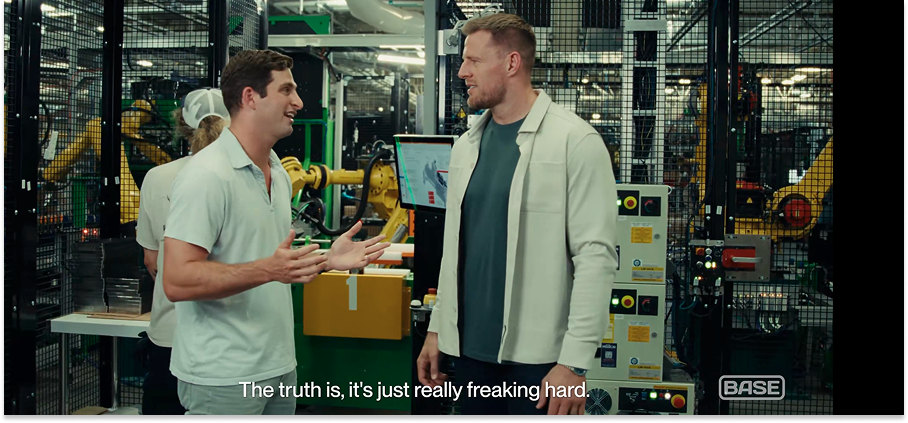
“Seeing it in action, I have a feeling I know the answer to this, but why has no one done this before?” new Base investor JJ Watt asked Zach in his new video (opens in new tab).
“The truth is,” Zach answered, “it’s just really freaking hard. It’s difficult. There’s no new physics. There’s no secret magic potion. It’s just a bunch of really smart people working their butts off to solve really hard problems, day in and day out.”
Those smart people are still working their butts off putting Base Core on as many homes as possible. At one point in Base’s life, one install seemed impossible. In Chapter 2, they’d hit a high mark of 22 in a day. Now, the record is 113. The next time we talk, it may be in the thousands. In July, Base installed twice as many batteries as it had installed in total in April 2025. It’s now deployed 585 MWh of storage, and aims to pass 1 GWh by the end of the year.
The more batteries they have in the field, the more they learn, the more they improve. Dino said that what excites him isn’t making the next shiny thing, but making Base Core into the Toyota Corolla, a supremely reliable machine that you can print at volume. Justin, Andy, Colby and their teams will fix the supply chain bottlenecks, and figure out how to increase production of Base Core by 30x, in BF1 and BF2. Dana and her team will continue to tighten the Deployment playbook, and then unleash it on a number of new markets, while Cole and Tim continue to earn the trust of their consumer and utility customers.
Utilities, already a much bigger part of the business than they were in April 2025, will be a bigger part still by Chapter 4. They are the guardians of the grid, and Base keeps figuring out new ways to help them guard it.
“We spend a ton of time with utilities, and as we’ve done that, we’ve learned that most of the problems that utilities face are coordination problems. It’s about blocking and tackling and solving problems across the stack, not just in Make, Move, Store, and Sell individually, but when you combine all them together,” Zach told me. “We’re pretty good at coordination problems and we have visibility into the entire stack, and so there’s a lot of stuff we can do in partnership with utilities.”
If there’s one person in charge of coordination problems and grid topology, it’s Jared.
His team’s firmware and software stitches the network together, pulls telemetry data from the batteries Base has deployed to over 17,400 customers’ homes, and understands the grid on a hyperlocal level in a way that not even utilities themselves do.
“Now, we’re starting to work on Solution Number Two, as well,” Jared said.
What’s next? I asked. Any hints?
“The mission is to fix the grid,” he said. “And what is the power grid for? Increasingly, it’s for driving compute.”
“And so if we want to do a good job at fixing the grid, well, it doesn’t work to fix the part of the grid that is going to be a shrinking portion of the pie. If you look forward a few years out at what are the factors that have the potential to make the grid unhealthy? Compute is a major part of that.”
What wasn’t clear was that those batteries would be next to homes. One of Base’s insights was to say, “Grid-scale batteries are great, but residential batteries are even better. They’re just harder. Let’s figure it out.”
Today, it is clear that compute will play a major role in the future of the economy, and become an increasingly large consumer of electrons, whether from the grid or behind the meter. Like batteries, idea number one is to put all the compute in big, centralized data centers wherever hyperscalers and neoclouds can find powered land, or land they can power themselves in a reasonable timeframe.
“One thing that’s hard with large, centralized grid-scale loads in general is that it’s sort of like…,” Jared searched for the right analogy.
“Here, imagine if you have a rock and you’re trying to suspend it in a spider’s web. Wow, totally crazy one,” he said, not realizing that he was not the only Base employee to use a spider’s web as an analogy…
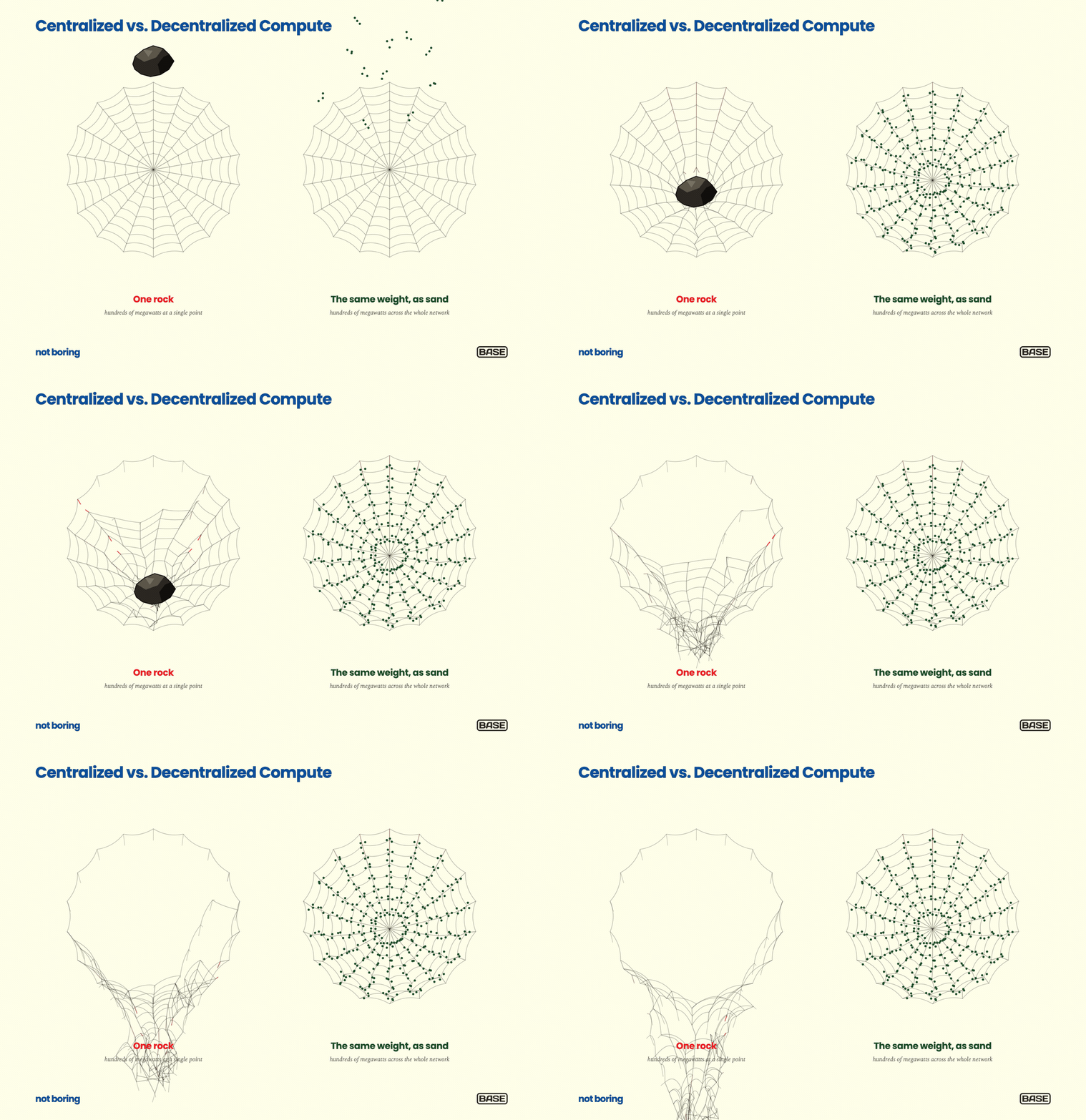
If you have like one big rock, it’s really hard to find a part of the web to put it where it’s not going to break the whole thing. But if you have a lot of sand, it’s much easier to distribute that across the web so that you don’t have so much load on any individual point that it causes the thing to collapse, so the spiderweb can hold a lot more sand. Wow.
If you can put the sand specifically in places where the grid has headroom and you don’t have any particular spot where you’re trying to connect hundreds of megawatts, and instead you’re able to connect hundreds of megawatts but across the whole network, you end up being able to connect more compute more quickly. Especially because you have the battery there where you can help with power conditioning and you can do it at a very high rate, because we control the hardware. You can make sure that you don’t have some bad effect on the power grid.
I think we should be able to bring a lot of compute online while keeping the grid healthy.
Base is not the first company to think about doing decentralized compute, just as it was not the first company to put batteries next to homes. Tesla, no slouch, did it earlier, and Base has grown like wildfire anyway, by vertically integrating to deliver the best product on the market.
But the capabilities Base has developed on batteries might give it an even better starting point for what it does next. Its ability to manufacture hardware and install it on homes seems important, as does its ability to make a distributed network of batteries operate as one.
As Base was building out all of the capabilities and culture it needed to do that well, “This new thing showed up in the past three years,” Zach said, “that is the fastest-growing consumer of electricity ever: AI.”
It’s always possible for a startup to build a better mousetrap and use it to topple incumbents. My whole thesis (opens in new tab) is that it’s possible. Joseph Schumpeter called this the kind of competition “which commands a decisive cost or quality advantage and which strikes not at the margins of the profits and the outputs of the existing firms but at their foundations and their very lives.”
Man, though, do times of great change help. Base made an early bet that electrification was such a time, that the growth of solar on one side and EVs on the other would demand batteries, and they were right. Then a second, even bigger, moment comes along, a faster and more violent shift in power, and Base finds itself in the right place at the right time and with the right capabilities to seize it.
This is how a small battery startup in Texas might, one day, become the largest energy company in the world, even as energy companies get larger.
While it’s a bit too early to share specifics, what Zach was willing to say was this: “So now, we’re taking this Capability Cannon and we’re pointing it at the infrastructure buildout, and we’re going to do it in two broad ways: one is bringing the power to the compute, and two is bringing the compute to the power.”
*We’re going to take that massive capability machine and we’re going to point it at AI. And we’re going to orient the company kind of entirely around this thing that is going to totally transform our industry. As a result we should be able to build the largest energy technology company ever.*
Because if we are the best energy technology company, and energy is going through this kind of once in a generation demand inflection as the result of AI, the company who does this should become the world’s largest energy company and perhaps the world’s largest company.
But we’ll see.
“The thing that feels most true if you were hanging out here and walking around or having lunch or dinner or sitting in our all-hands meetings is that it still feels so unbelievably early,” he concluded.
“We’re just firing up the stoves and buying the groceries. We haven’t even started cooking yet.”
Thanks to Gabe, Zach, Justin, Cole, Jared, Dana, Tim, Dino, Andy, Colby, Richa, Prithika, and the whole Base team for your time, insights, and for letting me help tell the Base story.
That’s all for today. We’ll be back in your inbox Friday with a Weekly Dose.