We can't find the internet
Attempting to reconnect
Something went wrong!
Hang in there while we get back on track
Casado on Invest Like the Best (Patrick O'Shaughnessy)
Martin Casado called his third conversation with Patrick O'Shaughnessy "the most in depth conversation I've ever had on the practice of venture" and "a good overview of what I've learned over the last decade" . O'Shaughnessy listed the main topics:
- the case for consensus investing
- why moats are overrated
- frontier model economics
- what happens when AI growth slows
- why private markets are efficient
- lessons from the Cursor, OpenRouter and World Labs acquisitions
A clip from the episode gives the central argument. Casado says that betting on non-consensus companies is "actually quite dangerous in the early stage" because "follow-on capital tends to be more and more consensus aligned." He adds that the portfolio companies that returned money "were actually very, very competitive" . YouTube · Spotify · Apple
Casado on Sequoia's "The Sequoia of Tomorrow"
Casado also praised Sequoia's public memo. He saw "a lot of really smart moves here" and expects that "over time it'll be very clear how thoughtful these decisions were" . Seven general partners signed it on behalf of the team . Here's what it says changed:
- Sequoia is ending its Arc accelerator and Scouts programs and putting its focus on "high-conviction, highly selective" investing .
- It no longer has separate Early and Growth groups .
- It is closing the London office. Sequoia says it doesn't need a local presence to back European founders .
- The partnership is flatter, and the firm has raised about $10B in new funds .
- The Monday partner meeting cycle is gone .
Chamath and Rick Rubin
Chamath Palihapitiya shared a conversation he recorded with Rick Rubin and called spending time with him a "pleasure and honor" . Chapters cover trusting your intuition and taste, investing in fringe ideas, the deals he passed on, and how he uses AI and his media diet. The headline quote is about being willing to "zag when everybody zigs" even if it means losing half the time . Episode
Sarah Guo on the Baseten Router write-up
Sarah Guo shared Baseten's technical article and called the router "best in class (cheapest at every pass rate)" . Baseten tested it on held-out coding benchmarks. It reports results within 0.8 percentage points of Opus 5.5 at 72% lower cost. It also says the router beat random routing by a statistically significant margin at every threshold, and none of the other routers it tested did . Article
Patrick Collison: Democracy in America
Patrick Collison said he spent the past week reading Tocqueville's Democracy in America and that it is "striking how much it still rhymes nearly two centuries later." He made the point while arguing that American democracy has responded to voter preferences over the last decade . Post
Shorter picks
- Jason Lemkin promoted a new SaaStr video, "Going from 10 to 1 SDRs," with Vercel COO Jeanne DeWitt on rolling out AI across Vercel's sales team . He highlighted her claim that Vercel's lead-qualification agent costs under $5k a year, takes 20% of one engineer to maintain, and works at quality "as high as the humans" . YouTube
- Aravind Srinivas shared a clip of Larry Page on taking on ambitious challenges and making big bets: "The world needs more Larry Page energy" . Post
- Elad Gil pointed to Sequoia's profile of Cresta, "From Stanford Research to AI at Work," with "Congrats to Cresta" . Article
Patrick O’Shaughnessy shared a video titled “The inside story of Cursor’s $60 billion sale to SpaceX” and linked it to his third conversation with Martin Casado, an a16z general partner (conversation); he closes the conversation post with “Enjoy!” . The conversation covers consensus investing, moats, frontier-model economics, AI growth, private-market efficiency, and lessons from Cursor, OpenRouter, and World Labs acquisitions .
Patrick O’Shaughnessy invites viewers to enjoy his third video conversation with a16z general partner Martin Casado, covering consensus investing, moats, frontier-model economics, AI infrastructure and competition, market efficiency, and lessons from major AI acquisitions (conversation). In the shared excerpt, Casado argues that AI makes it possible to deploy capital productively at scale, shifting tech from an engineering constraint toward a capital-allocation problem and giving investors a more direct role in shaping the future.
Sarah Guo shared and praised Baseten’s article, “Baseten Router: a Pareto-optimal model router for coding tasks”, calling it Baseten’s “first swing” at an intelligent router and “best in class (cheapest at every pass rate).” The article reports that the router performs within 0.8 percentage points of Opus 5.5 at 72% lower cost and beats random routing by a statistically significant margin at every threshold.
Patrick Collison offered a favorable, implicit endorsement of Democracy in America: while arguing that U.S. democracy has responded to voter preferences over the past decade, he said the book still “rhymes” with the present nearly two centuries later. Post
Chamath Palihapitiya promoted a recorded conversation with Rick Rubin, describing the chance to spend time with Rubin as a “pleasure and honor,” and linked to the episode. The linked promo calls it a new episode and lists chapters on trusting intuition and taste, investing in fringe ideas, and Chamath’s AI and media diet.
Patrick O’Shaughnessy recommends his third video conversation with a16z general partner Martin Casado (“Enjoy!”), spanning investing, AI economics and infrastructure, and venture-capital market efficiency. In a clip from the conversation, Casado argues that non-consensus early-stage investing can be dangerous because follow-on capital tends to align with consensus; he says the investments in their portfolio that returned money were highly competitive. Full conversation: https://x.com/patrick_oshag/status/2117971190534852725.
Patrick O’Shaughnessy shared his third conversation with Martin Casado, a general partner at a16z, and closed with “Enjoy!”; it is linked on YouTube, Spotify, and Apple Podcasts as an episode of Invest Like the Best. The conversation covers consensus investing, why moats may be overrated, frontier-model economics, AI growth and infrastructure, private-market efficiency, and lessons from the Cursor, OpenRouter, and World Labs acquisitions.
Martin Casado recommended @patrick_oshag’s video conversation with him on venture practice, calling it the most in-depth conversation he had ever had on the subject and a good overview of what he had learned over the prior decade. The listed topics include venture-investor types, network effects and moats, AI infrastructure and competition, market efficiency, and AI acquisitions.
Jack pointed followers to Ragavan Thurair’s MTS Live appearance about Dessa, writing “hear from ragavan on dessa”; Ragavan invited viewers to tune in to hear more about Dessa. MTS Live announcement
Garry Tan endorses GStack’s /review skill, saying it is still useful for preventing bugs (post).
Jason Lemkin promoted a YouTube video, “Going from 10 to 1 SDRs. How We Deployed AI Across our Sales Org” with Vercel COO Jeanne DeWitt; watch the video. His accompanying post highlights DeWitt’s claim that Vercel’s lead-qualification agent costs under $5,000 a year in tokens and infrastructure, takes 20% of one engineer to maintain, and runs 24×7 at quality as high as humans.
Elon Musk replied “True” to @brivael’s post, endorsing its thesis that AI and robotics could drive productivity growth enough to make debt manageable . The post argues that faster productivity gains would make capitalism’s benefits visible through lower prices, better services, and more opportunities . Post
Martin Casado praised Sequoia’s The Sequoia of Tomorrow, calling the decisions “a lot of really smart moves” and saying their thoughtfulness would become clear over time; the piece is signed on behalf of Team Sequoia.
Jason Lemkin shared a new video, “Going from 10 to 1 SDRs: How We Deployed AI Across our Sales Org,” featuring Vercel COO @jdewitt29. The post links to the video on YouTube.
Jason Lemkin promoted a new video, “Going from 10 to 1 SDRs: How We Deployed AI Across our Sales Org”, featuring Vercel COO Jeanne DeWitt and focused on deploying AI across Vercel’s sales organization. In the accompanying post, Lemkin quoted DeWitt saying Vercel’s support tickets are complex and highly technical, yet its support agents still resolve 93% of issues.
Jessica Livingston praised Ryan Petersen’s Twitter as making it “a happier place,” linking to his post about a shipping-conference host asking his team to confirm he would not criticize sponsors, followed by a Flexport marketing-team member accidentally replying that he would criticize other sponsors—an endorsement of his humorous Twitter content.
Aravind Srinivas praised @kevg1412’s linked post, which presents Larry Page on tackling ambitious challenges and making big bets, writing, “The world needs more Larry Page energy.”
Baseten Router: a Pareto-optimal model router for coding tasks

Today, we’re sharing our initial results from training an intelligent model router for Baseten Grid.
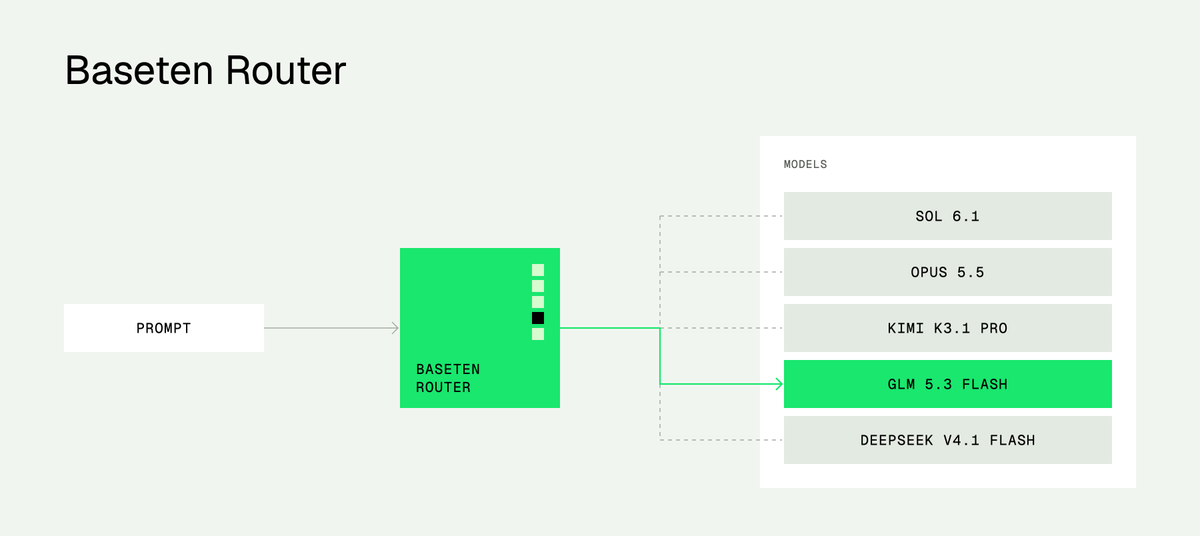
Not every coding task needs the most capable model. As AI coding spend continues to grow rapidly [1] (opens in new tab) and cheaper open-weight models close the capability gap [2] (opens in new tab), choosing the right model for each task becomes increasingly valuable. Baseten Router chooses between models based on their expected performance and cost for each coding task. The goal is frontier performance while paying frontier prices only when the task calls for it.
Baseten Router cuts costs by 72% compared to using Opus 5.5 for every task while remaining within 0.8 percentage points of its pass rate, measured on a test set spanning DeepSWE, SWE Atlas QnA, and Terminal-Bench. Adjusting the routing threshold lets users choose various trade-offs along the cost-performance Pareto frontier.
Among the commercial routers available - including those from Fireworks [3] (opens in new tab), Together AI [4] (opens in new tab), and Applied Compute [5] (opens in new tab) - Baseten Router is the only router we evaluated that beats random routing on these benchmarks at the same cost by a statistically significant margin.

We’re working closely with design partners to specialize Baseten Router for their production coding workloads and prove out performance in the real world. Early feedback is promising, and we will share those results soon.
Almost everyone at Opendoor uses AI, and most people don’t want an opinion on which model to pick. Auto routing sends them to the right model automatically, so they stay fully empowered and we stop paying frontier prices for work that doesn’t need it. - Chintan Parikh, Head of Engineering, @Opendoor
This post walks through how we built competitive performance into Baseten Router and how we continue to refine our approach.
How we built Baseten Router
Formulating the problem
From the input prompt, Baseten Router decides whether the coding task should be completed by a frontier closed-weight model or a cheaper open-weight model. In these experiments, we route between Opus 5.5 and GLM-5.3 Flash. We chose GLM-5.3 Flash because it is a strong coding model that is approximately 80% cheaper than Opus 5.5 across relevant workloads. Our approach can be extended to any model combination in any harness supported by Baseten Grid (opens in new tab).
Our aim is to build a model router that decides between two models and gives a better trade-off between success rate and cost than either model alone. We formulated routing as choosing the model with the highest score, where the score is the predicted success rate minus a penalty proportional to the predicted cost:

For a given coding task 𝑥, 𝑝̂ₘ and 𝑐̂ₘ are learned predictions of model 𝑚’s success rate and cost in USD on the task, respectively, and λ is a configurable weight that controls the trade-off. Intuitively, this favors Opus when its higher predicted success justifies its additional cost.

Why start with coding benchmarks
There are two distinct ways to evaluate a router: on coding benchmarks and in production. The router’s performance in production matters most to customers and to us: how much model routing reduces a team’s AI coding spend while preserving the quality of their engineering work.
However, it is challenging to compare results from online evaluations across routers. These tests involve different users and tasks, different definitions of task success, and different methods for calculating cost savings.
Coding benchmarks provide a controlled and transparent framework, enabling us to compare different routers on shared tasks with clear success criteria and cost calculations. Additionally, we believe that the expertise needed to develop a good router on benchmarks is a subset of the expertise needed to perform well in production. Consequently, we view strong performance on coding benchmarks as an important milestone toward deploying in production.
By being methodical about data quality, quantifying noise, and comparing against meaningful baselines, we have built confidence in Baseten Router’s capabilities as we bring it to our customers’ production workloads.
Building the training and test sets
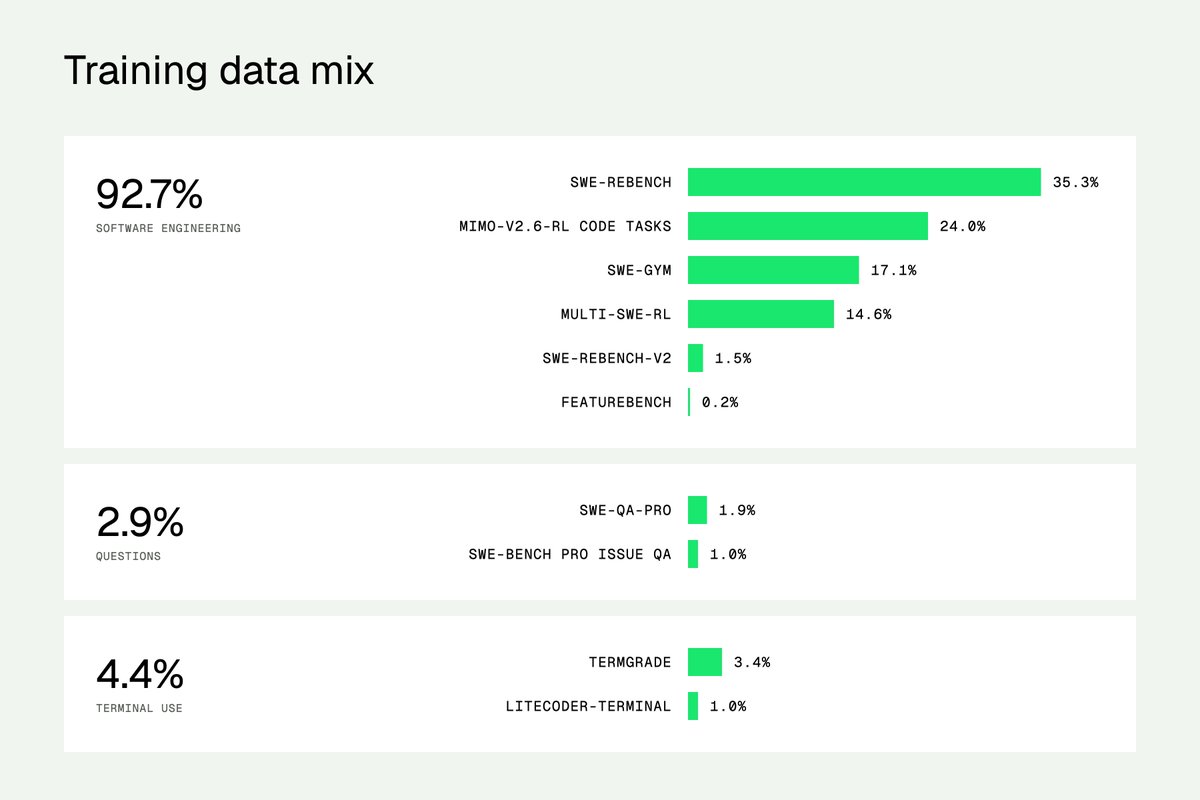
To train Baseten Router, we generated traces on verifiable coding tasks. We built the training set from public coding datasets spanning bug fixes, feature implementation, codebase question answering, and terminal tasks. For each task, we ran both Opus 5.5 and GLM-5.3 Flash at high reasoning effort and recorded the verifier output and model cost.

To evaluate generalization beyond the training set, we used three benchmarks spanning long-horizon coding tasks (DeepSWE 1.1), codebase Q&A (SWE Atlas QnA), and terminal tasks (Terminal-Bench 2.1) as our test set. We selected these benchmarks because they cover categories highly relevant to production coding work and were included in Artificial Analysis’s Coding Agent Index (v1.4) [6] (opens in new tab) and OpenRouter’s Router Benchmark (initial release) [7] (opens in new tab).
An underrated aspect of this process was cleaning the datasets. We corrected grader errors and broken task environments, added safeguards to prevent cheating, and removed training tasks with repositories present in the test set. Additionally, due to the non-deterministic nature of agentic coding, we quantified the uncertainty between repeats of the same task and repeated evaluation runs to improve the robustness of our results. We discuss this further below.
Controlling for noise
Benchmark results are noisy, meaning a router may perform well due to chance rather than genuine capability. To more rigorously control for this, we designed our evaluation to account for two sources of noise:
Label noise: The same model can pass the same task during one run and fail it during another.
Selection noise: A random router can route tasks, by chance, to GLM where it succeeds, making it seem more effective than it actually is.
Label noise
Models in production are non-deterministic, meaning the same model can pass a task on one run and fail it on the next. Consequently, a single run is an uncertain measure of how hard a task is for that model. To quantify this uncertainty, we calculate a signal-to-noise ratio (SNR). The signal, 𝜏², measures how much the true gap between Opus’s and GLM’s pass rates varies from task to task. The noise, 𝜎²_O and 𝜎²_G, measures how much each model’s results vary between attempts at the same task. Averaging 𝑘_O Opus runs and 𝑘_G GLM runs per task shrinks the noise according to the formula:

The higher the SNR, the more precisely we can measure a router’s performance. With one run per model, the pooled test SNR was 0.27, meaning the test set had almost four times as much noise as signal. By running each test task four times with Opus and eight times with GLM, we raised the SNR to 1.51. This higher SNR makes it easier to distinguish a router that makes better decisions from one that is lucky.
Every test set pass rate mentioned in this blog post is an average over those runs.

Selection noise
To demonstrate that a router has actually learned useful signals, we must show that it beats random routing by more than chance.
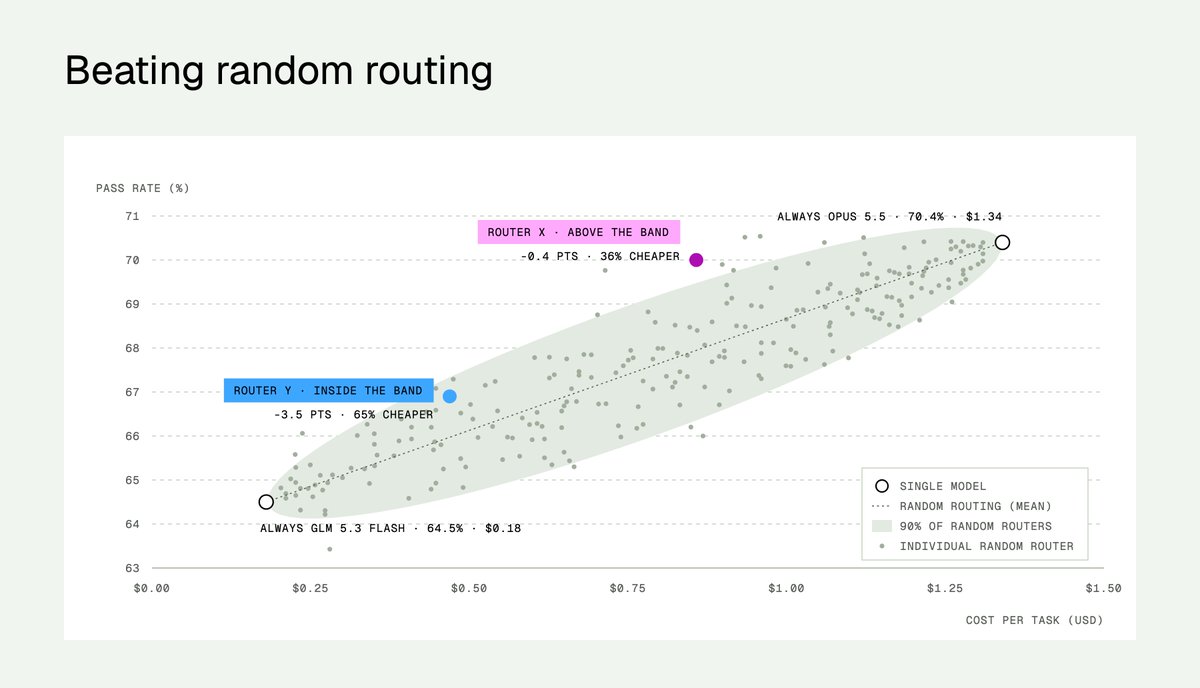
A random router is defined as sending a random subset of tasks to GLM and the rest to Opus. Sending more tasks to GLM lowers both expected cost and expected pass rate, so on average every random router lands somewhere between always using Opus and always using GLM.
The figure below plots pass rate against average cost per task. Always using Opus 5.5 (top right) and always using GLM 5.3 Flash (bottom left) are the two ends of random routing. The dotted line between them is the average random router at each cost.
For each fraction of tasks sent to GLM, we simulate 10,000 random routers, each choosing a different random subset. The gray points are a sample of these routers. The gray band spans the middle 90% of their pass rates, from the 5th to the 95th percentile. We call a router’s performance statistically significant if it lies above the band: its pass rate beats 95% of random routers at the same cost.

Experimenting with architectures
Baseten Router’s problem formulation requires it to find signals in a task that predict the value of choosing one model over the other. This section describes the architectures we tested and how early results shaped our final approach. We compared experiments on the training set using leave-one-benchmark-out cross-validation.
Exploring embeddings
We began by embedding the task instructions and fitting separate heads to predict each model’s probability of success and expected cost. Pre-trained embedding models, such as Qwen3-Embedding [8] (opens in new tab) and EmbeddingGemma 2 [9] (opens in new tab), are a natural starting point: they capture semantic features of the task without needing to train a language model.
To understand which predictions mattered, we compared three routing setups: predicting success advantage alone, predicting expected cost alone, and predicting success advantage relative to expected cost. Routing on predicted cost alone captured most, but not all, of the initial router gains over random routing.
One hypothesis is that embeddings capture task scope, which is a clearer signal of cost than of which model will succeed. Subsequent analysis supported this: requirement count and estimated code diff size are strongly correlated with cost, but not with the gap in success rate between models.
Combining predictions for both success advantage and expected cost led to the best cross-validation results, so we kept that setup for later experiments.

Looking beyond semantic similarity
Having established that the embedding router improved on random routing, we next explored which features were responsible for driving those gains. Some, such as the task category, are legitimate routing signals. For example, implementing a new feature and answering a question about a codebase have different success and cost profiles. However, embeddings can also capture cues specific to the benchmark a task belongs to. Relying on these cues risks learning shortcuts that do not transfer to new benchmarks or to production.
We trained a linear probe to test whether benchmark identity was encoded in the embeddings. This linear probe achieved 89% balanced accuracy, meaning benchmark identity was available as a routing shortcut. Next, we explored whether the embeddings captured useful task-level information. To route well within a category, a router must separate the tasks where a frontier model’s extra capability justifies its extra cost from the tasks where it does not. We found that tasks nearby in embedding space received similar routing scores, but the observed advantage of Opus over GLM on those tasks was only weakly correlated. This suggests that the naive embedding router struggles to learn meaningful representations necessary to distinguish tasks.
These findings motivated two directions: reducing benchmark-specific cues in the representation, and testing whether more explicit task characteristics provide additional routing signal. We tried multiple approaches, including rewriting prompts to strip out benchmark-specific cues, applying corrections to clusters of similar tasks, and extracting structured task attributes. Structured task attributes, such as a task’s scope, the domain knowledge it requires, and its level of ambiguity, were particularly useful because they describe the work a task requires more explicitly. We subsequently explored using decision models, specifically elephant-1 and mammoth-1 from Base Labs (opens in new tab), to extract these attributes.
Reading cost signals from model activations
In parallel, we explored whether a model’s internal state contained useful routing information [10 (opens in new tab), 11 (opens in new tab), 12 (opens in new tab)]. We ran GLM 5.3 Flash on each task without generating a response, captured its intermediate activations, and fitted a prediction head to estimate the number of steps in the subsequent response.
Intermediate activations predicted the number of agent steps with a Spearman correlation of approximately 0.6 on our validation set. The signal strengthened with depth, plateaued, and then declined in the deepest layers, consistent with findings in the literature [12] (opens in new tab). This supported using intermediate activations to estimate GLM’s run length, and by extension its expected cost.

To reduce the router’s latency incurred by retrieving GLM-5.3 Flash’s internal activations, we explored various quantization techniques and the use of smaller Qwen models as proxies for GLM-5.3 Flash’s internal layers. This significantly reduced the router’s end-to-end latency while preserving routing performance.
Putting the experiments together
Our final router combines the most useful signals from our experiments, including structured task attributes and internal model activations, to predict each model’s success and expected cost.
Results
We tested Baseten Router on three benchmarks held out from training - DeepSWE 1.1, SWE Atlas QnA, and Terminal-Bench 2.1 - and compared it with routers offered by other providers. The reported pass rate is an average over multiple runs for each task.
Baseten Router is Pareto-optimal
We observed strong generalization on the out-of-distribution test set. Baseten Router performs within 0.8 percentage points of Opus 5.5 at 72% lower cost, and every threshold setting lies on the Pareto frontier of pass rate against cost among the routers we tested.
Baseten Router lies above the gray band, which covers the middle 90% of random routers. This means it beats random routing by a statistically significant margin at every threshold. No other router we tested does so on this set of benchmarks.
Baseten Router offers a range of thresholds to configure where it lies on the Pareto frontier: Cost, Balanced, and Intelligence. These thresholds can be passed in at request time to the same router, without requiring any retraining.

Latency
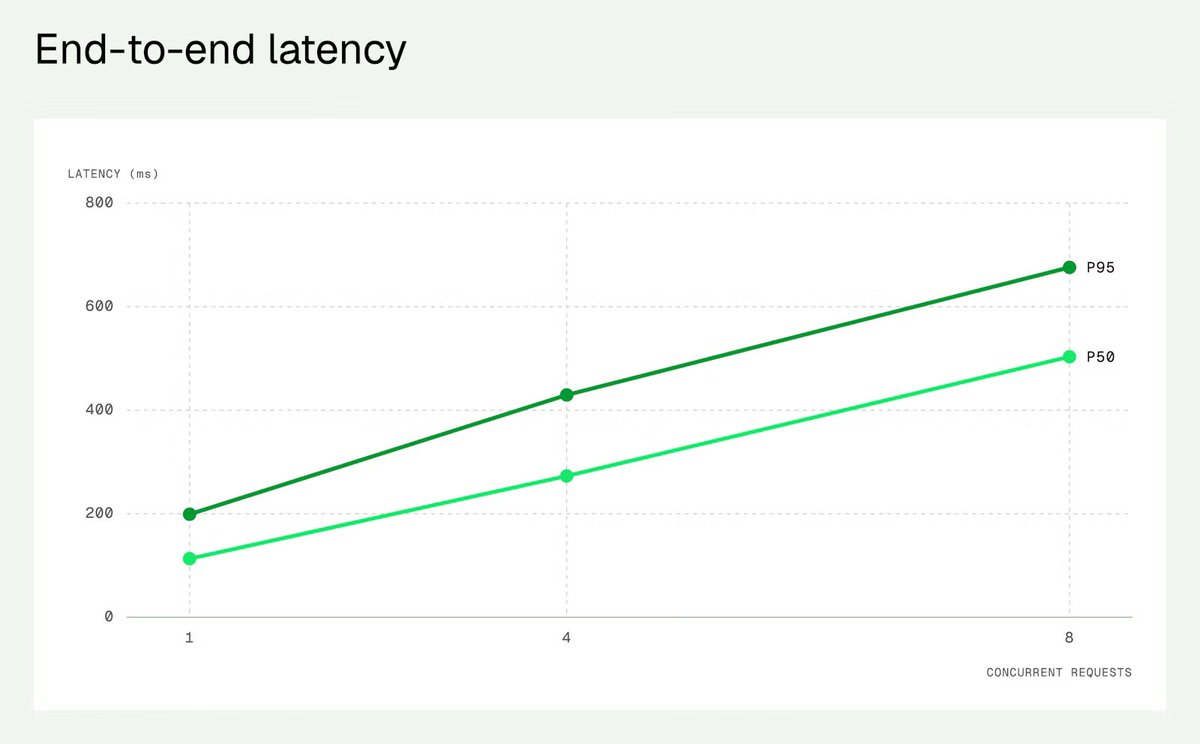
We measured the end-to-end latency of our router across increasing levels of concurrency on a single B200 GPU deployment. At 4 concurrent requests, the p50 and p95 latencies were 273 ms and 429 ms, respectively. This sub-second overhead routing is small relative to a full coding-assistant turn, which typically takes tens of seconds [13] (opens in new tab). We can easily scale up the deployment from a single B200 GPU if additional concurrency is required.

Comparing the routers fairly
These results demonstrate Baseten Router’s strong performance on benchmarks selected before running any evaluations. There are also a few factors to keep in mind when interpreting the results.
First, router performance depends on the underlying training distribution and optimization objective. Although most other routers we evaluated also report results on coding benchmarks, they may target different workloads. Our results establish performance on specific benchmarks, which we believe are representative of real software engineering work. Relative router performance may differ on other benchmarks.
Second, model pools are not identical across routers. All but one router offered both Opus 5.5 and GLM 5.3 Flash. One router was limited to Anthropic models. Our comparison evaluates each router as offered, and model pool selection is a choice that forms part of the router being evaluated.
Proving out performance in production
Our next focus is extending these gains from benchmarks to production. The two serve different purposes: benchmarks let us compare routers on the same tasks with the same success criteria, whereas production lets us measure cost savings and quality on real customer workloads.
Routing in production introduces three new challenges:
Requests are less explicit. A benchmark may describe a bug, identify the affected code, and explain how to reproduce it. In production, an engineer might simply write “fix this” and paste a stack trace.
Success is harder to measure. Benchmarks come with tests that verify whether a task was solved. A production task has no equivalent label, so training a router on production coding traces means deriving signals from the session, such as whether the user corrects the agent and whether the code is kept in subsequent turns [14] (opens in new tab).
Tasks are inherently multi-turn. In a benchmark, the agent receives a single prompt and works until completion. In production, the user reviews the agent’s work, corrects it, and asks for more work in later turns. This means one session can contain several tasks of different difficulties. The best model can change mid-session, but switching models can mean reprocessing conversation context and forfeiting the benefits of a warm KV cache. Consequently, turn-level routers must weigh the benefit of a mid-session model switch against its additional cost.
We’re addressing these challenges by building training and evaluation environments specialized for production requests, a labeling pipeline that derives success signals from real coding traces, and policies for KV-cache-aware turn-level routing.
We’re also working with design partners to specialize Baseten Router to their coding workloads and extend the cost-quality gains from benchmarks into production. Our goal remains the same: frontier performance on every task, at frontier prices only when the task calls for it.
If you’d like to see what Baseten Router can do for your workloads, we’d love to talk.
References
Menlo Ventures, 2025: The State of Generative AI in the Enterprise (opens in new tab)
Epoch AI: Open models lag state-of-the-art closed models by 4 months (opens in new tab)
Fireworks AI, Introducing FireRouter with Opus (opens in new tab)
Applied Compute, Shift-1, a SOTA coding router (opens in new tab)
Artificial Analysis, Coding Agent Index Methodology (opens in new tab)
Varshney et al., 2026: LLM Router: Rethinking Routing with Prefill Activations (opens in new tab)
Anthropic, 2026: Measuring AI agent autonomy in practice (opens in new tab)
Cursor, How Cursor Router chooses the right model for the task (opens in new tab)
Sarah Guo shared and praised Baseten’s article, “Baseten Router: a Pareto-optimal model router for coding tasks”, calling it Baseten’s “first swing” at an intelligent router and “best in class (cheapest at every pass rate).” The article reports that the router performs within 0.8 percentage points of Opus 5.5 at 72% lower cost and beats random routing by a statistically significant margin at every threshold.