We can't find the internet
Attempting to reconnect
Something went wrong!
Hang in there while we get back on track
Chamath: GPU finance through an airline lens
Chamath Palihapitiya called Alex Song's post a "super interesting comparison of GPU finance and the AI buildout to airlines." He noted that Ken Griffin and Sridhar Ramaswamy have made the same comparison, and said both are "very, very smart so worth learning more." Song says he traded ABS (asset-backed securities) on Wall Street and has structured more than $2B of debt financings. His view is that a GPU neocloud "runs on airline economics." He also argues that the debt behind it looks like aircraft engine ABS. His parallels:
- Compute is perishable inventory, like an unsold seat.
- More than 85% of costs are fixed.
- A levered cluster breaks even at roughly 65–75% utilization.
- NVIDIA plays the role of Boeing and Airbus combined.
More detail is in Part 1 of his blog post. This follows yesterday's debate about debt versus equity funding for the AI build-out.
Research picks on efficiency and agents
- Sarah Guo called Cartesia's new H-Net scaling-law work "fundamental." She pointed to a "huge compute efficiency gain," which she says comes partly from learned tokenization. Albert Gu's post reports 3–5x efficiency gains in controlled experiments. It also says that at larger scale the model matches an open-source model trained on 11T tokens while using about 10x less data and compute.
- Eric Schmidt called Maithra Raghu's Samaya Sterling announcement "pretty extraordinary, and on an open model to boot." Sterling is a post-trained 30B mixture-of-experts model with 3B active parameters. Samaya says it scored 58.9% on FrontierFinance, against 55.9% for the best frontier model, at 11x lower cost.
- Sarah Tavel called Alex Tamkin's Anthropic research post "Provocative and rings true." The study was a randomized trial with 50 professional data analysts. It tested whether experts still make the key decisions when they delegate work to an agent.
Martin Casado's notes on VC mindsets
Martin Casado published "The Evolving Landscape of Venture Capital Mindsets." It started as notes for his team, and he shared it "for those who have an interest in venture." The essay describes four mindsets: financial, productive, frontier and speculative. It recommends that a team pick one core philosophy and apply it consistently. The alternative he warns against is pulling arguments from all four as a "grab bag" to justify personal bias. Casado describes himself as "strictly a productive investor" in early-stage infrastructure. This is his own work.
Building agents
Jason Lemkin recommended D. Ternyak's article on building Owner Agent. His takeaway: Owner ranked hundreds of thousands of old support tickets by how much support time each took. It reduced them to about 2,000 operations, which became both its roadmap and its tests. Lemkin's summary: "Your support queue is the spec."
Longtime favorites
- Keith Rabois, asked whether he is bullish on podcasts, praised Ben Thompson's Stratechery instead. He said he has read it "for like a decade plus" and called it "by far the most consistent, original, and useful thinking in tech."
- Tobi Lütke said on Alex Heath's podcast that he recently reread Neal Stephenson's Cryptonomicon after his son read it. He said "literally everything in the book just happened," including cryptocurrencies and fractional ownership. The episode is on YouTube.
- Shaan Puri cited the old book Your Word is Your Wand. He said he loves its idea that words are spells that only work on ourselves, such as swapping "have to" for "get to."
Patrick O’Shaughnessy highlights his video conversation with Cliff Sosin, calling Sosin one of his favorite people to call with big questions and listen to, and describing the conversation as a version of those calls . The discussion covers intelligence, AI commoditization and who profits, agents, capital markets, AI-driven company transformation, portfolio concentration, and education . A featured takeaway is Sosin’s argument that demand can eventually shrink as prices fall, and that Jevons paradox applies to a particular point on the curve rather than every price level . Full conversation
While discussing content that can cut through the clutter, Keith Rabois praised Stratechery, saying he had read it for more than a decade and calling it “by far the most consistent, original, and useful thinking in tech.”
Patrick O’Shaughnessy promotes his conversation with Cliff Sosin, calling him one of his favorite people to ask big questions and listen to; the conversation ranges across AI, markets, and education. In a clip about educating children in the AI era, Sosin argues for teaching foundational skills away from models while also assigning ambitious model-assisted work that students must understand and defend. Conversation post
Tobi Lütke praised Cryptonomicon by Neil Stevenson: he recently reread the sci-fi novel, said he loved it, and was impressed by how it anticipated developments such as cryptocurrencies and fractional ownership.
Reid Hoffman endorsed university-based education for policymakers, citing Stanford and Harvard programs for Congress members and staff on subjects including cybersecurity and decision-making; he praised Condoleezza Rice’s work with the Spogli Institute and Jennifer Lerner’s work at Harvard on decision science. He said similar education in technology and AI is important because even basic understanding helps officials keep pace with rapid change.
Patrick O'Shaughnessy welcomed LIFE's announced return to print on November 23, 2026, saying he grew up loving the magazine; his endorsement reflects longstanding affection for LIFE, not a recommendation of a specific article or issue. LIFE's announcement
Scott Belsky shared “Potential Risks of Governing Agents”, an excerpt from IMPLICATIONS, Edition 48. The article warns that governments could use persistent agents to comb through people’s digital histories and construct negative narratives; it argues such agents need boundaries that protect basic rights and procedures, and suggests constitutional clarification may be needed.
Sarah Guo recommended Cartesia’s work on scaling laws for H-Nets, calling it “fundamental” and highlighting large compute-efficiency gains, partly from learned tokenization; she linked the post. The linked post reports up to 3–5× efficiency gains in controlled scaling-law experiments and, at larger scale, a match to an open-source model trained on 11T tokens using about 10× less data and compute.
Jason Lemkin recommends D. Ternyak’s “Building a self-improving agent: Owner Agent”, sharing its method of turning hundreds of thousands of historical support tickets—ranked by support time—into about 2,000 operations for the roadmap and tests. His takeaway: “Your support queue is the spec.”
Tobi (@tobi) expressed strong enthusiasm for a game built into EDITIONS, saying “so much love for this game”; the linked post describes it as Katamari Damacy-like . Linked post
Keith Rabois shared Coach Bowman’s post about Michael Phelps going six years without missing a training day, adding “No days off” as the takeaway.
Keith Rabois shared the Apple Podcasts episode “The future of vertical AI startups (especially law, finance, accounting, CS, code)”; the post gives no reason for the recommendation.
Chamath called the comparison of GPU finance and the AI buildout to airlines “super interesting” and said it was worth learning more, noting that Ken Griffin and Sridhar Ramaswamy had made the comparison too . The recommended material is @alexsongis’s analysis applying airline economics and aircraft ABS to GPU neocloud financing; its linked Part 1 blog post is at http://alexyangsong.com/blog/aluminum-to-silicon/ .
Tim Ferriss recommended watching his full interview with Arthur Brooks: YouTube interview. A related clip highlights Brooks’s advice to “Use a Reverse Bucket List.”
Tobi urged followers to check out his Expo Mode post/video . The post says Expo Mode was built with Google’s new HTML-in-Canvas API and that they think they are among the first to use it .
Vinod Khosla shared an approving post linking to a page with 20 of 300 examples of Agent Fo successfully challenging bills, fees, or denied refunds. He framed fighting medical-payment denials and debt as a major use case, noting that most examples involved phone calls, escalation to supervisors, written follow-ups, and repeat calls: linked page.
@tobi called @randgroup’s post “Absolutely astonishing” and linked to it: the post. The post claims the Soviet Union collapsed at 50%, while France is at 57% and striking for more.
Tobi Lütke praised Alex Heath’s conversation with him as a “Great conversation,” sharing Heath’s post about their interview/podcast on AI agents and Shopify . The discussion covers Shopify’s approach to AI agents, how they may change shopping, and AI’s effect on starting a business . Watch the episode on YouTube .
Sarah Guo recommends Conviction Embed workshops, calling one featuring @lulumeservey one of her favorites and describing Meservey as a “master of her craft.” Post
Shaan Puri shared a YouTube conversation with Ethan Evans, who spent 15 years at Amazon working with Jeff Bezos. They discussed what it was like working for Bezos, his “?” emails, the story of Amazon Prime, and whom Bezos studied; the post gives these topics but no explicit evaluative reason for recommending the video.
Building a self-improving agent: Owner Agent

The product and architecture behind Owner Agent, and how we built it to improve itself.
Originally posted on Building @Owner, with live versions of every demo: https://building.owner.com/self-improving-agent (opens in new tab)
Restaurant owners are some of the most customer-obsessed operators I’ve ever met. They usually talk to their customers dozens of times a day. That closeness gives them a great understanding of what their customers need.

At Owner, we build products to help restaurants grow. Our customers range from highly technical operators running dozens of locations to owners who would rather spend their time making delicious food and taking care of guests than looking at a dashboard. Okay, all of them would rather take care of their guests than look at a dashboard.
When we set out to build Owner Agent, we wanted to show our customers the same care and thoughtfulness that they show their guests.
Running a restaurant is demanding. Our customers don’t always have the time to dig into how their business is doing.
And when they need to make a menu change or toggle off their online availability due to a big dinner rush, digging around in a dashboard or app is the last thing they want to do.
Our vision for Owner Agent: customers should be able to get anything they need from Owner as easily as sending a text.
We’re getting there. Over the last two months, we’ve brought Owner Agent to GA, powered tens of thousands of conversations, and seen customer usage grow by ~30% week over week since launch.
This post walks through the product and architectural decisions behind Owner Agent, including how Owner Agent is integrated across Owner and how it’s set up to keep improving.
Where customers meet Owner Agent
Customers start using Owner Agent while they’re still becoming customers.
Our Grader (opens in new tab) helps restaurant owners understand how their website performs. It evaluates Google search visibility, CRO factors, and how the restaurant compares with its local competitors.
Through Grader, a swarm of agents researches the restaurant across the internet, gathering its brand identity, local details, menu, and photos. The Grader feeds our AI Website Builder, which rebuilds their website in near real time, turning it into a best-in-class website that will grow the restaurant’s sales.
Owner Agent is a companion throughout the experience, helping customers quickly refine their website in plain language.
Once they’re using Owner, customers can turn to Owner Agent in our dashboard and mobile app.
Some owners will never open a dashboard. From the app, they can make an operational change between lunch and dinner in one sentence and approve it on one card.
Changing Sunday hours from the Owner app
Others run several locations and want to go deeper. They can ask how their business is doing, and Owner Agent responds with insights from the restaurant’s data.
A multi-location question answered with restaurant data
Learning from our first users
We started dogfooding Owner Agent with our customer-facing teams months before the public release.
They were some of the best early users we could have hoped for. They were vocal about what they needed and brought us the problems they were solving for customers. Their feedback helped us iterate quickly and see whether the agent was useful.
Menu setup is one of my favorite examples. Our launch team used to drag food photos into ChatGPT one at a time to figure out which menu item each photo represented. Now, they just drop a menu PDF and a Google Drive folder of photos into Owner Agent.
[Please don’t ask me what our launch team did before LLMs existed.]
A menu and photos prepared for review
We wanted to prioritize the capabilities that would make the biggest difference for customers. We looked to our hundreds of thousands of historical support cases.
With these cases, we could see what the owner asked for, how our team handled it, and how long it took. This gave us a starting point to understand what to build, and what to prioritize.
We built an “Eval Dash” to explore those cases and prioritized them by how much support time it takes to resolve them.

An earlier snapshot of Eval Dash
Most of those cases ask for the same handful of things in different combinations.
Once we grouped them, hundreds of thousands of cases came down to about 2,000 distinct operations, like changing hours or issuing a refund. Those 2,000 operations became the evals we test Owner Agent against.
Hundreds of thousands of support cases, grouped into about 2,000 operations
Choosing our agent stack
We built Owner Agent on the Vercel AI SDK (opens in new tab). It’s model agnostic, so we can move between providers and models as they improve without rewriting Owner Agent. It has great developer experience and support, and it’s one of the most widely adopted agent frameworks, so the patterns and answers our engineers need are usually already out there.
On top of the SDK, John Harlow (opens in new tab), a senior engineer on our Agents team, built ownerTool.
The AI SDK’s tool describes something a model can call: a description, an input schema, and a function to run. That’s enough to call a function, but not enough to safely change a restaurant’s business. ownerTool makes every tool also declare who is allowed to run it, whether it reads or changes data, how much damage a wrong call could do, and whether the owner has to approve it first. With that, a product team can take an operation that already exists, like setting holiday hours, and give it to Owner Agent.
authZ checks the same permissions the user has everywhere else in Owner. If they can’t create special hours in the dashboard, Owner Agent can’t create them either.
effect says whether the tool only reads data (query) or changes it (mutation).
consequence says how costly a wrong call would be, from none to catastrophic. Looking up today’s sales is harmless. Closing a store on the wrong day is major, because it costs a day of sales.
toolApproval makes Owner Agent stop and ask the owner before the tool runs.
That risk disclosure bubbles up through Owner Agent’s patterns of interaction framework, to determine when operations need extra confirmation.
A high-impact operation gets a second check before it runs
Owner Agent as a client
Our historical support cases span the breadth of Owner’s products.
Our Agents team can’t build and maintain every capability on its own.
We treat Owner Agent as another client of our platform, alongside the dashboard and mobile app. Owner Agent calls the same services that power those surfaces, building on the same business logic and authorization patterns.
The Agents team owns the shared framework, approvals, observability, and eval infrastructure. Product teams know their domains and contribute the tools and capabilities to Owner Agent.
Our website team, for example, exposes the operations customers need to update their website.
We group capabilities into domains such as menu, website, and payments. A domain is how a product team ships a capability into Owner Agent as one unit, built with ownerDomain.
It bundles the domain’s tools, the instructions that tell Owner Agent how and when to use them, and skills for longer tasks. Importantly, every domain has a feature flag, so a team can roll it out restaurant by restaurant and turn it off instantly if something goes wrong. enabledWhen only loads a domain for restaurants that use that product, so a brand without our website builder never sees website tools.
Growing Owner Agent across the product
Making Owner Agent a client has shifted how our product teams work.
When a team ships a feature for customers, we now think about how customers can use it through Owner Agent.
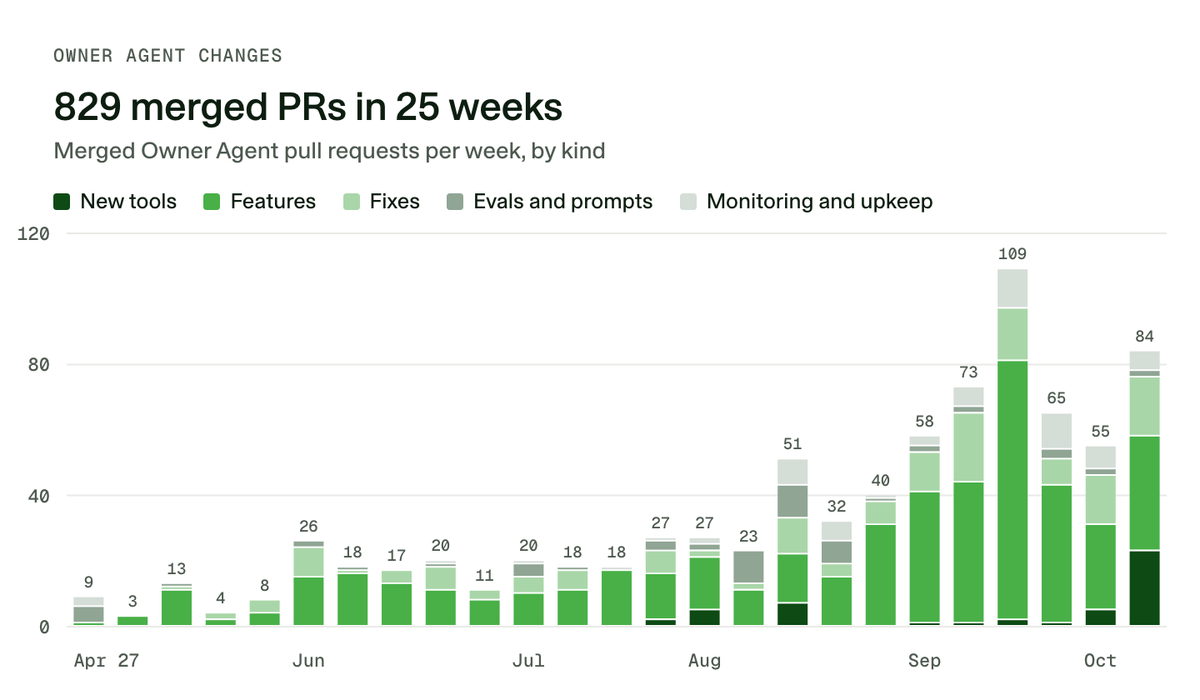
As teams have contributed, Owner Agent has grown beyond its initial menu and website capabilities. As of October 2026, Owner Agent has 241 tools across 27 domains, including sales reporting, locations, and custom domains.

Owner Agent tools by domain, week by week

Merged Owner Agent PRs by week and kind
Making Owner Agent’s actions understandable
Clarity of operation has been the biggest goal since we started building Owner Agent. It means that whenever Owner Agent proposes any action, it’s very clear what will happen when you hit “approve.” This is so important because tool call approvals are much more common in Owner Agent than in ChatGPT.
I think of it as UI design for a genie. The genie is going to grant whatever wish you make. But before the wish is granted, you need to make sure you understand what you’re getting out of the wish.
Cole Derochie (opens in new tab), our Agents design lead, has designed patterns of interaction for clarity of operation.
He views an agent conversation as a stream of four kinds of moments. For each one, Claude, ChatGPT, Cursor, and the MCP spec have converged on a small set of shapes.
Working. The agent shows what it’s doing.
Input. The owner gives an answer, access, or a next step.
Approval. The agent needs permission before something changes for real.
Output. The agent gives the owner a thing.
Patterns in action
Owners often send requests like this one.
Remove the pollo taco from the menu at the Miramar location. Also add tomatillo as a salsa option there. In Atlanta, raise the price of guac by $1.
A card that says “update menu” doesn’t give our customers enough context to be confident that Owner Agent will make the changes they intend. Through our clarity of operation framework we:
Get approval for every change. The card shows each item, location, and change, with the before and after in plain language. Owners can approve or reject each row on its own.
Act with the same permissions as the user. Tools use the same RBAC as the rest of Owner.
Hand off to a support rep when Owner Agent can’t finish the job. Our support reps pick up where Owner Agent left off, with the full conversation and context.
The feedback loop
When customers use Owner Agent in ways we haven’t built tools to handle yet, here’s what the feedback loop looks like to get Owner Agent working great for that use case the next time.
One failed request, followed around the loop
Traces, traces, traces. They live in Datadog, with the rest of our APM. We run online evals against our traces to identify opportunities for improvement in real time, as well as churn signals and other configurable alerting.
Owner Agent Insights is our online eval platform. We use an LLM to score production conversations to build metrics and trends, and to understand quality across capability, completeness, latency, feedback, and more. We measure approvals and rejections by tool, and give each domain a letter-grade score. A high rejection rate tells us something is off in the harness, the interface, or the model, and gives us a signal for where to improve.
Insights makes recommendations for new domains and tools based on that data. When owners keep asking for something Owner Agent can’t do, Insights writes it up as a Recommended Tool and alerts the team that owns that area in Slack.
Every failure becomes an eval. When Insights flags a failure, Forge, our internal platform for background coding agents, turns the conversation into an offline eval case, works on a solution, and runs the suite in Buildkite. We want the new case to pass, and enforce it going forward.
Owner Agent Insights scores conversations by domain and recommends new tools to add. Illustrative, fictional data.
Scaling Owner Agent
At first, we gave the model every tool definition and every domain instruction on every request.
Do things that don’t scale, right?
Past 200 tools, that context bloat started to hurt quality and drive up cost, so we added tool search and skills.
With tool search, tool definitions stay out of the model’s context until Owner Agent asks for them. A request to raise the price of guac loads 3 menu tools, not all 241 tools.
The same request with every tool loaded, then with tool search
Similarly, skills let us give Owner Agent instructions for a specific task without putting every instruction in every request.
John also wrote up these patterns and more, like routing and handoffs between agents, in Some agent patterns (opens in new tab).
Running Owner Agent in the background
Owner Agent has to keep working after a customer closes the app or a request times out.
In these cases, we run it headless.
For example, an owner might ask Owner Agent to match 80 photos to their menu, and then lock their phone.
A background worker picks up the job with that user’s permissions. If something needs approval, it sends a push notification to the owner, and idles until the owner comes back to the conversation.
Lessons we’ve learned
Start from requests customers have already made (support history) to anchor on known needed capabilities.
Match the agent’s permissions to the user’s.
Focus on clarity of operation. Make every change easy to confirm, with one row per change, plain language, and nothing happening before approval.
Invest in observability at step 0.
Build a self-improving agent. Turn every failure into an eval.
Proactive is the next frontier
Owner Agent is reactive today. The customer experience starts when Owner Agent is prompted.
We want Owner Agent to be a proactive partner in our customers’ growth.
Soon, it will notice opportunities to improve their business, bring those opportunities to the customer with context, and make the next step easy to approve.
We’re building toward the team of AI executives described in our Series C memo (opens in new tab) and Series D memo (opens in new tab).
If you’re interested in building agents at scale and going deep with customers, we’re hiring (opens in new tab).
After leading the Agents team at Owner for the last year, I’m super excited to share what we’ve been cooking. Here’s how we’ve built Owner Agent 👇 https://x.com/i/article/2115471276408029184 (opens in new tab)
Jason Lemkin recommends D. Ternyak’s “Building a self-improving agent: Owner Agent”, sharing its method of turning hundreds of thousands of historical support tickets—ranked by support time—into about 2,000 operations for the roadmap and tests. His takeaway: “Your support queue is the spec.”