We can't find the internet
Attempting to reconnect
Something went wrong!
Hang in there while we get back on track


🔥 TOP SIGNAL
Agent output is becoming a verification problem, not a review problem. Addy Osmani argues that ordinary code review cannot keep up with agent-generated volume, so quality checks need to move into the harness, environment, and operating system: constraints, tests, and production-boundary gates decide whether a proposal is safe, correct, scoped, and useful, while humans concentrate on intent, taste, and architecture.
Ref’s open-beta launch is the pre-code counterpart: a shared space for deciding what agents should build before code exists. Its sharpest warning is that letting agents make critical system and product decisions makes teams lose ownership.
⚡ TRY THIS
Put a human decision gate before the first tool call, then automated gates after it. Before granting repository write access, require a human-owned record of the goal, non-goals, acceptance criteria, and architectural choices the agent may not change. Then wire in unit, property, and acceptance tests; mutation testing; complexity and line-length checks; architecture lint; security policies; and CI deploy blocks. Pull a human in when those guardrails break—not for every routine diff.
Treat the first 40 lines as the agent’s contract. DHH’s field observation is that agents often skim
head -40and start acting. Kent C. Dodds adds a prompt anti-pattern: negative instructions can plant the very idea they were meant to prevent—“Do NOT add a carousel.” Put scope, non-negotiables, and acceptance checks at the top, and express constraints as positive outcomes instead. Treat the 40-line heuristic as something to test in your harness, not a law of model behavior.Put model routing and spend control in the harness, not in developer discipline. LangChain’s governance walkthrough recommends a minute-level rate limit plus daily, weekly, and monthly caps, with the daily limit set well below the monthly ceiling and enforcement applied per user, API key, and organization. Block the next call before it leaves when a cap is reached, then fall back to another model; route retrieval and summaries to cheaper models and reserve frontier models for difficult reasoning, validating the trade with evals. Vtrivedy10’s complementary rule is model–harness–task fit: mine production behavior into evals rather than assuming one universal model or harness.
Promote repeated prompts to durable, inspectable agents. A practical Managed Deep Agents skeleton is:
uv tool install managed-deep-agents;mda init; keep the invariant role inInstructions.md; put specialized workflows in a trigger-describedSkill.md; setmemory.pytoscope="agent"; runuv sync && mda devto inspect model decisions, tool inputs/outputs, and memory writes; thenmda deployand connect Slack or a cron schedule. The tutorial’s structure is explicitly reusable for engineering updates, security research, and incident summaries.
📡 WHAT SHIPPED
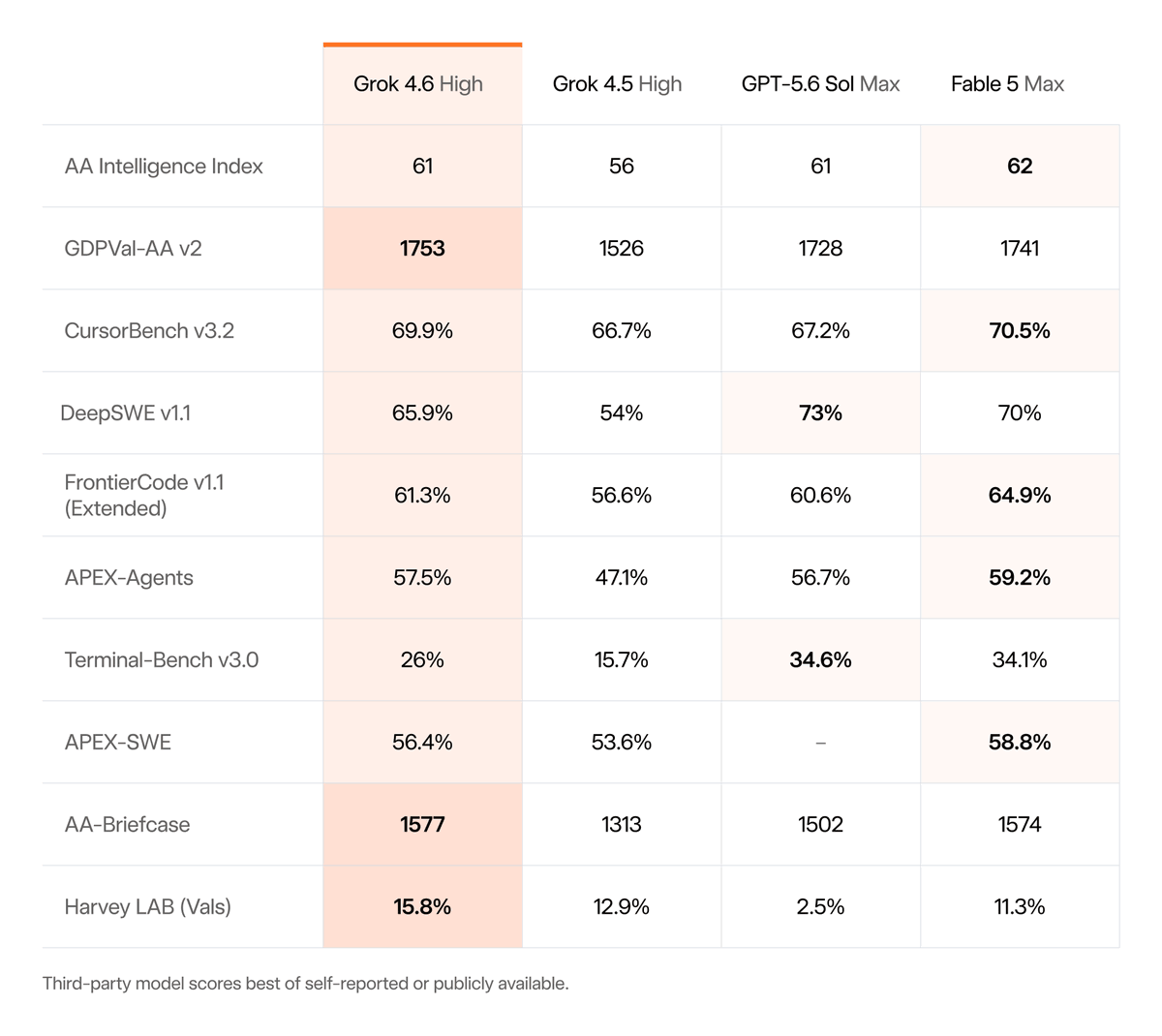
Grok 4.6. SpaceXAI says 4.6 is a significant improvement over 4.5 at the same price; Michael Truell describes better performance on difficult tasks and knowledge work with low cost and high speed. DHH’s firsthand Fast test reports
$4 in/$12 out, roughly one-quarter the price of other Fast modes, and a simple Omarchy PR with “No notes!” McKay Wrigley calls its intelligence per dollar “crazy good” while still putting Fable 5 clearly ahead. Treat this as practitioner cost/performance evidence, not a benchmark.Ref entered open beta. The product is a shared planning space for deciding what agents build before code is written; the company says it raised $4M and frames its target failure mode as “Velocity Sickness”: too many PRs, burnout, teams moving in different directions, and critical decisions being made by agents.
LangSmith tightened the observability/control plane. Rebuilt dashboards can place KPIs beside trends, compare metrics with different units, break traces down by model or user, add notes, and arrange views freely. Its AWS BYOC deployment keeps agent traces and runtime data inside the customer’s AWS boundary while LangChain manages provisioning, upgrades, scaling, and support.
Omarchy Quattro reached release candidate. DHH says the first RC is out for testing, with a final release planned for Friday if testing goes well. Quattro’s crash watcher can offer an agent-assisted diagnosis with a tracing skill and a verified upstream report, and the diagnosing agent is configurable under
Setup > Defaults > Agent. The native Codex Linux app is planned for Omarchy’s package repository, while Omarchy agents use an out-of-bandmisepath with a terminalmupupdate command.
🎬 GO DEEPER
- LangChain — “Build a social media agent with Managed Deep Agents.” Study the durable-agent pattern rather than the social-post use case: always-loaded instructions, trigger-loaded skills, cross-thread memory, Slack delivery, weekday scheduling, and local trace inspection before deployment. The presenter explicitly maps the same structure to engineering updates, security research, and incident summaries.
- LangChain — “Building Governed Agents.” Jump to the operational checklist on runaway loops: minute-level rate limits, layered spend caps, pre-call blocking, and fallback models. It is vendor-specific guidance, but a compact way to pressure-test the controls around a coding-agent deployment.
Editorial take: The high-alpha move is to own the control plane: decide scope before delegation, apply back-pressure throughout the loop, and make model, cost, state, and trace choices explicit instead of treating the chat session as the product.

In a first-hand walkthrough, the host introduces Grokbot, a new agentic system that deliberately departs from Cursor, Codex, and Claude Code: it shows no code, tool calls, or model picker, uses a native-chat UI, and treats every thread as an individual agent . Each agent gets its own full Linux VM with shared authentication across agents, and can also control the user's local computer; the host calls the cloud environment "very native" compared to Codex, which is more local-first .
The host demonstrates a chief-of-staff orchestration pattern (credited to the Cursor team): one main agent maintains long-running context and delegates to specialized agents (email, calendar, etc.) . Agents can message each other, and inter-agent conversations persist indefinitely as shared context — e.g., the chief of staff asks the email agent for a dry-run archive count and gets "Only 3 of 21 inbox threads clear the strict safe bar" .
Workflow automation: "Teach a Task" lets you click the button in the agent's own environment, manually perform steps (e.g., copy an Amazon URL and price into a spreadsheet), then press stop; Grokbot records the demonstration and generates a reusable skill. Skills can also be installed from a marketplace or private repo (e.g., a "Humanizer" skill) . Routines are scheduled recurring tasks defined in natural language (e.g., "look around my computer for files you think are stale... don't actually clean, just suggest"), with a test-run option and approval-first behavior .
The host welcomes hiding technical internals for a broad audience ("it's actually welcome", "most people don't care") and critiques app fragmentation — he prefers one super app that routes tasks to the right UI (code vs. simple answer) over separate coding and general agents; he already uses Codex almost exclusively over ChatGPT .

The speaker — LangChain's PM for its governance / LLM Gateway offering — gave first-party, vendor-specific guidance on running production agents (explicitly including coding agents) under cost, reliability, and compliance controls ().
- Core model: iterate agents through build → test → deploy → monitor, with governance built into every stage rather than bolted on; centralized runtime controls beat per-application policies as teams scale (). The LangSmith LLM Gateway is in public beta ().
- Runaway-loop defense: layer minute-level rate limits with daily/weekly/monthly spend caps (daily set well below monthly to pace against it), enforcing per API key/user/org. When a cap is reached, the next LLM call is blocked before it goes out and the agent stops, so set a fallback model to keep working (). Central rate limits also avoid provider cutoffs ().
- Model routing & resilience: keep frontier models for high-reasoning tasks and route easy/summary work to cheaper open-weight models, validating with evals that quality holds (); keep the same model reachable through a second provider (e.g., Bedrock) as a failover ().
- Adoption: small teams can start with LangChain middleware (fallbacks) before moving to a gateway; with a gateway, point the provider URL at it so fallback/retry/circuit-breaker policies run before calls leave ().
- Guardrails: regex for structured PII, LLM-based NER for unstructured, secrets detection for API keys/tokens; gateway can redact PII/secrets, and tool calls can require human-in-the-loop approval ().
- Observability & latency: data-protection checks add from 1–2s to many seconds of latency, so decide fail-open vs fail-closed timeouts (e.g., 5s) in advance (); traces + evals are the first-line debug tool, runtime monitoring can catch jailbreaks/hallucinations live, and one LangChain engineer used the Insights agent to explain a high LLM bill ().
- Agent-to-agent calls: define agent identity and permissions explicitly before agents call other agents, since errors compound across chains ().
- Scale context: 7,000+ active LangSmith customers, hundreds of millions of monthly open-source downloads, half of Fortune 10 ().

- Addy Osmani (ex-Google, engineering/DevRel leader) argues that human code review doesn't scale when agents generate code at high volume; software quality must be enforced through constraints and quality gates in the harness/environment around the agent .
- Concrete quality gates he recommends: unit, property, and acceptance tests; mutation testing; cyclomatic-complexity and line-length metrics; plus custom constraints like architecture rules enforced via ESLint .
- Practical pattern: push back-pressure throughout the loop — compilers rejecting invalid code, failing tests, security policies, CI declining deploys — instead of a single human review at the end .
- If verification can't keep up with agent change volume: scale verification capacity, reduce the rate agents generate changes, or lower the quality bar; alternatively relax constraints in low-risk areas while tightening where quality matters most to maximize throughput without sacrificing quality .
- Human attention is scarce: direct humans only to nuanced problems (taste, intent, architecture) and pull them in only when automated guardrails break .
- Firsthand take: the team operating the loop still determines whether agent output is useful or slop ; the article ends with a sponsored mention of Sonar as a quality-gate product for agent-written code .

Ben Tossell (@bentossell), a non-coder builder and investor in dev tools/infra, shares a firsthand working habit with AI coding agents: like reading a book full of unfamiliar words, he pushes through agent output he doesn't fully understand, picks up meaning as he goes, and frequently stops to ask questions in the main thread or in side chats . Reflection only — no tool, prompt, or step-by-step workflow is given.

Florian Herrengt's essay 'AI is removing the middle class of software engineering' (https://blog.florianherrengt.com/ai-removing-middle-class-software-engineering.html, quoted on Simon Willison's weblog) offers a contrarian counter-signal to agent-first workflows: a team's 4th attempt to fix a recurring bug by asking AI fails — 'not even Fable can figure it out' — and the feature's own author doesn't know where the data comes from, proposing 'Let me ask Claude' . The team watches Claude's confident wall of text with no way to tell whether any of it is true . His warning: the project has grown 'so convoluted, with so many layers and services, that no one on your team could possibly start to understand what's going on' — an illustrative second-person scenario rather than a documented incident, whose implied lesson is that heavy AI delegation erodes the human understanding needed to debug what agents produce .

@kotekjedi_ml claims to have found a way to extract hidden reasoning of frontier models via an API vulnerability affecting "every frontier AI company", and says the extracted reasoning token count matches billed API thinking tokens 1:1 for most prompts . This is a firsthand claim with no method disclosed yet.
@swyx calls it "already one of the most important papers of this year" , linking the Latent.Space AI News write-up (https://www.latent.space/p/ainews-how-to-steal-a-reasoning-trace) and the original thread (https://x.com/kotekjedi_ml/status/2087147042888114428) . He notes the methodology "doesnt seem clearly explained" and adds his own distillation notes . No reproducible coding-agent workflow is described yet.
- LangChain's Managed Deep Agents walkthrough (firsthand tutorial by presenter Kasper) builds a "Social Post Assistant" that scans Hacker News and X and delivers three draft social posts to Slack every weekday morning . The presenter says it saved "a ton of time" and is used daily, but no quantitative metrics are given .
-
Setup: Managed Deep Agents supports TypeScript and Python; tutorial uses Python 3.11 with uv as package manager. Install the CLI via
uv tool install managed-deep-agents, then init withmda init social-post-assistant; a LangSmith API key is required in .env . agent.py is the entry point where model, tools, subagents, and middleware are defined . - Model choice: uses "GPT 5.6 Luna" instead of a larger reasoning model because the focused research/drafting task doesn't need extra reasoning and to save cost — a model-size-to-task matching pattern .
- Custom tools: create a Tools/ directory; a json_result helper makes every tool return a consistent JSON string; the Hacker News tool calls the free Algolia API (no credentials), and the LangChain tool decorator turns a function into a tool with the docstring becoming the tool description and function args becoming agent-visible input parameters . X timeline/search tools need an X bearer token, are read-only, and are made optional so the agent falls back to Hacker News if X errors — built-in redundancy .
- Instructions vs. skills: Instructions.md is loaded into context every run and cannot be edited by the agent; a Skill.md with YAML front matter (name + description) is loaded dynamically only when needed, with the description specifying trigger cases like "run daily post drafts", "suggest social posts", "revise a draft" .
- Cross-thread memory: the agent remembers within one conversation only; create memory.py with scope set to "agent" to make memory available across every thread the agent handles .
- Channels and scheduling: a channels/slack.py connects a custom Slack app; schedules use a cron expression (weekdays at 9am Pacific) with conversation_id set to the target Slack channel and auto_post=true so the agent posts without human approval . The default sandbox for executing code is deleted because the agent only uses defined tools — sandbox considered overkill .
-
Local dev/debug and deploy:
uv sync+mda devbuilds and opens the agent in Studio (transcript: "Blanksmith Studio"), where you can chat, inspect model decisions, per-tool inputs/outputs, and memory writes with a tight local feedback loop before deploying .mda deploypackages agent, memory, schedule, channel, and runtime config into production on LangSmith;mda channel add slackgenerates a Slack manifest — use the full manifest (with the deployment URL) when creating the Slack app — then add Slack signing secret and bot token env vars and redeploy . - In Slack the agent replies with three posts plus reasoning and sources; markdown formatting differs from Slack formatting, but telling the agent to remember the fix corrects future replies . The same structure is suggested for engineering updates, customer research, account prep, security research, and incident summaries .

Cameron Pak frames agents as an "agent liason" that handles the overhead/paperwork of a task while you focus on the core work, using the ER analogy: every ER requires paperwork, so why not have an agent handle it? Pak says his agent Kody has his MCPs, tools, and memories, enabling it to act for him . Kent C. Dodds shared the post, endorsing it with "I love this framing" .
Ref, a new open-beta tool from @reactiverobot, is a "team's shared space to decide what agents build before any code gets written"; it raised $4M from Village Global, Daybreak Fund, and others, with @bentossell among the investors . It targets "Velocity Sickness" — moving fast without the expected impact — shown by too many PRs, burnout, engineers running in different directions, and "critical decisions being made by agents," which the author calls the most dangerous . The core principle: software engineering is about deciding what matters and making those decisions, so agents making critical decisions makes teams lose ownership of their system and product . Ben Tossell, a Ref investor, commented he's a "recovering non-planner" on "step 1 of my journey," endorsing the planning-first approach . More detail: http://ref.tools/blog/ai-broke-code-review.

Meta released Muse Glimmer, a 30B-parameter dense "agentic model" under the Apache 2.0 license, positioned to run on consumer hardware so an always-on local agent can access personal context (email, calendar) on-device . It is distilled via logit distillation from Meta's closed API-only Muse Spark model . To fit consumer GPUs, Meta quantized weights to ~4 bits (full precision needs >55GB; quantized is just under 20GB) and added speculative decoding with a small draft model, claiming a 3x speedup on an RTX 5090 . Per the TMBBS benchmark it beats Gemma 4 and matches Qwen 3.6; prompt-injection attacks succeeded 28% of the time vs 40% for Qwen . Meta says open weights for MuseSpark 1.2 are coming "soon", which would allow self-hosting the exact model behind Meta's own coding agent . This is secondhand release reporting from Fireship (Jeff Delaney), not firsthand usage; benchmark claims originate from Meta. In a sponsor segment, OpenRouter is promoted for routing between models by price/accuracy — e.g., sending coding requests to cheaper models while reserving pricier ones for UI work .
Kent Dodds notes that Grok Bot's login redirects to http://cursor.com, which he finds 'unsurprising and fascinating' . In a follow-up, he adds that the bot was already connected to @kodykoala and that he's unsure whether that connection came from Cursor or Grok, since he's connected to Kody in both .
Kent C. Dodds announced Kody is doubling down as a place to store and run your code, with Kody's home moving to http://kody.codes.
Kent C. Dodds, a developer and educator, says he has been using Cursor cloud agents and is "Moving to consumer," calling it a "natural evolution" . He points to the official Grok Bot announcement, adding he's told it works great with Kody (kodykoala) . In a reply, he confirms from firsthand use: "Confirmed. Works great with Kody!" . Grok Bot is now in early beta; per its announcement, "Bots are AI teammates that do real work for you. They sign in to your tools, use them just like you do, and come back with finished work" . The announcement includes a demo video (https://video.twimg.com/amplify_video/2087221157787525120/vid/avc1/3840x2160/6h-ilLTaW4Kxmusy.mp4?tag=29) .
Kent C. Dodds (firsthand, from his own use of agents that spawn sub-agents) flags a counterintuitive anti-pattern in agent prompt engineering: agents are "really bad about negative direction" . Explicit prohibitions like "Do NOT add a carousel" are risky because the agent may never have thought of that option unless the instruction planted it — "It never would have come up if you didn't say it" . Practical takeaway: phrase instructions positively (state what to do) and avoid enumerating forbidden behaviors when prompting coding agents.
SpaceXAI launched Grok 4.6, describing it as frontier intelligence and a significant improvement over Grok 4.5 at the same price . Developer and educator Kent C. Dodds, who says Grok 4.5 is already his daily driver for most work, calls Grok 4.6 a meaningful improvement . Practical takeaway: an upgrade at unchanged pricing from a model a prominent practitioner already trusts for his daily work.
Kent C. Dodds (firsthand, developer educator) reports a portability win for coding-agent state: when he installed Grok (@bot), it already had his Kody (@kodykoala) integration, so his durable runtime items — jobs, connections, packages, secrets, memories — were immediately accessible without reconfiguration because Kody makes those things portable .

@gakonst: agent harnesses (the eval/training scaffolding around models) are training-data generators for the next generation of models — the harness gets thinner after each release, then thickens again, with the cycle repeating as tasks get more ambitious ; the post links to a @Montyly thread . @jediahkatz — building the Cursor agent, previously at Figma, taught CS at Penn — calls it "the correct take" and says he may speak about it sometime . Secondhand conceptual take on the agent-harness release cycle, not a hands-on workflow.

- Peter Steinberger (@steipete) observes the dominant coding-agent interface shifting over time: CLI was the norm a year ago, apps ~6 months ago, and now it's services, web, and cloud sessions .
- He platforms @nateberkopec's take that tying one's developer identity to having 6 terminal windows open is outdated, and that the "we're gonna chat to this thing in Slack and Linear" approach is directionally correct for agent interaction .

@agentnative_ (quoted by @rileybrown) frames the current agent landscape as a "Super App" era: "an app that allows knowledge workers to control agents to help them do their work" . Secondhand, unverified claims from the quote: OpenAI has ChatGPT Desktop (previously Codex), SpaceX has GrokBot (built by Cursor), and Anthropic has Claude Desktop; Google's entry is unknown; Meta reportedly tried to acquire Manus but was blocked by China . Non-lab superapp platforms named: Manus (called arguably the first super app), Genspark, Hermes, and OpenClaw . Also claims Cognition acquired Poke to build its own superapp . Riley adds that "knowledge workers deserve agents too. That is the race now" . No workflows, prompts, benchmarks, or tool details — treat the acquisition claims as unverified secondhand reporting.
Jori Lallo (@jorilallo) reported that this was the first week in Linear's history when issues created through MCP (Model Context Protocol) surpassed issues created directly in the application, adding that "MCP usage is through the roof to put it mildly" — a firsthand production metric for agentic issue creation . Kent C. Dodds surfaced this milestone with the comment "mcp" .