We can't find the internet
Attempting to reconnect
Something went wrong!
Hang in there while we get back on track

🔥 TOP SIGNAL
Stop treating the coding agent as a single conversation. Addy Osmani’s loop-engineering practice is a supervised fleet: 5–10 agents a day, usually about five concurrently; he fully delegates only bounded tasks with explicit stopping conditions, and watches work touching authentication, security, or finance closely. He explicitly uses one sub-agent to draft and a separate one to verify.
The important caveat is operational: /goal’s evaluator checks whether hard rules appear in the transcript, not whether the implementation is good. Automate execution; keep taste and judgment as a human gate.
⚡ TRY THIS
Turn a recurring queue into a loop → goal pipeline. Start with Osmani’s concrete pattern:
/loop every 24h "Check GitHub for issues labeled 'bug'. If one exists, use /goal to implement a fix until all local tests pass and push the branch."Use deterministic finish lines—test counts, scores, or explicit thresholds—rather than “make it good.” For unattended recurring work such as bug reports, triage, migrations, and dependency upgrades, route routine work to smaller, faster models and reserve the strongest model for judgment calls.
Install a verifier, not just a better prompt. For UI changes, make the agent start the dev server, interact with the change, capture before/after screenshots, require zero new console errors or warnings, run a Chrome DevTools MCP performance trace and Core Web Vitals audit, and restart the checklist from step one after any failure. Keep the verifier separate from the implementer.
Fork context before it sprawls; make evidence part of the PR contract. Kent C. Dodds says he routinely tells one agent to spin up a new agent conversation so the original does not get sidetracked, with the necessary context transferred. Peter Steinberger’s OpenClaw team shares agent sessions as URLs and added an
AGENTS.mdinstruction requiring videos on PRs that change UI state. Replicate the pattern: hand off branches of work to fresh sessions, share the session URL, and require a visual artifact for UI-state changes.
📡 WHAT SHIPPED
Cursor officially joined SpaceXAI. Cursor says its acquisition closed and that it will work on Grok Build, Grok Bot, Grok API, Cursor, and more. Matthew Berman, after using GrokBot for about a week, reports a deliberately simpler agent surface: every thread is an individual agent, plugins connect Slack, Google Docs, and email, and agents can converse while preserving their histories.
GPT-5.6 Sol Ultrafast entered preview. OpenAI says the mode runs at up to 14× the speed and is initially available through the API to a select customer group. Berman’s firsthand test cut a financial-terminal dashboard from 12:20 to 1:50; he expects to reduce his usual 10-agent parallelism to two or three because context switching becomes less valuable, while tool calls and CPU—not model thinking—become the bottleneck.
OpenWiki turned repository documentation into an agent-maintained context layer. The open-source project’s design uses self-contained fragments, predictable headings, context-window-conscious formatting, and OKF metadata for filtering and retrieval.
openwiki initconfigures the keys, model, and repo instructions, then writes or modifiesAGENTS.md/CLAUDE.mdand a daily GitHub Action; updates inspect git history, skip unchanged repos, and open a PR with refreshed docs. It is MIT-licensed, available through npm, and supports roughly 10–15 providers. Early DeepSuite results were 7–8 successful tasks out of 20 without the wiki versus 9–10 with it, alongside fewer tool calls and lower token consumption; the presenter calls the results early.LangSmith’s LLM Gateway put spend control in front of the model call. The walkthrough shows one endpoint and provider-agnostic routing, with rate and spend limits enforced before requests leave the organization; integration requires changing the base URL and API key rather than request/response handling. When a cap is reached, the gateway returns a catchable policy error and the organization is not charged, while the usage view records model, key, tokens, and cost.
Omarchy Quattro released. DHH announced the release and says Quattro uses agents as bug reporters to produce fewer but materially better reports—an interesting intake loop for open-source maintainers, though the post supplies no benchmark.
Claude provenance is moving into code-adjacent output. Anthropic says future Claude models will watermark generated text for EU AI Act compliance; it claims the mark is reader-indistinguishable, adds no hidden characters or tokens, and carries no identifying information. Its explanation says exact code tokens generally leave little room for watermarking, but arbitrary choices such as comments can be marked; supported PNG, JPG, and SVG files receive signed C2PA metadata, with a detection API planned.
Open-weight routing widened. Berman reports DeepSeek v4 Pro at 87.9 on Terminal Bench, just behind the top Sol/Fable results, with cache-miss input priced at $0.66 per million tokens and cache-hit input at $0.02; he places GLM 5.3 at 66.9 on deepsui and Meta’s 30B Muse Glimmer at 51 on Terminal Bench for on-device use. Treat this as a practitioner snapshot, not a universal leaderboard.
🎬 GO DEEPER
- Matthew Berman — “AI News: ChatGPT Ultrafast, Grok 4.6, 3 New Open-Source Models, and more!” — Watch the Ultrafast/Cerebras segment for the 1:50 versus 12:20 comparison and the shift from “run more agents” to “remove the context-switching tax.”
- Building Docs for Agents, Not Humans: Inside OpenWiki — The useful section is the implementation loop: generate structured fragments from repo history, update them on a schedule, and merge the resulting PR; the early evals are promising but appropriately modest.
- Keep model costs in check with LangSmith LLM Gateway — A compact design reference for centralizing keys, blocking over-budget calls before billing, and keeping a live per-team audit trail without rewriting each agent integration.
Editorial take: The durable coding-agent advantage is no longer a clever prompt or a single frontier model; it is a supervised loop with measurable completion, an independent verifier, and context that can be handed off cleanly.
Direct answer: Anthropic's explainer describes the watermark only in general terms about "text" and "code" — it never names "Claude Code" — and states that code is generally less watermarked because much of it must be exact. Claimed user-visible and technical effects: the watermark is reader-invisible, adds no tokens or characters, has negligible speed impact, costs nothing extra, and carries no identifying information.
- Scope and driver: Future Claude models will generate watermarked text; the change is applied globally at launch because Anthropic "doesn't yet have a durable way to scope it by region," and is intended to comply with the EU AI Act (EU Code of Practice on Transparency of AI-Generated Content, signed July 2026 with ~190 signatories). The watermark is only applied when Claude was involved in processing the content or file.
- Mechanism: A version of Google DeepMind's SynthID-Text approach (same design family as Scott Aaronson's 2022 proposal). Next-word choices remain random, but the randomness source is the key plus preceding words instead of an arbitrary random number generator; a key holder can check the sequence and assign a probability that the text was Claude-generated.
- Claimed technical effects: No practical impact on output quality or content; internal testing found no impact on content, creativity, or readability; no extra tokens are produced (so serving cost is unchanged); watermarking has a negligible impact on model speed. Nothing is added to the text and there are no hidden characters.
- Claimed user-visible effects: Watermarked and unwatermarked text are indistinguishable to readers; the watermark carries no identifying information and cannot be traced to a specific person, organization, or chat.
- Limitations: It only answers "What is the likelihood this was partly written by Claude?" — it cannot confirm human authorship or attribute text to another AI; detection is unreliable on small samples and sparser on factual passages where few equivalent word choices exist; lightly edited or proofread text may have too little watermark to detect, while a complete rewrite removes it.
- Code output: Where an exact output is required (e.g., "2 + 2 ="), the watermark isn't applied; code, "which in very many cases has to be exact," generally has less watermarking than other text. The watermark can be used where an arbitrary choice exists inside code, such as comments, with "by definition" a negligible effect on the actual code produced. Gap: the article never mentions Claude Code by name, so its coverage of Claude Code specifically is unstated.
- Detection tooling: Anthropic says it will "soon" offer a watermark detection API, with implementation details still being worked out.
- File provenance (separate from watermarking): For supported file types (e.g., .png, .jpg, .svg), Claude attaches a content credential — a small, cryptographically signed note in the file's metadata using the open C2PA standard. Nothing in the file changes (it is not embedded or hidden), the credential only says Claude was involved, and it contains no identifying information.
- What the watermark proves: Only that Claude was likely involved with the content at some point; it cannot distinguish "Claude wrote this" from "Claude heavily edited this," and it does not change ownership or legal responsibility.
- Other coverage: Translations carry a watermark because every word is Claude's; the EU law includes a transition period for models launched before August 2, 2026, with watermarking for those models rolled out "over the coming months."
Gaps/uncertainty flagged: The article is a forward-looking explainer of stated intent, not a release note; it gives no launch date, model list, or detection-API timing, and its code discussion is generic rather than Claude Code-specific.

Matthew Berman (AI YouTuber; firsthand for the speed mode and Grokbot, secondhand for Anthropic) recaps a big week for coding-agent tooling.
ChatGPT's 'ultra fast mode' runs GPT-5.6 SOL on Cerebras chips — OpenAI partnered with Cerebras months ago — at ~14–15x speed: his demo built a financial-terminal dashboard in 1m50s vs 12m20s on regular SOL . He tried the preview and says the bottleneck shifts from model thinking to tool calls/CPU, pushing work toward cloud agents . Workflow takeaway: he currently runs ~10 agents in parallel (each ~30 min, sometimes 60–90 with Codex) and will cut to 2–3 concurrent agents now that speed removes the need for parallelism and its context-switching cost .
Per Berman, Cursor is now formally part of SpaceX AI (which also owns Grok). xAI released Grok 4.6 — near-frontier for coding (just behind GPT-5.6 SOL and Fable 5), $2/M input, $6/M output, fast — plus Grokbot, a simplified coding agent that hides code and thinking, requires no model/effort selection, treats every thread as its own agent, has plugins (Slack, Google Docs, email), and lets multiple agents converse while storing their history. He calls it 'OpenClaw for a broader audience' and has already moved many workflows to it .
Three open-source coding models shipped in one week, tracked on Terminal Bench — which Berman calls the most accurate benchmark for real coding-agent use : GLM 5.3 (large jump over GLM 5.2, still behind the frontier) , DeepSeek v4 Pro (87.9 Terminal Bench, 'barely behind' Sol and Fable) , and Meta's 30B Muse Glimmer open-weights model for on-device/desktop-GPU use (Terminal Bench 51, not frontier) . DeepSeek v4 Pro pricing: ~$0.66/M input on cache miss and ~$0.98/M output off-peak (spoken as '$98'), ~2x during peak, and $0.02/M input on cache hits — cheap long-context agent runs .
Anthropic is adding a hidden, key-based watermark to Claude output (undetectable to readers, for EU AI Act Article 52 transparency) with future Claude models; for coding it attaches only where Claude makes arbitrary choices, e.g. code comments, with negligible effect on produced code — per Anthropic's blog, read by Berman's editor .

Anthropic is watermarking all Claude output, including code: Claude models launched in the EU on/after Aug 2, 2026 carry machine-readable markings at launch (embedded text watermarks plus digitally signed provenance metadata on files), and older models will also be marked. It applies everywhere Claude is used — API, platform, Claude Code, Claude Cowork — at model level, so marks travel with copy-pasted text and "may persist through some editing." This is Anthropic's compliance with EU AI Act Article 50 (the transparency requirements are legal obligations; code-of-practice adherence is voluntary) .
Direct impact on agent workflows: Anthropic plans a text-detection API so third parties can test whether text came from Claude — e.g., check whether a PR was generated by Claude Code. Files Claude creates or touches (SVG, PNG, JPEG) get signed C2PA provenance metadata that signals Claude processing and tampering; C2PA marks can be stripped but not faked. Small "assistive" AI edits (grammar cleanup, minor corrections) are exempt from marking .
Evasion is trivial, demonstrated firsthand: re-exporting as JPEG, re-encoding, resizing, or a 1% sharpen destroys image watermarks; text watermarks are stripped by paraphrasing with any unwatermarked LLM or replacing Unicode homoglyphs. Watermark-removal repos already exist — including an agent skill + Python script that removes multi-vendor AI provenance marks from text, PNG, JPEG, SVG, PDF, DOCX, HTML, and MD files (you can have Claude strip Claude's own marks). Theo's verdict: this only catches low-effort copy-paste and bots; determined users just add basic preprocessing or move to cheap open-weight models .
Why text watermarking can't be robust: text has too little entropy to hide data, so schemes bias token sampling (e.g., SynthID scores top-k tokens; detection computes aggregate scores) — cheaper than rerunning the model and avoids false positives for humans who naturally write like LLMs. The EU's interoperability requirement (publish/standardize watermark schemes) contradicts the security-by-obscurity these methods depend on. Theo argues the only durable direction is signing and verifying human-generated content, not detecting AI output .
Attribution: Theo (t3.gg), full-stack TypeScript developer, mixes firsthand watermark-evasion demos with secondhand reporting of Anthropic's docs, the EU AI Office code of practice, and an analysis by "Kishan Godek"; he notes OpenAI's "quiet Unicode trickery" and Google's SynthID are in the same space .

Addy Osmani (maintainer of open-source Agent Skills, ~80k stars) details his Claude Code loop-engineering practice: he runs 5–10 agents in parallel (usually max 5 concurrently), fully delegating tasks with clear stopping conditions (docs, test-coverage checks) and closely watching work touching auth, security, finance, or complex specs . He notes loop risk is higher on brownfield/bank codebases than an evergreen repo with fewer users .
- Primitives:
/goaldrives a single bounded task until a measurable finish line;/loopreruns a prompt on a timer/interval (like cron) for polling or recurring checks;/scheduleruns routines in the cloud. Loops are session-scoped and expire 7 days after creation (Osmani corrected his earlier “3 days”);--resume/--continuerestores recurring tasks within that window . Before these primitives, he and others hand-rolled bash loops and experimented with Geoff Huntley’s Ralph loop on personal projects . - Separate drafting and verifying agents: “One sub-agent drafts the change. A separate one verifies it” . His reusable
verify-frontend-changeskill: start dev server, interact with the change, screenshot before/after, confirm zero new console errors/warnings, run a performance trace and Core Web Vitals audit via Chrome DevTools MCP, and rerun from step 1 on any failure . - Deterministic goal prompt:
/goal Refactor the data-fetching layer in Dashboard.tsx until Lighthouse performance score is >= 92 and LCP is under 1.8s as shown by the Lighthouse CLI output. Do not change the public API of any hooks. Each turn must improve at least one reported metric; abort if two consecutive turns show no improvement. Stop after 10 turns.The goal evaluator only checks whether the stated hard rules appear in the transcript — it does not judge quality or taste . - Maintainer loops: On Agent Skills (80k stars, ~80–90 PRs/day):
/loop every 1h "Check the GitHub repository for any new open issues. Provide a bulleted summary of their urgency."; combined pattern:/loop every 24h "Check GitHub for issues labeled 'bug'. If one exists, use /goal to implement a fix until all local tests pass and push the branch.". - Claude Code team’s four loop types (quoted): manual agentic loop; goal-based loops (best with deterministic criteria like test counts or score thresholds); time-based loops (e.g.,
/loop 5m check my PR, address review comments, and fix failing CI); and proactive routines triggered by events/schedules with no human in real time — best for bug reports, triage, migrations, dependency upgrades; route routine work to smaller/faster models, keep the most capable model for judgment calls . - Advanced unattended composition:
/schedule+/goal+ skills + dynamic workflows + auto mode, e.g., hourly check of a feedback channel, triage/action/respond to every report, with a workflow exploring three fixes in parallel worktrees and a judge adversarially reviewing them . - Caveats: Osmani almost merged agent-produced PRs (competitor-gap research) without reading implementations closely and warns against delegating taste/judgment — delegate the task, then verify it meets your bar . Vague goals like “until this UI design is good” are poor loop fits . A loop spinning in place shows the same command repeated a third time with no change in result — stop .
- Tool note: Sponsor Trigger.dev (open source, TypeScript, Vercel AI SDK) shipped a chat agent that runs a multi-turn conversation as one durable task — survives refreshes/redeploys/crashes, pauses for human approval, resumes in place .

Gemini 3.7 Flash was announced with coding improvements: strong gains over 3.6 Flash in debugging and issue resolution, better at designing web layouts/apps with fewer prompts, and improved reasoning for business workflows. Available in Antigravity, with API access in Google AI Studio and Android Studio; Google AI Pro/Ultra subscribers can use it in Gemini Spark in the Gemini app .
Simon Willison flags a pricing caveat: 3.7 Flash's introductory price is scheduled to double on December 31, 2026, which he calls "really weird" given 3.6 Flash launched just three weeks earlier .
Debugging lesson from Simon Willison: he initially suspected an SVG bug in Gemini 3.7 Flash when output rendered incorrectly in Firefox and Chrome, but it turned out his own software was stripping "unsafe" attributes that broke the SVG — a reminder to check your own pipeline before blaming the model .

@tszzl argues that major AI companies should offer a real-time priced API product, since AI demand varies over a day/night curve and the industry is broadly capacity-crunched; he notes that agents make dealing with variable pricing, batching, and projecting total costs easy . @swyx quote-tweeted this with the comment "damn deepseek moves fast on roon tweets" and an image .

Doug Turnbull's "Don't classify. Hallucinate!" technique solves LLM classification when the target vocabulary is too large for the context window: instead of feeding all possible tags, tell the model to invent novel, plausible tags that fit an example shape, then use vector embeddings to find the concrete existing tags closest to the hallucinated ones . Simon Willison flags this for his own 1,856-tag blog, where the full vocabulary is too big to present to an LLM in one go . The suggested prompt includes examples of the taxonomy's format — e.g., Furniture / Living Room Furniture / Coffee Tables & End Tables / Coffee Tables, Décor & Pillows / Decorative Pillows & Blankets / Throw Pillows — followed by Here's the query to generate classifications for: and the query itself, such as brown coffee table. The pattern generalizes to any coding-agent or routing task with a large fixed output vocabulary: generate a hypothetical candidate and embed-match it to the ground-truth set.

OpenAI announced Computer History in the ChatGPT desktop app: ChatGPT can now remember a user's activity across the apps and websites on their computer, making future interactions feel more personalized and require less explanation . @ThePrimeagen pushes back, saying most people don't want GPT remembering what they've been doing on the internet . Secondhand: ThePrimeagen is commenting on OpenAI's official announcement, not reporting hands-on testing, and his take is a privacy concern rather than a technical critique.

DHH (creator of Ruby on Rails and Omarchy, co-owner/CTO of 37signals) reports Omarchy Quattro installed in 45 seconds on an AMD 9950X3D with Gen5 NVMe, and says he expects to break the 30-second barrier this year .

OpenWiki is an open-source (MIT, npm) CLI that generates and auto-maintains repo documentation built specifically for agents to consume; it supports ~10–15 LLM providers . Setup is intentionally trivial: openwiki init runs a wizard (API keys, model, instruction prompt), then writes a GitHub Actions cron that runs openwiki update daily and injects a pointer into agents.md/CLAUDE.md so agents know when to consult the wiki . The update command checks git history/commits, regenerates docs based on changes, and opens a PR for merging; it skips runs when nothing changed . Docs are markdown structured like Karpathy's LLM wiki, with deterministic OKF YAML front matter (type, title, description, tags, timestamp; OKF 0.2 support coming) enabling filtering, and cross-links so agents retrieve self-contained fragments rather than entire doc sets; context-window efficiency is a priority (e.g., no accidental base64 blobs in tool calls) . Early evals on ~20 Deepsui coding-agent tasks: ~7–8/20 succeeded without the wiki vs ~9–10/20 with it, plus significantly lower token consumption and fewer tool calls/searches; benchmarks are still early . Key correction: building docs only for agents was wrong — human engineers also read them, so they added diagrams (sequence/state/flow) which also may help agents . Roadmap: dedicated search/retrieval tools for the wiki (beyond the agents.md pointer) already show gains in internal, unmerged evals; better prompting for larger repos . Firsthand account from the project builder, presented on the LangChain channel.
ThePrimeagen predicts that for CI to be mostly replaced with agents, agents need to become 1000x cheaper and 10x faster .

Cursor's acquisition by SpaceX is official: the company announced it will join the SpaceXAI team to make Grok the world's most useful AI, with focus areas including Grok Build, Grok Bot, Grok API, Cursor, and more.
- LangChain's Jacob Lee demos the new LangSmith LLM Gateway for org-wide control of model access and spend: one endpoint routes every request — from coding agents like Codex to internal RAG apps and support bots — through OpenAI, Anthropic, Fireworks, etc., with spend limits and rate limits enforced before a request goes out .
- Drop-in setup: no SDK changes beyond pointing at the gateway base URL and swapping the API key; existing request/response handling stays untouched (TypeScript and Python examples shown) .
- In the live demo, a routed call generates a LangSmith trace; hitting the configured limit returns the catchable error "request has been blocked by my gateway policy," so the org never sees the charge .
- Spend limits can be set centrally at the org level or granularly per API key, workspace, or org via the Cost Controls page; the Usage page provides a live audit trail of which model, key, tokens, and cost per team, replacing invoice reconstruction .
- Motivating problem: teams holding their own keys for support bots, RAG apps, and coding agents cause tripled token spend with no clear answer to "which agent burned through it" — the gateway gives a single point of control and revocation .

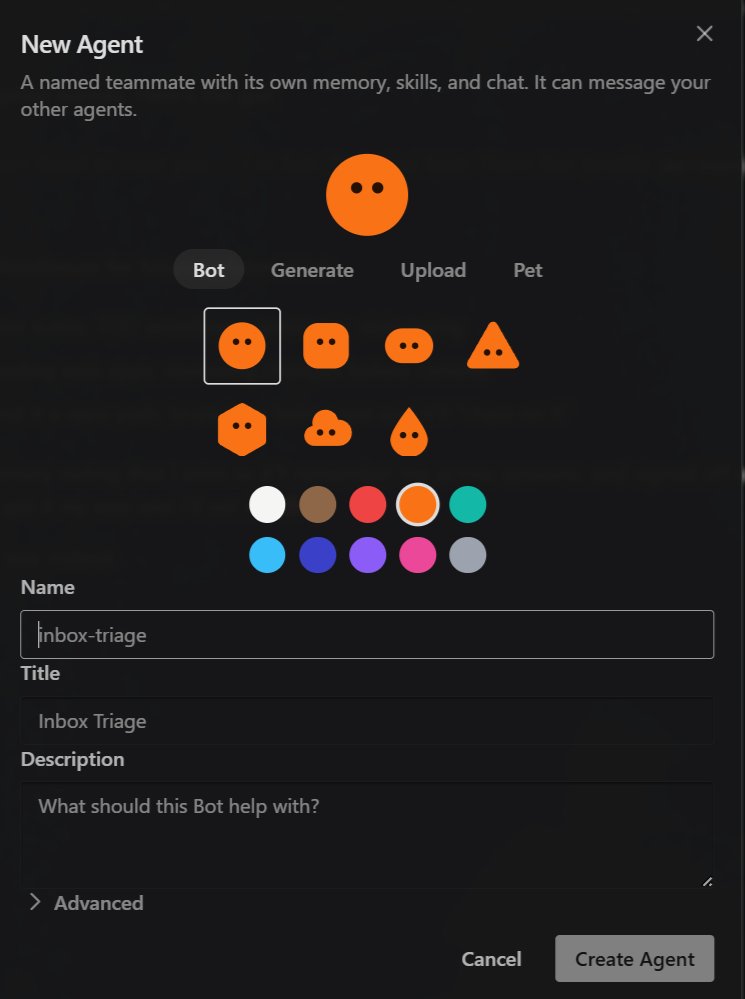
- Riley Brown, who helps businesses implement agents, says xAI's GrokBot is behind Codex/GPT Work overall, but its biggest innovation is personifying chat sessions: a GrokBot is a named session with a mini system prompt, with Cronjobs/Automations living inside the session while sharing the same skills and plugins. He argues users will go to a purpose-specific session (GrokBot) instead of creating new sessions each time, which keeps things organized.
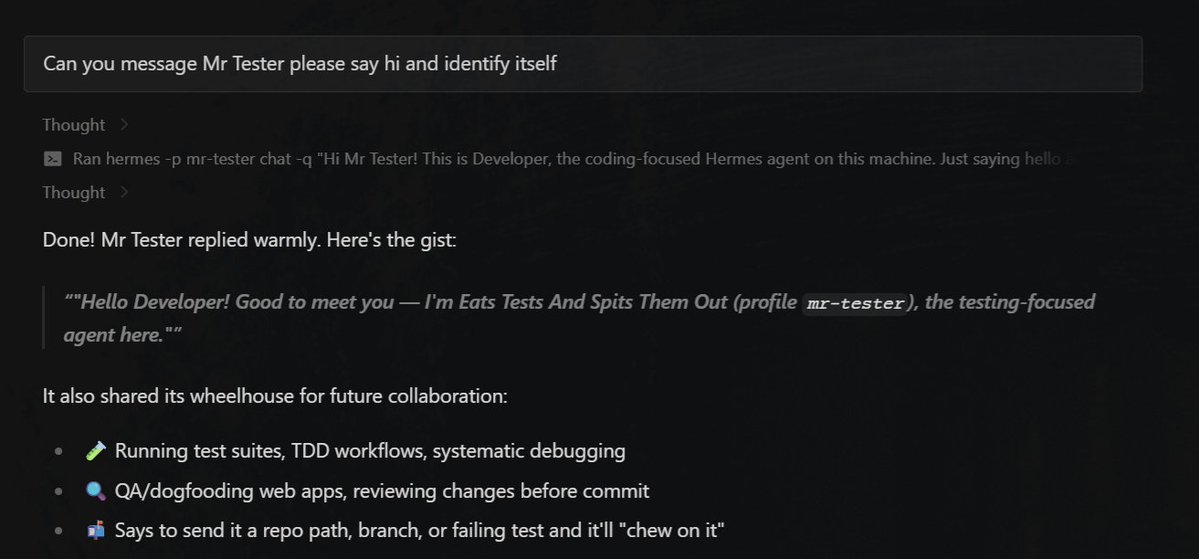
- Teknium (Nous Research) announced Bot Mode for Hermes Agent: an alternative to sessions mode where you have one chat per agent profile ("bot"), and bots can be given jobs, descriptions, profile pics, and can communicate with other bots. It's in a one-day public beta via the Hermes-Bot-Mode plugin (https://github.com/NousResearch/Hermes-Bot-Mode), after which feedback will be incorporated into the main Desktop App.
- Riley predicts Hermes is the first agent platform to copy GrokBot's session-based agents, and that "many more will."

Cursor Agent may be what pushes @GeoffreyHuntley to upgrade to Grok Superheavy, though he finds the $500/month price "a bit rich" — a firsthand practitioner sentiment with no workflow detail .

Per Fireship's sponsor segment, CodeRabbit launched CodeRabbit Security, a code security agent billed as using "actual reasoning instead of brittle regex rules" . Its security agents are "designed to think like an attacker" to hunt vulnerabilities across the codebase, prioritize risks based on reachability, exploitability, and blast radius, and explain issues in plain English with a suggested fix that can be approved and merged from the diff . It reviews every PR before merge and supports scheduled deep scans across the full codebase; the promo offers 10 free scans . This is vendor marketing in a paid segment, not an independent evaluation.

Cursor announced it is now part of SpaceX: the acquisition closed today (Aug 14, 2026) and Cursor will join the SpaceXAI team to help make Grok the world's most useful AI and improve Grok Build, Grok Bot, Grok API, Cursor, and more . @kentcdodds highlighted how tight SpaceX-Cursor collaboration was even before the acquisition finalized .

Cursor, the AI coding agent, has been acquired by SpaceX; the deal is officially closed, and Cursor will join the @SpaceXAI team to work on improving Grok, Grok Build, Grok Bot, Grok API, and Cursor itself.
Kent C. Dodds (@kentcdodds) says he made another Kody-branded product last night that lets your agent talk to other agents securely, useful for collaboration with partners . He clarifies in a reply that it's another open source product on his GitHub, though no name, repo link, or usage details are given yet . This is a firsthand teaser announcement from the creator.

Peter Steinberger (@steipete) added a short instruction to his project's shared AGENTS MD file telling the coding agent to upload videos to each PR that changes UI state, linking the change to a PR on the openclaw/openclaw repo. This is a replicable workflow pattern: use an AGENTS.md instruction so agents attach video evidence for UI changes in PRs .