We can't find the internet
Attempting to reconnect
Something went wrong!
Hang in there while we get back on track


Top Stories
1) Google ships Gemini 3.1 Flash‑Lite Preview (speed + cost focus, with adjustable “thinking levels”)
Why it matters: The release is positioned for high-volume, low-latency workloads, and adds a new control surface (“thinking levels”) that lets developers trade off compute vs. complexity on a per-task basis—useful for agent pipelines and real-time processing.
Key details from Google and independent evals:
- Availability: Rolling out in preview via the Gemini API in Google AI Studio and Vertex AI.
- Pricing:$0.25 / 1M input tokens and $1.50 / 1M output tokens.
- Speed claims (vs Gemini 2.5 Flash):2.5× faster time to first answer token and 45% faster output speed.
- Benchmarks shared by Google:1432 Elo on Arena leaderboard, up to 86.9% on GPQA Diamond, and 76.8% on MMMU‑Pro.
- “Thinking levels”: Google describes adjustable compute with “zero thinking overhead” on high-volume tasks, while reasoning through complex edge cases.
- Artificial Analysis (Gemini 3.1 Flash‑Lite Preview): scored 34 on the Artificial Analysis Intelligence Index (up 12 vs Gemini 2.5 Flash‑Lite) while served at >360 output tokens/s with ~5.1s average answer latency.
- Context + features (AA): retains 1M token context and supports tool calling, structured outputs, and JSON mode.
2) OpenAI rolls out GPT‑5.3 Instant broadly (and adds GPT‑5.3‑chat‑latest to the API)
Why it matters: This is a “most-used model” refresh focused on more direct, less defensive responses and improved web search behavior—the kinds of UX shifts that can materially change product adoption even without a headline benchmark jump.
What’s new / where it’s available:
- ChatGPT rollout: “GPT‑5.3 Instant in ChatGPT is now rolling out to everyone.”
- Stated behavioral goals: fewer unnecessary refusals, fewer defensive disclaimers, and answers that “get to the point more directly.”
- Web search improvements called out by OpenAI: sharper contextualization, better understanding of question subtext, and more consistent tone within a chat.
- Hallucination/factuality note: for “questions where factuality matters most,” one contributor reports 26.8% better (when searching) and 19.7% better (when not searching).
- API: “GPT‑5.3‑chat‑latest now also in the API.”
- Benchmarking access: “GPT‑5.3‑Chat‑Latest” is available in Arena’s Text Arena for testing.
OpenAI also teased:
“5.4 sooner than you Think.”
3) Anthropic momentum: $19B run‑rate reports + business share shift + senior talent move
Why it matters: Multiple signals point to rapid enterprise pull: reported revenue acceleration, business market share movement, and a high-profile research leadership transition.
- Revenue run‑rate: Sources cited by Bloomberg via Techmeme say Anthropic recently surpassed $19B run‑rate revenue (up from $9B end of 2025 and ~$14B a few weeks earlier).
- Run‑rate disclaimer: described as “annualized run-rate,” not realized revenue.
- US business AI market share claim: Feb 2025: ChatGPT 90%; Feb 2026: Claude ~70%.
- Talent move: Max Schwarzer (OpenAI post‑training leadership) said he’s leaving OpenAI and joining Anthropic to work on RL research.
4) “Document Arena” launches with PDF-based evaluations (Claude Opus 4.6 leads)
Why it matters: Document reasoning is closer to many real workflows (contracts, reports, technical PDFs). Arena’s new format uses user-uploaded PDFs and side-by-side voting, making the leaderboard a live signal for “doc work” performance.
- Document Arena is live and compares frontier models on document reasoning using PDFs.
- Leaderboard snapshot: Claude Opus 4.6 is #1 at 1525 (+51 lead).
- Arena says Opus 4.6 is now #1 across Text, Code, Search, and Document arenas.
- PDF upload workflows highlighted: summarize complex content, ask questions against the file, extract key insights.
5) Alibaba Qwen team turbulence (leadership change + departures + org restructure signals)
Why it matters: Qwen is widely credited as core infrastructure for open-weight ecosystems; leadership and staffing instability could change the pace and direction of open model releases.
- Leadership change: “Alibaba‑Cloud kicked out Qwen’s tech lead.”
- Departure posts: Qwen tech lead @JustinLin610: “me stepping down. bye my beloved qwen.” and @huybery: “bye qwen, me too.”
- Restructure context (Tongyi conference summary): Qwen described as a group priority with plans for expansion; references to resource constraints (including compute) and organizational changes.
- External view on impact: Qwen 1.0 launched in fall 2023; subsequent releases “pushing the frontier of open-weights,” enabling “hundreds, maybe thousands” of papers and many products/startups.
Research & Innovation
What to watch: reliability + efficiency are increasingly “core research,” not just engineering
Two clusters stood out this cycle: (1) methods that reduce the memory/compute cost of training and (2) evidence that multi-agent coordination is still fragile without deliberate design.
Training efficiency: FlashOptim (Databricks AI Research)
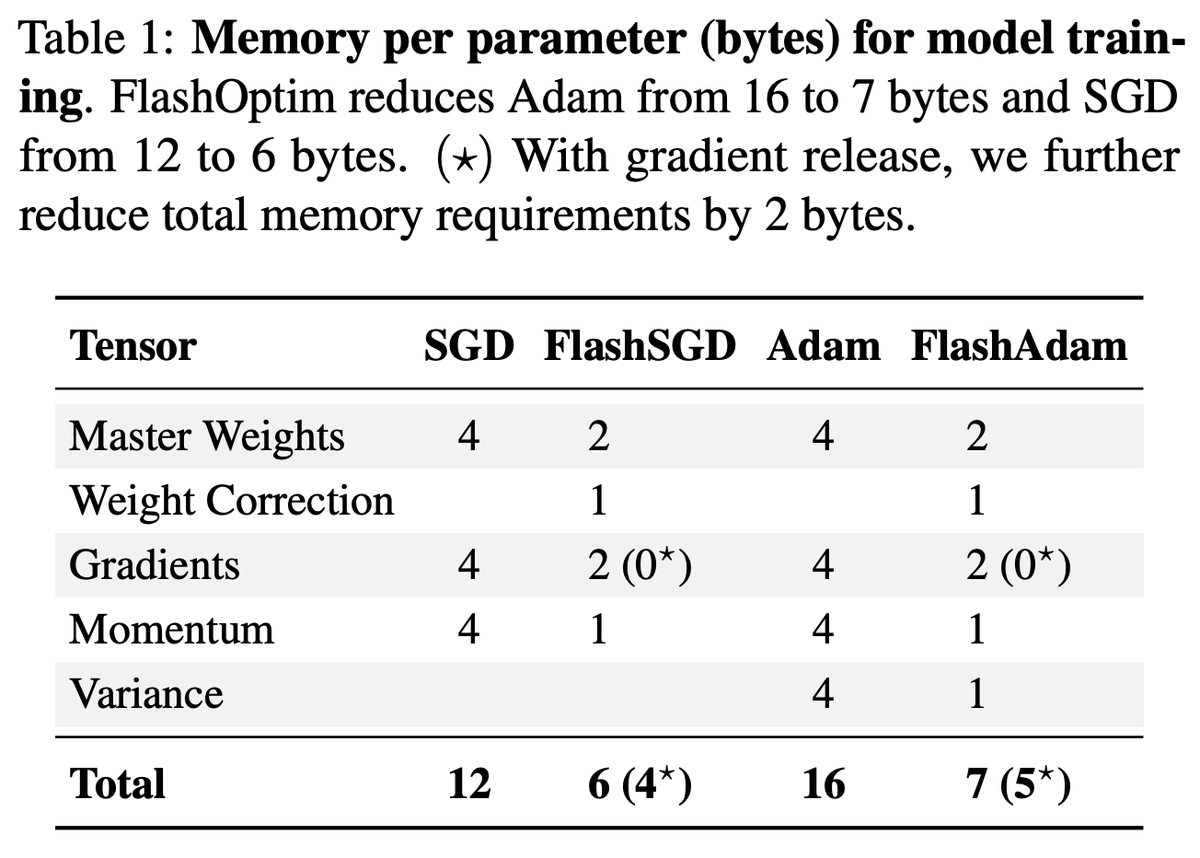
- Claim: cuts training memory by over 50% with no measurable loss in model quality.
- Concrete metric: AdamW training typically needs 16 bytes/parameter for weights, gradients, and optimizer state; FlashOptim reduces this to 7 bytes (or 5 with gradient release).
- Example: Llama‑3.1‑8B finetuning peak GPU memory drops from 175 GiB → 113 GiB.
- Compatibility: drop-in replacement for SGD, AdamW, Lion; supports DDP and FSDP2; open source.
- Techniques summarized by Databricks: improved master weight splitting + companded optimizer-state quantization.
Optimization + search: SkyDiscover (open-source)
- Releases an open-source framework with two adaptive algorithms reported to match/exceed AlphaEvolve on many benchmarks and outperform OpenEvolve/GEPA/ShinkaEvolve across 200+ optimization tasks.
- Reports +34% median score improvement on 172 Frontier‑CS problems and “discovers system optimizations beyond human-designed SOTA.”
Agent reliability: consensus + coordination don’t “just emerge”
- Byzantine consensus games: research finds valid agreement is unreliable even in benign settings and degrades with group size; most failures are convergence stalls/timeouts (not subtle value corruption).
- Theory of Mind (ToM) in multi-agent systems: a ToM/BDI + symbolic verification architecture shows ToM-like mechanisms don’t automatically improve coordination; effectiveness depends on underlying LLM capability.
Biology: Eubiota “AI co-scientist” claims lab-validated discoveries
- Eubiota is described as a multi-agent AI framework for end-to-end discovery (planning, tool use, evidence verification, wet-lab validation).
- Reports 87.7% mechanistic reasoning accuracy (vs GPT‑5.1 77.3%).
- Reported validated outcomes include: identifying the uvr‑ruv stress axis (screening 1,945 genes and 10K papers), designing a microbial therapy reducing colitis inflammation, engineering antibiotics, and discovering anti-inflammatory metabolites.
Products & Launches
What to watch: tools are converging on “agent runtimes” (compute + context + UI + eval)
This week’s releases focus less on single APIs and more on the scaffolding around agents: sandboxes, computer-use, document pipelines, and debugging/observability.
Developer agents and orchestration
- Cursor cloud agents: run in isolated VMs with full computer-use capabilities; produce merge-ready PRs and validation artifacts (video/screenshot) across web/mobile/Slack/GitHub.
- Cursor MCP Apps (v2.6): agents can render interactive UIs inside conversations; also adds private plugin marketplaces for teams.
- OpenAI Codex: shipped a new $chatgpt-apps skill in the Codex app for building ChatGPT apps with the Apps SDK (scaffolding, wiring tools to widget resources, iterating host-aware UI).
Search + research APIs
- you.com Research API: claims SOTA on DeepSearchQA and top scores on BrowseComp/FRAMES/SimpleQA “at a fraction of the latency and cost.” Offers one endpoint with five depth levels, up to “1,000+ reasoning turns” per query.
Document workflows: evaluation and production tooling
- Arena Document Arena: PDF upload + side-by-side voting and leaderboard for document reasoning tasks.
- LlamaIndex positioning: says it has evolved from a RAG framework to an “agentic document processing platform,” with LlamaParse processing 300k+ users across 50+ formats using multi-agent workflows (OCR + computer vision + LLM reasoning).
Speech / realtime
- AssemblyAI Universal‑3‑Pro streaming: brings AssemblyAI’s most accurate speech model to streaming audio; highlights include real-time speaker labels, strong entity detection, code-switching, and global language coverage.
Specialized models in production contexts
- Baseten: says it trained a specialist model that beats Gemini on emergency medicine documentation and runs 6–8× faster.
Industry Moves
What to watch: “distribution + workflow integration” is reshaping competition
- OpenAI building a GitHub alternative: The Information reports OpenAI is developing an internal alternative to GitHub after outages; staff discussed potentially selling it to customers.
- Perplexity Computer as a packaged runtime: Perplexity says its “Computer” orchestrates 20 different AI models and can be embedded into apps without developers managing API keys, using a secure sandboxed runtime they orchestrate end-to-end.
- US business market share claim: a post asserts ChatGPT fell from 90% (Feb 2025) to Claude ~70% (Feb 2026).
- Apple local-compute signal: Apple introduced M5 Pro and M5 Max with a “Fusion Architecture” merging two 3nm dies; claims include over 4× peak GPU compute for AI vs prior generation and 614GB/s unified memory bandwidth.
Policy & Regulation
What to watch: legal definitions are hardening into product constraints
US copyright: AI can’t be the author (Thaler v. Perlmutter stands)
- US courts held that “authorship” must be human (Thaler v. Perlmutter), and the US Supreme Court declined review (so the D.C. Circuit ruling stands).
- USCO guidance: prompt-only AI output can’t be registered; meaningful human creative contribution can be protected (and similar logic applies to AI-generated code absent human authorship).
New York bill targeting chatbot legal advice (SB 7263)
- SB 7263 would prohibit chatbot operators from permitting substantive legal advice that would constitute unauthorized practice of law; it passed the Internet & Technology Committee last week.
- Includes a private right of action with mandatory attorneys’ fees.
OpenAI–DoW/DoD contract language scrutiny continues
- OpenAI amended its agreement to state the AI system “shall not be intentionally used” for domestic surveillance of US persons/nationals, including deliberate tracking via commercially acquired personal/identifiable information.
- The Department affirmed services won’t be used by DoW intelligence agencies (e.g., NSA) without a follow-on modification.
- Commentators note the full contract text is not public; some argue language could still be porous given legal definitions of “collect/surveil” and “incidental” collection mechanisms.
Global governance signal
- The UN’s Independent International Scientific Panel on AI elected co-chairs Yoshua Bengio and Maria Ressa, with the first report slated for July 2026.
Quick Takes
What to watch: smaller signals that may compound
- METR Evals correction: fixed a modeling mistake that inflated recent 50%-time horizons by 10–20%; for Opus 4.6, one update reports P50 11h 59m (down from 14.5h) and P80 1h 20m (up from ~1h).
- Claude Code voice mode: rolling out (reported live for ~5% of users), toggled via
/voice. - Codex voice transcription: available to 100% of Codex users; in-app via mic or
Ctrl + M, and in CLI via config + press-and-hold Space. - Gemini 3 Pro sunset: Google is “turning down Gemini 3 Pro” on March 9; users can upgrade to Gemini 3.1 Pro Preview.
- Qwen 3.5 GPTQ Int4 weights: Alibaba released GPTQ‑Int4 weights with native vLLM and SGLang support (less VRAM, faster inference).
- H100 shortage watch: posts report near-zero H100 capacity on Prime Intellect and Lambda dashboards; one provider suggests capacity may improve in coming weeks.
- Bipartisan opposition to AI data centers: reported escalation includes New York proposing three-year construction moratoriums and communities pulling tax incentives.

Alibaba Qwen team developments from Tongyi Conference summary .
- Positioned as group's top priority for rapid closed-loop AI development; undergoing organizational restructuring and talent expansion from ~100+ members (dozen core contributors) due to grand ambitions outpacing current scale .
- Recent adjustments framed by chief HR as resource expansion, acknowledging growth pains .
- Compute resources given highest internal priority; CEO most aggressive in China for compute, issues due to communication and historical Ali Cloud limits .
- Expert analysis: Small team drove major modern LLM research via compute/data investments, akin to DeepSeek's algorithmic progress .
- No irrational retention for key personnel like Junyang amid changes .
Alibaba’s Head of Qwen AI identifies core issues in China’s AI community: overly fond of certainty, risk-averse, hesitant to explore new AGI directions; bluntly states, "We lack people who dare to do 'uncertain' things."
Satirical reference to DeepSeek V4's Party-issued political alignment dataset allegedly including pro-psychedelic propaganda .
OpenAI's DoD contract described as gateway to all NATO classified networks, announced within 3 days, amid accusations of misleading the public for foreign money .
@Teknium reacts: America was one thing, but EU government involvement is worse .
Evidence linked: https://x.com/tradfi/status/2028935094833168575.
FlashOptim released: Optimized implementations of Adam, SGD, and other optimizers that compute identical updates while saving substantial memory .
Available immediately via pip install flashoptim.
Accompanying paper: https://arxiv.org/abs/2602.23349.
Thread introduces innovative techniques enabling this .
Positive endorsement: @giffmana "learned surprisingly much" from it .
@hanchchch and @cloneofsimo released a tech report on video pretraining research they worked on last year, aiming to help the community build video models .
The report was uploaded this week: https://arxiv.org/abs/2603.00173.
@cloneofsimo conducted the work before leaving fal last year for 3-year military duty .
Alibaba's Qwen team under Junyang is praised for its top-tier vibe, efficiently utilizing tight resources to deliver one of the best models in the world. Internal drama at Alibaba risks hindering Qwen's progress, described as a "sin against human progress" .
Positive reactions to this assessment noted as "very whitepilling" .
DeepSeek AI model indicated V4 release on March 4th, interpreting "3/4" as transition from V3 to V4.
User response: Model's answer aligns with prior query, praising its insight .
Speculative manifestation includes Feng Shui and trigram analysis .
Expert commentary on AI compute economics:
Commoditizing the "compliment" (likely compute) "doesn’t make a lot of sense when the thing your trying to commoditize is the most capital intensive part of the entire stack." Hopes Meta "hangs in there for a while at least though" .
Response: "> meta alas too late" .
@swyx asserts that the best startup AI Engineers build their own agents to encounter SOTA challenges including Prompt Engineering, RAG, Evals, Tool use, Code generation, Long horizon planning. He compares it to a Jedi constructing their lightsaber and calls agents the Hello World of AI engineering .
@zachtratar reflects that building agent harnesses on GPT-3.5 was fun nearly 3 years prior .
Palantir CEO Alex Karp at a16z American Dynamism Summit warned: “If Silicon Valley believes we’re going to take everyone’s white collar jobs AND screw the military…If you don’t think that’s going to lead to the nationalization of our technology— you’re retarded.”
Observer commentary: Palantir engineers build glorified government CRMs rather than frontier AI models, averting dystopia.
In an all-hands meeting, Sam Altman told OpenAI employees that the company doesn’t ‘get to make operational decisions’ regarding how its models are used by the Department of Defense, with authority falling to Defense Secretary Pete Hegseth .
A response criticized this as bad faith reporting, clarifying Altman was relaying a quote said to him, not his opinion .
MiniMax MaxClaw powers Conflictly Clone, a real-time war room dashboard tracking conflicts .
Capabilities:
- Monitors missiles, naval zones, active fires, and battle damage on one map with live notifications
- Auto-refreshes every 15 minutes; AI runs everything
GPT-5.3 Instant is launching and rolling out today . Announcement links to OpenAI status .
5.3 Instant model features a new web search experience .
Developer @j_mcgraph credits collaborator @ManukaStratta for essential contributions, calling her a "data center of geniuses in a trenchcoat" with incredible endurance .
Links to OpenAI announcement: https://x.com/openai/status/2028893717877375132.
Endorsed strongly by @isafulf .
Associated Press AI initiatives: Newsroom leader reported many editors preferred AI-written articles over human ones, stating resistance to AI use is futile .
Expert commentary: Future journalism will gather facts and trust AI models to produce text, video, and audio content .
@Yuchenj_UW speculates that US VCs could invest in the Qwen core team that recently departed, potentially creating a new US AI lab to build frontier open-source models competing directly with Chinese OSS models .
Muon optimizer debate for CNN training:
- Reportedly faster than AdamW even for CNNs, but lacks evidence on superior model quality .
- CIFAR-10 speedrun: Muon achieves 94% accuracy vs 96% with SGD (no AdamW comparison) .
-
Conv layer issue in original Muon: rectangular shape
(in_channels, out_channels * kernel-h * kernel-w)unfavorable for NS; orthogonalization effect unclear . -
Suggestion: batch kernel positions into
(kernel-h * kernel-w, in, out)for parallel NS per slice . - Muon suits rectangular matrices cheaply; kernel-h,w on input channels side? .
- Costs: linear in longer edge, quadratic in shorter .
@agi2asi, Replit's AI Chief of Staff, demonstrated Replit Agent 3 by rebuilding macOS entirely on the web using natural language prompts—no templates or UI libraries .
Key capabilities showcased:
- Functional VS Code replica with integrated terminal and multi-agent AI copilot
- Custom servers integrated with PostgreSQL, Stripe, GitHub
- Siri-like voice/text controller for OS functions (e.g., wallpapers, app launching)
- Parallels Desktop emulation running Windows XP, Ubuntu, Mario Kart
- One-shot conversion to iOS mobile app
"The ceiling for software creation has been completely blown open with Agent 3... greater things are coming soon" . We are way past basic web apps.
Replit Agent hailed as new leader in "vibe coding" .
Google DeepMind released Gemini 3.1 Flash-Lite, their most cost-efficient Gemini 3 series model, built for intelligence at scale .
Demi Hassabis described it as "small but mighty", incredibly fast and cost-efficient for its performance .
Announces a thread with new features .
OpenAI shipped Handoff in the Codex app, a simpler workflow to move threads between Local and Worktree.
Video demo included .