We can't find the internet
Attempting to reconnect
Something went wrong!
Hang in there while we get back on track


Top Stories
Why it matters: Model competition is becoming a contest over reliable, affordable execution—not just headline scores.
Gemini 3.7 Flash makes rapid, cheap iteration the headline. Google introduced its “most intelligent workhorse” three weeks after 3.6 and reports gains from 34.4% to 43.6% on FrontierCode, 49.0% to 65.3% on DeepSWE, 1538 to 1588 WebDev Arena Elo, and 17.0% to 30.4% on AutomationBench. The introductory API price is $0.75/$3.75 per million input/output tokens through 2026, rising to $1.50/$7.50 in 2027; access spans developers, enterprises, and individuals through Spark for Google AI Pro and Ultra subscribers.
DeepSeek is shipping a model and a programmable harness layer. V4 Pro adds low/high/max reasoning effort, native OpenAI Responses API support optimized for Codex, and app/API access. An accompanying release thread identifies V4 Pro 0813 as an MIT-licensed open-weight checkpoint on Hugging Face; Harness v0.1 is also MIT-licensed and makes models, tools, sessions, sandboxes, loops, orchestration, and UI plugins. DeepSeek says new off-peak API rates will be 50% below peak, effective August 16, adding scheduling as another lever for agent economics.
Research & Innovation
Why it matters: The hard production problems are state retention, instruction overhead, and whether evaluations generalize.
Context compaction can erase operating constraints. A COMPINT evaluation summary says current compactors retain only 17% of standing rules, silently dropping session instructions such as “do not delete any emails until I confirm”; compacted runs can be worse than running without compaction. An SC-aware extractor recovered more than 90% retention without changing the model or compactor.
Skill libraries are not free guidance. A Microsoft-and-colleagues paper summary attributes 307 agent failures to loaded skills—125 functional failures and 182 efficiency regressions. Seemingly relevant skills sometimes caused agents to omit or misimplement requirements; excessive verification accounted for 67 cost regressions and heavy implementation pipelines for 30.
Agent leaderboards may rank specialization. A four-facet Generalizability Theory analysis across TheAgentCompany, tau-squared-bench, and AppWorld finds the agent effect explains under 3% of variance while agent-by-task interaction explains 7–23%; on the hardest quartile, reliability falls from 0.752 to 0, and per-family rankings invert.
Products & Launches
Why it matters: The execution layer is becoming a product surface, from inference speed to prebuilt environments and hands-off orchestration.
OpenAI’s Ultrafast mode, powered by Cerebras, promises up to 750 tokens per second—14× faster than standard GPT-5.6 Sol. It starts with a select API customer group and targets real-time voice, support, commerce, coding, financial research, and security response.
Cursor says prebuilt “builds” cut cloud-agent startup time threefold at no additional cost; failed builds never go live, and customers report start times falling from minutes to seconds.
NAC brings long-running delegation into an open harness. Launched with a beta expanded Open Models API, it was used daily by its research team since April for asynchronous, hands-off work and powered a significant portion of recent pre-training, post-training, and data-pipeline code before opening to everyone.
Industry Moves
Why it matters: Capital and infrastructure are following agents into governed data systems, observability, and national-scale compute.
Databricks says it crossed a $7B revenue run-rate, up more than 80% year over year in Q2, and raised $5B to invest in Lakebase, its serverless Postgres for AI agents; Genie, its business-data AI coworkers; and Unity AI Gateway for multi-AI governance and cost control.
Together AI and Larsen & Toubro are building a 10,000-Nvidia-B300 “AI Factory” in India, aimed at open-source inference, fine-tuning, and training at scale.
Arize entered a definitive agreement to be acquired by Dynatrace. Arize’s founder frames the deal around the convergence of software and agents: tools and prompts mix code, while software logs and traces help debug AI systems.
Quick Takes
Why it matters: Open and specialized releases keep widening the set of deployable alternatives.
- GLM-5.3: Z.ai positions the model for coding and cyber defense after post-training on a 743B base; it is available through GLM Coding Plan and ZCode, with API access and open weights staged after safety evaluations.
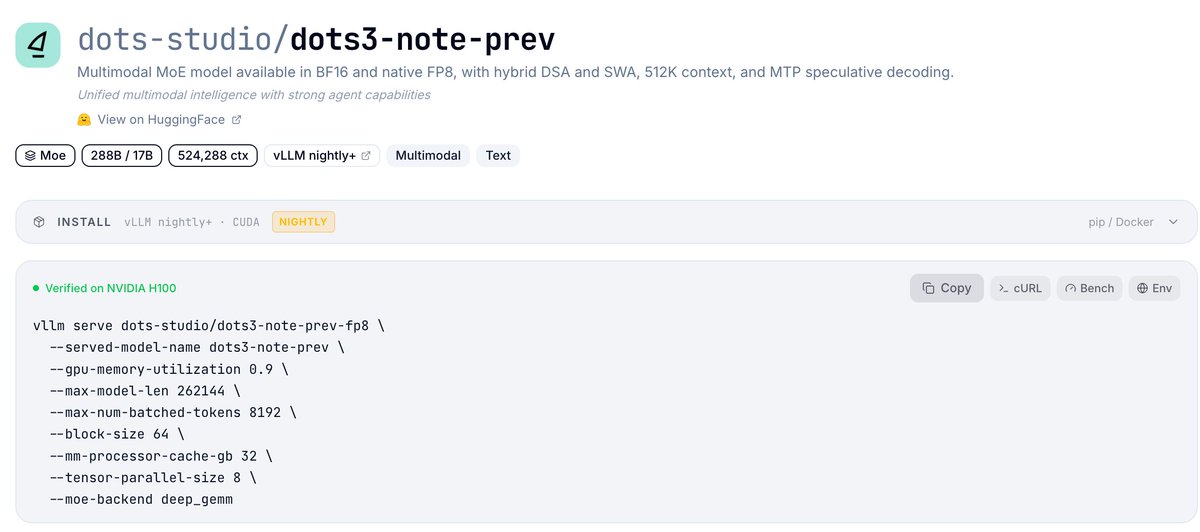
- dots3-note: Dots Studio’s preview is a 280B MoE with 16B active parameters, 512K context, multimodal input, and TEMPO for long-horizon agent training; vLLM says it is Apache 2.0 with day-one vLLM support.
- LlamaExtract Agentic Plus: LlamaIndex describes a document-extraction model-plus-harness engine; its release claims 95.6% value accuracy at less than a third of the closest peer’s cost.
- MiniMax-H3: Arena places it first overall in Video Edit Arena at 1,390 points, 32 points ahead of the next two models.

DeepSeek and Peking University published an open-source agent runtime 'DeepSeek Harness' and a preprint paper, 'A Programming Paradigm for Spatiotemporal Composability', that makes agent components (model adapters, tools, session manager, filesystem, the agent loop itself) replaceable and reversible . The underlying runtime, Cordis, draws on the Koishi chatbot framework and formalizes two ideas: temporal composability (every plugin effect is recorded and undone in LIFO order on removal) and spatial composability (reactive coeffects track dependencies; if a service disappears, dependents deactivate first, then recompose) . Goal: self-evolving agents can modify their own runtime without restarting or leaving broken state, with stable state determined by current configuration . Limits: it cannot undo irreversible external effects (emails, external API calls), assumes plugin authors supply correct inverse operations, and both Harness (developer preview) and the paper (preprint) are under active development .
Z.ai introduced GLM-5.3, described as 'Built to Code. Ready for Cyber Defense,' with top-tier coding and agentic capabilities achieved through post-training on the 743B base model, and a major leap in cybersecurity setting a new standard among open models . Tech blog: https://z.ai/blog/glm-5.3.
Full benchmark results for GLM-5.3 were released . @OfirPress commented that the 19% "almost resolved" score is the second-highest they have ever seen and, by a large margin, the highest open-weights model score .
AA displays V4-Pro's cost using peak-hours rates — 12x on cache reads, 3x on cache misses, 4.5x on outputs versus current costs — yielding $0.25/task; at permanent-discount rates it would be ≈$0.053 . The cost is within 2x of 0731-Flash, but Flash is also getting a price hike, making the comparison moot . A related post cautions that the observation was an outlier, not typical .
Z.ai introduced GLM-5.3, an open model positioned as "Built to Code. Ready for Cyber Defense," claiming top-tier coding and agentic capabilities achieved through post-training on a 743B base model, and a major cybersecurity leap among open models, with a tech blog for details . The announcement drew a skeptical "oh brother" reaction from AI commentator @teortaxesTex .
A tweet by @zephyr_z9 (retweeted by @teortaxesTex) claims AFD (Attention FFN Disaggregation) can handle a model nicknamed "Sol" with over 3T parameters, saying "This is the first commercial…" (text truncated), and links to an OpenAI post .
In a post, @zainhas claims DeepSeek-v4-pro 0813 is 2x cheaper per task than DeepSeek-v4-Flash 0731 . @teortaxesTex responds with skepticism, arguing the cost difference makes no sense because the model doesn't use fewer steps or tokens than Flash, and questions the data generation, suggesting the result is likely still Pareto-mogging .
Z.ai released GLM-5.3, built for coding and cyber defense, with top-tier coding and agentic capabilities from post-training on a 743B base model, claiming a major leap in cybersecurity among open models . It is available now via GLM Coding Plan and ZCode, with API and open weights rolling out in stages after safety evaluations . GLM-5.3 is a dramatic improvement over GLM-5.2 for agentic coding, achieving better results with fewer output tokens . An initial partner group is already offering GLM-5.3-powered services with safeguards, with partner access expanding under a consistent process .
Zhipu AI's GLM 5.3 is expected to launch soon . Commenting on the upcoming release, @teortaxesTex says Zhipu has neither unusual scale nor a novel architecture, attributing its progress to "pure brutal training competence," and asks how far it can push the 744B base model with that approach .
OpenAI's new VP of safety, Amelia Glaese, and head of core product, Thibault Sottiaux, are dating — a relationship some current and former employees described as unusual given tensions between safety and product teams . OpenAI chair Greg Brockman said "any perceived conflict of interest is being handled responsibly" .
OpenAI is previewing Ultrafast mode for GPT-5.6 Sol, promising up to 14x the speed; it launches first in the OpenAI API to a select group of customers, with expanded access as capacity grows . @gdb shared the announcement, describing it as "wild to see Sol at 14x speed" .
Together AI and OpenRouter are hosting a NYC fireside chat on the shift to open models, model selection, and adoption, with Q&A and networking . The post frames closed models as no longer the default . Registration is open .
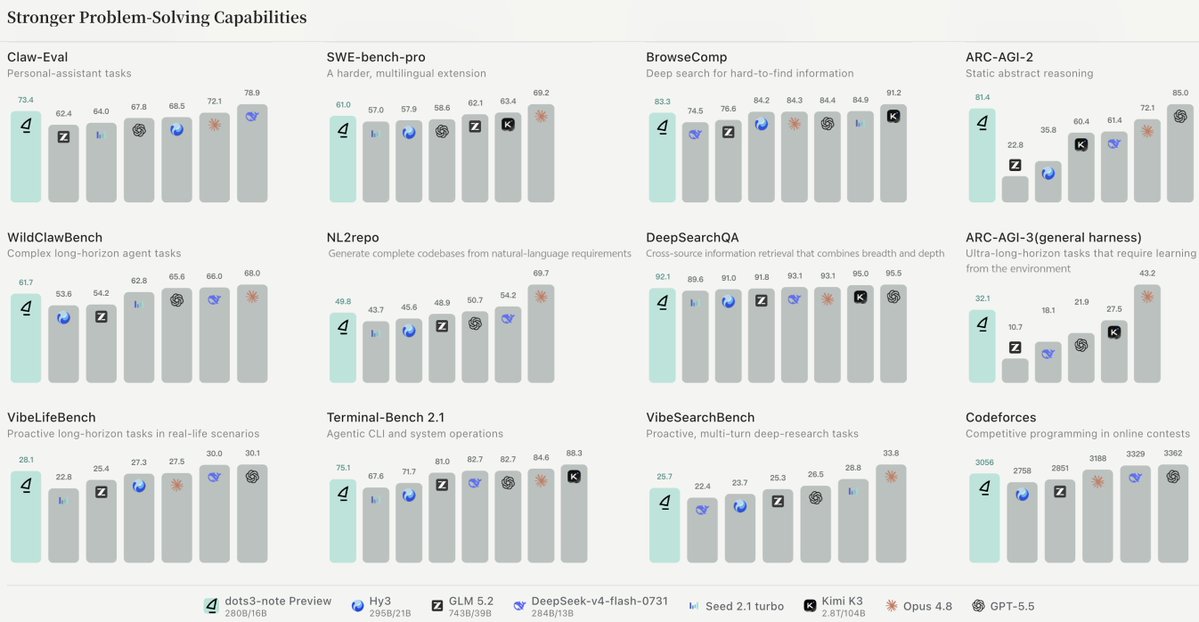
dots studio (RedNote's AI lab) released dots3-note preview, an open-weights 280B MoE model with 16B active parameters, a 512K context window, and text/vision/audio multimodal understanding . It introduces TEMPO, a new RL approach for long-horizon agent training through self-critiquing and test-time-scaled value estimation; the lab claims the 16B-active MoE scores >30% on ARC-AGI 3, though it notes this is an interim preview with RL not yet complete . Two open benchmarks for real-life agents, VibeSearchBench and VibeLifeBench, were released alongside the weights on Hugging Face .
Stas Bekman added a new section to the Art of Debugging book on diagnosing buggy NCCL collective calls that cause PyTorch programs to hang, claiming it works even better than py-spy .
Perplexity is moving Sonar to its Agent API, which keeps grounded web search and adds multi-step research, code execution, built-in tools, and access to multiple models through one API . On BrowseComp and WideSearch, the Agent API more than doubles the best existing Sonar score . @AravSrinivas wrote, "Perplexity Agent API is the best for web search and browsing agents" .
Unofficial speculation points to a GLM-5.3 release in about a week: @teortaxesTex estimates "1 week to GLM-5.3" , reacting to @jietang's "sooooooon" tease with an embedded post hinting at an imminent launch . Not confirmed.
Dots Studio released dots3-note preview, an open-weights 280B MoE model with 16B active parameters and a 512K context window, featuring multimodal understanding across text, vision, and audio . It introduces TEMPO, a new RL approach for long-horizon agent training via self-critiquing and test-time-scaled value estimation . Weights are open on Hugging Face under Apache 2.0 with day-0 support in vLLM , alongside two open agent benchmarks, VibeSearchBench and VibeLifeBench . The model is reported competitive with much larger models on reasoning, agentic, and multimodal evaluations .
@scaling01 argues against introducing token markets for AI compute, calling it "a terrible idea in the short-term" that would require extensive new regulatory structures, create massive windfall profits for AI labs, help large corporations, and create regional and permanent underclasses . Specific concerns: token prices coupled to ability to pay would create a permanent underclass; regions with less compute and costlier energy would become regional underclasses; near-100% hardware utilization could keep token prices high 24/7 and detach prices from production costs, pushing AI-lab margins from ~80%+ even higher; large corporations could hedge at fixed prices while startups face higher costs and volatility; model releases would cause price spikes; insider information and token derivatives invite market manipulation; and infrastructure attacks would be incentivized . The AI race itself makes token markets extremely unstable: if one lab pulls ahead, token prices explode into "the most insane windfall profits humanity has ever seen," amplifying all these problems; without regulatory structures and universal basic income, token markets are "equivalent to begging for a permanent underclass" .
ClickUp announced Gemini 3.7 Flash is now available in ClickUp Brain, calling it "a noticeable leap for everyday knowledge work" and inviting users to try it . A quoted reply asks "Give us Pro you cowards," signaling user demand for a Pro tier or model .
DeepSeek's 'harness' product is drawing sharp public criticism from Chinese AI accounts: @chunxiangai calls it a 'product-level disaster' and derides its plugin-ecosystem differentiation as Obsidian-like ; @fiapp_pro claims it doesn't rank on GitHub and that DeepSeek accompanied it with an 88-page paper . The thread amplifying these posts frames them as an 'insane meltdown driven by class resentment' and suspects astroturfing .