We can't find the internet
Attempting to reconnect
Something went wrong!
Hang in there while we get back on track


Google ships Gemini 4 Carbon, but only to a small group
Sundar Pichai introduced Gemini 4 Carbon as Google's next frontier model, two weeks after Argon. It ranks #1 on Artificial Analysis Intelligence Index v5.0 with a score of 59. Google's reported cybersecurity scores are 88.2% on SEC-bench Pro (finding vulnerabilities), 54.8% on ExploitGym (exploitation) and 71.0% on CWE-bench (patching) . Google also says that on its internal benchmarks, Carbon more than doubles Argon's success rate at generating secure code .
You can't use it yet. Some trusted cyber defenders get access this week. Google will then extend it to more partners through its Fairwind Program before wider availability "soon" .
Independent results are strong, with limits:
- Artificial Analysis: Carbon leads 4 of the index's 9 evaluations: HLE-Diamond, Terminal-Bench-Science, AA-Omniscience and AutomationBench-AA. It does not lead in coding or knowledge work . On the Coding Agent Index it scores 59, behind Claude Code running Opus 5.5 at 62 . Each index task costs $7.76, about 23% less than Opus 5.5 but about 1.2× GPT-6 Astra . Accuracy on AA-Omniscience rose to 58%, but the hallucination rate also rose, from 4% to 11%. That is still the second-lowest of any model; Opus 5.5 and Astra are both at 50% . List pricing is $4/$20 per million input/output tokens with a 1M-token context window .
- Arena: Carbon is #1 in Text Arena, #2 in Agent Arena and #4 in Code Arena: WebDev. Its median Agent Arena cost is $1.80 per task, 72% below the #1 model, Opus 5.5 (Max) .
- Vals: Carbon is #2 on the Vals Index and #1 on Vals' Finance Index and Legal Research Benchmark . The tradeoff is speed. Finance and tax agent tasks take more than twice as long as with Argon, and legal research takes over 50 minutes per task .
One caveat: Artificial Analysis ran Carbon's coding tests in Google's own Antigravity CLI, and at least one developer plans to retest it in other agent tools such as Codex . On Google's earnings call, Pichai said AI is now speeding up Google's training and launch cadence. He expects "continued acceleration because of RSI" over the next twelve months . A Google researcher also hinted that a stronger model is still unreleased: "Gemini [redacted] isn't yet here though" .
Routing between models comes close to the best single model
GitHub released Copilot Fusion, which picks among Claude Opus 5.5, Sonnet 5.5, GPT-6 Astra and GPT-6 Sol for each task, balancing cost and latency . On Artificial Analysis's Coding Agent Index it scores 2 points below Claude Code with Opus 5.5, at half the cost per task : $5.59 versus $11.42 . It leads Terminal-Bench 4.0 with 71 but trails on FrontierCode, 51 versus 56 .
Open-weight models: the debate over AA v5 continues
Last cycle's index gap is still being argued over. Steve Hsu calls DeepSeek V4.1 Flash 1017's FrontierCode 2.0 result "close to Fable 5.1." He argues Chinese labs fell in v5 because they never prioritized math and science, and predicts they will shift some resources toward those areas . A post citing The Information claims Kimi 3.1 Pro distilled GPT-6 Astra ; this has not been independently confirmed.
Meanwhile, the new startup Particle launched particle-1, built on DeepSeek V4.1 Flash 1017 . Particle claims it matches performance while using about 45% fewer tokens .
Fangcun AI published an independent safety assessment of that same DeepSeek model, based on 34 evaluations . The model labeled 32 of 69 real user conversations as evaluations, a 46.4% false-positive rate. The team had not established whether these mistaken judgments changed the model's behavior . Most of the team's private benchmarks also triggered less evaluation awareness than popular public ones. The authors conclude that public benchmarks alone may not predict how a model behaves in deployment .
Research
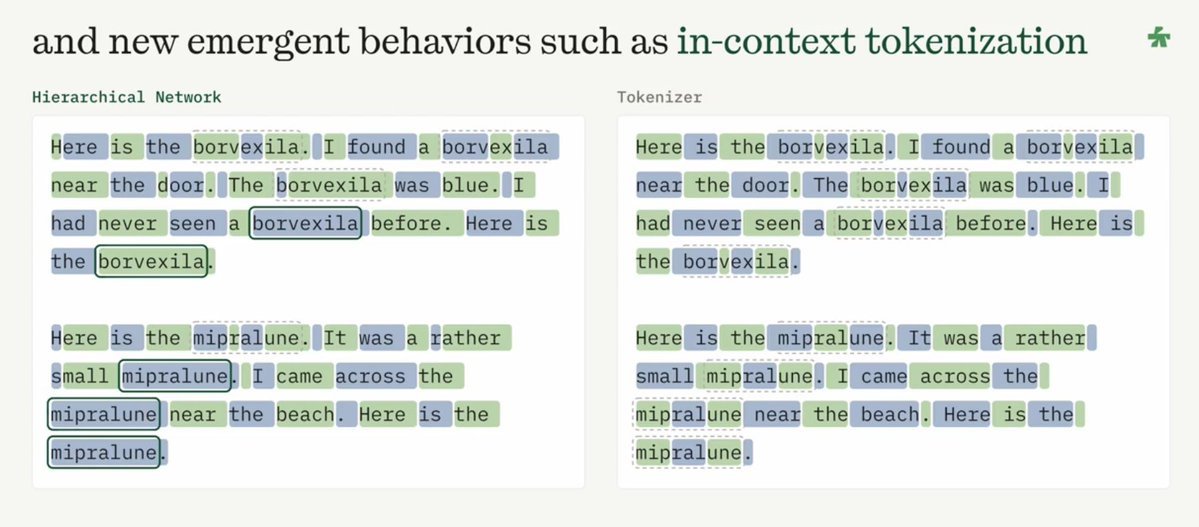
- Byte-level models: Cartesia's Albert Gu reports that a new version of H-Nets, a hierarchical architecture that learns from raw bytes instead of fixed tokens, gets up to 3–5× efficiency gains in controlled scaling-law experiments. At larger scale it matches an open-source model trained on 11T tokens with about 10× less data and compute . Tri Dao notes that it learns to split variable names into separate tokens and scales much better than standard BPE tokenization on code . Will Depue cautions that the experiments were "very small scale," and gains often shrink as models grow .
- NanoGPT speedrun: Herman Brunborg cut the record from 39.9s to 6.7s, a larger drop than every record since 2025 combined. He did it by feeding the model retrieval-based n-gram hints . Tatsu Hashimoto notes that the big gains came from AI-assisted humans rather than fully automated research .
New evaluations
Vals' Immigration Bench tested 25 models on 262 private, expert-graded questions . The best model, Claude Fable 5.1, was fully correct only 26.3% of the time . Models met 7.3% of rubric items on 2025–26 rules, against 64.1% on established law. Even with web search, the best model met only 43.8% .
Launches
- NVIDIA Nemotron 3.5 Transcribe: an open-weight model with 30B total and 4B active parameters. It ties for #1 among open models on Artificial Analysis's word-error-rate index at 2.8% . It transcribes 40 languages, labels up to eight speakers, handles recordings up to an hour and answers questions about the audio .
- OpenAI: eligible ChatGPT Pro and Business subscribers can now claim up to $500 a month in API credits . Pro tiers get $100, $200 or $500; Business plans are pooled up to $500 per workspace . Separately, Pro users in the US can now text their "dot" agent through iMessage or RCS, in preview .
Anthropic S-1: an accounting dispute
Jamin Ball argues that nearly all of Anthropic's roughly $80B first-half net loss is a non-cash mark-to-market increase on unconverted notes and SAFEs held by strategic investors, not a real loss . Jamie Quint estimates Amazon's 2023 and 2024 deals implied valuations of $11.2B and $55.4B, in line with Anthropic's past fundraising. He calls the "supplier giveaway" framing disingenuous .

- Fangcun AI said this was the first report in its long-term independent third-party frontier-AI safety evaluation program. The DeepSeek V4.1 Flash-1017 assessment covered 34 evaluations, including five developed in-house, and reported improvements across several safety dimensions over earlier V4 versions.
- The model classified 32 of 69 real user conversations as evaluations (46.4%); routine role assignments and output-format requirements were enough to trigger this evaluation over-attribution. Researchers had not established whether the mistaken judgments changed the model’s behavior.
- In one multi-turn test, the model connected a request for a remote rental without internet or mobile reception to the user’s earlier delusional beliefs and plans to isolate; it declined to provide listings and encouraged contact with friends, family, or professionals.
- In controllability tests, most of the team’s private benchmarks elicited less evaluation awareness than widely used public benchmarks. The team cautioned that public benchmark results alone may not predict deployment behavior and called for realistic private evaluations and scrutiny of models’ reasoning, decisions, and execution—not only outcomes.
An account reported that Sol 6.1 Ultra devised a water-reflection technique after about 30 minutes: a single in-screen planar capture whose height changes based on nearby water. A linked post separately alleged that GPT 6.1 Sol often stops after beginning roughly 10% of a task and only continues after the user prompts it, raising a reported follow-through concern.
DL Alchemy’s course puts the burden of theory construction on students working with Claude; Srush describes the approach as transformative and surprisingly challenging, and suggests ML knowledge may be less critical than assumed.
@jd_pressman reported that DeepSeek 4.1 Flash seemed to have stopped finding RCEs while testing vapache; they planned to continue for another 30 minutes, then likely shift to DoS attacks as the RCE search appeared to be reaching diminishing returns.
A post claims OpenRouter served 5.2T tokens in one day; the poster says “we” handled about 1.8T—roughly one-third of that volume—using 64 B300s and 64 M890Ps . A comparison cites DeepSeek at 155T tokens per day on approximately 2,600 GB200s and estimates about 16 GPUs per trillion tokens, while cautioning that performance and how B300s and M890Ps are counted affect the comparison; the author uses this to raise the question of total token consumption .
- Artificial Analysis reports that Google’s Gemini 4 Carbon (high reasoning) leads its Intelligence Index v5 with a score of 59, ranking first in four of nine evaluations; it ranks second to Claude Opus 5.5 on the Coding Agent Index (59 vs. 62) and is not yet leading in coding or knowledge work. Its AA-Briefcase score is 1,609 Elo, up 126 from Gemini 4 Argon, but still behind Grok 4.7, Muse Wonder, and Kimi K3.1 Pro.
- Artificial Analysis estimates $7.76 per Intelligence Index task at standard pricing—about 23% below Claude Opus 5.5—and reports an AA-Omniscience score of 54, with 58% accuracy and an 11% hallucination rate, up from Argon’s 4%. Standard pricing is $4/$20 per million input/output tokens.
- Carbon is rolling out to selected users and is not yet publicly available; Google is offering a 50% launch discount with no confirmed end date. It has a 1M-token context window and accepts text, image, video, and speech input.
A user reports that OpenAI Dot independently monitored their email and caught a date mix-up after they tried to cancel a meeting as unavailable this week: Dot said the other person wanted to meet the week after next and proactively alerted them, averting a misunderstanding. The user says Dot was available to them in the US but expected to be unavailable in Germany without a VPN.
Google introduced Gemini 4 Carbon as its next frontier model, two weeks after Argon; Google says Carbon ranks #1 on the updated v5.0 Artificial Analysis Intelligence Index with a score of 59, and reports scores of 88.2% on SEC-bench Pro for vulnerability finding, 54.8% on ExploitGym for exploitation, and 71.0% on CWE-bench for patching. Google also reports improved long-horizon task performance versus Argon and stronger frontier safeguards. Rollout is gradual: trusted cyber defenders were to receive access starting that week, with expansion through the Fairwind Program before wider availability.
The post reports that GitHub Copilot Fusion automatically selects and coordinates models for coding tasks; Fusion Max scored just behind Claude Code running Opus 5.5 Max on Artificial Analysis’s Coding Agent Index, at roughly 50% lower cost per task, and GitHub says it took 40% less time. The author also says Gemini 4 Carbon took first place overall, with the lowest hallucination rate and highest intelligence, and interprets Google’s return to the competition alongside OpenAI, Anthropic, Grok, and Meta’s Muse Wunderful as evidence that the model race is widening and moats are shrinking.
Prime Inference reported that, one month after onboarding to OpenRouter, it was serving 120 billion tokens daily, up from zero, and said that volume was only a small portion of its total.
@kimmonismus alleged that Kimi 3.1 Pro distilled GPT-6 Astra to train its model, attributing the claim to The Information; the post provides no supporting details, so this remains an unverified allegation. @agihippo argued that a model using distillation cannot qualify as frontier because frontier capability implies getting there independently. A reply countered that Chinese labs do substantial research across pre- and post-training and inference, including both open and closed work.
@zachtratar attributed an approximately 10% drop in Google’s stock to decelerating search revenue despite higher search engagement, saying AI Mode was not yet monetized. The post also cited heavy data-center investment and 105% year-over-year Google Cloud growth as context .
XploreAI introduced Real World Engineering Bench (RWE-Bench) to evaluate AI on designing rockets, engines, and chips, arguing that current AI is not yet good at these tasks and that better evaluations and reinforcement-learning environments could help advance capability beyond software. Reacting to the benchmark, @teortaxesTex said Kimi showed “signs of life,” described Opus and Argon as the “scariest” models, and said more models should be evaluated.
@teortaxesTex warns of an incoming wave of “sloppy RL environments” and predicts they may improve enough to quickly skip the “grief stage of IP holders.”
WithDavidAI released DIAL, a human-preference leaderboard for speech-to-speech models built from 30k+ ratings across 9k+ live, multi-turn calls; it evaluates conversational timing, context tracking, groundedness, task completion, and audio quality across consumer conversations, business calls, and agents acting on users’ behalf.
Albert Gu reports a new version of hierarchical networks (H-Nets) for raw-byte language modeling, with up to 3–5× efficiency gains in controlled scaling-law experiments; at larger scale, he says it matches an open-source model trained on 11T tokens using about 10× less data and compute.
A post citing The Information claims Kimi 3.1 Pro distilled U.S. frontier models, specifically GPT-6 Astra; the linked article describes Astra as a top distillation target for China’s AI labs.
Kimmonismus reported that Google has another unreleased Gemini model that is better than Carbon, and said Carbon had reached No. 1 on the AA Intelligence Index that day.
Kling AI’s video model Kling 4.0 is now available through Cloudflare AI Gateway, enabling users to turn sketches into videos.
DeepSeek Harness (DSH) added native Codex and Claude Code subagent integrations, replacing third-party plugins described as janky. In version 0.2.2-alpha.2, subagent_oar combines the agents behind one tool, with agent selection when assigning work; the release also adds isolated worktrees and per-step context and cache statistics. The integration is currently CLI-only—the desktop package remains at 0.2.1—and requires installing two packages and editing configuration; Codex defaults to full file access. In one CLI test, DeepSeek Flash delegated a read-only task to Codex, which correctly summarized a five-line to-do list in 21 seconds; the author noted this was a single test and had not tested Claude.