We can't find the internet
Attempting to reconnect
Something went wrong!
Hang in there while we get back on track


🔥 TOP SIGNAL
Coding agents are moving into the codebase control plane. Cursor’s Origin is rolling out an early beta around repos, pull requests, code browsing, and GitHub sync; its agents can answer about code, make changes, update PRs, or push a branch from the same surface. Zed’s DeltaDB makes the complementary bet below the commit: every operation between commits gets a stable identity, and every change links back to the agent conversation that produced it. Cursor’s caveat is the important one—“agent-native features ship soon”—so evaluate this wave on traceability and workflow integration before autonomy claims.
⚡ TRY THIS
Route by objective, then read the trace. Agents on Rails puts Claude Opus 5 at 58/63 runs, GPT-5.6 Luna as the cheapest and fastest model at a 3.3-minute median task time, and GPT-5.6 Sol as the best overall combination; four newly added models—including Grok 4.6, GLM 5.3, Gemini 3.7 Flash, and Claude Opus 4.8—did not reach the top. Start with Opus for expensive or high-risk changes, Luna for cheap quick passes, and Sol as the general default, then run the same matrix on your own repository. Treat the benchmark as a prior, not a verdict: models used provider-default effort, each task had only three attempts, and the suite is one small app—roughly 21 observations with ±5 points of noise. The trace data also suggests a review heuristic, not a rule: Claude Fable 5 failures usually missed the files containing the fix, while GPT-5.6 failures often found the right files and implemented the fix incorrectly.
Compile repeated tool use into “muscle memory.” Swyx’s pattern is to periodically use a larger model to turn a recurring sequence of primitive tool calls into a deterministic compound tool that smaller models cannot easily break. Find one repeated multi-step operation, make the successful sequence callable as one tool, and route routine instances through it.
Put agent guardrails in the framework, not the prompt. In @poteto’s account, Cursor’s agents window is 99% React and the team moved away from Solid partly because agents produced accidentally tracked code that created performance problems. Their Dune desktop framework bans direct
useEffectand exposes it only through framework-provided hooks; copy the pattern by making unsafe lifecycle behavior structurally unavailable, rather than merely documenting a preference.Make the remote machine the agent’s computer. Viticci reports coordinating dozens of threads from iOS; Codex Remote’s voice mode dispatches to individual threads, loads desktop context and plugins/skills, and can reopen threads on-screen. He used it over AirPods to set up a Mac mini, a remote KVM, and a connected Fingerbot. Theo’s alternative, T3 Code, emphasizes project creation, multi-PC management, remote configuration, and open source.
📡 WHAT SHIPPED
Cursor Origin entered early beta. Synced repositories update in real time while GitHub remains the source of truth; PR comments and replies sync both ways. Vercel supplies PR preview deployments and merge-to-production, while Depot and Buildkite run existing GitHub Actions workflows. The rollout covers paid plans except enterprise organizations that opt out. Kent C. Dodds also released a Kody Koala package for interacting with Origin through its API.
Zed DeltaDB opened early access. It records every operation between commits with a stable identity, links code changes to the agent conversation that produced them, and makes mid-run branching and live teammate annotation part of the workflow.
Claude Code
/designis in research preview. Run/designin the CLI or Desktop to get editable artboards, choose and tweak one, then have Claude implement it.LangChain and AWS added AgentCore Payments. When a tool receives a paid-API
402, the middleware checks the session budget, signs the payment, retries, and records the purchase beside the reasoning that triggered it in LangSmith.Agents on Rails expanded its public comparison. The update added Grok 4.6, GLM 5.3, Gemini 3.7 Flash, and Claude Opus 4.8, and published traces covering commands, diffs, and verdicts.
Claude Code CLI cut p99 CPU use by 2×. The team attributes the gain to changing Bun’s garbage collector from a fixed timer to an idle-only trigger, avoiding mid-turn CPU theft.
Omarchy’s community plugin repository passed 300 plugins. Until automated security reviews and versioning arrive, its maintainer guidance is to treat plugin code like an npm package, RubyGems gem, or AUR package—not as trusted code.
🎬 GO DEEPER
Study the Agents on Rails raw runs. The public directories include the full trajectory, shipped patch, hidden-test checks and verifier log, plus reward, steps, tokens, cost, and wall-clock data in
result.json—enough to build a review and routing benchmark instead of trusting a scorecard.Read the DeltaDB design page. Focus on the “between commits” model: stable edit identity, line-to-conversation lookup, free mid-run branches, and teammates joining before a commit or push.
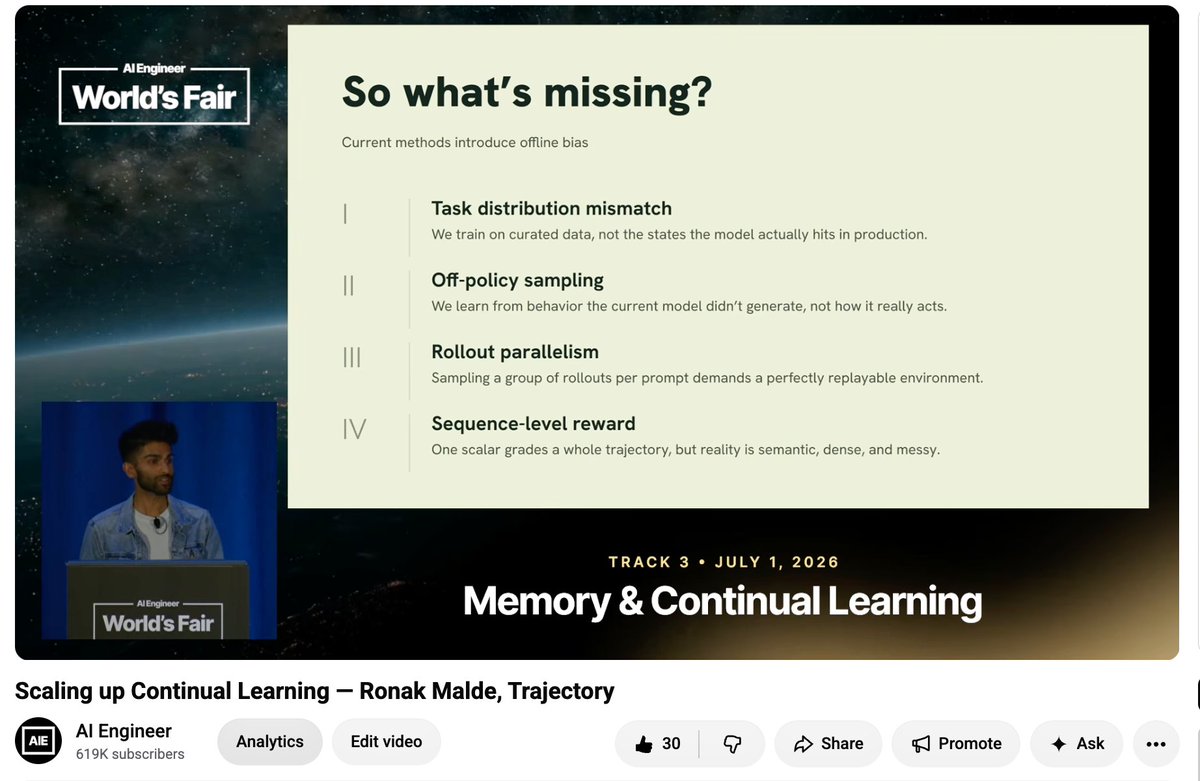
Watch Rronak’s continual-learning talk. Swyx’s hook is the practical post-training problem: why GRPO is insufficient for their setting, why they moved to on-policy data, and how they handle the issues that introduces.
Editorial take: The durable coding-agent edge is shifting from “which model types fastest?” to a controllable loop: route by measured task fit, constrain the application, and preserve a trace from conversation to edit to PR.
DeltaDB is a first-to-try version-control product whose landing page frames it around work between commits: the heading 'Software is made between commits' and "a version control system that records the work as it unfolds and keeps every change connected to the conversation that shaped it" .
- Ordered edit deltas: the page never uses 'delta' or 'ordered'. Its closest claim is that DeltaDB "captures every operation in between commits and gives each one a stable identity, so you can point to the code at any moment in its evolution" ; no ordering rules, operation granularity, or representation are described.
- Conversation linkage: "Every change is linked to the agent conversation that produced it. From any line of code, find the conversation. From any message, jump to the code it touched."
- Workflow claims: virtualized worktree makes new agent branches "effectively free", and any point in history is a valid branch point, including mid-run ; a teammate can join while the work is still happening, talk to the agent that did the work, and annotate as they go, without waiting for commit and push first .
- Unclaimed: the page contains no specification of ordering semantics, operation format, stable-identity mechanism, durability, merge/concurrency, scale/performance, git interop, security/auth, pricing, or launch timeline; the only availability signal is "Be among the first to try" . This absence is by inspection of the full page .
Direct answer. This is a follow-up post, not the full benchmark report: it links methodology.md but does not reproduce it, so task definitions and the full methodology must be read from the link and the public runs . What is stated in the bundle: all models were run at their provider’s default effort level ; each model has 63 attempts, but they are three attempts per task, so scores should be read as 21 observations with ±5 points of noise, not 63 independent trials ; the app is minimal and exercises none of Solid stack, multiple databases, or sharding ; scoring is hidden-test based, with per-run trajectory.json, agent.patch, checks.json, verifier.log, and result.json (reward, steps, tokens, cost, wall clock) now public . The only task examples given are an open-redirect fix, which Gemini 3.7 Flash refused based on the bug report wording, and a pentest-style audit that previously spooked Claude Fable 5 .
Published accuracy standings. Claude Opus 5 leads at 58/63; Kimi K3 (open weights) and Claude Fable 5 are one run behind . Newcomers: Grok 4.6 completed 52/63, just behind GPT-5.6 Sol, with 33% Rails API recall tying Fable 5 for second behind Opus 5’s 35%, at $49 ; GLM 5.3 scored 50/63, eight runs ahead of GLM 5.2, with no dollar figure (coding-plan subscription only) ; Claude Opus 4.8 scored 50/63, eight runs below Opus 5 ; Gemini 3.7 Flash scored 45/63 . The post’s score-card image (text metadata in the alt text) lists: Opus 5 92%, Kimi K3 and Fable 5 90%, GPT-5.6 Sol 84%, Grok 4.6 83%, GLM 5.3 and Opus 4.8 79%, Muse Spark 1.2 76%, GPT-5.6 Luna 73%, Gemini 3.7 Flash 71%, GLM 5.2 67%, DeepSeek V4 Flash 65% .
Cost and speed. Grok 4.6 cost $49 and Gemini 3.7 Flash cost $17.85; no other dollar figures are in the post . It gives no speed table or average wall-clock; per-run wall-clock is available in the public result.json.
Behavior and routing signals. GLM 5.3 re-runs the suite ~20× per run versus 3–6× for most models ; GPT-5.6 Sol writes tests first more than twice as often as after (unprompted TDD) ; Gemini 3.7 Flash had the leanest diffs, longest post-edit checking, no app-code comments, and all 112 comment lines in tests ; Claude Opus 5 has the wordiest diffs (1.65× task median) and is the heaviest app-code commenter . The post says these habits are traits, not tactics, and none predict solve rate . On failures, Claude Fable 5 usually failed outside the right files (only a quarter of failed runs touched the fix files), while GPT-5.6 models found the right files and fixed them incorrectly ~80% of the time; this is called a hint, not a rule, and would change how each family’s output is reviewed if it holds . The post draws no explicit routing recommendation; these facts plus Gemini’s refusal are the routing-relevant material .
Caveats and gaps. Trajectories record whatever models looked at; Muse Spark 1.2 ran env, leaked an OpenRouter API key, all keys were redacted, and the post advises assuming any sandbox secret will eventually appear in a trajectory . Error reports and corrections are invited . The post counts 756 scored runs and separately says 792 runs from both rounds are public, without reconciling the difference . Full methodology, per-task grid, and most costs are external, not in this bundle .
Origin is launching in early beta today on all paid plans (excluding enterprise orgs whose admins opt out), starting with repos, pull requests, code browsing, and GitHub sync, with agent-native features described as coming soon.
Code hosting
- Hosted repositories appear in a new Codebase tab; creating a repo via +New surfaces CLI install instructions and clone/push commands, and pushing hosts the code on Origin.
-
The first repo's name becomes the codebase name in every repo URL, e.g.
cursor.com/codebase/acme-corp. - GitHub repos can sit alongside hosted ones: after connecting GitHub and picking an org, you can select repos to sync, choose what syncs, and disconnect at any time; anyone with read/write access to a synced repo can view it in Cursor.
- Synced repos update in real time; pushes continue to GitHub, which remains the source of truth for repos started there, and icons distinguish Cursor-hosted vs GitHub-sourced repos.
Pull requests
- Every repo has PRs showing timeline, commits, checks, and files changed, with diff review, comments, and merge.
- PRs on synced repos sync both ways: comments made in Cursor post to GitHub, and GitHub reactions/replies appear in Cursor within seconds; GitHub-assigned reviews can be handled from Cursor.
Agent workflow
- Agents are integrated in every repo: ask Cursor about code being browsed and it can answer, make changes, update PRs, or push a branch from the same surface as code/PRs.
Integrations
- Vercel, Depot, and Buildkite integrations are already available, with more coming.
- Vercel (connected from the repo's Apps tab) gives every PR a preview deployment for testing and comments, and merge ships to production; for CI, Depot or Buildkite both run existing GitHub Actions workflows, and Buildkite also runs its native pipelines.
Settings and migration
- Repo settings expose GitHub sync status, access management, and connected apps.
- Migration is via sync/push rather than cutover: GitHub remains the source of truth for synced repos, which can be disconnected at any time; local projects can be pushed to Origin via the CLI.
Rollout notes and limitations
- The beta is on all paid plans except enterprise orgs whose admins opt out.
- The announced scope is "the essentials... designed for agent scale"; "agent-native features ship soon," so agent-native capabilities are not part of this initial beta release.
- The source gives no timeline for agent-native features or for the end of early beta (gap note).

At @aiDotEngineer's World Fair, Trajectory (@trajectorylabs) published a talk arguing that improving LLMs from real-world use requires redesigning post-training for non-verifiable, per-token rewards, and shared insights on scaling algorithms like SDPO for continual learning . Swyx, reporting firsthand from the Continual Learning track, says Trajectory's @rronak gave a "very thoughtful overview" of the main data problems left in continual learning — why GRPO isn't enough, the move to on-policy data collection, and fixing the issues that subsequently surfaced — and calls them "one of the early leaders in this field" with generally impressive execution ; the rest of the track was "quite stacked" . Recordings: Trajectory's talk video and rronak's YouTube overview at https://www.youtube.com/watch?v=zL1kLftVTlo. Both are firsthand: Swyx attended the talk; Trajectory authored its own announcement.

- @GavinSBaker says the @bot (Grok Bot) is another "Claude Code" moment; his personal AI usage is up ~100x, and he built a "podcast summarizer" in ~15 seconds in Grok Bot, better than his previous version .
- Mckay Wrigley (TakeoffAI/AgentShare) pushes back: "agent in the cloud with a computer" is the obviously correct direction, but the iMessage-style interface pattern everyone is using is the wrong direction for work tools . For a genuine Claude Code moment, SpaceX/Cursor should keep Grok Bot's good parts, adapt it for enterprises, and make Grok a strong model — "a big part of the claude code moment was the model itself and not just the terminal harness"; he's watching Grok 4.7, dismisses "pareto dominant" claims ("people did this with gemini for like a year") because "usage is everything" . With Cursor's team, SpaceX has all the pieces; it's a legit third contender .
- Wrigley is "HARD under" on Grok Bot being adopted by companies at scale in its current form; it needs to be more of a work tool and the interface decision is wrong, but he invites correction in a year .
- @altryne says he used @bot as a work tool today — cleared his inbox, reviewed documents, triaged Slack — saw no model-intelligence issues, and thinks this interface is exactly what non-engineers inside companies need .
- Wrigley's counter: lacking individual chats/tasks/issues/threads is "a legit insane decision"; the product has core pieces but is "shaped wrong in obvious ways" . He also calls "openclaw for normal people" a "very x/tech/sf bubble view" .

Firsthand from @leerob on Grok bot's design decisions:
- Text-first UI: "the best UI is none at all" — dramatically simpler than alternatives and built for current frontier-model capabilities, with UI restrained enough to stay easy as models improve .
- Thin client, thick server: the app harness is essentially one tool for client-server messaging; the coding-agent harness with specialized tools lives server-side, keeping the UI fast .
- Always-on computer per bot: rather than fresh VMs per conversation, bots connect to their own cloud-only computer with a persistent filesystem — the same pattern as using Tailscale from a phone to run an agent TUI remotely, without the hassle .
- Browsers + code: ask for a task in natural language and the agent writes a script; for steps requiring login/clicking, bots use a browser, and you can ask Grok Bot to record you doing the task and turn it into something repeatable . @kentcdodds: "they're making the right bets here. I just want an Android app!" Thread: https://x.com/leerob/status/2089169319099777364
@swyx, drawing on firsthand use, describes a pattern to escape the "larger models" tradeoff: periodically use larger models to make deterministic "compound tools" out of more primitive tools, so that smaller models cannot screw them up. He ties it to @erikdunteman's "muscle memory" idea — sequences you do more often should be within closer reach.
In the parent thread, @_jasonwei argues the "1B cognitive core + tools" hypothesis is wrong: doing tasks quickly and naturally without tool use matters because of speed, reliability (re-looking-up facts and redoing derivations compounds mistakes over long-horizon tasks), and aggregate knowledge (better than top web-search results). Parametric knowledge has an information limit, so even 1T parameters probably won't be enough; "bitter lesson strikes again."
Origin, Cursor/Graphite's TomasReimers-announced code hosting platform and long-awaited Git competitor for Cursor, is now live. It is scalable for agent workloads, extensible via API and MCP, and includes built-in merge conflict handling plus an agent-based failure-resolution feature (source text: 'co failure agent resolution') . Official Cursor announcement confirms Origin is live, fast, easy to use, deeply integrated with Cursor, and can be started by syncing repos from GitHub . Swyx also posted that Origin is live, linking the official announcement .

- Firsthand from @poteto (Lauren, core contributor to React Compiler, quoted by Theo ): Cursor has largely completed migrating from Solid to React — the new agents window is 99% React, with a few stragglers left — and both Cursor and @bot converted all SCSS/Tailwind to StyleX. The motivation was perf and maintainability: signal-based reactivity caused too much accidental fan-out in large, complex apps .
- Agents were bad at writing Solid; everything ended up accidentally tracked, causing perf problems, and non-React frameworks that look like React create an 'uncanny valley' that confuses agents. 'In the age of agents, choosing what pitfalls you're okay with is an important decision.'
- React Compiler solves most over-rendering perf problems; remaining cases need manual memoization/refactoring/composition, which an agent can easily do .
- Their agent-friendly React desktop framework Dune bans useEffect outright and exposes it only through framework-provided hooks (comparing useEffect to an unsafe block in Rust). The author recommends setting up similar guardrails in your own app .
- Full thread: https://x.com/poteto/status/2089227731305464150

Claude Code (@ClaudeDevs) introduced a new /design skill (research preview) that brings Claude Design's artboard workflow into the CLI and Desktop, built on artifacts . Workflow: run /design to get editable artboards for your UI, pick one, tweak it, then have Claude implement it . @bcherny amplified the announcement with "Let us know what you think!" and a link to the thread (https://x.com/claudedevs/status/2089471692762673408) — the feature details are secondhand from the official post, not firsthand usage.
Theo and Viticci compare iOS remote-control coding agents (August 2026).
- Viticci (firsthand, coordinates dozens of agent threads from iOS daily) reports Codex Remote for iOS is, as far as he knows, the only remote agent feature with full start-from-iOS flow, near desktop parity, and voice mode; Claude's and Cursor's remote features require starting from a Mac . Voice mode can dispatch to individual threads, load desktop context/plugins/skills, and reopen threads on-screen .
- Replicable workflow: wearing AirPods and speaking to Codex Remote on his iPhone, Viticci was guided through setting up a Tahoe Mac mini — Codex operated a connected Fingerbot and gave cable-connection instructions for a Comet Remote KVM . He wishes for Home Screen widgets, iOS framework (Reminders/Calendar) integrations, and Files app mount support .
- Alternative: T3 Code on iOS (by Theo's team) — smooth T3 Connect onboarding, multi-harness, but no voice mode . Theo (T3 Code's creator) counters that T3 Code goes beyond Codex with project creation, multi-PC management, remote configuration, and open source, while still conceding Codex leads other labs .
Kent C. Dodds announced he is relaunching kody.video (https://kody.video) on Product Hunt and preparing to launch another Kody-branded product later that same week . His Product Hunt launch did not go live immediately — because Product Hunt doesn't let you trigger a launch right away, it was scheduled for the following day . Announced firsthand by Dodds on X; no features, capabilities, or technical details are given.
Kent C. Dodds (@kentcdodds) on the shifting economics of development: "Implementation is getting cheaper" and advises understanding one layer above and below your own work . He posted a video of his discussion on the topic and linked the full conversation with Ronan Berder on skills beyond the IDE: https://www.epicproduct.engineer/write-it-down-process-benchmarking-and-product-judgment-with-ronan-berder~cr3bf.
Kent C. Dodds says tons of his recent development work has happened on his phone, sharing a post from Jared Palmer on cloud agents ; in a reply he adds 'Probably more than half to be honest' about how much of that work was done on his phone . Palmer reports being 'extremely cloud agent-pilled': he hasn't set up his laptop for local development since joining Cognition, and says working with Devin in Slack (with coworkers) and the webapp with the latest models is 'better in every possible way so far, even for frontend work' . Both are firsthand practitioner accounts crediting cloud-based coding agents for real work, including frontend development, which is often considered a weak spot for agents.
Claude Code CLI now uses 2x less CPU at p99, per the official @ClaudeDevs account: Bun's garbage collector previously ran on a fixed timer, kicking in mid-turn and stealing CPU right when Claude Code was busiest; it now waits until the process is idle . Boris Cherny (@bcherny) amplified the announcement — "Small quality of life improvements like this add up. More on the way" — linking the original thread: https://x.com/claudedevs/status/2089509659090780193. Firsthand reporting from the Claude Code team.

- Rails' official "Agents on Rails" benchmark (as of Aug 17, 2026) added Grok 4.6, GLM 5.3, Gemini 3.7 Flash, and Claude Opus 4.8 — none reached the top of the leaderboard .
- Current standings: Claude Opus 5 is most accurate (92% of runs, 58/63; Kimi close second for less cost), GPT-5.6 Luna is cheapest and fastest (median 3.3 min/task), and GPT-5.6 Sol is the best all-around combination; GLM 5.3 costs are unknown since it requires a subscription .
- Full traces of the first two rounds (every command, diff, and verdict) are shared on GitHub; full report by Evil Martians: rubyonrails.org/2026/8/17/agents-on-rails-grok-4-6-glm-5-3-gemini-3-7-flash-and-opus-4-8.
- DHH commented that Grok has already caught up to GPT-Sol, Meta's Muse is close to Luna, and Kimi showed well .

Jason Zhou, founder of Treg, announced Treg as an open-source "OpenRouter for tools" — a marketplace of 2,600 agent-friendly tools (SEO/geo, social, leads, ads) where agents search by task, see price/request/response, and call directly, paying per call with 0% markup and no subscriptions . Treg is live at https://treg.superdesign.dev/. The pitch contrasts "old world" SaaS bundles priced for humans ($139/mo) with the "new world" where "agents don't care about vendors" and want the best API per task, paying for the result . Treg launched on Product Hunt, with Zhou requesting upvotes and linking back to the announcement .

Cursor's official account launched Origin, its code hosting platform — now live, with beta rollout starting today — positioned as fast, easy to use, and deeply integrated with Cursor; users get started by syncing repos from GitHub . Origin launches with top GitHub integrations already available: Vercel, Buildkite, and Depot, with more coming . Changelog: https://cursor.com/changelog/origin-code-hosting. This is a first-party product announcement, not independent hands-on reporting.
Omarchy, DHH's coding agent, now has a community plugin repository with well over 300 plugins, curated by @hancore_linux; plugin submissions are open again at omarchyplugins.com. Security guidance from DHH: for now, treat Omarchy plugin code like any third-party package — an npm package, RubyGems gem, or AUR package (i.e., not inherently trusted) — until automated security reviews and versioning ship, which are planned .
Kent C. Dodds (@kentcdodds) released a new Kody Koala package for interacting with Cursor Origin through the API 🔥 kody.codes/@kentcdodds/origin.