We can't find the internet
Attempting to reconnect
Something went wrong!
Hang in there while we get back on track


Particle bets on cheaper intelligence per task
Suhail launched a new company, Particle. Its first model, particle-1, is the start of a developer-focused series. The company says it matches performance while using about 45% fewer tokens . It is post-trained on DeepSeek V4.1 Flash 1017. The stated long-term goal is "continuous post-training," meaning model improvements that ship as fast as software . OpenRouter relays Particle's claim of 28–52% fewer output tokens than the DeepSeek base across four coding benchmarks . Garry Tan says Particle will be at the frontier for the lowest dollar per unit of intelligence .
The underlying problem is cost per task, not price per token. Two Minute Papers says the new DeepSeek 4.1 Flash 1017 builds much better working software and costs just over $1 per million output tokens. In the host's own tests, though, it took two to three times as many tokens as Claude Opus to finish the same task . Particle's pitch targets exactly that gap: open weights with better token efficiency.
Other model signals from the period:
- Gemini 4 Carbon. Demis Hassabis calls it "SOTA across key benchmarks" but published no figures .
- ViBench 2.0. Replit's new benchmark has agents build a whole product from an empty project, one feature at a time. Even GPT-6.1 Sol, GPT-6 Astra and Opus 5.5 passed every check in only 49–65% of builds . Long-horizon autonomous building still has a lot of room to improve.
- OpenAI and Google TPUs. Reuters, citing The Information, reports that OpenAI plans to buy Google TPUs. No terms were disclosed and neither company commented .
- Cartesia H-Nets. Albert Gu reports that a new version of these byte-level models shows up to 3–5x efficiency gains in controlled scaling-law experiments. At larger scale it matches an open-source model trained on 11T tokens using about 10x less data and compute .
AI security: budgets are rising, but incumbents get the first call
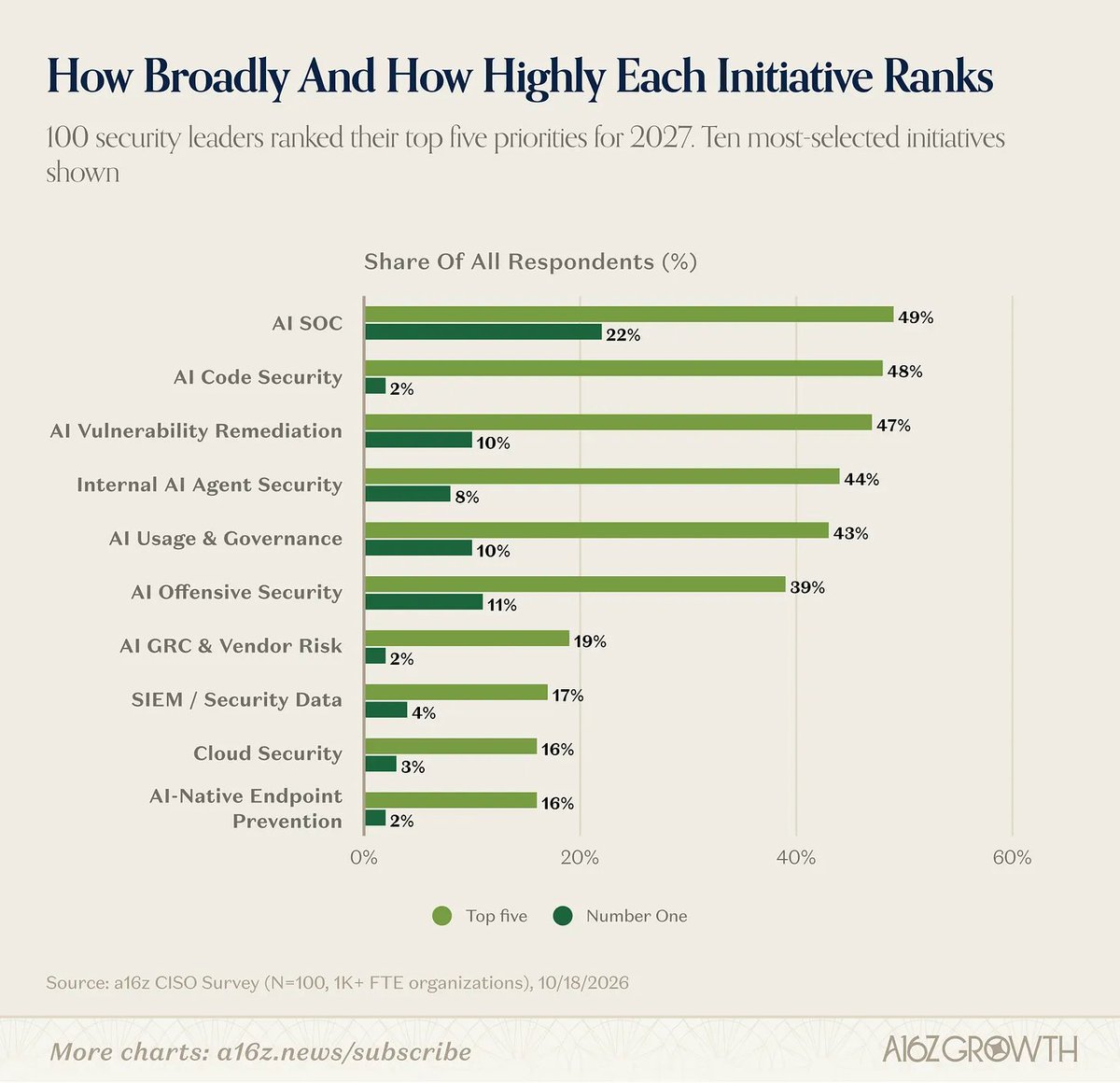
a16z surveyed 100 CISOs at companies with 1,000+ employees. 87% expect security spending to rise, driven mainly by AI-enabled threats and by their own AI deployments . All seven of the most-selected 2027 initiatives involve AI . Production use is still low: 18% run AI SOC tools in production, and 13% run AI offensive security or AI vulnerability remediation. Within 12 months, 45% plan to buy or upgrade internal AI-agent security, 42% offensive security, and 38% AI governance .
The go-to-market picture is less favorable for startups:
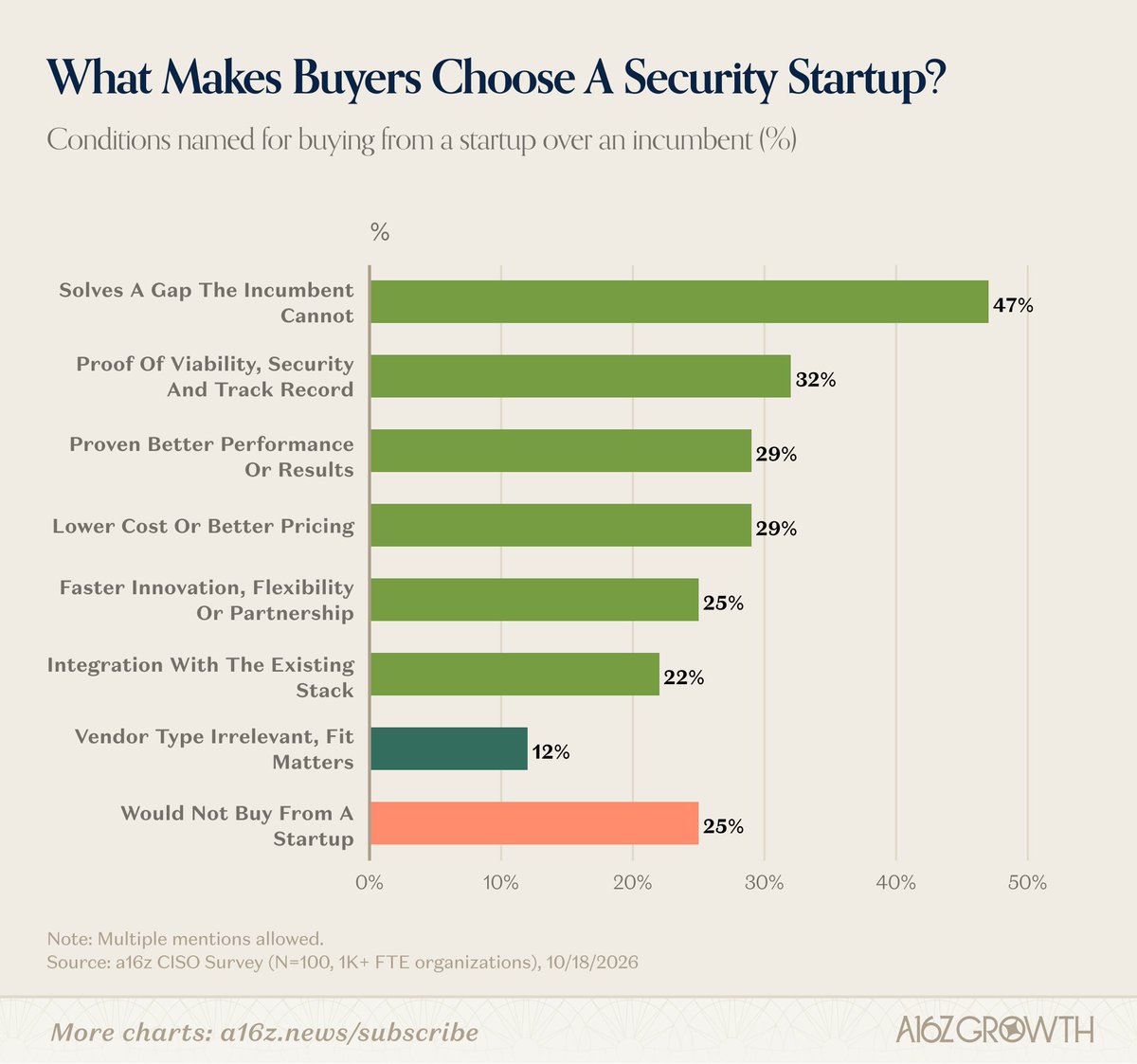
- 44% would first look for AI security features from their existing platform; 21% would start with an AI-native vendor. 47% say a capability gap their incumbent can't fill would lead them to pick a startup .
- Some categories have as many as 43 vendors .
- a16z discloses that it led Armadin's Series B. Armadin uses autonomous agents to find exploitable paths through enterprise systems .
Attack capability is the reason for the urgency. In a simulated 32-step network attack, GPT-4o stalled at step 2. Today's top models got about three-quarters of the way through on average, and the best runs completed all 32 steps . Wiz's CTO said the company's Atlas harness, which combines DeepMind, OpenAI and Anthropic models, made its PHP remote-code-execution finding possible. He described the flaw as affecting 12 years of PHP deployments in default configurations . He said most monitored workloads were still unpatched . He told startups to plan for critical vulnerabilities arriving monthly or even weekly, and to build automated patching and infrastructure-as-code while they are still small .
Rounds and launches
- Foundry Robotics raised a $100M Series A led by Marlinspike, with Khosla continuing. It is building a 130,000 sq ft factory in Emeryville and says it already ships to paying customers in energy, telecom, autonomous vehicles and defense .
- Broccoli (YC W22) raised $52M across its Series A and B for AI phone agents that serve plumbing, HVAC and electrical contractors. It has 1,500+ businesses on the platform and has booked 2.5M appointments. The founders knocked on 140 contractor doors, and the plumbing owner who first gave them time is now COO .
- Fragment launched with $56M: a Series A led by 8VC, plus a seed co-led by General Catalyst and A* . It resolves supply-chain exceptions, starting with direct procurement .
- Formation Bio launched a $600M fund to acquire drugs and move them through the clinic, pairing the capital with its AI platform .
- Diode, a PCB design-and-manufacturing company whose Series A a16z led, hired an a16z investor as president .
- Bunkerhill, which builds agents for health systems, says it has grown 12x annualized since January and closed eight figures of ARR in one week .
- FluxCap (YC P26), founded by former DOJ antitrust chiefs, came out of stealth building "Deep Legal Tech" .
Operating data from scaled vertical and defense companies
Hippocratic AI has about 300 employees, has raised about $450M, and launched its product only about 21 months ago. It reports 290M patient interactions and counts five of the top seven payers among its customers . The CEO says it charges about $9–10/hour. Running the same 31-model stack on closed models would cost about $105/hour in compute alone, which is why it uses open weights . Most of its traction comes from "infinite pilot" work, meaning care nobody offered before. In one example, calls to 1,700 patients lost to follow-up led 180 to complete CT scans, which found three cancers .
Stark, a European defense company backed by Sequoia, won billions in contracts within 18 months . It grew from zero to 700 people in two years and plans to invest about €600M in R&D and production capacity over 12–36 months . The founders say European procurement has gone from years to months, and they expect that change to last .
Pressure on incumbent software
SaaStr, citing the WSJ, says about $300B in risky PE-backed loans come due in 2028–29, and roughly a third of that is software . Software loans fell from about 95 to about 85 cents on the dollar after new Anthropic and OpenAI models came out, while other loans held near 96 . Elizabeth Yin argues customers will no longer pay $25,000 for a CRM they can rebuild themselves . She says Hustle Fund runs about 90% of its operations on agents . In her view the lasting value moves to support: maintenance, security and uptime .
Orbital compute
Cowboy Space, led by Robinhood cofounder Baiju Bhatt and backed by Index, unveiled a rocket built to carry five racks of NVIDIA Vera Rubin GPUs into orbit. Its stated aim is space compute that costs the same as compute on the ground . Starcloud, a competitor backed by Benchmark, is valued at $2.3B .

- Cost Plus Drugs grew from 111 generic medicines at launch in 2022 to roughly 4,000 SKUs; its discount card supports local pickup at 17,000 affiliated pharmacies, while its hospital-and-clinic marketplace sells sterile injectables at “cost plus 10 or 12” and claims millions in annual savings, though hospital purchasing teams remain a conversion hurdle. Cuban says incumbents use Cost Plus’s public prices in pricing discussions; one company reportedly was told it was in a large carrier’s network despite having no agreement.
- The company says AI and robotics let its Dallas facility produce drugs in 5,000 square feet and switch production to another drug every four hours; its roughly $20 million, trailer-sized manufacturing pods are configurable for different drugs, and the government was its first customer, with the first pod shipped and a second ordered. Cuban targets hundreds of pods annually within two years and thousands within five, but cited $365,000 plus fees for each generic-drug application as a barrier to scaling U.S. production.
- Cuban’s proposed direct-contract model would trust physicians absent exceptional cases, pay providers on time, assume patients’ out-of-pocket credit risk, and publish employer-provider contracts as reusable templates in return for better prices. The hosts said AI could help startups build full-stack health-plan offerings more quickly; Cuban argued its clearest near-term healthcare value is reviewing employer contracts before signature, since AI cannot undo unfavorable terms after signing. He urges employers to use AI to review existing benefits contracts and argues this could save millions for companies with more than 1,500 members.
- Cuban suggested a startup that uses agents to help patients find and use nonprofit hospitals’ financial-assistance programs; he cited his estimate that 40% of people cannot afford a $400 emergency bill and said some programs may cover families earning up to 600% of the federal poverty level.
- As a longer-term thesis, Cuban predicts that improved models and algorithms could drive the cost of DNA-informed personalized drug design toward zero, starting with over-the-counter medicines; he suggests subscription bundling and pod-based production, while acknowledging initially high costs and DNA privacy concerns. He does not expect personalized medicine to eliminate doctors, arguing clinicians will still be needed for human context and to interpret novel individual data.

- Hypocratic AI builds clinical voice agents for health systems, payers and pharma. At the interview, it reported about 300 employees, $450 million raised, 290 million patient interactions, and customers including five of the top seven payers and seven of the top 20 pharma companies; its product had launched about 21 months earlier.
- The founder says nearly all the company’s success has come from “infinite pilot” use cases—care that was not offered before AI made clinician capacity affordable. In one example, agents contacted 1,700 patients lost to follow-up after prior outreach; 252 scheduled CT scans, 180 completed them, and the scans produced nine significant findings, including three cancers. The founder estimated $1,700 in costs may have generated $2–3 million in revenue.
- Hypocratic delayed launch for 18 months and scoped agents to registered-nurse work, excluding diagnosis, prescribing, children under two, high-risk pregnancies and mental health. The founder says it ships only after output testing shows the system is safer than a human nurse; the process uses 7,000 U.S.-licensed nurses, tests each new model and use case, and had cost $40 million.
- The company says healthcare voice agents need both clinical intelligence and roughly 500-millisecond latency, prompting investment in a custom latency stack. Its 31-model product uses open-weight models that have been fine-tuned and reinforcement-trained; the founder estimates equivalent private models would cost about $105 per hour in COGS versus a product charge of roughly $9–10 per hour.
- The founder’s startup advice is to ride major technology shifts, build deep technology and a technically strong team, and assemble enough cofounders to reach the first milestone without hiring risk—even if that means sharing more equity—rather than optimizing for founder ownership. He also cautions that passion alone can lead to a poor business.

- AlphaFold’s database contains 250 million predicted protein structures and is used by more than 4 million researchers. Isomorphic Labs is building beyond protein-structure prediction toward AI-driven drug discovery, but Hassabis says the effort is still preclinical; its goal is to shorten a process that often takes years or about a decade to months or weeks, not a reported result yet.
- Hassabis sees AI systems that combine learned models with search as particularly suited to maths and coding, where answers can be quickly verified and generated synthetic data can feed later training. He says real-world experiments slow progress in natural sciences: one system proposed 200,000 new materials, but only a tiny fraction had been tested; he points to automated labs and simulations as possible ways to ease the bottleneck.
- His vision for the next decade is a hybrid AI stack: general multimodal models handle tasks such as reading literature and proposing hypotheses, then call specialized models such as AlphaFold or AlphaGenome for domain-specific predictions.
- Hassabis says current systems are not AGI, citing inconsistent performance and a lack of true invention; he expects the ability to generate new theories may emerge in two to four years, after a small number of breakthroughs. He also calls for a body to rigorously test frontier AI before public deployment and for international cooperation, with debate on the standards body ongoing.

- PHP exposure and patch lag: Schwarz said patches addressed two critical PHP bugs that could enable unauthenticated remote takeover on externally facing servers, including those using default configurations; he described the affected PHP deployments as spanning 12 years and the web impact as roughly 70%. At the time of the interview, he said a majority of monitored workloads remained unpatched.
- Disclosure bottleneck: A leak led researchers to accelerate the planned coordinated release; some downstream distributions were not ready, and some organizations shut websites while concerned attackers could reverse-engineer released patches.
- AI-assisted security research: Whiz CTO Tor Schwarz said its Atlas harness combines frontier-model capabilities from DeepMind, OpenAI, and Anthropic to explore attack paths; he argued AI enabled the PHP finding while researchers still direct experiments and select promising results, including testing many ideas over a weekend that could take months to pursue manually. He said open-weight models had been effective in past experiments, but the current harness used none and the model mix changes rapidly.
- Startup implications: Schwarz urged new companies to prepare for a possible cadence of critical vulnerabilities arriving monthly or weekly by designing for automated patching, infrastructure-as-code, and continuous deployment—changes he said are easier to make while a company is small. He recommended early in-house security expertise when trust or sensitive personal data is central to the business. He also said AI is changing cybersecurity and underlying IT, leaving the product blueprint unsettled; he advised existing cybersecurity startups to reinvent themselves and new entrants to build around those changes. Schwarz identified prior CTO/cofounder roles at Daz, acquired by Whiz, and Armis, acquired by ServiceNow.

- Andrew Ng argues AI-native teams gain execution speed rather than merely cut costs, and should be redesigned around new bottlenecks: as coding accelerates, deciding what to build becomes the constraint. He suggests roughly one-third of executives being AI-native as a starting point; feedback loops should shift from fast, informal checks at the earliest stage to surveys, A/B tests, and more rigorous evaluations as products mature.
- Ng says data cleaning remains a bottleneck and a shared company data layer can let agents support business decisions; in his experience, about a quarter of agent analyses of Redshift data produced bizarrely wrong conclusions and still needed steering.
- Early-stage founder examples: VocalBridge’s co-founder described a three-person team using dedicated Mac minis with engineer-level access for agents, while he handled specs and feedback from his phone. Ridekick’s founder said production errors trigger a coding-agent session to diagnose and resolve them, and that its internal tools have both human interfaces and CLI/MCP access for agents.
- IrisGo’s co-founder described its knowledge-worker workflow-mining and automation product as shipping through PC OEM partnerships with Acer, Asus, HP, and Dell, with claimed reach to billions of computers.

- Stark, a European defense “neoprime,” says it runs 10–15 programs; its current offering is a relatively inexpensive, software- and AI-driven strike munition, while its broader work includes autonomous maritime and aerial systems, electronic warfare, and software.
- The founders’ execution model combines in-house product development funded with venture capital (crediting Sequoia and others), close iteration with soldiers in Ukraine and European forces, and designing for certification and mass manufacturing rather than a few bespoke systems.
- The interviewers cite billions of dollars in contracts within 18 months; the founder calls this a success while also pointing to a favorable market moment. Stark’s founders say European procurement and certification have compressed from years to months as defense needs meet lower-cost, software- and AI-driven systems, and they believe the change will last.
- Stark was described in the interview as growing from zero to 700 people in two years; its founders said they intend to invest about €600 million over the next 12–36 months in R&D and production capacity.
- Stark says its autonomy stack follows NATO responsible-use principles, with audits and hard-coded safeguards; depending on customer configuration, a system may wait for operator confirmation before engaging a target.

- Kato Networks, founded in 2015, is described as having 4,800 customers and more than $400 million in ARR. Kramer says its converged network-and-security cloud spans more than 100 locations and provides compute for AI-security workloads and agent control.
- The interview describes vulnerability-response windows as shrinking from months to probably minutes; Kramer says agentic threats increase attack scale and velocity, while enterprise GenAI creates a new attack surface. Kato says its agentic defenses can protect the entire install base against a new vulnerability in 45 minutes, without customer work or false positives.
- Kramer's Kato thesis targeted fragmented security stacks—reportedly 60–70 products per CISO—and appliance-based architectures ill-suited to a digital world where location is abstracted. His founder-investor lesson is to pursue fertile problem spaces before outcomes are clear and sustain a contrarian approach long enough to build value.
- Kato acquired AIM for platform alignment and faster time to market, citing three years of development brought by the acquisition; Kramer said a platform should be built, not bought.
- AI Fund’s head of talent says automated mass applications, fake candidates and recruiter spam have flooded recruiting channels; he considers inbound a poor channel for many non-brand-name employers and recommends deliberate outbound based on explicit role criteria and verifiable evidence—such as hackathon results, authored papers or shipped production systems—rather than pedigree alone. Exa can filter candidate lists against such criteria and link to evidence for its claims.
- Mike sees a near-term opportunity to hire top new graduates because competition for them is lower, despite reports of limited opportunities for graduates; he says senior hires still matter for experience handling production issues.
- With coding-agent use treated as a baseline, interviews can change constraints and probe whether candidates critique agent output and explain their decisions. The discussion characterized AI as more reliable on verifiable tasks than on judgment tasks, making reasoning and tradeoffs useful signals beyond a polished output.

Diode, founded by Davide Esnaghi and Lenny Khazan, is addressing slow, fragmented PCB design and manufacturing; the founders previously took hardware from prototype to hundreds of thousands of units and taped out a custom silicon chip. a16z led Diode’s Series A; the announcement says AI advances in hardware design are increasing the value of manufacturing as demand for electrical engineering grows across hardware companies. @zabie_e is joining as Diode’s president and will remain an a16z special advisor; Diode is hiring in New York and San Francisco.

Prometheus is described as a new company pursuing an “artificial general engineer”: one host’s understanding is that it would apply AI to engineering and building in the physical world, based on the view that LLMs can produce useful knowledge workers but not strong engineering capability. The hosts frame it as a potentially Amazon-scale AI opportunity, while acknowledging they are unsure whether the product would involve robotics, planning tools, or another approach.

- Greylock advises founders to pitch prospective go-to-market hires differently from engineers: lead with customer pain and discovery, demo and customer reception, deals closed, and design partners converting to customers; show traction achieved before hiring a seller, then explain the opportunity’s defensibility, potential market, stickiness, and flywheel.
- Hire for the company’s stage, not a candidate’s prestigious employer or ability to run an established playbook. In Greylock’s example, a seller who had built a major-account sales engine at Zscaler lacked experience in the commercial/SMB motion required by an incubated startup; the fit proved wrong, though the team used the period to improve discovery and positioning before finding the right leader.
- Assess what candidates have built, why they made career moves, and whether they can create outbound prospecting and close deals themselves; a short stint merits probing rather than automatic rejection, since it may reflect a poor environment or a deliberate bet on a new opportunity.

- Two Minute Papers describes a newly available DeepSeek system, identified in the video as “4.1 Flash 1017,” as substantially better at building working software and using a computer terminal; the host says API output costs just over $1 per million tokens, but their tests used two to three times as many tokens as Claude Opus for the same task, so cost per task is less favorable than the per-token comparison suggests, while remaining “quite good.”
- The video says the model weights are free to download but running the model requires expensive hardware, and presents distillation into smaller, cheaper models as a path toward eventual use on a powerful laptop—not a current capability.
- The host reports a major capability improvement about five weeks after the prior version despite no architecture change, and suggests self-feedback—models critiquing their own work—as a possible explanation; this is explicitly an inference from announcement language, not a confirmed mechanism, and the host notes that self-evaluation is difficult.

- In a survey of 100 CISOs at companies with more than 1,000 employees, 87% expected cybersecurity spending to rise, driven mainly by AI-enabled threats and the attack surface created by enterprise AI; nearly half expected security headcount to increase, while only 4% expected cuts. All seven of the most-selected 2027 security initiatives involved AI, but production use remained early: 18% for AI SOC tools and 13% for AI offensive security or exposure-and-vulnerability remediation. Within 12 months, planned purchases or upgrades were highest for internal AI-agent security (45%), offensive security (42%), and AI usage/governance (38%).
- Enterprise AI is already deployed at scale: respondents reported production use of employee generative AI tools (92%), coding assistants or agents (83%), MCP or agent-to-application integrations (55%), and autonomous agents with tool access or write permissions (34%). Top concerns included AI attacks outpacing security teams (55%), employee data leakage into AI tools (47%), and agents exceeding permissions or being compromised (46%).
- Incumbents have a distribution advantage: 44% of CISOs would first seek AI-security features from an existing security platform, versus 21% from an AI-native vendor. Startups can win by filling a capability gap the incumbent cannot address (47%); buyers often add them alongside existing platforms rather than replace them. Competition is crowded, with some AI-security categories containing as many as 43 vendors, and buyers weighing completed work, required follow-up, safe actions, and operating cost.
- a16z highlighted two portfolio bets in these areas: it led Armadin’s Series B for autonomous agents that find exploitable paths through enterprise systems and help close them, and invested in Neo, which tracks agents, extensions, and MCP servers on employee devices and enforces real-time policy.
- In an a16z survey of 100 CISOs at companies with more than 1,000 employees, 87% expect cybersecurity spending to increase in 2027, driven mainly by AI-enabled threats and the attack surface from their own AI deployments. Nearly half expect security headcount to grow and only 4% expect cuts. All seven most-selected 2027 security initiatives involve AI, but production use remains limited: 18% report AI SOC tools in production and 13% report AI offensive security or exposure/vulnerability remediation; 45% plan to buy or upgrade internal AI-agent security and 42% offensive security within 12 months.
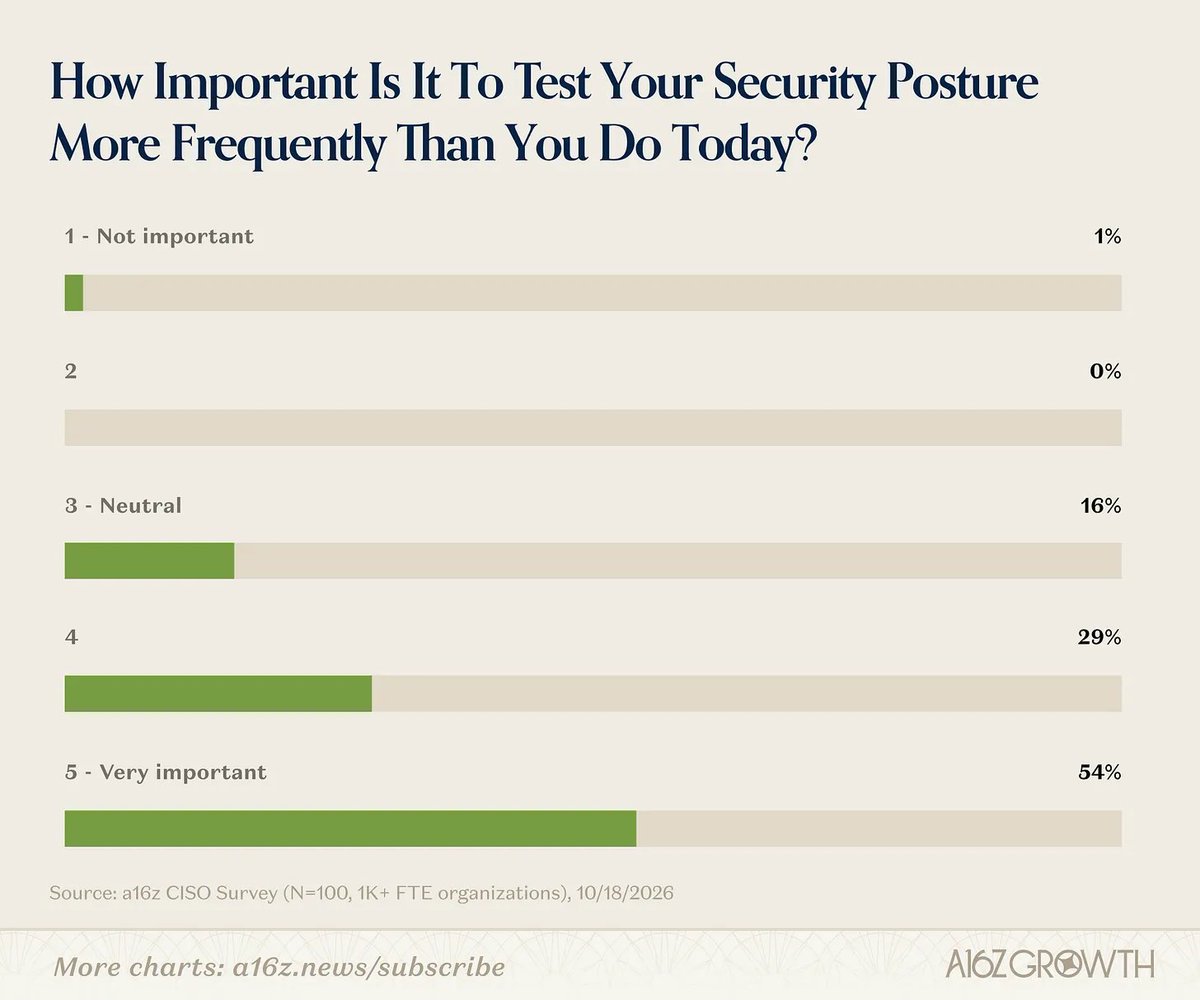
- Continuous offensive testing is a near-term use case: 18% say most of their offensive testing already runs continuously against production assets, and 52% expect that within a year; 70% want tools to retest and verify that vulnerabilities have been fixed.
- Startup GTM favors filling gaps alongside incumbents: 44% would first look to an existing security platform for AI security, versus 21% to an AI-native vendor, while 47% say an unmet capability gap could lead them to choose a startup. Competition is a caveat: some AI-security categories have as many as 43 vendors, and buyers report difficulty evaluating them all hands-on. a16z says it led Armadin’s Series B for agents that find exploitable paths through enterprise systems, and invested in Neo, whose endpoint security tracks agents, extensions, and MCP servers and enforces policy in real time.
- Mark Cuban’s AI-workforce thesis is that AI users displace workers who do not use AI . He says healthcare still needs entry-level hires and organizations need people who provide context, remain in the loop, understand consequences, and build implementation history as systems change .
- Cuban says Cost Plus Drugs grew from about 100 to roughly 4,000 generic drugs with a flat 15% markup, which he says pressured incumbents to change prices . He argues AI alone will not fix healthcare’s opaque prices and broken incentives .

Martin Casado linked a Databricks pitch to Snowflake, framing the companies as complementary and proposing that Snowflake source AI tokens through Databricks. The pitch offers access to cheap OSS and frontier models (listed as OAI/Ant/Gemini/Grok) through Unity Gateway, with smart routing, budgets, and access controls; it also says Omnigent works with any harness, including CoCo, and Genie can manage spend. The pitch claims customers cut token spend by about 30% over the last few months while token counts rose; this is a vendor-reported result, not independently substantiated in the post.
- In a simulated 32-step attack on a company network, GPT-4o stalled at step 2; today’s top models averaged roughly three-quarters completion even as they used up to 100M tokens, and the best attempts completed all 32 steps and took over the network.
- In a16z’s survey of 100 CISOs at companies with more than 1,000 employees, 87% expect cybersecurity spending to rise in 2027, primarily because of AI-enabled threats and the attack surface created by their AI deployments; all seven most-selected 2027 initiatives involve AI. Production use still lags: 18% report AI SOC tools in production and 13% report AI offensive security or AI exposure-and-vulnerability remediation in production, while 45% plan to buy or upgrade internal AI-agent security within 12 months.
- Buyer dynamics favor startup capability-gap wedges over broad incumbent replacement: 44% would first look to an existing security platform for AI capabilities versus 21% to an AI-native vendor, while 47% say an incumbent’s inability to solve a capability gap would lead them to choose a startup. Competition and evaluation are hurdles: some categories have as many as 43 vendors, and one CISO said it was not practical to run hands-on proofs of concept for all seven or eight vendors under consideration.
- a16z says it led Armadin’s Series B; the company uses autonomous agents to find exploitable paths through enterprise systems and help close them. a16z also says it invested in Neo, whose endpoint product tracks agents, extensions and MCP servers on employee devices, monitors their access and enforces policy in real time; its founders helped build SentinelOne.

Particle launched as a new company focused on developer models; its first model, particle-1, is claimed to match performance while using about 45% fewer tokens, and is live at particle.ai. Garry Tan says Particle aims to compete at the frontier on intelligence per dollar.

FluxCap (YC P26) came out of stealth; former DOJ antitrust chiefs are building “Deep Legal Tech” intended to let small teams take on difficult cases.
Broccoli (YC W22) raised $52 million across its Series A and Series B. Its AI agents answer calls around the clock for plumbing, HVAC, and electrical companies, book jobs into contractors’ existing scheduling software, and follow up on open estimates. More than 1,500 home-service businesses run on Broccoli; it has handled over 10 million customer conversations and booked 2.5 million appointments. After the founders’ EV startup stalled, Abhishek Jain and Aditya Ketkar knocked on 140 contractor doors, then built Broccoli’s first product in three weeks with a Sacramento plumbing owner who later became the company’s COO.