We can't find the internet
Attempting to reconnect
Something went wrong!
Hang in there while we get back on track


🔥 TOP SIGNAL
Agent Plugins makes the harness portable. OpenAI’s announcement describes an open standard built with AWS, Cursor, GitHub, VS Code, and Vercel that packages Agent Skills and MCP server configurations in a shared format; Romain Huet frames it as the portability step after AGENTS.md, Agent Skills, and .agents config. Cursor says it already supports bundling skills and MCP servers across agents. Build one small skill-plus-MCP bundle and test it in two clients now; interoperability is the hypothesis to validate, not a benefit to assume.
⚡ TRY THIS
Turn parallel threads into a dependency graph. Create one thread per independently testable task, have it ping back when finished, and preserve each thread’s work rather than collapsing everything into one context. swyx says this creates a workable kanban/waterfall graph in today’s coding agents; Theo’s inbox-style sidebar is the UI version of the same idea—he says it lets him keep 4+ threads active without losing context.
Choose the harness before writing the prompt. LangChain’s current rule is to start with
create_deep_agentwhen you want the bundled context machinery: filesystem-backed context, subagents, on-demand skills, and memory. Use the minimal LangChain loop plus middleware when you need fine-grained tool/context control or deterministic summarization and verification; move to LangGraph when the workflow needs a custom graph, durable execution, fault tolerance, or human-in-the-loop steps.Route models by task, then measure the routing. Cursor’s vendor-reported starting matrix is Grok 4.5 for routine work, GPT-5.6 Sol for planning and codebase comprehension, Opus 5 for execution-heavy tasks, and Fable 5 for debugging and visual implementation. Treat that as a policy to test against your own repository with latency, cost, and acceptance checks—not as an independent benchmark.
Run a product-shaped eval instead of another toy benchmark. swyx proposed giving developers $1,000 in tokens and one weekend to clone an enterprise SaaS his team might otherwise buy for more than $40,000 per year; the prospective customer evaluates the result, the winner gets $10,000, and the code is open-sourced. Borrow the format at smaller scale: pick a workflow your team actually cares about, cap tokens and time, and let the would-be user judge the build. This is a proposed eval format, not a demonstrated result.
📡 WHAT SHIPPED
Codex Security Review — research preview. OpenAI says it uses repository context to inspect GitHub pull requests for security issues and place actionable findings directly in the PR; automatic reviews are documented here: security review setup. Greg Brockman says Codex can now review every GitHub pull request and leave findings inline.
pi 0.84.0. Armin Ronacher’s agent tool adds fullscreen/alt-screen mode, LaTeX and Mermaid rendering in the transcript, improved Windows support, and
AGENTS.override.mdsupport. Full changelog.Cloudflare MCP v2. The rewritten MCP core is stateless and designed to run on web infrastructure such as Workers, with a new feature lifecycle and SDK migration path. Kent C. Dodds says Kody Koala is already updated to the latest spec, calling the change a major simplification.
Smol Forge opened its first 100-user alpha. swyx describes it as a fast, agent-native Git remote; the onboarding instruction is to point an agent at
forge.smol.ai/llms.txt. It is explicitly rough—transcript functionality is broken—so this is a hands-on watchlist item, not a production recommendation.Omarchy Quattro moved from alpha to beta. DHH reports a codebase 4× the size of the 3-series, including roughly 40K lines of Quickshell QML, while the overall system is a quarter of its former code, the ISO is 20% smaller, and installs are up to 40% faster. He calls it his most agent-accelerated codebase and credits frontier models with QML writing and Linux diagnosis; those are maintainer-reported figures, not an independent benchmark.
bb is picking up an adoption signal. Ben Tossell calls it “likely my new default.” Sawyer Hood’s project is an open-source, MIT-licensed orchestrator that works with Codex, Claude Code, Cursor, and ACP-compatible agents, while letting users ask the agent to extend the IDE itself. Repo.
CI reality check: Theo reported GitHub Actions had been down for five hours, with 85% of Actions webhooks not being processed; Armin Ronacher said a pi patch release was blocked because publishing depended on CI. Check provider status before debugging an agent loop that is waiting on PR webhooks or deployment signals.
🎬 GO DEEPER
- Video — Riley Brown: Guillermo Rauch on Vercel’s internal agent. The episode covers Vercel’s internal agent V, described as being used by almost 1,000 people, then gets concrete about building an agent: start with an
instructions.mdidentity, add atools/folder, connect a team channel, and keep writes behind existing permissions.
The follow-on segment is the part to copy: collect thumbs-up/down feedback, aggregate failures overnight, keep a human in the improvement loop, and encode behavior and accuracy as evals.
- Repo — bb. Study its extension model rather than just its UI: the launch post lists agent-built task management, 2D thread navigation, GitHub-webhook code review using Codex computer use, markdown editing, crons, inline previews, and remote access. It is a useful specimen of an orchestrator whose missing features become prompts.
Editorial take: The durable alpha edge is moving from clever prompts to portable capabilities, task-routed models, and measured control planes.

Vercel CEO Guillermo Rauch, speaking firsthand about Vercel's internal agent 'V', describes a single company-wide 'God agent' that routes to specialized sub-agents rather than a team of disconnected agents: V lives in Slack, is used by ~1,000 employees, has a content agent and a data-analysis agent ('Dzero') connected to the data warehouse, and can delegate to Codex, build prototypes with v0, and query Vercel production . The ideal UX is ambient (Star Trek computer / Jarvis); identity, access control, tools, guardrails, and audit trails are the core admin job .
EVE framework: Vercel productized what it learned into EVE ('the Next.js/React for agents') . An EVE agent is a folder with an
instructions.md'soul' file (borrowed from OpenClaw's SOL.md), plus tools, skills, sub-agents, and channels (Slack, WhatsApp, Telegram, Teams, iMessage) . It can run serverless and sleep when idle, with developer-defined tool access, human-in-the-loop approvals, and data-access controls .Build path: start from an instructions file with identity/values, add a
tools/folder (e.g., awordpress.tstool), connect to a chat channel, then scope permissions by role or delegate auth back to existing systems . V itself started as a single support assistant before growing skills and sub-agents .Improve agents the way you'd train a team: when the agent ships 'slop,' you edit its content-writing skill rather than scolding it; knowledge lives in skills/tools . EVE supports scheduled proactive runs (nightly social-media parsing + drafts, weekly Monday company metrics digest) — Rauch: 'most of the world still thinks about agents as something you prompt... automate even the prompting so the agent can be doing useful work for me while I'm not in the computer' . Agents should be event-driven too — subscribe to Stripe/email/Slack events via Vercel Connect (100+ systems) with developer-controlled access .
Evals: every Slack response has thumbs up/down; a nightly job aggregates negative feedback and proposes self-improvement, with humans in the loop; EVE ships evals as test cases, including personality evals — used to make V less verbose .
Model routing: for interactive Slack workhorses, pick speed/price (Groq for fast and highly accurate; Grok 4.5 or GLM for price-performance); for overnight analysis, use more reasoning or a 'consortium' of models (Kimi, Sol, Grok) and summarize their views; interactive = fast, async = accuracy . GLM 5.2 got a 4x-faster variant within days of launch on AI Gateway ; in Vercel's evals Kimi nearly hit Sol level on cybersecurity and clearly beat Opus 4.8, while Sol remains frontier .
Why model-agnostic: EVE/AI Gateway give access to every model so you keep ownership of data and skills and profit from competition; upcoming batch inference in AI Gateway is 'almost like a spot market for intelligence' (request tokens with no deadline, any provider can fulfill) .
Suggested first agent: deploy at eve.dev, connect it to your team's chat medium, pick one 'boring' toil task with a system, and write that skill; Vercel's changelog process now is one Slack thread where the agent refines engineer input into a benefit/cost/how-to-get-it formula .

Taalas HC1 launch (Feb 2026, per the Latent Space article): the 2.5-year-old startup announced a production API serving Llama 3.1 8B (launched July 2024) at 16,960 tokens/sec per user — swyx rounds to "17k tok/s" — plus non-speed gains (less build cost and power draw); HC2, due this winter, is slated to add standardized low-precision FP4 to resolve the quantization caveats . Announcement: https://taalas.com/the-path-to-ubiquitous-ai/
Strategy (swyx, firsthand — he hosted Martin Casado & Sarah Ding Wang on the Latent Space pod the day before ): this is a "huge capability overhang" AI Engineers should rush in to figure out — the "capability market fit" — even though the product form is still unknown ("we have no idea how to productize yet") . Catch: HC1 runs a model ~1.5 years behind the frontier, but he expects that gap to "converge to 0 in the next 2 years" as frontier-quality models reach >20k tok/s inference: "Build accordingly."
Casado's ASIC-per-model economics (firsthand quotes): a $1B training run only stays solvent if that model's inference spend exceeds $1B; a 20% inference saving (~$200M) already covers a ~$200M chip tape-out, and ASICs can plausibly save ~2x (typical MFU ~50), justifying custom silicon per model and fully integrated model-chip codesign, as foreshadowed by the OpenAI–Broadcom deal . Podcast: https://www.latent.space/p/a16z
Update (Aug 2026): swyx reports @taalas_inc was bought by AMD .
@waterloo_intern — a GPU kernel engineer by trade ("it is (was) my job") — went on @swyx's Latent Space pod two weeks ago, then doubled down in a follow-up thread, sarcastically apologizing for being right about everything . Key claim: GPU kernel optimization is "the single most RL-able task in existence" — the reward loop is check_correctness(kernel, shape) across shapes and, if all pass, time(kernel) — so an agent given the ncu CLI and an MCP server holding NVIDIA's "tribal knowledge" can do it, making human kernel dev "dead" . This is a prediction, not a tested workflow. Supporting theses: hand-fused megakernels — e.g., "a 67k loc hand-fused forward pass kernel" — are dead because launch-overhead and inter-kernel-overlap gains are marginal, NVIDIA's Rubin fixes straggler CTAs, and no serious inference provider runs them in production ; and since agents don't share humans' aversion to AMD/ROCm (warp = 64 threads), NVIDIA's software moat erodes — the moat becomes HBM capacity/bandwidth plus perf/price, where AMD is "goated" .
swyx counters with explicit short-term datapoints, noting these aren't refutations of waterloo_intern's long-term calls — including "cursor drops monster kitty kernel" against megakernels-dead .

- Vercel CEO Guillermo Rauch (interviewed by Riley Brown on Agent Native) says Vercel's internal agent 'V' — used by almost 1,000 people in the company via Slack — is one of the agentic killer apps: an internal brain that answers customer/product questions, drafts content, and coordinates other agents, with a data-analysis sub-agent 'Dzero' connected to the data warehouse . His contrarian framing: a company's IP edge becomes the ability to create, tune, and disseminate internal agents .
- Vercel packaged the framework behind V as EVE (eve.dev). Build pattern: an agent is a folder with an instructions.md 'soul' (e.g., 'you are the agent that helps run Riley's business' plus values like transparency and shipping), a tools folder (e.g., wordpress.ts to read/write WordPress), and skills such as contentwriting.md; it connects over Slack/WhatsApp/Telegram/Microsoft Teams/iMessage, sleeps when idle (serverless), and you define its tools, human-in-the-loop approvals, and data-access controls . Recommended first build: pick one 'boring' toil task, write down the skill, and connect the agent to a chat channel .
- Concrete Vercel workflow: publishing the product changelog collapsed to one Slack thread — the agent refines the engineer's description into 'context-free' copy using Rauch's formula: state the benefit, the cost, and how to get it (e.g., deploys 7 seconds faster, enabled for every customer, free) .
- Orchestration: V is a 'God agent' router — it delegates to sub-agents (content, support, Dzero data analysis) and can hand tasks to Codex or V0; users talk to the orchestrating agent . Rauch's mental model: the foundational agent ships preconfigured like a corporate phone; IT-style custodians decide capabilities and identity/permission boundaries .
- Improvement loop: every V response gets thumbs up/down in Slack; a nightly job aggregates negatives and proposes self-improvements; EVE includes evals/test cases, including personality evals (V was tuned to be less verbose) .
- Proactivity: agents run on schedules (nightly social-media parse → keyword analysis → content drafts → Slack report; Monday executive metrics digest), and events (Stripe failed payment, incoming email, Slack message) trigger work; Vercel Connect connects agents to 100+ systems with developer-controlled permissions .
- Model routing: V is model-agnostic and autonomously picks the best model per task . For an interactive Slack agent Rauch picks fast/cheap workhorses — Grok 4.5 or GLM on price/performance; for overnight analysis he spends more reasoning or runs a model 'consortium' (Kimi + Sol + Grok) and summarizes; interactive wants speed, async wants accuracy . He rates GLM 5.2 'incredibly good' (4x-faster variant within days) and says Kimi 'raises the bar' — beating Opus 4.8 in cybersecurity evals and nearing frontier 'Sol' . Planned AI Gateway batch inference would let agents request tokens with no deadline — 'a spot market for intelligence' .

Simon Willison's 6 Aug 2026 post points to three agent-relevant items: a new release of LLM adding support for reasoning traces, OpenAI Responses, server-side tools, and smarter logging; an article on one-shotting a Raccoon Heist game using Claude Fable 5; and a stateless MCP write-up that inspired mcp-explorer and datasette-mcp . The same post announces datasette 0.65.3, back-porting a SQL injection security fix from 1.0a38 .

Panelists at Black Hat's final keynote (a "locknote") said they were surprised that the OpenAI–Hugging Face incident debrief and other reporting on AI agent escapees at Anthropic/Meta has turned into a "marketing/PR play" — one called it "Felony humble-bragging" (secondhand report via @sharongoldman). Simon Willison amplified the quote, calling it "a great line" .
OpenAI announced Agent Plugins, an open standard developed with @awsdevelopers, @cursor_ai, @github, @code, and @vercel that packages Agent Skills and supports MCP server configurations in a shared format — a plugin built once works across compatible agent clients . Developer swyx pointed out a correspondence between the plugins spec and @harborframework's spec, teasing "you know what happens next" .
swyx opened smol forge (forge.smol.ai) alpha to the first 100 users — a "fast agent native git remote" — and suggests pointing agents to forge.smol.ai/llms.txt; alpha caveats include broken transcript support and updates via their AI devrel's blog, with non-committing "tire kickers" kicked out . He has been dogfooding it for ~a month as an "agentic GitHub clone" with built-in CI/CD via Workers for Platforms, and has 3 roadmap ideas before public launch, inviting collaborators to swyx inc . Early reaction: @MikeBirdTech says "I already like it more than GitHub" , and users are already submitting papercuts (bug reports) via forge gists .
Latent Space published 'Unpacking ChatGPT Work', @shloked's deep dive into the OpenAI ChatGPT Work harness — his 'deepest dive into ChatGPT yet' in an ongoing series breaking down frontier labs' harness engineering . The reconstruction covers Memory, Proactivity, Scheduling, Browser Use, Plugins, Skills and Tools . ChatGPT Work launched July 9, crossed 10M users 3 weeks later, and extends the OpenAI Codex harness to cloud and general knowledge work ; it aims to bring a full agentic experience to ChatGPT's ~1B weekly active users . Full article: https://www.latent.space/p/unpacking-chatgpt-work.

Armin Ronacher (@mitsuhiko, creator of Flask) reports from firsthand experience that his workflow runs are failing to start: he quotes a status-page update claiming "success rates have increased significantly and are now at 97%" for starting workflow runs, then notes he is in the failing 3% — the statistic is secondhand (quoted), his own experience is firsthand . He followed up that he had not seen a workflow start for over an hour, so he suspects the number of workflows actually starting is tiny, making the 97% figure unrepresentative while starts themselves are stalled .
@swyx proposed an "eval competition": his team will cover $1,000 in tokens for developers to clone an enterprise SaaS they're paying >$40k/year for, in a single weekend; his team evaluates the result, the winner gets $10,000 plus a Latent Space writeup, and all code is open-sourced. The goal is to repeatedly run this against increasingly ambitious SMB SaaS to find the boundary of what can be "killed in a weekend" by AI agents. This is a firsthand, concrete eval format for benchmarking agentic coding on real-world products.
swyx (affiliated with @smol_ai) is starting work on “forge agents”, a project he calls “quite substantial” and is running only at night while he sleeps via a /goal command that “only works during sleepytime” . In a linked status, SmolForge is getting four new features including customizable skins and spritesheet animations . No concrete workflow or timeline was provided; this is a firsthand project update.
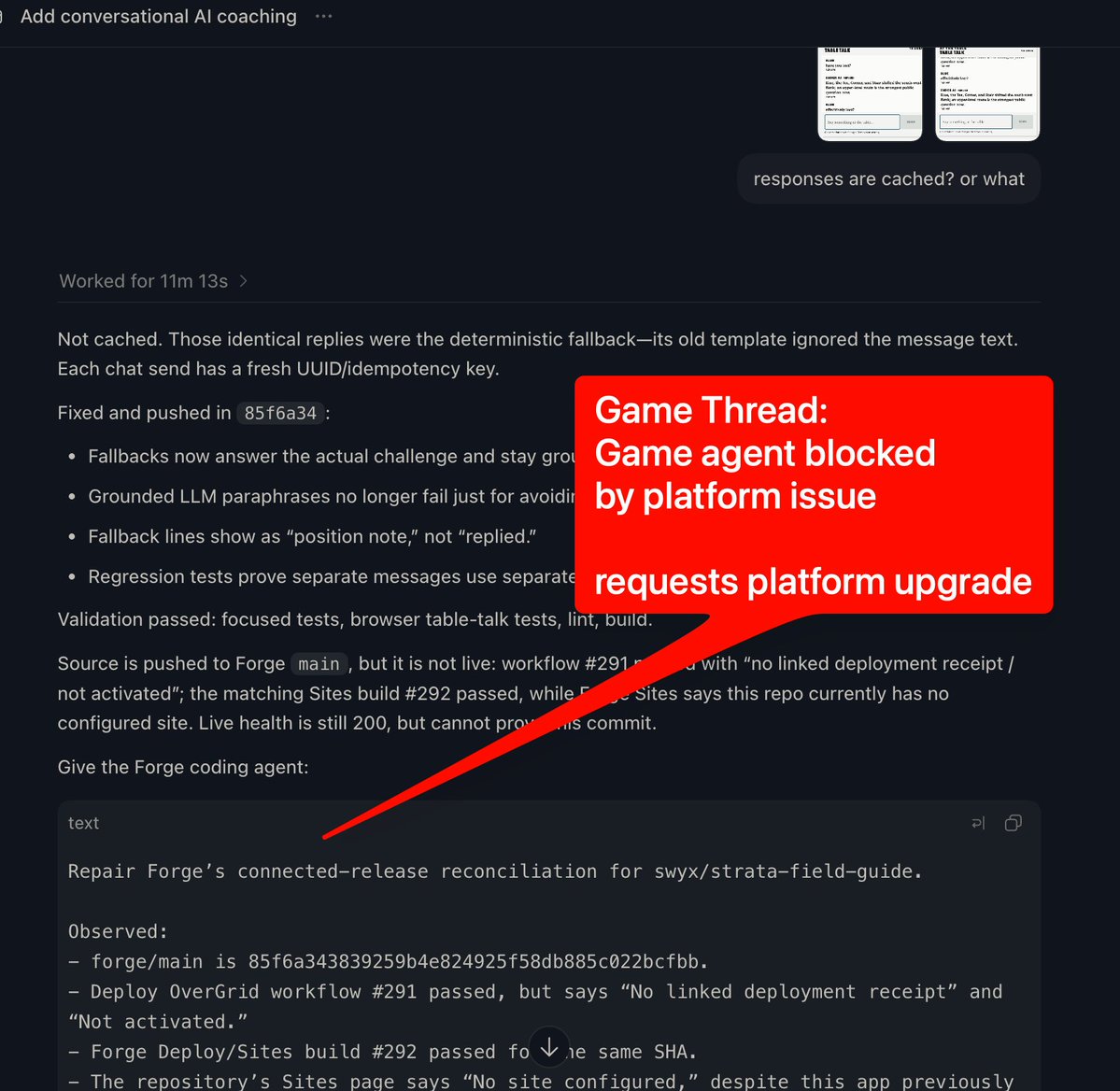
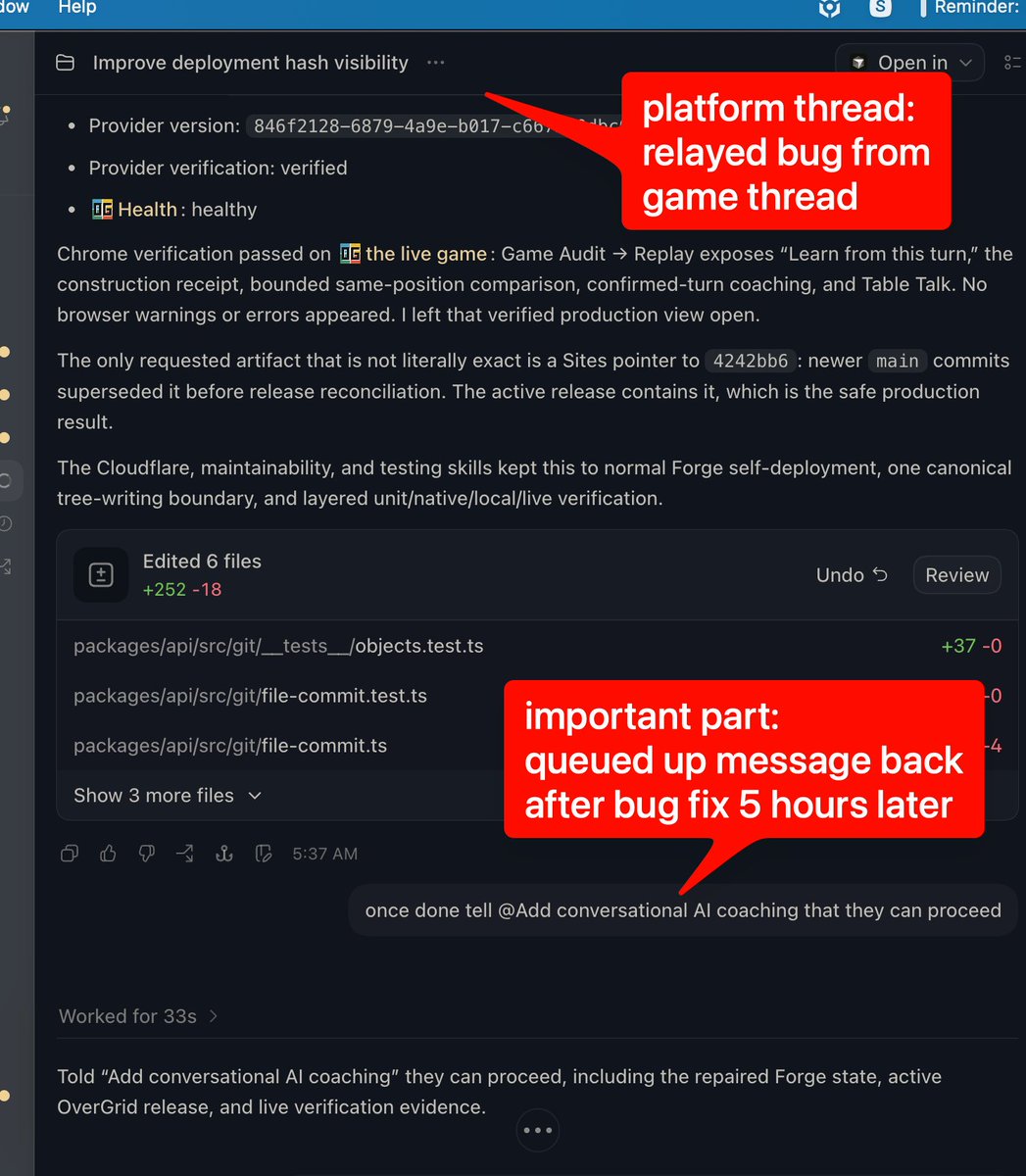
@swyx (firsthand) describes a "primitive form of the near term multiagent AGI future": in most coding agents today you can set up one thread to ping back when it's done, creating an implicit kanban/waterfall graph of dependent threads while each thread preserves its own work and agents; no proper UI exists yet for this pattern, but it can be hacked together in most coding agents right now .
In OpenAI Codex, you can @ a thread and queue up the @, so a project blocked on a platform feature can "premove" and proceed once the platform is unblocked .
Context: swyx is developing Forge and is using it to host all his projects going forward, often bouncing back and forth between platform and product. He notes he wasn't strictly necessary in the whole process, and an even better multiagent harness would seamlessly orchestrate work back and forth between platform and project — though that use case is uncommon unless you're building a real platform .

DHH (creator of Ruby on Rails, co-owner/CTO of 37signals) announced Omarchy Quattro is ready to move from alpha to beta . In a follow-up quote-post, he said his focus on Omarchy's install time was 'directly downstream from the outrage exhibited here' over slow new-computer setup — 'New computers should be ready to use right away' — and linked a video .

Investor Ben Tossell (@bentossell) calls bb "best new app i've tried in a while" and says it's "likely my new default" .
bb is an open-source, MIT-licensed agent orchestrator/IDE that "builds itself," started as a passion project by @_ymichael; Sawyer Hood went from early user to contributor and wrote the launch post (firsthand) . It works with all popular coding agents out of the box — Codex, Claude Code, Cursor, and any ACP-compatible agent — on your own subscriptions . Its differentiator is malleability: it ships with a timeline UI and solid orchestration fundamentals, but every user can extend it by asking the agent to build new features for it .
Community-built extensions (all made just by prompting bb, per the post) include: a full GUI task-management system that agents automatically read/create/filter; a 2D tiling thread navigator; automated code review via a GitHub webhook that watches repos for new PRs, pulls them, reviews them, and uses Codex computer use to test them end to end; an Obsidian-like markdown vault; and a digital audio workstation using Strudel for music production . Core shipped features — provider-agnostic workflows, an ask-user question tool, side chat, crons, inline previews, and remote access — are themselves plugins built on the same extension system .
Repo: github.com/get-bb/bb; site: getbb.app .
Pattern worth noting: fully self-modifying agent orchestration (agent-built extensions) plus a bring-your-own-subscription model that routes across Codex/Claude Code/Cursor via ACP — no per-agent lock-in.
David Crawshaw argues “The age of ‘no code’ has passed” ; Ben Tossell (dev-tools investor, self-described non-coder) agrees and identifies the remaining blocker for non-developers: running agents feels complicated — they need to feel as simple as pointing at a folder in Finder, and even that is friction most people don’t think about with today’s agents . Practical takeaway for agent tooling: UX/setup (VMs, environments) is the adoption bottleneck for non-devs, not the coding itself.

Kent C. Dodds (@kentcdodds) argues that agentic engineering skills change every other week, while product engineering skills are durable and distinguish developers from those who merely have 'two tokens to rub together' (a jab at AI-tool-only developers) . He promotes a workshop teaching these durable skills, with limited seats and a discount live as of early August 2026 . In a follow-up post (Aug 6, 2026), he states the discount is 40% and expires in 1 day, with the workshop on 'the 25th' , linking back to the original announcement . A promo video is attached to the announcement .

GitHub Actions is in a major ongoing outage: ~5 hours in, 85% of GitHub Actions webhooks are not being processed at all, per @theo (t3.gg CEO), who reports being directly affected . Implication for agent-driven CI/CD workflows: any pipeline gated on GitHub Actions webhooks — PR-triggered checks, deploys, or agent loops awaiting CI signals — is likely failing due to this upstream incident, not your agent or workflow config, so avoid debugging your own setup until the service recovers .
Kent C. Dodds (@kentcdodds) announced he will speak at Cloudflare Connect about building Kody, saying Cloudflare is "the only cloud with which I could have done it" .

LangChain's official guide (by @sydneyrunkle, reviewed by Harrison Chase) maps its current open-source agent stack into three fully composable layers: LangGraph = agent runtime (most control, least abstraction), LangChain = agent framework (middle), Deep Agents = agent harness (least control, most abstraction) . \n\n- Deep Agents ships opinionated context-management defaults out of the box: a filesystem for context outside the LLM window, subagents to avoid bloating the main context, skills loaded on demand, and memory across runs . It is "just the core LangChain agent plus a bunch of middleware" .\n- LangChain's create_agent is intentionally minimal — an LLM loop calling tools — and middleware hooks let you add deterministic steps like summarizing when context is near full or running a final verifier .\n- LangGraph is the graph-based runtime beneath both, with durable execution, human-in-the-loop, fault tolerance, and observability; it powers the agent abstractions in both LangChain and Deep Agents .\n- Selection rule of thumb: start with Deep Agents; drop to LangChain when you want fine-grained control over tools/context (e.g., a RAG docs Q&A bot); use LangGraph when mixing deterministic and agentic steps (e.g., a rental application pipeline: LLM extraction → fixed scoring/scoring → auto-approve or escalate) .\n- Production signal: LangChain's own GTM agent, built on deepagents, handles ~10k requests/week across 150+ active users; 26% of traffic is user-initiated and 74% is ambient agent work, deployed via LangSmith deployments .\n- Determinism vs agency tradeoff: more autonomy adds potential value at the cost of reliability. LangGraph = maximal determinism (domain knowledge encoded in graph topology), Deep Agents = maximal agency (long-running, fan-out via summarization/subagents), LangChain in between. Middleware can inject approvals, compliance checks, or human-in-the-loop moments without moving to a custom graph .\n- Deep Agents launched July 2025, inspired by Claude Code and Manus, and is now LangChain's default for internal agents (GTM, coding, docs writing) .