We can't find the internet
Attempting to reconnect
Something went wrong!
Hang in there while we get back on track


Sequoia shrinks to its core
Sequoia published a restructuring plan:
- Programs cut: it is sunsetting its Arc batch accelerator and its Scouts program, and simplifying the Sequoia Capital Fund .
- One team: Early and Growth are no longer separate. "There is only Sequoia" .
- London: the office is closing and several people are leaving. Sequoia says it still expects Europe to produce outlier founders and will support them from the Bay Area .
- Partnership: it describes changes that flatten the partnership. It also reports raising about $10B in new funds .
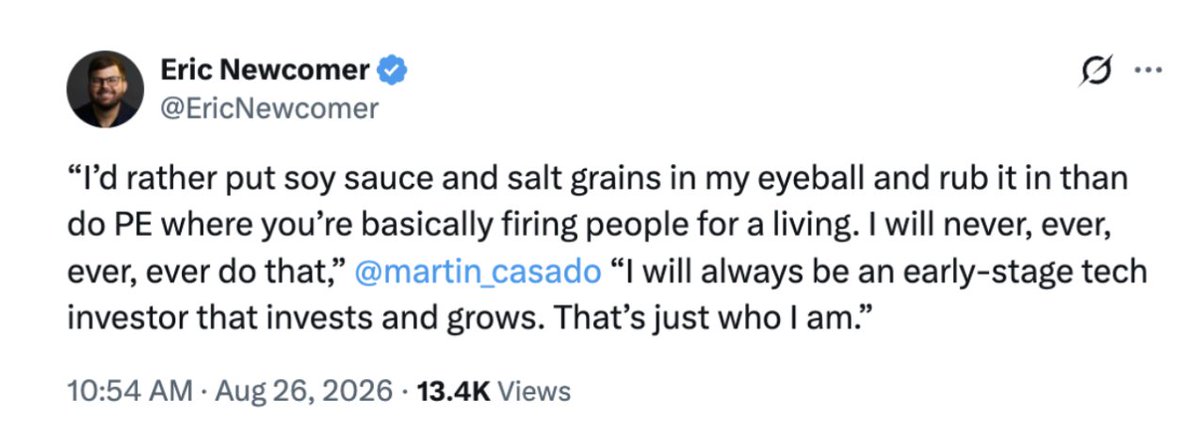
Newcomer, citing unnamed sources, reports that at least three US-based partners were forced out as part of the overhaul .
Luciana Lixandru, who led the London team, will stay in Europe. She remains a Sequoia partner, keeps her board seats, and plans to invest personally in European founders . She listed early-stage work with Pennylane, STARK, Profound, Rillet, Trade Republic and others .
Reactions split. Nathan Benaich called it "europe in managed decline" . Martin Casado called it "a lot of really smart moves" .
What it means for investors: the most prominent firm in the business is dropping its accelerator, scout program and European office to concentrate capital on fewer, higher-conviction bets. That leaves room at the pre-seed stage and in Europe for other investors.
Where AI money comes from, and how concentrated it is
Menlo Ventures (enterprise survey). Menlo's fourth annual report estimates enterprise AI deployment spend at $176.8B in 2026, up 5.4x from $33B. That is about 30% of public-cloud revenue . The survey covered about 400 enterprise decision-makers. Their new AI spending came from:
- 55% net-new budgets
- 22% software budgets
- the rest from labor and other budgets
Of the 22% taken from software budgets, incumbents got 13 points and AI-native vendors got 9 points ($12.6B) .
Incumbents win where they already own the workflow. ServiceNow has 91% of AI spend in IT and Workday has 68% in HR. In customer success, AI-native Sierra and Decagon lead the fastest-growing category, at 4.3x .
Coding is a $34B category. Claude Code and Codex take $24B of it, or 70%. Independent coding apps total $10.1B, up 2.9x . For screening, this means thin layers on top of a frontier model compete directly with the model's maker. Startups have better odds where the customer pays from labor or new budgets than from software seats.
Ramp (business card transactions). Ramp's data shows the risk that comes with that concentration. The top 1% of firms spent $9,568 per employee per month on AI in September, down 3.1% from a July peak. Over the same period, the top 10% and the median firm kept rising . Those top-1% firms account for 80% of OpenAI and Anthropic spend, and spend about 600x what the median firm does .
Ramp's lead economist attributes the stall mainly to falling model prices, such as Opus 5.5 cutting cost per task by about 40% . SaaStr reads Anthropic's still-blank October 31 run rate this way:
- above about $75B would mean heavy users came back
- about $68–70B would mean they have plateaued
Two other views:
- Casado, passing on a point from Vitaly Gordon, notes that tokens are still under 5% of labor cost at most companies, which argues against assuming spending has saturated .
- Newcomer's sources, investors who have backed both labs, see Anthropic pulling away from OpenAI. One described "infinite demand" from long-term investors and expects the IPO before Thanksgiving . That is investor sentiment, not confirmed timing.
Open-weight inference is becoming its own business
Cohere is now following Mistral in offering "sovereign inference": serving frontier open-weight models that it does not train itself . Benaich's summary: "you either die trying to get to the frontier, or you live long enough to serve inference" .
Several data points this period:
- Fireworks says it serves more than 40T tokens a day to customers' customized models. Nathan Lambert expects its total to be well above 100T, but that is his forecast, not a reported figure .
- Baseten is building a full platform: Grid (gateway and router), agent sandboxes, and Loops (serverless SFT and RL) . Its new coding router comes within 0.8 points of the pass rate of always using Opus 5.5, at 72% lower cost. That result is on held-out benchmarks, not production workloads .
- Cognition launched SWE-2 Flash, which it says is about 3x faster than SWE-2 at one-fifth the price. It has 276B total and 12B active parameters and was adapted from Thinking Machines' open Inkling-Small. Cognition is holding back the weights over cyber-capability concerns. All benchmark figures are Cognition's own .
- Deep Principle released Hydrogen-1.0, open weights post-trained from GLM-5.3 for science. It reports 38.3% vs. 33.3% for GPT-6 Astra on FrontierScience Research, at about 72% lower output cost, but trails Astra on NMR . These are self-reported results.
The pattern: frontier capability is increasingly something to buy and post-train, and value is collecting in serving, routing and vertical fine-tunes.
a16z: tech buyouts are under stress
a16z's Jen Kha argues that tech buyouts are a late-cycle asset class and that venture does better when a new technology wave is starting . Her evidence:
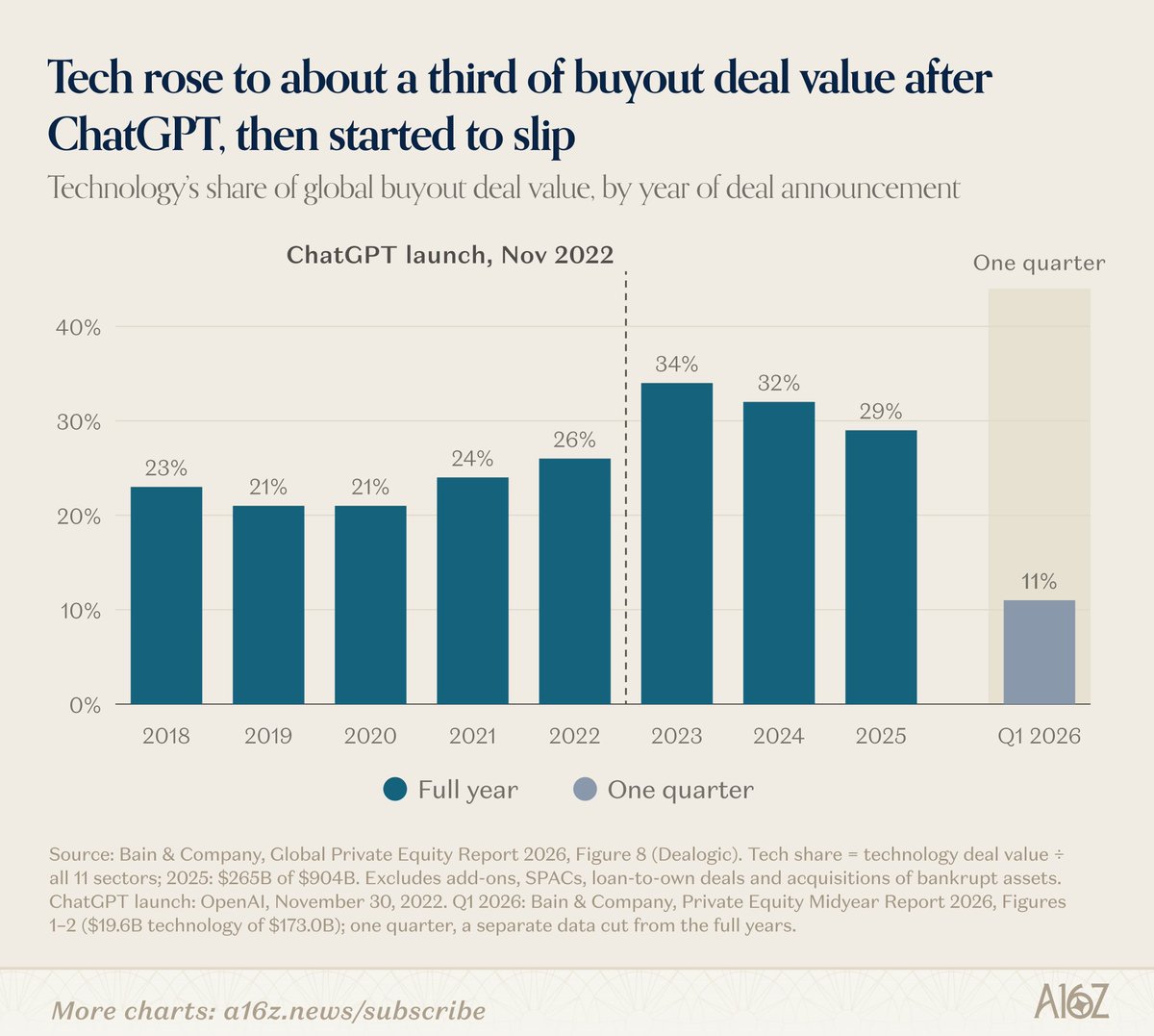
- PE's share of global buyout deal value going to tech fell from 34% in 2023 to 11% in Q1 2026 .
- About $140B of risky PE-backed loans mature in 2028 and $160B in 2029. About a third is software .
- A typical deal now needs 10–12% annual EBITDA growth to return 2.5x, compared with about 5% in 2015. Meanwhile, Golub's software borrowers slowed from 9% to under 3% revenue growth .
She concedes that smaller buyouts outside leveraged software can still do fine . a16z is a venture firm, so this is its own case for venture.
Deals and teams
- Discovery Loop: Jeff Dean revealed the company, a public benefit corporation co-founded with Oriol Vinyals, Quoc Le and one other Google colleague . It aims to automate experimental loops in ML research and hardware design and make domain experts "20x to 50x more productive." It says it has about 20 automated improvement loops running .
- Phaze: the team that built Parsec raised an $8.75M seed led by Casado at a16z. The product is remote access to real computers for both humans and agents, with handoff of control between them .
- Weave (YC W25): raised a $13.5M Series A led by Standard Capital to measure the output of humans and agents against AI spending. It also launched a model router .
- Eve: the plaintiff-law AI company says 1,700+ of about 29,000 US plaintiff firms use it, and its linked hiring post references $164M in funding .
- Salesforce signed a definitive agreement to acquire Listen Labs. No terms were disclosed .
- Talent: Cat Wu is leaving Anthropic to lead product management for Core Products at OpenAI . Allie K. Miller says that makes three of Anthropic's top product communicators to leave within weeks .
Hustle Fund's October funnel
Hustle Fund received 2,718 deals in October :
- Screening stage: geography caused about 46% of passes. The fund generally passes on companies not set up as US Delaware C-Corps .
- Closer review (370 deals): passes were mostly due to market competition (66%) .
- Sectors: AI/ML was the most common category founders selected, at 41% .
- Valuations (self-reported): 67% were under $10M .

- Just over 100 people attended an agent meetup where 10 AI-assistant builders pitched; participants described the field as an open frontier with no settled landscape. In a separate review of more than 147 assistants, one speaker grouped products as general, work-oriented, multiplayer, or travel-focused, with finance assistants not yet materializing; most products still leaned toward general productivity, while playful and multiplayer formats were emerging alternatives.
- Trust is a prominent reported user concern: about 22% of roughly 3,600 messages in AI-power-user group chats cited it as the main fear. The discussion emphasized permission fences, monitoring, separation of personal and work access, and keeping users in control of consequential actions.
- In a flower-ordering test balancing same-day delivery with low cost, Instinct, Kicker, and Season best handled both constraints; other agents found same-day delivery but tended to deprioritize price. In a separate LA-trip test, Instinct balanced cost and time, Grockbot favored time, and DOTS favored cost—evidence that agents interpret competing preferences differently and may need to elicit preferences and present trade-offs.
- In a test of the top 15 benchmarked agents, all but one would export a memory file for transfer to another agent; the speaker described the resulting files as generally solid, suggesting portability may ease switching.
- The speakers argued that agents’ ability to search patiently could help direct and long-tail brands reach buyers while compressing aggregators, and speculated that clean APIs and documentation could influence agent choices. Separately, they reported sharp performance differences at hundreds of thousands of users, with some products degrading and facing outages—indicating that scaling execution may remain a moat even as software is described as commoditizing.

- Jeff Dean presented Discovery Loop as a new AI-for-science-and-engineering company he co-founded and leads, aiming to automate experimental loops; it is a public benefit corporation with a stated mission to address societal problems and broaden access to its benefits.
- The four-founder team consists of long-time Google colleagues who have worked together for 14–30 years, with experience across Google products and infrastructure, Gemini, AlphaChip, and AlphaFold. The company says roughly 10% of its staff have an ACM prize in computing and 10% have IOI Olympiad medals.
- Discovery Loop says it has built a collaborative agent harness and agent-first infrastructure, with about 20 automated improvement loops running. Its initial focus is machine-learning research and engineering plus hardware design, with a stated goal of making domain experts 20–50× more productive; AI for healthcare is a longer-term ambition, while digitally executed work is currently more amenable to speeding up.
- Dean distinguishes self-improvement—automating experiments to improve a target model—from recursive self-improvement, where the system proposing improvements is itself improved. He says automation can accelerate the process, but computation and experimentation impose physical limits, so improvement cannot run infinitely fast.
- Fei-Fei Li, introduced as World Labs’ co-founder and CEO, said the company’s founding moment came when computer vision and generative models converged, enabling generative models beyond words.

- a16z’s Jen Kha argues that private-equity tech buyout exposure is retreating as the AI-era technology shift unfolds: tech’s share of global buyout deal value rose from 23% in 2018 to 34% in 2023, then fell to 29% in 2025 and 11% in Q1 2026.
- Her case is that leveraged software buyouts face tougher growth hurdles: deals now need roughly 10–12% annual EBITDA growth versus about 5% for 2015 deals, while software borrowers tracked by Golub Capital saw revenue growth slow from 9% to under 3% in two years. She argues venture is better suited to the early stage of a technology wave, but says smaller buyouts outside leveraged software may still do well; she also cautions that venture/buyout comparisons are illustrative because company stages, capital structures and valuation methods differ.

- For disruptive-tech deals, the investor favors diligence on the technical approach, adjacent markets, pace of evolution, value capture, team, customer use, adjacent budgets and early willingness to pay. He cautions that business models and monetization lag disruptive technology, so mature revenue-quality or TAM tests can be premature.
- AI may reopen the infrastructure stack: the investor treats models as infrastructure and distinguishes agent-generated software that still needs conventional compute and databases from new AI-native systems. He sees potential for new OLTP databases and networking entrants, including optical and materials changes, while agent-runtime abstractions remain unsettled. He is confident digital tasks can ultimately be solved with enough capital and simulation/RL, but says it is unknown whether the same scaling applies to robotics, physical science or medicine.
- The investor says frontier models captured over 80% of dollar-weighted demand during three years of rapid market growth, while enterprise AI budget penetration is roughly 1% or less by his estimate. He puts model lifetimes at about three to six months and warns that a delayed release could quickly cost a provider its market. If demand saturates, value could shift toward open source; however, he argues that task saturation alone does not make cheaper models viable when competing firms may still pay 10× for the most capable model.
- The investor sees AI turning some software development from an engineering bottleneck into a capital-resourcing problem, though returns on large deployments remain uncertain. For neoclouds, he identifies hardware supply and power as the immediate constraints, expects roughly 80% of the market to go to scale providers and the remainder to fragmented niches, and separately warns that tighter debt availability favors investment-grade firms; less creditworthy providers may need customer prepayments.
- In recounting Cursor's strategic transaction, he says the company was nearing a large raise when model-building needs increased its need for compute; SpaceX had compute, while Cursor had a large user base, data and a team experienced in building models. His broader advice is that strategic deals depend on trust and a credible case for expanding into a large market, while leaks can destabilize negotiations.

- Baseten shared initial results for Baseten Router, which routes coding tasks between Opus 5.5 and the cheaper GLM-5.3 Flash according to predicted task success and cost.
- On held-out DeepSWE 1.1, SWE Atlas QnA, and Terminal-Bench 2.1, Baseten reports pass rate within 0.8 percentage points of always using Opus 5.5 at 72% lower cost; it also reports statistically beating random routing at every threshold, the only evaluated router to do so on these benchmarks.
- The router combines structured task attributes with internal model activations. Results remain benchmark-stage: Baseten says production validation is its next focus and it is working with design partners; it cautions that relative performance may differ by workload and that evaluated routers used different model pools.

- The hosts’ thesis is that communities can grow alongside AI without being AI products, and that communities, networks, and marketplaces may remain defensible moats. NADA 20 Groups illustrates the model: members reportedly pay about $6,000–$8,000 annually to join groups of 24 noncompeting business owners who compare P&Ls; one host estimates $13–$15 million in annual revenue and suggests adapting the model to less-competitive professions.
- The hosts cite BNI as a scaled local referral network with 800,000 members, low-thousands annual dues, and a recent acquisition; a billion-plus-dollar price is described only as a rumor. Moda, a collector marketplace run through roughly two dozen Facebook groups, is described as having 600,000 members and more than a dozen full-time employees; dealers are vetted, and a host estimates $5–$10 million in yearly revenue. A cohost warns that reliance on Facebook creates platform risk if changes to reach or member-add rules hurt the business.
- A consumer-commerce model discussed is app-based collectible pack openings with buyback credit for unwanted pulls—for example, a $50 pack with a $43 buyback offer—encouraging another purchase while allowing the card to be resold. The hosts compare the mechanic to gacha-style gambling and caution that headline revenue may include GMV alongside card costs and fulfillment, rather than representing straightforward net revenue.

- Open-weight adoption is accelerating among startups and established companies to reduce costs; enterprises also value on-prem deployment for data privacy and residency. Providers may monetize through inference or cloud lock-in, revenue-sharing licenses, and enterprise contracts; Alibaba can pair models with cloud, while US open-weight providers may need other routes such as custom enterprise work.
- Task-specific harnesses are a potential startup opportunity: they can tailor capable models to specialized work and may themselves be a revenue stream. Standardized pre-deployment evaluation suites for harnesses are lacking, and evaluating agentic workloads can cost millions; startups may favor frontier APIs initially, then optimize open models on-prem as they scale.
- Chinese open-weight labs are gaining prominence, while Hugging Face’s policy chief says buyers still want US-developed open models. She cites geopolitics, perceived data-location risks, and differences in model refusals or values as factors in buyer choices, while noting that US-based inference arrangements can avoid sending data to mainland China.
- Open infrastructure carries security and support costs: an approximately 48-hour agentic attack on OpenCode sought third-party API keys and caused financial damage, while Hugging Face’s earlier incident reportedly did not compromise user or financial data. The interviewee says permissive communities and valuable data or keys make platforms targets, and that smaller providers cannot match closed labs’ product support even as defenders need access to permissive models.
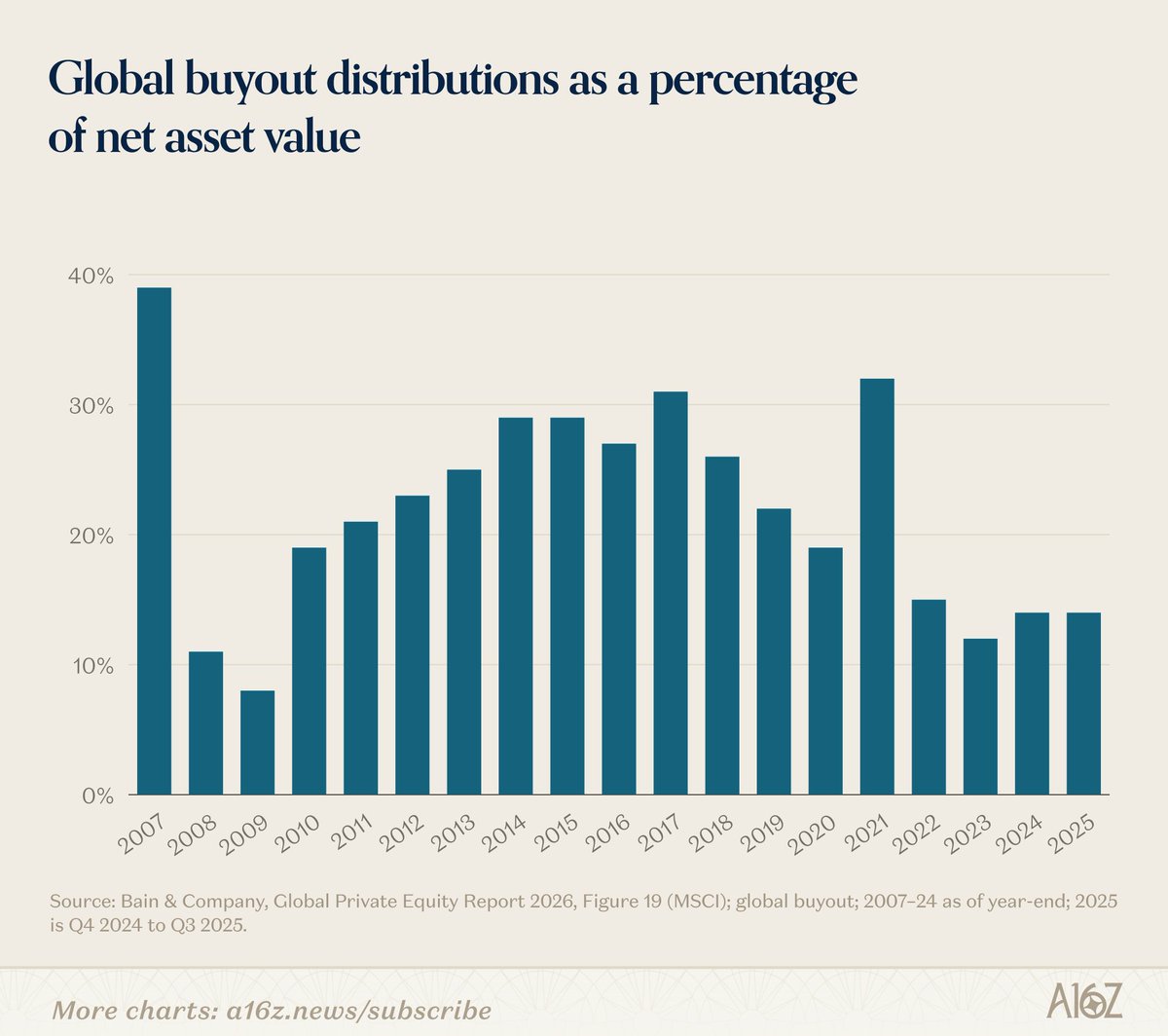
- a16z partner Jen Kha argues that buyouts are a late-cycle strategy and venture is better positioned when a new technology wave begins. She reports PE-backed tech exit value was down 77% year over year and buyout fundraising fell 16% to $395B in 2025, still lagging at midyear 2026.
- Kha cites a financing overhang: about $140B of risky loans owed by PE-backed companies mature in 2028 and $160B in 2029; roughly one-third is software and one-quarter is rated CCC+ or below.
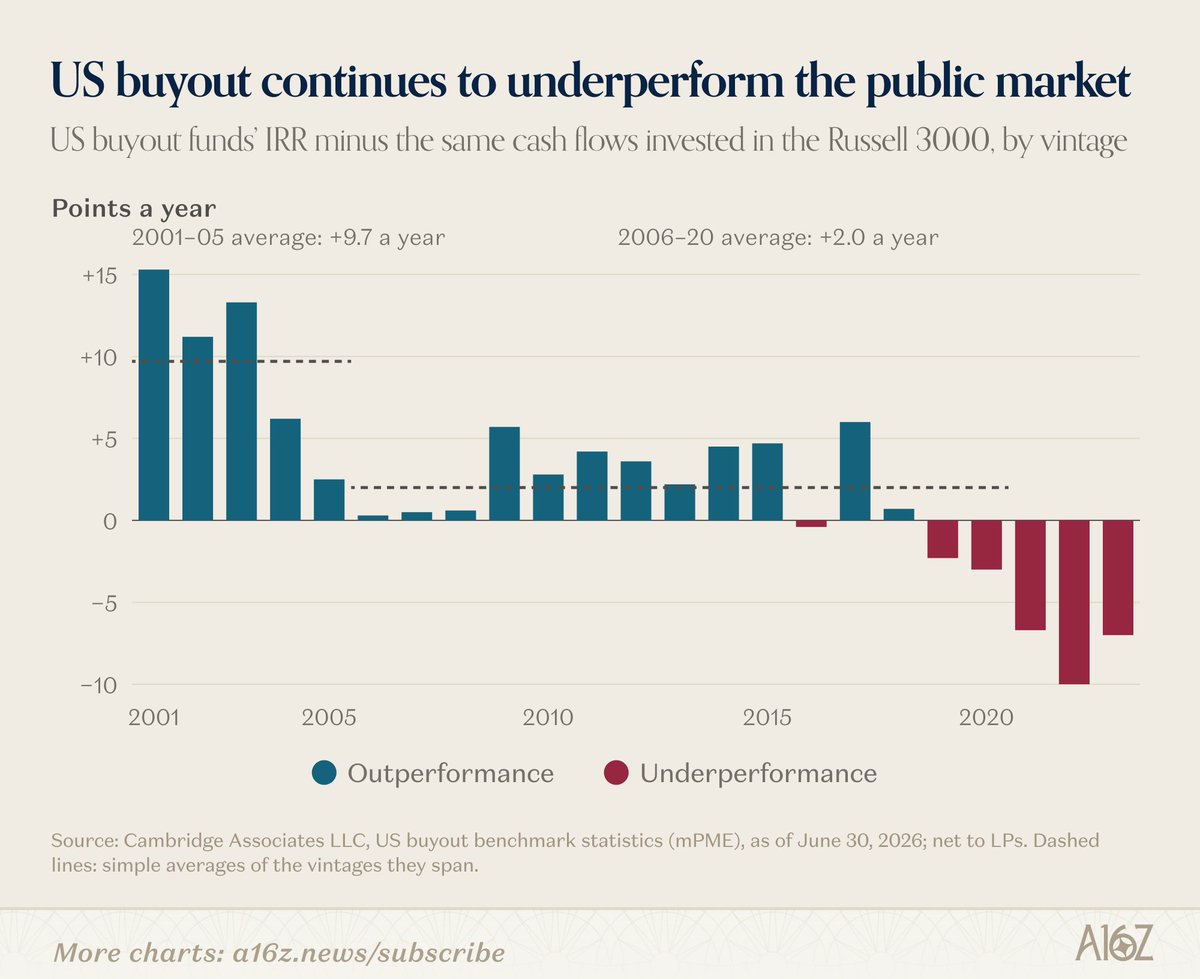
- US buyout funds trailed the Russell 3000 for every vintage since 2019. Over the reported 10-year period, US buyout returned 14.5% annually, below the Russell 3000, while US venture returned 17.6%, 2.3 points above the index and unlevered. Kha notes that the comparison is illustrative because venture and buyout differ in company stage, capital structure, and valuation methodology.
- The venture case is selective rather than a claim that the whole asset class is strong: Kha says exits slowed sharply after 2021 and argues that returns depend on access to top-5% managers rather than the median; she says VC track records have remained meaningful predictors of the next fund.

Weave (YC W25) helps engineering teams assess whether AI coding tools improve productivity by measuring human and agent output against AI spending; it recently raised a $13.5M Series A led by Standard Capital and launched Weave Router to select models for coding tasks. The company describes a progression from measuring tools such as Cursor to helping teams build software factories that can work autonomously, with a focus on measuring agent output and spreading the practices of strong AI users.

Perplexity CEO Aravind Srinivas framed the company’s agents as outperforming ad agencies for business owners . In a company-shared Get Maine Lobster case study, its Computer agent managed $30,000 in Meta ad spend and reportedly delivered 3.5× revenue and 63% higher ROAS than the business’s usual ads by automating creative analysis, ad production, and media buying .

- The speaker advises academic founders to prioritize what users will adopt and pay for over grades, citations, or interesting research without practical impact , and argues that solving an unmet customer problem can matter more than technical novelty .
- In his Focal example, three months spent training retail people-tracking models produced insights stores would not pay for; he says manual video labeling could have yielded the same result . He recommends AI startups validate demand with a human-in-the-loop approach before spending heavily on model training or compute .
- He also argues academic founders must personally take on work such as sales, marketing, product development, hiring, and managing cash runway, rather than outsource business responsibilities while remaining focused on research .
- a16z says the 2010s buyout playbook is unlikely to return: PE-backed tech exit value was down 77% year over year, and buyout fundraising fell 16% in 2025 to $395 billion and was still lagging at midyear 2026. It says large firms and 2021 software deals are weighing on benchmarks, while smaller buyouts outside leveraged software may still do well.
- Among the top 5% of US funds from 2007–16 vintages, venture returned 8.5x TVPI, including 5.3x in cash, versus buyout at 3.8x TVPI and 3.5x in cash. The article argues that venture track records remain predictive and the best firms tend to attract top founders.
- a16z frames the current period as the start of a major technology wave, but cautions that the VC/buyout comparison is illustrative because the funds hold companies at different stages and use different capital structures and valuation methods.
Assistant Benchmark creator David Pawlan says he has tracked 147 AI assistants; in AI power users’ group chats, trust was the top fear, appearing in 22% of roughly 3,600 messages. The discussion argues stated privacy concerns can diverge from revealed behavior: consumers may grant broad data access for small benefits, citing a promotion where $30 in pizza reportedly required access to an entire Google Workspace; it also identifies embarrassment and social signaling as potentially higher-stakes concerns than practical real-world consequences. Pawlan’s benchmark tests agents on competing preferences, such as finding low-cost same-day flowers or planning a luxurious yet cost-efficient LA weekend, making preference trade-offs a concrete evaluation dimension.
Google, Anthropic, and Databricks were founded by PhD-holding founders, but YC presents them as exceptions and cautions that academic instincts can work against building a startup . YC’s guidance for researcher-founders is to prioritize important problems and customer demand over interesting or novel research, move faster with imperfect information, and talk directly with customers . The advice comes from YC Visiting Partner Francois, who is a PhD student, previously researched in Fei-Fei Li’s lab, and founded and ran Focal Systems (W16) .

Nathan Benaich called Europe “in managed decline” and warned that “we cannot miss this moment because we are distracted by side quests”; his text does not specify the moment or distractions, so this signals broad concern about Europe’s trajectory and focus rather than a concrete technology or investment development.

Garry Tan says GStack’s /review skill is useful for preventing bugs, a positive but unelaborated signal about the tool’s developer workflow value.
Garry Tan said California tech builders had “dodged a bullet” on an asset-seizure tax, hoped Prop 42 would pass, and argued that asset seizure threatens abundance and could kill the state’s tech “golden goose.”
- a16z reports latest-available median software revenue growth of 3–7% for PE-backed companies, 10–16% for public software, and 18–30% for VC-backed private software; it says top companies staying private longer means more of their growth occurs before IPO.
- Its essay says PE tech’s share of buyout deal value rose from 23% in 2018 to about one-third after ChatGPT launched, then began retreating. It also reports PE-backed software borrowers’ revenue growth fell from 9% to under 3% in two years, though EBITDA continued growing through margin expansion; meanwhile, the essay estimates a typical buyout now needs 10–12% annual EBITDA growth to reach 2.5x in five years, versus about 5% for a 2015 deal.
- a16z cautions that venture/buyout comparisons are illustrative because the funds hold companies at different stages and use different capital structures and valuation methods.

Scott Kupor spent 16 years helping grow Andreessen Horowitz from 3 people to about 700; an interview teaser highlights the firm’s borrowing of Michael Ovitz’s CAA playbook and its Skype deal as historical topics.

- Sequoia is closing its London office, saying it no longer needs a local presence but will continue supporting European outlier founders from the Bay Area; it has also combined Early and Growth into one team.
- Luciana Lixandru says she will remain a Sequoia partner, continue serving on portfolio boards, stay in Europe, and personally invest in the next generation of European founders. She says her conviction in Europe is unchanged and that investing there has been her life’s work since 2011.
- She cites partnering with founders in the very early days at Pennylane, STARK, Profound, Rillet, Robco, Serval, Nevis, Avelios, Aspora, and Trade Republic.