We can't find the internet
Attempting to reconnect
Something went wrong!
Hang in there while we get back on track


Ship decisions should weigh how bad a failure is
Ravi Mehta gave product leaders a launch call. A checkout change lifts conversion 4%, but on older Android phones one in 500 orders gets a duplicate charge, which is refunded automatically within 24 hours. The options were to ship, exclude those devices, or hold . Then he added a detail: the order is for $5,000. That customer could see $10,000 charged, maybe while rent is due .
His point is that this bug was contained: the team knew the affected devices, the frequency and the fix. AI failures are harder to predict or contain. An AI travel planner's closed-restaurant recommendation might mean a short walk or a wasted 20-mile drive. A support agent only saves time if the cases it can't solve don't leave customers stuck . "A product can perform well on average while creating experiences that customers find unacceptable" . For launch reviews, that means scoring AI features on how bad and how contained their failures are, not only on aggregate metrics.
How OpenAI is earning enterprise trust in agents
On a16z, OpenAI's computer-use team described two layers of enterprise control:
- Deterministic sandboxes. Admins choose which apps and websites the agent can use .
- Configurable human-in-the-loop rules. For example, a person must approve any download, upload or new website .
An "auto approve" model reviews each action, and consumers and enterprises can set approval differently . Small UX choices also build trust: a visible, animated cursor, and asking permission before using a new app or site .
The team named the "boring" opportunities as the near-term targets: systems of record such as ERP and CRM, procurement spreadsheets, and month-end finance reconciliation across tools without APIs . For product teams whose sites agents will visit, they flagged a business-model tension: agent ad impressions generally don't count as revenue. They also pointed to WebMCP as a standard that lets humans and agents use a site together .
Prototypes over PRDs at Shopify
Shopify design lead Marvin Schwaibold says the process is still iterative, but he now uses Figma as a scratchpad and moves quickly to Codex and Claude Code to build demos he can test on his phone . Designers are "more the editors now than ever." AI can write code, "but it doesn't know what looks good" . Prototypes "are a million times more useful than any PRD" and win buy-in faster . They live in an admin playground, not production code .
A clone can copy your screens, not your users
Aakash Gupta wrote a one-page spec from Linear's public docs. In 3 minutes 28 seconds, Codex built a working issue tracker with five statuses, priorities, drag-and-drop and Cmd+K. It covered only part of Linear . What it lacked was the moat: issue history, existing users, GitHub sync, and Slack, Figma and Sentry integrations. His question for PMs: which of your features could an agent copy from a one-page spec this afternoon?
Practitioner threads
- The PM workload. A product lead with one junior PM averages 60 hours a week fielding every requirements request . One fix that worked for another PM: route all requests through a doc and triage once a day, which cut interruptions by at least half . A lead PM with eight developers works 40–45 hours, using AI for test scenarios, requirements from notes, and decks . Another PM noted the catch: if you own the results, you still have to review everything it produces .
- Diagnose activation before adding reach. A B2B founder's first week: 18 sign-ups, 7 finished setup, 5 used the product, 1 came back . Commenters pointed out that 11 of 18 never finished setup, so the biggest drop-off comes before setup . Another said to judge returns against how often users actually need the tool .
- AI search keeps old positioning alive. After a startup repositioned, AI still cited the old messaging. Fixing it meant updating owned pages, influencer content, bottom-of-funnel (BOFU) content and pages on other sites . One PMM now audits AI snippets every sprint and found that rewritten comparison pages and integration guides were what pushed the old content down .
- Agent security. A reply to Ryan Hoover noted that ClickFix attacks need a human to paste a command. Agents with shell access skip that step, so "a planted instruction file is the new fake prompt" .
- People. Peter Ellis is joining X to lead Product .

- Shopify product-design lead Marvin Schwaibold says AI has changed the tools, not design’s iterative nature: he uses Figma as a scratchpad and coding agents such as Codex and Claude Code to make testable prototypes faster. Designers still need to break complex work into subtasks, curate AI output, make quality decisions, and own the final result.
- At Shopify, designers use AI to turn Figma concepts into prototypes in an admin playground, not production code. Schwaibold says prototypes communicate ideas more effectively than PRDs and help build internal attention and buy-in; after teams align, they branch into versions within the shared demo.
- Product-entry pages should make one primary action clear, reduce competing calls to action, and organize features around a few main capabilities with details progressively disclosed. For Instaplay, the review recommends letting visitors create and try a game before requiring signup, then asking them to register to save, revisit, or share it.
- Design interactions to remain interruptible: in a prototype, users had to wait for one asset’s animation to finish before selecting another, which Schwaibold said would quickly frustrate users. He also criticizes scroll-jacking for overriding users’ expected control of scrolling.

Lenny warns that design partners can be a trap: their feedback may amount to “playing Steve Jobs.” The linked interview with Rob Snyder discusses why he skips design partners when advising on the first sales call.
In B2B sales, focus on the individual buyer and the project they personally need to get done, rather than pitching the company as an abstract customer; for example, identify the head of legal with a project she cannot complete herself.

A design-systems post frames the challenge as managing system complexity and persuading Marketing that brand colors can change . The linked IPAX update is titled as adding a Theme Builder, an open-source scoring engine, and color simulators; the post provides no further details about these features .

- Launch readiness is a consequence-sensitive tradeoff: a checkout change promised a 4% conversion lift but could duplicate-charge 1 in 500 orders on older Android phones; the options were to ship, exclude those devices, or hold for a fix. A $5,000 order could temporarily leave a customer charged $10,000, potentially disrupting rent or another payment, showing why frequency and eventual refunds must be weighed against the amount and timing of harm.
- AI quality decisions need to account for failure severity and containment, not just average performance: a wrong restaurant recommendation could be a minor detour or a serious problem after a 20-mile drive, while a support agent that cannot resolve an issue could leave a customer stuck. The article warns that AI products can perform well on average while still creating unacceptable experiences, and their failures may be harder to predict or contain than a known checkout bug.

An aspiring PM/APM job seeker describes role discovery—not interviews—as the main bottleneck: openings are scattered across company career pages, LinkedIn, Twitter, and startup job boards, and many listings labeled “PM” are actually ops, marketing, or program roles; they also observe that early applicants seem to get noticed more often . The poster built an early, rough tool called PM Radar to aggregate openings and spot them sooner .
Peter Ellis announced he is joining X to lead Product ; he says he aims to accelerate what he describes as recent momentum and keep making X beautiful and useful for its community, new users, and businesses globally .
When a customer discovery or sales call is going nowhere, ask: “Is there anything on your to-do list that you would pay me to do right now?”—the post calls this the “Hail Mary” question.
Lenny promoted an 86-minute conversation with Rob Snyder about finding product-market fit; Snyder is described as having helped over 50 startups reach $1M+ ARR. The discussion covers the PULL framework for finding customers who are “weird not to buy,” sources of startup ideas, cold outreach, first sales calls and why Snyder skips design partners, plus the “Hail Mary” question and “goblin mode.”
- Pain-point severity and frequent design-partner use do not prove willingness to buy: one startup had both yet prospects still did not purchase, and design partners can provide feedback without becoming customers. Snyder’s PULL framework tests for a buyer with a Project, a reason it is Unavoidable now, a List of options already tried, and Limitations that leave them stuck; assess pull at the individual buyer level, and look for concrete steps toward getting started rather than compliments.
- Use the first sales call for discovery: ask why the prospect took the call and listen for what they need to accomplish, why now, and what they have tried; if interest is lukewarm, ask whether there is something on their to-do list they would pay you to do now, which can surface an initial paid opportunity.
- For growth, find a customer type that is highly satisfied before and after buying, make that success repeatable across pipeline, sales, and delivery, then focus on the bottleneck preventing more repetitions.

Kevin Weil said that describing AI as used “primarily for email” is “somewhat true” now but “won’t be true for much longer,” signaling his expectation that AI use will broaden beyond email; he offered no examples or timeline.
A product lead with a two-person team asked whether AI could substantially increase output, particularly in discovery and prioritization. In response, a commenter argues AI can label and organize structured inputs but cannot uncover new pain points; that discovery requires direct engagement with users, customers, buyers, and markets. The commenter also frames product work as figuring out what to build—not just executing work defined by others—and favors cross-functional product pods over an insular department.

- US Levels.fyi median total compensation over the prior 12 months showed career-span multiples of 2.8× at Microsoft (level 62 to 67), 2.7× at Google (L4 to L7), and 2.2× at Meta (L5 to L7); Meta’s L7 figure had fewer than 20 submissions and should be treated as directional. Some other company comparisons are estimates, scaled from software-engineering ladders because PM data was sparse at the lowest and highest levels. Gupta’s practical advice: compare promotion jumps rather than titles, and ask for the next level’s median compensation instead of an in-level raise.
- In a clean-room test, Codex built a working issue-tracker board called Fieldwork in 3 minutes 28 seconds from a one-page spec based on Linear’s public docs; it reproduced a limited slice of Linear, not the whole product. Gupta’s product-strategy takeaway is that screens are easier to copy than accumulated issue history, existing users, GitHub sync, and integrations—so assess whether a product’s moat depends on assets and connections a clone cannot simply reproduce.
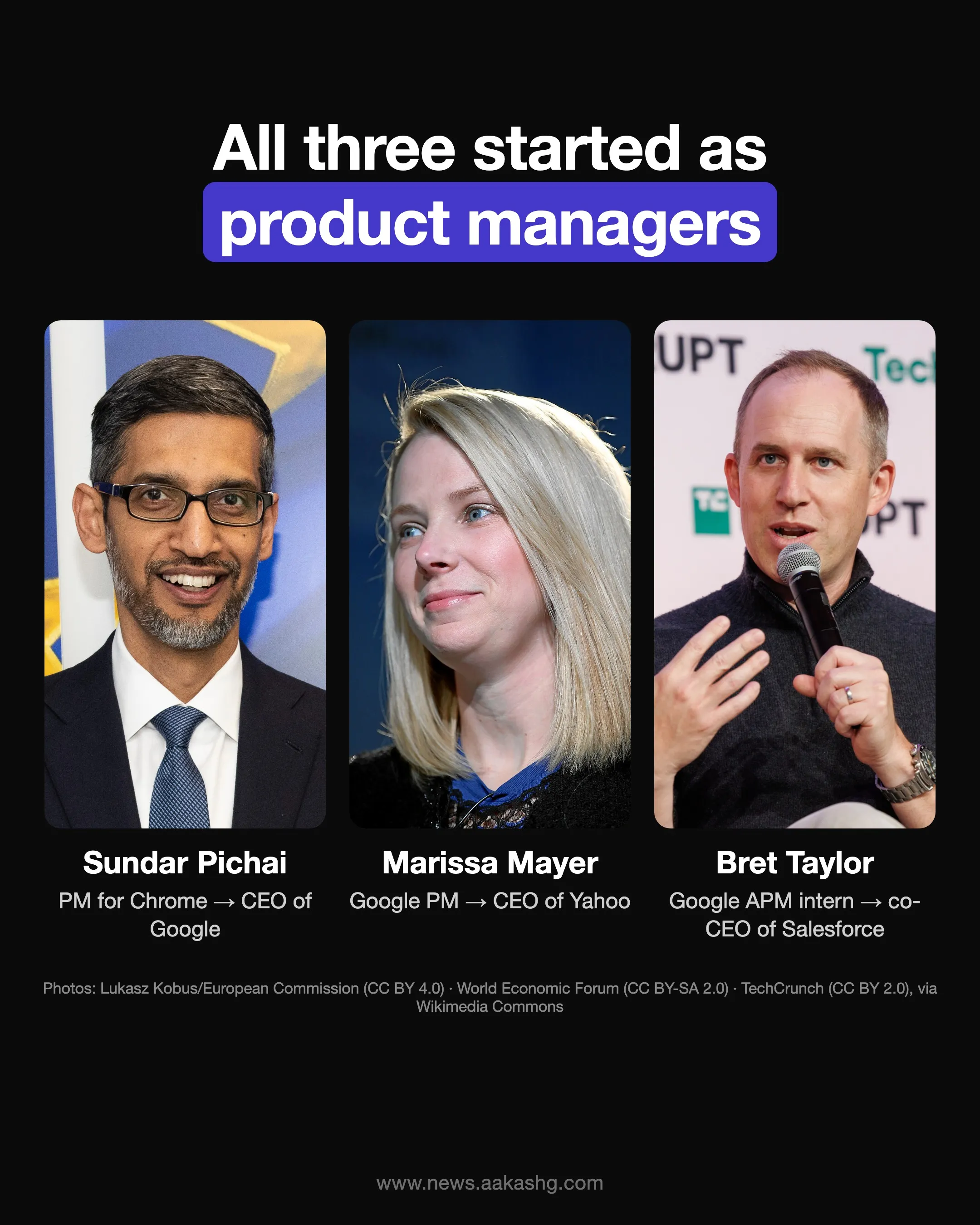
- Gupta points to Sundar Pichai, Marissa Mayer, and Bret Taylor as examples of leaders who came out of Google’s product organization. He argues that PM work builds a broad leadership toolkit—understanding customers, engineering, design, business economics, and how to win team commitment—which company leadership applies at organizational scale.

- For a startup building complementary web and mobile products, commenters recommended shipping one product as the MVP and holding the other until users arrive; they argued that getting real users sooner enables learning that further coding without users cannot provide.
- For AI-assisted development, one commenter advised delegating understood boilerplate while keeping core logic and the data model under the builder’s control and reviewing every change; another cautioned that authentication, edge cases, and deployment still require careful checking and may limit AI’s time savings.

Hiten Shah shared an early-access playbook he says he wished he had when he started, drawing on 20+ years of launching products and features: https://docs.google.com/document/d/1bo9n52j_M4Nx094TObZQVAq1htlB6h9XlySLgFsH710/edit?usp=sharing

A product lead overseeing all product with only a junior PM reported averaging 60 hours a week and struggling to track multiple projects while handling direct requirements requests . Practical ways to manage the load included routing requests through a written intake doc and triaging daily—one PM said this cut random interruptions by half—and using a roadmap readout to align stakeholders on priorities and explain why new requests must wait .
Set explicit capacity boundaries: one PM said working 60-hour weeks had neither been necessary nor accelerated their career, while another described using outcomes, roadmap, and capacity to explain why they could not take on additional work . A lead PM with eight developers reported working 40–45 hours with AI helping create test scenarios, turn meeting notes and runbooks into requirements, and build decks; they cautioned that PMs still need to review artifacts when accountable for results .
An indie founder says he released SimpleCal, a calorie tracker positioned around being simpler and less expensive than existing apps, at $2.39 per month. Seeking its first users, he asks for low-budget promotion advice and is considering TikTok or smaller content creators because he prefers not to appear in videos.
- A designer recommends using AI for narrow iterations rather than whole-screen generation: provide the design system as a plain-text spec (tokens, components, spacing scale), then use the agent for existing-screen variations, renaming/cleanup, or component swaps; keep layout judgment manual because full-screen generation was slow and required corrections. Another commenter reports using Claude via MCP for large, tedious token changes and says Figma AI is poor.
- One designer’s code-first workflow is to build a page in a side repo with the desired seed/demo data, transfer its HTML into Figma via MCP for tweaks, then send the Figma link to Claude to implement; they note that getting the tool to follow the design system remains difficult. For learning, a commenter recommends write-ups of real shipped work over prompt-to-app demos, which they say often skip the messy parts.
- For a parenting startup whose founder reports SEO bringing users, some users from X/LinkedIn networking, and zero from Meta ads, responders recommend checking which SEO pages produce signups before scaling; add distinct pages for specific, high-intent questions rather than generic bulk content, which commenters warn may be thin or underperform .
- Paid-channel suggestions differed, including Google search and LinkedIn, but commenters recommended focused, small tests: use one channel and an aligned landing page, then evaluate signups or cost per signup rather than clicks. One suggested stopping after a week without signups; another proposed a $200 LinkedIn test over two weeks .
For a patching product adding device-health monitoring, one small-team respondent says they use their cloud provider’s built-in tools and advises prioritizing integration with customers’ existing tools over any one specific APM; another commenter questions whether APM is the right category to investigate.