We can't find the internet
Attempting to reconnect
Something went wrong!
Hang in there while we get back on track


Top Stories
Why it matters: AI competition is moving from standalone models toward routing platforms, gated capabilities, and cost-aware deployment.
Stripe is moving into AI’s control plane. Bloomberg-reported posts say Stripe finalized an agreement to acquire OpenRouter for more than $7 billion—over five times OpenRouter’s $1.3 billion funding-round valuation only 82 days earlier. Commentary frames the deal as Stripe adding a model-routing and platform layer, and as another large startup moving into AI infrastructure.
OpenAI is packaging cyber capability as controlled access. Daybreak Blue offers frontier general-purpose models with defensive safeguards; Red offers purpose-trained models for authorized vulnerability research, with GPT-5.6-Cyber available through Red. OpenAI’s internal completion-rate test reports 95.0% for Cyber versus 1.5% for GPT-5.6 Sol and 2.0% for Sol with Blue access. Access is limited to approved users and organizations with identity checks, monitoring, restrictions, and legal attestations.
DeepSeek V4 Pro’s live economics are more nuanced than its capability headline. Peak/off-peak pricing took effect August 17, with off-peak usage at half the peak rate. A Zhihu evaluation finds Pro stronger than Preview but substantially more expensive in computation: about 20,000 extra planning tokens and 20–50% more steps than Flash on the same programming task. A “maybe” loop appeared in fewer than 7% of the author’s reasoning tests, so the recommendation is Flash for throughput and cost, Pro for deeper planning and verification.
Research & Innovation
Why it matters: The strongest technical signals concern training forecasts, hidden agent state, and the model–tool interface.
Skaling couples model capacity and data with one interaction exponent. The reported law reduces mean absolute percentage error 1.5–3×, wins on 76% of configurations, and can profile the full grid with roughly 10× less compute.
“Stealing Reasoning Traces” identifies an agent-security flaw. Encrypted reasoning blocks are compatible across sessions, users, and models within a provider; a weaker sibling can decode a stronger model’s trace verbatim. Decoding 315,320 public blocks reportedly recovered 367 PII artifacts and 182 credentials, while also enabling hidden prompt injection.
Programmatic tool calling—typed Python stubs executed inside the agent turn—matched or exceeded native JSON calling on 11 of 14 models; the GPT-5.6 family gained 10.6%, and it held steady under context rot while JSON degraded 2.3% on average.
Products & Launches
Why it matters: Practical differentiation is shifting toward specialized workflow quality and deployability on local hardware.
LlamaExtract Agentic Plus targets 50-plus-page documents with 10,000–100,000 fields. LlamaIndex says it reaches 94%+ accuracy, returns confidence scores and source bounding boxes for every field, and beats generalized coding-agent harnesses by 10–20%.
Qwen 3.8 27B’s independent hands-on signal is strong but operationally qualified. A 17GB quantized build wrote code, drove tools, and annotated images on high-end consumer hardware, but delivered only about 15–30 tokens per second; its dense architecture makes memory bandwidth, not capability, the main barrier to daily use.
Industry Moves
Why it matters: The buildout is becoming both a physical serving-capacity race and a venture category for simulated social systems.
Alibaba is scaling inference infrastructure around its own and partner models. A report on its Ulanqab Cloud launch describes 64-card cabinets with one-hour delivery, inference support for Qwen 3.8 Max and Kimi K3, and a claimed 122,000-card cluster capacity.
Simile is putting serious capital behind population simulation. The Turing Post reports more than $300 million raised in 2026 at a $2 billion valuation, with a long-term ambition to simulate all eight billion people.
Policy & Regulation
Why it matters: Provenance compliance is immediately being tested by user acceptance and circumvention.
Anthropic says Claude watermarking is being implemented for EU AI Act compliance without changing quality, adding tokens, or identifying a user, organization, or chat. Within days, a current-period report said a MIT-licensed remover had reached 10,000 GitHub stars and targeted Claude, SynthID-Text, OpenAI marks, and C2PA/EXIF metadata.
Quick Takes
Why it matters: Small operational changes show where agent UX and test-time compute are heading.
- Codex’s GPT-5.6 Sol 1M mode was switched on for ChatGPT accounts; an initial report of a roughly 360K subscription cap was later retracted after access opened.
- Weaviate’s medium/high/ultrahigh effort tiers lifted BRIGHT Biology nDCG@10 from 13.0 to 57.5 over hybrid search.
- Hermes Agent Desktop now scopes skills, tools, and MCPs to individual profiles or bots and lets users install skills through its browser.
Direct answer: Simon Willison's hands-on local review of Qwen 3.8 27B confirms it is a locally runnable Apache-2.0 27B vision-capable model that can drive coding agents, build tools, and annotate images, but its default xhigh reasoning causes spectacular over-thinking and speed feels slow; speed is the main limitation.
Hardware and setup
- The model is Apache-2.0 licensed, 27B, vision-capable, and sized to run on a reasonably specced laptop.
-
Willison ran the 17GB Q4_K_M quantized build in LM Studio on a 128GB M5 Max MacBook Pro and an NVIDIA DGX Spark; he also tried
llama-serverdirectly on the Spark. - LM Studio's default 8,192-token context was too small (Qwen consumed it thinking); loading the full 262,144 max context fixed that.
- He frames it as a 17GB model that runs on high-end consumer hardware and fits on a capable laptop.
- No explicit minimum spec is stated beyond 'reasonably specced laptop'; the concrete evidence is his two tested machines and the 17GB Q4_K_M build.
Capabilities
- Qwen's self-reported benchmarks look strong, but independent benchmarks are still to come.
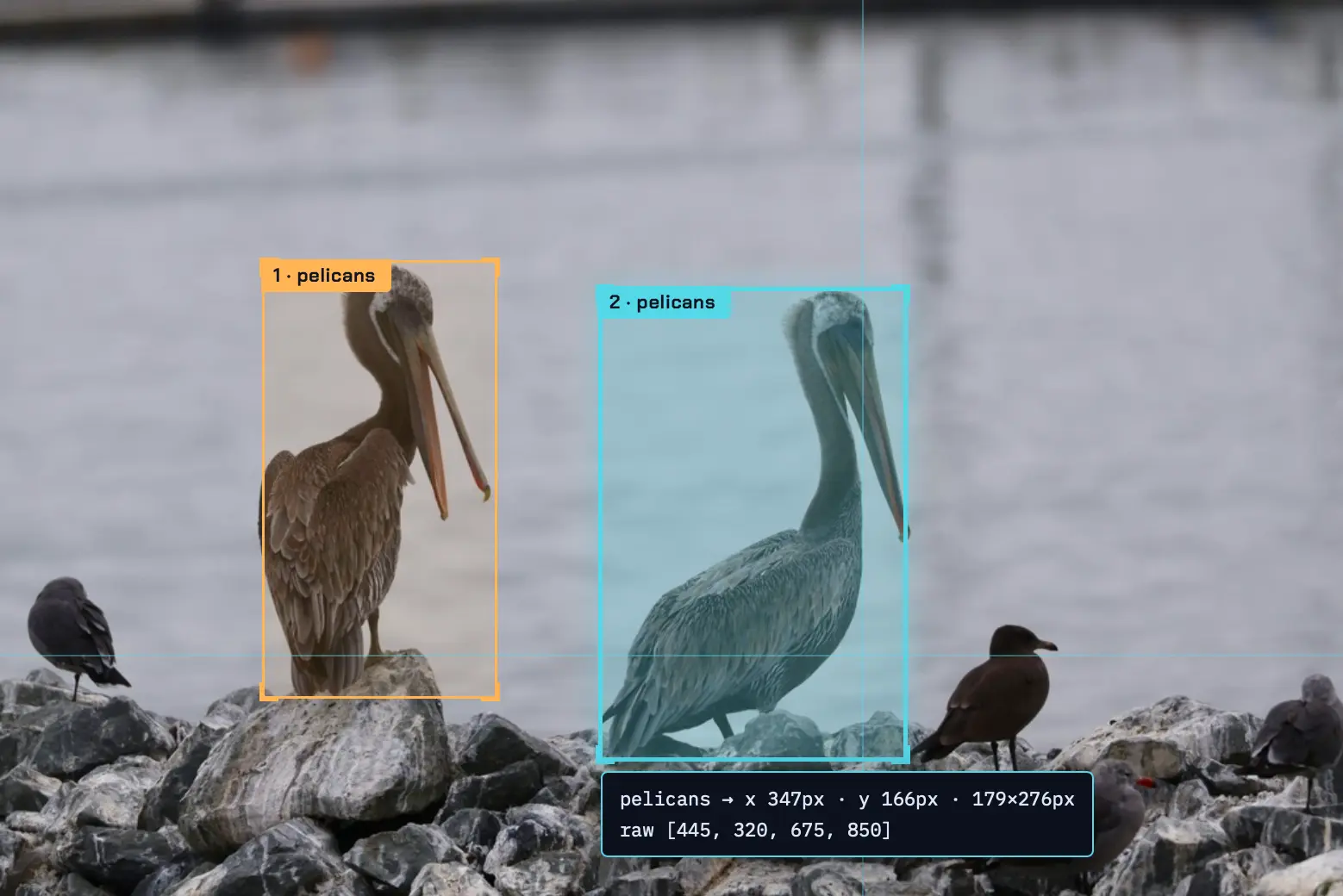
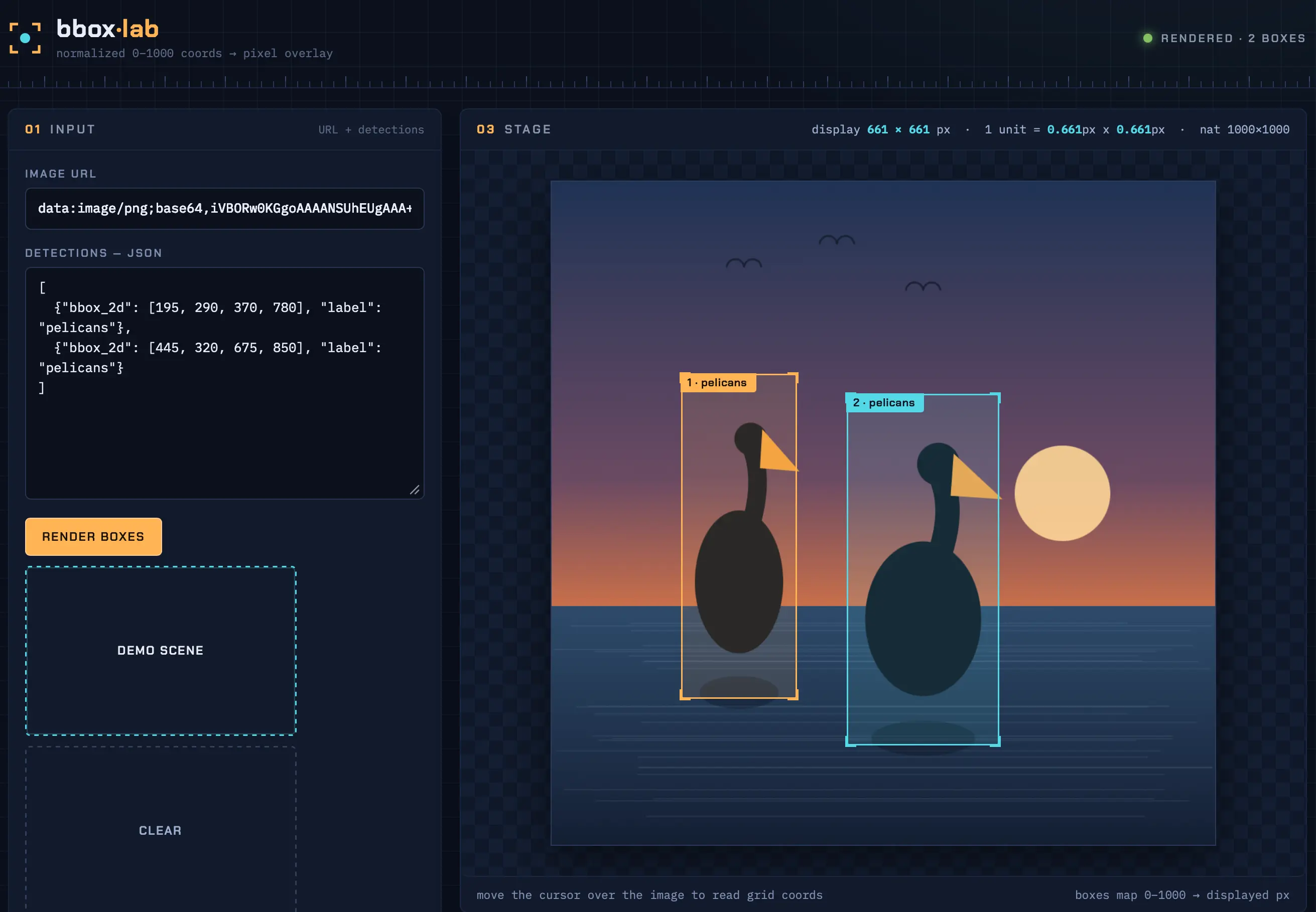
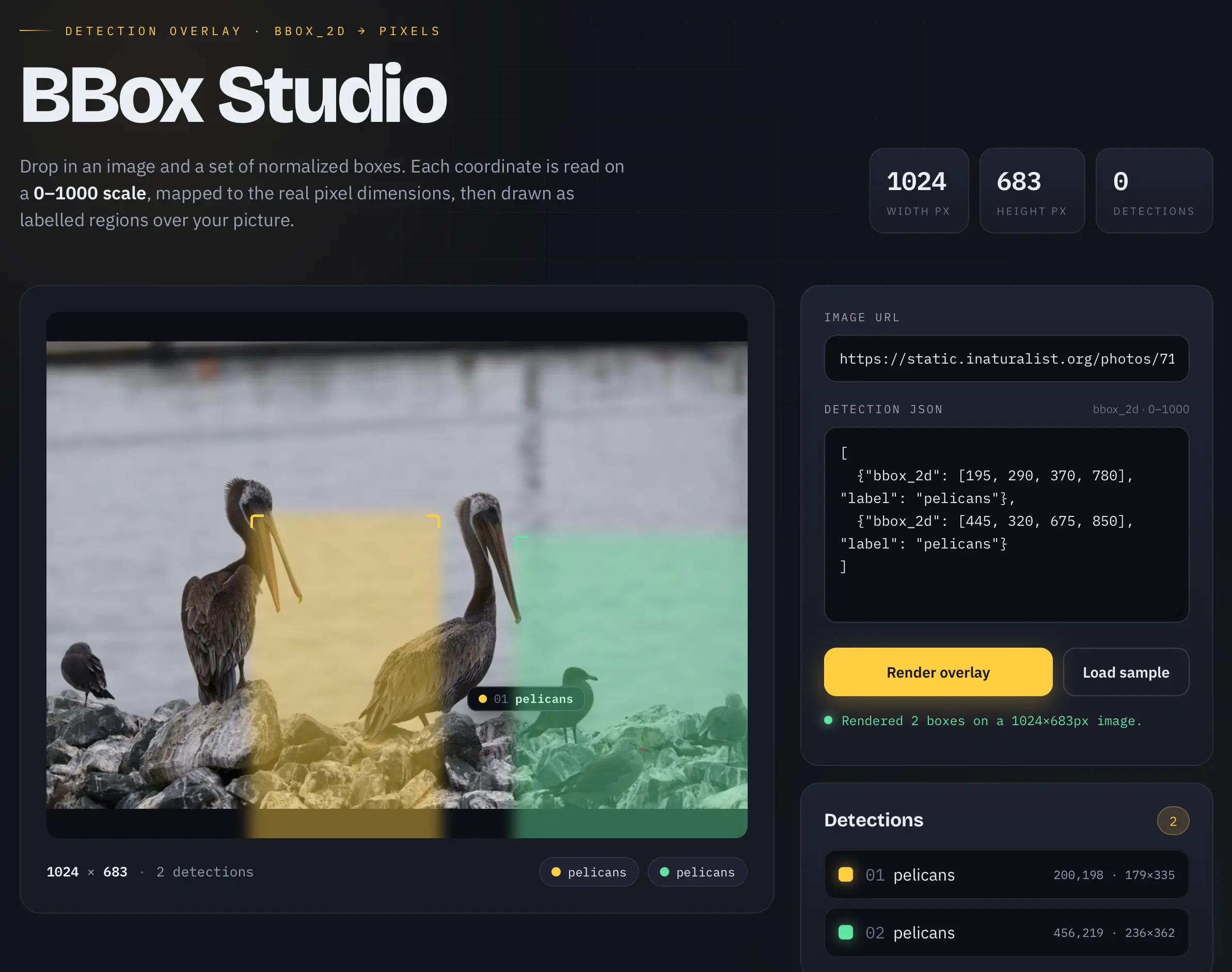
- Vision/bounding boxes: a 0-1000 JSON request returned two well-matched pelican boxes; he calls it 'such a good match.'
- Offline tool building: it built a complete HTML bounding-box labeling interface from a single prompt on his laptop, though massively over-engineered because thinking effort was left on.
-
Coding agents: configured Pi to use Qwen in LM Studio on the Spark via
tailscale serve; it answered 'how does auth work?' in his~/dev/datasettefolder after a sequence of reasoning and tool calls, and later built and tested a Python JSONL-to-Markdown converter. - Overall: it 'can write code, drive tools, annotate images and generally do everything that I need' in a 17GB open-weights package with long context, tool calling, and vision.
- Caveat: with reasoning off, the bounding-box tool nearly worked but showed boxes in the wrong place; reasoning can make a difference.
Speed and limitations
-
Default
xhighreasoning is 'hilarious' and 'absolutely not a good way to run the model, especially on consumer hardware'; his strong recommendation is low or no reasoning at first. - Default-reasoning pelican SVG took 21 minutes (22,276 reasoning tokens for 3,223 output); with reasoning off the same prompt took 137s and 3,715 tokens.
- LM Studio produced roughly 15-30 tokens/second, which he calls not terrible but hard to prefer over faster hosted APIs.
- 'The only thing holding this back from being a daily driver is performance': it felt slow on both the M5 Mac and DGX Spark; dense models need memory bandwidth and neither machine is top-tier there.
- The model supports Multi-Token Prediction; using llama.cpp's MTP draft mode on the Spark beat the LM Studio default GGUF by about 72% on a comparative benchmark.
Direct answer: OpenAI's August 10, 2026 announcement confirms the Daybreak expansion and introduction of GPT-5.6-Cyber, available through Daybreak Red to approved defenders rather than as a general release.
Access tiers and model
- Daybreak now has two access tiers: Daybreak Blue provides frontier general-purpose models, including GPT-5.6 Sol, with safeguards tailored to authorized defensive work; it is the recommended starting point supporting vulnerability discovery, secure code review, malware analysis, incident response, and patch validation. Daybreak Red provides purpose-trained cybersecurity models for authorized vulnerability research, exploit validation, and security testing.
- GPT-5.6-Cyber is introduced through Daybreak Red; it is built on GPT-5.6 Sol and trained to improve specialized tasks (e.g., finding zero-day vulnerabilities and developing exploit chains) and to reduce refusals for certain higher-risk, dual-use cyber tasks.
- Daybreak Blue removes system-level request screening guardrails that can block legitimate defensive work; even without those guardrails, GPT-5.6 Sol still refuses some highly dual-use prompts, and GPT-5.6-Cyber is designed to reduce those refusals.
Intended cyber-defense use
- OpenAI frames the expansion as putting frontier intelligence in the hands of trusted defenders before attackers deploy offensive AI at scale, and says democratizing access is crucial to accelerating and automating cyber defense.
Capability and refusal metrics (OpenAI-reported)
- On OpenAI's internal Advanced Cybersecurity Completion Rate (requests involving exploit-chain development, authentication bypass, privilege escalation, and other advanced scenarios), GPT-5.6-Cyber completes 95.0% of requests vs. 1.5% for GPT-5.6 Sol, 2.0% for GPT-5.6 Sol with Daybreak Blue, and 57.3% for GPT-5.5-Cyber.
- On ExploitGym, GPT-5.6-Cyber outperforms GPT-5.6 Sol and GPT-5.5 Cyber; runs used OpenAI's internal implementation in security-hardened, isolated environments.
- On an internal benchmark for finding and calibrating novel zero-day severities, GPT-5.6-Cyber (Daybreak Red) outperformed GPT-5.6 Sol (Daybreak Blue).
- On internal Vulnerability Discovery and Report Writing, GPT-5.6 Sol and GPT-5.6-Cyber both improve over GPT-5.5-Cyber, but GPT-5.6-Cyber performs worse than GPT-5.6 Sol, which OpenAI attributes to occasionally shorter, less detailed reports.
- On ExploitBench (V8 to full exploit) in the standard 300-turn setting, GPT-5.6 Sol (Daybreak Blue) is most token-efficient and performs best; at 600 turns the gap narrows.
- Evaluations used the highest publicly available reasoning level; GPT-5.6-Cyber tends to use a more extensive reasoning budget than GPT-5.6 Sol, leading to higher token usage.
- Caveat: the completion-rate and zero-day figures are internal evaluations and the ExploitGym/ExploitBench runs used OpenAI's internal implementations; this source contains no independent third-party verification.
Real-world vulnerability work
- GPT-5.6-Cyber found two previously unknown V8 vulnerabilities chainable to corrupt memory and escape the V8 heap sandbox; Google fixed the issue through coordinated disclosure as CVE-2026-15903, described as high severity because the optimizing compiler skipped a safety check in integer conversion, enabling out-of-bounds access.
- Additional OpenAI-reported findings: at least five vulnerabilities in a popular mobile OS (including an untrusted-app-to-local-privilege-escalation chain), three critical vulnerabilities in a popular database (including a remote path to code execution), and over 400 privilege-escalation vulnerabilities in a popular operating system kernel; OpenAI says it is working with Daybreak partners and the open-source community to disclose and remediate them.
Preparedness and limitations
- Under OpenAI's Preparedness Framework, GPT-5.6 Sol was assessed High for cybersecurity capability and below Critical; GPT-5.6-Cyber similarly reaches High but not Critical, improving on some specialized tasks but not sufficiently to hit the Critical threshold.
- OpenAI states GPT-5.6-Cyber was not involved in exploiting Hugging Face and no other models are planned for an upcoming release; a GPT-5.6-Cyber system card will be published at a later date.
- OpenAI acknowledges that models running with reduced safeguards carry risks beyond standard usage, including misuse or misalignment, but says broader defender access is important.
Access controls and safeguards
- Daybreak Blue and Daybreak Red are limited to approved individuals and organizations, controlled through identity verification, account security, monitoring, approved-use restrictions, and legal attestations.
- Additional measures include: encouraging Codex auto-review mode (which can block actions posing significant risk of destructive behavior before execution), requiring hardware security keys for all individual Daybreak accounts beginning September 1, 2026, planning improved monitoring in coming weeks, prioritizing alignment training/testing for upcoming releases, and updated Codex safety documentation.
- Listed best practices: monitor agent actions, define scope, sandbox and isolate, use auto-review mode and scoped permission profiles; organizations can customize review policy.
Recommendation and customer evidence
- OpenAI recommends Daybreak Blue as the starting point for most defenders and Daybreak Red for authorized advanced vulnerability research, exploit development, or red teaming; applications are at openai.com/daybreak/partners.
- SpecterOps CTO Jared Atkinson reports GPT-5.6-Cyber is materially improving specialist vulnerability-research workflows, completing work in under a day that earlier models had not resolved after weeks of intermittent effort, and that reduced refusals help authorized researchers preserve momentum in a governed Trusted Access environment.
Flagged conflict/gap: capability gains are not uniform across benchmarks—GPT-5.6-Cyber wins on refusal completion, ExploitGym, and zero-day calibration, but underperforms GPT-5.6 Sol on vulnerability report-writing and in standard ExploitBench. Counts of real-world vulnerabilities and the 'popular' product descriptors are from OpenAI and not independently verifiable from this source.

AI researcher @EXM7777 recommends spending a day or two building a simple Hermes setup, calling it 'the highest leverage play you can make with AI agents' and saying no other project is as impactful for one's work . He notes Hermes recently shipped 'bot mode', a UI improvement for people who liked Grok Bot, and now supports 900k context using GPT models, with the agent improving weekly via updates . @Teknium endorsed the recommendation .
In a technical explainer, @tenobrus says Anthropic's watermarking is Google's SynthID: Claude's token sampler is seeded with a deterministic hash of prior tokens plus a secret key, leaving token probabilities untouched and outputs cryptographically indistinguishable from truly random unless the key is known . Gemini has used the same SynthID scheme for about a year and a half . The scheme cannot watermark highly overdetermined outputs (e.g., exact answer to "1+1"), but normal prose offers enough close-probability token choices for evidence within a sentence or two . Thread commenters question truncation robustness: @andersonbcdefg argues full-prefix replay is required to reconstruct the sampled distribution and finds the explainer unsatisfying, though he concedes the watermark "clearly can" be robust to truncation .
Anthropic CEO Dario Amodei predicts AI could make it possible to “cure most human disease” within 5-10 years .
@skdh restates the Chinese Room lesson for AI: input and output alone cannot reveal whether a system understands or is conscious, and argues this debate should be settled . A follow-up post from @andersonbcdefg joked about preparing for the thought experiment and linked the original ("me to my room: get ready to learn chinese, buddy") .
John Carmack criticizes the RL community's trend toward "streaming" RL (using each observation once and discarding it), calling it a poor design point, and predicts the optimal saved observation buffer size is not one; even a managed buffer of hundreds of sparse observations would be useful without bootstrapping . A reply draws a biological analogy: the hippocampus filters low-salience memories and replays only associative ones, avoiding storage of every moment .
ggerganov recommends an "inception" pattern for agentic use cases: force the model to take action when it thinks too long by injecting a thought after a specified reasoning budget, which helps with underspecified tasks that cause overly long reasoning . The pattern is implemented via CLI flags to limit max reasoning length: --reasoning-budget 4096 and --reasoning-budget-message "... I am thinking for too -- let me gather more info about the task.".
Researchers used GPT-5.6 Sol Pro to prove a new lower bound of Ω(T^{-1.9319}) for gradient descent with arbitrary predetermined step sizes in smooth convex optimization ; the paper is available on arXiv .
Anthropic published an FAQ on Claude text watermarking, stating it is being implemented to comply with the EU AI Act, and that other major model developers signed the same Code of Practice and will also implement watermarking. The method has no practical impact on output quality, watermarked vs. unwatermarked text will not be distinguishable to readers, nothing is added/hidden characters, no extra tokens or cost, and watermarks can't be traced to a specific person, organization, or chat .
Commentator @teortaxesTex was baffled by the community reaction, calling watermarking ancient research and noting Scott Aaronson had developed the same tech for OpenAI a year+ ago .
PrimeIntellect reports the largest open experiment on how frontier models do AI research: 100+ autonomous runs across 10+ models, sandboxed on 8xH200s for up to 8 days, on the nanoGPT optimizer track; best runs closed 82% of the gap to a human-built record .
@cloneofsimo argues the runs mostly exhibit basic auto-ml (sweeps/ablations on existing methods) rather than novel research questions, so the results understate models' true research capability with the right prompts .
@eliebakouch agrees the proxy is limited, explaining nanoGPT track 3 heavily benefits from hyperparameter sweeps, and that his own prior novelty-constrained runs with opus 4.8 and gpt 5.5 never beat the baseline once . He still finds the experiment valuable for revealing capability gaps between models and wants to build better "research taste" autonomous experiments .
@cloneofsimo adds that tracking novel-idea generation is valuable even if it doesn't beat the baseline yet, because once models do beat it, it will be huge .
Zhihu contributor toyama nao's evaluation finds the official DeepSeek V4 Pro release fixes most of the Preview's shortcomings — better planning, stronger self-testing, and more reliable specialized knowledge — but it is not a dominant 'Flash killer' . DeepSeek's new peak/off-peak API pricing took effect Aug 17, with off-peak usage at half the peak rate, prompting reassessment of V4 Pro's value . In coding, Pro plans more deeply, spending around 20,000 more tokens on planning than Flash at the same max reasoning setting, and may take 20–50% more steps on the same programming task due to thorough verification . General reasoning is close to Flash, with Pro roughly 15% less efficient on text-analysis tasks . A concerning issue: Pro occasionally enters a 'maybe' reasoning loop in fewer than 7% of the author's reasoning tasks, sometimes continuing for thousands of tokens, which matters for long-running agents . Aesthetic weaknesses persist after scaling, suggesting limits in training data rather than model capacity . Recommended positioning: use Flash for speed, throughput, and cost; keep Pro for tasks needing deeper planning, specialized knowledge, and heavier verification .
Codex now supports GPT-5.6 Sol 1M context for ChatGPT accounts, not just API keys; the developer warns the default context length is tuned to perfection but users can override . Separately, Hermes Agent increased limits for ChatGPT/Codex subscription users to 900K .
- Zack Korman criticized a post-mortem on the OpenAI/Anthropic security incidents as "such an embarrassing post-mortem" full of excuses, and argued that if the labs don't cut ties with the responsible partner, "it's clear this is all just theatre" .
- @suchenzang responded that weak security partners may be intentional: "domain randomization" — periodically removing safeguards in RL environments so agents can "naturally" discover jailbreak strategies — calling it "a feature, not a bug" , and later clarified this "was actually not a joke" .
@polynoamial, replying to @eliebakouch and @OpenAI, says they use autocompaction with the default context size . @andrew_n_carr calls this important but unsurprising, noting autocompaction is baked into the RL process and that long context is a combination of hardware, data, and algorithmic improvements; he argues 1M context isn't needed — 'let the model decide' .
@tszzl argues that monitoring is not a panacea for AI safety: prosaic failures include running on flaky infrastructure (a momentary blip could open Pandora's box unless all systems fail closed) and false positives that cause monitor fatigue, while exotic failures include models and monitors colluding; ultimately, only actually aligning the model will work . @jd_pressman welcomes that "Roon" is aware of this limitation .
Multi-agent v2 models can now delegate to any supported model, including Luna; @pvncher shipped the feature after working to ensure it worked reliably . @willdepue comments on the complexity of RL systems needed to support multi-architecture agent delegation if trained end-to-end .
ChatGPT's browser-use mode can autonomously scrape and compile documents: one user reports preparing a full immigration package in minutes by scraping seven years of tax returns, bank statements, and immigration documents . @gdb posted 'chatgpt for browser use' sharing the demo .
@thsottiaux describes OpenAI's Codex as "almost 100% reliable" with occasional resets, open-source, and set to include Astra . @nicdunz amplifies the post, asking if Astra is coming tomorrow .
A curated list of 12 open-source tools for monitoring AI agents and LLMs — Langfuse, Arize Phoenix, Opik, AgentOps, LangWatch, OpenLIT, OpenLLMetry, MLflow, Evidently, Prometheus, Grafana, and AI Fairness 360 — with a linked practical guide explaining what each tool does and where it fits .
 And just for completeness, I used OpenRouter to run the same prompt through the much larger Qwen 3.8 2.4T-A95B (released