We can't find the internet
Attempting to reconnect
Something went wrong!
Hang in there while we get back on track
Big Ideas
Agent products are being judged by continuity, not capability alone. In one agent builder’s account, a product shipped after six days of work in a Slack thread exceeding 1,000 messages because context and decisions survived across sessions; the same system timed out, lost context, and sent one alert 34 times. Capability and dependability proved to be separate achievements.
The surrounding harness—state, tool connections, permissions, recovery, routines, and verification—creates “continuity of execution”: retaining what changed, which decisions survived, what remains unresolved, and where to resume. Evaluate an agent on a consequential task and count context restores, cross-system handoffs, restarts, repeated instructions, completion checks, and interventions to stop runaway work; whatever falls back to the operator is a product gap. Keep repeatable operator work in the product, but reserve priorities, boundaries, approvals, and “good enough” for human judgment.
The implication extends beyond agents: company-specific operating knowledge is “specialized intelligence” mostly trapped in people’s heads, so the edge goes to companies that capture it as work happens rather than relying only on generalized model output.
Tactical Playbook
Match automation architecture to task risk. A four-part taxonomy distinguishes a scheduled task (fixed time, no memory), loop (memory and gates), goal (an explicit finish line), and workflow (locked order for auditable output). Examples are a morning brief, weekly business review, 14 interview notes completed when each has a summary/theme/quote, and launch-readiness or meeting-notes-to-tickets workflows. Use the five-second test before building: fixed time, need last time, “done when X,” or repetitive auditability.
Make strategic recommendations leave receipts. Anchor analysis to the organization’s goal; for churn, inspect cancellation data and exit surveys, segment the cohort, use win/loss interviews, then propose an intervention and show the work. Bring evidence on customer segments, pricing/packaging, or messaging—not generic “strategy.”
Case Studies & Lessons
Turn launch into a research loop. Enigma AI says its live robot deployment let online users ask robots to do tasks they were never taught, with zero task-specific data or fine-tuning. Scott Belsky’s product read is that the launch simultaneously engages curious users, yields interaction data, shortens deployment cycles, and creates storytelling from day one. For novel products, design launch to produce learning and repeatable release loops, not just awareness.
Gate growth on independent use. A free social app reportedly spent 4–5 years reaching roughly 20 monthly active users, mostly friends, with no revenue or obvious differentiation; its founder also paid for bar coasters before confirming bars would use them. A sharper practical gate: wait for at least one stranger to discover and keep using the product before scaling marketing; otherwise pivot or shut down.
Career Corner
The headline is better; the market is not easy. PM listings rose 2.3% to 25,905 (+19% year over year), but every region except EEA and LATAM declined. Hybrid grew 3.5% while remote fell 3.4%, with the longer view showing work consolidating around hybrid. One recruiter-data commenter estimates more than 30 open-to-work PMs per opening globally; a hiring manager reports roughly 300 applications and says finalists stood out through curiosity, learning drive, intelligence, and communication rather than checkbox backgrounds. Target geography and work format, and show differentiated work rather than applying at volume.
Tools & Resources
Shared AI pods are a practical team pattern. One PM organization reports shared memory for vision, strategic bets, product context, knowledge bases, and Jira; PM, design, and architecture personas; a council agent; and live connections to Jira, Confluence, support, and funnel tools. Its reported payoff was consistency across five PMs, standardized artifacts, and architect stress-testing before engineering. Another team built an internal search in four hours versus an estimated three-plus months for developers, while pausing before granting write access. Start with read-only sources, shared context, and review personas; add write permissions only after evaluating failure modes.
- PM job listings worldwide rose 2.3% in August 2026 (second straight month of growth, matching July's 2.3%), reaching 25,905 open listings, +19% year over year but 0.2% below the six-month average .
- Regionally, only EEA (+1.7%) and LATAM (+0.4%) grew; Canada fell 9.1%, the US fell 2.7%, the Middle East fell 2.5%, APAC fell 1.2%, and the UK was essentially flat at -0.2%, so the global gain masks broad regional declines .
- By level, associate PM listings jumped 20% (largest move) though still down 3.4% over two months; PM roles grew 3.5% (+17% YoY); senior PM fell 3.1% but is up 25% YoY; leadership roles rose 15% (+6.4% over six months) .
- Work environment: on-site listings grew 4.6%, hybrid 3.5%, remote fell 3.4%; over six months hybrid is up 8.2% and 36% YoY, while remote is down 7.7% despite +32% YoY - flexible work is consolidating around hybrid .
- A commenter notes 35% of PM roles are in the Bay Area, making almost every other market trickier .
- The report author shared LinkedIn recruiter data showing over 30:1 open-to-work PMs globally, most competitive in APAC, with spam/automated applications worsening the pile .
- A hiring manager on the thread received ~300 applications for a PM req, ~80% with similar India-engineering-to-US-MBA backgrounds; they shortlist atypical candidates showing natural curiosity, drive to learn, intelligence, and communication, not checkbox matches .
- An Indian PM aspirant with mechanical-engineering, Amazon HR, MBA, and wealth-management background who built a trading bot, fleet-management SaaS, and web-development agent is targeting AI PM roles ; the report author advised focusing on finance/product roles first, since AI PM is very competitive for that background .
- Commenters urge PMs in declining regional markets to adapt rather than stay complacent, calling flexibility survival .
Guest author Kristen Lowe, narrative strategist and incoming Director of Founder & Editorial Communications at Scribe, argues founder-led communication is a low-cost, high-leverage way for startups to cut through AI-generated noise; the only thing most founders need is an answer to "Why did I start this company?", and that founding story is the most narratively powerful idea to share .
Her framework sorts founders into three archetypes that map to how audiences connect: Problem (started to solve their own problem → "I identify with you"), Insight (saw a problem only they saw → "I trust you"), and Vision (imagined a better world → "I'd follow you"). The archetype determines the comms goal, voice, messaging pillars, and success conditions — not posting cadence or channel details .
- Problem founders (e.g., Sara Blakely/Spanx, Tobi Lütke/Shopify): goal is a loyal following who feel deeply understood; voice is personal, honest, detailed, (appropriately) urgent/frustrated; primary pillar is high-repetition, scene-based vignette storytelling about their experience with the problem ("I was crying in my car during lunch," not "existing options weren't working for me"), plus pillars on product design (every feature has a personal origin story) and community experiences. Common mistakes: overgeneralizing, slipping into CEO persona, oversharing beyond the story .
- Insight founders (e.g., Stewart Butterfield/Slack, Reed Hastings/Netflix): goal is an audience that trusts their opinions and analysis; voice is clear, analytical but accessible, curious, opinionated, generous; primary pillar is regular, incisive thought leadership with explicit reasoning (being helpful, not just right), plus predictions (especially in high-ambiguity moments like the AI boom) and engagement with other thinkers. Common mistakes: making people feel stupid, publishing takes without reasoning, never admitting uncertainty; favor long-form content over LinkedIn's conclusion-forward format .
- Vision founders (e.g., Steve Jobs/Apple, Elon Musk/Tesla): the rarest type; goal is followers deeply invested in the future; voice is expansive, certain, hopeful, plainspoken; primary pillar is "x doesn't have to be true" — breaking down status-quo assumptions with fair, generous explanation — plus the vision in concrete detail and milestones/progress as proof the vision is achievable. Common mistakes: contempt for the status quo, making yourself the protagonist, talking scale instead of shape; best on video/audio/keynote stages .
Success signals per archetype: Problem founders see customers sharing their own related experiences in comments/replies; Insight founders see their language and reasoning recycled by others and get invited to new formats; Vision founders hear people describe the imagined world back in their own words .
Grok Bot, an AI-agent product in early beta, is announced as AI teammates that do real work for you — they sign in to your tools, use them as you do, and come back with finished work .
Lenny Rachitsky, a prominent PM community voice, got early access and says he hasn't been this excited about a new AI product in a while; he calls it "like OpenClaw, but super easy, reliable, and less scary to use" and predicts it will be a huge new product line for Cursor/Grok/SpaceX, disclosing that he is not an investor and has no ties to the product .
His live use cases: matching job seekers with hiring companies, auto-replying to support emails (saving him hours), scanning credit card statements to find subscriptions to cancel, and sending briefs for upcoming podcast guests .
- The author, writing a week after stepping down from an executive role at Ancestry, describes how identity becomes wrapped up in the title, company, or role under one's name; when that disappears, even by choice, identity feels thinner, and the instinct to fill the blank space with the next title can lead you into the next chapter without ever deciding what it should be about .
- Her three-step process for discovering the "post-name-tag" self: Reset (stop moving; the pause is where the work happens), Reflect (tell yourself the true version of what happened, then set it down; minds prefer a preventable story over a random one, but carrying a self-blame story into your next role is fighting a war that already ended), and Reimagine (then ask what you liked, didn't like, and want the next chapter to be about, now that nobody is assigning you a title) .
- Her "permission slip": rewrite your story to make it more accurate, not to look better, because most people carry a version that blames them for things never theirs to control, shaping how they walk into the next room and what they type under their name .
- Example: Brad Smith, CEO of Intuit for over a decade, after stepping down became president of Marshall University and wrote openly about the in-between .
- Hiten Shah, after months building AI agents the hard way, concludes capability and dependability are separate achievements: longer-running work gives failures more time to compound, more state must survive, and context can disappear while the system keeps going .
- He became the 'infrastructure': restarting processes, restoring context, checking outputs, handling permissions/routing, and deciding when work was finished — small interventions that added up .
- He frames the surrounding system as the 'harness': the model supplies capability, while the harness preserves state, connects tools, manages permissions, supports recovery, and provides routines plus verification. 'Continuity of execution' requires remembering the work itself — what changed, which decisions survived, what's unresolved, where to resume — not just facts .
- Product boundary principle: repeatable operator work belongs inside the product; human judgment belongs in consequential work (priorities, boundaries, approvals, defining 'good enough'). Human attention should enter because judgment is needed, not because the system lost the thread .
- Evaluation heuristic for agent products: ask an agent to do something consequential and watch how often you restore context, move output between systems, restart failed work, repeat instructions, check completion, or stop a runaway loop — that work falling back to you is the product gap .
- Grok Bot shows the target state: files, apps, ongoing work, coordination, and human takeover feel like one coherent interaction — 'making a complicated system feel obvious is difficult product work' .
- In a companion post he contrasts the builder's desire for open source with the user's desire for zero-maintenance software: one wants freedom through control, the other freedom from thinking about software at all .
Lenny Rachitsky published a newsletter post, "How to make people care about your startup" (https://www.lennysnewsletter.com/p/how-to-make-people-care-about-your) , and a related post asking "Which founder archetype are you?" that covers the three founder archetypes (https://www.lennysnewsletter.com/i/210403546/the-three-founder-archetypes) . The archetypes post links back to the startup-caring post .
- A new approach called "VIP coding" (explaining what you want in plain English and iterating with AI, rather than reading/writing code) lets an idea become an application in hours instead of roughly 6 months, and the speaker says 100,000+ new projects are created daily; it shifts software creation from the <1% who previously had access to the 99%, who can now build, and is called a complete transformation of the software economy .
- Career guidance for knowledge workers in the AI transition: decompose your job into tasks — some AI/robots will perform, some you'll do with them (requiring AI fluency and awareness of the latest tools), and a third bucket of human-unique, entrepreneurial work you bring to any role. "If you are not changing your job, your job is changing on you"; leaning into curiosity and defining yourself around your unique lived experience gives more agency, "no one beats you at being you" .
- As customer interactions shift to AI conversations, companies will need new roles such as "conversation designers" and "AI architects" to make those experiences exceptional, with conversation design predicted to be as important as UI design .
- Product principle for the AI age: trust cannot be outsourced to machines; keep human agency as the source of trust and prioritize it from the start in any product or business, especially as machines gain computing, reasoning, and action capabilities .
Lenny Rachitsky shared a newsletter article, "How to make people care about your startup" (https://www.lennysnewsletter.com/p/how-to-make-people-care-about-your), relevant to startup/product storytelling and growth . In a reply, he tagged @lulumeservey, suggesting she'd like it .
- If someone has to ask whether what they built is a product, it probably isn't one yet; start by clarifying the problem being addressed, since fuzzy problems make everything else fuzzy .
- The honest answer is "I don't know": quantify it with evidence — does it solve a need, is the market accessible, how many people want it, was it built with industry requirements (cybersecurity, design, scale) in mind. Validate via soft launch or a hobby project before giving a definitive answer; comfort with uncertainty is part of the PM job .
- "It’s only a product if enough people find it valuable enough to pay. Until then, it’s just a project."
- An organizational blocker: stakeholders often can't agree on definitions of product vs feature vs subscription (even at Series B). Writing these definitions down and making them canonical aligns other teams. Start from: what is the business → what are we selling and to whom (value proposition) → then requirements for being a product, a feature, and how to price/package .
- Product vs feature test: a product solves a customer problem; a feature is an attribute that alone can't solve it. Example: disposable plates — the plate is the product; size, material, color are features; pricing/packaging (e.g., pack of 100 for $5) is a separate decision .
- Avoid getting stuck in ontology debates (project vs product); focus on getting the idea and its value articulated into documentation .
- A contract PM/PO on a 6-person team was fired after ~10 weeks despite turning around a food-bank platform project: he took over from the tech lead and senior dev who had delivered little in the first 6 weeks, got the timeline under control, won key wins, and secured a contract extension; the firing feedback acknowledged strong project/client management but cited the team's dissatisfaction with his soft skills.
- He attributes the outcome to having responsibility without clear authority: no decision-making hierarchy was defined, and the tech lead and senior dev expected to drive the project, creating a 2v1 dynamic.
- The lead dev likely issued an ultimatum, and the company chose to keep the lead dev (who writes 90% of the code) over the PM who had saved the engagement.
- A specific relationship mistake: he called out the QA in the group chat in front of the team, which he now sees as damaging the relationship.
- His takeaways: start 1:1s earlier; clarify roles, responsibilities, and decision-making authority on day one; and improve how he gives/receives feedback, as he can get hot-headed under criticism.
- He asks the community how to protect against such projects, what questions to ask before joining about decision-making authority, and how to align responsibility with authority.
In response to OpenClaw founder Peter Steinberger prompting PMs to move beyond "Loops" to "the next thing," this Product Growth post asks whether PMs now need to learn graphs . After weeks of testing, the author's verdict: yes, PMs do need to learn graphs — "perhaps unfortunately" — but they are "extremely easy to learn and prompt" .
CircleBack founder Ali (YC W24) shares operational tactics for AI-native product teams:
- Customer feedback loop: CircleBack runs a weekly run rotation where an engineer handles inbound support and talks to customers; feedback from customer visits is captured automatically, and the founder asks the recording for a customer's wish list and follows up to confirm shipped items .
- AI output quality: the team maintains evals for action-item detection (e.g., an action completed during the meeting should not appear as a to-do) and writing style — notes are opinionated and never use the word 'discussed' as it adds no signal; every model/prompt change is checked against these evals to avoid regressions .
- AI guardrails: agents are never allowed to send emails unattended (drafts are OK) or publish product copy without human final pass; engineers own architecture while agents build, and AI performs review passes on code, architecture, product, and copy for consistency .
- Recording thesis: as LLMs and AI agents do more company work, shared context becomes essential, so companies will default to recording every conversation; products must let customers trust that one-on-one remarks won't be shared widely .
- Product philosophy: as software cost falls, what matters more than shipping speed is what you decide to build and how systems interoperate .
One PM team's shared AI pod (built on Cursor/Claude): shared memory with team vision, strategic bets, product context, KBs and Jira; multiple personas (PM, designer, architect) with baked-in context and constraints; a PM council agent distributing tasks across personas and synthesizing outputs; live MCP connections to Jira, Confluence, support tickets, and funnel tooling; quarterly updates to shared memory . Reported benefits: consistency (five PMs don't produce five interpretations of the same strategic bet), standardized artifacts (PRDs, Jira templates, prioritization) through shared personas, outcome-focused planning, and an architect persona that stress-tests PRDs before engineering, surfacing gaps early .
Another PM org using Cursor for a year: AI tools for research and discovery, pulling from ADO work items, wiki, legacy technical docs, SQL artifacts, meeting transcripts, and local exports; PMs have built read-only internal apps (search pages, data dashboards, workflow dashboards) and are pausing before giving PM-built apps write access to the database . A PM built a complex search that had been on the backlog 8 months in 4 hours — deployed to users, when it would have taken devs 3+ months — and backburner items are now being tackled by non-devs .
Hiten Shah describes an emerging layer of bespoke internal software that AI has made economically buildable, citing his own AI marketing systems as an example . His approach: four marketing systems built around jobs his team already does — two Hermes agents in Slack, one media system that saves hours and may become a product, and one kept-secret system with multiple sub-agents and a real-time interface . The systems are useful because they start from existing work and are shaped by the team's context and decisions; he frames the technical foundation as "a model becomes an agent when its harness gives it a way to see, do, remember, and check" .
PM with 12+ years left his job to build an AI marketing-analytics SaaS with a co-founder. Despite a Product Hunt launch at #6 and strong organic push, the product was too thin: 1,000 signups produced zero paid users, investors passed, and by month 9 he was burning savings after the co-founder checked out . Post-mortem: the first wedge (AI agent for Google Analytics only) demoed well but drew free-tool users who structurally would never pay; meanwhile users repeatedly asked for more integrations — 'them literally describing the full vision back to us' — but milestone-driven roadmap discipline kept them monetizing the wrong slice. Lessons: validate that the wedge monetizes, not just that the vision is right; when users repeatedly ask for the same thing, listen over your milestone; momentum decays .
Rebuilding solo, Claude Code removed the need for a tech co-founder; he launched last December, went 1.5 months with no paid users, and got his first Stripe payment on 11 Feb from a customer in 'Chili', then six more within a month; SaaS crossed $1,000 MRR 'last month'. A side agency (SEO/AEO services) landed its first client — a mid-size clinic that found him through ChatGPT — and grew to a $30k retainer base with 8 clients, leading him to quit his full-time PM job. He credits his PM training for the turnaround, automating with agents wherever possible .
Community takeaways: wanting is confirmed only when someone pays, not through interviews, waitlist forms, or signups ; prioritize real validation over arbitrary milestones because users were 'telling you what they wanted all along' . The author adds that speed and CTO-dependence were the real blockers; now paying users reach him on WhatsApp, the feedback loop is fast, and features sometimes ship within hours . One commenter sees a big usage gap in marketing data and credits the product with opening that analysis to mid-sized firms .
Hiten Shah shares product lessons from months of building AI agents. A product shipped in six days with nearly all work in one 1,000+ message Slack thread; context accumulated and decisions survived across sessions . Core distinction: capability and dependability are separate achievements — longer-running work gives failures more time to compound, e.g. disappearing context, restarts, and a loop that sent the same alert 34 times . Introduces the 'harness': the surrounding system that keeps agent capability usable over time by preserving state, connecting tools, managing permissions, and supporting recovery . This is 'continuity of execution' — the system must remember the work itself (what changed, which decisions survived, what's unresolved, where the next step starts), not just facts . Design guidance: repeatable operator work belongs inside the product; human judgment belongs in consequential work (priorities, boundaries, approvals, defining 'good enough') . Evaluation heuristic for agent products: assign a consequential task, then count how often you restore context, move output, restart failed work, repeat instructions, verify completion, or intervene because the system kept going — 'That work falling back to you is the product gap' . The best agent products absorb that accidental operator work, letting humans focus on judgment and taste .
An X post critiques a "new launch meta for labs": create an inferior product, give influencers early access (or pay them), they all post praise, but no one actually uses the product — adding that Grok Bot is no different and that better, cheaper alternatives have existed for months . Hiten Shah replies that he understands the take given users burned by larger labs and later-stage startups, but @bot is not that kind of launch — "It is a damn good product" .
A PM at a large public company reports a pod of four PMs with no attached engineering teams, a backlog of disconnected tasks, persistent engineering pushback ('needs more research,' 'check with another team,' 'dependencies'), low morale, and a manager who says they're doing great despite nothing shipped — leaving the PM unsure whether to push for shipping or focus on visibility for the performance review .
Top advice from the thread:
- Treat your boss as your #1 customer: find out what they care about and what helps/hurts them, then define success in your role from that; send follow-up emails after 1:1s with a 90-day plan and 6-month tentative goals; and assess your product's P&L health (profitable vs. dying) to decide whether to push or leave .
- Find one engineering partner who shares your frustration and ship one small thing fast; a visible fast-ship example lends weight when you claim other teams are too slow, and once one team ships rapidly, management starts questioning the rest .
- Build a baseline metric (e.g., average new-product development time or new-product revenue), then implement a strategy that shows improvement — usable as a performance-review KPI and resume builder .
- Treat checked-out behavior as a symptom: diagnose the root cause (here, no clear ownership around project boundaries) and fix it as a PM would; at junior level a PM identifies org-level impediments, at senior level overcomes them — present problems with factual anecdotes and proposed solutions to management .
- Beware the blame shift: if engineering produces little, leadership may later blame product for not giving good enough/final requirements — ship something you can tell a good story about within a quarter or two, and don't let your review hinge on strategy docs while the product stagnates .
- Realistic caveats: coasting while hunting another job is common (pay and resume-name reasons), but it risks frustration, eventual team axing, and layoffs; and incentives matter — PMs with little equity and mediocre pay at non-big-tech companies won't be highly motivated .
Hiten Shah observes that the hardest part of building AI for a team is finding the judgment nobody realized one person was supplying — pointing to the challenge of surfacing tacit knowledge that AI products for teams must capture .
- Reframe the PM role on complex products: focus on the business problem, customer pain points, and value; you don't need to know every technical detail, only enough to make or facilitate decisions and dive deeper when needed .
- Lean on engineering and mentors: schedule meetings with developers to understand what they're doing and why, ask them to explain technical choices in plain language, and get an outside mentor for an unbiased perspective .
- Ask for help as a risk management move: one PM got scope reduction and a new hire after telling their manager they were overwhelmed; another built dashboards, prototypes, and proof-of-concepts to successfully request UX and analytics support .
- Treat difficulty as normal growth, not failure: imposter syndrome is common and confidence comes from progress, not technical prowess; break learning into weekly pieces, ask questions, use the product, and track commercial data to show impact .
How to make people care about your startup
👋 Hey there, I’m Lenny. Each week, I share deeply researched product, growth, and career advice. For more: Lenny’s Podcast (opens in new tab) \| Lennybot (opens in new tab) \| How I AI (opens in new tab) \| Become an AI-Native Builder (opens in new tab) and other favorite AI/PM courses (opens in new tab)
P.S. Get a full free year of Cursor, Notion, Replit, Lovable, Factory, Wispr Flow, Linear, ElevenLabs, PostHog, Brain.fm, Waking Up, and more, by becoming an Insider subscriber (while supplies last). Learn more (opens in new tab).
Kristen does such an incredible job of introducing this piece that I’ll just skip my regular intro and jump right into it.
Kristen Lowe is an executive ghostwriter and narrative strategist, and the incoming Director of Founder & Editorial Communications at Scribe (opens in new tab). Previously the Director of Operations at Hinge, she has built founder communication platforms across LinkedIn, Substack, X, and keynote stages, and written for leaders in every format from essays to TED Talks. You can find more of her work on AI, careers, and storytelling on Substack (opens in new tab) and TikTok (opens in new tab).

It’s never been easier to start a company. It’s also never been harder to get someone to care that you did. Anyone can now go from idea to business in less time than it takes to hire a single engineer. But the same tools that make building simple make standing out a challenge.
As channels like X and LinkedIn flood with soulless AI slop, startups are having to work harder to grab people’s already fractured attention amid all the noise. But this moment presents an opportunity for founders who can say something honest and connective by “going direct”—or what I call founder-led communication. Today, a solid founder-led communications strategy is one of the lowest-cost, highest-leverage tools at your disposal to get people’s attention.
Most founders seem to know this. When I started writing for founders as an executive ghostwriter and comms strategist, the biggest surprise was the constant stream of inbound clients at all stages who thought they “should” be building a public platform but didn’t know how to start. I’d assumed people would want ghostwriting help because they just hated writing, but the number one reason founders reached out for help was “I have no idea what to say.”
There’s a discouraging misconception that for comms to be impactful, you have to be vulnerable, contrarian, or profoundly entertaining in every message you put out there. I hear from founders all the time who are daunted by that expectation. But in my experience, the only thing most people need to build a credible comms strategy is an answer to the question “Why did I start this company?”
This answer is usually the most narratively powerful idea to share about your business. Starting a company is a life-altering pursuit with a famously high failure rate. Whatever reason sent you down that path, it was once compelling enough to rearrange your whole life around and recruit others to do the same. Founder communications work because people care about and root for other humans, not entities or widgets.
More importantly, if you’re not excited about the story of why you started this company, you should probably look for a different line of work. As more people stray from traditional career ladders and as entrepreneurship becomes more popular, there will be a wave of founders who start companies simply because they can, or because it looks like a fast track to a lot of money. People can tell when you’re in it for the wrong reasons—which includes no reason at all. There’s no comms strategy for that. But for everyone else: if your reason was convincing enough for you, it’s convincing enough to make other people care too.
Once you know your “why,” this guide will help you figure out the right strategic communications choices for your business, so all you have to do is start writing and hit post.
The three founder archetypes
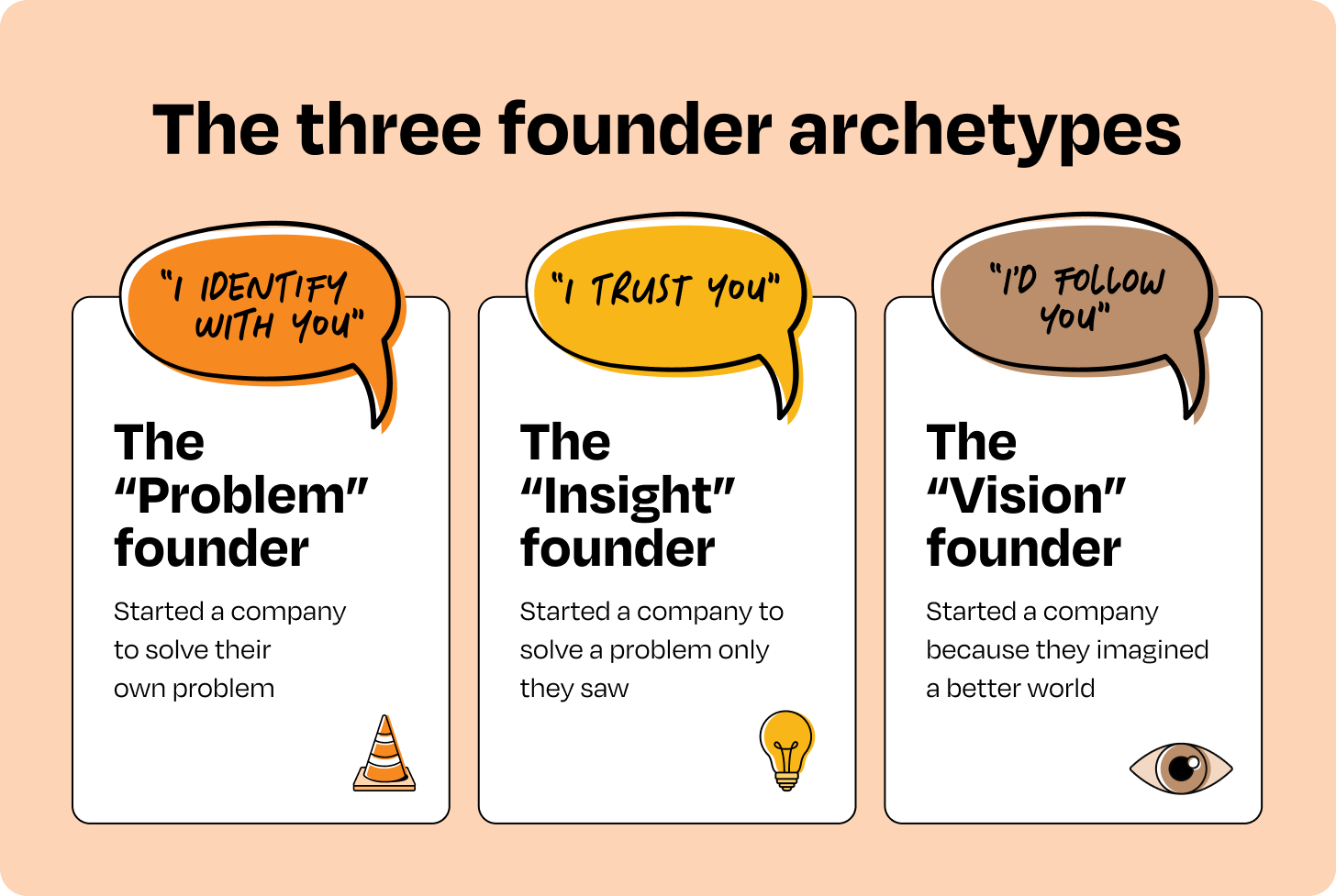
While every founder’s “why” is unique, they almost always fall into one of three categories, each mapping to a founder archetype that can help you define your comms strategy:

The “Problem” founder: The person who started a company to solve their own problem
The “Insight” founder: The person who started a company to solve a problem only they saw
The “Vision” founder: The person who started a company because they imagined a better world
Lumping yourself into an archetype might seem like a counterintuitive way to build distinctive founder content, but the ways people connect with founders map to these three relationships: I identify with you, I trust you, I’d follow you. A unique story makes your content interesting, but your archetype determines which feeling it evokes in your audience, and cultivating the right one for your business requires different strategic choices.
Your founder archetype will guide you to the decisions that matter for a comms strategy:
Goal: What specifically your content strategy is meant to achieve
Voice: How you should sound
Messaging pillars: What you should talk about
Success conditions: How you’ll know if it’s working
What your founder archetype will not tell you are answers to questions like “How often should I post?” Founder comms are like workout routines: the best one is the one you can commit to. Regardless of your archetype, committing to any channel and cadence that works for you beats agonizing over the perfect one. And everything else you might be worried about—audience segmentation, attribution, earned vs. organic media balance—is secondary. You can tackle that once you have a substantial body of content to optimize around.

Archetype 1: The “Problem” founder
The Problem founder is someone who started their business to solve a problem that was personally tormenting them. Think Sara Blakely, who hated how pantyhose looked under her pants, so she cut the feet off them and founded Spanx, or Tobi Lütke, who tried to sell snowboards and got so frustrated with the existing e-commerce programs that he decided it would be easier to build Shopify instead.
What makes these founders compelling is that they understand the customer better than anyone else could, because they are the customer. When you’re solving a problem because it caused you so much pain that you restructured your life around fixing it, you have a unique power to make your customer feel seen and understood. You get to say that you’re working for “us,” not for “them,” and your success becomes “our success.” That narrative is a powerful tool for building affiliation and brand loyalty. The Problem founder has a singular ability to identify as a customer first and business owner second, which should anchor their entire comms strategy.
You’re a Problem founder if: you started your business to fix a problem you were personally experiencing, when you realized the only way to get it solved was to do it yourself.
The Problem founder playbook
Goal: Build a loyal following of customers who feel deeply understood and recognized by your product.
Ideal voice: Personal, honest, detailed, (appropriately) urgent/frustrated
Primary messaging pillar: The centerpiece of a Problem founder’s comms strategy is high-repetition, vignette-style storytelling about their experience with the problem. I think of this as the Taylor Swift method: communicate specific, scene-based details about an experience to evoke universal and strong emotional responses. You should have a well-rehearsed “origin story” that describes your experience with the problem and can be repeated across channels. For that story to connect, it can’t sound like “existing options weren’t working for me.” It needs to be more like “I was crying in my car during lunch.”
Additional pillars:
Product design. The Problem founder has one of the best excuses to talk about the product in granular detail because every feature likely has a personal origin story. Beyond telling the founding story, you should share the experience of building the product, the choices you made, what personal experiences led you to make them, and which features you love the most and why.
Community experience. The Problem founder can also engage and highlight early and devoted supporters of the company by recapping interactions with customers or directly sharing their stories. Share what it meant to you to hear from other people who needed your product. Use their words to explain why your product exists.
Founders who have done this well:
Sara Blakely (Spanx): Her LinkedIn (opens in new tab) posts (opens in new tab) are the template for talking about the problem, even after decades of doing so. If you want to hear what a detailed origin story sounds like in full, listen to her Masters of Scale (opens in new tab) episode.
Dave Gilboa (Warby Parker): His Good Life Project (opens in new tab) podcast episode and Daily Californian (opens in new tab) interview are excellent examples of how to tell the same story across mediums.
Will Ahmed (Whoop): His How I Built This (opens in new tab) episode sounds well-rehearsed but not canned. Check out his original Whoop “Locker Blog” posts (opens in new tab) and this tweet (opens in new tab) for short, effective examples of the written version of this storytelling mode.
Tope Awotona (Calendly): His How I Built This (opens in new tab)episode stands out because he also talks about companies he started just to make money. Listen to the contrast to understand why the personal narrative plays so well.

This Spanx 19th “birthday” post (opens in new tab) is a great example of how to talk about your role in your company’s journey.
Common mistakes:
Overgeneralizing. A Problem founder who wants to decenter their story or who worries their experience is too niche often ends up talking about vague descriptions of the problem that anybody could share. Stay in the details. Remember, you are Taylor Swift, not a corporate sales team.
Slipping into CEO persona. A Problem founder who is busy thinking about the mechanics of their business can end up accidentally talking in the language of market gaps and competitor shortcomings instead of their actual experience. That slip pulls you away from the part of your identity that matters to your customer: your shared challenge or frustration.
Oversharing beyond your story. It’s easy to think that because people care about your founding story, they want to hear about your whole life, but a Problem founder who gets sucked into acting like an influencer can quickly dilute their message. You don’t need to reveal tons of information about your personal life. It sacrifices your privacy without bringing anyone closer to the business.
Best channels: Problem founders play well with organic storytelling opportunities and community-forward environments: social media, podcasts (think: How I Built This or The Diary of a CEO), and profile pieces. Go where your community already is, pick a short-form video platform you can commit to (if you’re willing), and try to get a conversation-style speaking engagement where you can tell your story in full. Then clip and spread it across your other channels. X is not usually your best storytelling channel, and panels won’t always give you space to tell your story. That doesn’t mean you should say no to them on principle, but your time is limited, so try to spend it where you can tell the full story and then syndicate.
How you’ll know it’s working: Customers will start telling you about their experiences in your comments, replies, and inbox instead of just writing “great post!” Followers will share and amplify your content.
Prompts to get you started:
What was the very worst day I ever had with this problem? (Be vivid!)
What was the tipping point when I decided I had to fix this myself?
When did I realize that it wasn’t just me dealing with this?
Once I figured out how I wanted to fix this for myself, why did I feel like I had to fix it for other people too?

Archetype 2: The “Insight” founder
The Insight founder is someone who started their business because they saw or understood something before others did and decided to change it. Insight founders are intriguing because the inciting incidents in their stories usually take the same shape, but the motivations vary widely. Some Insight founders see a better way to do something and recognize the gap as a financial opportunity; others see a suboptimal system and are just so annoyed by the inefficiency that they have to fix it themselves.
Classic examples of Insight founders include Stewart Butterfield, who built Slack because he noticed that the workplace was running on informal communication without a specific product to support it, and Reed Hastings, who recognized that the most profitable part of the video rental business, late fees, was also the part customers hated most.
What makes Insight founders compelling is that they were right—early. Where Problem founders build customer loyalty by making people feel understood, Insight founders do almost the reverse. They make people feel smarter by helping them consider new perspectives, understand complex subjects, and form opinions that they otherwise wouldn’t have come up with. That relationship with customers is a slow build, but it’s a durable one. An audience that believes you understand things others don’t and trusts your read on an industry will borrow your language, repeat your conclusions, and eventually accept your opinions as a reason to believe in your company. Most founders you think of as “thought leaders” are Insight founders, and they’re uniquely positioned to share and debate their points of view.
You’re an Insight founder if: you spotted an incorrect assumption, a broken process, or a mispriced problem—and once you saw it, you dove in to correct it.
The Insight founder playbook
Goal: Build a following of people who trust your opinions and analysis enough to adopt your ideas and believe in your company.
Ideal voice: Clear, analytical but accessible, curious, opinionated, generous
Primary messaging pillar: The core communication pillar for an Insight founder is regular, incisive thought leadership about their industry. It’s easy to believe an Insight founder builds credibility by being right all the time, but the more important thing is being helpful. You can lend credence to your original insight by generously helping people understand other subjects with clear, explicit reasoning. The insight you’ll explain the most should still be the one that sparked your business. Speak about it frequently but not exclusively, so you don’t get branded as someone who was only right about one thing one time.
Additional pillars:
Predictions. The natural extension of sharing opinions about industry changes and events is predicting what happens next. Especially in high-ambiguity moments (like the current AI boom), the Insight founder is uniquely positioned to make a prediction early. If you’re right, it’s a major boost to your credibility, but too many wrong calls will catch up with you, even if you can explain what you misread. Only make predictions that you feel confident about your reasoning for.
Engaging with other thinkers. An Insight founder who only puts out their own takes can come across as interested only in their own thoughts. Interacting with other thought leaders will strengthen your thinking. Debate, share what inspires you, and comment on other people’s posts. This content is easy to produce and shows people you’re learning as much as you’re speaking.
Founders who have done this well:
Aaron Levie (Box): Aaron is the person I think about when I think about founders who do X (opens in new tab) well. He posts (opens in new tab) original insights (opens in new tab), engages with others, and gets basically every part of this right.
Patrick Collison (Stripe): His Atlantic (opens in new tab) byline (opens in new tab) and personal website (opens in new tab) both illustrate how you can generate thought leadership without just talking about your company.
Jason Fried (37signals): His “Why work doesn’t happen at work” (opens in new tab) TED Talk is a brilliant example of explaining without patronizing. Also check out his posts on X (opens in new tab) and his Signal v. Noise essay (opens in new tab) for effective written examples.
Des Traynor (Intercom): The Intercom Blog (opens in new tab) is a strong model for company-hosted thought leadership, especially if social channels intimidate you.
Rahul Vohra (Superhuman): This First Round Review (opens in new tab) byline is a standout example of letting people into your reasoning. Awesome long-form.

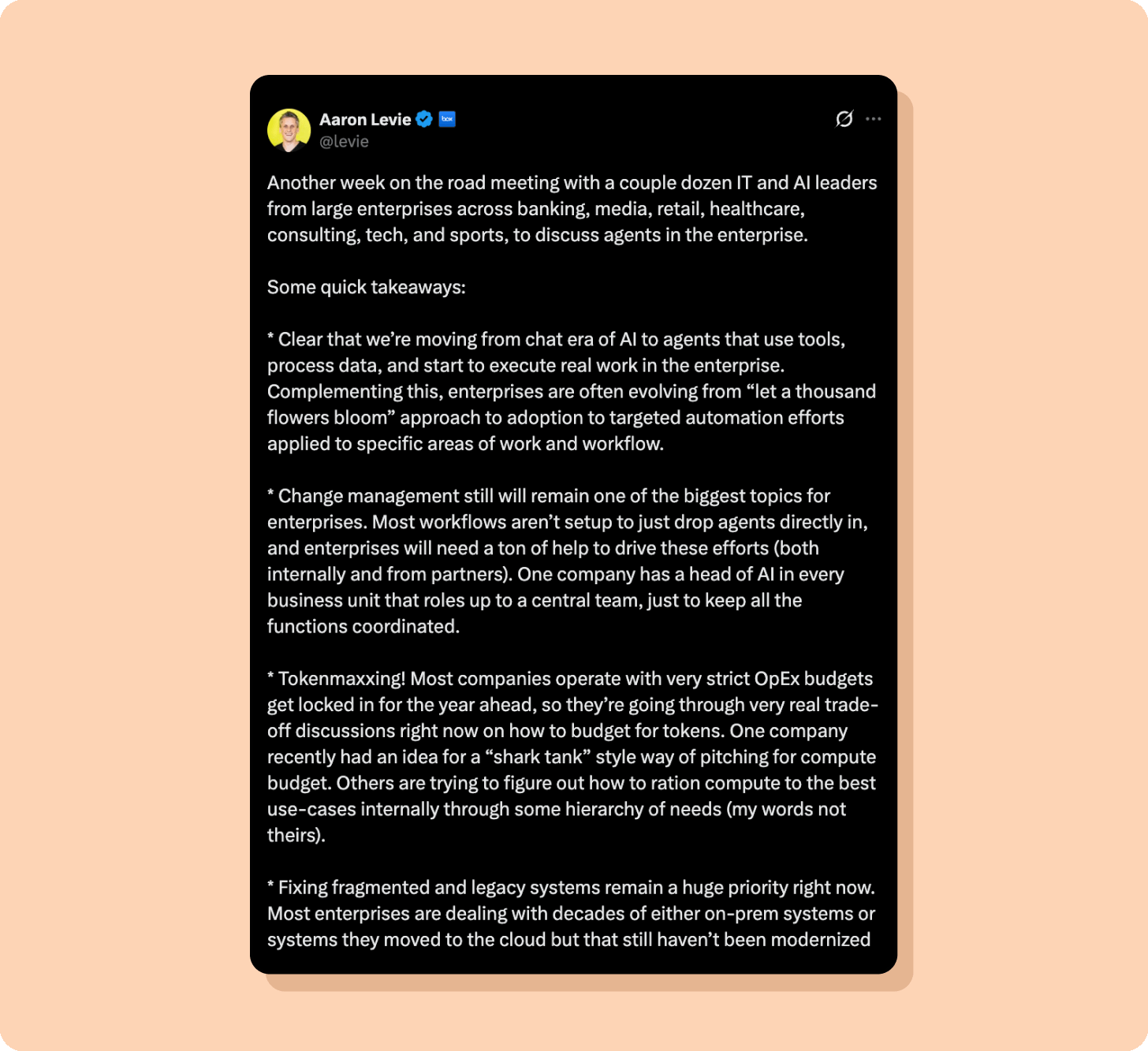
Aaron Levie’s recurring X series where he posts (opens in new tab) about what he’s learning from talking to IT leaders is the best example of an Insight founder using their vantage point to be helpful to others in their industry.
- Common mistakes:
Making people feel stupid. The Insight founder fails most consequentially when their reasoning is unintelligible to their audience or when they make people feel stupid for not seeing what they do. Watch out for being contemptuous or disrespectful to your audience or industry incumbents. Explain why people couldn’t see what you did (what you had access to that they didn’t or why the inertia was strong), not how dumb they were for missing it. Remember, your superpower is that you make people feel smarter. Do so carefully and generously.
Publishing “takes” without reasoning. An Insight founder who is all hot takes without reasoning can build a high-engagement platform and mistake it for a high-loyalty one. Remember that it’s your thinking that people care about and want to learn from. Don’t just shoot out daily hot takes without helping other people understand how to get to those conclusions. It reads as loud, and it makes being wrong more punishing.
Never admitting uncertainty. The Insight founder should be confident enough for others to believe in their reasoning while also admitting when they’re not. You are allowed (encouraged, even) to publish takes about your uncertainty. Especially once you have a larger platform, people find it relieving to hear someone they trust say, “I’m not sure either, but here’s what I make of this so far.”
Best channels:
Go long-form whenever you can: Essays, newsletters, podcasts, and long panels. Best-case scenario, you eventually publish a book if you have a consistent enough thesis. Insight founders need space to explain the nuances of their thinking, so while you should stay present on engagement-heavy platforms like X and LinkedIn, you almost always benefit from some form of regular, long-form content.
My hottest take might be that you shouldn’t use LinkedIn as your platform for that content. LinkedIn rewards conclusion-forward takes, and it’s an AI bloodbath right now, so if you’re going to use it, at least use the newsletter feature instead of normal posts. Short-form video should distribute your long-form thinking, but it’s not a substitute for it.
How you’ll know it’s working: You’ll see your language getting recycled by other people, your reasoning will show up in other people’s arguments, and you will start receiving outreach and invitations to share your thoughts in new formats.
- Prompts to get you started:
What about my life experience, background, and perspective made the idea that launched my startup clear when it wasn’t clear to others?
Why was my industry doing things the way it was?
What are three things about my industry that I find myself thinking about often? What’s my POV on them?
What’s something other people might struggle to make sense of in my industry that feels logical or intuitive to me?

Archetype 3: The “Vision” founder
The Vision founder is the rarest of the founder archetypes, and it is easy for Insight founders to mistake themselves for Vision founders by inflating the grandeur of their own venture. The Vision founder is someone who starts their business because they can imagine a radically different, nonexistent world that others can’t see and builds a company to get there. They’re not always solving a problem, at least not one that feels like a pain point. Steve Jobs, perhaps the most famous Vision founder of all time, didn’t think computers had to be ugly and inaccessible. Yvon Chouinard, who founded Patagonia, wasn’t willing to accept that profit and environmental stewardship were mutually exclusive and started a business to prove it.
Just as Problem founders make us feel seen and Insight founders make us feel smarter, Vision founders make us feel hopeful.We care about them and their companies because they are passionate and determined enough to try to change the world. Their recruits and investors tend to be like-minded, and their customers can feel like followers more than buyers. These founders are often charismatic and a little mysterious, but they are best positioned to make their audience feel like supporting their business is equivalent to being part of a movement.
You’re a Vision founder if: you started your business because you could picture a fundamentally different way the world could work, and a company was your way of getting people there. You are unironically trying to change the world.
The Vision founder playbook
Goal: Build a following of talent, customers, investors, and general supporters who are deeply invested in where you’re going and feel motivated to be a part of it.
Ideal voice: Expansive, certain, hopeful, and plainspoken
Primary messaging pillar: The Vision founder’s communication strategy is in many ways the least obvious of the three. Instead of focusing solely on the vision, it’s anchored in breaking down the assumptions that keep people attached to the status quo. The Vision founder has to disagree with a convention or belief about why the world is the way it is, and it is the disagreement—more than the vision—that makes them interesting. As a Vision founder, your primary messaging pillar is “x doesn’t have to be true,” and it should include fair and generous explanations of why the status quo logic needs revision. This requires repetition, patience, evidence, and thorough explanation, but it’s what prevents the Vision founder’s future from feeling naive and aspirational.
Additional pillars:
The vision (in detail). The Vision founder does need to talk about the future, and this pillar should show up often and across channels. To create a compelling vision, details are the game. “A better way of working” is intangible and uninspiring, but “Never being late to picking your kids up because…” is emotional and concrete. The trick is letting people visually locate themselves in your future and imagine their life in it. Like the Problem founder, you don’t have to speak to every single person; you have to capture an emotion that feels concrete and universal.
Milestones and progress. Launches, partnerships, new releases, and incremental business steps matter more for the Vision founder than the other archetypes. When you sign a partnership or launch a new feature, it’s proof that your vision is possible and you can actualize it. It’s why Vision founders do over-the-top launches and broadcast-scale product announcements. A keynote might not be in your budget, but try to find opportunities to show your progress.
- Founders who have done this well:
Steve Jobs (Apple): This was an internal speech, but his “Think Different” talk (opens in new tab)for employees is one of my favorite examples of being clear on what you stand for. Skip to 6:30 to listen to him talk about Apple’s “why.” It’s fantastic.
Melanie Perkins (Canva): Her “note to the Canva Community” (opens in new tab) illustrates how to make the biggest announcement of your company’s life without making it about you. Her SXSW interview (opens in new tab) showcases that messaging in a keynote setting.
Elon Musk (Tesla): His Master Plan essays (check out Part I (opens in new tab) and II (opens in new tab)) are a perfect example of how to prevent the vision from sounding too grand or naive.
Yvon Chouinard (Patagonia): “Earth is now our only shareholder” (opens in new tab) is top-tier “x doesn’t have to be true” messaging.

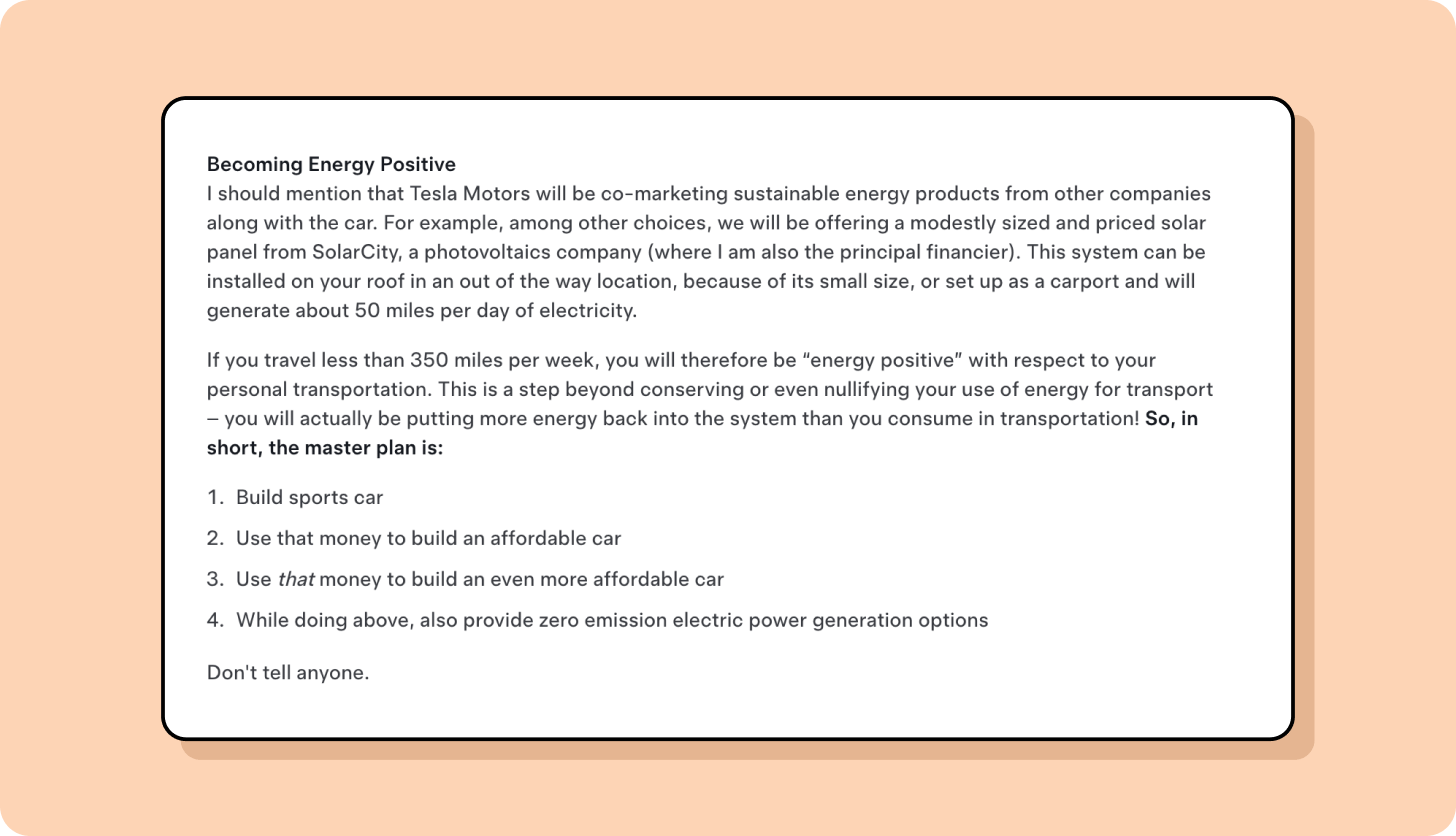
Elon Musk’s “Secret Master Plan” essay (opens in new tab) is one of the best examples of a Vision founder making their idea concrete.
Note: Vision founders are rare, good ones are rarer, and a lot of Insight founders position themselves as Vision founders but don’t actually reach that bar.
- Common mistakes:
Contempt for the status quo. Like the Insight founder, the Vision founder runs the risk of making people feel foolish. Be mindful to steer your tone away from “look at this ridiculous thing you’ve all accepted,” and keep it closer to “it makes sense that you believed that, but here’s what you can believe now.”
Making yourself the protagonist. The worst type of Vision founder is someone who wants to be at the center of the world they create. Although they need to be persuasive and energizing, the Vision founder best serves their vision by staying out of it. Keep your founder-specific content rare and narrow. The goal is not to make people think you’re a genius or aspiring world leader. You want to avoid cult-leader allegations and keep people focused on what you’re trying to achieve.
Talking in scale instead of shape. An excited Vision founder loves to talk about how big the coming transformation is. So much disruption, so many lives changed, etc. But talking about the scale instead of the specifics can make the future feel daunting and less achievable. The “what” is more important than the “how big.” Don’t get lost in telling people how different things will be; just be concrete in your descriptions of what will be different.
Best channels: Vision founders do best with video and audio, and there’s just no real way around that. The conviction you’re trying to build requires persuasive firepower—tone, cadence, body language—and most of your audience isn’t going to absorb that in manifesto form. Keynotes, launch events, TED-style stages, long-form video and audio, and anything clippable are where you’ll thrive. You’re the hardest archetype to run channel strategy for, because your best formats are scarce. That doesn’t mean you should say yes to every speaking opportunity, but any time you have a credible invite to a stage or a mic, take it. You need those opportunities more than the other archetypes do.
How you’ll know it’s working: People will start describing your world back to you in their own words and start championing the vision for you.
Prompts to get you started:
What does a day in my better world actually look like? What’s the best part of it?
What are people currently accepting as normal that’s actually just a choice? Where’d they learn it?
Why do I believe this is possible when most people don’t?
What makes my idea worth believing in, even if it’s hard to get there?
When (and how) to use AI in your content process
Guest author Kristen Lowe, narrative strategist and incoming Director of Founder & Editorial Communications at Scribe, argues founder-led communication is a low-cost, high-leverage way for startups to cut through AI-generated noise; the only thing most founders need is an answer to "Why did I start this company?", and that founding story is the most narratively powerful idea to share .
Her framework sorts founders into three archetypes that map to how audiences connect: Problem (started to solve their own problem → "I identify with you"), Insight (saw a problem only they saw → "I trust you"), and Vision (imagined a better world → "I'd follow you"). The archetype determines the comms goal, voice, messaging pillars, and success conditions — not posting cadence or channel details .
- Problem founders (e.g., Sara Blakely/Spanx, Tobi Lütke/Shopify): goal is a loyal following who feel deeply understood; voice is personal, honest, detailed, (appropriately) urgent/frustrated; primary pillar is high-repetition, scene-based vignette storytelling about their experience with the problem ("I was crying in my car during lunch," not "existing options weren't working for me"), plus pillars on product design (every feature has a personal origin story) and community experiences. Common mistakes: overgeneralizing, slipping into CEO persona, oversharing beyond the story .
- Insight founders (e.g., Stewart Butterfield/Slack, Reed Hastings/Netflix): goal is an audience that trusts their opinions and analysis; voice is clear, analytical but accessible, curious, opinionated, generous; primary pillar is regular, incisive thought leadership with explicit reasoning (being helpful, not just right), plus predictions (especially in high-ambiguity moments like the AI boom) and engagement with other thinkers. Common mistakes: making people feel stupid, publishing takes without reasoning, never admitting uncertainty; favor long-form content over LinkedIn's conclusion-forward format .
- Vision founders (e.g., Steve Jobs/Apple, Elon Musk/Tesla): the rarest type; goal is followers deeply invested in the future; voice is expansive, certain, hopeful, plainspoken; primary pillar is "x doesn't have to be true" — breaking down status-quo assumptions with fair, generous explanation — plus the vision in concrete detail and milestones/progress as proof the vision is achievable. Common mistakes: contempt for the status quo, making yourself the protagonist, talking scale instead of shape; best on video/audio/keynote stages .
Success signals per archetype: Problem founders see customers sharing their own related experiences in comments/replies; Insight founders see their language and reasoning recycled by others and get invited to new formats; Vision founders hear people describe the imagined world back in their own words .