We can't find the internet
Attempting to reconnect
Something went wrong!
Hang in there while we get back on track


🔥 TOP SIGNAL
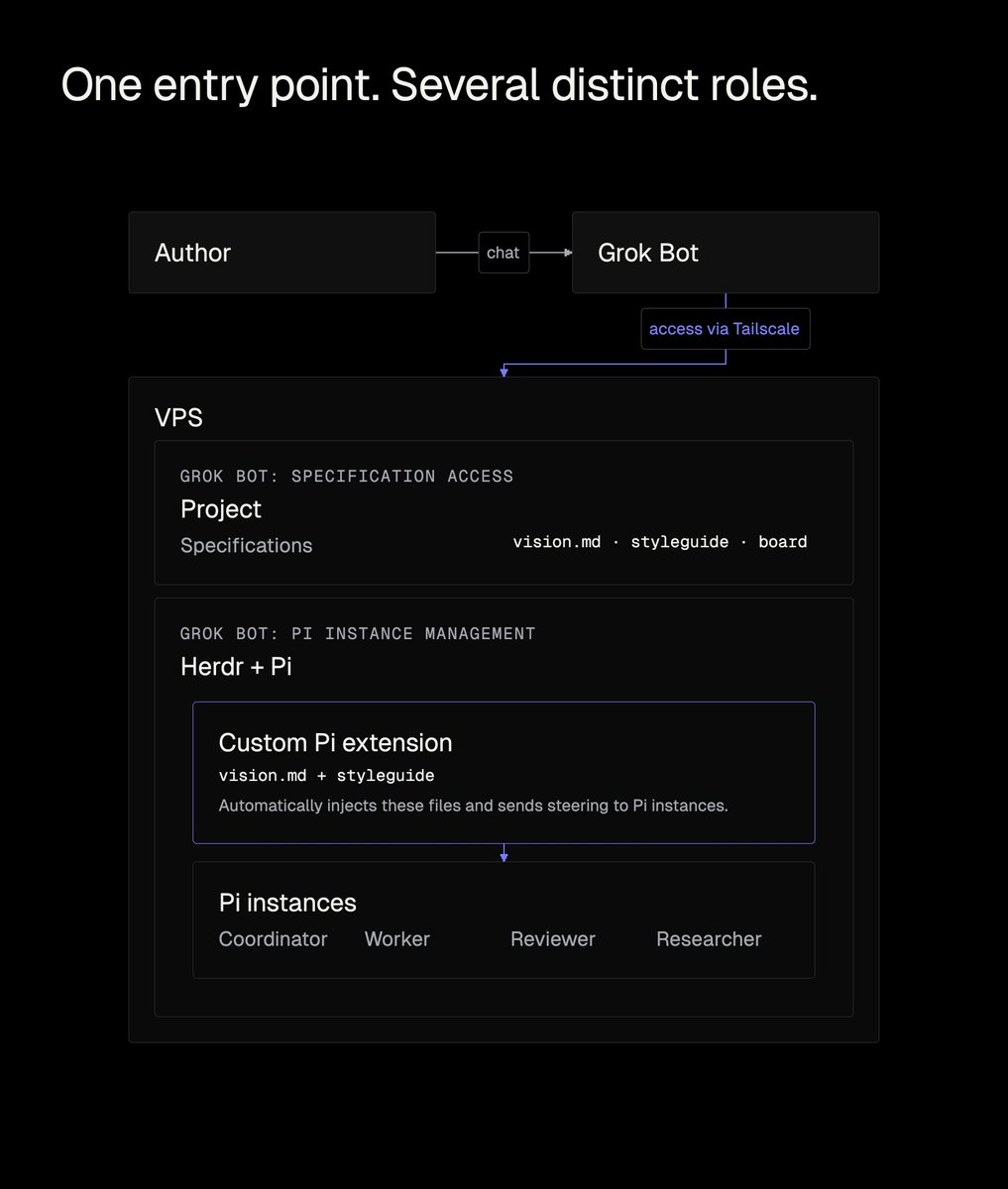
Overment says he scrapped a four-year-old product and rebuilt its app, website, and API in five days; he describes it as a tool people relied on daily and says it had helped generate about $750,000 through campaigns. His account puts the emphasis on the system around the agents: unified logs, an app-connected test surface, persistent project context, and role-based Pi instances steered through Grok Bot.
⚡ TRY THIS
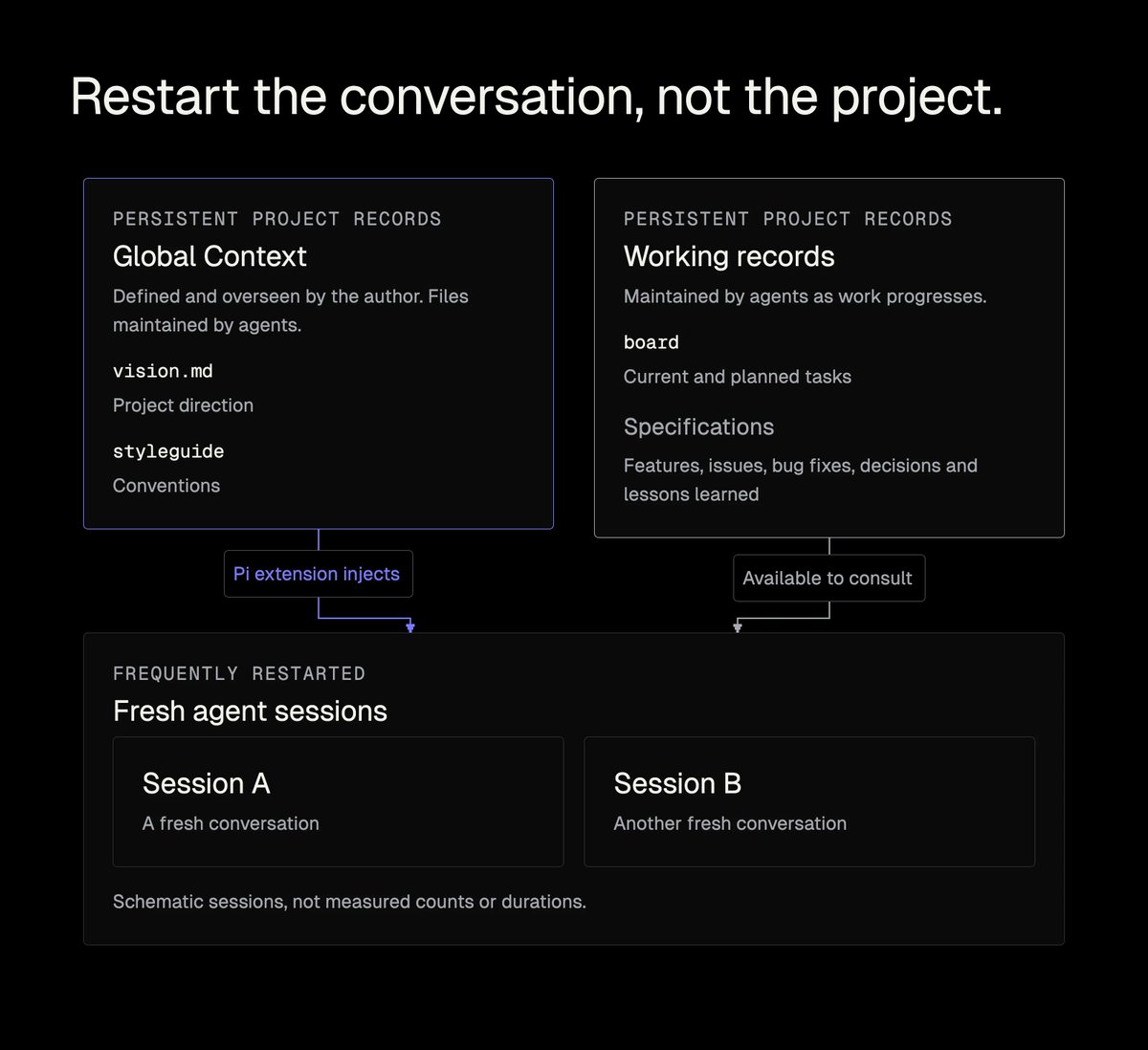
Build the harness around the app. Overment unified API/Rust/Svelte logging and connected a test environment to the app’s webview so agents could interact with it, take screenshots, and collect measurements. He kept a project vision (
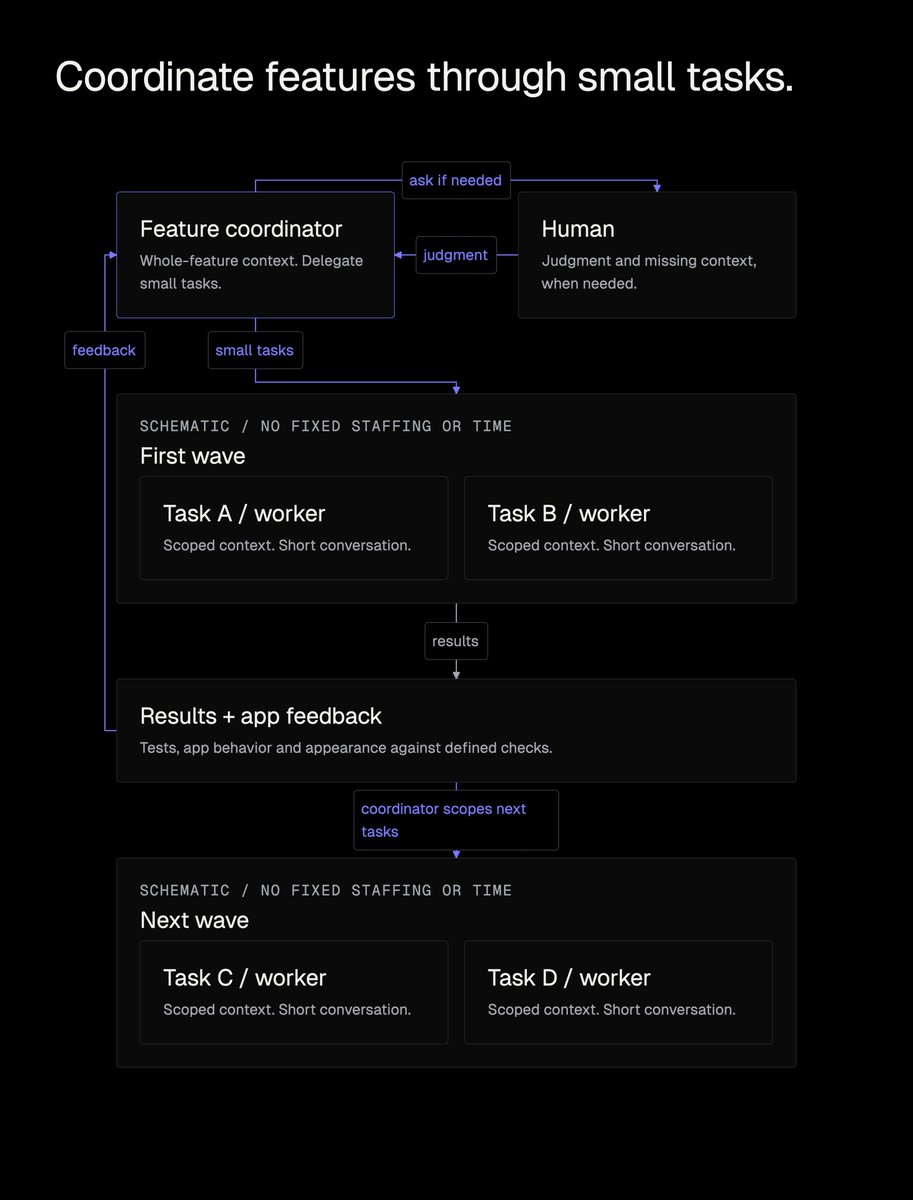
vision.md), style guide, board, and feature/bug specifications available to agents; Coordinators spawn Researchers to draft specs and manage Workers. He recommends narrow tasks and short agent threads.Use formal methods on the risky state machine, not the whole repo. Boris Cherny’s follow-up describes the loop: model a race-prone or otherwise tricky part, find counterexamples, reproduce the suspected bugs, then fix them. He explicitly says this does not amount to formal verification of the entire codebase.
Give computer-use agents a concrete repo-to-PR endpoint. Theo describes Opus 5.5 finding the repository on his machine, recognizing that his local clone was stale, updating it, creating a worktree, opening a PR, verifying the fixes, and merging. It’s a reported successful run, not a general reliability guarantee.
Start a codebase audit with an explicit checklist: “I want you to do an audit around security, performance, accessibility, maintainability, scalability, architecture, documentation, testing, automation, etc.” Kent C. Dodds says Opus 5.5 found a significant security issue other models missed; treat that as one practitioner’s report, not a controlled comparison.
📡 WHAT SHIPPED
Cursor harness efficiency: Cursor reports 7% lower token costs without reduced agent quality. Its engineering write-up says it trimmed roughly 66% of its system prompt as models improved, moved most built-in tools to on-demand loading (most were used in fewer than 20% of conversations), and A/B-tested tool configurations against token use, cost, latency, errors, and overall agent use. On GPT-5.6, explicit cache breakpoints cut cold cache misses by 20%; numbering every tenth line in file reads cut cache-read tokens by 1.6% with no quality loss. Write-up.
Cursor Rollouts: Tracks a change from PR opening through production. It reads the diff and drafts an editable monitoring plan before merge, then compares post-deploy signals with the baseline; depending on configuration, it can notify the author, pause a progressive rollout, or prepare a revert PR for approval. Feature-flag ramping is still listed as coming soon. Available on Teams and Enterprise, with 10 days of trial credits. Details.
Cursor Security Reviewer: Runs on every PR, examines changes in whole-codebase context, and reports vulnerabilities with severity, an attack path, and a proposed fix. Cursor reports average review time falling from 4.8 to 3.8 minutes and comment acceptance rising from 45–50% to 60–70%.
Claude Code cloud sessions are out of research preview. Sessions run on Anthropic-hosted infrastructure, so work continues with the laptop closed; start one with
claude --cloudor from the app. GitHub must be connected. Existing subscribers get a one-time $100 Pro or $250 Max credit, claimable through Oct. 7.LangChain Managed Deep Agents can run on a schedule: add a file under
schedules/with a cron expression and prompt, then deploy; the agent runs itself. Docs.
🎬 GO DEEPER
- Video — DHH on coding with agents for Linux: DHH says agents have been writing his serious production code and that implementations improve when models critique one another. Useful as a firsthand workflow report, not an independent measure of code quality.
- Repo — Overment’s
limen: A custom Pi extension that injects the project vision and style guide and steers Coordinator, Worker, Reviewer, and Researcher instances.
Editorial take: The repeatable pattern is a closed feedback loop: give agents persistent context and a testable product surface, verify changes at the PR boundary, then check production signals after deploy.
Improved token efficiency for longer agent runs
- Cursor reports a 7% reduction in token costs across changes to its agent harness, without reducing agent quality; it does not break down how much of the 7% came from each change.
- Shorter system prompt: As models improved, Cursor removed guidance it considered unnecessary, trimming the system prompt by roughly 66%. It used A/B tests on a large user base to optimize for real traffic, noting that evals can overrepresent hard problems and fail to match the distribution of user requests.
- Load built-in tools on demand: Most built-in tools were used in fewer than 20% of conversations. Cursor A/B tested which tools to leave in static context, tracking token usage, cost, latency, tool-call errors, and overall agent usage. It kept frequently used reading, searching, editing, and shell tools, plus
ask_questionand tools needed for specific flows such ascreate_plan; the remaining tools load when needed. - Improve cache reuse: Since GPT-5.6, Cursor uses explicit cache breakpoints after stable request layers and before the growing conversation. It also keeps rarely changing tools and instructions up front and moves variable setup—including skills, subagents, and environment information—into the “phantom user message” past the breakpoints. Cursor reports a 20% reduction in cold cache misses.
- Compress file reads: The
Readtool now includes line numbers every tenth line rather than on every line; Cursor reports 1.6% fewer cache-read tokens with no reduction in quality. - Use subagents more selectively: Cursor removed prompts strongly encouraging subagents for codebase exploration, since models had learned the pattern, and says this produced more balanced use. It also changed model selection so a subagent uses a different model only when the user or harness directs it. The post notes a coordination tax from context-isolated agents, but gives no separate token-savings or quality measure for these subagent changes.
Bots for the last mile: Rollouts, Security Review
- Rollouts: It follows a change from PR opening through production. The team connects source control, its deploy system, and telemetry; before merge, Rollouts reads the diff and drafts a monitoring plan describing risks, intended effects, and instrumentation gaps, which users can edit. After deployment it compares the plan’s signals with the pre-deploy baseline; if it detects a regression, it identifies the suspected change and proposed response. Depending on configuration, that response can be a ping to the author, a paused progressive rollout, or a revert PR awaiting approval.
- Rollouts is described as catching regressions limited to one endpoint in one region, distinguishing intended effects from regressions, and flagging missing instrumentation before merge. Feature-flag integration for ramping or unramping traffic, and awareness of release trains and deploy freezes, are listed as coming soon—not current capabilities.
- Security Reviewer: It runs on every PR, examines the change in whole-codebase context, and reports vulnerabilities with an explanation and proposed fix. Its approach follows where user input enters, where it ends up, and what it passes through; the post contrasts this with static analysis that pattern-matches code.
- Its out-of-the-box checks include injection, authentication or authorization problems on new and changed routes, committed secrets, unsafe deserialization, unvalidated redirects, vulnerable dependency changes, and insecure infrastructure or configuration defaults. Each finding includes severity, an attack path, and a one-click fix.
- The post reports average review time falling from 4.8 to 3.8 minutes and comment acceptance rising from 45–50% to 60–70%; it does not provide the measurement method or sample details in the supplied text.
- Access: Rollouts and Security Reviewer are available today on Teams and Enterprise plans; either bot can be enabled from the automations tab.

- In his early hands-on testing of Opus 5.5, Theo favors Medium, High, or XH High and advises avoiding Low and Max. In his Skatebench run, moving from XH High to Max raised reasoning use from about 330 to nearly 5,000 tokens per question for only about a 1% score gain; a separate Max run looped for 6.5 hours on a Markdown plan and was only halfway done when he stopped it and switched to XH High.
- Anthropic says typical-workload costs are 40% lower than Opus 5; Theo gives prices of $4 per million input tokens, $20 per million output tokens, and $0.20 per million cache reads. But Opus 5.5 at Max used nearly 120,000 tokens per task in the cited comparison, versus 73,000 for Opus 5 and 27,000 for Astra, so lower prices do not necessarily mean greater token efficiency.
- Theo describes a practical computer-use workflow: he asked the agent to find a cloud project’s repository, recognize that his local clone was outdated, update it, create a worktree, open a PR, verify the fixes, and merge it. He also used computer use to retrieve data from Artificial Analysis while building a model-comparison visualizer.
- In Theo’s codebase-review benchmark, Opus 5.5 nearly doubled Opus 5’s accuracy and reliability, but he still considered it weaker than OpenAI’s Frontier for exhaustive code review—a task he does about every two weeks. For front-end design, he personally preferred Fable’s polish and animation, though Mia reported that Opus 5.5 was her best-tested model after 100 HTML page generations.
- Long jobs can still expose failure modes: while investigating a remote task, Theo saw the agent focus on being 10% from autocompaction and warn that a crash would lose work, which he considered an unfounded concern in that setup. He cautions that his quality assessment was preliminary—day-one testing with roughly five PRs.

- The creator says he uses Fable and Astra with Hyperframe for his own product-launch videos, and uses Astra High in this walkthrough. Hyperframe expresses video as timeline-based HTML/CSS/JavaScript compositions and lets the model capture frames; unlike Remotion’s React/CSS approach, he finds HTML gives models more creative freedom. For setup, he recommends Hyperframe core and related animation/keyframe skills, with its registry and task-specific skills (such as product-launch video) loaded as needed.
- Replicable loop: ask for a text storyboard, refine it around a real user journey and concrete value propositions, then review layout and copy frame by frame before approving animation. Make revisions in small batches and scene by scene; establish pixel-faithful product UI and visual standards in early scenes, then ask the agent to apply them to later scenes. Keep on-screen text short and specify UI states and camera/zoom changes. Existing HTML composition folders can also be given to the agent as reusable references.
- A one-prompt website-to-video attempt took 21 minutes but still looked like slides; the creator says roughly 1.5 hours of iteration produced a version he was happy with. His example suggests treating one-shot output as a draft and using detailed human feedback to improve quality.

- DHH says that while working intensively on his Linux distribution, he had written no serious production code himself for about four months; agents generated the code and, in his judgment, produced better work than he could most of the time, despite his 25 years as a professional programmer.
- His transferable orchestration pattern is adversarial multi-model review: have models critique one another’s implementations, which he says yields especially strong results.
- For Linux troubleshooting, DHH says he had not encountered an issue since around November that an agent could not fix, and that agents explained their fixes; he credits their effectiveness partly to models’ exposure to Linux code during pretraining.

- Matthew Berman reports GPT-6 Luna Max at 66.6% and $0.22 per task on a benchmark he calls his most accurate measure of agentic coding; in a Frontier Code comparison, he reports Luna Max at $0.11 per task, versus $0.80 for GPT-6 Soul Medium and $1.70 for Astra Low.
- He lists GPT-6 Luna at $0.10 per million input tokens and $0.50 per million output tokens, compared with GPT-6 Soul at $2 and $10, respectively. His comparison says GPT-6 Luna, Soul, and Opus 5.5 scored within about 6–7 percentage points on Frontier Code despite multiple-fold price differences, framing the cheaper releases as efficient workhorse models rather than the absolute-performance tier.

- The @_overment rebuild featured by Mega was a substantial practitioner project, not a casual “vibe-coded” side project: he says he scrapped a four-year-old product people relied on and rebuilt the app, website, and API in five days.
-
His setup used Grok Bot as the chat entry point to a VPS over Tailscale, with Herdr hosting Pi instances; a custom Pi extension injects the project vision and style guide and steers Coordinator, Worker, Reviewer, and Researcher roles. He organizes context in
vision.md, a style guide, a board, and feature/issue specifications; agents maintain these files while he oversees the global context. - Feature workflow: record and send Grok Bot an audio brief; it checks the board and active Coordinators, then routes the work to one or spawns one. A Coordinator uses Researchers to gather context and draft a specification, discusses direction with him, and manages Workers; he can steer Workers directly. After each work wave, he discusses project status and technical details with Grok Bot, while scheduled Coordinators handle quality work in the background.
- For observability, he set up unified API/Rust/Svelte logging and connected a testing environment to the app’s webview so agents could interact with it and capture screenshots and measurements. His guidance is to keep tasks narrowly scoped and agent conversations short, and to permit controlled indirect access to production data rather than direct production-database or root access. For the design system, he says Fable 5.1 and Astra worked in Ultracode mode.

- Anthropic made Claude Opus 5.5 the Claude Code default at medium effort; launch coverage reports it is about 30% faster and 40% cheaper per task than Opus 5. The savings are setting-dependent: Opus 5.5 uses more tokens, and the reported max-effort cost is $5.98 per task versus $5.86 for Opus 5; the 40% cheaper claim applies to medium effort. A reported agentic-coding chart showed xhigh effort costing about 2.8× as much as medium while scoring 3.2 points lower; commentary recommended medium and suggested unnecessary changes and scope creep may explain the result.
- Anthropic’s prompting playbook: delegate the whole task, define what “done” means and when to check in, omit “think carefully,” and after a long run ask what the model needs to go further. In Claude Code v2.1.280+, changing effort mid-session does not break the prompt cache.
- OpenAI rolled GPT-6 Sol and Luna out to Codex, ChatGPT Work, and the API, at $2/$10 and $0.10/$0.50 per million input/output tokens, respectively; OpenAI described each as about 50% cheaper than its GPT-5.6 predecessor. OpenAI also announced up to 90% discounts on cached input reads, a Prompt Caching Dashboard, and diagnostics for investigating broken cache reuse—particularly relevant to long-running agents.
- DigitalOcean’s Managed Agents entered public preview with support for Claude Code, Codex, and LangGraph-style agents, plus pause-when-idle runtimes, governed tool endpoints, and 75+ model choices. VS Code Agent Merge introduced an experimental PR mode for automatically resolving review comments, failed checks, and merge conflicts.
- Step Code v0.1.0 launched as an MIT-licensed coding-agent CLI, reporting 80.9% on Terminal-Bench 2.1 and 73.3% on the 150-task long-horizon Multi-Frame benchmark. For agent evaluations, keep the harness controlled: practitioners noted it can materially change benchmark outcomes even with the same model and prompt.

Jerry Tworek says Core Automation uses many agents in its work on large distributed systems, but agents still cannot build “very good distributed systems” by themselves—a firsthand caveat that agent use does not eliminate the need for skilled systems builders.

Simon Willison says he vibe-coded a browser-based, bring-your-own-key Gemini TTS playground with GPT-6 Astra, using the Gemini API’s open CORS policy; composition settings can be bookmarked or shared without the key, which stays in page memory and is sent directly to Google rather than saved to browser storage.
Fable 5.1 Medium was prompted with “Build an artifact to explain shadow roots in CSS with interactive examples” to produce an explainer covering style encapsulation, inheritance, slots, parts, and JavaScript access—a concrete single-prompt artifact-generation example, though the source does not describe an agent workflow.

@hraness reports that his software factory uses 5–10 billion tokens per day, with 24 Devin SWE-2 Max agents, 6 Codex Astra Ultra agents, and 2 Claude Code Fable Max agents, running in Zed; this is a first-person usage claim, not a reported productivity or product-quality result.
ThePrimeagen counters that software factories and “factory factories” are nearly always useless beyond demos, saying he has not seen them produce anything worthwhile from a real-product perspective, while qualifying his view with “I could be wrong.”

Claude Code cloud sessions are now generally available: start a task, close your laptop, and let it continue running. Addy Osmani shared the announcement; this is a product update, not a firsthand workflow report. Existing subscribers get a one-time trial credit of $100 on Pro or $250 on Max; claim it here.

- Primogen endorses Mitchell Hashimoto’s “whiteboard defense” as a responsible-AI standard: engineers should be able to explain a customer-facing system and defend its design, including why one approach was chosen over another, how an actor might behave maliciously, what data structure is used, and where the system fails—without needing line-by-line familiarity.
- His practical takeaway is to stay actively involved in AI-assisted development: ask questions, set guardrails, and push back on ship-at-all-costs demands rather than approving code without understanding it. For learning, he says he personally writes code by hand to understand specific libraries and major architectural decisions, because reading documentation alone does not give him the same understanding.

Simon Willison built a small UI for Gemini 3.8 TTS, then had Claude write a script for a generated conversation between two pelicans debating a move to Pacifica Pier; the project is Gemini TTS playground.
Addy Osmani says Opus 5.5 is his new daily driver, describing it as “Fable-level on most work” and cheaper and faster than Opus 5; this is a first-person endorsement, not a benchmark or detailed workflow report.
Claude Code cloud sessions are out of research preview and keep working when your laptop is closed; they run on Anthropic-hosted infrastructure and can be started at claude.ai/code, from the Claude mobile app’s Code tab or desktop app, or with claude --cloud in the CLI. Existing subscribers get a one-time cloud-session credit—$100 for Pro or $250 for Max—that is separate from usage limits and applies automatically; if a local limit is reached, work can continue in the cloud until the credit runs out. Claim the credit through the provided link or /claim-credit in the CLI by Oct. 7; GitHub must be connected to start a session.
Simon Willison reports using datasette-mcp to talk by voice with a backup of his blog through the ChatGPT iPhone app—a firsthand example of exposing a personal data source to ChatGPT via MCP, though not a coding-agent workflow.
Luke Diebold says the “skills repository” framing made the packages concept click; he usually chooses MCP because it is easier to set up than skills and avoids repeating setup across environments, where API-token management for skills can be a hassle. He says this lets him move between AI tools with Kody as the only MCP he needs.
ThePrimeagen argues that AI’s speed is not a reason to skip product judgment or ship unconsidered work: developers should challenge what a feature is for, how customer success will be measured, and what alternative solutions have been considered . He recommends spending a day exploring options and forming a reasonably sound architecture before production, and pushing back on deadlines that make a 24-hour delay seem fatal .
Kent C. Dodds argues that a good harness can keep coding agents useful through massive conversations and regular compaction; he says he has not experienced the “dumb zone” with Cursor, whose agents he considers good at this.