What’s the point of content knowledge when you can teach skills instead? Scotland decided to find out.
In 2011, Scotland destroyed its secondary school curriculum, once ranked among the best in the world. It was not the first country to do so.
Between 1990 and 2010, Sweden, France, Germany, Japan, and England — among many others — radically reformed their school curricula to emphasize general skills over content knowledge. In Scotland and France, the reforms were orchestrated by left-wing progressives committed to social equity; in England and Sweden, by free-market devotees as a means to enhance economically valuable skills. In Germany and Japan, the impetus was simply to update the school curricula for modern economic conditions. All of the reforms had the same logic: Remove facts, content, and structure, and replace them with general analysis and synthesis tasks.
These reformers discarded the traditions their predecessors had built over the previous century. Children in Scotland, France, and Sweden no longer study a humanities curriculum resembling that of their parents or grandparents; nor do they necessarily study anything resembling the curriculum of their peers in neighboring schools. Any sense of a collective tradition, going forward or backwards, unifying a country or a people, has vanished.
The loss of these traditions might have been justifiable had they achieved the goals of the reformers. In each country, however, the reforms have been accompanied by sharp declines in reading, writing, and mathematics competencies. Socioeconomic inequality between pupils has not fallen: In Scotland, for instance, it is now greater. Yet the reforms have not been undone. Rather, their defenders call for intensification.
This piece attempts to explain why education researchers, civil servants, and teachers across the political spectrum came to believe, and continue to believe, that removing knowledge from school curricula would fix their education systems. It does so through a close study of Scotland’s education system, in particular the English literature curriculum, using a series of interviews with retired civil servants and a close study of over a century of past exam papers.
It is also a personal reflection: I was a student in the Scottish education system from 2011 to 2017 and experienced many of these changes firsthand. It was only a decade later, when I was training to be a teacher, that I realized what had been done to the Scottish curriculum.
The Great Tradition
Scotland was once famed for the quality of its schooling. In the 18th century, lowland male literacy rates were among the highest in Europe, in part due to Scotland’s system of broad parish schooling.[^1] A century later, the generalist curriculum of natural and moral philosophy taught in Scottish universities, intermingled with Glaswegian industry, was producing scientists like Lord Kelvin and James Clerk Maxwell. Scotland continued this tradition into the 20th century, with the top 30% of Scottish students ranking at the top of the 1960s, ’70s, and ’80s international education studies.[^2] All of this was marked by a strong sense of national pride for what the Scots called their Great Tradition.
The Great Tradition was distinct from the curricula of England and other European systems. First, it was unusually committed to a common course of subjects. Until 1951, a Scottish high school student could only graduate by passing all the subjects in the Group Certificate, comprising English, mathematics, a natural science, and a modern language. Second, it placed special emphasis on systematic principles unifying the common course. At university, these principles were provided by moral philosophy, while at secondary school English literature served this role.[^3]
What pupils were taught followed from a pair of all-important exams: the Lower and Higher School Leaving Certificates. Both were designed with close input from university academics; in the case of English literature, they were designed to match the syllabi of the four ancient universities of Scotland. The Higher Literature SLC exam in 1961, for example, included mandatory questions on Shakespeare’s plays and Chaucer’s The Canterbury Tales; optional poems by Burns, Fergusson, Dunbar, and Henryson; and, further south, to be identified by poem rather than by name, Pope, Auden, Milton, Gray, Goldsmith, Wordsworth, Keats, Tennyson, Browning, Yeats, and Thomas.
That same 1961 exam had optional questions on famous nonfiction stylists and essayists like Bunyan, Swift, Boswell, Macaulay, Bacon, Addison, Steele, Goldsmith, Lamb, Hazlitt, Stevenson, Chesterton, and Beerbohm. The range of novels on offer was similarly impressive, including Austen, Scott, Dickens, the Brontë sisters, Thackeray, Hardy, Stevenson, Conrad, Joyce, and Woolf, all to be identified exclusively by characters in their books. For those unfamiliar with 19th- and 20th-century British literature, this is an exceptional range, certainly beyond a contemporary first or second year undergraduate course.
In 1962, around a fifth of pupils made it into a Higher or Lower course, and 10% to 15% passed the courses needed to get the full group certificate.[^4] A further quarter received qualifications at the mid-secondary level, in tests roughly equivalent to the modern Higher today, and almost all pupils made it through elementary school. This matters because the expectation of deep knowledge was held for every level. A school inspectorate report from 1905, for instance, described the work like so:
In… seven months, [a] 13-year-old working class girl, and the teacher, revised with the whole class The Merchant of Venice, A Christmas Carol, The Talisman, The Abbott, Enoch Arden, Evangeline.
A reading course this developed would be remarkable for a modern Higher class and unthinkable for an elementary student. For 20th-century teachers, however, this course was ordinary. As Jonathan Rose records, the average quality of reading was much higher, with Scottish weavers and Welsh miners casually reading Shakespeare and Homer for pleasure.[^5] The school curriculum could take this foundation and go much further.
In addition to their literature classes, Scots learned about English grammar, philology, and literary history. They were taught the historical origins of words; the advantages of one grammatical construction over another in precision and accuracy; and how the geographical-historical context of authors, combined with their personalities, might inform their choice of style and subject. All of this linguistic and literary knowledge was connected to other subjects. The Higher paper from 1926, for instance, could set a question like the following:
-
“The angles at the base of an isosceles triangle are equal”
2. “In a straight-edged three-sided shape having two sides of the same bigness the openings between these two sides and the third side will also be of the same bigness”
The examinations were also more philosophically interesting. Composition essay prompts provoked pupils with questions about the development of civilization and moral progress (or degeneration); reactions to new technologies; appraisals of changes to artistic and aesthetic standards; and commentary on the destiny of Britain:
Without war, the world would deteriorate into materialism. Somehow or other, courage of the ancient, heroic, physical kind has been preserved in the modern character. Is war the only condition that calls it forth? (SLC 1912)
The composition question was the most long-lived aspect of the Great Tradition. Scottish students faced prompts on steam, petrol, nuclear power, and eventually microcomputing as the decades rolled on. These exam papers, alongside other curricular documents, present a tapestry of the Big Questions of Scottish society. Students were asked about “the impossibility of war” in 1914, whether the “chances of adventure are growing greater or less” in 1929, the great promises and dangers of atomic power in 1956, and the “Faustian powers of the research biologist” in 1970.
As the comprehensive school reforms of the 1960s progressed, the Great Tradition was expanded and modified. The Higher examination was made easier, reducing the expectation of literary knowledge, while new intermediate examinations were introduced for less capable students — the Ordinary Level and Standard Grade. At the very top end — for those who would have acquired the full group certificate in 1920, for instance — a new examination was developed: the Certificate of Sixth Year Studies. By 1986, these reforms had greatly widened the old course: 50% went on to Higher examinations, with 33% of the population passing at least one Higher.[^6]
No course anywhere today, at any level of institution, possesses the interdisciplinarity of this course. Not even those in Scotland, home of the Great Tradition. We rapidly destroyed our curriculum in the late 20th century. In 1991, the exceptional Higher composition paper was removed because it was seen as too difficult to mark and unjustifiably open-ended. In 2000, the practical criticism questions were cut and the literature questions were ruthlessly standardized. Once the most recent 2011 reforms were completed, nothing from the old tradition remained.
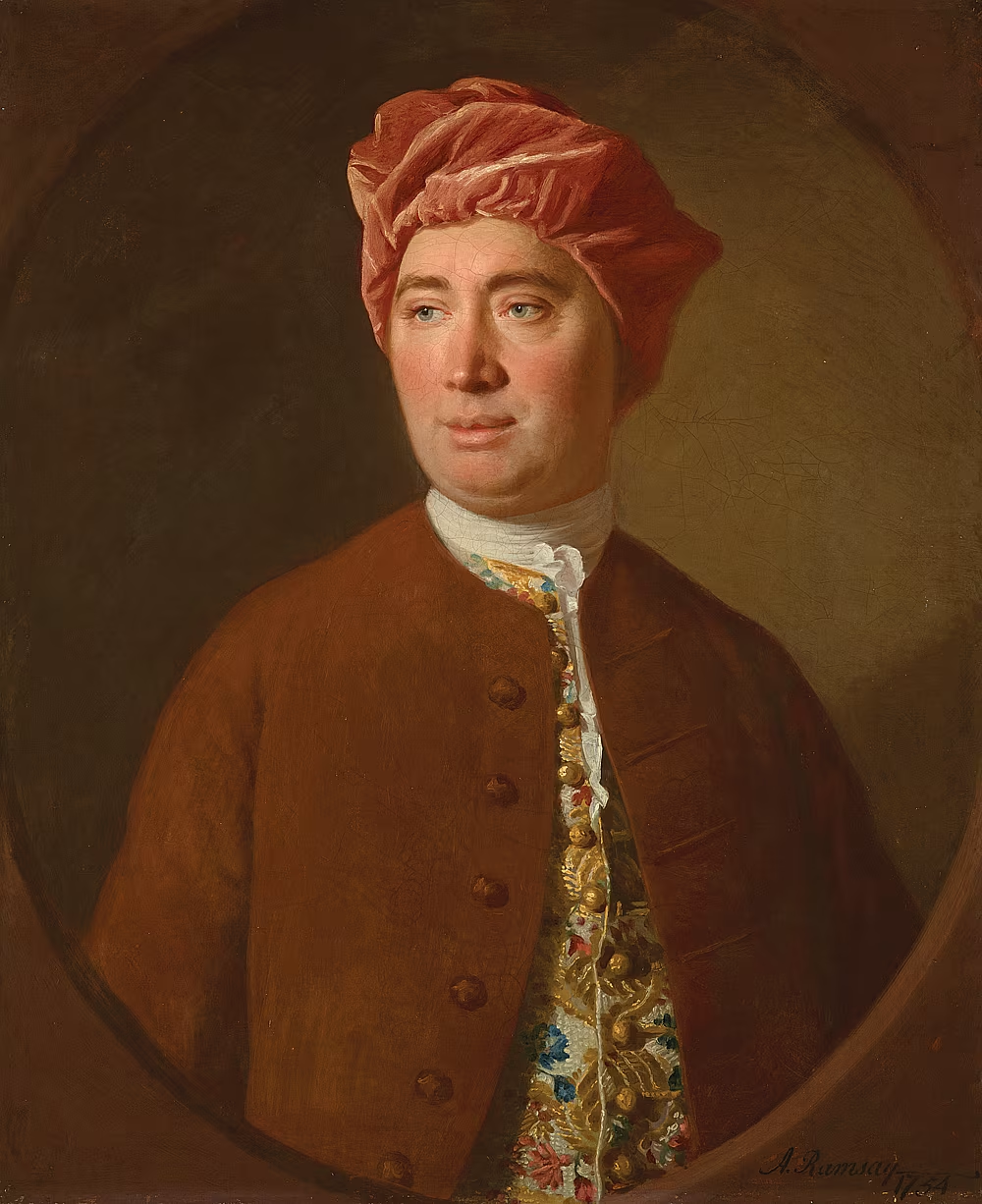
Allan Ramsay, Portrait of David Hume (1711–1776). Courtesy the Scottish National Portrait Gallery.
A curriculum for excellence
To give a flavor of the post-2011 curriculum, here is the reading list for my final two years of secondary school, ending in 2017:
Romeo and Juliet by William Shakespeare
Of Mice and Men by John Steinbeck
Tess of the D’Urbervilles and The Mayor of Casterbridge by Thomas Hardy
The Crucible by Arthur Miller
The Cone Gatherers by Robin Jenkins
Uncle Vanya and The Cherry Orchard by Anton Chekhov
Studying these texts as a group is almost impossible for a secondary school class. There is no attempt to curate works with mutual influence, shared context, or common needs and events they might be responding to. My historical curriculum was similarly fragmented, covering the transatlantic slave trade; 19th-century German unification; Nazi Germany; the Scottish Wars of Independence; and the Russian Revolution (in that order). All my subjects were scattered, from the chopped-up modules of chemistry and physics to the mathematics lessons stripped of all conceptual vocabulary.
This uneven diet was the result of a major education reform carried out in the 2010-11 school year known as the Curriculum for Excellence or CfE. According to the new curriculum, the learning objective for the student of English literature is to develop “an awareness of the relevance of texts in my life.” [^7]
There is no mention of acquiring knowledge, developing taste, or becoming encultured in a literary tradition.[^8] It is entirely pupil-focused, even framed in the first person, and success is defined purely subjectively. In the words of Keir Bloomer, member of the CfE review group: “We are now more concerned about what young people are able to do, more concerned with understanding and skill and less concerned with the ability to regurgitate factual content.”
Among education academics, the CfE’s design is typically referred to as a “skills-based” model.[^9] Its premise is that “general thinking skill” is a real and important aptitude which cuts across disciplines and contexts of knowledge. Curricula and examinations inspired by it tend to treat the content of lessons as essentially fungible, passing through the heads of children as a means to build up these skills, little different from, say, the weights at a gym or the food in a meal.
Due to the emphasis on skills training over knowledge in the CfE, the post-2011 curriculum is much thinner than the old tradition. A literature student no longer receives a “sound training in their mother tongue,” as the 1950s phrase went, but acquires “credit points” in atomized Scottish Credit and Qualifications Framework units classified by skill, such as “Communication NC” or “Literature 1.”
Skills-based curricula avoid giving guidance on content, either because it is too politically controversial or too costly to devise, and thus are unhelpfully vague. The ensuing vacuum produces a greater emphasis on formal testing: Because critical thinking skills have no particular content, the English lesson must be oriented toward the tests that define their successful acquisition. To be “good at English” literature in a skills paradigm means mastering the marking rubric and “scoring points,” typically through rudimentary formulas like “point, evidence, analysis, link” or by providing “two pieces of evidence.”
Any sense of an inherited tradition has drained away. Literature 1 and Communication NC are fully independent units which “can be delivered on their own or together to provide a programme of study.” Meanwhile, in examination, students can answer questions using any individual book, play, or poem. Following the media studies movement in the 1980s and 1990s, students can now answer questions on any movie or television drama. I remember the older brother of a friend answering a question using an episode of the medical drama Casualty which he had seen the night before. All that mattered was that he could provide evidence for how a particular “medium of idea communication” successfully “met my needs and expectations.” English, stripped of any sort of hierarchy of values or specific content, has become blank:
-
Take any one of the following and show how it reflects the character of its author and of its age: — The Pilgrim’s Progress, Gulliver’s Travels, The Vicar of Wakefield, Speech on American Taxation, Waverley, Heroes and Hero-Worship. (Higher English, 1935)
8. Discuss how significant themes are introduced and developed in two novels. (Advanced Higher English, 2025)
Where did all the knowledge go?
Getting from the 1935 Higher exam to the 2025 Advanced Higher version was a slow process traced by many developed countries concurrently. In brief, Scotland and its peers fell victim to an unfortunate affinity between an erroneous pedagogical theory and political incentives on both the right and left.
The theory is well intentioned and intuitively attractive. The moderate form of this argument, made by John Dewey in 1916 and Alfred North Whitehead in 1929, was that students in a dynamic modern society needed to spend less time memorizing and more time on discovery, inculcating the habit of practical, active thought. Nonetheless, both Dewey and Whitehead regarded knowledge as an important component of these skills.
The modern interpretation of “general thinking skills” in education, known broadly as the “skills-based model,” has taken the recommendations of Dewey and Whitehead further than they ever considered prudent. At its furthest extreme — found in, for instance, the 1989 French curricula and the 2011 Scottish curriculum — skills-based reform assumes general thinking skills can be taught independently from any particular body of knowledge. The skills gained through English, history, politics, and philosophy: All of these are actually the same general skills of “synthesis, analysis, evaluation, and communication.” What matters is the inculcation and assessment of formal “capabilities.”
If treated as a falsifiable theory, the modern skills-based model would merely be an unhelpful dead end. Unfortunately, the theory also has close affinities with several major political ideologies. On the progressive left, it is attractive because it respects the “true self” of the child, providing them autonomy and freedom to grow naturally away from a constraining, deadening pile of content. Further, it dodges the evils of a communal curriculum, avoiding both the reproduction of class codes in language and a chauvinistic sense of national identity, and is therefore taken as a means for achieving social equity between pupils.
On the economically liberal right (or “progressive right”), skills-based pedagogy is seen as more efficient. Teaching classics, or an elaborate cultural curriculum, appears a poor way to train and assess economically significant skills. In addition, later vocationalists would argue, skills can be more easily converted into “modules,” allowing for student choice, and if the free market teaches us anything, it is that free choice produces better outcomes than central planning.
Scotland is an ideal case study because it was influenced by both forces during the past century. The first set of reforms occurred in the postwar era between 1960 and 1980. Left-wing progressive reformers removed technical knowledge from the English curriculum ceaselessly after the war: Philology, literary history, and grammar were all cut. In their place, the reformers emphasized everyday uses of English, sincerity in the analysis of texts, “project work,” and child-centered teaching.[^10] In 1969, all specific references to authors — except Shakespeare — were taken out of the literature paper, blurring the contours of the inherited canon. These changes were designed to make the curriculum relevant to the larger postwar secondary population, implicitly seen by the reformers as less “bookish” and “academic” than the pre-reform minority.
The reform had powerful support from progressive teaching training colleges, governmental research groups like the Central Committee on English, and statutory reforms toward more child-centered pedagogies at the primary level.[^11] Nonetheless, a deep cultural conservatism remained at the heart of the system. The most important lever of reform in Scotland was (and remains) the central examinations, controlled by the Scottish Examination Board. The SEB hired part-time teachers as its examiners; these men and women had uniformly scored highly in their Higher literature exams, often inspired by particular teachers from the 1930s and 1940s.They had then gone on to study literature at one of the ancient Scottish universities, and proceeded to teach English at the best schools in Scotland.
Filled with its most successful products and devoted acolytes, the SEB defended the Great Tradition, guarding the “Holy of Holies,” the Higher paper. Indeed, much of the early movement, although progressive on the surface, remained surreptitiously loyal to the Tradition. The Central Committee on English was culturally elitist, recommending teachers use “great masterpieces” in class and railing against “T.V. serials; comic-strip adventures; sensationalist novels.” [^12] Interviews with the English examiners of the 1970s and 1980s showed the same pattern. One elderly teacher, previously head of the English panel, summarized the subject as follows: “English means rigor! Rigor and hard work!”
Things started to change in the late 1980s and early 1990s. The old guard on the Examination Board from the 1950s and 1960s were retiring. Their successors, products of the reformed curriculum and influenced by market-based vocational education, were skeptical of the messiness of the old Higher. In interviews, these examiners argued that the traditional literature exam was difficult to mark given its imposing content; placed an excessive burden on teachers and markers; and took the examining teams more time to design. Further, they argued pupils and teachers disliked how unpredictable it was. Better “consumer satisfaction” for exam-preparing pupils and exam-teaching schools could be achieved by standardizing the questions:[^13]
-
Choose a poem which you enjoyed because of surprising features of its language. Identify the features which surprised you, and go on to explain, with close reference to the poem, how you came to enjoy it. (Higher English, 1994)
The trend toward standardization was accelerated by another event: the merger of the SEB with the Scottish Vocational Education Council in 1997. The latter institution was a well-funded quasi-corporate public body responsible for issuing vocational qualifications, such as carpentry, welding, and cake decorating. Each subject in SCOTVEC’s curricula was split into “competences” which could be individually assessed and accredited, such as “components of communicative competence,” or “skills for personal and social development.” Typical of many Thatcherite organizations, its chairman and “C-suite” were occupied by those with experience in business rather than teaching or academia.
Members of the SEB regarded SCOTVEC as an institution “filled with suits,” and were skeptical of the quality of its certifications.In turn, SCOTVEC staff considered the SEB to be elitist, condescending, and precious about their Higher exam. In the end, the suits prevailed. The merged organization, the Scottish Qualifications Authority, was staffed predominantly by SCOTVEC executives, so much so that several ex-SEB members referred to the merger as a “hostile takeover.” The examination culture of the SQA thus reproduced the vocational philosophy of SCOTVEC, and subsequent exams became far more focused on analysis skills.
By the 1990s, the Lower (recast as “Standard Grade”) and Higher already bore little resemblance to their 1950s predecessors. In 2000, the last named author in the exam — William Shakespeare — was expunged. Yet there was still more knowledge to remove. The latest reform, this time pushed from the progressive left, was the Curriculum for Excellence in 2011. Its consultation was very wide, drawing in support from academics, the inspectorate, local authorities, and the major teaching unions. It also coincided with an important third force: an OECD report in 2007, which exerted a powerful influence on Scottish policymakers who wanted to update the curriculum for “21st century needs.”
The report — heavily influenced by the French sociologist Pierre Bourdieu — found Scotland had unacceptable levels of educational inequality and claimed it was produced by overemphasis on structured knowledge in the place of a more holistic skills-based approach. In the words of the report, the Scottish system’s problem was that it was “mainly academic,” and had an excessive “academic culture” at schools. A “strong emphasis on examinations in subjects of an academic or general kind favors” what the report called “middle class aspirations.” [^14]
The Curriculum for Excellence consultation group followed these recommendations closely, abandoning knowledge and turning wholesale toward a subjectivist, skills-based model; in doing so, Scotland retraced steps France had taken two decades earlier. In 1989, the French Socialist Party dismantled France’s knowledge-rich national curriculum (programme scolaire) in favor of local curricula designed and implemented by progressive teacher training colleges. Like the Scottish reformers, they were convinced by an expert report — authored in part by Jacques Derrida and led by Bourdieu — which suggested middle-class knowledge would alienate and disadvantage working-class students. Thus, the French discarded a previously successful and centuries-old tradition and, like the Scots today, had to ask themselves an important question: Were the reforms worth it?
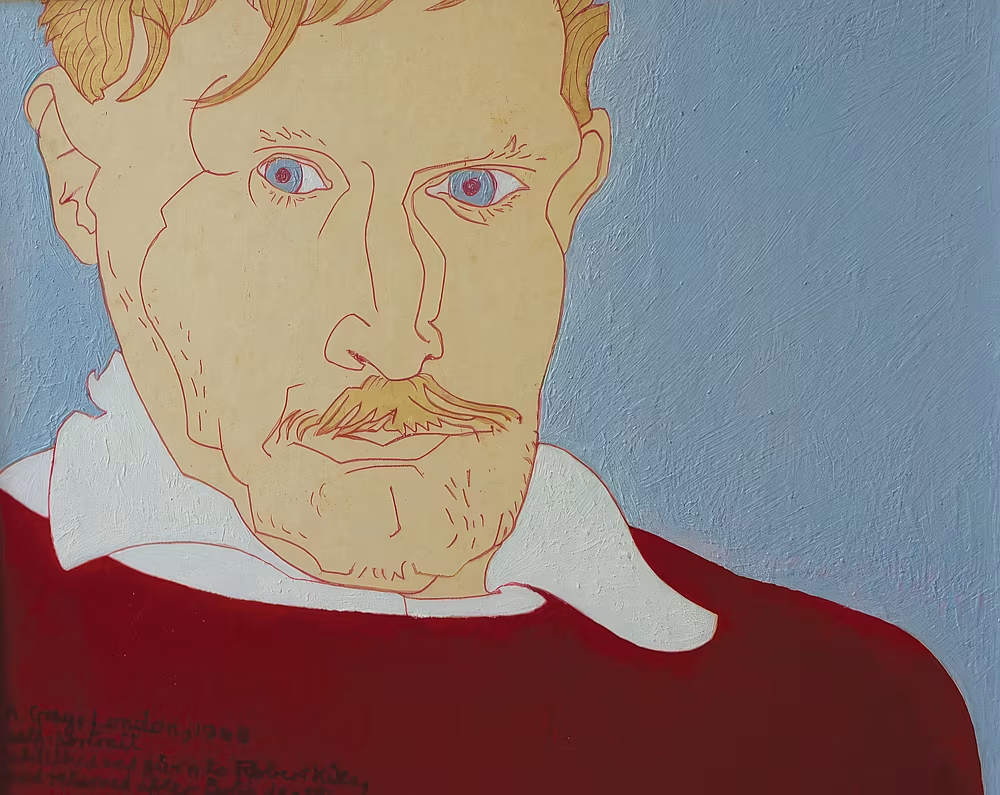
Alasdair Gray, Self Portrait, 1968, red biro tinted with acrylic. Courtesy of the Estate of Alasdair Gray.
The best laid schemes
Scotland’s international education scores have fallen almost ceaselessly since the 2000s.[^15] The modest reduction in socioeconomic educational inequality between 2012 and 2018 was driven primarily by the high-status students’ scores falling faster than their low-status peers.[^16] Then, between 2018 and 2022, even this “narrowing” has vanished, with low-status Scottish students’ scores in mathematics, science, and reading plummeting. Although Scotland remains above the OECD average, 15-year-old Scots are now scoring well below those of the corresponding groups in England whose scores have remained mostly stable.
Scotland appears to have destroyed its traditional curriculum for nothing. Worse, it is likely the skills-based reform was not merely inefficacious but actively harmful. Determining causation is difficult in the context of education reforms, but there are indications, both theoretical and in international comparisons, that the skills-based reform has harmed Scotland’s pupils.
Consider the theoretical assumption at the heart of modern skills-based pedagogy: “general thinking skills.” Expertise studies suggest no such skill with any meaningful effect exists.
Instead, the vast majority of expertise lies in specific knowledge domains, and far transfer between them is small. In the subject of English, for example, a child’s ability to analyze complex texts appears to depend primarily on their preexisting knowledge of the material the text covers — say, chemistry, history, or politics — rather than their mastery of general reading strategies and skills.
Turning to international comparisons, the same pattern of skills-based reform followed by literacy and numeracy declines shows up in many countries. Quebec introduced a skills-based curriculum in staggered phases between 2000 and 2010. Comparisons in 2014 of pupils who received the curriculum and pupils who didn’t showed falls in mathematics attainment for the former across all ability levels. Japan, after implementing a Western-style skills-based curriculum to meet “21st century needs” in the 1990s, also found a drop in performance, remedied by a return to their traditional knowledge-based model. Similar declines occurred in England and Sweden during the 1980s and 1990s after the center-right parties implemented skills-based curricula on market principles. In France, literacy and numeracy scores fell so substantially, especially among the lowest socioeconomic classes, that it was called “the crisis of the school.”
Despite the theoretical and international counterevidence to the modern Scottish curriculum’s philosophy, it appears to be here to stay. At an institutional level, skills-based education remains the orthodox pedagogical theory in British university education departments and within teacher unions. The OECD remains fervently committed to its principles, even criticizing Scotland for failing to fully implement its recommendations. The Scottish government, along with the teaching unions, claims the educational decline is attributable primarily to COVID (despite England, in similar conditions, doing significantly better).
The lengthy consultation process for the Curriculum for Excellence has given it a broad coalition of allies, from the unions, inspectorate, local authorities, and universities to the Scottish Qualifications Authority and major left-wing parties. This coalition, in addition to the fact that Scotland remains above the OECD average, makes the CfE almost impossible to dislodge.
As a matter of deeper ideology, the skills-based model remains attractive to both the left and the right, so much so it can be put forward as a technocratically neutral consensus.[^17] Modularized, metricized exams are notionally socioeconomically fairer; they are also notionally more economically efficient. The progressive examiners I interviewed from the 1960s and 1970s were baffled by the dual purpose of skills-based learning. One gave the following account:
In the ’60s and ’70s, I did very well bringing the radical English of England to the stuffy Scottish schools. They loved the rebellion![^18]
By the late 1990s, however, there was no longer a traditional system to rebel against. Instead, the examiner was being outvoted in examiner meetings by market-inspired reformers who agreed with her child-focused, individualistic philosophy. After all, who, if not the individual child, was a “consumer-focused” system for? Where, exactly, was the oppression? If anything, the old progressive approach was the paternalistic one. How does learning Shakespeare help a working-class pupil become more employable?
Farewell, Ivanhoe?
Almost all historians of Scottish education agree the postwar generation was faced with a demographic challenge. Scotland’s liberal tradition was too difficult for the majority of pupils, yet new social and economic forces meant increasing numbers of children were staying on in high school. A new curriculum was needed that could meet the needs of a more diverse cohort. The Curriculum for Excellence was one response to this challenge, but others are possible.
Some countries met the postwar challenge by adapting their traditional, knowledge-rich curricula. Singapore, China, Estonia, and Ireland retained knowledge in their curriculum; equally, they remain some of the top performing countries according to the OECD. Other countries initially abandoned knowledge and went down a skills-based route but, upon seeing some of its apparent problems, moved back toward the traditional curriculum. Poland, Japan, and Germany have returned to knowledge-rich curricula. Northern Ireland is on track to reform its curriculum, and England already reintroduced knowledge during the coalition government in 2014. England now outperforms Finland in the international rankings, and has left Scotland trailing behind.
In an alternative timeline, Scotland retained the traditional curriculum while modifying its unremitting rigor. It was on track to do so in the 1960s, ’70s, and ’80s, introducing more finely graded exams for both the low and high end of the achievement curve. Moreover, it retained an organic link with the old tradition, carrying on the distinctive spirit and interdisciplinarity of the old Scottish curriculum. The 1990s reformers broke this continuity, trashing the inherited curriculum and replacing its traditional guardians. Skills-based reforms have now proceeded for so long it is unclear how much of the old tradition remains at all. Lindsay Paterson gives the following dark suggestion: “[the old academic tradition] has been set aside for so long now that it is no more than a set of documents.” If Paterson is correct, the organic life of the Great Tradition has died, and no more children can inherit it, nor can they prove themselves worthy of its legacy.
The Tradition’s destruction is a tragedy. Knowledge enriches life and cannot be acquired outside a course of disciplined study. This was the Scottish tradition’s philosophy: By mastering the common course, children would acquire a systematic, structured view of the world. So equipped, its students could enjoy complex literature, understand the natural world, trace the origins of their language, and make sense of their national history, all as part of a single whole. The old curriculum’s teachers and professors brought a particular spirit unique to Scotland, a certain attitude or element of taste in thought, a particular temperament and pride. As perfectly decontextualized knowledge becomes ever more automated, this tacit, untextualized spirit may be one of the last things which remains distinctively human. Yet, Scotland, oblivious to past and future, rushes ahead to discard the last remaining traces of its once Great Tradition.
[^1]: T. C. Smout, A History of the Scottish People, 1560–1830 (William Collins, 1969); cf. R. A. Houston, Scottish Literacy and the Scottish Identity: Illiteracy and Society in Scotland and Northern England, 1600–1800 (Cambridge University Press, 1985), for the revisionist account.
[^2]: Lindsay Paterson, Lessons from Scottish Schools: Why Knowledge Matters (Edinburgh University Press, 2026), 27–31, citing international comparison surveys in 1964, 1970, and 1980 (with more details in the appendix, at p. 196).
[^4]: Paterson, Scottish Education and Society Since 1945, 39.
[^6]: Paterson, Scottish Education and Society Since 1945, 39.
[^8]: These were the specified aims in the Scottish Education Department, Report on the Teaching of English in Scottish Schools (1955), Cmd. 9722, 1.
[^9]: Note that this model is not unique because it prioritizes skills, but because it supposes they can be taught without content knowledge. See Daisy Christodoulou, “ Skills vs. Knowledge, 13 Years On (opens in new tab),” No More Marking (blog), November 13, 2023.
[^10]: For example “Paper III: Literature” in Scottish Higher 1970, sec. 1, 5: “Choose a theme — childhood, adolescence, love, jealousy, ambition, evil, war, honour, war, social injustice, etc. — which now seems to you to be of central importance in a play you have studied. Show that the same theme occurs in any work of poetry or prose and compare the dramatist’s treatment of this theme with that of any other writer.”
[^11]: “Paper III: Literature” in Scottish Higher 1970, sec. 1, 5.
[^12]: Scottish Education Department, The Teaching of Literature, CCE Bulletin No. 2 (H.M. Stationery Office, 1970). The revised syllabus for the 1969 Higher examination, for instance, cautioned students against choosing a “novel of poor quality or low repute.”
[^13]: Personal interview with later Scottish examiners.
[^14]: OECD, Quality and Equity of Schooling in Scotland, 99.
[^15]: Paterson, Lessons from Scottish Schools, 18–20.
[^17]: Convery, “‘There Is No Alternative,’” 176–77.
[^18]: Personal interview.