We can't find the internet
Attempting to reconnect
Something went wrong!
Hang in there while we get back on track
Ferriss: "my greatest hits books"
In his new episode, Timeless Principles for Fast-Changing Times, Tim Ferriss lists the books he keeps rereading. He says he has reread every one he mentions at least four or five times .
- Peter Drucker, The Effective Executive: Ferriss's reason is that "doing the right things matters a lot more than doing things well," so start by picking your targets .
- Anthony de Mello, Awareness: He has read it "probably 50" times. He says it helps you see "the stories and the beliefs that govern your life," and everything else is downstream of that .
- Oliver Burkeman, 4,000 Weeks: Ferriss takes from it that "priority" was singular for a long time, so you need to know your one priority .
- Richard Branson, Losing My Virginity: He calls it a "great read... full of adventures," though "I'm sure it dates very poorly." He uses it as a lesson in asymmetric bets, pointing to how Branson negotiated with Boeing to nearly eliminate the downside when starting Virgin Atlantic .
- Paul Graham's essays: Ferriss names maker versus manager schedule and the essay on labels. He sums up the labels essay as "the more labels you apply to yourself, the dumber you become" .
Wilson: Manufacture vs. Construct
Fred Wilson shared USV's Manufacture vs. Construct by @livjenkss. He said it explains one of his favorite USV themes: turning traditional construction projects into mass-produced products, which the firm "want[s] to do more of" . The essay's core line is that construction is a project and manufacturing is a product . It argues that AI lowers the upfront cost of manufacturing. Combined with a shortage of trade labor and the urgent need for more power on the grid, that makes factories make sense for things that never justified the capex before . Livjenkss invites founders "turning a project into a product" to get in touch .
Casado: a16z's DHH conversation
Martin Casado promoted a16z's conversation with DHH, which he co-hosted. He called it "pure excitement about the AI wave" from someone who shaped "the technical and cultural tone of the last 30 years," and said it is "crammed full of '90s/00s pop culture" . The episode covers Omarchy, DHH's agent-first Linux distribution, along with open models and whether taste matters when AI writes code . During the conversation, DHH recommends a quote of his own. He says the only prediction of the future he enjoys is William Gibson's "The future's already here. It's just not evenly distributed" .
Chamath: the NYT on Jensen Huang
Chamath Palihapitiya quoted a link to the New York Times piece on Nvidia's culture under Jensen Huang . He said it "makes me want to work for him MORE." His reasoning is that leaders with "ridiculous expectations, impatience and vision" filter out people who "can't take the heat," leaving a team that can build the world's most valuable company .
Belsky: the front door is an agent
Scott Belsky highlighted Savneet S.'s essay The Front Door Is an Agent. Most Companies Are Remodeling the Lobby. His takeaway is that GTM is increasingly "the sum of your quote latency, uptime, fee transparency, and the machine-readable surface you expose" . The essay argues that companies are adding chat widgets when buyers' agents will judge everything behind the front end, so the real work is "a rebuild, not an upgrade" .
Levie and Naval: two X posts
- Aaron Levie quoted KSimback's "Most of us are managing agents all wrong", which argues you should "hire agents as experts, not interns" . Levie agreed that this year's jump in model capability means agents should get goals and freedom rather than step-by-step instructions. He expects this to play out in finance, legal, life sciences and cyber .
- Naval quoted PersianMacroGuy's Nvidia thread, specifically its line "NVIDIA has to become a frontier lab faster than frontier labs are becoming chip companies" . The thread argues that labs are building custom silicon and that Nvidia will struggle to make that shift without Jensen Huang .
Shorter picks
- Packy McCormick told Not Boring readers to watch SpaceX's slow-motion footage of Mechazilla catching Ship 42 after an orbital flight. He called the catch "one of the greatest engineering feats in human history" .
- Tobi Lütke wrote "Agreed. Use it" about Vercel's DeepSec harness, quoting Dillon Mulroy's advice to run it over your services and code .
- Matt Mullenweg called Paul Graham's 2022 prediction of a bimodal distribution of remote work "prescient and correct" .
- Tim Ferriss recommends Peter Drucker’s The Effective Executive as a starting point for choosing the right targets: doing the right things matters more than doing tasks well.
- He calls Richard Branson’s Losing My Virginity a great, adventure-filled read, while cautioning that it may have dated poorly.
- He recommends Oliver Burkeman’s 4,000 Weeks as a “great book,” invoking its point that “priority” was historically singular to argue for choosing one priority.
- He recommends Anthony de Mello’s Awareness as a starting point for noticing the stories and beliefs that govern one’s life; he says he has reread it “probably 50” times.
- Tim praises Paul Graham’s short essays, mentioning the maker-versus-manager schedule and an essay on labels; he says self-applied labels can constrain a person.
- For fear-setting, he points to his own TED talk, which he says is free to find online, as an exercise for taking the “emergency brake” off.
Scott Belsky shared Savneet S.’s article, “The Front Door Is an Agent. Most Companies Are Remodeling the Lobby”, highlighting the takeaway that GTM increasingly depends on quote latency, uptime, fee transparency, and a machine-readable surface. The article frames those operational signals as becoming the brand in an agent-first market.
DHH singles out William Gibson’s quote, “The future’s already here. It’s just not evenly distributed,” as the future-oriented prediction he enjoys; he contrasts it with imagining several model advances ahead, which he says can make you “go crazy.”
Fred Wilson endorsed @livjenkss’s Manufacture vs. Construct as an explanation of a USV investment theme: turning traditionally one-off construction projects into mass-produced products, a shift he says USV wants to back more. The article’s case is that manufacturing can make repeated production cheaper and more efficient at scale; it argues that AI is lowering manufacturing’s upfront costs, making factory production viable for more things.
Naval highlighted PersianMacroGuy’s X analysis thread on NVIDIA, quoting its thesis that “NVIDIA has to become a frontier lab faster than frontier labs are becoming chip companies” and linking the full post. The thread’s argument is that frontier labs are developing custom chips, making NVIDIA’s move into frontier-model development strategically important.
Morgan Housel shared a video for The Psychology of Money Podcast episode “When an Opportunity Becomes a Liability (Housing and Tech)”; the title connects the episode to housing and tech, but the post gives no stated reason or takeaway. Video
Tobi (@tobi) endorsed Vercel’s DeepSec harness with “Agreed. Use it,” responding to Dillon Mulroy’s post . Mulroy calls the harness “v. good,” recommends running it over your services and code, and credits @cramforce with making it; Vercel OSS DeepSec .
Chamath positively endorsed the New York Times article on Jensen Huang and Nvidia linked in the post he quoted: he said it made him want to work for Huang more, citing Huang’s “ridiculous expectations, impatience and vision” and the prospect of filtering out people who cannot take the heat to build a team capable of creating the world’s largest, most valuable company. Article
Chamath enthusiastically recommended the linked All-In Podcast episode, posting “Pod!!!!!!” with a link to its “POD UP!” promo; he gave no specific reason for the recommendation. The episode covers Chamath’s theory of 10 AI megacorps spanning “Dirt to Application,” Anthropic’s IPO and AI disruption, a proposed open-source disclosure rule for Chinese models, and Nvidia’s stock, talent, legal issues and Jensen’s future.
Tim Ferriss recommends his own 2026 Holiday Gift Guide, “My 2026 Holiday Gift Guide: 17 Gifts to Make Your Holidays Extra Fun, Relaxing, and Delicious,” and directs readers to the full guide.
Jason shared a clip from his conversation with Lenny Rachitsky on Lenny’s Podcast, highlighting his view that every great VP of Product he has worked with spends their first two weeks talking to 20 customers .
Tobi (@tobi) praised Neuralink’s video post, “Playing GTA VI with a Neuralink,” calling it “so amazing”; he gave no further reason or takeaway. Link: https://x.com/neuralink/status/2123890949029818800
Dario Amodei recommended The Making of the Atomic Bomb to people joining Anthropic; the article says it was his favorite book but gives no reason for the recommendation.
Brian Armstrong called @heymakio’s visualization of his current AI workflow “good” (view). He added that his internal “Brain” needs to capture more lessons so PRs require fewer major edits and create less review and modification work.
Packy McCormick (Not Boring) urged readers to watch SpaceX’s slow-motion Starship catch footage . He highlighted Flight 15’s Ship 42 reaching orbit, deploying Starlink satellites, surviving re-entry, and being caught by Mechazilla as an engineering feat that brings humanity closer to becoming multiplanetary .
Chamath Palihapitiya called Social Capital’s Anthropic Deep Dive “Interesting” and linked to it . Social Capital said the Deep Dive examines how much additional usage price cuts need to generate to pay for themselves; its post noted that discounts on new models reduced Anthropic’s Q3 revenue by about $600 million .
Jason Lemkin shared a new SaaStr article, “The Top 10 Things That Have Changed in Sales & GTM in the Age of AI. And 10 Things … That Really Haven't”. Its stated takeaway: agents now own both ends of the funnel and SDRs were cut first, but AI still does not close complex deals; teams are 20% to 43% smaller.
Tobi endorsed his own short video/post, “If you’ve got an idea, go make it real. We’ve got you,” saying it “Still hits.” Original post.
Jason Lemkin points readers to a free AI Sales Agents guide/playbook and to more information about “our AI agents”; he gives no specific reason or takeaway for recommending the guide. Guide · AI agents
Matt Mullenweg shared “TLD ideas” as further brainstorming on TLDs .

Weekly Dose of Optimism #220

Cover Image by Runway (opens in new tab)
Hi friends 👋,
Happy Friday and welcome back to our 220th Weekly Dose of Optimism!
What a week to be alive. Since we spoke last Friday, GTA 6 is finally out, Anthropic is public, Starships are reusable, leukemia may not be as deadly, we may be able to live on the open seas, and… there’s just so much more. I think we might have both the highest density of great things in the Main Dose and the longest section of Extra Doses to date (there are 10 down there, including Anthropic and new Google models). Almost everything in Extra Dose would have made the top 5 even like 3 months ago.
Plus, I’ve been having a lot of fun building a new notboring.com (opens in new tab). You can click on a bunch of the companies on the home page for little Easter Eggs, check Roundup (opens in new tab) for all of the day’s top not boring-relevant stories, and Scarce Asset Tracker (opens in new tab) for the completed and upcoming sales relevant to what I wrote in Scarce Assets (opens in new tab). I even built a better reading experience for all of our Essays (opens in new tab). Enjoy! And let me know what else you’d like to see, so I can tell my agents to build it.
Let’s get to it.
This Week’s Weekly Dose is brought to you by… Runway (opens in new tab)
If you want to blow your family’s mind over Thanksgiving, bring their ideas to life with Runway (opens in new tab).
*Runway (opens in new tab) is building foundational AI for how the world creates. 65M+ people use Runway to generate, edit and produce video, images and audio with 80+ top media models. You can read my essay (opens in new tab) with co-founder Anastasis Germanidis to learn more on where Runway is headed beyond video.
Nvidia, Amazon, Lionsgate, Chime, and 95%+ of the Fortune 100 are part of a growing community of teams, founders, and independent creators using Runway to make national TV spots, social ads at scale, launch videos and more.
You can also use Runway in ChatGPT, Claude, Grok, Cursor, Replit and more via the Runway MCP (opens in new tab).*
Humanity is one giant leap closer to being multiplanetary.
Over the weekend on Starship Flight 15, Ship 42 launched from Starbase, Texas, reached orbit, deployed a batch of Starlink satellites, spent more than 22 hours in space, survived fiery hypersonic re-entry, flipped upright, and dropped cleanly into Mechazilla’s chopsticks. The SpaceX team made one of the greatest engineering feats in human history look easy.
SpaceX has already caught Super Heavy boosters before, which was already absurd. Catching the orbital upper stage, the part that goes into orbit carrying the payload to complete a mission, was the final boss of rapid, full reusability. The final boss is dead.
While the booster is more expensive at around 70% of Starship’s cost, it is somewhat easier to reuse given that it carries the upper stage up and comes right back. Having proven that the booster is reusable, the upper stage was like 90% of the marginal cost per flight. Having to make a new one each time would leave Starship with a hard floor around \$30-40M per launch, but making it reusable means that the marginal cost of launch drops to something like \$2-10M per launch, or \$20-100/kg versus Falcon 9’s \$1,000/kg internal cost.
SpaceX still has plenty of work ahead on heat-shield durability and turnaround time before Starships are flying as repeatably as planes, of course, but the goal is to send up about two a week by the end of 2027, hundreds per year by 2029 ,and multiple per day beyond that. They’ll carry satellites and data centers and drug factories and eventually all sorts of things we’ll need to thrive in space and on other worlds.
For now, just watch the slow-motion footage above and marvel. Humans rock.
Video created with Runway (opens in new tab)
At this point, you know how we feel about cancer here at the Dose. Hate it.
It’s been a big year for us cancer haters, and the streak continues.
On Tuesday, SELLAS Life Sciences (opens in new tab) and Memorial Sloan Kettering Cancer Center announced positive topline results from the pivotal Phase 3 REGAL trial of galinpepimut-S (GPS), an immunotherapeutic vaccine for acute myeloid leukemia (AML). AML is a brutal blood cancer with roughly a 33% five-year survival rate that kills around 11,500 Americans every year.
The trial followed 126 patients whose AML had relapsed, who had fought their way back into a second (or later) remission, and who weren’t eligible for a stem-cell transplant. The patients were a high-risk group with very few options left.
And GPS extended their lives. Patients who received GPS alone (with no chemo alongside it) had a median overall survival of 24.0 months, compared to 14.7 months for patients on investigator’s choice of best available treatment. That’s more than nine extra months of life and a 41% reduction in the risk of death.
Huge. While it’s not a total cure, we seem to be entering a period in which a number of therapies are able to extend patients’ lives while researchers around the world work to find more permanent cures. Meaning, an extra nine months both nine months and a call option on much longer.
This isn’t the first promising vaccine this year. Back in Dose #207 (opens in new tab), we covered Merck and Moderna’s personalized mRNA melanoma vaccine that cut recurrence or death by 42% in Phase 3. The exciting thing about GPS isn’t custom-built from an individual tumor like that one, but an off-the-shelf peptide vaccine, which should make it faster, cheaper, and more widely available if approved. Even better, the WT1 protein shows up in a number of blood cancers and solid tumors, so GPS may be effective against more than just AML.
Say it with us… get fucked, cancer!

Keep saying it with us. I don’t even know what to say anymore. I got to my computer to wrap up the Dose, opened up X, and the first tweet I saw was one from the BBC (opens in new tab) saying that there’s a new pill for pancreatic cancer that shrunk tumors in one in 12 patients so completely they were undetectable in scans, and stopped tumor growth in 90% of the 61 patients.
“Experts are calling it the biggest breakthrough in pancreatic cancer treatment for decades,” the BBC reported.
This pill isn’t a cure, either, and doctors aren’t sure yet how long its effects last. But pancreatic cancer has been one of the hardest-to-drug, hardest to catch early, and therefore most deadly cancers known to mankind, and it seems that we now have a way to slow it down at the very least.
And if this year’s pace in cancer treatments is any indication, there will be more where that came from.
GET FUCKED, CANCER.
Well, here’s a happy challenge we might have to deal with. If people live a lot longer, where are we going to but them all?
Bah gaw that’s Palmer Luckey’s music!
Fresh off announcing Warhound and a drumbeat of positive Anduril announcements, Luckey announced on X (to preempt a journalist working on the story) that he’s “developing a seastead called SLAB with a 1,000 year design life.”
To get ahead of people thinking he might just be another guy doing an ocean data center thing (this is “way cooler” than that, Palmer said that he’s actually been privately funding and building SLAB since selling Oculus to Facebook for \$2 billion in 2014. He and some friends capitalized it at a \$1 billion valuation, and put more money in recently.
The idea is that SLAB will be a massive off-shore floating industrial platform engineered to last a thousand years that’s meant to be cheaper than land while operating outside the regulatory morass that chokes American heavy industry. On SLAB, future Palmers may build factories for metal processing, desalination, oil refining, chemical engineering, and frontier medical research and treatment.
Thousand Year Luckey Empire.
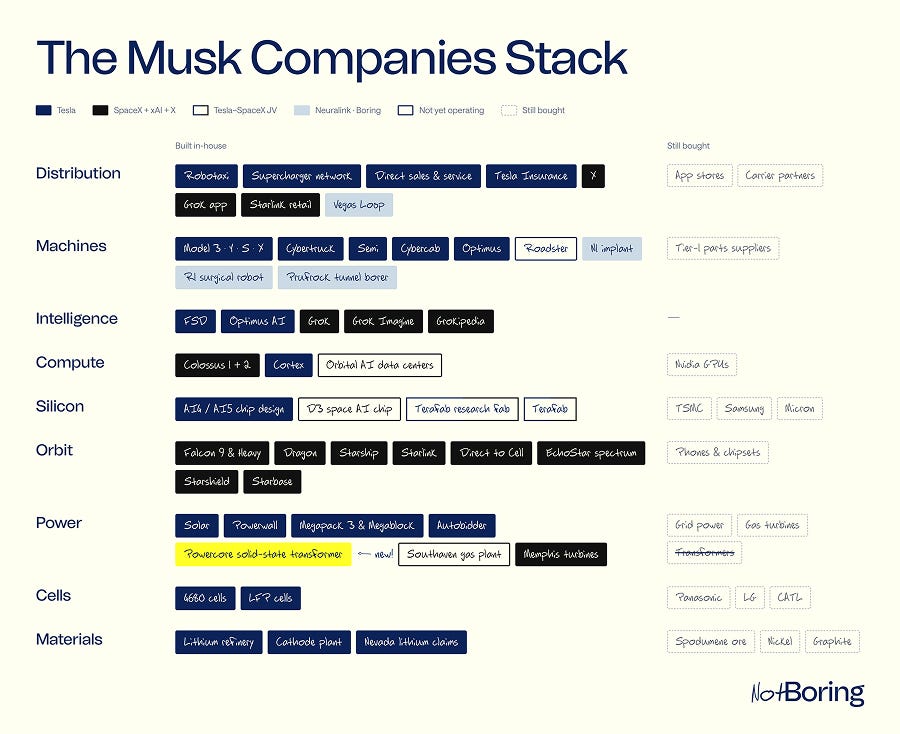
Tesla announced that it’s doing solid state transformers with its new Powercore.
Ho hum. Another week, another huge chunk of the capability stack that eliminates a big bottleneck and also plays really well with the other pieces of the stack from The Musk Companies. Just look at how much of the future this man controls:

We’ve talked about SSTs in the context of Heron Power, founded by ex-Tesla SVP of Powertrain and Energy Engineering, Drew Baglino many times, in Dose #181 (opens in new tab), Dose #183 (opens in new tab), Dose #187 (opens in new tab), and Thank God for Data Centers (opens in new tab). We are fans of both Drew and of SSTs, for their ability to speed up and cost down data center construction today and potentially help stabilize the grid in the future.
I think both Heron and Tesla will do well here. There is a ton of demand, and as I wrote in the America Spins on Westmag (opens in new tab):
In the Electric Era, maintaining design leadership without manufacturing leadership is not a coherent strategic position, and one that gets less coherent the better you believe AI will get.
Elon has solved this by building practically everything inside of his own companies. There is a parallel American ecosystem emerging to serve the growing number of electric companies not in the Elonverse.
A few years ago, we barely had one modern industrial base. Now we have two. 🇺🇸
If those two parallel electric universes do even one-tenth of what they’re planning to do, we’re going to need a lot of metal. Challenge is: the world spends something like \$14 billion searching for new mineral deposits, but major discoveries have dropped ~70% over the past decade. We’ve already pulled out the easy stuff, and it’s going to take new technology to get at the harder stuff economically.
Luckily, as you may know, we are in a golden age of technology, and our friends and not boring capital portfolio company Earth AI are using it to find metals.. This week, the company announced that its Alpheus AI model found a continuous copper, gold, and platinum-group metals system stretching more than 3 kilometers at the Fontenoy/Meridian project in New South Wales, Australia. There’s some Tungsten in there too. Roman showed me one of the rocks - the Tungsten shows up as black spots and is easy to mistake for nothing.
Explorers actually drilled the site back in 1969 and again in 1997, but they thought it was just some scattered pockets that wouldn’t have been economical to mind. Back in January, Earth AI turned its models on the old data, and the models recognized that they weren’t looking at discontinuous “black smoker” pockets; they predicted that it was actually a massive magma-filled fault line.
Five weeks later, Earth AI started drilling (it owns its own rigs and labs, so it didn’t have to wait for slow and expensive contractors; vertical integration (opens in new tab) ftw). It’s drilled 35 holes and traced mineralization from 30m to 478m deep across the 3km seam, with hints that it might actually be 8km long.
As we covered in our Deep Dive on Earth AI (opens in new tab), discovery is just the first step in a long process towards getting metal out of the ground, but with its rigs, it’s moving towards feasibility more quickly than other explorers traditionally could.
I think the company has the potential to be one of the world’s most beautiful businesses as these discoveries prove out, sell off, and turn into cash which buys more rigs and allows Earth AI to prove out the other 4,500 targets on its list. This week’s news is a golden step in the right direction.

EXTRA DOSES: Science Breakthroughs, Anthropic \$1.5T IPO, Google Neon, Isomorphic Labs’ \$5B Round (+ Boltz), Science Corp’s \$400M, Prime Intellect’s Model Factory, Genesis AI’s \$500M for Robot Hands, Grand Theft Auto VI, Where is the mind? and Sam Kriss on a Buddhist AI Monastery
Packy McCormick (Not Boring) urged readers to watch SpaceX’s slow-motion Starship catch footage . He highlighted Flight 15’s Ship 42 reaching orbit, deploying Starlink satellites, surviving re-entry, and being caught by Mechazilla as an engineering feat that brings humanity closer to becoming multiplanetary .