We can't find the internet
Attempting to reconnect
Something went wrong!
Hang in there while we get back on track


Wispr Flow: performance-based creator ads, after the product proves itself
On Lenny's Podcast, Hector Serrano described Wispr Flow's paid-growth program. Creators make the ads and get paid a cut of the ad spend, and the best of them earn more than $100K a year. Lenny's post says Wispr Flow grew revenue 30x+ over the past year and recently raised at a $2B valuation . The post doesn't say how much of that growth came from the program.
Serrano credits growth to the product first. Founders who have to "force it" should rethink positioning and value, because "there's really no hack besides having a good product" . Even so, he argues paid should start early, within budget limits. If cold traffic converts into paying users, that's a signal the messaging will also work organically .
Details worth copying:
- Vanity reach isn't enough. An earlier organic UGC program, where creators were paid per thousand views, hit about 500 million views in 2½ months. It didn't produce many conversions, so they shut it down .
- Pay on performance. Wispr Flow now has about 50 creators and launches 500–600 ads a month . For SaaS, where attribution is fuzzy, creators get a percentage of ad spend. When purchases are easy to trace, such as e-commerce, they get a percentage of GMV .
- A "smart retainer" as a floor. Example: a creator who makes 25 videos is guaranteed $1,500, so if commissions come to $500, the company tops them up by $1,000 .
- Skip the 10-page brief. Rigid guidelines take away the creativity that makes creator ads work .
Cagan: if you're handed a roadmap, you're a project manager
Marty Cagan's Orange County talk describes three kinds of teams. Delivery teams implement backlogs. Feature teams get a roadmap and are told to "design and code." Empowered product teams get problems to solve and are accountable for results . He says bluntly that on feature teams, "the product manager is a project manager" . He also says companies rarely report that more than half of their roadmap items worked, and most estimate 10–20% .
His fix for OKRs not working: you can't give teams both objectives and dated roadmaps, because the roadmap wins . On discovery, an MVP built by engineers takes weeks or months when it should take hours or days. Teams should run 15–30 prototypes a week, mostly built by designers, before anything reaches the backlog . Teams with user-facing products should have at least three one-hour customer sessions a week, and the PM is responsible for making sure they happen .
Claude Design vs. designers
In r/ProductManagement, a PM said Claude Design produced a working prototype of a simple flow in about 15 minutes. The designer took about 4 hours on work "arguably of the same quality, better in some ways, worse in others" . A solo PM said they no longer expect to hire a designer .
Most replies drew a narrower line. The tool is good at workflows and layout when it has an established design system, but it's "annoyingly uncreative" and can't be trusted to get a good design in one shot . Designers still own the design system, cross-product consistency, accessibility, and business context . Cagan's talk lands on the same point from the other side: fast prototyping depends on a professional product designer .
PM market: postings vs. hires
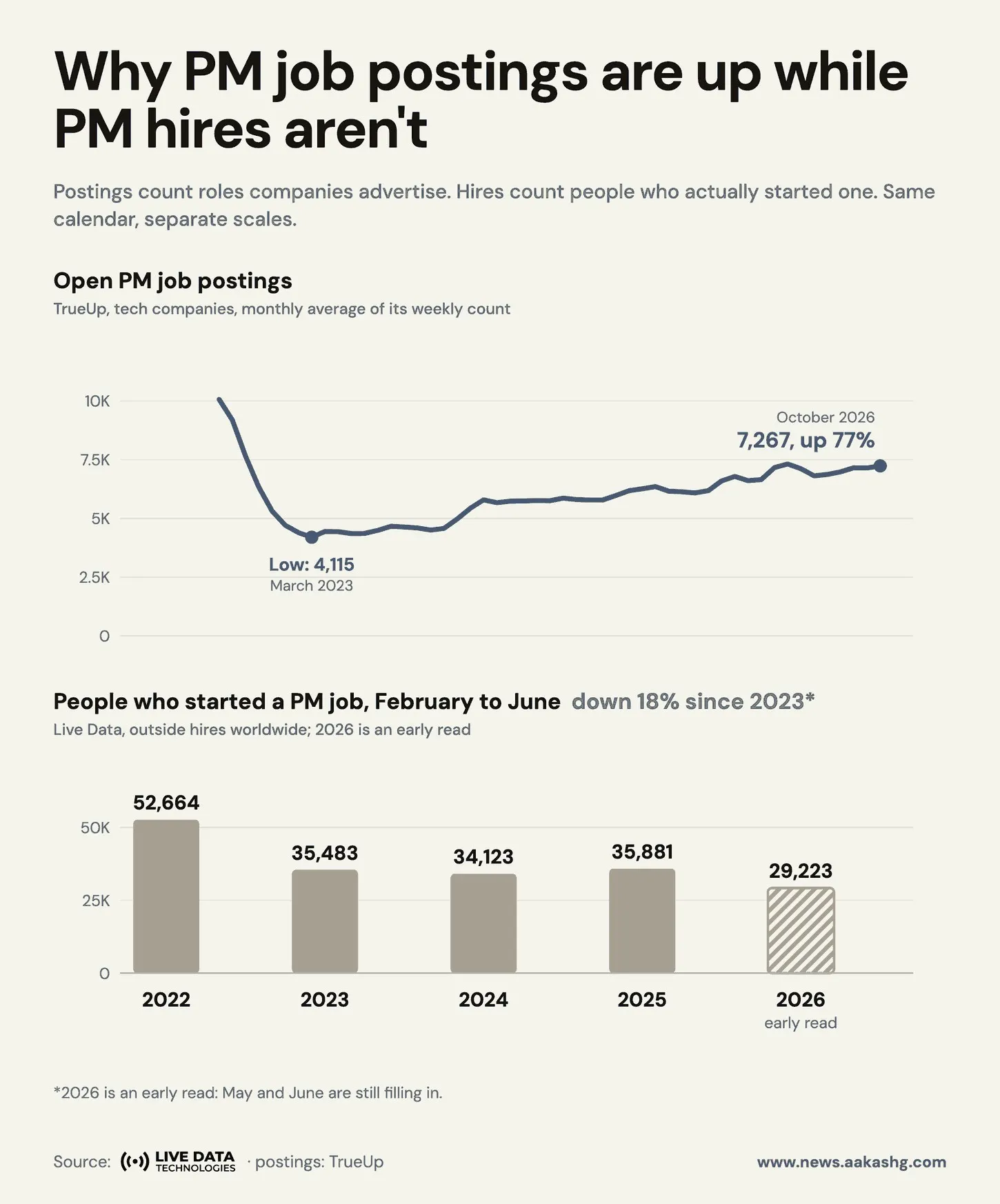
Aakash Gupta says PM job postings are up 77% from their March 2023 low, while the number of people who actually started PM jobs is down 18% since 2023. "One of those numbers is the market" .
Smaller signals
- PMing an ML model. For a new computer-vision PM, one practitioner's advice is to focus on how the model is applied for users, not its architecture. Use the evaluation dataset as the spec: if the model must be very good at identifying cats, build a dataset of cats and set a high bar for it. And don't pretend to be more technical than you are .
- AI unit economics. Elon Musk said serving Grok Bot cost "unsustainably high relative to revenue" . Ryan Hoover called it "saying the quiet thing out loud" .
- Quality bar. Hiten Shah says coding agents make it much easier to be picky about the software you ship, and teams should take advantage of that .

- WhisperFlow’s growth lead says product-led pull is the foundation: if growth must be forced, revisit product value or positioning. He also recommends small, budgeted paid tests early to learn faster whether messaging converts cold traffic; paid is a learning lever, not a substitute for a good product.
- WhisperFlow’s organic UGC program generated about 500 million views in 2½ months but did not deliver the desired conversions, so the team stopped it rather than optimize for vanity reach. Its later performance-based paid UGC program reached 500–600 ads per month; for SaaS, creators are paid a share of ad spend when attribution is difficult, while trackable commerce can use a share of GMV. A quota-linked “smart retainer” tops up low commissions when creators meet an output quota, while stronger performance can earn uncapped commissions.
- Build a creator roster for distinct ICPs and creative gaps, not headcount alone: in WhisperFlow’s experience, 150–250 targeted Instagram DMs over a week produced five or six strong creators. Match creators to the audience—for example, use credible technical users for developer tools—and preserve their creative freedom; copying winning ads can make a library repetitive and accelerate fatigue.
- For growth-marketing hires, prioritize demonstrated content creation or audience-building, work ethic, values, and learning potential over grades or school pedigree; give promising early-career hires time and room to experiment. A lean paid-UGC setup can separate creator communications and creative work from media buying.
- Treat founder-led content as a long-term trust and brand channel: tie content to the company’s mission and journey, provide value before selling, and use organic touchpoints alongside paid. For YouTube, titles, thumbnails, storytelling, pacing, and payoff are central to performance; strong long-form videos can also keep attracting views over time.

- WhisperFlow’s growth was attributed first to product-led pull, with new channels adding fuel; paid should not be treated as a fix for weak product value or positioning. Hector also recommends small, budget-limited paid tests early: cold-traffic conversion can quickly test message resonance and provide a signal—though not proof—that the proposition may work organically.
- For performance-based creator ads, Hector describes paying SaaS creators a percentage of ad spend and e-commerce creators a percentage of GMV when purchases are directly attributable. A “smart retainer” can provide a floor while creators ramp: his example guarantees $1,500 for 25 videos, topping up commissions only when they fall short of that amount.
- To seed a creator program, he recommends targeted manual outreach: 150–250 DMs in a week yielded roughly five or six strong creators. Choose a varied roster that fills distinct audience or messaging gaps, rather than maximizing headcount; leave room for creators to experiment, since copying winning ads can make the library repetitive and accelerate fatigue. For technical audiences, even plain product screen recordings may outperform polished-looking ads.
- For social-content hiring, prioritize demonstrated audience-building and content skills, work ethic, and culture fit over grades or school pedigree; give early-career hires time and freedom to experiment and learn.
- Treat founder-led content as a long-term growth channel: tie installments to the company’s mission, deliver value before selling, and use organic touchpoints alongside paid. Hector also cautions against AI-generated final creative and argues that human attention to quality can help content stand out amid high-volume output.

- For this screen-free desk study timer , one proposed paid-demand test is to cap refundable deposits (for example, at 50), disclose known flaws, and specify a fixed ship/refund date ; measure paid conversion rather than rely on tester enthusiasm alone , but interpret a small deposit cautiously: a commenter said €20 may test willingness to risk that amount, not willingness to pay €80+ .
- Delivery readiness matters: the team flagged a component with a 28-week lead time ; replies advised waiting until the supplier is locked and the ship date is credible before taking deposits , and treating deposit cash as owed while mapping supplier bills against receipts . The stated 200-unit break-even cannot be assessed without sale price and unit margin .
- Pair payment intent with usage testing: five working prototypes were awaiting distribution , and the team had contacted students and people seeking concentration tools ; a commenter recommended checking who still uses them after a week . As a different route to test distribution, a founder suggested reselling existing study timers in batches of 10, 50, then 250 before committing to custom hardware .

- Cagan distinguishes delivery teams, which implement supplied backlogs, from feature teams, which work from roadmaps and often leave PMs doing project coordination, and empowered product teams, which receive customer or business problems, choose solutions, and are accountable for results. In his model, leaders set objectives and teams propose key results; adding OKRs while retaining committed roadmaps creates competing signals, with roadmaps likely to dominate.
- Discovery tests whether a solution is valuable, usable, feasible, and viable; delivery builds production-quality software that is reliable and scalable. Cagan recommends using prototypes to learn quickly and putting work on the production backlog only when it is worth building, rather than spending weeks or months engineering an MVP. Strong teams assess risks upfront, collaborate around prototypes with engineers involved, and measure business results after launch instead of treating shipment as success.
- For empowered teams, PMs need deep knowledge of customers, product data, the business, the industry, and the product. Cagan says customer interaction is non-negotiable: at least three one-hour customer sessions weekly for each user-facing product team, with the PM responsible for ensuring it happens. Use both quantitative methods, which show what is happening, and qualitative methods, which help explain why.

Wispr Flow adapted e-commerce’s paid-UGC model for B2B SaaS: creators make ads in exchange for a share of ad spend, and top creators earn $100K+ a year. The source also reports 30x+ revenue growth over the past year and a recent $2B valuation, but does not explicitly attribute that growth to the creator program. Lenny also spotlights the view that “the best marketers are allergic to AI [output].”
Wispr Flow adapted e-commerce creator ads for B2B SaaS: creators make ads and receive a share of ad spend, with its best creators earning $100K+ a year. Over the past year, the company grew revenue 30x+ and recently raised at a $2B valuation.
Wispr Flow’s paid-growth program adapts e-commerce creator advertising to B2B SaaS: creators make ads and receive a share of ad spend, with top creators earning $100K+ annually; Hector Serrano initially made the ads himself for 1.5 years. The post reports that Wispr Flow’s revenue grew 30x+ over the past year and that it recently raised at a $2B valuation, but does not establish the program as the cause of that growth.

- In one PM’s test of a simple product flow, Claude Design produced a working prototype in about 15 minutes after design-system setup and a couple of refinements; the designer took about four hours to produce work the PM judged broadly comparable, with mixed strengths. Other PMs describe using it for quick visual anchors or clickable prototypes and faster stakeholder-feedback iteration, particularly when design capacity is scarce.
- The thread’s practical boundary is to treat AI as a prototyping and execution aid, not a full substitute for design expertise: commenters say it works better with an established design system, but can be uncreative or fail to make complex pieces cohere; designers contribute critique, UX judgment, research, design-system consistency, accessibility, and business context.
- Recommended reading included Product Discovery, Escaping the Build Trap, and Inspired , along with Product Management in Practice , The Mom Test , and PMDOK for the project-management side . One commenter noted that useful skills vary by setting, from a feature factory to an early startup with 90 days of runway .
- For an existing product, talk to users to understand their underlying problems and how they address them today, rather than focusing on feedback about the product itself .
- Use a repeatable decision loop: define the problem, assess whether the product solves it well enough, compare improvement options by payoff and priority, and persuade stakeholders . Avoid treating feature shipping as progress ; strong working relationships also matter .
- A PM at a mature, non-software-focused organization described being expected to handle discovery, exhaustive requirements, blocker coordination, and much of QA, while reporting absent automated testing and an uninvolved tech lead; the team was missing milestones.
- Replies recommend aligning with the manager on role boundaries—PM owns priorities and outcomes, while the tech lead should proactively communicate delivery progress—and securing business support and an engaged engineering partner; without that backing, accountability efforts may not stick.
- One respondent suggests using baseline software metrics to make the case for stronger development practices, then involving developers in deciding what to automate and which testing areas are most critical. The PM also reported that developers were merging Claude-generated code without review; a reply cautioned that AI could amplify low-quality output and increase the PM’s oversight burden in a dysfunctional team.
- Complaint-heavy feedback channels are not necessarily representative of overall satisfaction: satisfied customers may simply use the product and move on, while complaints are easy to post. One commenter suggests that complaints shifting from “this is broken” to “this could be better” can indicate a different, more manageable kind of product problem.
- Suggested success checks beyond a single management metric include usage and adoption, profitable growth or continued payment, and whether a real customer pain point has improved. One commenter also cautions that the customer may not be the user, and frames the PM’s job as creating value paths rather than maximizing customer satisfaction alone.

Kevin Weil sees opportunity in problems at the intersection of fields, where people may go deep in one area rather than work broadly, and says both depth and breadth matter. He also favors “rock band” teams to tackle problems at Warp Sciences.

Coding agents make it easier to be selective about what software ships, an opportunity teams should use to raise their bar for shipped work.
- For a social-app founder with 500 users after six months but little PMF learning, commenters suggest that the issue may be poor segmentation: focus on users who returned repeatedly, such as multiple times in one week, and ask what they were trying to do during their last visit and whom they tried to invite, rather than relying on cold outreach to strangers.
- For customer interviews, recruit against specific recent behaviors—not broad preferences—and ask about the last time someone performed an action, including the context outside the product. For existing users, target people who performed a relevant action; the commenter recommends still offering an incentive, citing a $50 gift card as an example.
- One founder reported getting well over 100 replies after posting a specific problem with real numbers and asking what people would do; direct requests for interviews had received little response. This is an anecdotal alternative for finding potential research participants, not evidence of product-market fit.

In response to a PM seeking a referral, a commenter recommended building AI skills and pursuing AI PM, claiming demand was high and increasing and suggesting a 30–55 LPA package . The commenter clarified that this was only a recommendation, not a job opening .
For AI and computer-vision products, focus PM work on the model’s intended user benefit and highest-value applications, guiding engineers toward outcomes rather than trying to lead debates on model architecture; build enough technical fluency to reason about evaluation measures and edge cases. Treat the evaluation dataset as part of the product specification: define target examples and performance criteria, decide how ground truth and ambiguous cases will be handled, and weigh requirements such as speed, cost, privacy, and accuracy when planning release and monetization.

A fintech company is seeking two product and program management consultants for strategic AI initiatives; the work is hands-on, and candidates must work in person in NYC. Interested candidates are asked to DM the poster.
A senior PM with 10 years’ experience, recently laid off and interviewing for Senior/Lead/Staff/Principal roles in India and Europe, sought a committed peer or small group for 3–4 weekly sessions covering structured-feedback mock interviews, product sense and strategy, and agentic-AI product development and emerging use cases. A commenter proposed a topic-based group that spends a week on each topic and shares participants’ experiences.
One commenter said tools make them more efficient rather than making them a better PM . Other replies named Claude Code and Claude Cowork, Granola, and Figma Make .

- Gupta reports PM job postings are up 77% from their March 2023 low, while people who actually started PM jobs are down 18% since 2023—advertised roles and hires point in different directions.
- Gupta’s proposed Company OS organizes company context as linked files for people, teams, products, metrics, and rituals, each with an owner, date, and source. It can answer ownership and decision questions in Slack with sources and turn a Slack line into a reviewed feature; the workflow runs from idea through PRD, prototype, product review, spec, engineering-agent build, and engineering review, with review gates set by the user. A first setup requires Slack, Claude Code, an Anthropic API key, and GitHub, and is estimated at about an hour.