We can't find the internet
Attempting to reconnect
Something went wrong!
Hang in there while we get back on track
Scott Belsky: "Nobody Wants Dial-Up AI," by Artur Meyster
Belsky shared Meyster's X article on Cerebras ($CBRS) under the line "speed is the new moat." His takeaway: we won't want to wait for agents to finish very complex tasks "if there's a faster way to get it done."
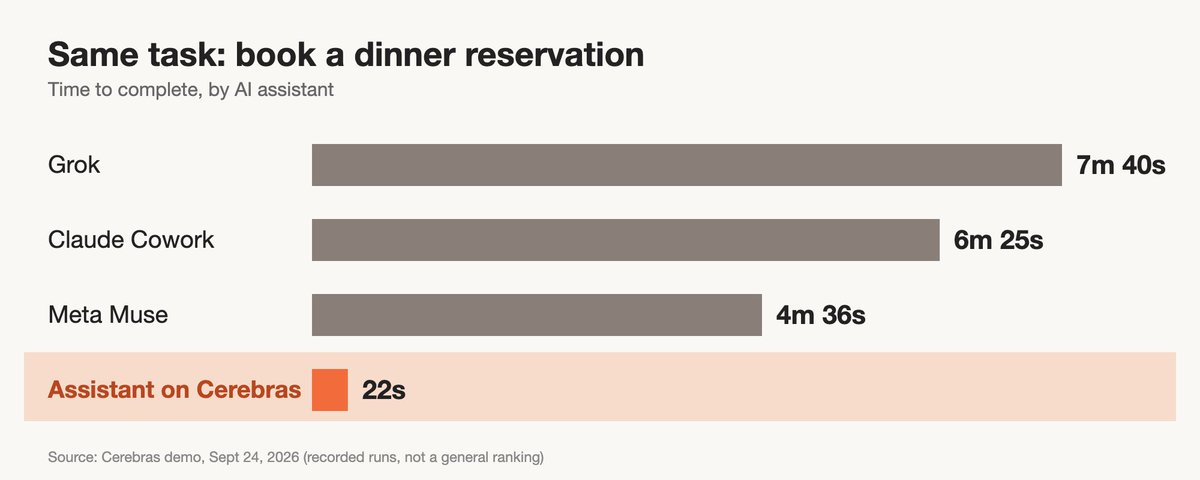
Meyster's main evidence is a test Cerebras ran last month: booking a dinner reservation through an AI assistant. Grokbot took 7m40s, Claude Cowork 6m25s, Meta's Muse 4m36s, and an assistant running on Cerebras 22 seconds. He argues that now that every assistant is smart, the question is "how fast does it get things done?" He compares this to dial-up giving way to broadband. Keep in mind that the author has held Cerebras since 2024 and bought more after the stock fell about 40% below its IPO price.
Vinod Khosla: Anthropic and Theorem Labs on formal verification
Khosla said he is "a total fan" of Theorem Labs' work adding formal verification to probabilistic LLMs, calling it an "Important concept broadly." He shared Anthropic's Frontier Red Team post on the work. Anthropic says formal verification used to be practical only for small codebases or took a lot of expert time. With Theorem Labs, it used Claude to prove security properties in more than 100 real-world open-source libraries over a few weeks. (Full research)
Fred Wilson: two listens on autonomy and agency
Wilson recommended two videos for people with a lot of commuting, driving or working out ahead, saying both "speak to autonomy and agency in the AI era."
- A conversation between the founders of Cloudflare and Nous/Hermes about the emerging open agentic stack and why it matters.
- A video on how a teenage spent deep in the Napster/BitTorrent era led to founding startups and investment firms focused on autonomy and agency.
Tobi Lütke: dquickts
Tobi called stencil-hq/dquickts an "Excellent code mode env." He shared it by quoting an earlier post of his. There he argued that the MCP-vs-CLI debate is at the wrong layer: both work well when LLMs run inside a REPL-like environment that keeps state, and code-mode REPLs (usually QuickJS) are among the best options.
Shorter mentions
- Tony Fadell marked the iPod's 25th anniversary by sharing Steven Levy's WIRED piece, "I'm Still Convinced the iPod Was the Perfect Gadget". He noted that Levy "was there from the start."
- Ryan Hoover told founders to "embrace the cringe," linking Sandy B. Kwon's essay "Is It Cringe or Am I Just Uncomfortable?".
- Tim Sweeney said a post by @JNavok is "exactly what's happening." The post argues that Valve's labels on AI-assisted games draw hostile attention that hurts indie developers' finances.
- Brad Gerstner called a John Mackey clip shared by David Senra "Beautiful & true." In the clip, Mackey argues that capitalism creates "win win win" outcomes and that all philanthropy and taxes ultimately come from business.
- Brian Armstrong linked Coinbase's new research with The Block on the "always-on economy." He shared it alongside his argument that stablecoins suit agent payments because agents need instant, global settlement, including for small amounts. Coinbase produced the research, so this is a self-promotion.
- Shaan Puri called Nathan For You season 1, episode 4 "a work of art." He found it after the Elizabeth Holmes movie sent him down a Nathan Fielder rabbit hole.
Sarah Guo shared a YouTube video in a reply to Jachiam’s post speculating that Greg Brockman was doing uncredited work behind the scenes to fix the internet and contribute to AI safety and resilience; her reply gives no title, creator, or reason for sharing it.
Jensen Huang pointed audiences to an unnamed website write-up about NVIDIA and Anthropic partnering to create Claude Open Shell agents, calling it “a really great write-up”; the transcript does not identify its creator or provide a URL .
Fred Wilson shared two things to watch or listen to for people commuting, driving, or working out, saying they speak to autonomy and agency in the AI era.
Chamath Palihapitiya enthusiastically endorsed the linked All-In episode as “#1 Pod!!!!”; he gave no specific reason for the recommendation. The episode listing includes Ken Griffin’s AI-bubble warning, an AI-cyber discussion with Palo Alto Networks CEO Nikesh Arora, and France’s political and economic situation.
Tobi called Foda’s post about the KidSuper x DC Super-Villains launch “Incredible work” and linked to it . Foda presents the Vercel–Shopify partnership as bringing “whimsy” back to the web and links the launch site, https://DCSV.KIDSUPER.COM .
Vinod Khosla endorsed @shivanipod’s post about Fo, saying an AI assistant should “get things done,” including hiring humans when needed, and that @shivanipod “gets it.” The post describes Fo as an executive assistant that hires humans to complete tasks and links to a Forbes video, “Why this AI system uses human experts to finish complex tasks”.
Vinod Khosla praised Theorem Labs’ work adding formal verification to probabilistic LLMs, calling it an “important concept broadly,” while sharing Anthropic’s Frontier Red Team research announcement on the work . Anthropic says it collaborated with Theorem Labs to use Claude to prove security properties in more than 100 real-world open-source libraries; the full research is available here .
Scott Belsky endorsed @ArturMeyster’s article “Nobody Wants Dial-Up AI: Why I'm Bullish on Cerebras ($CBRS),” calling its “speed is the new moat” argument compelling: people won’t want to wait for agents to complete complex tasks if they can be done faster.
Elon Musk wrote “Forward this to your friends” in a reply in the thread . The main post calls James Talarico “hates Texas” and links to @KanekoaTheGreat’s post . The linked post lists Talarico’s reported votes against several Texas border-security measures from 2021 to 2025 .
Jason Lemkin shared the video “New The Agents!!” (YouTube) . In the accompanying post, he recommends asking Muse to implement sales or marketing ideas that have not been acted on, saying it may work out how and run 24/7 using its own LLMs, browser, and computer .
Jack shared Blocks’ video of Cara playing a guessing game with Dessa and called it “magically intelligent”; the post says the model guessed the first answer right away and the second soon after. Dessa demo
Brian Armstrong pointed readers to Coinbase’s new research with The Block, saying it “goes deeper on this new always-on economy” . The recommendation accompanied his argument that stablecoins suit agentic finance because agents need instant, global, real-time settlement .
Tobi recommended stencil-hq/dquickts as an “Excellent code mode env.” In the discussion linked with the recommendation, he argued that LLM tools work well in persistent-state REPL environments and listed code-mode REPLs, usually QuickJS, among the best options.
Jason Lemkin recommends the free SaaStr AI agent playbook, which its authors say explains which agents they use, in what order, and where they break; the post frames it around a setup of 3 humans, 20+ AI agents, and about $20M in revenue.
@jasonlk promoted a new SaaStr article, “The New ‘Ask Your Developer’ Is Ask Your Agent” (article). Its takeaway is that software buyers are becoming agents rather than humans; as an example, he says an agent chose Render, bought Resend, and churned vendors within 12 hours.
Elon Musk affirmed an @XFreeze post with “Yeah,” endorsing its video excerpt of his warning that environmentalism taken too far can cast humanity as a plague; the excerpt also cites a New York Times front-page comment that Earth would be better with no people. The linked post
Elon Musk shared “Odyssey with Grok Imagine”, a post presenting Episode 1 of an Odyssey series made with Grok Imagine . The @imagine post credits a creative collaboration with @WonderStudiosX and director Dev Walker; Musk gave no explicit reason or takeaway .
Elon Musk amplified Kevin Bass’s video compilation of 34 clips of Talarico with the caption “In his own words.” Bass presents the clips as showing Talarico’s extreme views and what Bass calls lies told to hide them from voters.
Elon Musk praised @tetsuoai’s video post, captioned “Super intelligent Beauty,” calling it “Beautiful” (post).
Shaan Puri endorsed Alexei’s advice to radiate positive energy by tipping generously, complimenting strangers, and sharing knowledge without expecting anything in return; Puri called it “so simple, so effective, yet… so rare,” and asked why. Original post
Nobody Wants Dial-Up AI: Why I’m Bullish on Cerebras ($CBRS)

Why I doubled down on Cerebras $CBRS while the market ran for the exits.
I’ve been a Cerebras investor since 2024, and I still own it. This past week, while the market punished every semiconductor name in sight, I doubled down and bought more. I believe we’re on the cusp of something incredible.
After a brutal week for semis, Cerebras closed around $110 a share. That’s roughly 40% below its $185 IPO price in May, and about 65% below where it closed on its first day of trading. To me, it’s a buying opportunity of a lifetime.
Here’s why.
The 22-second dinner reservation
Last month Cerebras ran a simple test: ask an AI assistant to book a dinner reservation. Grokbot took 7 minutes 40 seconds. Claude Cowork took 6 minutes 25 seconds. Meta’s Muse took 4 minutes 36 seconds. An assistant running on Cerebras took 22 seconds.

Seven minutes to book dinner is a waste of time. Twenty-two seconds is magic.
Speed is the new moat
Every major AI company is now shipping a personal assistant: Grokbot, Muse, Instinct, Claude, and OpenAI’s Dot agents. That quietly changes how we judge them. For the last three years the question was “is it smart?” Now that they’re all smart, the question is becoming “how fast does it get things done?” That’s how you judge a good human assistant, too.
We’ve seen this movie before. Nobody browses the web on dial-up anymore. Once broadband existed, waiting a minute for a page to load went from normal to unthinkable almost overnight. Every web company since has learned the same lesson: every bit of delay costs you users.
Try a thought experiment. How much would someone have to pay you to go back to dial-up for a week? No streaming, no video calls, every page a thirty-second wait. For most of us, the number is shockingly high. Now jump five years ahead and look back. How much would someone have to pay you to wait five minutes for every AI answer, when you’re used to getting it in 22 seconds?
That number is what fast inference is worth. It isn’t a feature people will politely prefer. It’s a standard they’ll refuse to go back from, and it grows every year we get used to speed.
AI is about to hit its broadband moment, and it matters more here because of how assistants work. An agent doesn’t answer once. It thinks, searches, clicks, checks and tries again, often dozens of model calls for one task. A two-second delay per step turns into minutes. Speed doesn’t just add up; it compounds. To be fair, faster tokens won’t speed up a whole workflow by the same amount, because websites, tools and networks still take their time. But model thinking time is a big part of the wait, and cutting it changes how the product feels.
That compounding runs in the other direction too, and this is the core of my thesis:
Speed drives repeat use. If an assistant answers in seconds, you ask it ten more things today.
Repeat use builds habits. It becomes the first thing you reach for.
Habits build a relationship. It learns your context, your preferences, your history.
Relationships create switching costs. Leaving means starting over with a stranger.
Switching costs compound into network effects as usage, data and integrations pile up.
Speed without giving up quality is the first domino. I believe it will decide which AI tools keep gaining users and which fall behind. And the company best placed to deliver speed without sacrificing quality is Cerebras.
Where speed is worth real money
Consumers will love fast assistants. But some industries will pay almost anything for speed, because in their world the faster side wins.
Trading. Picture an analyst reading a live news feed, an earnings call and a dozen filings at once. An AI that digests all of it in two seconds instead of two minutes is a trade made, not missed. It’s no coincidence that Jane Street, one of the most sophisticated trading firms in the world, was among the first named testers of OpenAI’s Ultrafast tier (opens in new tab). Reports say it spent hundreds of millions of dollars (opens in new tab) to lock up fast-inference compute. When the smartest money on Wall Street pays up for speed, pay attention.
Cybersecurity. Soon attackers and defenders will use the same AI models. Security systems have a tiny window to inspect what’s happening and respond before damage is done, and faster inference fits far more AI analysis into that window. If attacker and defender have equally smart models, the one that thinks faster gets more chances to be right first. CrowdStrike already runs its Falcon AI models on Cerebras, and Cerebras says it’s enabling inline AI security that inspects enterprise traffic as it flows.
Coding agents. Developers notice every second they wait, and coding agents make hundreds of model calls a day. Cognition, Lovable and Figma are all Cerebras users.
The pattern: anywhere AI is doing real work in a loop, speed turns into money.
The chip they said couldn’t be built
To see why Cerebras is fast, you need to know one thing about how AI writes an answer.
A model generates its answer one token (roughly, one word fragment) at a time. For every single token, the chip has to read the model’s weights, its billions of learned parameters, out of memory. It isn’t heavy math that slows this step down. It’s moving data. The chip spends much of its time waiting for memory to deliver the next batch of weights.
On a GPU, those weights live in high-bandwidth memory (HBM) that sits next to the processor. Fast, but it’s still a trip down the hall for every token. It’s like a chef who has to walk to the pantry for each ingredient.
There’s a second problem with that pantry: there isn’t enough of it. HBM is the scarcest part of the AI supply chain right now. SK Hynix has sold out its memory supply to Nvidia through 2026, and the industry broadly expects the HBM shortage to last until at least 2028. That’s why memory stocks like SK Hynix, Samsung and Micron have run so hard. SK Hynix nearly tripled in the first five months of this year. Every GPU needs a stack of HBM, so every GPU is waiting in that line.
Cerebras took a different, crazier path. Instead of cutting a silicon wafer into hundreds of small chips, it uses the entire wafer as one chip: about the size of a dinner plate, with 4 trillion transistors and 900,000 cores. Everyone said it couldn’t be manufactured. A single dust-sized defect ruins a normal chip, and a wafer always has defects. Cerebras built in spare cores and routes around the bad spots.

The payoff is memory. Each wafer carries 44 GB of fast on-chip memory (SRAM) spread right next to those cores. The ingredients are already on the counter. No trips to the pantry, so tokens come out dramatically faster. OpenAI’s Ultrafast preview, running on Cerebras, delivered answers up to 14x faster (opens in new tab) than its standard tier.
It also gets Cerebras out of the HBM line. Its memory is built into the wafer itself, in the same factory run as the cores, so it doesn’t need to buy scarce memory stacks from SK Hynix, Samsung or Micron. Cerebras says it also skips CoWoS, the advanced packaging TSMC uses to bond GPUs to their HBM, which has been the other big bottleneck in AI chips. Cerebras still depends on TSMC for wafers, so it isn’t immune to supply crunches. But in a world where HBM is the bottleneck, an architecture that doesn’t need HBM is a real advantage.
The obvious objection: 44 GB is small, and frontier models are huge. Cerebras (@cerebras) recently showed how it handles that (opens in new tab) in an explainer by its Head of DevX, Sarah Chieng (@MilksAndMatcha). It splits a ~3-trillion-parameter model across 59 wafers like an assembly line. Each wafer holds a few layers, and only the in-between results pass from wafer to wafer, at about 2 microseconds per hop. The result is 1,000 to 2,000+ tokens per second on a frontier-scale model.
The part most people miss, and @NTMonX put it well on X, is that Cerebras doesn’t have to beat Nvidia at everything. AI inference has two phases. Reading your prompt (“prefill”) is heavy math, and GPUs are great at it. Writing the answer (“decode”) is the memory-bound part, and that’s where Cerebras shines. So the industry is starting to split the job. AWS is pairing its Trainium chips for prefill with Cerebras for decode on Amazon Bedrock, and AMD is building a combined system with Cerebras. It’s a complement, not a replacement, which makes the opportunity much bigger than “beat Nvidia.”
This isn’t a story stock
Plenty of AI companies have a great pitch and no customers. Cerebras has a $25.4 billion backlog.
The anchor is OpenAI. In December 2025 the two signed a deal worth more than $20 billion for 750 megawatts of Cerebras capacity, delivered in three 250 MW steps by the end of 2026, 2027 and 2028 (via @SVTrivo (opens in new tab)). OpenAI also holds an option for another 1.25 gigawatts by 2030, which isn’t in the backlog at all.
That backlog isn’t a someday number. Cerebras expects about $5.6 billion of it to become revenue by mid-2028, and another $10.9 billion over the two years after that.
The business is already moving. Q2 core revenue was $210 million, up 103% from a year earlier, and cloud revenue nearly quadrupled. Management guides 2026 revenue to $880–890 million and expects it to more than triple in 2027. Manufacturing capacity is scaling more than 10x this year, with more than 600 MW of data center capacity live or contracted by the end of 2027.

And the OpenAI contract isn’t just signed; it’s already paying. Cerebras recognized about $56.8 million of revenue from OpenAI in Q2 alone, before most of the dedicated capacity has even come online.
Demand isn’t the constraint. Plugging in capacity is. That’s the whole game for the next few quarters.
So why is it down 65%?
If the story is this good, why has the stock been cut by nearly two-thirds since its first day of trading? Four things hit at once.
1. The Nvidia scare. On Sept 29, OpenAI launched a new Ultrafast tier for its latest model. The next day, research firm SemiAnalysis (@SemiAnalysis_) reported it was running on Nvidia GPUs, not Cerebras. X lit up with “Cerebras is done” takes. Then on Oct 2 Sam Altman (@sama) posted: “Cerebras is a close partner, and we have a deep engagement pushing on the frontiers of speed.” My read: OpenAI needed speed now, and Cerebras’s new capacity for OpenAI isn’t online yet. Notice the new tier runs at about 300 tokens per second, versus up to 750 on the earlier Cerebras-powered version. That looks like a stopgap, not a breakup.
2. The lockup wall. Since the May IPO, early shareholders have been allowed to sell in waves. Roughly 19 million shares unlocked at a time on Sept 30 and Oct 14, and another wave is due Oct 28. That’s a lot of supply hitting a newly public stock.
3. Insider selling. The CEO and CTO sold more than $240 million of stock between late August and late September through pre-scheduled 10b5-1 plans. Those plans are set months in advance and are routine after an IPO, but headlines don’t do nuance.
4. The AI trade cracked. CoreWeave fell about 25% in a single week on worries about its debt. Anthropic’s revenue grew 46% last quarter, but growth slowed and some investors were disappointed ahead of its IPO. The chip index fell eight sessions in a row, tying its longest losing streak since 2006. When the whole AI trade gets repriced, the newest and most volatile name gets hit hardest.
Look at that list again. A capacity delay, a supply overhang, routine insider sales and a sector selloff. Those are timing and supply problems. None of them is a demand problem.
What you’re actually paying
At $110 a share, Cerebras is worth about $26 billion. It had about $8.6 billion of cash and investments at the end of June, against roughly $0.9 billion of debt to OpenAI. Strip out the net cash and the market values the actual business at roughly $19 billion.
Now hold that number up against one deal, a comparison @JKeynesAlpha has been making loudly on X. Last December, Nvidia paid about $20 billion to license Groq’s inference technology and hire its team. Groq is another fast-inference chip company, and Cerebras’s closest rival in the speed race.
So the market is pricing all of Cerebras, with its wafer-scale tech, a $25.4 billion backlog, OpenAI, AWS, AMD and a factory scaling 10x, at roughly what Nvidia paid for Groq’s IP and people. That feels like a clearance-rack price for the fastest inference hardware on the planet.
Strategic buyers have noticed, too. Before the IPO, Arm and SoftBank approached Cerebras about an acquisition, and Cerebras said no. There’s history here: CEO Andrew Feldman (@andrewdfeldman) sold his last company, SeaMicro, to AMD in 2012. AMD is now building a combined system with Cerebras. I don’t own this stock for a takeout. But real strategic interest gives it a floor that most young chip companies don’t have.
The math behind my bull case
I think Cerebras can be a $500 to $1,000 stock in about three years. That’s a bold claim, so here’s the math.
Start with the share count, because it matters more than most people think. Cerebras has about 238 million shares today, but customer warrants and stock compensation will add more. I use about 300 million diluted shares. On that basis, $500 a share is a ~$150 billion company and $1,000 is ~$300 billion.
Check #1: revenue and multiples. Here’s the share price at different 2029 revenue levels and price-to-sales multiples (10x / 15x / 20x sales):
$8B revenue: $267 / $400 / $533
$12B revenue: $400 / $600 / $800
$16B revenue: $533 / $800 / $1,067
The anchors: management expects 2027 revenue to more than triple from this year’s ~$885 million. UBS models $3.3 billion for 2027 and $22.6 billion for 2030. A steady path between those two points lands around $12 billion in 2029, which puts $500 within reach at roughly 12–13x sales. $1,000 takes UBS’s 2030 revenue at about 13x.
Check #2: megawatts. Cerebras sells capacity, so you can also build the target from the ground up: megawatts running × revenue per megawatt × operating margin × a multiple.
2,000 MW of productive capacity earning $10–20 million per MW per year = $20–40 billion of revenue
At a 40% operating margin (management’s long-term target) = $8–16 billion of operating profit
At 20x operating profit = $160–320 billion enterprise value
÷ 300 million shares = roughly $530–1,070 a share
Both methods land in the same range, which is why I’m comfortable with the target. But look at what the second one requires: about 2,000 MW running all year. That’s nearly three times the entire 750 MW OpenAI commitment. Getting there takes major new contracts, data centers built on time, strong pricing and real profits, which are still ahead of them.
Dilution is the quiet variable. At 360 million shares instead of 300 million, every number above drops by about a sixth.
To be clear about what all this implies: from $110, $500 in three years is about 66% a year, and $1,000 is about 109% a year. That’s my bull case, not a base case. For context, the average Wall Street price target today is around $283 and the highest is $330. I’m well above the Street, and I’m comfortable saying why: I think the Street is modeling a chip vendor, and I think Cerebras is becoming the speed layer of AI.
What would make me wrong
I’d be doing you a disservice if I only told you the good half. Here’s what keeps me honest:
Capacity slips again. The whole thesis runs through bringing data centers online. If the first 250 MW for OpenAI slides well into 2027, revenue slides with it.
OpenAI stays on Nvidia. If OpenAI permanently serves its fast tier on GPUs, the 1.25 GW option looks less likely, and the market will question the core contract.
Groq catches up inside Nvidia. Nvidia now owns the rights to Groq’s LPU technology and has its team. With Nvidia’s money, manufacturing scale and sales force behind it, a Groq-based product could close the speed gap and win enterprise customers who already buy everything from Nvidia. If fast inference becomes something Nvidia bundles, Cerebras loses its uniqueness.
Customer concentration. OpenAI was about a third of revenue last quarter. One customer that large is a gift and a risk.
OpenAI’s own finances. OpenAI has signed enormous compute commitments across many vendors, and it is still a private, cash-burning company. If its IPO stalls or funding dries up, it may have to cut or renegotiate vendor contracts. A $20 billion backlog is only as strong as the customer paying it.
Big Tech builds its own. Microsoft said in October that its in-house Maia chips will become its primary inference system from 2027. Every hyperscaler wants its own silicon.
It’s still burning cash. Core operating margin was around -16% last quarter, and building data centers is expensive. More dilution or debt is possible.
More selling. The last lockup expires in November, and insiders may keep selling on schedule.
I’ve weighed all of these. I think each one is a speed bump on a road that goes somewhere very big. But you should weigh them yourself.
What I’m watching next
Two dates are circled on my calendar.
Nov 9: the last IPO lockup expires. After that, the wave of forced and scheduled selling that has hit the stock every few weeks is largely behind it.
Nov 12: Q3 earnings after the close. I want three answers:
When does the first 250 MW for OpenAI go live?
Did gross margin bottom in Q3, as management guided?
Are the AMD (Q4 2026) and AWS Bedrock (Q1 2027) launches on track?
Get good answers to those, and I think the market will stop pricing Cerebras like a broken story and start pricing it like what it is: the company that makes AI feel instant.
Nobody wants dial-up AI. I’m betting on the broadband.
Disclosure: I own shares of Cerebras (CBRS) and bought more this week. This is my personal opinion, not investment advice. Do your own research.
Scott Belsky endorsed @ArturMeyster’s article “Nobody Wants Dial-Up AI: Why I'm Bullish on Cerebras ($CBRS),” calling its “speed is the new moat” argument compelling: people won’t want to wait for agents to complete complex tasks if they can be done faster.