We can't find the internet
Attempting to reconnect
Something went wrong!
Hang in there while we get back on track
Chamath: "Anthropic's IPO is where the AI build switches from debt to stock"
Chamath Palihapitiya called @nodiligence's post a "Good read…" . The post links to the article and gives its stance in one line: Anthropic is "probably the best business in AI right now," but the author "wouldn't touch it on day one" because the offering is "set up for suppliers and insiders to sell into the index buying."
The article draws on S-1 figures: $974m of Q2 operating profit, an 85% gross margin and $637bn of compute contracts. It adds that most suppliers are also lenders and shareholders . Its main argument is that the IPO marks the point where public equity, not credit, becomes the marginal source of funding for the AI build-out . In the author's view, the value goes to whoever gets paid in cash up front, mainly TSMC and Google. The losses fall on whoever lent long-term against short contracts: neocloud bondholders, data-centre bonds and Oracle . Yesterday's founders read the S-1 for operating strength. This adds a skeptical read of the financing structure.
Patrick O'Shaughnessy: Cliff Sosin, on the podcast and in an essay
O'Shaughnessy is promoting his own Invest Like the Best episode here. He calls Sosin "one of my favorite people to call, ask some big questions, and then shut up and listen." The episode covers the limits of intelligence, owning the things that complement it, Meta and the frontier labs, capital markets, and why Sosin keeps 80% of his portfolio in Carvana . It's on YouTube, Spotify and Apple .
He also quoted Sosin's essay "Maybe Intelligence Ain't All That." Its central claim: "The limit is contact with reality." A smarter reasoner fills gaps between known facts but "doesn't produce new facts," so most problems are still limited by how fast you can build something and test it .
Shorter mentions
- Brad Gerstner shared Collision's video with United CEO Scott Kirby and Ben Thompson. He said he recruited Kirby to United in 2016 and called him "one of the smartest CEOs in any industry I know" . Topics include capex, route planning, the Starlink decision and credit card economics .
- Vinod Khosla called an Encord clip of Pim De Witte "a strong view on world models" . De Witte argues models should learn directly from data the universe produces, not from simulators, and that the training runs are "tiny compared to frontier LLMs" .
- Tim Sweeney called the CFSG formalization, "43M lines of Lean proof," amazing. He said he wished John Conway were still alive to see it .
- Farnam Street called Shane Parrish's conversation with Steven Kotler "Insanely useful" . It covers flow, picking challenges that hold your attention, and focusing on work you don't feel like doing . This is Parrish promoting his own show.
- Garry Tan shared @grepdotai's "THE SWARMS ARE COMING", calling agent swarms "a big unlock" because one agent "can only do so much" .
- Andrew Chen published his own essay, "New Founder Archetypes in the AI Age" . It weighs reasons for and against five types: solo founders, non-technical founders, domain experts, young builders and content creators. One example of a "why not": "Hoteliers didn't create Airbnb" .
Paul H. Graham, who said he sold a software company, credited The Promise Principle as a major help to his prayer practice; he describes its guidance as approaching prayer with gratitude and thanking God for strength, courage, and perseverance through uncertainty . In the same reflection, he contrasted this with his earlier request for a “burning bush,” saying signs may be subtle and require awareness and patience .
Patrick O’Shaughnessy highlighted Cliff Sosin’s essay “Maybe Intelligence Ain’t All That,” excerpting its argument that intelligence is constrained less by reasoning than by contact with reality: complex systems must be tested, and the speed of feedback remains a bottleneck. He points readers to a video conversation where Sosin walks through the essay; O’Shaughnessy calls Sosin one of his favorite people to ask big questions and listen to. Conversation
Patrick O’Shaughnessy shared a video conversation with Cliff Sosin, praising him as one of his favorite people to call with big questions and listen to. The conversation covers the limits of intelligence, AI commoditization, who profits from AI, and investing in the AI build-out. Original conversation post. In a follow-up excerpt, Sosin argues that broadly useful “very good” intelligence may commoditize, while use cases for super-elite intelligence may be rare.
Patrick O’Shaughnessy highlights his conversation with Cliff Sosin, describing Sosin as one of his favorite people to call with big questions and listen to; he frames the conversation as a version of those calls. Watch the conversation. In the shared clip, Sosin argues that investors should own the complements to cheap, ubiquitous intelligence—data, attention, love, physical proximity, scale, and regulatory capture—and points to Meta’s data and attention as assets that remain valuable.
Tim Ferriss praised Pixar’s Ratatouille as a fun film and used its kitchen-station scene as a reference while discussing kitchen organization.
Patrick O’Shaughnessy highlighted his Invest Like the Best conversation with Cliff Sosin, describing Sosin as one of his favorite people to call with big questions and then listen to. They discuss AI, capital markets, and why Sosin is comfortable with 80% of his portfolio in Carvana. The episode is available on YouTube, Spotify, and Apple Podcasts.
Palmer Luckey pointed viewers to the Project Meridian announcement, saying it explains that the initiative is about the future of warfare, particularly 2040–2050, rather than primarily how the Pentagon operates.
Patrick O’Shaughnessy points readers to his video conversation with Cliff Sosin , presenting Sosin as one of his favorite people to call with big questions and listen to .
Elon Musk spotlighted Mattyp’s video “What’s New in Grok Bot” as a tour of new Grok Bot features . Its listed segments cover Pages, Vault, 1Password and Apple integrations, video creation, bot characters, X Spaces, font options, design polish, and rapid-fire updates . The post gives no rationale beyond framing it as a new-features update .
Elon Musk shared @imagine’s announcement for its “Inside Episode 1: The Oath” workflow guide, labeling his post “Grok Imagine.” The guide shares the script-to-final-edit workflows behind a short-episode project based on The Odyssey; @imagine says readers can learn the techniques for their own creative projects, and credits director Dev Walker and Wonder Studios with the episode tips.
Chamath Palihapitiya called an @nodiligence X post “Good read” and linked it; the post links to the article “Anthropic’s IPO is where the AI build switches from debt to stock.” The article’s thesis is that AI infrastructure funding is shifting from credit to public equity, with value accruing to cash-paid suppliers such as TSMC and Google while lenders exposed to long-term financing against shorter contracts bear risk.
Jason Lemkin shared a YouTube video captioned “New The Agents!!” (https://youtu.be/n08SkoyEZ8k); no reason for sharing it or creator is stated. In an embedded video clip, he says 10K built its own AI prospector because follow-up is a weak point in existing AI SDRs and outbound agents.
Andrew Chen shared his essay “New Founder Archetypes in the AI Age” (link) . It considers how AI could help solo founders, nontechnical founders, domain experts, young builders, and content creators build software, while weighing each group’s limitations, such as product reliability, industry experience, company-building, and sustainable growth .
Andrew Chen followed his question about founder types that AI might unlock with his essay, “New Founder Archetypes in the AI Age”, saying he had “ended up writing more about this.” The essay weighs potential advantages and limitations for solo, non-technical, domain-expert, student, and content-creator founders.
Vinod Khosla highlighted an Encord video featuring Pim De Witte as “a strong view on world models” (post). De Witte argues that models should learn directly from continuously generated real-world data rather than simulators, with training runs much smaller than those for frontier LLMs.
Garry Tan shared @grepdotai’s “THE SWARMS ARE COMING” post/video, calling agent swarms “a big unlock.” He said one agent can do only so much, while many agents woven together via an “artifactory-hack-style message board” can do more.
Garry Tan recommends GBrain’s customer-comms skill for founders handling their own customer support , describing an agent that drafts replies and call recaps, writes a “what went wrong” note for customers who cancel, manages the CRM, and files bugs, with the founder reviewing and sending the replies .
Jason Lemkin (@jasonlk) shared a new SaaStr article about AI agents wiping critical data. Its takeaway: unplanned copies saved the company in both incidents, so readers should plan backups in advance.
Elon Musk amplified an @cb_doge post with video about Starlink enabling a remote specialist to guide an ultrasound for Karina in rural Colombia and prompt an urgent hospital transfer; the post says Karina and her baby were safe. Musk’s accompanying text was only “Starlink,” so he gave no explicit reason for sharing it.
Tim Sweeney highlighted the CFSG Lean proof, called it amazing, and noted that it comprises 43 million lines of Lean proof. He said he wished group theorist and Game of Life creator John Conway were still alive to see it.
Anthropic’s IPO is where the AI build switches from debt to stock

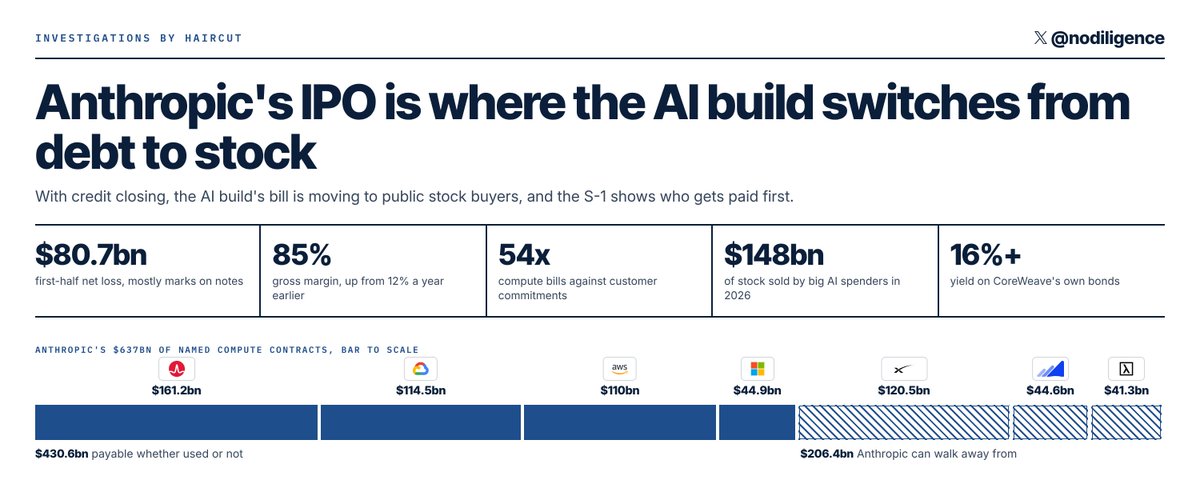
Anthropic is a much better business than I expected. It made $974m of operating profit in Q2 and has an 85% gross margin.
But most of the S-1 is about money it owes. It has $637bn of compute contracts, a bunch of loans that turn into shares, and most of its suppliers are also its lenders and shareholders. Google and SpaceX (which owns xAI) are even its competitors. This IPO is basically public investors coming in to pay for the next few years of data centres.
I’ve been bullish on compute for a while now and I still don’t think demand is the issue. GPU rents went up this autumn while neocloud stocks fell by a third. The funding is the issue. Lenders have mostly stopped lending unless a big investment-grade company is backing you, the big spenders are selling stock now, and Anthropic’s raise of about $100bn is the biggest one yet. I think the build keeps going and the companies getting paid in cash, mainly TSMC and Alphabet, keep making money. The ones who lose are whoever lent long-term money against short contracts, and anyone buying ANT in the first few weeks before the lockups start ending.
My thesis is pretty simple that this IPO is where the AI build switches its marginal funding from credit to public equity.
Credit for the build has mostly closed to anyone without an investment-grade name standing behind the cash flow (the day before the filing Musk said debt markets have “almost entirely shut off” (opens in new tab) for companies that depend on AI data centres), the biggest spenders have stopped buying back stock and started selling it, and Anthropic’s own contracts are built so that a growing share of its compute bill can be paid in ANT shares. The money that ends up funding this comes in through a float of about 5% to 7%, fast index entry and leveraged ETFs, while the people closest to the numbers have spent the year selling or moving up the capital structure.
The value accrues and goes to whoever is paid in cash, up front and on short terms: TSMC, and Google as the one landlord that owns the chip, the cloud and a stake in the tenant. It drains from whoever lent long against short contracts: neocloud bondholders, data-centre bonds with four-year leases under them, and Oracle. Anthropic itself is a better business than its $80.7bn loss suggests and a weaker counterparty than its suppliers’ backlogs suggest.
Rents are rising while the cost of money for the build jumps
The Fed raised rates to 3.75% to 4% on 16 September (opens in new tab), its first hike since 2023, and its chair Kevin Warsh has flagged AI spending as more than half of the 9% rise in business investment (opens in new tab). Headline inflation was 3.7% in September with energy up 20.4% (opens in new tab), Brent was about $115 for December delivery (opens in new tab), the 10-year Treasury touched 5.15% on 19 October (opens in new tab), and futures put about 78% odds on higher rates by December (opens in new tab). For this IPO that chain matters more than any model launch. The AI build is now big enough to be part of the inflation the Fed is fighting, so it raises its own cost of capital: more capex pushes rates up, and higher rates cut the price of the long fixed-rate paper that funds the next round of capex.

Meta’s Hyperion data-centre bond shows that loop at work. It pays 6.581% to 2049 and fell to a record low of 94.4 cents while Meta’s own stock was rising (opens in new tab), and later slipped to just under 92 cents (opens in new tab). Part of that is the 10-year at 5%. The other part is in Meta’s 10-Q (opens in new tab): each of its joint-venture leases has an initial four-year term, and Meta’s residual value guarantees across its two data-centre joint ventures, up to $41.49bn, carry no recorded liability. A bondholder to 2049 is really underwriting whether Meta renews in year four.
CoreWeave’s own borrowing is the cleanest record of the shift. In March it raised $8.5bn at 2.25 points over SOFR with an A3 rating (opens in new tab), backed by one AI customer’s contract. By late July a $2.6bn loan tied to its Anthropic and Jane Street deals was being sold at 5.5 points over the benchmark (opens in new tab), at 96 to 97 cents (opens in new tab). The 9.75% notes it priced at 102 in April (opens in new tab) yielded above 16% on 15 October (opens in new tab). Meanwhile its new contracts are priced at about $40m per megawatt on three-to-six-month terms (opens in new tab). That is the trap for every neocloud: the most profitable contracts it can sign today are the least financeable, because lenders size GPU loans on long take-or-pay contracts with investment-grade customers.

Sources: The Deep Dive (opens in new tab); Lambda (opens in new tab); Protos (opens in new tab); CoreWeave (opens in new tab); SEC filing (opens in new tab); Bloomberg Law (opens in new tab); Yahoo Finance (opens in new tab)
In every one of these deals the price tracks who stands behind the cash flow rather than the GPU itself. Anthropic’s credit costs 5.75% with Broadcom’s name on it and about 8.5% on its own, and KBRA gave it that BB+ without free cash flow or EBITDA figures from the company (opens in new tab). Anthropic-linked contracts cost CoreWeave more than 9% in a secured loan, and CoreWeave’s own unsecured bonds yielded above 16%. Every structure that reached investment grade did it by borrowing someone else’s balance sheet, and the slice carrying the AI tenant’s own risk is always the small one. Broadcom’s 9% notes, where interest is added to the loan instead of paid, are what a vendor accepts when outside junior money would cost more or would wait for the IPO.

The credit market sorts the industry by distance from a hyperscaler balance sheet. CoreWeave sits near 1,066bp, Oracle near 308bp after starting the year at 144bp (opens in new tab), SpaceX at a record 226bp, Meta at 108bp and NVIDIA at 101bp, per Forbes’ tally of FactSet and Morgan Stanley data (opens in new tab). The equity market priced none of that on filing day, when NVIDIA, Broadcom, AMD and Micron rose 2% to 3% (opens in new tab). Credit desks are hedging the layer that owes the money while equity desks own the layer that is owed, and I think the credit desks have it right about who ends up holding the loss
The biggest spenders stopped buying back stock and started selling it

Sources: Meta (opens in new tab); SEC filing (opens in new tab); Alphabet (opens in new tab); Nasdaq release (opens in new tab); Oracle (opens in new tab)
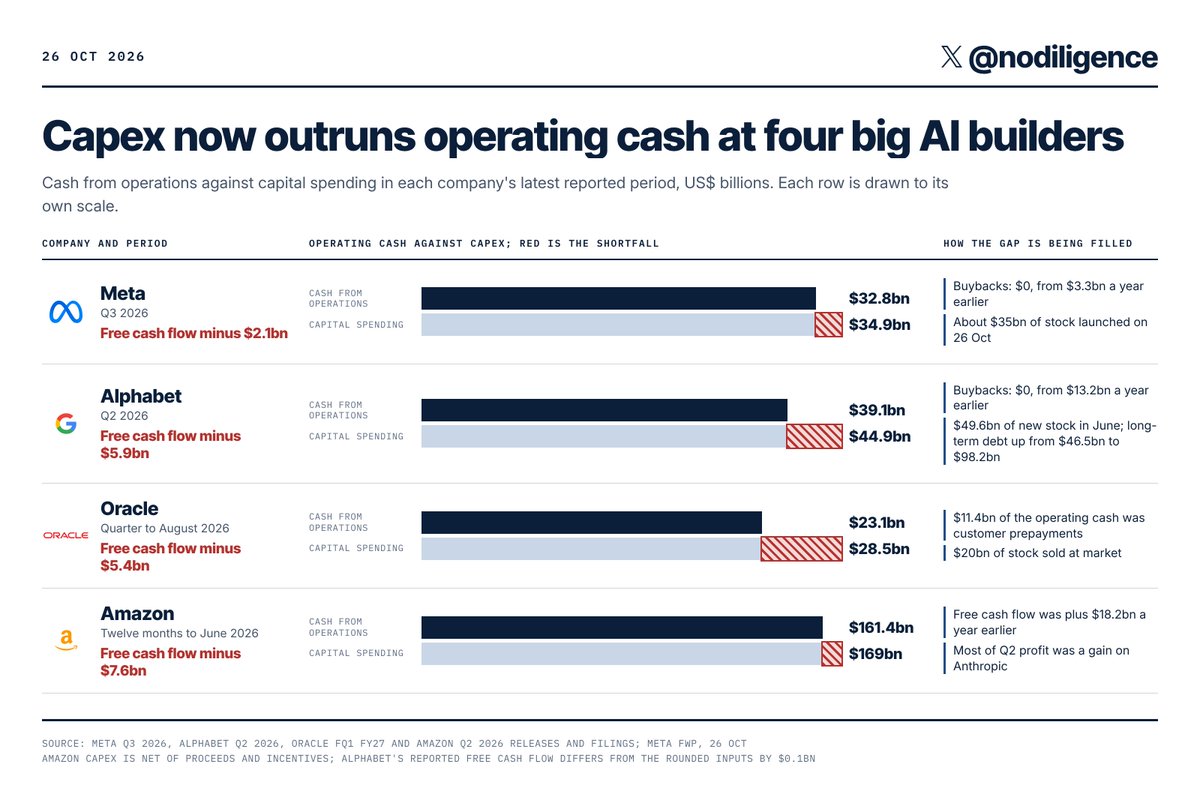
Four of the largest builders now run negative free cash flow, and the two that stopped buybacks did it in the same year their CEOs said demand outruns supply. Zuckerberg said in July there is “nowhere near enough compute” (opens in new tab) and that outsiders offer Meta’s capacity “a significant premium over what we paid for it”. If that premium were large and long-dated, Meta could rent out capacity and keep its cash. It sold stock instead, and NVIDIA, AMD and Broadcom indicated non-binding interest in buying up to $5bn of it (opens in new tab). Vendor financing has moved from the neoclouds up to a hyperscaler, and suppliers offering to buy their customer’s stock so the customer can keep buying their chips is the clearest sign in this cycle that end demand is not yet paying for the capex at the pace it is growing.
Oracle is the version of this with the least room. S&P cut it to BBB- on 9 July and expects a free operating cash flow deficit of nearly $42bn in fiscal 2027, with OpenAI about half of its $638bn backlog at the time (opens in new tab). Its operating cash flow now includes $11.4bn of prepayments from customers, so part of what Oracle reports as operating cash is customers financing Oracle’s build.

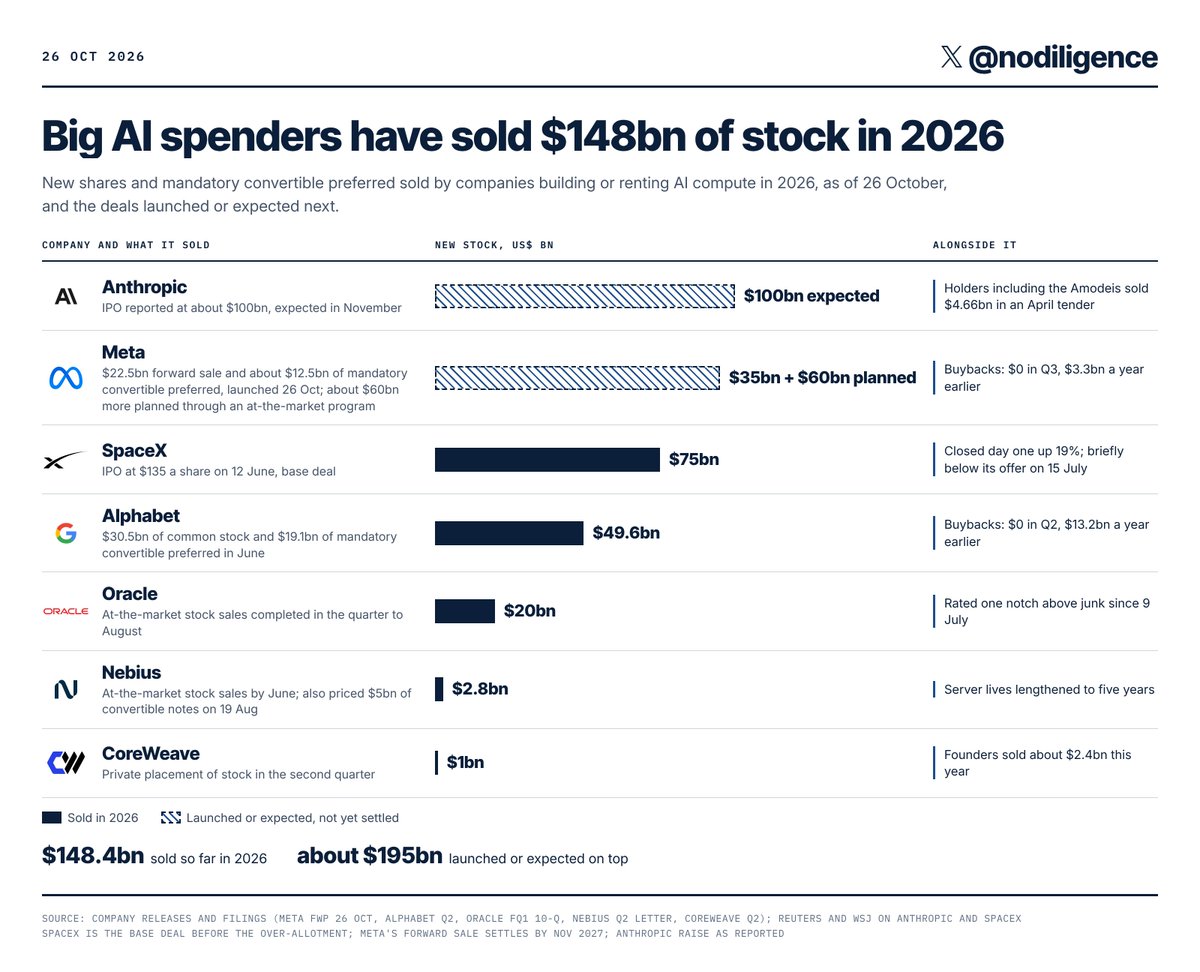
Add Anthropic’s reported $100bn (opens in new tab), the $35bn Meta launched on 26 October and its planned $60bn, and AI companies are asking the stock market for about $340bn inside a year, with the Fed hiking. The bond market had already signalled the limit: Amazon, Alphabet, Meta and Oracle sold about $194bn of bonds by 7 July against $108bn in all of 2025, the extra yield needed to clear new deals rose from 2.25bp to 12bp, and order books fell from nearly five times covered to under two (opens in new tab). The Bank of England’s financial policy committee (opens in new tab) cites Morgan Stanley’s estimate of about $450bn of AI-related debt by early September and JPMorgan’s estimate that about $4.1tn of AI capex will be debt-financed between 2026 and 2030. Equity is the window still open, which is why this many issuers are going through it at once.
A large share of cloud backlog and profit rests on two private labs

Sources: Investing.com (opens in new tab); Investing.com (opens in new tab); StockAnalysis (opens in new tab); PPC Land (opens in new tab)
The growth story at the clouds and Anthropic’s liabilities are the same contracts seen from two sides. If the minimums are fully booked, a fifth of Google Cloud’s and AWS’s backlog is one customer that bills its own customers by the token, and most of Microsoft’s backlog growth is one other customer. That is why I treat the IPO as a refinancing of hyperscaler backlog with public equity: the money raised from ANT buyers is what lets Anthropic keep adding to a fifth of two clouds’ booked revenue.
The profit side is more concentrated still.
Alphabet booked a $99bn gain on equity securities, worth $6.26 of its $9.11 of earnings per share (opens in new tab), which Fortune attributes mostly to its Anthropic and SpaceX stakes (opens in new tab) since Alphabet does not split it out, and Microsoft added a $3.2bn gain on Anthropic (opens in new tab).

Anthropic’s $72.4bn first-half charge for the change in fair value of its convertible notes (opens in new tab) is the same revaluation counted from the other side. Once ANT trades, its price flows into Amazon’s and Alphabet’s non-operating income every quarter, so a weak ANT becomes an earnings miss at two of the largest index weights. Both have a direct interest in a strong book, and Google holds an option to buy up to $10bn of stock at the IPO price (opens in new tab). The IPO turns a private mark into a public input to S&P 500 earnings.
Anthropic’s own numbers are better than the loss and harder than the story
Revenue was $4.59bn in 2025 and $16.29bn in the first half of 2026 (opens in new tab), with Q2 alone at $11.56bn. The filing leaves Q3 blank, but the business section puts Q3 revenue at 86 times Q4 2024’s and the risk factors put Q4 2024 at $197m, about $16.9bn, close to the $16.8bn reported by the FT (opens in new tab). Anthropic leads enterprise LLM spending with 40% against OpenAI’s 27% in Menlo’s latest survey (opens in new tab), and Ramp’s September index has it ahead on business adoption, 43.8% to 40.6% (opens in new tab).

Q3 is still about 46% growth on Q2. What changed is the size of the step: Q2 added $6.82bn of quarterly revenue and Q3 about $5.4bn, the first quarter in the series to add fewer dollars than the one before. Model versions released in the six months to 30 September produced over 80% of Q3 revenue (opens in new tab), and the September releases cut cost per task by about 25% for Fable 5.1 and about 40% for Opus 5.5 (opens in new tab). A 40% cut means usage has to grow about two-thirds just to keep revenue from the same work flat. Revenue arrives in jumps tied to releases and price cuts, and the jumps got smaller just as the long-dated bills start landing
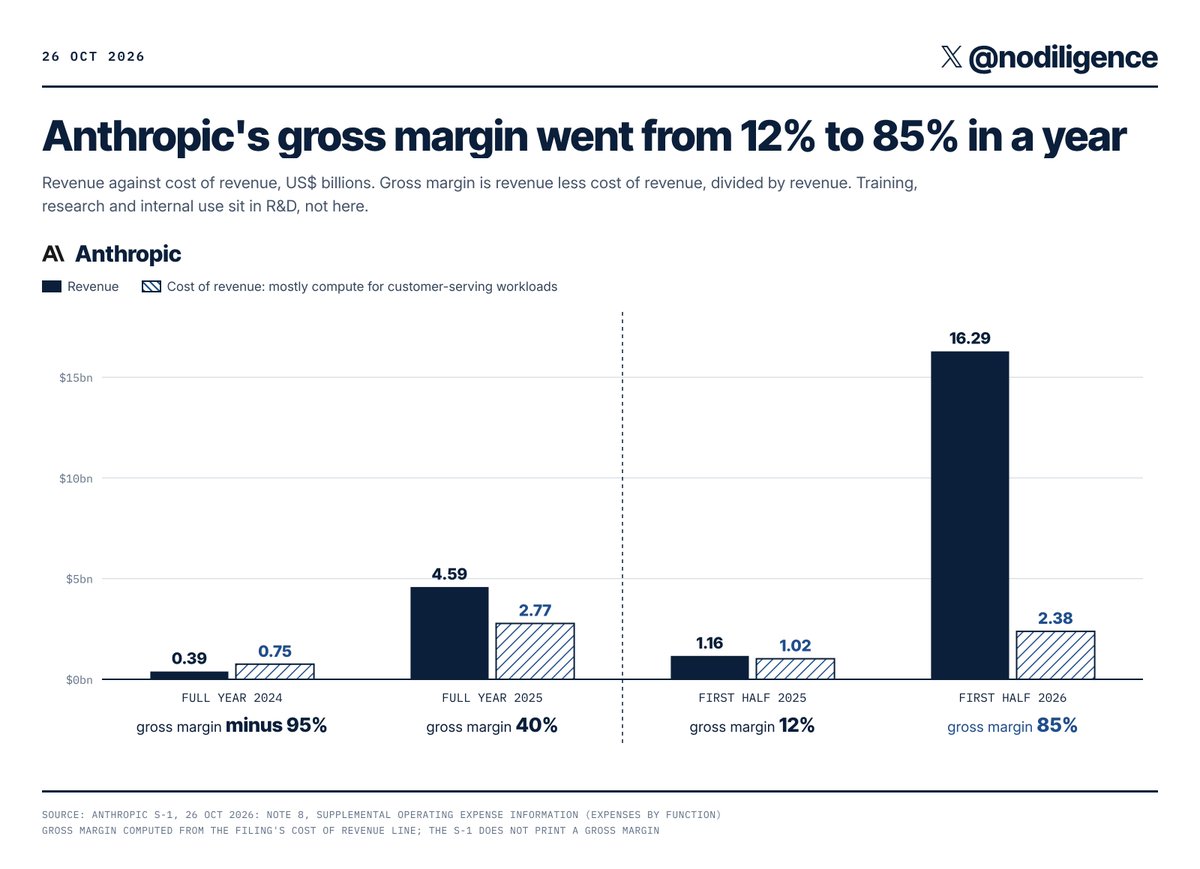
The margin is the strong part. Note 8 restates costs by function and puts cost of revenue at $2.38bn against $16.29bn of first-half revenue (opens in new tab), an 85% gross margin, up from 12% a year earlier.

That 85% rests on Anthropic’s own split of one compute pool between serving and training, and I suspect part of it reflects supply that never arrived: the filing says Anthropic has in the past sought more compute from its clouds than they were willing to provide (opens in new tab) and expects more short-term compute at higher prices to compress its operating margin in the near term. The rental prices in the first chart are a good proxy for that short-term compute. Rising GPU rents help the neoclouds’ collateral and hurt Anthropic’s margin at the same time
The loss is mostly paper: the operating loss was $693m (opens in new tab) for the half, with a $974m operating profit in Q2, and operating cash flow was $3.93bn against $482m of capex. The $80.7bn net loss comes from marks on notes held by the same companies that rent Anthropic its compute.

On valuation, a listing at $1.5tn to $2tn is about 22 to 30 times Q3’s revenue annualised. OpenAI is negotiating to raise $30bn or more at $1.4tn before the new money (opens in new tab), about 52 times its latest reported quarter of $6.7bn (opens in new tab) annualised. Anthropic books its cloud marketplace sales, 48% of first-half revenue (opens in new tab), gross and puts the clouds’ cut in its expenses, which flatters its side a little, but the gap is still wide. Public buyers are being offered the lab that made an operating profit in Q2 at a lower multiple than private investors are paying for the one that did not, which tells you the public discount for the financing risk in this piece is already large.
Anthropic signed hard contracts with the strong and soft ones with the weak
The filing puts dollar figures on seven compute contracts worth about $637bn (opens in new tab). The four with Google, Amazon, Microsoft and Broadcom, $430.6bn in all, are payable whether the capacity is used or not, or are leases that cannot be cancelled short of a default. The three with SpaceX, Nscale and Lambda are maximums Anthropic can walk away from or pays only on delivery.

That design is smart for Anthropic, and it moves risk to the providers least able to carry it. The flexible layer is where the neoclouds sit.

Sources: SEC filing (opens in new tab); Forbes (opens in new tab); SEC filing (opens in new tab); Data Centre Review (opens in new tab); TechCrunch (opens in new tab); TeraWulf (opens in new tab); Nasdaq release (opens in new tab)
Two smaller arrangements sit outside the chart. TeraWulf signed a 20-year lease worth about $19bn for about 401MW (opens in new tab), with investment-grade credit support for Anthropic still to be named, while Google already stands behind $600m of a separate TeraWulf lease to Fluidstack, which also serves Anthropic. CoreWeave has Anthropic as a customer below the S-1’s named contracts, and it carried $640m of Q2 net interest against a $49m operating loss (opens in new tab) on new contracts that run three to six months.
Each of these companies built its backlog on Anthropic, and Anthropic kept the option to leave. Nscale has 2.5% of its contracted value running. Lambda tripled its backlog in a quarter mostly on one deal it can lose if a lease falls through. SpaceX is the biggest neocloud on the list and its owner is the loudest bear on the rest of them: Musk said 200+ neoclouds face “guppy-level death and consolidation” (opens in new tab) the day before the filing, while holding a $120.5bn contract that turns into a 90-day rolling deal from early 2027. Gartner expects more than 80% of neoclouds to stop operating independently by 2030 (opens in new tab). If Anthropic’s growth slows, its first move is to stop renewing the flexible layer, and the neocloud lenders and shareholders take that loss before any hyperscaler does.

Google is Anthropic’s largest take-or-pay cloud claim, behind only Broadcom’s lease rent, a shareholder with a 14.99% cap, a note lender whose draws are tied to conditions in Anthropic’s third-party compute agreements and revenue targets (opens in new tab), and the credit behind some of the data centres that host Anthropic’s chips. The S-1 says some of Anthropic’s capacity depends on “credit support provided by a third party that is also a competitor” (opens in new tab). Alphabet’s backstops for data-centre payments reportedly rose to $43.8bn of notional exposure by June from $16.9bn at the end of 2025 (opens in new tab), and it took about 5.4% of Cipher for backing one Fluidstack lease (opens in new tab) in 2025. Google is the lender of last resort for its main model rival’s compute, and it collects rent, notes, equity in the landlords and marks on its Anthropic stake on the way.
The bills run for a decade, and part of them can be paid in ANT stock
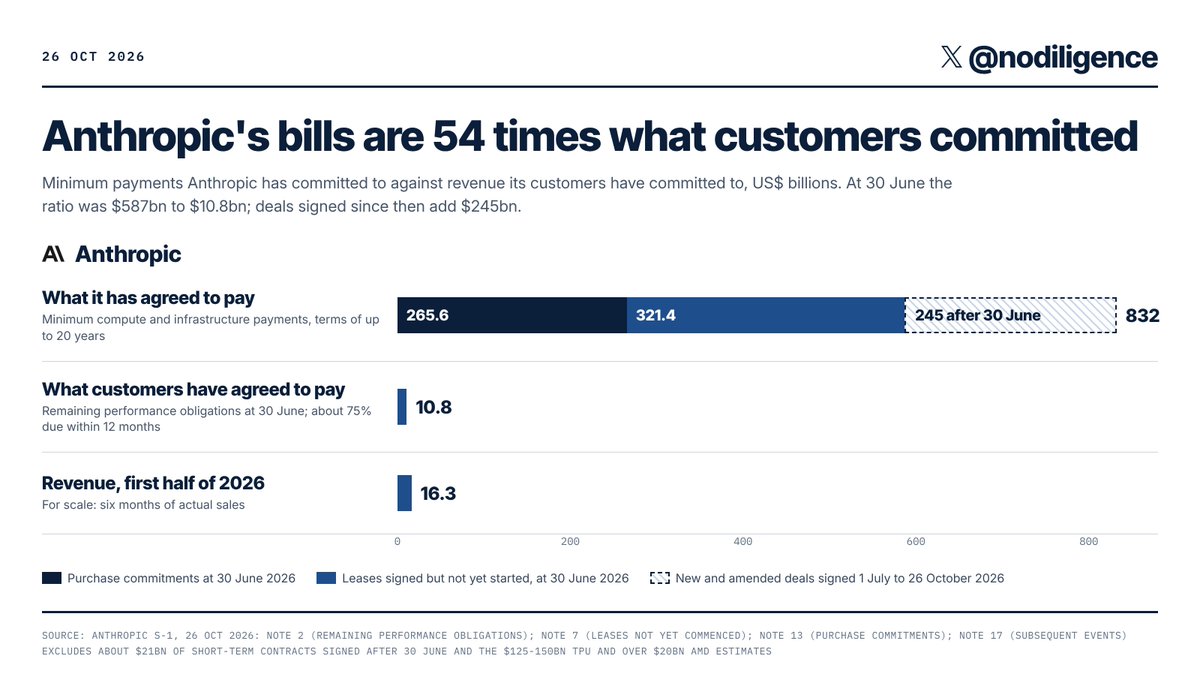
At 30 June the notes showed $265.6bn of fixed or minimum purchase commitments and $321.4bn of leases signed but not yet started (opens in new tab), and Anthropic signed about $245bn more between July and the filing. Its customers had committed to $10.8bn.

The S-1 also says Anthropic has “significantly underestimated our compute requirements” (opens in new tab) in the past, which is the stated reason for buying this much. Amodei put the risk of the opposite mistake plainly earlier this year: off by a year on growth and you go bankrupt (opens in new tab). The named compute contracts end between 2033 and 2036, but the filing puts the tail of its commitments out to 2045, and some power deals run 20 years with take-or-pay terms and uncapped fuel pass-throughs, while many top customers can cut or stop spending at any time (opens in new tab). With US energy prices up 20.4% in a year (opens in new tab), that fuel clause is the macro risk sitting inside the filing.

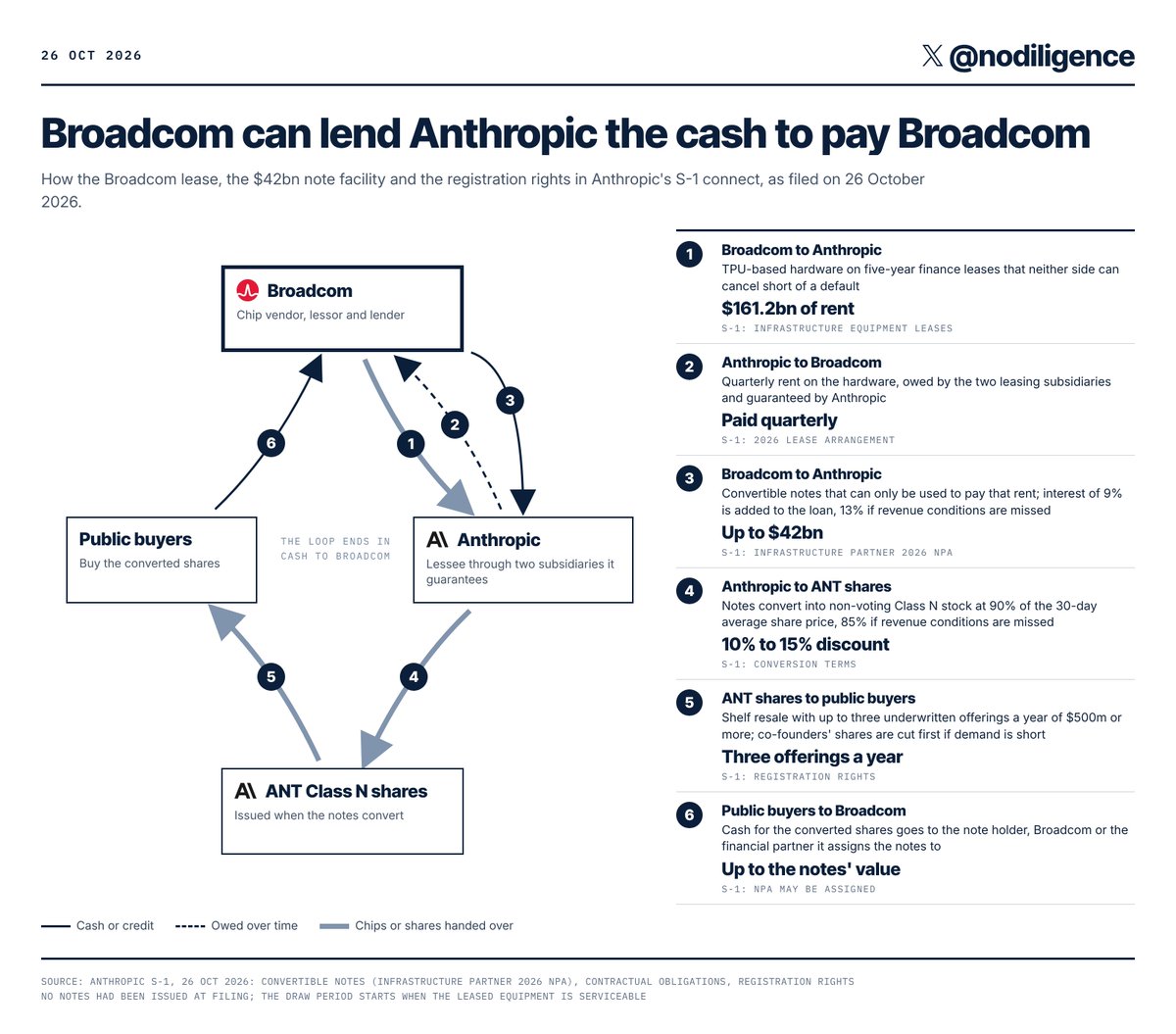
The part of the filing I think the market has missed is how much of this bill can be settled in shares. Broadcom can lend up to $42bn (opens in new tab) only to pay Broadcom’s rent; the notes convert into stock at 90% of the 30-day average price, or 85% if revenue conditions are missed, and come with a shelf for resale and up to three underwritten offerings a year. Draws on Amazon’s $15bn facility (opens in new tab) are settled in shares at the 30-day average as compute milestones are hit. Google’s $20bn can be settled in shares at the 30-day average, with resale registered within 60 days of each quarterly closing. AMD buys up to $5bn of stock as its GPUs are delivered.

Put together, the compute bill and the share count are linked: the more compute Anthropic draws from these suppliers, the more new shares it can issue to them, and the suppliers hold registration rights to sell. Broadcom can also assign its notes to a “designated financial partner”. A financial holder of notes that convert at a 10% discount to a trailing average price would normally hedge by selling ANT short, which makes it a steady seller. Broadcom already sits on three sides of the same risk, as lessor, lender and, since 26 October, guarantor of residual value to the banks on a $63bn vehicle that buys its chips and leases them to Anthropic (opens in new tab). Its AI revenue grew 221% last quarter while receivables almost doubled from $7.1bn to $13.7bn in nine months (opens in new tab). The June chip platform it endorses already finances part of that revenue, and the note facility and the $63bn vehicle will finance more.
Public buyers get the economics, little say and a supply calendar
Just before the IPO a single Class F share goes to an LLC owned by the seven co-founders and carries 50.1% of the vote on everything put to shareholders (opens in new tab). The Long-Term Benefit Trust elects four of seven directors (opens in new tab), and the strategic holders sit in non-voting Class N, so the companies owed the most money have no vote.

Anthropic has also put 846,840,960 Class N shares, 5% of fully diluted shares, into its own Public Benefit Fund (opens in new tab), and the board can issue the fund another 2% each time the stock rises 50% above the last milestone, starting from the IPO price.

A buyer gives up a slice of the upside in exactly the scenarios where the stock does well, on top of the supplier conversions above. Against all that dilution, the deal itself is built for a strong start. Goldman Sachs and Morgan Stanley lead 22 banks on a raise of about $100bn at $1.5tn to $2tn (opens in new tab), a float of roughly 5% to 7%. Under rules adopted this year, the Nasdaq-100 adds a top-40 IPO after its 15th trading day, with no minimum float and an index weight of up to three times the float (opens in new tab), so a small float earns triple weight. GraniteShares has filed 2x long and 2x short Anthropic ETFs (opens in new tab).

SpaceX is the only listing of this size to compare against. It priced at $135 on 12 June at a $1.77tn valuation, closed day one up about 19%, then dipped below its offer price intraday on 15 July (opens in new tab) and was at $147.49 on 23 October (opens in new tab). Polymarket odds of ANT closing day one above $2tn fell from 74% on 10 September to about 42% (opens in new tab), and Reuters reported some investors now value it at about $1.5tn, down from roughly $2tn (opens in new tab). If ANT prices on 18 November, index buying arrives on days 5, 10 and 15, the Fed meets on 9 December and the Nasdaq-100 adds it after the close on 10 December. Insider supply starts on day one, when up to 10% of staff and director shares are released (opens in new tab), and the day-27 release on 15 December, the first to free shares from the 365-day group too, lands three trading days after the Nasdaq-100 buying.
The best-informed money has been selling or moving up the capital structure

Sources: Meta call (opens in new tab); StockAnalysis (opens in new tab); NVIDIA call (opens in new tab); NVIDIA (opens in new tab); Kiplinger (opens in new tab); Yahoo Finance (opens in new tab); AI Weekly (opens in new tab); Invezz (opens in new tab); SEC filing (opens in new tab); SiliconANGLE (opens in new tab); TipRanks (opens in new tab); Trustnet (opens in new tab); Seoul Economic Daily (opens in new tab)
The operators all talk about scarcity, and their actions point the other way: stock sales, vendor credit and receivables growing faster than revenue. The Amodeis sold in April at less than half the Series H price, so they gave up money by selling early, and it still means the people with the best view of Claude’s demand chose to take cash before any public price existed. NVIDIA’s numbers matter most here. A supplier with real pricing power gets paid faster, and NVIDIA’s cash conversion halved in a quarter as it borrowed $24.9bn and announced partnerships to mobilise over $500bn of third-party capital for its customers (opens in new tab). Its next quarter is expected around 18 November, inside the ANT pricing window.

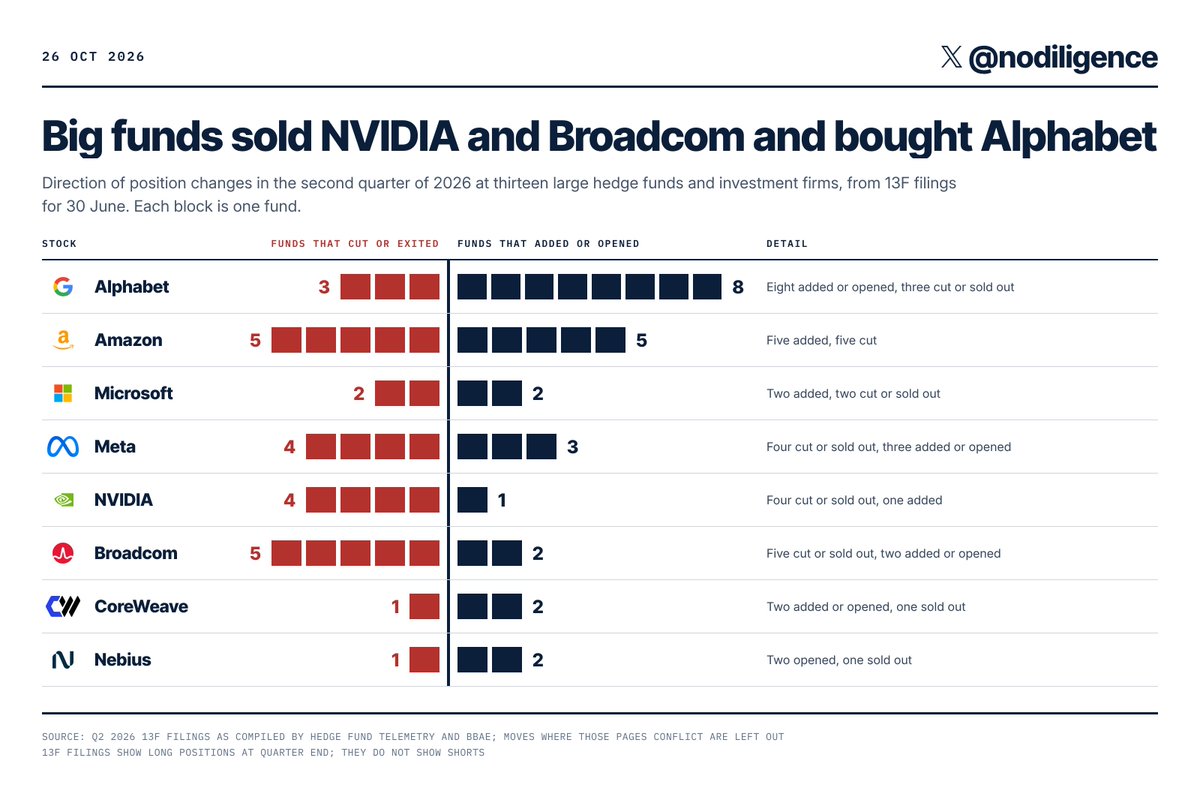
The second-quarter 13F filings (opens in new tab) show the rotation. Coatue, D1, Tiger and Third Point cut or sold NVIDIA, five of thirteen big funds cut or left Broadcom, and eight added Alphabet, Berkshire Hathaway by about 83% (opens in new tab). Altimeter, Coatue and D1 led or co-led Anthropic’s $65bn Series H at $965bn (opens in new tab), and all three added Alphabet or Amazon in the same quarter, the two companies whose earnings carry most of the Anthropic mark. They doubled their exposure through stocks they can sell any day. The October BofA survey (opens in new tab) has bond yields as the top tail risk at 31%, with an AI bubble down to 23%, and semiconductor crowding down from a record 82% in July to 45%. Money has not left AI. It has moved from the suppliers to the balance sheets that pay them, and that works until those balance sheets start issuing stock, which Alphabet did in June, in the same quarter these funds bought it, and Meta began on 26 October. Shorts are concentrated in the most levered layer, with CoreWeave short interest at 23.7% of its free float (opens in new tab), and Burry has said the market should “tank hard” (opens in new tab)to stop the OpenAI and Anthropic IPOs. The third-quarter 13Fs are due on 16 November, because the 45-day deadline falls on a Saturday, days before ANT prices, and will show whether those crossover funds trimmed Amazon and Alphabet ahead of getting direct exposure.
Where the value accrues, and what I would own
Whoever is paid in cash, up front, on terms shorter than the asset’s life keeps the value. Whoever lends long against short contracts, or takes payment in the customer’s own paper, holds the risk. Hyperscalers push usage risk down to the labs with take-or-pay contracts, construction risk out to neoclouds and bondholders with short leases and value guarantees booked at zero, and price risk back to chip vendors who take notes and stock. The labs push the flexible part of their demand onto the neoclouds. The equity buyers at the end of the chain hold the residual of all of it.

Of these, Alphabet is the one I hold with the most conviction, because it sits on the senior side of every Anthropic relationship and still keeps the upside. The weak point is that more than two-thirds of its Q2 earnings per share came from stake gains, and the IPO will set that mark in public. I would size it knowing that an ANT trading below the value Alphabet’s books carry becomes an Alphabet earnings problem in its Q4 2026 results.
The calendar from here
28 and 29 October. Alphabet’s backlog (has the $114.5bn Anthropic contract landed, and did the backstop exposure grow again), Microsoft’s backlog growth outside OpenAI, Amazon’s free cash flow, the Fed decision and the Q3 GDP print.
Around 12 November, CoreWeave’s Q3. If new contracts are lengthening and interest is falling as a share of revenue, the credit market is too pessimistic and the neocloud layer is a buy.
16 November, third-quarter 13Fs. Whether Altimeter, Coatue and D1 trimmed Amazon and Alphabet before ANT lists.
NVIDIA’s quarter, expected around 18 November. Receivables growing faster than revenue again would confirm that vendor credit is carrying demand.
The S-1 amendment with the price range. Below about 75% gross margin in Q3 would say the first half was flattered by rationed supply, and the blank Run-Rate Revenue as of 31 October should finally be filled in.
9 to 15 December. The Fed decision, Nasdaq-100 entry and the day-27 lockup release in one week.
January to March 2027. Whether either side gives notice on the SpaceX contracts once they become cancellable, which will show who needs the GPUs more.
The start of Broadcom’s draw period. The first quarterly rent paid with notes instead of cash would show the conversion supply beginning.
My mind is still very open on the core thesis but if there is a fall in long yields that reopens the credit window, I will reconsider where things are going. With the 10-year back near 4.5% and the Fed on hold, the build could fund itself with bonds again and the equity issuance would stop looking forced.
Disclaimer
I am doing this independently and sharing it as part of my own research and thinking. The views here are my own and are based on the information available to me at the time. This should not be treated as investment advice or a recommendation to buy, sell, or invest in anything mentioned.
If you have a correction, a better source or a data point I missed, leave it in the comments or send it to me on X at @nodiligence (opens in new tab).
Chamath Palihapitiya called an @nodiligence X post “Good read” and linked it; the post links to the article “Anthropic’s IPO is where the AI build switches from debt to stock.” The article’s thesis is that AI infrastructure funding is shifting from credit to public equity, with value accruing to cash-paid suppliers such as TSMC and Google while lenders exposed to long-term financing against shorter contracts bear risk.