Once you realize what that means, you’ll be giving two cheers for the American work ethic.
What will people do all day? I mean, of course, if the AIs surpass us at all economically necessary forms of labor.
There’s an emerging consensus on this point, assuming we’re all still alive and not subjects of a cyberpunk feudalist dystopia. When the machines can do everything else, our relationships will be what’s left.
Maybe we won’t have to work at all. Or maybe we’ll still have something that superficially resembles modern employment, just concentrated in what economist Alex Imas [^1] calls “the relational sector” in his essay “ What Will Become Scarce (opens in new tab).” We’ll always need humans to supply the human touch. And how will we get those relational jobs? Relationships, obviously. It’s not what you know, it’s who you know, since everyone knows everything anyway.
What is really being suggested here is less a continuation of modern work than a return to a much older cultural understanding of labor. Imas makes this point directly: “Before industrialization, it was difficult to separate a product from the person who made it … Economic transactions had a distinct social component that was innately linked to the consumption experience.”
Relatedly, before industrialization, there was very little sense that working, in itself, could be dignified or meaningful.[^2] We were not defined by our jobs but by our participation in a densely interconnected social world. And we might be again. That’s the natural consequence of all these relationalist predictions — a world where our connections to other humans are what give us structure, identity, and meaning.
I am afraid they’re right.
Power and sex among apes
Making sweeping statements about the relationship between technology and cultural change is always a risk, and I’d rather avoid it until it’s absolutely necessary. At the same time, our degree of ignorance about the future is greatly exaggerated. If the future looks anything like the past — and there’s good reason to believe it will — then we can make progress with case studies.
Let’s start with 18th-century aristocrats. Aristocrats are (typically) rich, which we certainly will be if we have robots capable of all normal nonrelational labor. More importantly, when they did need to acquire material resources, they did it through leveraging their connections to obtain more land or a lucrative position at court — no drudgery necessary.
They did not work for pay; they certainly did not see work as a source of meaning. It’s certainly true that some of them had real obligations, like governing or killing each other, but court life in the age of absolutism is as close to a purely relational world as anything I can think of.
We also know a great deal about what mattered most to them and how they chose to occupy their time. Aristocrats tend to be sensitive social observers who are also extremely self-involved, which makes them talented and prolific memoirists. The most famous work in the genre, rightfully, is the memoirs of Louis de Rouvroy, duc de Saint-Simon.[^3]
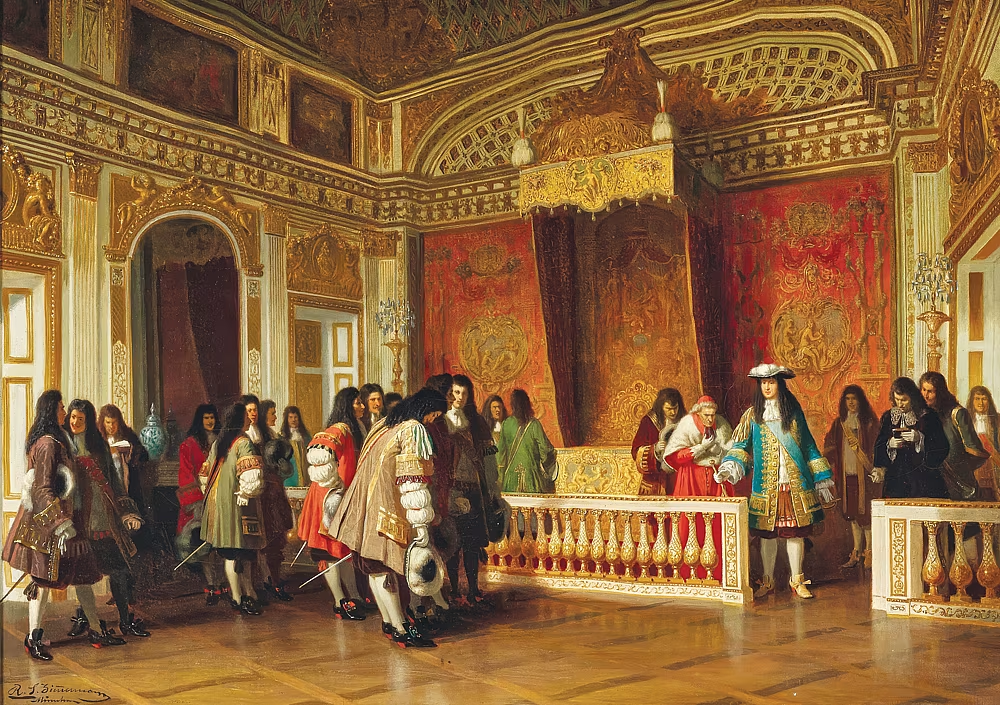
Saint-Simon was a courtier at the Versailles of Louis XIV. This was the wealthiest and most brilliant court in Europe, a center of unparalleled refinement in aesthetics and manners; according to Voltaire, another courtier, it was the greatest of the four great ages of light, surpassing Athens, Rome, and Florence at their peaks.
It might seem surprising, then, that Saint-Simon himself is dull, petty, anti-intellectual, and obsessed with nuances of heredity and precedence to the exclusion of every other human concern. Most of his life was spent in incomprehensible litigation over which families might be entitled to a certain heraldic emblem or whether parliamentary magistrates could wear a particular bit of ceremonial headgear in the presence of dukes. He despised the king, in part for elevating his bastards to positions of ceremonial precedence, in part for turning over the governance of the realm to talented commoners. (Voltaire was an upjumped nobody, barely worth dismissing if not for his unfortunate reputation among “certain kinds of people.”) His dignity was immense and constantly outraged. Reading his memoirs is like spending a few hundred pages in the mind of Daffy Duck.
Reinhard Sebastian Zimmermann (German, 1815–1893), Audience with the French King Louis XIV, oil on canvas.
None of this is to say the memoirs aren’t entertaining to read: they are, in large part because of the contrast between the keenness of Saint-Simon’s observations and the inanity of their content. All the amusements of court life — plays, operas, masques, fetes, games, feasts that last for a week and feature hundreds of servants dressed as figures from classical myth — are a backdrop to the real organizing activity of daily life: intrigue. In this world, nobody goes to the theater to appreciate the genius of Molière or Corneille. (That’s the kind of thing Voltaire points out in his own history of the period, which is how we know he’s hopelessly bourgeois.) They go to see who else is there, and what they’re wearing, and whether what they’re wearing could be construed as a statement of allegiance in some ongoing factional conflict.
It would be unfair to judge an entire society from the recollections of one disappointed man. And this isn’t how we typically picture 18th-century French aristocratic culture. You might be imagining glittering salons where the leading figures of the Enlightenment discussed poetry, drama, and the most pressing philosophical issues of the day. This is (mostly) a lie. Salons existed and philosophes attended them, but more for entertainment than for rational discourse. When we look at the enormous amount of written material the salonnieres and their guests produced — as French historian Antoine Lilti did — it is clear that their conversation consisted overwhelmingly of political gossip.[^4] They were almost all aristocrats, and they almost always talked about themselves.
I’m no Lilti, but I’ve read a lot of aristocratic memoirs, and all of them are like this. Saint-Simon might be an unusually advanced case, but that’s all he is: The morbid symptoms are universal. Take the memoirs of Catherine the Great. Catherine is everything Saint-Simon is not: open-minded, intellectually voracious, an admirer of Voltaire, and ruthlessly pragmatic in the pursuit of power.
Catherine is a very different kind of observer, but the world she’s observing is essentially the same. St. Petersburg might not hold a candle to Versailles, culturally speaking, but the distinction hardly matters — as in the French court, the only path to advancement was through politics, and all politics was relentlessly personal. Daily life was, again, gossip: who was seen speaking to whom, who’s too religious or not religious enough, who’s having an affair, who’s offended or might offend or could be maneuvered into offending the empress. There was no freedom, no privacy, and almost no conversation that is not ultimately about jockeying for favor with someone closer to the center of power.
It’s difficult for modern readers — at least, for this modern reader — to understand why intelligent, perceptive adults with every material resource would behave like this. It all seems so undignified. But then, aristocrats are not like us. We’re bourgeois: Our idea of dignity involves being diligent, productive, responsible citizens. (That is, it involves working.) Aristocratic dignity comes from honor, which is to say it comes from maintaining distinctions of family and class.
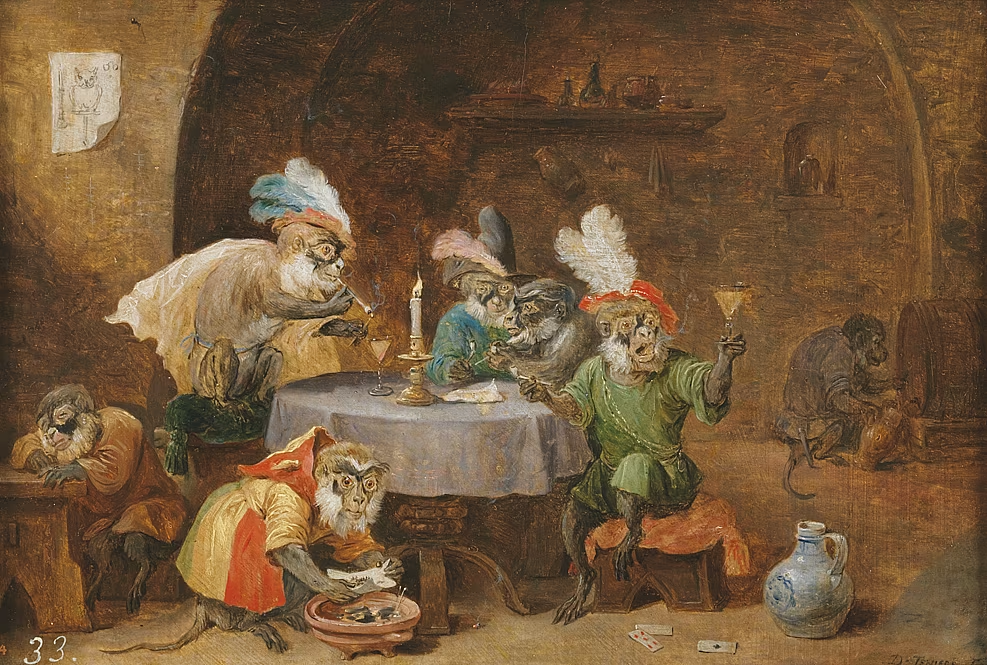
In addition to aristocratic memoirs, I enjoy reading about primate ethology. Indeed, I like these books for similar reasons: Aristocrats are basically chimpanzees. They’re highly social, cunning, at all times hyperaware of their strict internal dominance hierarchy, and constantly, obsessively tracking alliances, challenges, displays of prowess, and attempts to get ahead. Norbert Elias argues in The Court Society that the highly elaborate etiquette and ceremony that consumed life at Versailles was part of a civilizing process — part of the transition from a military aristocracy who handled outbursts of emotion by stabbing each other to a form of institutionalized self-control. Clearly, they needed it.
But another important lesson from Elias is that we shouldn’t see the behavior of aristocrats under absolute monarchy as some kind of inevitable regression to our universal primate instincts. The inmates of Versailles or St. Petersburg are hardly the inevitable product of a world without work. They were all born into centuries-old webs of feudal institutions and court ceremonials, which were themselves warping under pressure from the birth of the modern state. Our own society will be evolving from a much saner starting point. Should we expect to do better?
David Teniers the Younger (–1690), S moking and drinking monkeys, c. 1660, oil on panel.
Ladies who lunch
Susan Ostrander’s Women of the Upper Class [^5] is an ethnography of upper-class women in an unnamed Midwestern city in 1984.
Theirs isn’t a pure post-work society. All the women have husbands who have jobs, even if it’s just managing the family money, and one of them (but only one) works herself. Even so, I think this book is about the best modern case study of a relational society as we’re going to find.[^6] None of Ostrander’s subjects grew up with the expectation that they would work outside the home, and none of them feel any obligation to do so as adults. And Ostrander is interested in the same questions we are: Why do these women do what they do? What matters to them? What are the structuring assumptions of their lives?
The main structuring assumption, it turns out, is that class matters. Unlike 18th-century aristocrats, they are not especially ambitious (“These are men and women born to privilege, and social striving is not necessary”). Instead, “the women see to it that the social network of ‘congenial’ people is kept in good order.” Much of this work involves socializing and hosting, as well as supporting their husbands and — perhaps most important — ensuring that their children contract socially appropriate marriages. But this isn’t what occupies most of their time. One can only host so much, and by the time the kids are in boarding school they practically raise themselves. Instead of working, politicking, or developing rich and varied hobbies, they volunteer.
Volunteering, for the upper classes, is a very specific kind of activity. It does not involve picking up trash or ladling out soup. All of the women served on the boards of prominent nonprofit institutions — the opera, the symphony, hospitals, and various local philanthropies. Their work on these boards consisted almost entirely of fundraising. They raise funds, they say, because they’re best placed to do it: They’re all very rich, and they know all the other very rich people. They’re all socialized into the appropriate rituals of asking for money — the path to higher-level charity work runs through the Junior League, an exclusive upper-class service organization to which nearly all of them belong.
Most of them enjoy volunteering — because it provides them with an opportunity to exercise a degree of responsibility for which they would not be qualified in paid professions or because it affords them flexibility to look after their families. About a third of them dislike the work but do it anyway, seeing it as socially necessary. All of them feel the need to justify their high social position by giving something back. (This is a point Alexis de Tocqueville understood: “In the United States, a rich man believes that he owes to public opinion the consecration of his leisure to some industrial or commercial operation or to some public duties. He would consider himself of bad reputation if he used his life only for living.”)
Interestingly, while most of the women acknowledge a sense of noblesse oblige, none of them care much if their volunteer work achieves tangible results for the communities they serve. Instead, Ostrander writes,
The volunteer work of upper-class women has an elusive quality about it, and specific accomplishments, in terms of actually improving the life of the community, are difficult to come by. Mrs. Holt is a dedicated and influential community activist. In what appeared to be a slip of the tongue accompanied by a flush of apparent embarrassment, she said, “It’s that illusion of being useful that’s satisfying.” Mrs. Smythe referred to volunteer work as “a demonstration of sincerity.” And Mrs. Harper confessed, “I’m not sure that what I’ve done has really accomplished anything, a lot of it is busy work.”
I am both fascinated and disturbed by the institution of volunteering in the lives of 1980s Midwestern society ladies. We all want to believe that if we had all the money in the world we’d be following our dreams, not spending most of our time on a fairly specific and restrictive socially mandatory activity that nobody believes even accomplishes its own ostensible goals. But this is what the idle rich do — in fact, I’d argue that this is what they do at their most functional.
They do this, Ostrander argues, because volunteer work is part of what separates them from the lower orders (“If you’re brought up this way, you just do it. You can’t imagine not doing it”). This is true both in the greater societal sense and inside the organizations for which they volunteer: Many of the women emphasize how undesirable it would be for either the paid professionals who manage these organizations or the clients they serve to have too much influence over the way things are run. It’s all about keeping “the social network of congenial people” in good order — that is, the order where they’re on top.
These women still exist in the context of a larger commercial society, and it does seem to help. They’re all much nicer than anyone at the court of Versailles. But both societies share the same fundamental source of value: one’s family and the system it belongs to. And in both societies, this leads to the same result: The central activities of one’s life all involve preserving and defending one’s own place in that system.
In both cases, this results in a remarkably restricted social world. The range of acceptable activities and interests is narrow. The range of people you’re allowed to talk to is narrower. Everyone in the study belonged to the same set of exclusive social clubs. Almost all of them have lived in the city for many generations. One subject born to an equally elevated family on another city wryly described herself as an “outsider” in her current home, having married into one of the city’s oldest families 20 years ago.
All in all, this isn’t a bad life — just a small one. On the whole, the women enjoy it. They like material comforts, and they appreciate spending time with like-minded friends who share their interests in art, music, and civic responsibilities. When reading Ostrander, I kept thinking about Anthony Trollope, whose novels are really all about members of the landed gentry trying to maintain their traditional way of life in the face of industrialization or Whiggism. It doesn’t seem too bad. But I also kept thinking about something else — a different set of ethnographies about a very different set of people, with yet another very different relationship to work.
The working classes
That would be The Urban Villagers,[^7] a 1962 ethnography of working-class Italian Americans in the West End of Boston by sociologist and urban planner Herbert J. Gans. This seems like an odd comparison. Don’t the working classes, by definition, work?
They do — but “working class” is a broad descriptor. In the 1950s and ’60s, a cluster of ethnographers — including Gans in Boston, Michael Young and Peter Willmott in London, and Henri Coing in Paris — all wrote books about a particular strain of working-class life that was at that time just beginning to cease to exist. Their subjects lived in dense, centrally located, low-income neighborhoods, all of which were about to be swept away by urban renewal. Gans lived in the West End in 1957 and 1958 while researching the book; his writing was part of an unsuccessful campaign against the city’s “slum clearance” program. The West End, he argued, was not a slum, but a close-knit and socially functional community.[^8]
Gans’ use of the term “urban village” was deliberate: He believed that the West Enders had inherited the basic forms of social organization from their parents and grandparents, rural peasants from Sicily or Southern Italy. These were not people who had absorbed a typically Yankee relationship to work. Most male West Enders worked unskilled or semiskilled blue-collar jobs, and their employment was typically precarious. They did not see a fulfilling career, or indeed a career of any kind, as possible or even desirable.
It’s not that West Enders liked their dead-end jobs. They just didn’t think much about them. Work was not a central organizing activity of West End life. West Enders worked just enough to support their lifestyle, which revolved around what Gans calls the peer group. The West End, in his words, was a “peer group society.” An adult peer group might include a married couple’s same-age relatives — siblings, cousins, in-laws — and perhaps a few childhood friends, who would probably be “adopted” in as godparents to the couple’s children. These people would spend almost all of their time together, meeting in the apartment of one family or another after work and staying late into the night. The men might gamble at a local corner store — gambling is absolutely omnipresent in this world — but mostly, they talked, and talking mostly meant gossip.
Construction site of Charles River Park, which replaced the West End neighborhood, 1961, from the Charles Frani Collection of The West End Museum.
This is where the parallels to old money Midwestern ladies and European aristocrats start to show. While there are any number of things these groups don’t have in common, all of them share certain features.
First, none of them see work as a source of status. West Enders do like to show off, but never about their jobs: Their talent as conversationalists in the peer group setting is much more important. Second, they are exclusive. A West Ender knows all the same people from early childhood. They’re very skeptical of outsiders, including members of other ethnic groups who’ve lived in the same neighborhood their whole lives.
Finally, they all spend an enormous amount of energy policing deviant behavior. In the West End, this usually means sexual promiscuity for women, effeminacy for men, and class aspirations for anyone. A boy might be mercilessly bullied for doing too well in school or for wanting a white-collar job. Even unusual success is frowned upon. A person’s primary source of dignity is not their own achievements, but their relationship to the group:
The major criteria for ranking, differentiating, and estimating compatibility are ingroup loyalty and conformity to established standards of personal behavior, as well as interpersonal relations. West Enders expect each other to maintain prevalent social practices and consumer styles, to marry within the ethnic — or at least the religious — group, and to reject middle-class forms of status and culture … The most significant criterion of interpersonal behavior is behavioral control — the ability to regulate one’s own needs and wishes and to defer to the needs of the group when necessary.
Gans, like all good ethnographers, likes his subjects, and their way of life has a lot tolike — they really do enjoy a warm, rich, close-knit social world. But he also goes out of his way to emphasize that these people are extraordinarily conformist relative to middle-class American suburbanites in the 1950s.
Of course, there are selection effects: The second-generation Italian Americans who wanted white-collar jobs and a house in the suburbs were no longer in the West End. Invariably, their earlier social connections did not survive the transition. (“As one family who had moved out of the West End into an aging lower-middle-class town explained: ‘People don’t visit us here; they think we’re rich.’”)
West End culture was good for many of the people who lived it, but it was limited, and these limitations could have tragic consequences. One of them was the destruction of the West End. The West Enders don’t want their homes to be torn down and turned into luxury condominiums — but they repeatedly fail to organize against it. This is because the West Enders are not good at organizing. The peer group is, of necessity, egalitarian: They don’t trust anyone who tries to set himself up as a leader.
They also struggle with the concept of impartial bureaucracy — to a West Ender, the idea of prioritizing a formal rule over the interest of one’s own family seems cold, even immoral. As a result, West Enders have a lot of what sociologists like to call social capital, but none of the institutions that come with it. There are no labor unions, Rotary clubs, bowling leagues, or PTA meetings, and while they do attend church, their parish is run by the Irish. As we would expect, they are not very effective politically.
Here, Gans draws on Edward C. Banfield’s 1958 book, The Moral Basis of a Backward Society. The backward society is a poor Southern Italian village he calls Montegrano — exactly the kind of place the West Enders’ grandparents might have been born in. Its residents operate by the principle of what he calls amoral familism: “maximize the material, short-run advantage of the nuclear family; assume that all others will do likewise.” Banfield argues that this mindset is why the Montegranans are poor: Their mistrust of anyone outside the family circle makes it impossible for them to build the kinds of abstract institutions necessary for economic growth.
This work, then and now, is highly controversial. In any case, Gans draws the opposite conclusion: The West Enders might be amoral familists, but this is (mostly) a rational response to their chronic poverty. It really is the case, in Montegrano and in Boston, that their bosses are exploitative, their politicians are corrupt, and the institutions of civic life are controlled by groups hostile to their basic interests.
But all these conditions are much less fixed in America than they were in Italy, and as conditions changed, so did norms. In America, unlike in Italy, women were able to work outside the home — and West End girls enjoyed significantly more freedom to go where they wanted and marry who they chose than their mothers and grandmothers. Even their brothers can’t ignore the siren song of the formal labor market forever: “As economic conditions improve,” Gans writes, “the ethos which Banfield calls amoral familism has begun to recede in importance.”
In other words, our material conditions don’t just change what we have, but what we want. We may not have a choice.
Friendship was invented in 18th-century Scotland
Relational living comes to us naturally. It’s the most common form of social organization in human history, and millions of people around the world are perfectly happy with it. But when our personal dignity comes from our membership in a group, everything the group does reflects on us — and everything we do reflects, unavoidably, on the group. It’s not a coincidence that Russian princes and Bostonian Italian day laborers spent most of their time gossiping (or, if we want to be technical, constructing and enforcing norms of behavior). They were defending their collective reputations: the thing that mattered most to them in the world.
This is why so much contemporary discussion of work and meaning is misguided. It’s very clear that humans don’t need work or anything like it to live meaningful lives. Nor do we need the things that people who talk about “meaning” mean — individual self-actualization, personal growth, serving a greater purpose. We can get by just fine without any of them, as historically most of us have. What we absolutely can’t live without is a social framework for understanding ourselves in relation to the rest of our society and gaining the respect of our peers. The most important thing work gives us — after money, of course — is an alternative way to meet those needs. Not all jobs are pleasant or rewarding, but all of us benefit from living in a system where we can earn respect and dignity as adults from what we do, not who we know, or who we are.
And this is exactly what we see when we look at what Americans actually get out of work.
As the anthropologist Claudia Strauss has documented, plenty of people with very ordinary jobs report that their work is fun. But that’s not why they do it. In one study, Strauss looked at the experiences of workers coming back to the office after COVID-19 lockdowns. None of these people lived to work; they enjoyed having more vacation and shorter hours. They wanted to spend time with their families. And most of them greeted their return to the office with overwhelming relief:
An immigrant from El Salvador who had been a bartender in Las Vegas before the casinos closed told a reporter, “Sometimes one feels afflicted, desperate, because we want to work. We don’t want unemployment benefits, free money for no work. We want to feel useful.” A young Native man in Arizona who had become a Level 2-certified sommelier missed his job. He spoke of how wine had become his “window to the world, this way for me to travel” to which he otherwise had no access. A Black woman in her fifties cried for joy when she returned to her job at the Grand Rapids, Michigan, visitor center after being furloughed for months. She loved her job: “It seemed like a fairy tale because I just love being a team member where I can help people.” She commented, “I hate being stuck at home. I hate not being able to go to work, not so much for the money, but just for a part of my sanity. After so much time, you’ve done all the projects at your house, so what else is there to do?” [^9]
Strauss’ subjects liked lots of things about their jobs, but some themes stood out more than others. Respondents enjoyed it when the physical work environment was pleasant or interesting. They liked socializing with coworkers. Most of all, they liked feeling competent and respected.
We can find the same pattern in more synoptic studies. In the late 1930s, as part of an effort to fight a different employment crisis, the Roosevelt administration hired out-of-work writers to record the life stories of thousands of elderly Americans.
The Federal Writers’ Project (FWP) is a uniquely comprehensive snapshot of American life, from pioneers to circus performers to leading businessmen to former slaves. Because the project’s subjects were mostly approaching the ends of their lives, it’s also a valuable resource for understanding what they felt gave those lives meaning. An analysis (opens in new tab) of the corpus from 2025 found — to the authors’ surprise — that work featured just as prominently as family and community involvement. It was equally important for men and women, across regions and across races. Like Strauss’ respondents almost a century later, these men and women didn’t especially care if their work was a true vocation. They valued “the pride in a job well done, the skills they developed, or the recognition by bosses and peers.”
One of the FWP’s beneficiaries was a young writer named Studs Terkel. After the New Deal wound down, he worked as a radio host and starred in a semi-autobiographical sitcom before coming back to oral history. His book Working is about as comprehensive as any account of the subject can be while focusing exclusively on Chicago in the early 1970s.
On the whole, his subjects did not have a rosy view of work (this was Chicago in the early 1970s). But, once again, there were patterns in what they hated and in what kept them going. Everyone from migrant farm laborers to ad executives complained about being treated like a “robot.” It wasn’t so much that their jobs were repetitive, which, in itself, inspired mixed feelings — it was the disrespect. Workers hated being condescended to or spied on. The most miserable interviewees were the ones who felt they were denied an opportunity to exercise their talents — a white assembly line worker, say, who wanted a promotion to utility man, or his Black colleague who worked the night shift while earning a degree that would let him land the white-collar jobs for which he was already qualified.[^10] The happiest were the ones who felt that they were respected by their peers, skilled at their trades, and useful to their communities.
Like all other human beings in history, workers want to be respected. But unlike members of relational societies, the things we want respect for are impersonal: our skills, our accomplishments, our contributions to a shared goal. These contributions don’t have to be earth-shatteringly significant — a waitress in Chicago or an office assistant in Grand Rapids can still feel that work matters. (Tocqueville, again: “American servants do not believe themselves degraded because they work; for around them everyone works. They do not feel debased by the idea that they receive a salary; for the President of the United States also works for a salary.”)
Moral equality is something relational societies struggle with. They tend to be more restrictive and more exclusionary. It’s nice to imagine a world where everyone is satisfied to be simply a good spouse or parent or friend, but that’s not how these things work in practice. When our dignity depends on our membership in a group, we start to police who else can join and what happens when they do. When humans get relational, we get clannish.
This brings us back to what we already know: The modern labor market has dissolved the bonds of tradition, family, and clan. In the modern world, relationships matter less. And because they matter less, we can do much more inside them. They are freer. They have room to breathe.
As with so many things, the Scottish Enlightenment understood this first.[^11] The possibility of friendship in a commercial society was a serious concern for Adam Smith, David Hume, and Adam Ferguson. Specifically, they believed that commercial society made friendship possible. In the bad old days before impersonal markets and bureaucracies, the only way to survive was through personal ties to allies or to kin. As a result, every personal relationship was transactional.
When we can all support ourselves by our own labor, these transactions are no longer necessary. For Smith, the absence of necessity created room for a better form of friendship, based on “natural sympathy” instead of mutual need. This sympathy between individuals would in turn serve as the basis of a more universalist social morality, not bound to the competing needs of feudal institutions or family groups.
Our attitude to work is just one part of the historical transition to a liberal, democratic, individualist culture, but it is an important one. Today, work makes our personal independence materially possible. But even if our material needs are met, relying on our personal relationships to meet all our needs for identity and belonging creates a similar kind of dependence. We can see it in Ostrander’s ladies: When we take away more impersonal forms of work from the rest of the package, the older ties reassert themselves.
I’m not certain that that’s what we’re facing now. I said that I don’t like making sweeping statements about the relationship between technology and cultural change, and I meant it. If a more relational world is the most serious problem AI causes, I’ll certainly be relieved. Still, that doesn’t mean I’m looking forward to it. I like my job, and I like liberal individualism. If the former will one day be a casualty of progress, I hope the latter will survive it.
[^1]: Alex Imas is now the director of AGI Economics at Google DeepMind.
[^2]: Which is not to say that industrialization necessarily caused a reevaluation of the dignity of labor and not the other way around. It’s less debatable that the modern work ethic, like industrialization, had its roots in 18th-century England and got much more intense in 19th-century America. Daniel T. Rogers, The Work Ethic in Industrial America, 1850-1920 (University of Chicago Press, 1974).
[^3]: Louis de Rouvroy, Duc de Saint-Simon, Memoirs of the Court of Louis XIV and of the Regency, trans. Bayle St. John (P.F. Collier & Son, 1910).
[^4]: Antoine Lilti, The World of the Salons: Sociability and Worldliness in Eighteenth-Century Paris, trans. Lydia G. Cochrane (Oxford University Press, 2015).
[^5]: Susan Ostrander, Women of the Upper Class (Temple University Press, 1984). Don’t quote me, but I’m pretty sure the city is Cleveland.
[^6]: The contemporary ultrarich aren’t as interesting for our purposes because they mostly either work or socialize extensively with people who do. The 1980s might have been the last decade when wealthy women were free of the expectation to have some kind of job. I’ve heard that this might be different for Gulf citizen men, but I’m still looking for good ethnographic literature on them.
[^7]: Herbert J. Gans, The Urban Villagers: Group and Class in the Life of Italian-Americans (The Free Press of Glencoe, 1962).
[^8]: While I will focus on Gans here, Young and Willmott and Coing made broadly similar arguments about their own subjects.
[^9]: Claudia Strauss, What Work Means: Beyond the Puritan Work Ethic (Cornell University Press, 2024), 236–37.
[^10]: An accountant in the 1970s needed a high school diploma and the ability to convincingly claim they liked math.
[^11]: See Allan Silver, “Friendship in Commercial Society: Eighteenth-Century Social Theory and Modern Sociology,” American Journal of Sociology 95, no. 6 (1990): 1474–1504.