We can't find the internet
Attempting to reconnect
Something went wrong!
Hang in there while we get back on track


The standout: the physical layer of AI infrastructure
- Title:Land Man (the title as spoken in the discussion)
- Content type: TV series
- Author/creator: Not stated in the source
- Link/URL: No direct link supplied
- Recommended by: Gavin Baker. The episode introduces Baker, asks him to address the energy and data-center supply needed to scale AI, and he answers that the best way to understand the people building data centers is to watch the series.
- Key takeaway: Baker’s point is “atoms, not bits”: the work involves the oil patch, 110° heat, and coordinating thousands of people in remote locations.
- Why it matters: This is the most concrete recommendation for understanding AI infrastructure as an operations problem rather than only a model or chip story.
A model for the terrestrial-to-orbital constraint
- Title:AI Compute “Keystone” Model and its linked public brief
- Content type: X post and research brief
- Author/creator: Vlad Saigau; the post is associated with Mach33 Financial Group.
- Link/URL:X post · public brief
- Recommended by: This is a recommendation chain rather than a single direct endorsement: Elon Musk linked Owen Lewis’s post while arguing that orbital compute may be the only way to scale AI around 2029; Lewis called the underlying orbital-compute point “literally the most important part” and linked Saigau’s work.
- Key takeaway: Saigau’s model says orbital data-center compute could become necessary for AI scaling in the 2030s. Its own projections put terrestrial capacity at a 111 GW peak in 2031 and roughly 438 GW of a 488 GW 2040 fleet in orbit, while the author stresses that no one—including the authors—has a narrow projection and that the framework is built to evolve.
- Why it matters: Read this as an assumption-rich infrastructure framework, not as a forecast to accept wholesale. Its value is that it makes terrestrial capacity, demand, price deflation, and uncertainty explicit.
A concrete pattern for self-improving research
- Title: Copacetic’s “auto research” X post (no formal title supplied)
- Content type: X post
- Author/creator: Copacetic
- Link/URL: No URL supplied in the source
- Recommended by: Tom Blomfield, who calls it a “great tweet.”
- Key takeaway: The post applies an iterative loop to machine learning: have AI generate research ideas, test them overnight, and hill-climb toward a measurable outcome—discarding moves downhill and retaining moves uphill.
- Why it matters: It is a compact design pattern for self-improving ML, where evaluation and repeated experimentation are part of the system rather than a one-off prompt.
A collateral-risk reading for compute finance
- Title: John Geanakoplos’s academic literature on collateral (the specific paper or title is not named)
- Content type: Academic literature / research
- Author/creator: John Geanakoplos
- Link/URL: No link supplied in the source
- Recommended by: Josh Wolfe, one of the panelists identified in the discussion. In the conversation about securitizing AI compute, the transcript directs readers to Geanakoplos’s literature.
- Key takeaway: The housing crisis is framed as a collateral problem—not merely a bubble or a debt problem—with collateral becoming worthless and the debt following it.
- Why it matters: The recommendation is a useful historical check on AI-compute financing: the same discussion flags unknown GPU depreciation and duration mismatch, so Geanakoplos offers a way to pressure-test whether compute can support long-lived financing assumptions.
The supplied source lines are from an X post by Owen Lewis (@is_OwenLewis) .
Author: Owen Lewis, handle @is_OwenLewis .
Musk amplification: the supplied bundle does not mention Elon Musk or any amplification/endorsement by him ; this cannot be verified from the material.
Topic and endorsement: Lewis refers to "a ton of good stuff in here," singles out "the part that everyone mainstream is overlooking," and calls it "literally the most important part." The quoted point is: "It's ironic that today orbital datacenter compute is considered a niche...because the model suggests it will be a necessary condition for AI continuing to scale in the 2030s."
Referenced other resource: the phrase "in here" suggests another resource, but the supplied lines do not identify it by name/URL and do not summarize it; only the quoted passage is included. The "model" referenced in the quote is also not identified.
Metadata: post timestamp 1:11 AM · Aug 14, 2026, with 4.2M Views .
Direct answer: The supplied bundle is a single X status by Vlad Saigau (@VladSaigau), timestamped 5:32 PM Aug 13, 2026 and linked to Mach33 Financial Group . It announces the 'AI Compute Keystone Model' — a market-clearing engine for AI compute, 2026 to 2040, with uncertainty built in — and does not contain an explicit thread title. The post's explicit thesis is that orbital datacenter compute, currently treated as niche, will become a necessary condition for AI scaling in the 2030s. All quantitative claims are self-reported model outputs, not independently verified.
Findings:
- Attribution and scope: The X profile and handle identify the author as Vlad Saigau (@VladSaigau), with Mach33 Financial Group as the associated profile entity . The bundle contains only this status, so a separate 'original thread' beyond this post cannot be confirmed from these materials.
- Topic: The post presents the AI Compute 'Keystone' Model: a market-clearing engine for AI compute, 2026 to 2040, with uncertainty built in, simulated across thousands of assumption permutations, and described as combining nine months of terrestrial and orbital compute work .
- Explicit thesis: 'Its ironic that today orbital datacenter compute is considered a niche...because the model suggests it will be a necessary condition for AI continuing to scale in the 2030s' . Supporting model projections include: terrestrial capacity peaks at 111 GW in 2031; by 2040 the fleet (excluding training) runs ~488 GW, ~438 GW of it orbital (~90%); compute supply grows 180x through 2040 while compute market revenue grows only ~7x to ~$3.2T a year; 96% of the volume growth is given back in price .
- Concrete evidence offered in the post: The model runs thousands of assumption permutations and 5,000 futures; a 46-tab Excel workbook and Python engine compute everything twice and agree to 2.11×10⁻¹⁴ across 513 tracked outputs; a public brief is linked at research.33fg.com/analysis/brief-ai-compute-grows-180x-while-prices-fall-96 .
- Qualifications and uncertainty: The author describes the output as a framework built from nine months of work and 'built to evolve', and explicitly states 'No one has a narrow projection for a technology this unprecedented, us included' . No independent verification is provided in the bundle; the post's figures are the author's model outputs.


Findings on explicit organic external recommendations:
X post by 'Carpathia' — explicitly endorsed.
- Recommender: Tom Blomfield
- Wording: 'This is a Carpathia tweet, uh which I thought was very good.'
- Creator: Carpathia (handle/URL not specified in transcript)
- URL: none provided
X post by 'Copacetic' — explicitly endorsed.
- Recommender: Tom Blomfield
- Wording: 'Copacetic um uh had a great tweet about 3 weeks ago now on like the auto research thing.'
- Context given: tweet applied to machine-learning research ideas, testing ideas overnight, and hill-climbing on a GPT-2-equivalent model.
- Creator: Copacetic (handle/URL not specified in transcript)
- URL: none provided
Ambiguous/implicit mentions (not counted as explicit organic recommendations):
- Jack Dorsey tweet: referenced as one that 'kicked this whole thing off about 2 months ago,' with his words quoted later, but no endorsement language ('great', 'recommend', etc.) is attached.
- 'James's talk from PostHog': mentioned as an example of the same self-improving product loop ('if you were here earlier for um James's talk from PostHog'), not explicitly praised or recommended.
- Speaker's own YouTube talk: explicitly mentioned but excluded as self-promotion.
No explicit organic recommendations of books, articles, podcasts, videos, or papers were found in the transcript; the only qualifying endorsements are the two X posts above.


Explicit organic recommendations
Land Man (TV series)
- Resource: Land Man (series; title as transcribed).
- Recommender: unidentified speaker (transcript has no speaker labels; context is the energy/data-center segment).
- Recommendation wording: "the best way to understand it is go watch that series Land Man" .
- Creator: not stated in source; transcript mentions actor Billy Bob Thornton .
- URL: not provided.
Bad Therapy (book) by Abigail Shrier
- Resource: Bad Therapy.
- Recommender: unidentified speaker.
- Recommendation wording: "Abigail Shrier, author of Bad Therapy, a fantastic book" .
- Creator: Abigail Shrier .
- URL: not provided.
- Note: Phrase occurs while announcing an All-In Summit guest; the book endorsement itself is organic and external.
Morgan Stanley research note on Nvidia
- Resource: Morgan Stanley research note (no title or date given in transcript).
- Recommender: unidentified speaker.
- Recommendation wording: "Morgan Stanley wrote a great note, I think two days ago. Nvidia could become, and these are effectively royalties, these revenue shares. They could very quickly become a very large cloud with a capital light business." .
- Creator: Morgan Stanley.
- URL: not provided.
Implicit / ambiguous mentions (not explicit recommendations)
- Zuckerberg essay — "the future is for everyone the path to a positive AI future" (Mark Zuckerberg): discussed in depth; panelists say they read and agreed with it, but do not explicitly tell the audience to read it .
- "The Vision of the Anointed" by "Thomas Soul" (likely Thomas Sowell): referenced as a conceptual source; no reading recommendation .
- Jensen Huang X article — "Nvidia AI factory compute is becoming an investable asset class": referenced as Jensen's published vision; no recommendation .
- Dorcash X post on Anthropic: quoted as resonating with the speaker; not recommended to listeners .
- DHH X post on Grok: "posted something really positive"; not recommended .
- Data Bricks and "merkor" evaluations: cited as supporting evidence; no recommendation .
- Wall Street Journal story on Ellenale data center: cited as a positive example; no recommendation .
Excluded (self-promotion / event promotion)
- All-In interview show with Rahm Emanuel ("worth checking out") .
- All-In Summit guest lineup and event details .

This issue of Not Boring by Packy McCormick contains two explicit organic recommendations of external X posts. No external books, articles, podcasts, videos, or papers are explicitly recommended beyond self-promotion and product mentions.
- In the Recast Systems section, McCormick writes: “You can see it in founder Olivia Li’s behind the scenes here” — an explicit recommendation to view an X post by Recast founder Olivia Li (URL: https://x.com/oliviali_/status/2087586151955865931?s=20).
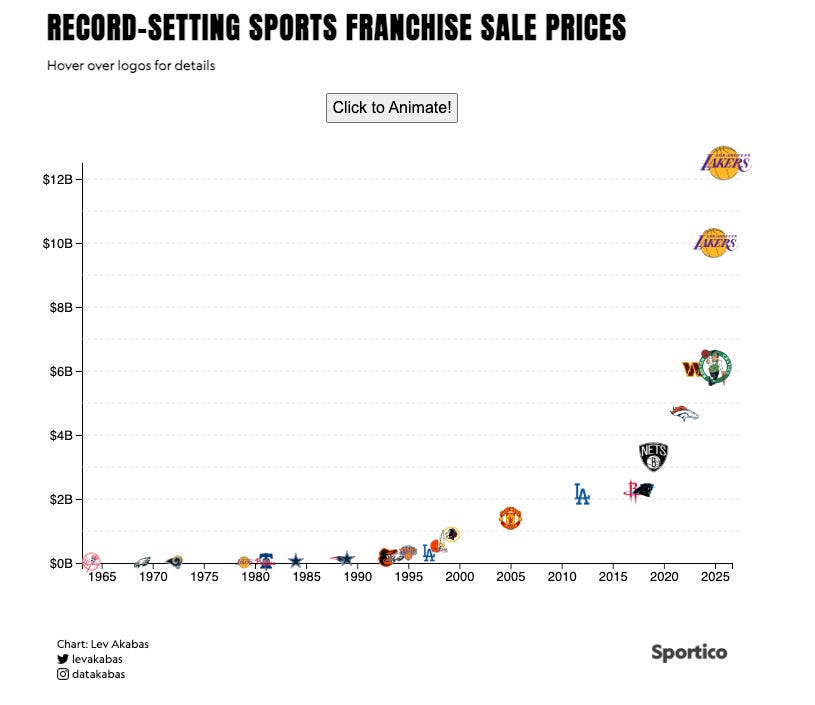
- In the Lakers/Scarce Assets section, he points readers to “see: Jeff Dean’s Disco Loop is in talks to raise $1B at $10B” — an explicit recommendation of an X post by TBPN (URL: https://x.com/tbpn/status/2087718683896697322?s=20).
Other external links (e.g., ESPN, Sportico, X posts by Hunter Weiss, Matic, Joshua Kushner) are cited as sources or illustrative material, not framed as recommendations. Self-promotion (the recommendation to read his own “Base Power Company” chapter) and the Matic purchase recommendation fall outside the scope (self-promotion and product/paid content).

In the provided bundle, the featured speaker makes one explicit organic recommendation of external media figures: Travis Kalanick says, "you can go and talk to a David Senra. You can go and talk to uh Joe Rogan or name your guy and it's you can say what you need to say in a in an environment that's not like a struggle session in Mau China" . The transcript names only David Senra and Joe Rogan — no podcast titles, articles, or URLs are given. No other explicit organic recommendations of books, articles, podcasts, videos, papers, or X posts appear. Mentions such as Andy Grove's "constructive confrontation" , "founder mode" , and the earlier joint podcast are contextual references or self-promotion, not recommendations.
- Gavin Baker recommended the TV series “Land Man” as “the best way to understand” the people and conditions behind the AI data-center energy buildout — the Permian patch, 110° heat, and orchestrating thousands of people in remote locations (a “Billy Bob Thornton” world), where “it's atoms, not bits” and the work is “really, really hard” .
- David Sacks cited Thomas Sowell's book “The Vision of the Anointed” as the intellectual template for effective-altruist arguments for centralized AI control — intellectuals who believe that “if they're maximally empowered” they can “engineer society in a more benevolent direction”; Sacks said this “has always backfired,” producing broken promises and becoming “an excuse for totalitarian schemes and state power” .
- Gavin Baker credited a post by Doresh (also transcribed “Dorcash”), a “podcaster … close to the AI scene,” that “really resonated” with him: Anthropic's AI and its constitution are “wired to do what Anthropics thinks is best for humanity” — a point Baker extended into a case for open source, since a “rich variety of AIs” beats “one, two or three dominant models” .

Josh Wolfe (Lux Capital co-founder) cited John Geanakoplos's academic literature as the key to understanding the 2008 housing crisis — "it was a collateral problem... it wasn't just a bubble, it wasn't debt... it was the collateral," which became worthless along with the debt — the framing he used to warn that today's securitization of AI compute ("collateral, debt, collateralized debt obligations") risks the same collapse .
- Tom Blomfield credits a Jack Dorsey tweet with kicking off his thinking on AI-native companies: that intelligence can live in the system rather than being routed through human hierarchy, with people living at the edge handling intuition, ethics, and high-stakes decisions .
- Tom Blomfield praised a Copacetic tweet as 'a great tweet' for applying self-improving AI research loops — the AI generating research ideas, testing them overnight, and hill-climbing toward better outcomes .

Jason Lemkin (@jasonlk) recommended a YouTube video of Klaviyo's @abialecki at SaaStr AI, titled on how a 2,300-person, $1.5B ARR public company builds with agents . Key takeaways he highlighted:
- Every employee (CEO to summer interns) had to reach AI 'L3' by end of June: L1 = using AI to search, L2 = running an agent, L3 = constantly running multiple sessions or a team of agents; everyone commits code .
- Klaviyo uses 'Dark Factory' — a prompt that acts as PM, decomposes problems into subsystems, and writes contractual API interfaces before subagents build; Composer (now 95,000+ users in month one) started as a weekend run .
- The base model is an 'athletic high schooler'; the harness (proprietary data feed + coach agent that scores every campaign) is the coaching .
- Agents are power users on day one; Composer asked for email APIs almost no human customer had figured out .
- Customers get an agent pre-trained on 5-10 of their own use cases at a 50-70% resolution rate, avoiding heavy implementation .
- Headless is default so product becomes infrastructure; Twilio was left for dead 18 months ago at 4% growth, now almost 20% because the API works with agents .

Elon Musk recommended @is_OwenLewis's X post on orbital compute, endorsing the claim that orbital compute will be the only way to scale AI, probably by 2029, due to power availability and permitting problems on land, and shared the link: https://x.com/is_owenlewis/status/2088071043487502350. In that post, @is_OwenLewis recommended a thread by @VladSaigau on orbital datacenter compute, calling it "a ton of good stuff" and highlighting the most important overlooked part: the quote that "It's ironic that today orbital datacenter compute is considered a niche...because the model suggests it will be a necessary condition for AI continuing to scale in the 2030s", with link: https://x.com/VladSaigau/status/2087955507650724344.