We can't find the internet
Attempting to reconnect
Something went wrong!
Hang in there while we get back on track
Sweeney: a former App Review chief on Apple's account bans
Tim Sweeney shared Phillip Shoemaker's Substack post. He introduced it as the former Apple App Review chief's take on "Apple's recent banning of developer accounts with long histories of being in good standing." Sweeney used it to argue that "The App Store needs competition, worldwide!" Shoemaker says he ran App Review for seven years and wrote the guidelines. In his account, rule 3.2(f) "used to mean real fraud" but is now used against developers who did exactly what Apple approved. He describes a case where Apple approved a developer's fix and months later terminated the account, removing every app. He has made the post free so every developer can see it.
Khosla: four write-ups from the 2026 CEO Summit
Vinod Khosla shared highlights from the Khosla Ventures CEO Summit, where founders and CEOs talked about company building, AI and ambitious technology. These are his firm's own posts:
- Company Building 102: his updated lessons. Founders need "an irrational belief in their mission" and should be "obstinate about the vision and flexible about the tactics."
- Conviction, Consequence, Comeback: Travis Kalanick on hiring the person, not the résumé. Khosla's summary is that "Pedigree is a poor substitute for capability, adversity and alignment with the mission."
- BFFs, Boards, Financials, Fundraising: partners David Weiden and Keith Rabois on survival. "Cash is the fuel gauge."
- Hiring Top Engineering and Sales Talent: Dave Paffenholz on why founders must earn attention. "266 companies contacted one engineer. Three got a response."
Lemkin: a Reddit earnings call as a sign of where the internet is going
Jason Lemkin quoted @buccocapital's post. That post calls Reddit's call "absolutely fascinating" and says everyone should listen to it "as a bellwether for where the internet is going." Its argument is that Google's AI Mode gives people less reason to leave search. It calls this "a massive headwind" for media companies that aren't destinations and for content-driven go-to-market. Lemkin agreed that it's "a real issue for content providers." He said reading SaaStr content in Google AI Overviews is "probably better than reading SaaStr itself 9 times out of 10."
Chamath: the new All-In episode
Chamath Palihapitiya promoted the latest All-In episode ("Pod!!!!!!"). It covers Anthropic's S-1, "AI's Biggest Financial Risk," Google's $500B market-cap drop and midterm predictions. In the episode, one host called a recent Vox article "very interesting." He summarized its argument: if you separate Anthropic's rhetoric from what it does, Anthropic is "leading the charge on recursive self-improvement."
Masad: a whitepaper on sandboxing coding agents
Amjad Masad warned that "coding agents on employee or contractor laptops are a massive cyber and national security risk." He pointed to Replit's own whitepaper, Agent Habitat Architecture, on "how to properly sandbox agents to maximize productivity and reduce risk."
Shorter picks
- Elon Musk called Cleo Abram's Neuralink video a "Good video." Abram visited Neuralink's Austin headquarters, and the video shows the company's next-generation R1 surgical robot for the first time.
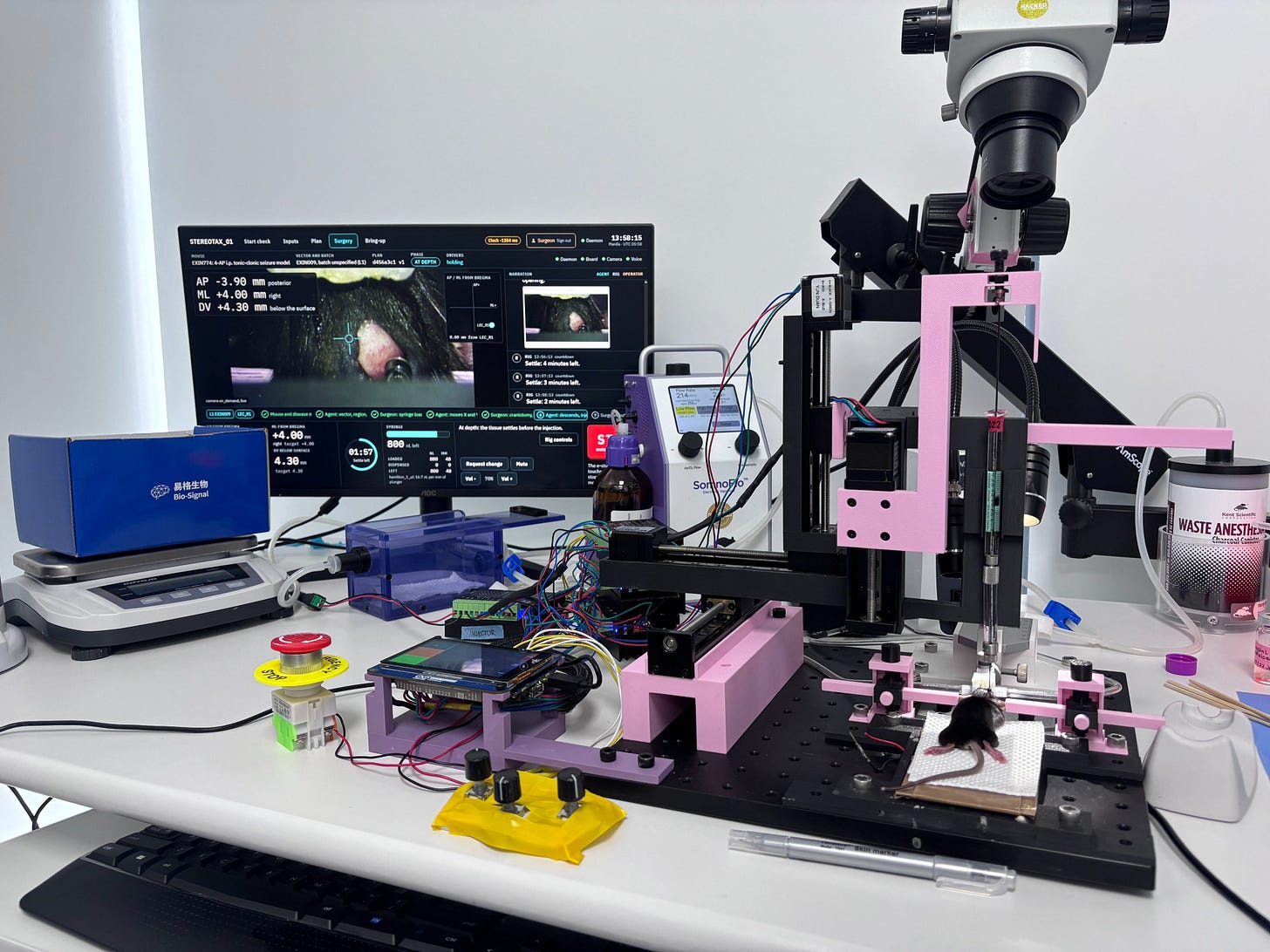
- Packy McCormick pointed Not Boring readers to a claymation explainer he made with Runway on a model refuting the Exponential Time Hypothesis. He said it explains the idea "well enough that I could actually understand it." He also told readers to read this X thread about AI agents performing brain surgery on a mouse.
- Bill Gurley: "If you don't know about DEFUSE, learn about DEFUSE." He linked @ECLOGITE110's post and called sitting on that knowledge "inexcusable."
- Bill Gates linked a Gates Notes piece that grew out of a conversation with Alzheimer's experts. His point is that "breakthroughs are moving faster than the system built to deliver them."
- Tobi Lütke reacted "🤯" to Qwenputer. According to its creator, Qwenputer is Qwen3.5-4B with a RISC-V CPU built into its weights, so it runs C and MicroPython with no external runtime. The creator says it scores 97.5–100% on DeepMind math problems.
David Sacks called a Vox article “very interesting,” praising its reported argument that Anthropic’s actions, more than its safety rhetoric, put it at the forefront of the push toward recursive self-improvement (RSI).
- Packy McCormick recommends his Runway-made claymation explainer on the Exponential Time Hypothesis, saying it made the concept understandable to him.
- He also tells readers to read @OcanaSantero’s headline and X thread about a robot and AI agent performing brain surgery on a mouse, emphasizing the AI-agent feat.
Khosla introduced the posts as highlights from the 2026 Khosla Ventures CEO Summit, where founders and CEOs shared lessons on company building, AI, and ambitious technology.
- Khosla shared Company Building 102 as his updated lessons from the summit: founders need irrational belief in their mission, should stay obstinate about the vision, and remain flexible about tactics.
- Khosla shared Conviction, Consequence, Comeback, presenting @travisk’s hiring advice: prioritize capability, adversity, and alignment with the mission over pedigree.
- Khosla shared BFFs, Boards, Financials, Fundraising, featuring David Weiden and @rabois on survival: cash is the fuel gauge, and a CEO who does not know how much remains is “flying blind.”
- Khosla shared Hiring Top Engineering and Sales Talent, presenting @davepaffenholz’s point that founders must earn candidates’ attention: 266 companies contacted one engineer and three got a response, so recruiting the best is not a volume game.
Jason Lemkin shared @buccocapital’s post, in which @buccocapital called a Reddit call “absolutely fascinating” and urged everyone to listen as a bellwether for where the internet is going . The post’s takeaways were that Google AI Mode keeps users engaged in search with less incentive to leave, creating headwinds for media and content-led go-to-market businesses . As related context, Jason said Google AI Overviews may make reading SaaStr content better than reading SaaStr itself “9 times out of 10,” and make follow-up questions easier .
Patrick O’Shaughnessy credits Jeremy Giffon’s “billion dollar PDF” idea as the origin of the “trillion dollar PDF” . He praises ideas that crystallize at the right moment, set an era’s narrative, and draw billions or trillions of dollars around them . The post includes a video .
Jason Lemkin shared a related YouTube video with @bhalligan, titled “Many great start-ups never get a single great M&A offer,” alongside his discussion of whether founders should accept a strong acquisition offer; he gave no explicit reason or takeaway for the video. Watch the video.
Bill Gates shared a link (https://gatesnot.es/4sAOGMI) connected to an Alzheimer’s issue he had been thinking about after a conversation with Alzheimer’s experts . In the accompanying post, he says breakthroughs are moving faster than the systems that deliver them, leaving many patients without their benefits, and calls fixing delivery the next frontier .
Tim Ferriss urges viewers to watch his full conversation with Dr. Keith Baar, titled “What Actually Builds Grip Strength — Dr. Keith Baar Explains”; watch the conversation on YouTube.
Bill Gurley recommends learning about DEFUSE, saying that sitting on knowledge of it was inexcusable . He points readers to an X post by @ECLOGITE110: https://x.com/eclogite110/status/2115693788853055615 .
@tobi shared @divagr1925’s post about Qwenputer with a “🤯” reaction; the post describes Qwenputer as Qwen3.5-4B with a RISC-V CPU inside its weights, running C and MicroPython in forward passes without an external runtime. The post reports DeepMind math results of 97.5–100% for Qwenputer, compared with 55–90% for the base model and 95–100% for the base model with a Python tool; Tobi gave no further rationale.
Jason Lemkin shared a new SaaStr article, The B2B Category the Markets “Hate” the Most Today: GTM, linking to the article. Its takeaway is that markets price GTM companies based on seats versus agents rather than current performance; it contrasts Braze at 3.7x with CrowdStrike at 42.6x despite similar growth.
Chamath Palihapitiya promoted an All-In Pod episode with “Pod!!!!!!,” linking to the @theallinpod post; he did not state a specific reason for recommending it. The episode agenda covers Anthropic’s S-1, AI financial risk, Google’s $500B market-cap drop, and midterm predictions.
Tobi Lütke shared Petrolicious’s film with the reaction “wow!” . The film covers his Le Mans debut in the #14 Shopify car and its hand-drawn livery, and was directed by Paolo Lekai . Watch the film .
Jason Lemkin shared a CRO Confidential video featuring Databricks CRO Rob Gabrisko and Sam Blond, CEO of MonacoGTM; its takeaway is that AI-enabled sales reps still need to be great storytellers, and humans must be trained to do this. YouTube video
Tim Sweeney shared @UnrealSensei’s video, “How to make games in Unreal Engine with AI.” His accompanying comment called the next 12 months of gaming and game development “insanely cool and empowering,” but did not give a video-specific reason for sharing it.
Jack called a Tidal album linked alongside Cordae (@cordae) “incredible” and shared the album link: https://tidal.com/album/552536330/u . He gave no further reason for the praise.
Garry Tan shared a GBrain Cloud setup guide from Claude Code, describing GBrain Cloud as the fastest way to get GBrain running across agents; he says GBrain lets users run their context on those agents.
Tim Sweeney amplified Phillip Shoemaker’s free Substack post, presenting it as a former Apple App Review chief’s account of Apple banning developers with long good-standing histories; Sweeney argued that the App Store needs competition worldwide. The linked post describes Apple approving a developer’s fix before later terminating the account, and urges developers to read and share the essay.
Tim Sweeney reacted “Wow!” to GhostUEP’s post about KUBO BEAT, a Fortnite rhythm game featuring seven original songs from an easy warm-up to 160 BPM; the post credits GhostUEP x @CobaltStudiosFN and links to the playable map.
Shaan Puri gave a strong general endorsement of TBPN’s Halloween episode (“THEY JUST DONT MISS”) and linked to TBPN’s post.

Weekly Dose of Optimism #217

Cover Image by Runway (opens in new tab)
Hi friends 👋,
Happy Friday and welcome back to our 217th Weekly Dose of Optimism.
And what a week it’s been! Per New York Metro Weather (opens in new tab), we’re in the midst of the longest streak of 8/10 or higher days since the account started in 2021, and here at the Dose, we’re in the middle of a string of 9/10 or higher weeks so long that I’ve lost count.
Have a great Halloween tomorrow. For now, all treats no tricks.
Let’s get to it.
This Week’s Weekly Dose is Brought to You By… Reducto (opens in new tab)
The Document Editor Built for AI Products
AI products need more than file generation. They need a fast, accurate document editor that agents can also use.
Reducto Editor (opens in new tab) brings full-fidelity DOCX, PPTX, and XLSX editing into your product through an SDK and embeddable UI. Lightweight and browser-based, it gives agents the tools to revise contracts, update presentations, and edit spreadsheets while preserving formatting and all the functionality you’re used to.
Users collaborate in the same file, review native Word tracked changes and comments, and make their own edits without leaving your application. Files retain their full formatting when opened in Microsoft Office.
From the team behind the document infrastructure trusted by Harvey, Scale AI, Toast, and Vanta, Editor runs in the browser or on your own servers.
Another week, another extension of Anduril’s capabilities1.
Last week, we wrote about Warhound (opens in new tab), Ben Lamm’s effort to (humanely) genetically engineer dogs to be used in police and military work. Anduril is providing “software and hardware enhancement for items such as dog protection vests and eye goggles.”
This week, Palmer Luckey announced that Anduril would be making its very own Made in America computer, BlueChip: designed here, with components from here, with metals America can mine, refine, process, and mill at scale and at reasonable price. American batteries, too.
This is cool because as Palmer says in the video, “If you don’t control your technology, you can’t control your future.” But it’s also cool because it seems as if Anduril has gotten to the point where it’s built a machine that can make machines. Assemble enough engineers, capital, manufacturing capacity, distribution, etc… and you can build almost anything. It’s very Elon Companies-esque.
And as we wrote in The Electric Slide (opens in new tab), making products that can sell a ton of units, like laptops, can create the pull to bring more of the supply chain here, too.
Video created with Runway (opens in new tab)
The race to solve everything solvable continues apace.
This week, OpenAI announced “three new discoveries in mathematics, computer science, and physics about harmonic analysis, complexity theory, and quantum field theory.”
In math, OpenAI’s models produced a proof of Christopher Sogge’s 1991 local smoothing conjecture in every dimension, which would also settle the Kakeya conjecture and Stein’s restriction conjecture (of course). For context, Hong Wang and Joshua Zahl proved Kakeya in three dimensions just last year, and it was one of the biggest math stories of 2025.
In computer science, a model refuted the Exponential Time Hypothesis (ETH), the widely held belief that problems like 3-SAT can’t be solved meaningfully faster than brute force. If that makes no sense to you, check out the explainer video I made with Runway (opens in new tab), which breaks it down in claymation well enough that I could actually understand it.
In physics, the models produced a rigorous proof that interacting quantum field theories, including QCD and pure Yang–Mills, exist in four dimensions. That’s half of a Millennium Prize problem.
Whereas before OpenAI has just dropped a bunch of solutions on the internet’s head and walked away, leading to quasi-embarrassing situations like when they said GPT-5 had solved ten open Erdős problems but it turned out the model had mostly found solutions that were already sitting in the literature, this time, OpenAI is sharing the outputs as research data with experts they call “shepherds” in each field, who will choose what to do with the data and where/when to publish.
Shepherds don’t have to sign NDAs, don’t get paid, and do get the credit for explaining the work. Russell Impagliazzo and Ramamohan Paturi, who proposed ETH, are leading the review of its disproof with MIT’s Ryan Williams. Nobel laureate David Gross is leading the physics group, which chose to withhold the AI material and write it up themselves. The math proof and the ETH disproof are on GitHub with Lean formalizations. Lean, a checking software, guarantees the proof proves the formal statement, but human shepherds still have to confirm that the formal statement is the right one.
Big week for Lean, by the way. On Tuesday, Axiom announced (opens in new tab) a complete Lean auto-formalization of the Classification of Finite Simple Groups, the “periodic table of symmetry.” The proof runs about 15,000 pages and was written by more than 100 mathematicians over several decades. It’s so big that no single person has ever checked all of it. For a sense of scale, it took Georges Gonthier’s team six years to formalize just one piece of the classification, the Feit–Thompson theorem, back in 2012. But Axiom’s machines can do a lot of human-years quickly, and they’re going to need to to keep up with all of the math and physics coming out of the labs.
Because not only did OpenAI announce those results this week, a physics neolab, Physical Superintelligence (which we covered in Dose #209 (opens in new tab)) released results on five problems from IQOQI Vienna’s list of open quantum problems (opens in new tab), each with a paper, a Lean formalization, and open source verification code on GitHub.
For those of you who were planning to spend the weekend cracking OQP 12: Can vacuum correlations violate the CHSH Bell inequality at arbitrarily large separations? or OQP 12: Can vacuum correlations violate the CHSH Bell inequality at arbitrarily large separations?, I’m sorry. Machines did it. You’re going to have to find a new hobby.
Also, if you were trying to use the entanglement between two empty regions of space no matter how far apart they are to violate the Bell Theorem, I’m sorry for you too. The machine found that you can’t do it past some finite distance.
Anyway, it seems like this is just how we do math and physics now.

Apparently, it’s how we do drug development now too, if Anthropic succeeds.
AI for drug discovery is hot, but most of the focus is on discovering new molecules, which creates bottlenecks further downstream in actually developing these drugs and getting them to market. To understand and fix them, Anthropic believes, it needs to get inside the programs themselves, so for the past several months, its life sciences team has partnered with six organizations to start running programs of its own.
At the discovery end, Divergence Labs announced positive results in the fight against food allergies (opens in new tab). Allergic reactions are triggered by IgE, which sits on your immune cells as well as floating in your blood. Standard drugs mostly neutralize the floating IgE, so Divergence’s approach aims to pry it off the cells instead. Claude turned that goal into a design plan and, largely on its own, generated about 35,000 antibody designs in a month. Three of the early hits dislodged IgE better than the standard medication, and people seem psyched that this represents meaningful progress against food allergies.
Another biotech, Generate Biomedicines, used Claude Code to redesign part of CAR-T, the therapy that uses a body’s own immune cells to hunt and kill cancer, so that it could eventually work on solid tumors. One of Claude’s designs was about 70% shorter than the standard version and got cells to make roughly 10 times as many cancer-spotting receptors.
At BigHat Biosciences, Claude proposed improvements to two antibody fragments, and BigHat’s automated lab made and tested about 1,010 variants in 10 weeks. The best ones bound more than 10x more tightly. Along the way, Claude and an Anthropic researcher figured out that the standard stability metrics were misleading and proposed better ones.
But the point is that these improvements are still hard to get to patients, so Anthropic turned to paperwork with Enveda, whose manufacturing scientists spend up to 75% of their time on it. Claude reviewed 1,061 pages of manufacturing records, caught all of the issues human reviewers had found (plus seven they’d missed), and cut review time by 89%. It also drafted a regulatory document in four hours that takes about three months by hand.
At the trial stage, Bristol Myers Squibb is using Claude to assess plans for an early-stage drug and estimate its odds of success. The Column Group, a biotech investor, is launching Pleiades, a company built to run many more drug programs with Claude than a small team normally could. The theory is that if discovery gets cheaper and faster, investors can back riskier ideas.
Anthropic is also running programs itself. In July, it acquired Mithril Medicine, a one-person company whose founder, Cody Tranbarger (aka Professor Oak), used Claude to run experiments across 11 outside labs. In under 18 months, he took a treatment for a rare muscular dystrophy from idea to promising results in mice. In one cohort of 42 kids with the severe form of the disease, only one ever walked on their own. If the treatment holds up, human trials could start as soon as late 2028.
Anthropic is upfront that nearly all of this is preclinical, so most of these drugs haven’t been tested in people yet, but they showed speedups in every part of the process. The tricky thing about complex processes like drug development is that you have to improve the whole thing at once, lest any one thing that didn’t improve slows the whole thing down.
We might finally have a machine capable of doing just that. Bad time to be a disease. Good time to be a human.

I just saw this one this morning, so didn’t have time to write it up, but that’s ok, just read the headline and the tweet thread and realize that AI AGENTS PERFORMED BRAIN SURGERY ON A MOUSE.
I’m an investor in Readwise, friends with its founders Dan Doyon and Tristan Homsi, and I love reading, so I’ve been lucky enough to get to be a part of the beta for what they were calling Bookwise and are now calling Readwise Books (opens in new tab).
I love this app. It’s my second-most-used app on my phone, after X (need to break that habit again), and that’s not counting the time that I spend reading through Readwise Books on my Daylight Computer (opens in new tab). The description people give most often is Kindle x Goodreads, which is part of it, but there’s also a little Strava mixed in there. There’s a leaderboard, which has definitely pushed me to read more, like the week I ended up #1 on the Readerboard in July (opens in new tab).
The reading experience itself is familiar to those used to reading on the Kindle App, but it’s just a little bit better in places. There’s AI natively built in, which I don’t use normally, but was a lifesaver when I was reading Jean Beaudrillard’s Simulacra and Simulation (opens in new tab), for example. Highlights go right into Readwise. And its text-to-speech is really good for listening when I get off the subway and start walking.
I am a firm believer that people should Read More Books (opens in new tab), and although I’m biased, I’ve also voted with a ton of my time that this is the best product out there for doing that.
So go Read More Books. There’s a waitlist, but if you’re reading this, you can skip it here (opens in new tab).

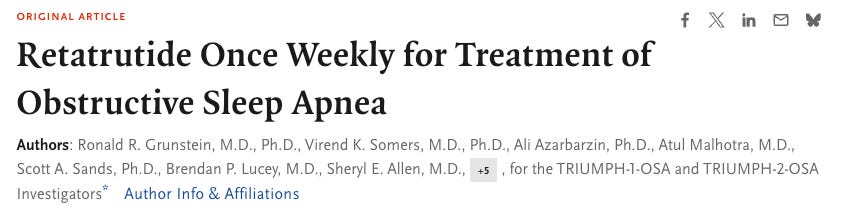
Lilly’s Retatrutide is perhaps the closest thing we have to a miracle drug.
We first covered Reta in Dose #175 (opens in new tab), as a gray-market “holy grail” in Vectorculture’s piece on Chinese peptides (opens in new tab). By May, it was the lead item in Dose #194 (opens in new tab), after Lilly’s TRIUMPH-1 trial showed people on the top dose losing 28.3% of their body weight over 80 weeks.
Since then, the triple-hormone shot, which mimics GLP-1, GIP, and glucagon, has kept piling up wins. Now, it seems to work on sleep apnea.
Tens of millions of Americans have obstructive sleep apnea (mostly undiagnosed). The standard treatment is strapping a CPAP mask to your face every night. In two 80-week Phase 3 trials, TRIUMPH-1-OSA and TRIUMPH-2-OSA, 691 adults with moderate-to-severe sleep apnea started out stopping or nearly stopping breathing about 57 times an hour. In the trial without diabetes, the 9 mg dose cut that by 34 events an hour, versus 10 on placebo. About half of patients on the higher doses ended up with apnea that was resolved or mild without daytime sleepiness, compared with roughly one in ten on placebo. Along the way, they lost about a fifth of their body weight.
Some people have pointed out that of course, losing weight should help with sleep apnea, but OK sure whatever the mechanism, Reta just keeps fixing stuff:
Diabetes: In TRANSCEND-T2D-1, presented at ADA in June, 75–83% of patients got their A1C to 6.5% or lower in 40 weeks.
Heart risk: In TRIUMPH-3 in July, people with severe obesity and existing heart disease lost 22.6% of their body weight, with inflammation (hsCRP) down 51% and systolic blood pressure down 9.3 points.
Knees: In TRIUMPH-1, knee osteoarthritis pain fell by about three-quarters.
Liver: In a Phase 2 substudy, 93% of patients on the top dose had normal liver fat after 48 weeks.
The drug hasn’t even hit the market yet (if you don’t count the grey market). There’s still an open question as to whether these improvements also prevent heart attack and stroke, which Lilly’s dedicated cardiorenal trial will attempt to show, and which would be another massive win, but for now, we’ll just have to be happy with a drug that cuts weight, lowers heart disease risk, fights diabetes, cuts liver fat, makes our knees feel better, and replaces a CPAP.
Lilly, which crushed earnings this week and raised its full year revenue outlook by \$5 billion (opens in new tab), deserves every dollar of its \$1.3T market cap.
From miracle drugs to downright miracles. Given the quantity and consistency of mind-blowing breakthroughs we cover here in the Dose, it’s easy to forget how miraculous some of them are, and how miraculous they must feel to those who benefit from them.
This week’s news out of Neuralink is one of those.
ALS, or Lou Gehrig’s Disease, is a fatal, progressive neurodegenerative disorder that destroys the motor neurons in the brain and spinal cord that control voluntary muscle movement. It takes away its victims’ ability to speak even though it leaves their mind intact, meaning they can think clearly but can’t verbalize those thoughts.
Neuralink has been working to fix that with VOICE. This week, it released early numbers from one participant who hit 75 words per minute with a 5.8% error rate across a 125,000 word vocabulary in their first week with the implant. Before VOICE, the best published result on the same vocabulary size, Stanford’s 2023 system, managed 62 words per minute with nearly a quarter of words wrong.
Natural conversation runs around 160 words per minute, so we’re about halfway there. Importantly, the system can also speak in the participant’s pre-ALS voice.
VOICE launched at UT Southwestern last October with FDA Breakthrough Device designation and plans to enroll up to six people with ALS, spinal cord injury, or stroke. That’s not a big group, and the one person in this study is just one-sixth of that. But every person who’s able to get their voice back through a BCI is a win, and the technology will only get better, faster, more accurate, and less invasive from here.
In related news, Elon Musk announced yesterday that its second product, Blindsight, which will restore sight to the blind, is ready engineering-wise.
Age of Miracles, pending regulatory approval.
EXTRA DOSES: The Commanding Heights, Science Breakthroughs, DoorDash Acquires Instacart, Thrive Holdings Acquires ADT, LIFE
- Packy McCormick recommends his Runway-made claymation explainer on the Exponential Time Hypothesis, saying it made the concept understandable to him.
- He also tells readers to read @OcanaSantero’s headline and X thread about a robot and AI agent performing brain surgery on a mouse, emphasizing the AI-agent feat.